Design of a vacuum seed metering system for kenaf planting
Mohammad Reza Bakhtiari
1*, Desa Ahmad
2(1. Agricultural Engineering Research Department; Hamedan Agricultural and Natural Resources Research and Education Center,
AREEO, Hamedan, Iran;
2. Department of Biological and Agricultural Engineering; Faculty of Engineering, University Putra Malaysia (UPM), 43400 UPM,
Serdang, Selangor Darul Ehsan, Malaysia)
Abstract: In this study, a vacuum seed metering system was designed and developed based on physical and aerodynamic properties of kenaf seeds (Hibiscus cannabinus L.). The kenaf vacuum seed metering system was evaluated in the laboratory by using kenaf seeds. For laboratory tests, a completely randomized design (CRD) with three replications was chosen. The data were analyzed by Statistical Analysis Software (SAS) program version 9.1 and means separation test were done by using Duncan’s multiple range test (DMRT). The study results showed that the most suitable opening diameter and opening angle for planting kenaf seeds were 2.5 mm and 120°, respectively, which having the minimum missing and multiple indices with optimum quality of feed index.
Keywords: kenaf, physical and aerodynamic properties, design and development, seed metering system
Citation: Bakhtiari, M. R., D. Ahmad. 2017. Design of a vacuum seed metering system for kenaf planting. Agricultural Engineering International: CIGR Journal, 19(3): 23–31.
1 Introduction
Kenaf is an important and economical crop in many countries. It is widely grown in a large part of the world as a fiber source for producing rope, cloth, twine, carpet felting and burlap. Furthermore, it provides fiber for paper pulp and forage for animals (Mohamed et al., 1995; Hossain et al., 2016). Various useful components are present in the kenaf and each of these components is multiple usable portion (Webber & Bledsoe, 2002).
So far, many row crop planters (seeding machines) have been designed and fabricated, but the existing seeding machines are more suitable for seeds that have almost regular shape or crops with row plantings spaces are more than 40 cm such as corn or sugar beet. Kenaf seeds are irregular in shape, and looks somewhat like a shark’s teeth, fairly triangular in shape and sometimes
Received date:2016-12-31 Accepted date: 2017-01-30 * Corresponding author: Mohammad Reza Bakhtiari, Researcher Assistant Professor, Agricultural Engineering Research Department, Hamedan Agricultural and Natural Resources Research and Education Center, AREEO, Hamedan, Iran, Email: [email protected]. phone: +98 813 4372740, FAX: +98 813 4373606.
looks like a kidney, with roughly pointed corners (Anonymous, 2012). Besides the irregular shape and size of kenaf seeds, it has a high angle of internal friction and is most suitable for row plantings of 30-40 cm. The physical and aerodynamic properties of kenaf seeds are completely different from that of corn and sugar beet. Therefore, existing seeding machines with high numbers of missing and multiple planting characteristics are not suitable for planting kenaf seeds. Thus, there was a need to design a new row crop planter (seeding machine) based on physical and aerodynamic properties of kenaf seeds.
upkeep and seed drift are better, and its implementation has a wide spectrum. These are the few benefits which the precision pneumatic seeders have over mechanical seeders (Özmerzi et al., 2002; Karayel et al., 2004).
A study was conducted to investigate some moisture-dependent physical and mechanical properties of kenaf seeds (Hibiscus cannabinus L.). The average length, width, thickness, geometric and arithmetic mean diameter of kenaf seeds were 4.9, 4.7, 2.8, 4.0, and 3.8 mm. The average of the surface area, projected area, thousand seed mass and volume of kenaf seeds increased from 46.9 to 53.7 mm2, 9.9 to 11.3 mm2, 26 to 30 g, and 19.4 to 25.0 mm3 respectively, with increasing moisture content from 6.8% to 25.2% db. Studies showed that the true density and bulk density decreased from 1341.4 to 1202.8 kg m-3 and 662.3 to 589.3 kg m-3, respectively with the moisture content increased (Bakhtiari et al., 2011).
The performance of the seed metering system of a pneumatic planter was investigated under laboratory and field conditions to optimize the design and operating parameters for cotton seed planting. The effects of the seed plate operational speed, vacuum pressure and shape of the seed opening entry was evaluated by examining the mean seed spacing, precision in spacing (coefficient of variation), miss index, multiple index, and the highest quality of feed index. For picking the single seed, the planter disc had a seed opening of 2.5 mm in diameter. The opening entry cone angle was varied from 90° to 150°, the disc speed was also varied from 0.29 to 0.69 m s-1 (1.0 to 2.5 km h-1), and the vacuum pressure was change from 1 to 2.5 kPa. The metering system of the planter was then set to place the seeds at 250 mm spacing (Singh et al., 2005).
It was observed that the planter disc with a 120° opening entry cone angle gave the best performance at all speeds and operating pressures. However, there was no conclusive statistical evidence to identify a single value of disc speed or vacuum pressure. The metering system with a disc speed of 0.42 m s-1 (1.5 km h-1), and a vacuum pressure of 2 kPa produced better results with a feed index of 94.7% and a coefficient of variation in spacing of 8.6%, and recorded a mean seed spacing of 251 mm.
Optimization of the regression equations incorporating disc speed and operating vacuum pressure revealed that a disc, operating at speeds from 0.34 to 0.44 m s-1 (1.2 to 1.6 km h-1) and a vacuum pressure of 2 kPa, yielded similar performance. Performance indices of the pneumatic planter were determined under field condition by measuring the distribution of cotton plants spacing based on the optimized operational parameters. A mean plants spacing of 298 mm was found in the field with a 19.1% precision (coefficient of variation). Within the range of 210-300 mm of row spacing, 49% cotton plants were distributed compared to 88% seed spacing distribution which was observed on the laboratory test rig. Displacement of seeds in the field can affect the plants spacing distribution due to its rolling and bouncing (Singh et al., 2005).
A study was conducted by Barut and Özmerzi (2004) to determine the effect of different operating parameters on seed holding in a single seed metering system (unit). In this research a vertical seed plate with a vacuum metering system was used in seeding maize (Zea mays L.). An electronic counter in the metering unit was used to determine the openings on the plates without seed. The shapes of the openings, peripheral velocities, vacuum pressure, opening area on the seed plate and one thousand grain weights of seed (TGW) were selected as the operating parameters. To plant the seeds of maize, the most suitable and available hole shape was the oblong. Among all the holes that the seed holding possessed, the circular holes were the best in contrast with the other shapes of hole. The pressure was 3.0-4.0 kPa at the highest ratio of holding in circular holes, while for seed holdings the pressure of vacuum which was of 1.0 and 2.0 kPa was not enough (Barut & Özmerzi, 2004).
The best possible levels of vacuum pressure were found to be 5.5 kPa, with 3 mm diameter of openings for precision seeding of cotton seeds. In case of peripherals plate no such optimum value was achieved (Yazgi and Degirmencioglu, 2006).
meter the seeds to attain the optimum yield when planting most kinds of crops. So, metering of seed is considered as one of the major functions in any types of planting or seeding machine. In addition, for appropriate working of the seed metering system, some factors must be measured for various seeds such as shape, diameter, angle of opening (hole or cell) and linear speed of the seed plate, and vacuum pressure inside the seed metering system. Therefore, with respect to the above statements, the first stage was to design a unit of vacuum seed metering system for kenaf seeds based on its physical and aerodynamic properties, and then to evaluated it.
2 Material and methods
2.1 Design and develop of a vacuum seed metering
system for planting kenaf seeds
2.1.1 Shape of openings on the seed plate
Based on Barut and Özmerzi (2004), the shape of openings (holes) for the seed plate was recommended as a circular hole.
2.1.2 Angle of openings on the seed plate
To prevent the seed from entering for seed opening on metering plate (2β), it should be conical in shape (Figure 1) that could be completely closed by a seed to avoid multiple seeds being picked up by the seed plate (Singh et
al., 2005). They showed that most suitable conical angle of the seed plate was 120°.
Figure 1 Dimensions of openings (holes) on the seed plate
2.1.3 Diameter of openings on the seed plate
In order to determine the diameter of opening on the seed (metering) plate (do) for cotton seeds, the study considered the opening diameter based on less than 50% size of the geometric mean diameter (Dg) that means “do
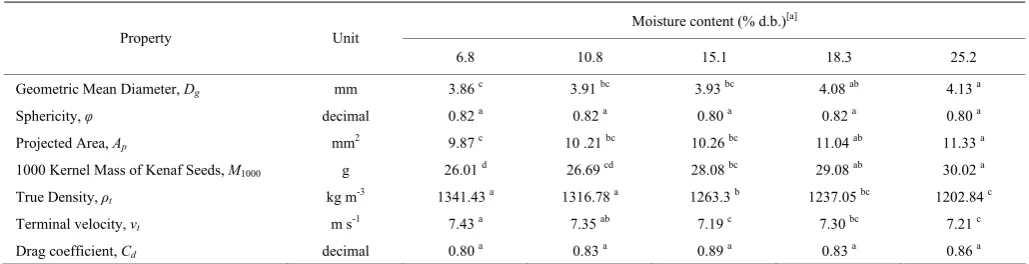
≤50% Dg” (Singh et al., (2005). In the present research, the diameter of openings on the seed plate (do) was also based on the less than 50% size of the geometric mean diameter of the kenaf seeds. Due to Bakhtiari et al. (2011) the maximum geometric mean diameter of kenaf seeds was Dg= 4.13 mm (Table 1), Thus:
do≤ 0.50 × Dg and do≤ 0.50 × 4.13 mm (1) then do≤ 2.065 (Figure 1).
Table 1 Means of the some physical and aerodynamic properties of kenaf seeds at different moisture content
Moisture content (% d.b.)[a]
Property Unit
6.8 10.8 15.1 18.3 25.2
Geometric Mean Diameter, Dg mm 3.86 c 3.91 bc 3.93 bc 4.08 ab 4.13 a
Sphericity, φ decimal 0.82 a 0.82 a 0.80 a 0.82 a 0.80 a
Projected Area, Ap mm2 9.87 c 10 .21 bc 10.26 bc 11.04 ab 11.33 a
1000 Kernel Mass of Kenaf Seeds, M1000 g 26.01 d 26.69 cd 28.08 bc 29.08 ab 30.02 a
True Density, ρt kg m-3 1341.43 a 1316.78 a 1263.3 b 1237.05 bc 1202.84 c
Terminal velocity, vt m s-1 7.43 a 7.35 ab 7.19 c 7.30 bc 7.21 c
Drag coefficient, Cd decimal 0.80 a 0.83 a 0.89 a 0.83 a 0.86 a
Note: [a] Means in the same rows followed by different letters are significantly different at 5% level by DMRT. (Source: Bakhtiari et al. (2011) and Bakhtiari (2012)).
Based on Sial and Persson (1984), Afify et al. (2009) and for 2β=90° or 120° or 150°;
Dg cosβ≤do < Dg (2) When 4.13 cos45°≤do<4.13, then 2.92≤do<4.13; when 4.13 cos60°≤do<4.13, then 2.07≤do<4.13; when 4.13 cos75°≤do<4.13, then 1.07≤do<4.13;
Therefore, in this study, the opening diameter of the seed plate (metering plate) must be considered between
1.07 to 4.13 ≈ 4.5 mm for kenaf seeds.
For calculating distance of wide hole “Do”, considering b=t–t1=1 mm, the optimum diameter and angle of openings on the seed plate do=4.5 mm and 2β = 150° was used to calculation from Equation (3) to Equation (5):
a=btanβ=(t–t1) tanβ (3)
1
2( ) tan
o o
D = t t− × β+d (5) Now for calculating opening diameter of the seed plate, with b=1 mm or t–t1=1 mm, do=4.5 mm and entrance section cone angle (opening angle of seed plate) 2β = 150°, and according to Equation (5), then Do=2×
1×tan75+4.5=11.96≈12.0 mm.
2.1.4 Number of openings on the seed plate
Whereas the rotational speed of the ground (transporting) wheel of seeding machine and seed plate were considered equal (ns=nw), then the circumference of ground wheel (Cw) for wheel diameter Dw=25, from Equation (6) it will be:
Cw = π × Dw (6)
Cw=π×(25×2.54)=199.5 cm ≈ 200 cm
If seed spacing within row (xs) for kenaf seeds is 5 cm, thus from Equation (7), the number of openings or cells on the seed plate with assuming Nr=1, kenaf seeds must be: w s r C n x N =
× (7)
Then: 200 40
5 1
n= =
× .
2.1.5 Pitch circle diameter
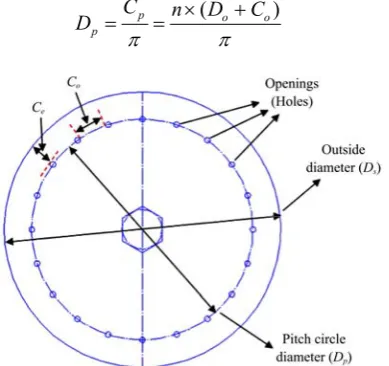
It can be given in terms of a circumference of pitch circle seed plate (Figure 2), as follows:
( )
p o o
p
C n D C D
π π
× +
= = (8)
Figure 2 Schematic of seed plate and its components
Substituting by n = 40, Do = 12 mm (from Equation (8) for do=4.5 mm, b=1 mm and 2β = 150°) and Co = 4 mm, then:
40 (12 4)
203.8 200 3.14
p
D = × + = ≈
2.1.6 Outside diameter of the seed plate
For determining the outside diameter of the seed plate,
Ds(Figure 2) from Equation (9):
Ds=Dp+Do+2Ce (9) Then: Ds=200+12+(2×19) ≈ 250 mm.
2.1.7 Vacuum of negative pressure
Based on study in (Table 1), the following have been obtained for kenaf seeds properties:
Geometric mean diameter of kenaf seeds, Dg=4.13 mm One thousand kernel mass of kenaf seeds, M1000= 30.0 g and for one seed, Mp=0.030 g
Projected area of kenaf seeds, Ap=11.33 mm2 Thus, from Equation (10) (Singh et al., 2005):
Po = FD / Ap = Mp g / Ap (10) Then:
Po = ((0.030×10-3) kg×9.81 m s-1) / (11.33×10⁻⁶ m2)
Po=25.975 Pa
or based on results of this study for kenaf seeds considering from Table 1:
Terminal velocity of kenaf seeds, vt=7.21 m s-1 Drag coefficient, Cd=0.86
Mass density of the air, ρa =1.168 kg m-3 (for given arbitrary constant temperature T=30°C and based on Geankoplis (2003)) and from Equation (11):
2
2
0.5
0.5
d a p t D
o d a t
p p
C A v F
P C v
A A
ρ
ρ
= = = (11)
Then: 0.5 0.86 1.168 (7.21)2
o
P = × × × , 26.108Po= Pa.
By considering the highest amount for Po = 26.1, Dg = 4.13 (Table 1) and from Equation (12) (Sial & Persson, 1984): 2 g m o o D P P d ⎛ ⎞ = ⎜ ⎟
⎝ ⎠ (12)
Pm = Po × (Dg / do)2 = 26.108 × (4.13 / do)2 (13) If do=2.0 mm→Pm=26.1×(4.13/2.0)2=111.33 Pa = 0.111 kPa
If do=2.5 mm→Pm=26.1×(4.13/2.5)2=71.25 Pa= 0.071 kPa
If do=3.0 mm→Pm=26.1×(4.13/3.0)2=49.48 Pa= 0.049 kPa
do ranging from 2.0 to 3.0 mm, it would be 49.48 and 111.33 Pa, respectively.
Also, based on the study in Table 1, the following have been obtained:
1) Predicted vacuum pressure of the pneumatic seeding machine as a function of one thousand kernels mass may be identified from Equation (14):
P=1.18 × (M1000)0.20, (R2 = 0.92) (14)
P=1.18 × (30.02)0.20 = 2.33 kPa
2) Predicted vacuum pressure of the pneumatic seeding machine as a function of projected area may be identified from Equation (15):
P=1.96×(Ap)0.11, (R2=0.59) (15)
P=1.96× (11.33)0.11=2.56 kPa
3) Predicted vacuum pressure of the pneumatic
seeding machine as a function of sphericity may be identified from Equation (16):
P=0.04×(φ)+0.43, (R2=0.80) (16)
P=0.04×80+0.43=3.63 kPa
4) Predicted vacuum pressure of the pneumatic seeding machine as a function of true (kernel) density may be identified from Equation (17):
P=0.002×(ρt)+1.02, (R2=0.57) (17)
P=0.002×1341.43+1.02=3.70 kPa
The predicted vacuum pressure values by the models for kenaf seeds were: 2.33, 2.56, 3.63, and 3.70 kPa.
Based on present results, in order to planting kenaf seed, a vacuum seed metering system was installed on pneumatic seeding machine was designed and developed (Figure 3).
a. Side view b. Rear view Figure 3 Vacuum seed metering system, laboratory test for kenaf seeds
2.2 Testing and Evaluation
Experiments were conducted to determine optimum factors affecting the performance of the vacuum seed metering system. The experiments consisted of (a) six seed plate opening diameters [(1) 1.0 mm, (2) 1.5 mm, (3) 2.0 mm, (4) 2.5 mm, (5) 3.0 mm and (6) 3.5 mm], and (b) three intake shapes (cone angle) of openings (2β) on the seed plate [(1) 90°, (2) 120°, and (3) 150°]. The tests comprised of a laboratory experiments (in triplicate each): A two factors factorial experiment involving opening diameter and cone angle of the opening, with considering 3.0 kPa and 1.0 km h-1 for vacuum pressure and liner speed of the seed plate.
Forty seeds spacing were evaluated on the greased belt (Figure 3) to determine performance of the vacuum seed
metering system and the parameters evaluated included mean seed spacing, miss index, multiple index, and quality of feed index. The data was statistically analysed by using the SAS program version 9.1 in CRD to determine the effect of seed plate opening diameters (do) and intake shape of seed opening of seed plate (2β) based on the above mentioned performance factors.
2.2.1 Mean seed spacing
After each half turn of the greased belt the vacuum seed metering system “planted” some seeds on the belt. The seed spacing of forty seeds were measured in mm by using measuring tape.
2.2.2 Miss index
drop (delivery) tubes. This was described by an index called miss index (Imiss) which is the percentage of spacing greater than or equal to 1.5 times the theoretical spacing(Kachman & Smith, 1995; Ismail, 2008; Jiten Singh et al., 2015). Therefore, the miss index is the percentage of spacing greater than 1.5 times the set planting distance (xs) in mm.
miss miss
t
n I
n
= (18)
2.2.3 Multiple index
Multiple planting occurs when more than one seed is delivered by a seed opening (hole or cell). It was described by an index called multiple index (Imult) which is the percentage of spacing that are less than or equal to half (0.5 times) of the theoretical spacing (Kachman & Smith, 1995; Ismail, 2008; Jiten Singh et al., 2015). The multiple index is the percentage of spacing that are less than or equal to half of the set plant distance (xs) in mm.
mult mult
t
n I
n
= (19)
2.2.4 Quality of feed index
The quality of feed index (Iq) is the percentage of spacing that are greater than half but not greater 1.5 times than the set planting distance (xs) in mm. The quality of feed index is an alternate way of presenting the performance of miss and multiple seed planting (Jiten Singh et al., 2015).
0.5xs≤Iq≤1.5xs (20) or
100 ( )
q miss mult
I = − I +I (21)
3 Results and discussion
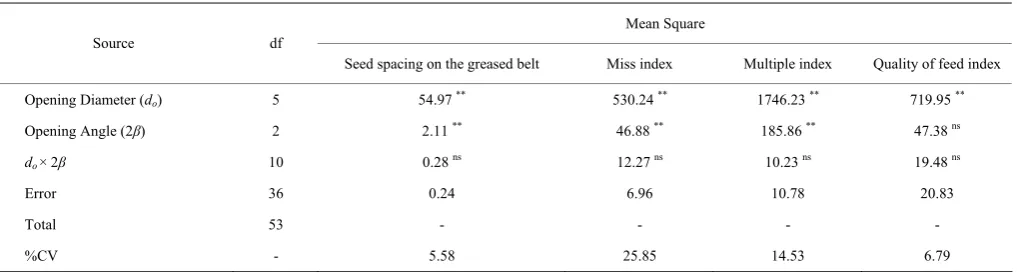
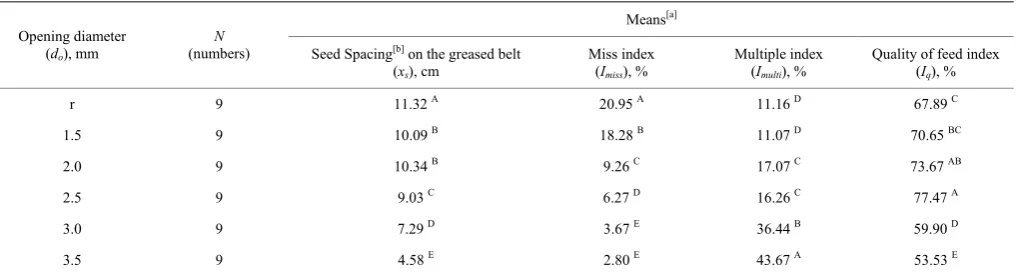
The results of the analysis of variance (ANOVA) of the openings (holes) diameter and opening angles of the seed plate were shown in Table 2. Means of the machine performance indices (seed spacing on the greased belt, miss index, multiple index and quality of feed index) at different opening diameters and angles of the seed plate were presented in Table 3 and Table 4, respectively. Table 5 showed the relationship between the opening diameters and opening angles of the seed plate with the machine performance indices.
3.1 Mean seed spacing
The analysis of variance (Table 2) showed that the effects of different levels of opening diameters and angles of the seed plate were highly significant (p<0.01) with respect seed spacing (xs) on the greased belt; but the interaction effect was not significant. Before the laboratory tests, the transmission system of the pneumatic seeding machine was set to place the seeds at 10 cm spacing. The best opening diameters for planting kenaf seeds was 1.5, 2.0 and 2.5 mm resulting in seed spacing of 10.09, 10.34 and 9.03 cm, respectively (Table 3). Results on QOF indicated that the highest QOF (77.47%) belongs to opening diameter of 2.5 mm, and hence this size of opening diameter can be recommended for the seed plate for planting kenaf seeds (Table 3).
The results also indicated that both 90° and 120° opening angles of the seed plate were the best opening angles for planting kenaf seeds at a seed spacing within row of 10 cm apart since the amounts of the QOF were at the same level (Table 4).
Table 2 Analysis of variance of the opening diameters and angles of the seed plate on the machine performance indices in laboratory tests, CRD
Mean Square Source df
Seed spacing on the greased belt Miss index Multiple index Quality of feed index
Opening Diameter (do) 5 54.97 ** 530.24 ** 1746.23 ** 719.95 **
Opening Angle (2β) 2 2.11 ** 46.88 ** 185.86 ** 47.38 ns
do×2β 10 0.28 ns 12.27 ns 10.23 ns 19.48 ns
Error 36 0.24 6.96 10.78 20.83
Total 53 - - - -
%CV - 5.58 25.85 14.53 6.79
Table 3 Means of the opening diameter of seed plate (do) on the machine performance indices in laboratory tests
Means[a]
Opening diameter (do), mm
N
(numbers) Seed Spacing[b] on the greased belt
(xs), cm
Miss index (Imiss), %
Multiple index (Imulti), %
Quality of feed index (Iq), %
r 9 11.32 A 20.95 A 11.16 D 67.89 C
1.5 9 10.09 B 18.28 B 11.07 D 70.65 BC
2.0 9 10.34 B 9.26 C 17.07 C 73.67 AB
2.5 9 9.03 C 6.27 D 16.26 C 77.47 A
3.0 9 7.29 D 3.67 E 36.44 B 59.90 D
3.5 9 4.58 E 2.80 E 43.67 A 53.53 E
Note: [a] Means in the same columns followed by different letters are significantly different at 5% level by DMRT. [b] The transmission system of the vacuum seed metering
system was set to place the seeds at 10 cm spacing.
Table 4 Means of the opening angle of seed plate (2β) on the machine performance indices in laboratory tests
Means[a]
Opening angle (2β), degree
N (numbers)
Seed Spacing[b] on the greased belt, cm Miss index, % Multiple index, % Quality of feed index, %
90 18 8.91 A 11.49 A 19.75 C 68.76 A
120 18 9.03 A 10.73 A 21.99 B 67.28 A
150 18 8.38 B 8.39 B 26.09 A 65.52 A
Note: [a] Means in the same columns followed by different letters are significantly different at 5% level by DMRT.[b] The transmission system of the vacuum seed metering
system was set to place the seeds at 10 cm spacing.
Table 5 Equations representing relationship of the opening diameters (do) and angles of the seed Plate (2β) on the machine performance indices (Laboratory tests)
Source of Variation R2 Regression Equation Equation Number
Seed spacing on the greased belt, cm (xs) 0.8426 xs= –2.481do – 0.0087β + 17.885 (22)
Miss index, % (Imiss) 0.8081 Imiss = –7.862do – 0.0516β + 41.945 (23)
Multiple index, % (Imulti) 0.7958 Imulti= 13.591do + 0.106β – 34.232 (24)
Quality of feed index, % (Iq) 0.2989 Iq = –5.729do – 0.054β + 92.287 (25)
3.2 Miss index
Miss (skip) index (Imiss) of seeds showed highly significant differences (p<0.01) in both the levels of opening diameters and opening angles of the seed plate (Table 2, Table 3 and Table 4). The lowest miss index of 2.80% occurred with the opening diameter in 3.5 mm and the highest was 20.95% for the opening diameter in 1.0 mm, but only 2.5 mm can be recommended, because it had the highest QOF of 77.47%.
The results indicated that the lowest and highest miss indices occurred at 120° and 150° with miss indices of 10.73% and 8.39%, respectively, for opening angles of the seed plate.
3.3 Multiple index
Multiple index (Imulti) of seeds showed highly significant differences (p<0.01) in both levels of opening diameters and opening angles of the seed plate, (Table 2) but the interaction effect was not significant.
Table 3 showed the lowest multiple index (11.16%) occurred with the opening diameter in 1.0 mm and the highest (43.67%) occurred with the opening diameter in 3.5 mm, but only with the opening diameter in 2.5 mm it had the highest QOF. Therefore, a seed plate with 2.5 mm of opening diameter was recommended for planting kenaf seeds.
The results indicated that the lowest and highest multiple indices occurred at opening angles of to 90° and 120°, respectively (Table 4). The opening angles had no significant effect on amounts of QOF.
3.4 Quality of feed index
lowest QOF of 53.53% occurred with the opening diameter in 3.5 mm and the highest was 77.47% with the opening diameter in 2.5 mm, but only the opening diameter in 2.5 mm can be recommended, because it had the highest quality of feed index.
The effect of the quality of feed index on the opening angles of the seed plate was the same (Table 4).
4 Conclusions
In this study a vacuum seed metering system was designed and developed to install on the pneumatic kenaf seeds planter based on physical and aerodynamic properties of kenaf seeds. The study results showed that the most suitable opening diameter and opening angle for having the minimum missing and multiple indices with optimum quality of feed index, in order to planting kenaf seeds were 2.5 mm and 120°, respectively.
References
Afify, M., Z. El-Haddad, G. Hassan, and Y. Shaaban. 2009. Mathematical model for predicting vacuum pressure of onion seeds precision seeder. Journal of Agricultural Engineering,
26(4): 1776–1799.
Anonymous. 2012. Information and property about kenaf seed, kenaf leaves, stem and adult plants. Available at: http://www.kenaf-fiber.com/en/seme-kenaf.html Accessed 4 September, 2017
Bakhtiari, M. R. 2012. Design, development and evaluation of a kenaf pneumatic seeding machine. Ph.D. diss., Department of Biological and Agricultural Engineering, University Putra Malaysia, Kuala Lumpur.
Bakhtiari, M. R., D. Ahmad, J. Othman, and N. Ismail. 2011. Physical and mechanical properties of kenaf seed. Applied
Engineering in Agriculture, 27(2): 263–268.
Barut, Z. B., and A. Özmerzi. 2004. Effect of different operating parameters on seed holding in the single seed metering unit of a pneumatic planter. Turkish Journal of Agriculture and
Forestry, 28(6): 435–441.
Geankoplis, C. J. 2012. In Transport Processes and Separation
Process Principles, 4th ed. M. Vincenti ed, Ch. 4, 287–302.
New Jersey: Pearson Education.
Hossain, M. D., M. H. Musa, A. A. Nuruddin, H. Jol, and H. A.
Hamid. 2016. Physio-agronomic performance of kenaf as influenced by different carbon levels. Plant Omics, 9(1): 61. Ismail, Z. E. 2008. Developing the metering unit of the pneumatic
planter, 2-The injection planting seed. Journal of Agriculture
Science Mansoura University, 33(10): 7317–7330.
Jacobs, C. O., and W. R. Harrell. 1983. Agricultural Power and
Machinery. New York: Gregg Division, McGraw-Hill.
Jiten, S. H., D. De, and P. K. Sahoo. 2014. Development and evaluation of metering mechanism for multi-crop planter for hilly regions. Agricultural Engineering, 4: 21–33.
John, D. 1981. Fundamental of Machine Operating: Planting (2nd ed). Moline, Illinois: Deere and Company.
Kachman, S. D., and J. A. Smith. 1995. Alternative measures of accuracy in plant spacing for planters using single seed metering. Transactions of the ASAE, 38(2): 379–387.
Karayel, D., Z. B. Barut, and A. Özmerzi. 2004. Mathematical modelling of vacuum pressure on a precision seeder.
Biosystems Engineering, 87(4): 437–444.
Mohamed, A., H. Bhardwaj, A. Hamama, and C. Webber. 1995. Chemical composition of kenaf (Hibiscus cannabinus L.) seed oil. Industrial Crops and Products, 4(3): 157–165.
Murray, J. R., J. N. Tullberg, and B. B. Basnet. 2006. Planters and
Their Components, A. Burgi ed. Section 2. Canberra: Elect
Printing.
Özmerzi, A., D. Karayel, and M. Topakci. 2002. Effect of sowing depth on precision seeder uniformity. Biosystems Engineering,
82(2): 227–230.
Searle, C. L., M. F. Kocher, J. A. Smith, and E. E. Blankenship. 2008. Field slope effects on uniformity of corn seed spacing for three precision planter metering systems. Applied
Engineering in Agriculture, 24(5): 581.
Sial, F. S., and S. P. E. Persson. 1984. Vacuum nozzle design for seed metering. Transactions of the ASAE, 27(1): 688–696. Singh, R. C., G. Singh, and D. C. Saraswat. 2005. Optimisation of
design and operational parameters of a pneumatic seed metering device for planting cottonseeds. Biosystems
Engineering, 92(4): 429–438.
Webber, C. L., and V. K. Bledsoe. 2002. Kenaf yield components and plant composition. Trends in New Crops and New Uses.
In Proc. the Fifth National Symposium, 348–357. Atlanta,
Georgia, 10-13 November.
Nomenclature
Symbol Definition Symbol Definition
Ap Projected area normal to direction of motion, m2 M1000 One thousand kernel mass, g
a Horizontal length of conical openings, mm Mp Mass of a single seed, kg
b Thickness (vertical length) of conical openings, mm n Number of openings (holes or cells) on the seed plate
Cd Drag coefficient, dimensionless Nr Ratio between teeth of drive wheel sprockets and seed plate gears
Ce Clearance from edge of openings to outside edge of the seed plate, mm ns Rotational speed of the seed plate, rpm
Co Clearance between openings on seed plate, mm nw Rotational speed of ground wheel of the planter, rpm
Cp Circumference of the pitch circle seed plate, mm nmiss Number of spacing ≥1.5 xs, numbers
Cw Circumference of drive (transporting) wheel, cm nmult Number of spacing ≤0.5 xs, numbers
%CV Percentage of Coefficient of Variation nt Total number of measured spacing on the greased belt, numbers
Dg Geometric mean diameter of seed, mm P Predicted vacuum pressure, kPa
do Opening diameter of the seed plate p Probably level
Do Diameter of conical opening edges (outside diameter of the seed opening) on the seed plate, mm Pm Required minimum pressure difference, Pa
Dp Diameter of pitch circle of the seed plate, mm Po Negative (vacuum) pressure, Pa
Ds Outside diameter of the seed plate, mm R2 Coefficient of determination
Dw Diameter of drive (transporting) wheel, cm t Thickness of the seed plate, mm
Fc Contact force, N t1 Thickness of openings, mm
Ff Friction force, N vt Terminal velocity of seeds, m/s
FD Drag force, N xs Theoretical seeds spacing within the row, cm
FG Weight force, N
g Gravitational acceleration of seed, m s-2 Greek symbols
Imiss Miss index, % 2β Entrance section cone angle, degree
Imult Multiple index, % ρt True density, kg m-3