Physics Department Yarmouk University
Physics 261 Final exam 22/5/2010
Name:
………ID#
... ... Sect#
………=======================================================================================
Q1.
A gas has the following equation of state: 2RT
v aPT bP
P . The gas has heat capacity cp. a) Calculate the Joule- Thomson coefficient. (5 points) b) Calculate the temperature at the inversion state in
terms of a, b . (5 points)
Hint: The figure to the right shows the inversion curve for real materials and it is presented here to remind you of the inversion curve in general.
2
2
1
)
,
2
2
h P T P T T P
P P
P
T P T
T
T
h
h
h
v
a
T
v
P
h
P
c
P
P
T
RT
R
v
v aPT
bP
aPT
T
P
P
T
RT
v
T
aPT
P
T
h
v
h
RT
T
v
P
T
P
P
2 2
2
aPT
v
bP
aPT
2
) 0
1 1
0
h
h P T P
T
b at theinversion curve
P
T h
bP aPT
P c P c
b T
a
Q2.
A reversible cycle plots as a perfect circle on a T-S diagram with maximum and minimumtemperatures of 600 K and 300 K and a maximum and minimum entropy of 600 kJ/K and 300kJ/K. a) What is the net work of this cycle, in Joules? (4
points)
2 4 4
300 3 10 9.4247 10
For close cycle W Q Tds the area of the cycle
W J
b) Calculate the absorbed heat. (2 points)
2 4
1 2
4 4 4
450 600 300 1.5 10 300 450 4.7123 10 13.5 10 18.212 10
H H
The heat absorbed equals tothe area under theupper half of the circle
Q r
Q J
c) Calculate the rejected heat. (2 points)
2 4
1 2
4 4 4
450 600 300 1.5 10 300 450 4.7123 10 13.5 10 8.7877 10
L
The heat rejected equals tothe area under the lower half of the circle r
Q J
d) What is the thermodynamic efficiency of this cycle? (1 points)
4 4
9.4247 10
0.5 18.2123 10
H
W Q
e) Is the efficiency you found higher than, equal to, or less than the Carnot efficiency for a cycle running between 300 K and 600 K? ( Calculate the efficiency of both cycles and compare). (1 points)
1 2
1 0.5
carnot
T T
Q3.
An ideal gas is carried through a thermodynamic cycle consisting of two isobaric and two isothermal processes as shown in the Figure. Calculate the net work done by the gas in the entire cycle in terms of P1, P2, V1 and V2. (10 points)2 1 2 1
2 2 2
1 2 1 2 1 2 1
2 2
1 1 1 2
1 1
ln
(
)
ln
(
)
(
)
(
)
(
)
(
),
(
)
(
)
0
ln
ln
,
ln
ln
ln
ln
A D
total AB BC CD DA A C B D
B C
C B C B C B
C B C B
A D
A D
B C
D A
D A
C B
V
V
W
W
W
W
W
nRT
P V
V
nRT
P V
V
V
V
P V
V
PV
PV
nR T
T
P V
V
nR T
T
P V
V
P V
V
V
P
V
P
nRT
PV
nRT
PV
V
P
V
P
V
V
nRT
nRT
V
V
2
2 1 1
1
2
2 1 1
1
ln
ln
total
P
V
V P
P
P
W
V
V P
P
Q4.
The internal energy of a gas as a function of S and V is given by: 0 2 2 3 3 0 0( , ) e
S S nR
V U S V U
V
, where U0, V0, and S0 are constants. a) Calculate the entropy S(V, T) as a function of V and T. (4 points)
0 2 2 3 3 0 0 0 0 0 0 0 0 2 e logarithm 3
2 2 2 2
ln ln ln
3 3 3 3
2 3
ln ln ln
2 3
V S S
nR
U
From the first law TdS dU PdV T
S
V
T U takethe of both sides
V nR
U V S
T S
nR V nR nR
U V
S S nR T nR
V nR
b) Calculate the free energy F(V,T) as a function of V, T. (3 points)
0 0 0 2 2 3 3 0 0 0 0 0 0 0 0 2 2 3 3 0 00 0 0
2 ln 2 3 3 2 3 3
e ln ln ln
2 2 3
2
2 2
ln ln ln
3 3 3
2
2 3
ln ln ln ln
3 3 2
e
S S nR
U T V S S
nR V nR
F U TS
V V U
F U TS U TS nRT T nRT nRT
V V nR
U V
S S T
nR V nR
U
V nRT V
S S T
nR V nR U V
e 2 3 0 2 3 0 0 0 0 0 3 2 2
3 3 3
ln ln ln
2 2 2 3
nRT V
U V
U
nRT V
F TS nRT T nRT nRT
V nR
c) Find the equation of state of the gas. (3 points)
0 0
0
2
3 3 3
ln ln ln
2 2 2 3
T
U
nRT V
F TS nRT T nRT nRT
Q5.
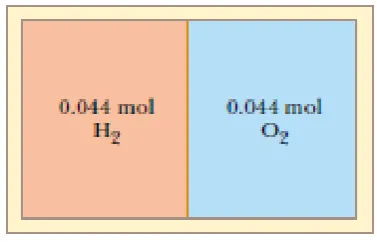
A 2.00-L container has a center partition that divides it into two equal parts, as shown in the Figure. The left side contains H2 gas, and the right side contains O2 gas. Both gases are at room temperature and at atmospheric pressure. The partition is removed, and the gases are allowed to mix. What is the entropy increase of the system?(10 points)
2
2 2 2
2
,
0
.
0
0
0
0
0
v0
H
H H H
H
Q
U
W
W
No work has been done on or by the system
if the system is in good thermal contact withthe invironment T
U
Q
If the system is surrounded by adiabatic walls Q
U
C
T
TdS dU
PdV
PdV
dV
P
dS
dV
n R
T
V
2 2
2
2 2 2 2 2
2
2 2 2 2
ln 2
ln 2
(
) ln 2
0.088 ln 2
H H
O
O O O O O
O
total H O H O
S
n R
dV
P
dS
dV
n R
S
n R
T
V
S
S
S
n
n
R
R
6 of 8
Q6.
A diatomic ideal gas traverse the cycle ABCDA. The processes AB , CD are isothermal processes and theprocesses BC , DA are isobaric processes. a) Calculate the total work done of the cycle. (5
points)
5 5 5 5
5 5 5
ln ( ) ln ( )
ln ln ( ) ( )
1 2
10 1 ln 10 2 ln 5 10 0.4 0.2 1 10 2 1
0.25 0.4
10 ln 4 2 10 ln 5 10 ln 5
A D
total AB BC CD DA A C C B D A D A
B C
A D
total A A D D C C B A D A
B C
total total
V V
W W W W W nRT P V V nRT P V V
V V
V V
W P V P V P V V P V V
V V
W
W
ln 4
22314Jb) Calculate the total change in internal energy of the cycle. (1 points)
U
0
state function
c) Calculate the total change in entropy of the gas after completing the cycle. (1 points)
S
0
state function
d) Calculate the change in enthalpy for CD process. (1points)
0 0
0
D C D D D C C C D C D D C c
H
H
H
U
P V
U
P V
U
U
P V
P V
H
0
2
4
6
0
0.5
1.0
1.5
2.0
2.5
D
C
B
A
V(m
3
)
P
(b
a
Q7.
For Hydrogen (H2) near its triple point (Ttr=14K), the latent heat of vaporization Lvap=0.5 J/kg. The liquid density is 71 kg·m-3, the solid density is 81 kg·m-3, and the meltingtemperature is given by 𝑇𝑚 = 13.99 + 0.4𝑃 , where Tm and P measured in K and N/m2 respectively. Compute the latent heat of sublimation in J/kg at the triple point. (10 points)
12
12
3 3
,
0.5 /
(
)
(
)
(
)
0.4
1
1
1
1
(
/
)
,
(
/
)
71
81
1
1
14(
)
(
)
71
81
0.0608 /
0.4
0.4
0.0608 0.5
0
sub mel vap vap
mel
mel
mel
sub mel vap
l
l
l
l
J kg
l
P
T v
v
T v
v
l
T
T
T v
v
P
v m
kg
v m
kg
T v
v
l
J kg
l
l
l