September 2013
Dampening Financial Regulatory Cycles
Brett McDonnell
Follow this and additional works at:http://scholarship.law.ufl.edu/flr
Part of theAdministrative Law Commons, and theCorporation and Enterprise Law Commons
This Article is brought to you for free and open access by UF Law Scholarship Repository. It has been accepted for inclusion in Florida Law Review by an authorized administrator of UF Law Scholarship Repository. For more information, please [email protected].
Recommended Citation
Brett McDonnell*
Abstract
Financial regulation should be countercyclical, strengthening during speculative booms to contain excessive leverage and loosening following crises so as to not limit credit extension in hard times. And yet, financial regulation in fact tends to be procyclical, strengthening following crises and loosening during booms. This Article considers competing descriptive and normative analyses of that procyclical tendency. All of the models and arguments considered are rooted in a public choice perspective on financial regulation, i.e., rational choice ideas drawn from economics and applied to politics, but with that perspective modified to take account of behavioralist biases in rationality, particularly the availability bias. That bias helps explain the procyclical tendency in financial regulation, as both the public and regulators ignore the threat of financial crises during boom times and become very focused on that threat when crises actually occur. The normal dominance of concentrated interest groups temporarily shifts as public attention turns to financial regulation following a crisis.
The models considered here differ greatly in their normative conclusions; some mainly criticize the deregulation that occurs during booms, some mainly criticize the regulation that occurs following crises, and some criticize the timing of both. The models differ in how they understand the balance of interest groups outside of crises and how likely that balance is to lead to outcomes that reflect the public interest; in how well they think the crisis-related public attention can be channeled to reflect the public interest; and in how they analyze the underlying vulnerability of financial institutions and markets and the intellectual difficulty of regulation. After analyzing these differing models, this Article considers historical evidence to determine the best approach, and then considers various administrative mechanisms that might help dampen the procyclical tendencies of financial regulation. This Article considers procedures such as bicameralism and the committee system in Congress, notice-and-comment rulemaking, hard-look judicial review, independent agencies, sunset clauses, mandated agency studies, regulatory “contrarians,” and automatic triggers for
various rules.
INTRODUCTION ... 1598
I. THE BASIC CHARACTER OF FINANCIAL MARKET AND REGULATORY CYCLES ... 1602
A. Financial Market Cycles ... 1602
B. Financial Regulatory Cycles ... 1605
II. COMPETING MODELS OF REGULATORY CYCLES ... 1606
A. Overreaction in Both Phases (Model 1) ... 1608
B. Overregulation Following a Crisis (Model 2) ... 1613
C. Excessive Deregulation During Booms (Model 3) ... 1615
D. Graphing the Models ... 1617
E. Extensions and Summary ... 1621
III. HISTORICAL EVIDENCE ... 1624
IV. ADMINISTRATIVE RESPONSES ... 1631
CONCLUSION ... 1639
INTRODUCTION
Financial markets tend to experience cycles. After periods of relative calm and good news, one sees speculative bubbles. Investors crowd into favored markets and assets, often financing their investments with ever-increasing levels of debt. The bubbles eventually burst, and that debt helps lead to contagious panics. These crises frequently bring entire economies into recession, and those recessions are often painful and long lasting, as institutions try to dig out from under their debts.1
Governments’ responses to these cycles also tend to follow a pattern, but the pattern is not ideal. Insofar as governments regulate financial markets and institutions to reduce speculative bubbles and avoid crises, such regulation should kick in or become stronger during the boom times, when restraint on markets is (arguably) needed. Strengthened regulation during and immediately following financial crises, in contrast, risks further reducing credit precisely when credit has collapsed and needs to expand to help finance recovery. In short,
optimal financial regulation should be countercyclical.2
1. See CHARLES P.KINDLEBERGER &ROBERT Z.ALIBER,MANIAS,PANICS, AND CRASHES:
AHISTORY OF FINANCIAL CRISES 9–10(5thed.2005);CARMEN M.REINHART &KENNETH S.
Alas, in practice, regulation appears to be procyclical.3 That is, major new regulatory initiatives, both statutory and administrative, happen most frequently during or immediately following financial crises. The leading, prototypical examples are the extensive financial regulatory
statutes enacted during the New Deal.4 In contrast, during boom times
there appears to be a tendency for politicians, judges, and regulators to share the optimism that helps fuel the booms, with the result that they
tend to deregulate precisely when regulation should strengthen.5 The
gradual loosening and then elimination of the separation of commercial
and investment banking is an important example.6
What causes financial regulation to be procyclical, and is there anything we can do to reverse, or at least reduce, the trend? This Article addresses these questions. A number of scholars have noticed this problem, and this Article discusses some of them. Review of their work, though, shows a split in how scholars evaluate the procyclical regulation problem. Some think the main concern is governments’ tendency to overregulate following crises; these scholars see deregulation in good
times as a useful corrective.7 Others think the main concern involves
deregulation in good times and see crises as the only time that needed regulation is politically feasible.8 Still others think we get things quite
wrong in both phases.9 Which diagnosis one believes greatly affects
which prescriptions look most attractive.
Part I describes the basic character of financial markets and regulatory cycles. Part II analyzes some of the leading scholarly narratives addressing procyclical regulation and categorizes these narratives into three models. Model 1 sees overregulation following crises and excessive deregulation in boom periods. However, compared to the other two models it does see a bright side; it describes the average level of regulation over time as roughly correct, even if its cyclical variations are out of optimal phase. Model 2 is more concerned with overregulation following crises, which it believes leads to a long-run pattern of overregulation. Model 3 is more concerned with excessive deregulation occurring in boom times, believing that this helps lead to a long-run pattern of overly weak regulation.
3. See infra Section I.B (discussing how new financial regulations are typically not enacted until after the passage of a financial crisis). This Article uses the term “procyclical” as a contrast to “countercyclical,” and uses the latter term in the conventional way to refer to policy that acts to counteract financial cycles.
4. See infra 110–16 and accompanying text.
5. ERIK GERDING, BUBBLES,FINANCIAL REGULATION, AND LAW 11 (forthcoming 2013). 6. E.g., Gramm-Leach-Bliley Act, Pub. L. No. 106-102, 113 Stat. 1338 (1999) (codified as amended in scattered sections of 12 U.S.C. and 15 U.S.C.).
All models considered here are rooted in a classical public choice
analysis10 in which more concentrated interest groups (as opposed to
diffuse groups) are more capable of organizing to promote their preferred policies. The models are compared on three dimensions: the regulatory demand side, the regulatory supply side, and normative foundations.
The “regulatory demand side” refers to how the models understand the usual organizational success of differing interest groups focused on financial regulation. The models differ somewhat in their analyses of competing groups. Models 1 and 3 see most financial regulation as characterized by one-sided organization, with financial insiders well organized and consumer groups and the general public poorly organized. Model 2, on the other hand, sees more divergence among organized interests within financial markets, and hence more balanced political competition. All of the models see a fundamental change occurring during financial crises, as the general public and ordinary politicians suddenly focus on financial regulation, which they usually ignore. However, Models 1 and 2 see this as leading to impulsive, uninformed, and overly restrictive (or else empty) new rules, while Model 3 thinks there are actors who can help guide the new rules in a more positive way (although their efforts sometimes meet only limited success).
The “regulatory supply side” refers to how regulators and politicians respond to interest group pressures. All three models see both legislators and regulators as heavily influenced by the best organized group, but wanting to at least appear responsive to the general public when public attention focuses on financial regulation. Model 2 adds emphasis on the tendency for bureaucrats to favor rules that extend the power of their agencies.
The third dimension of comparison is “normative foundations,” which refers to concepts of how well lightly regulated financial markets and institutions are likely to function and how intellectually demanding effective financial regulation will likely be. Model 2 sees markets as functioning relatively well and regulation as extremely challenging conceptually, while Model 3 is more distrustful of markets and less distrustful of regulation.
10. See generally DANIEL A.FARBER &PHILLIP P.FRICKEY,LAW AND PUBLIC CHOICE: A
CRITICAL INTRODUCTION 1 (1991) (providing an overview of public choice theory); DENNIS C. MUELLER,PUBLIC CHOICE III, at1–2,6 (2003) (surveying the field of public choice theory and
its impact on positive and normative understandings of politics); MAXWELL L.STEARNS &TODD
J.ZYWICKI,PUBLIC CHOICE CONCEPTS AND APPLICATIONS IN LAW 1–2, 45–46(2009)(contrasting
public interest, pluralism, and modern public choice models); D. Daniel Sokol, Explaining the Importance of Public Choice for Law, 109 MICH.L. REV 1029, 1029–30 (2011) (reviewing
Table 1 summarizes the three models:
Model 1 Model 2 Model 3
Period of cycle of most concern
Both
overregulation after crisis and excessive de-regulation in boom
Overregulation
after crisis Excessive de-regulation in boom
Long term
trend Roughly right level of
regulation
Overly strong
regulation Overly weak regulation
Regulatory
demand side Industry groups favor weak regulation in boom; populist pressure for strong regulation after crisis Balanced interest groups in boom; ignorant populist pressure after crisis Industry groups favor weak regulation in boom; populist pressure reflects public interest after crisis Regulatory
supply side Interest group capture Interest group capture and bureaucratic aggrandizement
Interest group capture
Normative
foundations Lightly regulated markets are unstable but regulation is hard Lightly regulated markets work well, regulation is very hard Lightly regulated markets are deeply unstable, regulation isn’t all that hard Table 1
system for regulating financial institutions and markets that, on balance, seems better than the much more laissez-faire approach of the nineteenth century. We have achieved greater stability without much less efficiency and innovation. The core of that regulatory system was instituted following financial crises, above all in the New Deal. Strengthening the rules in boom times and loosening them following a crisis would be better, yes, but doing so mostly exceeds our political and cognitive capacities.
Part IV nonetheless tries to learn from the models and the historical evidence to consider ways to smooth out the financial regulatory cycle, and encourage sensible new rules while weeding out overregulation. Which procedures look best will depend of course on which model one thinks best fits our experience—Model 2 will tend to encourage procedures that limit new rules and help undo past mistaken rules, while Model 3 will try to stop existing rules from being undone. Many existing elements of administrative procedure already help achieve some of these goals, and there are a variety of proposals for other procedures that might further help. Some of the procedures this Article considers include bicameralism and the committee system in Congress, notice-and-comment rulemaking, hard-look judicial review, independent agencies, sunset clauses, mandated agency studies, regulatory “contrarians,” and automatic triggers for various rules.
I. THE BASIC CHARACTER OF FINANCIAL MARKET AND REGULATORY
CYCLES
A basic premise of this Article is that financial market cycles and financial regulatory cycles are closely tied to each other. Similar
psychological factors help drive each, and each helps cause the other.11
This Part quickly sketches some of the basic characteristics and causes of each kind of cycle, starting with financial market cycles. Later parts will both build and elaborate upon these characteristics and causes.
A. Financial Market Cycles
This Article’s account of financial market cycles follows that of
Hyman Minsky.12 Financial bubbles begin after a period of economic
11. GERDING, supra note 5.
12. Compare HYMAN P.MINSKY,STABILIZING AN UNSTABLE ECONOMY 197–220 (1st ed. 1986), with José Gabilondo, Dodd-Frank, Liability Structure, and Financial Instability Cycles: Neither a (Ponzi) Borrower nor a Lender Be, 46 WAKE FOREST L.REV. 469, 469–70 (2011), Brett McDonnell, Don’t Panic! Defending Cowardly Interventions During and After a Financial Crisis, 116 PENN ST.L.REV. 1, 27 (2011) [hereinafter McDonnell, Don’t Panic!], and Brett H.
quiet has caused investors and businesses to forget the pain and lessons of the last bust. Some new developments spur new investments. Optimism grows and starts feeding on itself as more new investors get into the game, inflating asset prices and helping assure good returns for the early investors. Investors take on increasing amounts of debt; a great way to multiply profit so long as things go well, but a source of serious
risk if things go badly and they are unable to pay off the debt.13 Debt
grows, and the whole system becomes increasingly unstable as the boom enters its final period of frenzy. Eventually expectations shift— even very small pieces of bad news can set off the end of the bubble and the beginning of the bust. With debt so high, once expectations start turning, investors start trying to get out of their investments to pay off their debt. But as growing numbers try to sell off, asset prices start to plummet. A vicious cycle of falling prices and bankruptcies leads to a
crash.14 The financial crisis feeds into the real economy as businesses
are unable to fund operations. A major contraction follows. It typically takes years to recover, as financial companies and businesses hoard cash and try to rebuild their shattered financial status.15
As mentioned, Minsky was the key innovator in developing an economic model of financial market booms and busts. Minsky, in turn, built on the work of Keynes.16 But these ideas are not limited to liberal Keynesians—a somewhat similar story can be found in Mises and
Hayek’s Austrian business cycle theory.17 Minsky’s theory underlies
Charles Kindleberger’s pathbreaking work on the history of manias and panics.18 It also fits well with the more recent and systematic history of
13. See MINSKY, supra note 12, at 211–14.
14. See MINSKY, supra note 12, at 214–17; see also KINDLEBERGER &ALIBER, supra note 1, at 9–11.
15. See KINDLEBERGER & ALIBER, supra note 1, at 9−11; Irving Fisher, The Debt-Deflation Theory of Great Depressions, 1 ECONOMETRICA 337, 342 (1933); see alsoMINSKY, supra note 12, at 219–20.
16. Compare JOHN MAYNARD KEYNES, THE GENERAL THEORY OF EMPLOYMENT,
INTEREST, AND MONEY 46–47 (1936) (describing the dependence of producers’ business decisions on their expectations of consumer demand), with HYMAN P.MINSKY, JOHN MAYNARD
KEYNES (1976), and MINSKY, supra note 12, at 172 (“The fundamentals of a theory of financial instability can be derived from Keynes’s General Theory . . . .”).
17. FRIEDRICH A.HAYEK,PRICES AND PRODUCTION 75−101 (2d ed. 1935) (“[I]ndustrial
fluctuations consist essentially in alternating expansions and contractions of the structure of capital equipment . . . .”); F.A. HAYEK,THE CONSTITUTION OF LIBERTY 4 (1960); F.A. Hayek,
The Use of Knowledge in Society, 35 AM.ECON.REV. 519, 526–27 (1940) [hereinafter Hayek, The Use of Knowledge in Society] (discussing how individuals with limited knowledge can communicate relevant information in the marketplace via prices); McDonnell, Of Mises and Min(sky), supra note 12, at 1288–89 (noting the similarities between the Austrian and Keynesian theories); see also Larry E. Ribstein, Commentary, Bubble Laws, 40 HOUS.L.REV.
crises by Reinhardt and Rogoff.19
Recent work on behavioral economics20 and behavioral finance21
reinforces Minsky’s story. People vary systematically from the sort of rational behavior usually assumed by economists in a variety of ways. Perhaps most central to our story is the availability bias—people give
too much emphasis to recent and salient events.22 Thus, as the boom
develops, market participants forget busts in the past, and are beguiled
by recent good market news. Also important are rational herding23 and
the social nature of expectations.24 People tend to follow the beliefs of
others around them, making both bubbles and busts self-reinforcing. One important objection to behavioral finance is that even if many people suffer from such deviations from rationality, with so much money at stake, markets should correct mistakes, as more rational
investors find ways to benefit from the mistakes of others.25 But as
economic theorists and empirical researchers have developed behavioral finance, they have put forward a number of reasons why such market
corrections may frequently be weak and delayed.26
Of course, not everyone buys into the Minsky-style story of financial market instability. Believers in the efficient capital market hypothesis typically maintain that financial markets are better behaved than Minsky would suggest, although even within an efficient markets approach, some significant instability is possible.27 Given the extensive history of
unstable markets, this view seems hard to maintain.28 At any rate, this
19. REINHARDT &ROGOFF, supra note 1 (providing a quantitative analysis of different types of financial crises throughout history).
20. See Christine Jolls, Cass R. Sunstein & Richard Thaler, A Behavioral Approach to Law and Economics, 50 STAN.L.REV. 1471, 1476–77 (1998); see also Amos Tversky & Daniel
Kahneman, Judgment Under Uncertainty: Heuristics and Biases, 185 SCI. 1124, 1124–30 (1974).
21. See ANDREI SHLEIFER, INEFFICIENT MARKETS: AN INTRODUCTION TO BEHAVIORAL
FINANCE 113−14, 154−55 (2000).
22. See Amos Tversky & Daniel Kahneman, Availability: A Heuristic for Judging Frequency and Probability, 5 COGNITIVE PSYCHOL. 207, 208–09 (1973) (proposing and
analyzing the availability heuristic).
23. See Andrea Devenow & Ivo Welch, Rational Herding in Financial Economics, 40 EUR.ECON.REV. 603, 603–05 (1996) (noting the significance of herding in the financial realm). 24. See Claire A. Hill, Justification Norms Under Uncertainty: A Preliminary Inquiry, 17 CONN.INS.L.J. 27, 28–29, 34–35 (2010) (identifying herding and social norms as influential on
decision making).
25. See SHLEIFER, supra note 21, at 2–5. 26. Id. at 23–27.
27. See Karl Shell, Sunspot Equilibrium, in THE NEW PALGRAVE DICTIONARY OF
ECONOMICS (Steven N. Durlauf & Lawrence E. Blume, eds., 2d ed. 2008), available at
http://www.dictionaryofeconomics.com/article?id=pde2008_S000325 (subscription required) (describing different extrinsic sources of market volatility in economic outcomes).
Article will not relitigate that dispute. This Article will assume a Minskyan understanding of financial markets.
Given this understanding, there is clearly conceptual room for welfare-improving financial regulation. One would want that regulation be countercyclical. That is, regulation should become more strict during boom times, working to lean against the wind of euphoria and to help keep bubbles from inflating as far and as fast as they would in the absence of regulation. When busts hit, the regulation should lighten up, so that it does less to inhibit financial companies from extending credit during a time when credit is tight anyway.29
B. Financial Regulatory Cycles
And yet, that is not what we typically observe. Major new financial rules, both legislation and agency regulations, tend to occur in the wake of financial crises. The most dramatic example in American history is
the New Deal financial regulation.30 In the last decade we have seen the
Sarbanes-Oxley Act following the dot-com bust,31 and then the
Dodd-Frank Act following the financial crisis of 2007–2008.32
These are not isolated examples. Stuart Banner has studied the history of securities regulation over the last several hundred years.33 In an article summarizing some of that research, Banner writes that “[i]f new technology doesn’t cause new securities regulation, what does? In a
nutshell, crashes.”34 Of course, as Banner notes, this is not a universal
rule, but it is a strong one:
This is just a general trend, not an absolute rule. There have been sharp price declines without subsequent regulation, and of course there has been regulation without immediately
sixty-six countries over eight centuries).
29. See Amitai Aviram, Countercyclical Enforcement of Corporate Law, 25 YALE J. ON
REG. 1, 8–9 (2008) (noting that the availability bias justifies enforcement of corporate fraud in
economic upturns and limited enforcement in downturns); Samuel G. Hanson, Anil K Kashyap, & Jeremy C. Stein, A Macroprudential Approach to Financial Regulation, 25 J.ECON.PERSPS. 3, 5–8, 17 (2011) (”We have argued . . . imposing substantially higher capital requirements on financial firms, particularly in good times.”); Michal Kowalik, Countercyclical Capital Regulation: Should Bank Regulators Use Rules or Discretion?, FED. RES.BANK KAN. CITY
ECON. REV., no. 2, 2011, at 63, 66–69 (2011) (arguing in favor of “countercyclical capital
requirements”).
30. See infra notes 110–16 and accompanying text. 31. See infra notes 158–64 and accompanying text. 32. See infra notes 128–33 and accompanying text.
33. See generally STUART BANNER, ANGLO-AMERICAN SECURITIES REGULATION:
CULTURAL AND POLITICAL ROOTS,1690–1860 (1998) (analyzing regulation of securities markets
from 1690 England to 1860 United States).
preceding price declines. But most of the major instances of new securities regulation in the past three hundred years of English and American history have come right after crashes.35
Banking regulation also shows a marked tendency for innovation and strengthening in response to crises.36
Meanwhile, in boom times there is some tendency for a loosening of financial regulation. Regulators fail to respond to new market developments and risks. A good example is the opposition to the Commodity Futures Trading Commission’s proposal to regulate derivatives in the 1990s. Agencies become less vigorous in enforcing existing rules by interpreting rules in ways that lessen their bite. The gradual erosion of the Glass-Steagall separation of commercial and investment banking is a leading example. Sometimes, regulators may amend or repeal regulations or legislation completely, as eventually happened to Glass-Steagall in 1999. Governments may affirmatively subsidize financial frenzies in a variety of ways.37
As the next Part explains, scholars differ in how they describe the pattern and its causes, and in the normative consequences they draw.
II. COMPETING MODELS OF REGULATORY CYCLES
Many scholars have noted the procyclical tendency of financial regulation. They have analyzed both its causes and the normative consequences. There is some significant overlap in these analyses. Some of the judgment heuristics and biases that cause market cycles
also help explain the regulatory cycle.38 Most importantly, the
availability bias has a particularly strong effect on the general public
and the media.39 Most of the time, financial regulation is not a subject
that interests the average citizen. But during a financial crisis, this changes. Frauds committed during the boom typically come to light during the bust, many people feel deep pain due to the crisis, and
35. Id.
36. See JILL M. HENDRICKSON, REGULATION AND INSTABILITY IN U.S. COMMERCIAL
BANKING:AHISTORY OF CRISES 14 (2011).
37. See GERDING, supra note 5, for numerous examples of all of these.
38. E.g., HENDRICKSON, supra note 36; Stephen J. Choi & A.C. Pritchard, Behavioral Economics and the SEC, 56 STAN.L.REV. 1, 5, 44–45 (2003); David Hirshleifer, Psychological Bias as a Driver of Financial Regulation, 14 EUR.FIN.MGMT. 856, 865–67 (2008); Jeffrey J.
Rachlinski & Cynthia R. Farina, Cognitive Psychology and Optimal Government Design, 87 CORNELL L.REV. 549, 553–55 (2002).
39. See Tversky & Kahneman, supra note 22; Timur Kuran & Cass R. Sunstein,
Availability Cascades and Risk Regulation, 51 STAN. L. REV. 683, 711–15, 735–36 (1999)
ordinary people expect politicians to react. Politicians are quite aware of
this pressure to act.40 Even more informed actors within the financial
industry and financial regulatory agencies are affected by the availability bias (indeed, its effect on industry participants is a leading source of the underlying financial cycle), and their own assessments of
the need for a regulation shift.41 Thus, during and for a while after a
financial crisis, there is both significant political pressure to act to prevent future crises and some willingness on the part of industry insiders to allow regulation. This pressure following crises is hardly unique to financial regulation, but as this Article argues below, the linkages between regulation and the phenomenon being regulated are tighter here than for other forms of regulation.42
These factors reverse themselves during a boom period. The general public and most politicians pay little attention to financial regulation. Thus, financial market participants’ and regulators’ perceptions and
interests dominate the politics of regulation.43 While things are going
well, everyone is making money, and financial companies appear healthy, there is little appetite for major new regulation and often quite significant desire for loosened regulation. New financial products and markets appear, and regulators do little to address them.
Since financial regulation should optimally be countercyclical, it should come as no surprise that commentators have found much to dislike in this procyclical pattern of financial regulation. Regulators must be getting some things wrong during at least one phase in the cycle, and quite possibly both.
Despite many similarities, commentators have differed sharply in their analyses of procyclical financial regulation. This is true even for those who work within an economic understanding of politics. The public choice tradition can be seen as considering both the demand for and supply of regulation. On the demand side are a variety of interest
groups.44 Analysts differ on the incentives and balance of power among
these groups, and how that balance changes over the course of market and regulatory cycles. On the supply side are politicians and regulators. Analysts also differ over the incentives they face and how those shift
over the course of a cycle.45 Finally, there is much debate over the
normative conclusions to be drawn from the analysis. Those with a more pro-market slant are typically more concerned with overregulation
40. See HENDRICKSON, supra note 36, at 13–14; Choi & Pritchard, supra note 38, at 39.
41. See, e.g., Choi & Pritchard, supra note 38, at 5. 42. See infra p. 16.
43. See Choi & Pritchard, supra note 38, at 24–25; cf. HENDRICKSON, supra note 36, at
13–14.
following a market crisis, while those with a more pro-regulatory slant are more concerned with loosened regulation during good times.
This Article sorts these differing analyses into three different models. Model 1 sees regulators overreacting in both phases—during busts they overregulate; during booms they loosen regulation too much. Model 2 is more concerned about overregulation in the wake of market busts. Model 3 is more concerned about excessively loose regulation during market booms.
These models are stylizations. No one scholar may fit exactly within any of them. The world is messier than any of the models, and good scholars recognize that mess, at least in the nooks and crannies of their analyses. Still, the models help impose some analytical order, and highlight some of the crucial questions on which scholars differ.
A. Overreaction in Both Phases (Model 1)
In a sense, Model 1, finding overreaction in both phases, is the most natural framework that emerges once one recognizes the basic procyclical nature of financial regulation. One can arrive at variants of Model 1 by recognizing all of the competing political forces analyzed in Models 2 and 3 and the competing normative elements, and concluding that they all roughly balance one another, leading to less condemnation of bust overregulation than Model 2 and less condemnation of boom underregulation than Model 3. For expository simplicity, though, this section will focus on the core forces that tend to drive overregulation following a crisis, leaving Model 3 to describe forces that may counteract them, and will focus on the core forces that tend to drive underregulation during a boom, leaving Model 2 to describe forces that may counteract them.
The basic story of loosened regulation during boom times follows
from Mancur Olson’s theory of interest groups.46 On most political
issues, one should generally expect effective lobbying to be dominated
by relatively small, concentrated interest groups.47 Each member of
these groups has a strong interest in the outcome of regulation, and the strength of those interests combined with relatively small numbers allow the members to overcome the “free rider” problem inherent in lobbying for regulations that will affect all members of the group, whether they contributed to the lobbying effort or not. In contrast,
consumers and the general public are large and diffuse groups.48 Each
member has relatively small stakes in regulation on a particular topic,
46. See generally MANCUR OLSON, JR., THE LOGIC OF COLLECTIVE ACTION (1965)
(presenting Olson’s theory of groups and organizations).
47. See JAMES M.BUCHANAN &GORDON TULLOCK,THE CALCULUS OF CONSENT:LOGICAL
and although the collective public interest in good regulation may be quite considerable, free riding prevents effective lobbying from taking
place.49 Heightening the problem, industry insiders will have much
greater expertise than members of the general public, and hence will be
better able to provide useful information to regulators.50 However, the
information they provide is likely slanted.
Olson’s story is not specific to financial regulation, but it certainly
applies.51 During boom times, the general public neither understands
nor cares about financial regulation.52 Financial market insiders do.
Business is going well as is. For the most part, insiders are happy with things as they are. They do not want burdensome new rules, which may
limit their ability to make money.53 Indeed, they may well want to
reduce the burden of existing rules, which have imposed unwanted costs. As noted above, there are a variety of ways of doing this. Some may involve simple regulatory inaction. As markets boom, financial market participants develop new products and markets not clearly
addressed by existing rules.54 Think, for example, of the development of
credit default swaps, particularly those tied to the growing mortgage securitization market from the 1980s on. Generally, those market
49. See OLSON, supra note 46, at 14–16; see also BUCHANAN &TULLOCK,supra note 47,
at 36–38; George J. Stigler, The Theory of Economic Regulation, 2 BELL J.ECON.&MGMT.SCI.
3, 13–14 (1971).
50. See John C. Coffee, Jr., The Political Economy of Dodd-Frank: Why Financial Reform Tends to Be Frustrated and Systemic Risk Perpetuated, 97 CORNELL L. REV. 1019, 1031–32, 1047 (2012).
51. For applications of public choice theory to financial regulation, see HENDRICKSON, supra note 36, at 13; George J. Benston, Federal Regulation of Banking: Historical Overview,
in DEREGULATING FINANCIAL SERVICES:PUBLIC POLICY IN FLUX 1 (George G. Kaufman & Roger C. Kormendi eds., 1986); Coffee, supra note 50, at 1020–23, 1046–47 (applying to the Dodd-Frank Act); Franklin R Edwards & James Scott, Regulating Solvency of Depository Institutions: A Perspective for Deregulation, in ISSUES IN FINANCIAL REGULATION 65, 78
(Franklin R. Edwards ed., 1979); David D. Haddock & Jonathan R. Macey, Regulation on Demand: A Private Interest Model, with an Application to Insider Trading Regulation, 30 J.L.& ECON. 311, 311–12 (1987) (applying to SEC rules); Gregg A. Jarrell, Change at the Exchange: The Causes and Effects of Deregulation, 27 J.L.&ECON. 273, 284–85 (1984) (applying to the
deregulation of the New York Stock Exchange by way of the Securities Acts Amendments of 1975); Edward J. Kane, Changing Incentives Facing Financial-Services Regulators, 2 J.FIN.
SERVS. RES. 265, 265–66 (1989) (applying generally to decisions by financial services
regulators); Jonathan R. Macey, Administrative Agency Obsolescence and Interest Group Formation: A Case Study of the SEC at Sixty, 15 CARDOZO L.REV. 909, 922 (1994) (applying to the SEC).
52. See Brett McDonnell & Daniel Schwarcz, Regulatory Contrarians, 89N.C.L.REV. 1629, 1644–45 (2011).
participants will not want to see new rules burdening new products and markets and will oppose such proposals. Thus, for example, the securities industry opposed attempts by the Clinton Administration’s Commodities Futures Trading Commission to regulate credit default
swaps.55 This is the most likely form of effective regulatory loosening.
More affirmative loosening of existing rules may occur through simple
underenforcement.56 As markets become larger and more complex,
regulatory resources may become more stretched.57 Industry interests
will oppose attempts to provide more resources to regulators.58 Market
participants may lobby for liberal agency interpretations of existing rules, which interpret ambiguities in ways that allow them to do what they want—the gradual evisceration of Glass-Steagall is a key
instance.59 Going further, they may lobby agencies to amend or repeal
unwanted regulations, or even lobby Congress to amend or repeal unwanted legislation.60
Olson’s story focuses on the regulatory demand side, namely the organization of political lobbying. What of the supply side? The most standard public choice story sees politicians focused on reelection. For a policy area in which one side of the issue features concentrated interests and the other side diffuse interests, the way to achieve that is to favor
the side with concentrated interests.61 Those with diffuse interests will
pay little or no attention to the rules, while those with concentrated interests will provide votes both directly and, more importantly, through
campaign contributions.62 A similar story holds for regulators, where
public choice analysts speak of “regulatory capture.” A variety of mechanisms cause regulators to favor the industry they are regulating.
Through the revolving door,63 regulators may either themselves come
from the industry or may anticipate getting cushy industry jobs after they leave government. The industry also provides crucial information needed for regulating. This is apparent, for instance, in the detailed comments from banks and their lawyers on the proposed regulation
55. See Coffee, supra note 50, at 1033, 1033–34 n.56. 56. See, e.g., id. at 1027–28.
57. GERDING, supra note 5; Omarova, supra note 54, at 1688–91.
58. Again, we shall consider counterforces under Model 2. See infra Section II.B.
59. See Saule T. Omarova, The Quiet Metamorphosis: How Derivatives Changed the “Business of Banking,” 63 U.MIAMI L.REV. 1041, 1049–52 (2009).
60. GERDING, supra note 5.
61. See MICHAEL T. HAYES, LOBBYISTS AND LEGISLATORS: A THEORY OF POLITICAL
MARKETS 93–95 (1981).
62. Cf. Coffee, supra note 50, at 1021–22.
63. See MICHAEL SMALLBERG, PROJECT ON GOV’T OVERSIGHT, REVOLVING REGULATORS:
SEC FACES ETHICS CHALLENGES WITH REVOLVING DOOR 4 (2011), available at
http://www.pogo.org/our-work/reports/2011/fo-fra-20110513.html; McDonnell & Schwarcz,
implementing Dodd-Frank’s Volcker Rule, as compared with the
emptier although numerous letters from more populist sources.64 Those
in the industry constantly push for changes favoring them, providing strong expert documentation for their positions, while few have incentive to argue the public interest, so the regulators get biased
arguments.65 Compounding the tendency for underregulation on both
the demand and supply side, the availability bias and other heuristics that drive the markets will also affect market participants and regulators
when it comes to thinking about regulation.66 Insofar as financial
regulation is aimed at avoiding crashes, even well-informed insiders will tend to underestimate the probability of such crashes during a boom, and hence undervalue the benefits of regulation. Indeed, there are fewer arbitrage mechanisms to correct such bias in regulation than there are within markets.67
Things change markedly in the wake of a market crash. Most importantly, the general public becomes engaged. The risks that flow from market crashes are suddenly highly salient. There is pressure to both do something about the current contraction and also avoid future
crashes.68 Crashes will typically reveal a variety of frauds and shady
practices that occurred during, and at least arguably helped heighten, the
market boom.69 The public wants to see something done to reign in the
rich, reckless financial manipulators who have brought the economy crashing down. Even financial market participants will have become much more aware of the dangers of lightly regulated financial markets, and may favor at least some new regulation to avoid a repeat—after all, market crashes are disastrous for many of them. So for instance, following the latest crash, the Dodd-Frank Act finally imposed regulations on derivatives such as credit default swaps by implementing
clearinghouses and similar mechanisms.70
On the regulatory supply side, politicians and regulators will become more aware of the risks of loosely regulated financial markets. For
64. See Kimberly D. Krawiec, Don’t “Screw Joe the Plummer”: The Sausage-Making of Financial Reform, 55 ARIZ.L.REV.53,58–59, 84 (2013).
65. See id. at 80.
66. See Kuran & Sunstein, supra note 39, at 710 (“[V]arious characteristics of risks affect lay judgments about whether they call for public regulation.”).
67. Although, there may be some mechanisms for a political analog to arbitrage. See
Aviram, supra note 29, at 17–18.
68. See HENDRICKSON, supra note 36; Zachary J. Gubler, Public Choice Theory and the Private Securities Market, 91 N.C.L.REV. 745, 779 (2013); Hirshleifer, supra note 38, at 861, 865.
69. See Aviram, supra note 29, at 8.
politicians, the political calculus changes sharply; suddenly being seen as favoring Wall Street over Main Street risks losing a lot of votes. Agency regulators may feel shame and face blowback from having failed to prevent the crash. Both major new legislation and regulation may follow as a result. Unless it is given delayed effect, this risks imposing new obstacles on financial market participants right when they
are already hurting, thereby delaying recovery.71 The new rules may
respond narrowly to the specific problems that cause the crash, failing to anticipate what might cause the next one. Worse, in responding to the problems that caused the last crash, the rules might not even be based on a correct analysis of the causes. Rules passed in great haste in response to pressure from an uninformed public are at risk of being poorly thought through. Financial regulation is difficult even under the best of conditions—trying to do it in a hurry to appease an angry mob does not make the task more likely to succeed.
The effect of visible crises on the politics of regulation is not unique to financial regulation. There is now literature on this phenomenon in a
variety of areas.72 Many scholars share a concern that crisis-driven
regulation will not be well-thought through.73 However, financial
regulation may be unique compared to most other areas because similar heuristics are at work in the underlying financial markets being regulated. There is a tighter feedback loop and hence a more pronounced cyclical movement to financial markets and regulation.
Thus, under Model 1 financial regulation tends to go off track at each stage. During financial booms, when regulations could usefully reduce market excesses, politicians and regulators are captured by the financial industry and loosen rules rather than tightening them. Following crashes, when markets are struggling, politicians impose onerous and uninformed new rules in response to public panic and disgust.
Cheerily enough, none of the other two models are really any more optimistic than Model 1. Rather, they focus even greater ire on one part of the cycle. Indeed, the contrast with Models 2 and 3 suggests a hidden silver lining in Model 1. Each of the other two models sees overreaction in one phase leading to a long-run pattern of non-optimal levels of regulation—overregulation remaining in place, according to Model 2, long after the crises which provoke that regulation, and underregulation remaining a problem that new crisis regulation does not adequately resolve according to Model 3. In contrast, in Model 1 the long-run
71. GERDING, supra note 5.
72. See generally Kuran & Sunstein, supra note 39 (discussing the role of availability bias in increasing regulation following a variety of crises and offering a framework for identifying the consequences of availability bias).
average level of regulation is roughly right. This suggests a possible long-run trend for political pressure to lead to financial regulation that is within hailing distance, at least, of the optimal level, in line with a minority view within the general public choice literature.74 This Article explores this idea further after first sketching Models 2 and 3.
B. Overregulation Following a Crisis (Model 2)
Model 2 focuses its ire on the bust phase, when major new regulation occurs. It is relatively laissez-faire and antiregulation in outlook, and vigorously decries the new legislation and regulation that
are frequently foolish and usually overly restrictive.75 However, unlike
Model 1, it is much less concerned about underregulation during financial booms. Model 2 either maintains that such reduced regulation does not occur at all, or if it does, it is limited and temporary and helps counteract a dominant long-term trend toward overregulation.
Model 2 agrees with the basic sketch of bust-period overregulation given above under Model 1. The availability bias induces the public and politicians to push for new regulation, even though they do not know what they are doing. Even more informed private and public actors are acutely conscious of the risks of an unregulated market following a
crisis. Regulation happens too quickly, and it is usually underinformed76
and overreaching.77
Regulation skeptics see a few additional factors that tend to make overregulation following a crisis even more problematic. For one, they tend to see concentrated interest groups as less uniformly antiregulation
than the picture sketched earlier under Model 1.78 Some well-organized
interest groups may favor strong regulation. Incumbent firms may benefit from regulation relative to potential challengers, and hence may favor many regulations as a form of barriers to entry. Some groups may favor regulations that promote their personal interests—e.g., plaintiffs’ law firms favoring securities rules that encourage suits; unions and public employee pension funds favoring rules that promote shareholder activism; too-big-to-fail banks favoring bailout provisions; and retailers
74. E.g., Gary S. Becker, A Theory of Competition Among Pressure Groups for Political Influence, 98 Q.J.ECON. 371, 383–84 (1983).
75. HENDRICKSON, supra note 36, at 246–47; Stephen M. Bainbridge, Dodd-Frank: Quack Federal Corporate Governance Round II, 95 MINN.L.REV. 1779, 1818–19 (2011); Paul
G. Mahoney, Review, The Pernicious Art of Securities Regulation, 66 U.CHI.L.REV. 1373, 1391–92 (1999); Ribstein, supra note 17, at 82–83; Roberta Romano, Regulating in the Dark, in
REGULATORY BREAKDOWN: THE CRISIS OF CONFIDENCE IN U.S. REGULATION 86, 86 (Cary Coglianese ed., 2012).
76. Kuran & Sunstein, supra note 39, 736–37; Macey, supra note 51, at 925–26; Romano,
supra note 75, at 86–87; Stigler, supra note 49, at 11–12.
favoring the limits on payment card fees in the Dodd-Frank Act. Academics, especially legal academics, are another occasionally
influential group that often favors regulation.79 Thus, while Model 1
tends to see the sudden public attention following a crisis as temporarily shifting an interest group status quo that usually favors overly weak regulation (a view that is promoted even more strongly in Model 3), supporters of Model 2 see concentrated interest group politics as more balanced, so that in ordinary times both pro and antiregulation arguments should be heard. But when the uninformed public and politicians get involved following a crisis, that balance is tipped strongly in favor of unwise regulation.
Model 2 also presents a somewhat different picture of the regulation supply side. The Model 1 story above focused on industry group capture, detailing reasons why both politicians and agency regulators are likely to favor causes championed by the best-organized interest groups. Model 2 does not at all deny this tendency, but it also points to a different tendency. Regulators may prefer strong regulations because it advances their own interests. This may be seen through a crass personal influence light—regulators in active agencies have more personal clout
and influence.80 A somewhat more benign variant suggests that
regulators are self-selected, overly representing the viewpoint that the
regulations in question tend to be helpful.81 Either way, there is a
powerful independent tendency for regulators to push for more regulation. Thus, when the demand side factors align to support more regulation following a crisis, the regulators seize the moment.
Finally, adherents of Model 2 tend to have rather laissez-faire preferences generally. They tend to think that markets, including
financial markets, generally work well on their own.82 They also stress
how intellectually difficult financial regulation is.83 The public choice
arguments set out here further strengthen their skepticism concerning regulation. For all of these reasons, adherents of Model 2 are even harsher than adherents of Model 1 in their condemnation of regulatory
79. See Ribstein, supra note 17, at 87, 92.
80. WILLIAM A.NISKANEN,JR.,BUREAUCRACY AND REPRESENTATIVE GOVERNMENT 38– 40 (1971). Jonathan Macey argues that this tendency is particularly strong in agencies whose initial public-regarding purpose has ceased to exist. Bureaucrats will find inefficient ways to protect their jobs in such circumstances, and Macey argues that the SEC is such an agency. Macey, supra note 51, at 913.
81. Canice Prendergast, The Motivation and Bias of Bureaucrats, 97 AM.ECON.REV. 180,
188 (2007).
82. This is consistent with recognizing some tendency to non-optimal boom/bust swings.
initiatives following market crashes.
Model 2 has a far different understanding than Model 1 of what typically happens during market boom phases. As we have seen, Model 2 identifies a variety of interest groups who will lobby in favor of maintaining or increasing regulation. Thus, even during boom times when the general public and politicians ignore financial regulation, interested groups remain to provide some significant pressure in favor of regulation. Political pressures during a boom are thus more balanced than conceived under Model 1 (or Model 3, as we shall see). The inherent push of regulators for maintained or increased regulation provides another counterforce. The antiregulation normative stance of adherents of Model 2 also makes them tend to favor any trend towards deregulation that may occur. Indeed, a particularly pessimistic strand of Model 2 sees the pressures for regulation as so strong that even during
booms little to no deregulation occurs,84 while more optimistic versions
do expect some welcome (from their perspective) deregulation to occur during boom periods, although quite possibly not enough to undo the damage from crisis regulation.
C. Excessive Deregulation During Booms (Model 3)
Model 3 focuses its ire on the deregulation that occurs during financial bubbles. It largely accepts the picture painted above under Model 1 for boom phases. The public and most politicians ignore financial regulation as it loses salience while memories of the last crash
fade.85 Well-organized interest groups within the financial industry
dominate, capturing the regulators who themselves gradually become
less afraid of the shame they would feel should a new crash occur.86 A
general pro-market, antiregulation cultural and political climate takes hold. In this climate, new financial products and markets go unregulated, and restrictions on old products and markets gradually loosen.87
Adherents of Model 3 need not completely deny the pro-regulation interest groups identified under Model 2. But they argue that, particularly as bubbles start to accelerate, such interest groups become increasingly weak relative to those advocating weakened regulation. Incumbent firms are either themselves profiting from new products and markets and do not want burdensome regulations imposed on them, or they find their old products and markets under pressure from the new competitors, and respond by pushing to loosen or remove old
84. Romano, supra note 75, at 87–88, 94–95.
85. See McDonnell, Don’t Panic!, supra note 12, at 61.
86. See SIMON JOHNSON &JAMES KWAK,13BANKERS:THE WALL STREET TAKEOVER AND THE NEXT FINANCIAL MELTDOWN 88–90, 92–97, 118 (2010).
shackles.88 A classic example is savings and loans (S & Ls) in the late 1970s, which faced pressure from new savings devices such as money market funds. Rather than push to clamp down on the new devices (which other groups supported), they pushed to remove old limits on interest rates for deposits and products they could sell. This loosening allowed S & Ls to engage in risky strategies, which eventually led to
their collapse.89 As incumbents become less tied to strong regulations,
newcomers strongly push deregulation—their whole strategy is based on identifying new products and markets, and they do not want the government blocking them. As for the interest groups that favor specific regulations, they tend to weaken during booms. Pension funds favoring strong securities laws or retailers favoring limits on card fees are less focused on these issues during booms, as the money is flowing in anyway.90 Too-big-to-fail institutions are happy to support deregulation,
confident that when the crash hits they will be saved anyway.91
Adherents of Model 3 also need not completely reject the regulatory supply side analysis put forth under Model 2. Sure, some regulators may tend to favor strong rules either for crass personal influence reasons or because it fits the worldview that makes them become regulators. Still, during bubbles these forces will lessen and the forces favoring regulatory capture increase. The lures of the revolving door become stronger as riches are being made in the private sector. The general cultural and political climate more and more strongly lionizes the market and advocates of strong regulation look more and more like out-of-it old-timers.92
Seeing such a strong tendency for excessive deregulation during booms, adherents of Model 3 pin their hopes on new regulations passed in the wake of crises. They see the public’s and politicians’ new attention on financial regulation as a potentially very good thing. That attention makes it possible to counterbalance the excessive dominance of concentrated interest groups that characterizes most of the financial
and political cycle.93 Yes, it may advance the personal interest of
regulators to write new rules during this time, but that just counterbalances the excessive capture and the revolving door that
88. See id. at 1027–32 (describing the asymmetrical power, resources, and organization of interest groups versus regulated industries lobbying for weakened regulation); see also Ribstein,
supra note 17, at 79.
89. KATHLEEN C.ENGEL &PATRICIA A.MCCOY,THE SUBPRIME VIRUS:RECKLESS CREDIT, REGULATORY FAILURE, AND NEXT STEPS 16 (2011); see also George Hane, The Banking Crisis of the 1980s and Early 1990s: Summary and Implications, in 1 FED.DEPOSIT INS CORP.,AN
EXAMINATION OF THE BANKING CRISES OF THE 1980S AND EARLY 1990S 3, 10, 26 (1997).
90. Coffee, supra note 50, at 1030–31.
91. See JOHNSON &KWAK, supra note 86, at 173, 178–84.
92. Id. at95–97.
corrupts them during good times. However, more pessimistic versions of Model 3 fear that regulators will draft crisis regulation to seem tough to uninformed members of the public, but to actually do little to interfere with the profits of financial industry players who dominate political gift giving and have much more say in the process of drafting rules to implement the legislation.94
Adherents of Model 3 on the normative side see more room for socially beneficial regulation than do adherents of Model 2. They are both more distrustful of markets and less distrustful of regulators. They stress the tremendously destructive possibilities of crashing financial markets. To them, the Great Depression is not just an aberration, but is always a looming possibility.95 If true, that makes living with the costs of financial crises less attractive than pictured under Model 2. On the other hand, adherents of Model 3 are somewhat more optimistic of the cognitive abilities of regulators, if freed from corrupting influences, to create and enforce rules that will improve on the results of unregulated financial markets. Wise financial regulation may indeed be quite hard, but those who support it naturally believe that it is not impossible.96
D. Graphing the Models
A few simple illustrative graphs may help to solidify some of the
ideas in the models.97 Let us look at how regulation varies over time,
before and after a financial crisis. For the most part, this Part pictures regulation as a one-dimensional factor that can vary from lower to higher levels. This is quite a simplification, although for a few specific items of financial regulation it is not that much of a simplification—for instance, capital requirements. At the end of this Part, I will briefly discuss how one might complicate this simple picture.
The graphs compare a posited optimal level of regulation with actual levels given the political economy issues described above. The first set of graphs (Figures 1 through 4) assume that the long-run optimal and actual levels of regulation remain unchanged, with only cyclical variations above and below the long run levels preceding and following a crisis. The second set of graphs (Figures 5 through 11) drop that
94. See Scott Baker & Kimberly D. Krawiec, The Penalty Default Canon, 72 GEO.WASH.
L.REV. 663, 671–73 (2004); Krawiec, supra note 64, at 69–70; see also Coffee, supra note 50,
at 1079–80.
95. See KEYNES, supra note 16, at 381–82 (describing the instability of markets as a cause
of war); PAUL KRUGMAN, THE RETURN OF DEPRESSION ECONOMICS AND THE CRISIS OF 2008 (2008); MINSKY, supra note 12, at 94–95; JOSEPH E.STIGLITZ, FREEFALL: AMERICA, FREE
MARKETS, AND THE SINKING OF THE WORLD ECONOMY 24–26(2010).
96. See Coffee, supra note 50, at 1029.
assumption and allow for upward and downward movement in the long run levels of regulation. In all eleven figures, the optimal level of regulation is shown as a dashed line, and the actual level is shown as a solid line.
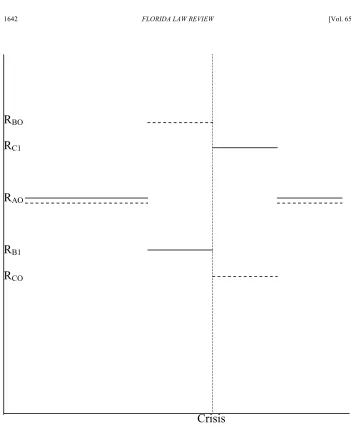
Figure 1 starts by showing the optimal level of regulation. We
assume there is some long-run optimal average level of regulation, RAO.
However, in a boom period preceding a crisis, the optimal level of regulation increases. To simplify, assume that increase is simply a
one-time temporary increase from RAO to RBO.98 Following a crisis, for a
time the optimal level dips below the long run optimum, to RCO. After a
while, the optimal level returns to RAO.
Now, let us see how each of the three models sees the actual level of regulation compared with the optimum. Start with Model 1, as depicted in Figure 2. Outside the boom and crisis period, the actual regulation level is at the optimal level, RAO. As noted above, this is the relatively optimistic side of Model 1 as compared with the other two models. However, during the boom period, the actual level of regulation drops to RB1 rather than rising to RBO, as it optimally should. Following the crisis, the postcrisis reaction causes the regulatory level to rise above the average level to RC1, rather than dropping to RCO as it should.
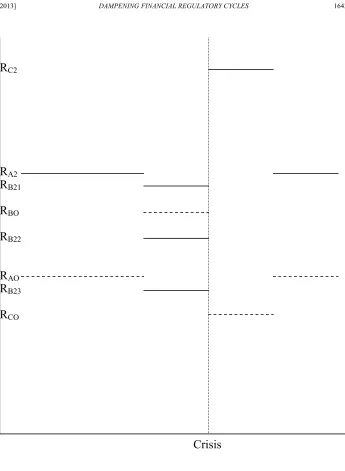
Models 2 and 3 are slightly more complicated. Figure 3 shows
Model 2. The long-run average level of regulation, RA2, is above the
optimal level RAO.99 As with Model 1, the boom level falls below RA2
and the crisis level rises above it, the opposite of the optimal pattern.
The level following the crisis, RC2, is much higher than the optimal
level RCO—the difference reflecting both the procyclicality of the actual regulation and also the overly high baseline level of regulation. The analysis gets more complicated in the boom period, though, and Figure 3 shows several possibilities. Although the strength of regulation drops when it should rise, since the starting point is too high, how one evaluates that drop depends upon how large the drop is and how big the gap between average actual and optimal level regulation is. If the level only drops a small amount, to RB21 > RBO, then the level remains higher than even the optimal level during a boom (which, you will recall, is elevated above the average optimum). At this point, one can simply wish regulation would fall even more. If, however, boom period regulation drops more to RB22, where RBO > RB22 > RAO, then at that point the level of regulation is weaker than the optimum for that period of time, though still above the long run optimal level. How one
98. One could of course assume the optimal level increases in several stages, or in a smoother upward curve. See infra Figures 5–11.
evaluates this case is thus a little trickier.100 Should the boom period regulation fall to RB23 < RAO, it has become, for this period of time, too weak even by the libertarian standards of Model 2; although if one sees these cyclical changes as affecting long-run average movements in regulation, a temporary period of overly weak regulation may still be beneficial in the long run.
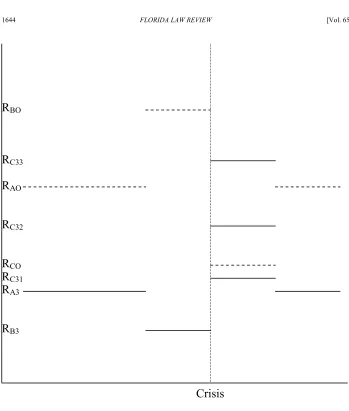
Model 3 is the mirror image of Model 2, as shown in Figure 4. The long run average level of regulation RA3 is below the optimal level RAO, reflecting the financial industry’s capture of the regulatory and political
processes. During the boom period, regulation weakens to RB3 rather
than strengthening, putting the level even further below the optimal
boom level of RBO both because of the procyclical movement and
because it is starting from a low baseline. As regulation increases following the crisis, several possibilities exist. The increase may be slight enough, as with RC31, that it remains below the optimal postcrisis
level RCO even though regulation has strengthened rather than
weakened, given the low baseline level. Or, the strength of regulation may rise more, so that RCO < RC32 < RAO, so that the strength is more than the optimal level following a crisis but still less than the long run
optimum. Finally, one could have RC33 > RAO, so that regulation
temporarily rises above the long-run optimal level.
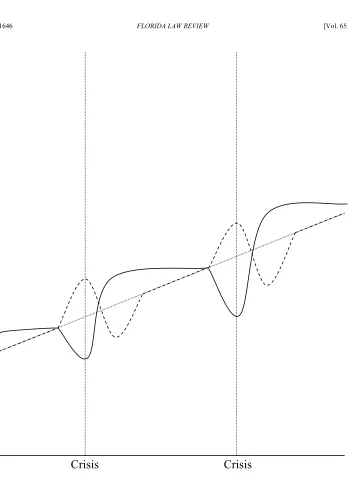
These simple graphs so far treat the long run average levels of regulation, both actual and optimal, as constant. This does not fully capture some of the dynamics underlying the models. That is particularly true for Models 2 and 3, but let us first consider Model 1. Figure 5 illustrates one plausible possibility. It assumes that there is a long run trend of increasing strength in regulation, perhaps reflecting greater complexity and interconnectedness of financial markets. The optimal path of regulation follows an upward sloping line, moving above the trend line at the height of the boom periods and dropping below the trend line after a crisis, then returning to the trend. The actual deviation from trend in Figure 5 is relatively modest—beyond the boom and bust, regulation follows the optimal trend line. It dips below the trend during the height of the boom, then rises and returns to the trend following a crisis.
Figure 6 illustrates a somewhat more episodic dynamic under Model 1. Actual regulation stays largely fixed between bust and boom periods. During the height of the boom, regulation weakens, falling below the optimal trend level. The postcrisis strengthening of regulation greatly increases the level, bringing it well above the optimal level. As the postcrisis stasis kicks in, the optimal level gradually comes to match the
100. It becomes trickier still when we allow the long-run average level to move over time, with the possibility that the cyclical variations help affect that long-run movement. See infra
actual level, then the actual level drops below the optimal again as the next speculative boom kicks in. As we shall see, this graph may well come closest to reflecting the core tendencies of American financial regulation. The actual level of regulation diverges from the optimal level most of the time—sometimes too high, sometimes too low. However, over time the level of regulation stays within shouting distance of the optimal level. There is a second-best story here. Increasing regulation during a crisis is not what happens in the first-best scenario. However, that regulatory burst is needed to put in place essential new rules. It may overshoot, and cause some problems during the crisis. However, the overshooting corrects itself over time, as the regulatory level flattens out and then falls during the boom period. That fall is itself an overcorrection, but some pruning of ill-conceived or dated rules is helpful. The second-best nature of this pattern reflects both political problems and inevitable imperfections of human learning.101
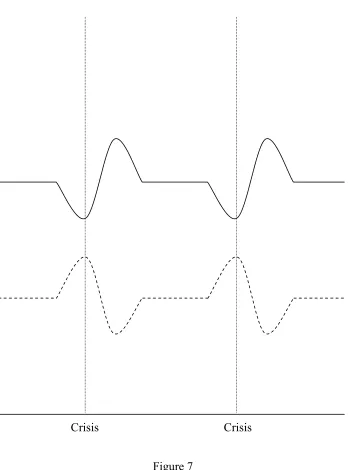
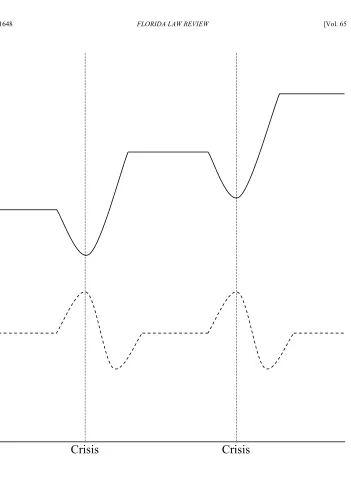
Figures 7 and 8 compare two different sorts of scenarios under Model 2. Both scenarios assume that the long-run optimal level of regulation is constant, with cyclical adjustments in the boom and bust
periods.102 In Figure 7, the actual level of regulation is above the
optimal level, but at least the gap does not widen over time. As drawn, the deregulatory move during the boom period is clearly a good thing— it brings the level of regulation closer to the optimum, helping to eliminate the excessively strong regulation that occurs following crises. Figure 8 sketches a more pessimistic scenario (pessimistic by the preferences of Model 2 proponents, with their skepticism about regulation). The boom period deregulation is weak and the postcrisis regulation is very strong, leading to an upward ratchet effect over time. The long-run average level of regulation increases over time, even though the optimal level does not.103
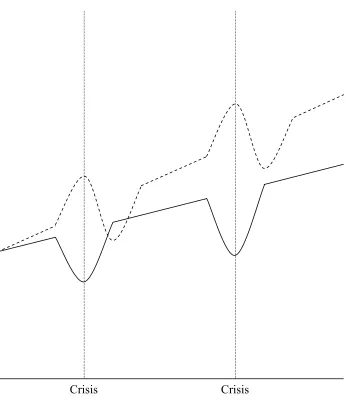
Figures 9 and 10 compare scenarios under Model 3. These scenarios assume, consistent with this model’s pro-regulatory tilt, that the optimal
level of regulation trends upward over time.104 In Figure 9, the actual
level of regulation also trends upward over time, but it lags below the optimal level. The postcrisis strengthening, even if not the optimal timing for increased regulation, helps counterbalance the excessive deregulation that occurs during booms. Figure 10 shows a more
101. See McDonnell, Don’t Panic!, supra note 12, at 20–29; McDonnell, Of Mises and Min(sky), supra note 12, at 1281.
102. It is of course also possible to have the long-run level of optimal regulation increasing or decreasing under Model 2, but the discussion in the text goes far enough to illustrate the key dynamics.
103. See Romano, supra note 75, at 87, 106.
pessimistic scenario. The actual level of regulation trends downward over time. Boom period deregulation brings regulation down, and the postcrisis strengthening is too weak to counterbalance that deregulation, perhaps reflecting a tendency for crisis regulation to look good to the uninformed while in fact allowing industry insiders to stop it from having much effect.105
E. Extensions and Summary
Even the more complicated graphs in Figures 5 through 10 do not do reality anything close to full justice. Consider two further complications. First, as graphed so far, the timing of crises is taken as fixed, being the same for both the optimal and actual paths of regulation. That is not correct. The timing of financial crises is in part endogenous to the path of regulation. Optimal regulatory levels and timing will probably lead to fewer (and more manageable) crises than suboptimal regulatory levels. The word “probably” is included because under Model 2 this may not actually be true—the overly high level of actual regulation may delay the onset of financial crises, but may do so at a cost to innovation and growth in the long run that is not worth paying. But at least under Models 1 and 3, one would expect to see more distantly spaced crises under the optimal regulatory path.
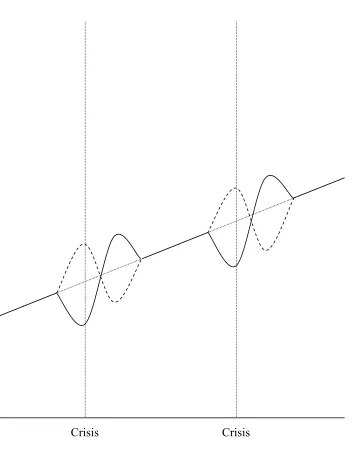
This Article will not inflict on the patient reader alternative versions of all of the below graphs to reflect this possibility. Instead, Figure 11 illustrates how Figure 6 (which may best reflect much reality) might differ once the timing of crises is treated as endogenous. Figure 6, recall, shows a version of Model 1 in which the optimal level of regulation trends up over time; the actual level does as well, but more episodically and procyclically. In Figure 11, the crises, shown by the vertical dashed lines, are now different for the optimal and actual regulatory paths (dashed for the optimal, solid for the actual). The first crisis occurs earlier on the actual path than on the optimal, and indeed in the time period graphed, there is only one crisis on the optimal path while there are two on the actual path.
The second complication this section notes, and tries (inadequately) to address, is that these graphs treat regulation as one-dimensional. That is of course a wild oversimplification; there are obviously many, many dimensions to financial regulation. In a big piece of legislation such as Dodd-Frank, changes may lead to strengthened regulation in some
dimensions and loosened regulation in other dimensions.106
Enforcement of a rule could further be represented as a separate dimension from the formal rule itself. The optimal level of regulation