PhD Dissertation
International Doctorate School in Information and Communication Technologies
DISI - University of Trento
Structural Mapping between
Natural Language Questions
and SQL Queries
Alessandra Giordani
Advisor:
Prof. Alessandro Moschitti
Universit`a degli Studi di Trento
Abstract
A core problem in data mining is to retrieve data in an easy and human friendly way. Automatically translating natural language questions into SQL queries would allow for the design of effective and useful database systems from a user viewpoint.
In this thesis, we approach such problem by carrying out a mapping be-tween natural language (NL) and SQL syntactic structures. The mapping is automatically derived by applying machine learning algorithms. In par-ticular, we generate a dataset of pairs of NL questions and SQL queries represented by means of their syntactic trees automatically derived by their respective syntactic parsers. Then, we train a classifier for detecting correct and incorrect pairs of questions and queries using kernel methods along with Support Vector Machines. Experimental results on two different datasets show that our approach is viable to select the correct SQL query for a given natural language questions in two target domains.
ker-are again represented as syntactic trees. The f-measure of our model on standard benchmarks is in line with the best models (85% on the first ques-tion), which use external and expensive hand-crafted resources such as the semantic interpretation. Moreover, we can provide a set of candidate an-swers with a Recall of the answer of about 92% and 96% on the first 2 and 5 candidates, respectively.
Keywords[Natural Language Interfaces, Database, Question Answering, Kernel Methods, Tree Kernels]
Acknowledgements
I would like to thank my advisor Prof. Alessandro Moschitti for the valuable perseverance and helpful patience shown over the years.
Special thanks go to Periklis Andritsos for providing the initial problem and discussing possible solutions at early stages.
Prof. Roberto Basili, Prof. Philipp Cimiano, Prof. Michael Minock and Prof. Martha Palmer for having demonstrated genuine interest in my research and for having devoted to it their time and long-standing experience accepting to be members of my Ph.D. defence board.
Bonaventura Coppola for having implicitly instigated me to take my time in writing this thesis, as long as I did finish it.
Rohit Kate, for his help in obtaining the GeoQueries and RestQueries datasets, and Ana Maria Popescu for providing us with the corresponding queries translated into SQL.
All the anonymous reviewers for having read my papers thoroughly and for having helped me improve them.
My family, for their constant support.
The most stubborn and proudest part of me, for having guided me into completing another important step of my life.
The work compiled in this thesis has been partially supported by the Euro-pean Community’s Seventh Framework Programme (FP7/2007-2013) un-der the grants #247758: EternalS – Trustworthy Eternal Systems via Evolving Software, Data and Knowledge, and #288024: LiMoSINe– Lin-guistically Motivated Semantic aggregation engiNes.
Contents
1 Introduction 1
2 Preliminaries 11
2.1 Natural Language Processing . . . 12
2.1.1 Stemming . . . 13
2.1.2 Parsing . . . 13
2.1.3 Stanford Dependency Parser . . . 14
2.2 Databases . . . 16
2.2.1 Relational Databases . . . 17
2.2.2 Metadata and Information Schema . . . 18
2.2.3 SQL queries and Relational Algebra . . . 20
2.2.4 SQL Parsing . . . 23
2.3 SVMs and Kernel Methods . . . 25
2.3.1 Tree Kernels . . . 26
2.3.2 Relational Kernels . . . 28
2.4 Motivating Example . . . 30
3 State of the art 35 3.1 Spoken Language Understanding . . . 36
3.2 Keyword Search . . . 37
3.3 Question Answering in NLI . . . 39
4.1 Generalizing Pairs . . . 51
4.2 Pair Clustering and Final Dataset Annotation . . . 54
4.2.1 The Clustering Algorithm . . . 56
4.3 Representing Pairs . . . 57
5 SQL Query Generation 59 5.1 Building Clauses Sets . . . 62
5.1.1 Motivating Examples . . . 63
5.1.2 Optimizing the Dependency List . . . 65
5.1.3 Stem Categorization . . . 66
5.1.4 SELECT Clauses . . . 70
5.1.5 WHERE Clauses . . . 73
5.1.6 FROM Clauses . . . 77
5.2 Composing Queries . . . 79
5.2.1 Clause Cartesian Product . . . 79
5.2.2 Pruning Useless Queries . . . 80
5.2.3 Weighing Scheme . . . 82
5.3 Reranking Model . . . 84
5.3.1 Preference Reranking . . . 84
5.3.2 Preference Kernel . . . 84
6 Experimental Evaluation on Classifying Mapping 87 6.1 Setup . . . 87
6.2 Results . . . 91
6.2.1 Evaluation on Geo dataset . . . 91
6.2.2 Evaluation on Rest dataset . . . 95
6.3 Related Work . . . 98
7 Experimental Evaluation on Reranking Mapping 103
7.1 Setup . . . 104
7.2 Generative Results . . . 106
7.3 Reranking Results . . . 107
7.4 Related Work . . . 110
8 Conclusions 115 8.1 Future Work . . . 117
Bibliography 121
List of Tables
3.1 State of the Art Systems’ Review. . . 47
5.1 Another example of a subordinate question that requires
nesting. . . 74
6.1 Number of pair generated starting from increasing
percent-age of the Geo880 corpus. . . 90 6.2 Kernel combination accuracies for Geo dataset . . . 92 6.3 Advanced kernel combination accuracies for Geo dataset . 94 6.4 Kernel combination accuracies for Rest dataset . . . 96 6.5 Advanced kernel combination accuracies for Rest dataset 97
7.1 Kernel combination recall (± Std. Dev) for Geo dataset . 108 7.2 Comparison between state of the art learning systems. . . 112
List of Figures
1.1 Propositional/relational pairs of trees and the relationships
between their nodes . . . 4
2.1 Syntactic tree of a NL question. . . 15 2.2 GeoQuery database fragment . . . 17
2.3 Conceptual Database Model diagram for the MySQL IS
database . . . 19
2.4 IS fragment a SQL DBMS containingGeoQuery and
Restau-rantQuery . . . 20 2.5 Modified MySQL Grammar . . . 24
2.6 Question/Query Syntactic trees . . . 28
2.7 Joint space STK+STK for the tree pair in Figure 2.6 . . . 28 2.8 Cartesian product STK×STK feature spaces for the tree
pair in Figure 2.6 . . . 29
2.9 Sample feature space of the cartesian product between
sync-tactic tree kernels. . . 33
4.1 Example of an initial dataset. . . 51 4.2 Example of the generalized dataset. . . 53
4.3 Discovering new positive examples inside the same cluster. 54 4.4 Discovering negative examples. . . 56
4.5 Clustering Algorithm . . . 57
4.6 Question/Query Syntactic trees . . . 58
5.2 Categorizing stems into projection and/or selection oriented
sets . . . 70 5.3 Clauses generative grammar for fields matching stems in Ξ 71 5.4 A subset of SELECT clauses for q1 . . . 72
5.5 Possible pairing between clauses for q2. Actually Π0 have
been merged with Π and Σ0 with Σ, optimizing by avoiding
nesting with equivalent joining. . . 82
6.1 Building the Geo dataset starting from GeoQueries . . 88 6.2 Learning curves for GeoQueries corpora . . . 95 6.3 Learning curves for RestQueries corpora . . . 98
7.1 Recall of the correct answer within different top k positions
of the system rank for Geo700 dataset . . . 107 7.2 Recall of the correct answer within different top k positions
of the system rank for Geo500 dataset . . . 109 7.3 Learning curve . . . 110
Chapter 1
Introduction
It would appear that we have reached the limits of what is possible to achieve with computer technology, although one should be careful with such statements, as they tend to
sound pretty silly in five years.
John von Neumann, 1949
The design of models for automatically mapping natural language se-mantics into programming languages has been always a major and inter-esting challenge in Computer Science since if effective they would have a direct impact on industrial and social worlds. For example, accessing a database requires machine-readable instructions that common users are not supposed to know. Ideally, they should only pose a question in natural language without knowing either the underlying database schema or any complex machine language.
The central issue in NLIDBs is understanding the user intent when he/she poses a question to a system, identifying concepts and relationships between constituents and resolving ambiguities. Systems that embed a relational database should perform a translation from a natural language question into an SQL query. Suppose that a user types the following natu-ral language question: N L1: “Which states border Texas?” The answer to
this question can be found in the Geoquery database, a collection of data regarding US geography developed by Tang and Mooney [2001]. With re-spect to that database, a translation of question NL1 into a SQL query could be the following SQL1:
SELECT border_info.border FROM border_info
WHERE border_info.state_name = ’Texas’;
This query is trivial enough to be understood even by a reader who does not have any knowledge about how the database has been constructed or how SQL are executed. However, without this knowledge it could be hardly written using the proper syntax and semantics.
This task becomes more difficult as soon as we ask more complex ques-tions that require nesting queries and merging sparse data joining more tables. A slightly different but more articulated question similar to N L1
is the following, N L2: “Which capitals are in states bordering Iowa?”. It
can be answered executing query SQL2: SELECT state.capital
FROM state
WHERE state.state_name IN
SELECT border_info.border FROM border_info
3
This is evaluated starting from the inner query (retrieving “states bor-dering Iowa”) and then projecting only the columncapitalof tablestate, such that the name of the state is in the retrieved set.
The same result could be obtained without nesting, joining the two tables as shown in query SQL02:
SELECT state.capital
FROM state JOIN border_info
ON state.state_name = border_info.state_name
WHERE border_info.border = ’Iowa’;
This is not surprising since there can be multiple SQL queries that correctly retrieve the same answer to a NL question, as well as a question could be rephrased in different ways (e.g. “Capitals of states that borders Iowa.”, “What are the capitals next to Iowa?”). Both natural and artificial languages can be very expressive and have complex structures and finding a mapping using a rule-based approach would be too demanding, requiring a lot of human intervention.
Instead, we rely on a machine learning algorithm to derive such map-ping exploiting structured kernels. The idea of using such approach arose looking at the similarity between syntactic tree structures of NL questions and SQL queries.
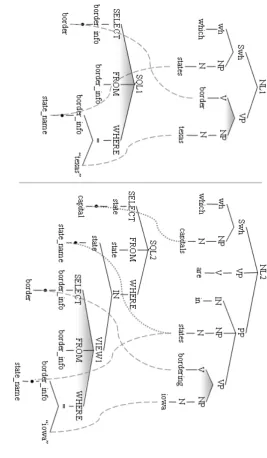
With respect to the previous examples, Figure 1.1 represents the NL questions with syntactic propositional parse trees and SQL queries with relational parse trees. It shows that N L2 shares some similarities with
N L1, which are reflected also by corresponding relational translated trees:
SQL2 embeds V IEW1, whose structure is identical to the one of SQL1.
Dashed lines and triangles reflect the similarities between the structure of SQL2 and the substructure V IEW1 of SQL1. Dotted lines indicate
Figure
1.1:
Prop
ositional/relational
pa
irs
of
trees
an
d
the
relationships
b
et
w
een
their
no
5
These parse trees can be derived from questions and queries using parsers as illustrated in Sections 2.1 and 2.2 respectively. Knowing this structure, the user would be able to straightforwardly substitute values of similar concepts (e.g. Texas VS Iowa) to create new SQL queries (see relational tree V IEW1 in Figure 1.1). Generalizing similar concepts1 can be easily
performed exploiting the SQL constituents of the query.
From this pilot example, it is clear why we approach the problem of question answering as a matching problem. The main idea is deriving a shared semantics between natural language and programming language by automatically learning a model based the syntactical representation of the training examples.
Given pairs of trees, we can compute if and to what extent they are re-lated using a tree kernel. The kernel represents tree-like structures in terms of their substructures and defines feature spaces by detecting common sub-structures. Exploiting Kernel Methods (Sections 2.3) we can operate in a Cartesian feature space without ever computing the coordinates of the data and relying on the cheaper and faster computation of the inner products between the images of all pairs of data in the feature space.
In Chapter 4 we illustrate how we can easily build a NLIDB implement-ing a machine learnimplement-ing algorithm to learn from an existimplement-ing trainimplement-ing set. First, starting from a set of correct pairs of questions and the related SQL queries, available for our target DBs, we need to produce incorrect pairs and additional correct pairs, i.e. negative and positive examples needed for training. This process requires that the pairs refer to general concepts in order to detect false negatives. We create clusters of pairs that represent the same information need and consider all pairing among the same clus-ters as positive examples and pairwise combinations between NL questions and SQL queries belonging to different clusters as negative examples.
1For exampleTexas andIowa are istances of the general concept
Second, we propose a structural representation of the question and query pairs in terms of syntactic structures. We construct pairs of parse trees where the first tree is automatically derived by off-the-shelf natural lan-guage parsers whereas in order to build the second tree we implemented an ad-hoc parser that follows SQL grammar rules.
Third, we train Support Vector Machines with the above data, where the structural representation of the pairs is encoded by means of different types of kernels. Besides relying on linear and polynomial kernels, that computes the similarity of similar words, we exploit the potential of tree kernels and their combinations to compute the number of syntactic tree fragments. This allows us to automatically exploit the associative patterns between NL and SQL syntax to detect correct and incorrect pairs from an operational semantics viewpoint.
Finally, given a new question and the set of available queries (i.e. the repository of queries asked to the target DB), we produce the set of pairs containing such question and then we use the classifier to rank pairs in terms of correctness. We select the top scored pair to find the query that answer the given question.
Experimental results with this approach on two different datasets,
7
In order to have a more useful and powerful approach, it should have been a generative one. It follows that, instead of learning a classifier, we have to generate plausible SQL queries and use a similar kernel-based re-ranker to select the one that best answers a given NL questions.
While in the first approach we needed at lot of positive pairings between NL questions and SQL queries to be given, in a generative approach we only need the answer (the result set or a SQL query that when executed retrieves it from the DB) for each NL question in the training set.
In Chapter 5 we illustrate how we can builds the sets of SELECT, FROM, WHERE clauses used to generate the set of possible SQL queries with respect to a given NL question based on its grammar dependencies. To prepare the reader to the core problem and proposed solution, we will first introduce the notion of typed dependencies and how to obtain a col-lapsed list of dependencies starting from an NL sentence. Then, we will describe the subset of Structured Query Language that our system can deal with and, in order to formalize the problem, we will recall the notation of corresponding operations in relational algebra. We also will introduce DB metadata, to show how executing SQL queries we can generate components of the final SQL query in a recursive fashion.
Combining all clauses in these three sets we obtain a huge set of SQL queries, possibly involving nesting and joining. However we also need to prune and weight queries from all possible combinations to generate an ordered set of meaningful queries among which we need find the answer.
Our results compare favourably with state of the art systems. As il-lustrated in Chapter 3, the problem of automatically translating natural language (NL) questions into SQL queries is an interesting and appealing research in many research fields, i.e. data mining, information retrieval, artificial intelligence, etc.
In the last decade a variety of approaches have been proposed to trans-late the human intent into machine-readable instructions [Dale R., 2000; Tang and Mooney, 2001; Popescu et al., 2003; Ge and Mooney, 2005; Zettle-moyer and Collins, 2005; Kate and Mooney, 2006; Wong and Mooney, 2006; Minock et al., 2008]. Despite this, little progress has been made in devel-oping a system that can be used by any untrained user without manual annotation and intervention.
A major challenge for mapping natural language to another language is recognizing syntactic variations of the same sentence meaning. For ex-ample, the question “Which states border Texas?” can be rephrased as “Texas is next to which state?”. Previous work approach this problem with manually annotation of all these variations into the grammar, but it is tedious and error-prone. While in a restricted domain it is fairly easy to specify a grammar, in larger real-world applications it is not feasible due to the complexity and the subjectivity of all possible annotations. For this reason the ultimate goal of question answering is developing unsupervised methods that do not rely on annotated corpora.
In this research, we demonstrate that it is possible to fill the lexical gap between natural language expressions and database structure by relying on (i) the informative metadata embedded in all real databases, (ii) natural language processing methods, e.g., syntactic parsing, grammar dependen-cies, and (iii) advanced machine learning to build kernel-based rerankers.
9
paired with NL questions in the dataset only to obtain the real answers. Indeed we are not committed to any specific representation or language in our generative approach.
Similar semi-supervised machine learning approaches have been recently proposed [Clarke et al., 2010; Liang et al., 2011] but our system performs comparably given that our lever of supervision is much lower then the one requested by those systems to achieve slightly higher results.
Chapter 2
Preliminaries
Natural language is what humans use for communication. It may be spo-ken, signed, or written but for our purposes we consider only written text. In the field of question answering this text is typically modelled as ques-tions or sentences paired with the corresponding answer. That answer may be again a natural language sentence, a machine readable instruction in an artificial language, some structured data like tables, images and graphs or raw values (e.g. numbers of the result set of a database query).
In this research we consider only questions whose answers can be found in a database. Indeed we deal with pairs in two different languages, the human one and the Structured Query Language. In fact, to retrieve the final answer we need to execute a SQL query over a database to retrieve a result set.
appear to be promising. Our solution indeed is based on robust machine learning algorithms, i.e. Support Vector Machines (SVMs), and effective approaches for structural representation, i.e. Sequence and Tree Kernels
This chapter introduces the reader to some basic knowledge in the fields of Natural Language, Databases and Kernel Methods while it gives a mo-tivating example to clarify the overall process.
2.1
Natural Language Processing
Natural language understanding has been often referred to as an AI-complete problem because it requires extensive knowledge over multiple domains and the ability to manipulate it.
As previously stated, we do not perform natural language understand-ing but we apply shallow semantics models. However the natural language processing (NLP) problem of automatically extracting meaningful informa-tion from natural language input in order to produce a meaningful output (e.g. the correct answer to a given question) is still demanding. The prob-lem is that natural language grammar is ambiguous and typical sentences have multiple possible interpretations. At the same time, the expressive-ness of a language allows to have many semantically equivalent sentences, i.e. syntactically different questions that have the same semantics.
Natural Language Processing 13
2.1.1 Stemming
Stemming is the process that reduces inflected and/or derived words to their root form. The obtained stem could not necessary be the word’s morphological root, for example the words city and cities are associated with the stem citi.
In our framework we use the off-the-shelf stemmer written by Martin Porter as its stemming algorithm is widely used and has become the de-facto standard for English. We slightly modified his released and official free-software implementation1 to accommodate the use of stems in order to better map those words whose stems ended with an -y. In these cases this letter just drops to allow the correct matching between, for example, city (that is now stemmed as cit) and citizens. This way we use stems to exploit conflation, a process also used by search engines to perform query broadening.
2.1.2 Parsing
The task of parsing deals with syntactically analyzing a string text to derive the grammatical structure that characterize it. The string of text should be first tokenized, using a lexical analyser to create tokens from the sequence of input characters. A grammatical analyzer then determines the relationship between the tokens (ie. words of the input string) and builds a data structure. The output of this process can be a parse tree (syntax tree) or other hierarchical structure.
In the following we introduce two kinds of off-the-shelf parsers that we embed in our framework to determine relationships betweenstems of input questions.
Charniak Parser
The aim of our research is to derive the shared shallow semantics within pairs by means of syntax. While early work on the use of syntax for text categorization used to be based on part-of-speech tags, e.g. Basili et al. [1999], the efficiency of modern syntactic parsers allows us to use the complete parse tree.
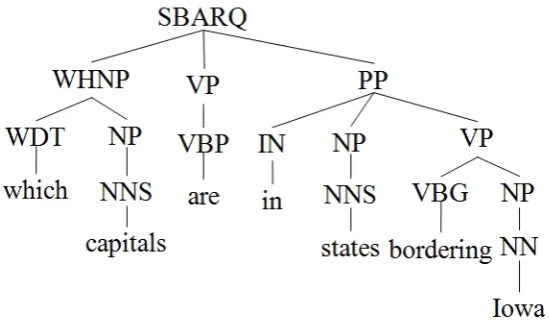
Thus we represent questions by means of their syntactic trees, obtained from the output of the open source2 Charniak’s syntactic parser [Charniak, 2000]. An example of such parse string for the sentence Which capitals are in states bordering Iowa? is the following.
(ROOT
(SBARQ
(WHNP (WDT which) (NNS capitals)) (VP (VBP are)
(PP (IN in)
(NP (NNS states)) (VP (VBG bordering) (NP (NN iowa)))))))
The corresponding visual representation of its parse tree is shown in Figure 2.1.
2.1.3 Stanford Dependency Parser
In addition to constituency parsing we exploit dependency parsing. While the first is used for representing questions by means of constituencies in a hierarchical way, the second one is useful to directly capture binary depen-dency relations holding between the words in a question.
Natural Language Processing 15
Figure 2.1: Syntactic tree of a NL question.
We use the Stanford Dependencies representation [Marie-Catherine de Marneffe and Manning, 2006] since it provides a simple and uniform de-scription of binary grammar relations between a governor and a depen-dent. As shown in the example below, each dependency is written as abbreviated relation name (governor, dependent). The governor and the dependent are words in the sentence associated with a number indicating the position of the word in the sentence.
In particular we refer to collapsed representation, where dependencies involving prepositions, conjuncts, as well as information about the referent of relative clauses are collapsed to get direct dependencies between content words.
For example, the Stanford Dependencies Collapsed (SDC) representa-tion for the quesrepresenta-tion, q1: “What are the capitals of the states that border
the most populated state?” is the following:
SDCq1 = attr(are-2, what-1), root(ROOT-0, are-2), det(capitals-4, the-3), nsubj(are-2, capitals-4), nsubj(border-9, states-7), rcmod(states-7,
border-9), det(states-13, the-10), advmod(populated-12, most-11),
The current representation contains approximately 53 grammatical re-lations but for our purposes we only use the following: adverbial and adjec-tival modifier, agent, complement, object, subject, relative clause modifier, prepositional modifier, and root.
For this reason, as we will see in depth in section 5.1.2, we’ll modify the list given as output from Stanford Parser removing useless relations (e.g. determinant, det(states-13, the-10) and reduce each governor and dependent to their stemmed form.
2.2
Databases
A database consists in a collection of data organized in possibly very large data structures.
It is worth noting that the term database does not apply directly to a database management system (DBMS). The combination of database (data collection and data structures) and the underlying DBMS is referred to as database system.
A large variety of database systems have been used and developed as soon as they started to be popular. In the past twenty years, relational sys-tems have shown to be the most dominant, while the most spread database language is the standard SQL for the Relational model.
Databases 17
2.2.1 Relational Databases
According to the relational model, data is organized into two-dimensional arrays called relations (database tables). Each relation has a heading and a set of tuples. The heading is an unordered possibly empty set of attributes (table’s columns). Each tuple is a set of unique attributes and values (table’s rows). Data across multiple tables is linked with a key, that is, the common attribute(s) between tables. The dominant language associated with the relational database is the Structured Query Language (SQL).
In this research we experiment with different relational databases, about:
• Geographic information regarding cities, rivers, mountains and lakes in US states and their surrounding states. It is called Geobase and is part of the GeoQuery corpus of R.Mooney and his group. This corpus is available in different sizes and languages.
• Restaurants information including names, addresses, ratings of Cali-fornian restaurants. This corpus has been also provided by Mooney’s group and is part of RestaurantQuery dataset.
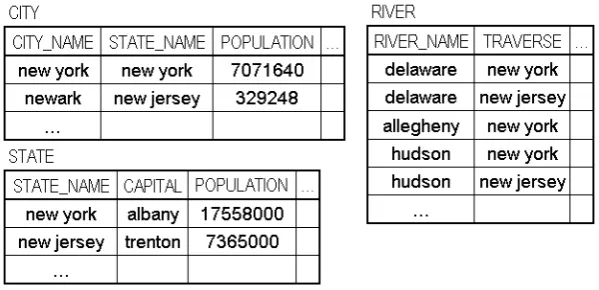
Figure 2.2 shows a fragment of the GeoQuery database. In particular this piece of information, distributed across the tables RIVER, STATE and
CITY embeds the intrinsic information that NEW YORK is a state name, its capital is ALBANY and its population is around 17 million people. However
NEW YORK appear to be also a city name in the homonymous state with a population of 7 million people. Last, NEW YORK shows up also on table RIVER under the fieldtraverse. Whether this information regards states or cities is clear to the reader but from the DBMS point of view this relation should be stored as metadata in a specific data structure: the database catalog (called Information Schema in SQL systems).
2.2.2 Metadata and Information Schema
The DBMS manage the database(s) that resides in it by means of a storage engine. It stores all the information about the data (metadata) into internal data structures.
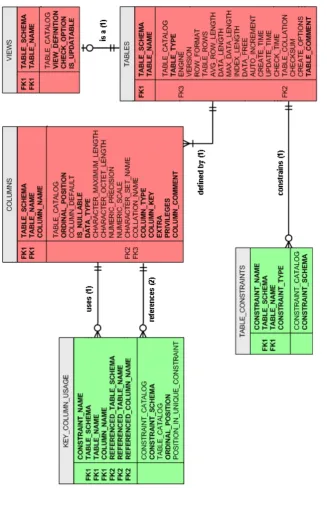
In a relational-database metadata is stored into tables. Some examples are shown in Figure 2.3 and are basically the following:
• A table containing all tables’ names for every database, along with
their size and number of rows.
• A table storing column names in each database, together with the
information about which tables and database they are used in and the type of data they store.
• A table that keeps track of referred tables and columns by means of external keys.
• A table used to maintain database constraints to ensure database integrity.
Databases 19
Figure
2.3:
Conceptual
Data
base
Mo
del
diagram
for
the
MySQL
IS
Figure 2.4: IS fragment a SQL DBMS containing GeoQuery and RestaurantQuery
To show an example of what kind of metadata is typically stored into IS, lets look at Figure 2.4. It contains table names and column names of the GeoQuery and RestaurantQuery databases, but as actual values, not as table or column names (see Figure 2.2 for a comparison).
With respect to the previous example (introduced discussing Figure 2.2), the fact that NEW YORK shows up in table RIVER under the field traverse can be used to disambiguate the term NEW YORKas being referred to a state name.
2.2.3 SQL queries and Relational Algebra
Databases 21
The basic components of statements and queries are called clauses. The SELECT components is the most important: it indicates which columns should be kept in the final result (an asterisk specify that all columns in the tables should be kept). Tables that contain this data are indicated in the FROM clause (it can include optional JOIN sub-clause to specify the rule for joining tables). The WHERE clause is optional, and consist of a comparison predicate. In order to restricts the rows in the final result set, it eliminates all rows from the result set for which the comparison predicate doesn’t hold. Other possible clauses, that we don’t take into account are GROUP BY, HAVING and ORDER BY.
Hence, the general SQL query that our system can deal with has the form:
SELECT COLU M N FROM T ABLE [WHERE CON DIT ION] (2.1) The query is interpreted starting from the relation in the FROM clause, selecting tuples that satisfy the condition indicated in the WHERE clause (optional) and then projecting the attribute in the SELECT clause.
In relational algebra, selection and projection are performed by σ and π operators respectively. The meaning of the SQL query above is the same as that of the relational expression:
πCOLU M N(σCON DIT ION(T ABLE)) (2.2)
We introduce this formalism to be more concise in all the definitions that follow in the remainder of the thesis.
field. In our QA task we expect that questions can be answered with a single result set (e.g. we can deal with “Cities in Texas” and “Populations in Texas” but not with the combined query “Cities and their population in Texas”). That is, even if in general COLU M N could be a - possibly empty - list of attributes, in our system it just contains one attribute. We can ap-ply to this attribute aggregation operators that summarize it by means of SUM, AVG, MIN, MAX and COUNT, always combined with DISTINCT keyword (e.g. SELECT COUNT(DISTINCT state.state name)).
Instead, CON DIT ION is a logical expression where basic conditions, in the form eL OPeR, with OP={<, >,LIKE,IN}, are combined with AND,
OR, NOT operators. While eL is always in the form table.column, eR
could be:
• numerical value (e.g. city.population > 15000) or
• string value (e.g. city.state name LIKE "Texas") or
• nested query (e.g. city.city name IN (SELECT state.capital FROM
state)
In other words, every expression can produce scalar values or tables consisting of columns and rows of data. The result of a nested query (called subquery) can be used in another query via a relational operator or aggregation function.
An example of a complex WHERE condition could be the following one, referring to “major non-capital cities excluding texas”:
WHERE city.population > 15000 AND (city.city_name NOT IN
Databases 23
The meaning of T ABLE is more straightforward, since it should just contain table name(s) to which the other two clauses refer. This clause could just be a single relation or a join operation, which combines records from two or more tables by using values common to each. We only deal with theta-joins where we take the Cartesian product of two relations and exclusively select only those tuples that satisfy a condition C.
The notation for theta-joins of relations R and S based on condition C is R./SC . We use the SQL keyword ON to keep this condition C separated
from the other WHERE conditions since it reflects a database requirement and shouldn’t match to anything of the NL question. (e.g. city JOIN
state ON city.city name = state.capital).
The complexity of generated queries is fairly high indeed, since we can deal with questions that require nesting, aggregation and negation in addi-tion to basic projecaddi-tion, selecaddi-tion and joining (e.g. “How many states have major non-capital cities excluding Texas”).
2.2.4 SQL Parsing
Since we aim at transforming NL trees into SQL trees, we need to represent also the SQL as a syntactic tree. To build the SQL tree we implemented an ad-hoc parser that follows the syntactic derivation of a query according to our grammar. Since our database system embeds a MySQL server, we use the production rules of MySQL, shown at the top of Figure 2.5, slightly modified to manage punctuation, i.e. rules 5*, 6* and 20* related to comma and dot, as shown at the bottom.
the database, category variables or operators. This allows for matching between the subtrees containing table, column or both also when they appear in different clause types of two queries.
It is worth noting that rule 20* still allows to parse nested queries and that the overall grammar, in general, is very expressive and power-ful enough to express complex SQL queries involving nesting, aggregation, conjunctions and disjunctions in the WHERE clause.
Note that, although we eliminated comma and dot from the original SQL grammar, it is still possible to obtain the original SQL query by just performing a preorder traversal of the tree.
To represent the above structures in a learning algorithm we use tree kernels described in the following section.
SVMs and Kernel Methods 25
2.3
SVMs and Kernel Methods
Kernel methods (KMs) define a class of learning algorithms used for pattern analysis typically associated with support vector machines (SVMs). The problem in pattern analysis is finding any kind of relations (e.g. rankings, correlations, classifications, etc.) in any types of digital data (e.g. text sequences, sets of points, vectors, trees, images, etc.).
KMs approach this problem by mapping the data into a high dimen-sional feature space, where each coordinate corresponds to one feature of the data items. This data is transformed into a set of points in a Euclidean space where a variety of methods can be used to find relations among them, and indeed, holding also in the original data.
KMs make extensively use of kernel functions, which are able to operate in the feature space without ever computing the coordinates of the data in that space, but just computing the inner products between the images of all pairs of data in the feature space. This operation is often computationally cheaper than the explicit computation of the coordinates.
The main idea is that the parameter model vector w~ generated by SVMs (or by other kernel-based machines) can be rewritten as
X
i=1..l
yiαi~xi (2.3)
where yi is equal to 1 for positive and -1 for negative examples, αi ∈ <
with αi ≥ 0, ∀i ∈ {1, .., l} ~xi are the training instances. Therefore we can
express the classification function as
Sgn(X
i=1..l
yiαi~xi ·~x+b) = Sgn(
X
i=1..l
yiαiφ(oi)·φ(o) +b) (2.4)
K(oi, o) =hφ(oi)·φ(o)i (2.5)
is the kernel function associated with the mapping φ.
Note that it is not necessary to apply the mappingφ, we can useK(oi, o)
directly. This allows, under the Mercer’s conditions [Shawe-Taylor and Cristianini, 2004], for defining abstract functions which generate implicit feature spaces. The latter allow for an easier feature extraction and the use of huge feature spaces (possibly infinite), where the scalar product (i.e. K(·,·)) is implicitly evaluated.
In the following section, we first propose a structural representation of the question and query pairs, then we report the two more adequate kernels for syntactic structure representation, i.e. the Syntactic Tree Kernel (STK) [Collins and Duffy, 2002], which computes the number of syntactic tree fragments and the Extended Syntactic Tree Kernel (STKe) [Zhang and
Lee, 2003b], which includes leaves in STK. In the last subsection we show how to engineer new kernels from them.
2.3.1 Tree Kernels
The main underlying idea of tree kernels is to compute the number of common substructures between two trees T1 and T2 without explicitly
con-sidering the whole fragment space. Let F = {f1, f2, . . . , f|F |} be the set of
tree fragments and χi(n) an indicator function equal to 1 if the target fi
is rooted at node n and equal to 0 otherwise. A tree kernel function over T1 and T2 is defined as
T K(T1, T2) =
X
n1∈NT1
X
n2∈NT2
∆(n1, n2) (2.6)
where NT1 and NT2 are the sets of nodes in T1 and T2, respectively, and ∆(n1, n2) =
P|F |
SVMs and Kernel Methods 27
common fragments rooted in nodes n1 and n2, and thus, depends on the
fragment type. We report its algorithm for the evaluation of the number of syntactic tree fragments (STFs).
Syntactic Tree Kernel (STK)
A syntactic tree fragment (STF) is a set of nodes and edges from the original tree which is still a tree and with the constraint that any node must have all or none of its children. This is equivalent to state that the production rules contained in the STF cannot be partial. To compute the number of common STFs rooted in n1 and n2, the STK uses the following
∆ function [Collins and Duffy, 2002]:
1. if the productions 3 at n1 and n2 are different then ∆(n1, n2) = 0;
2. if the productions at n1 and n2 are the same, and n1 and n2 have only
leaf children (i.e. they are pre-terminal symbols) then ∆(n1, n2) =λ;
3. if the productions at n1 and n2 are the same, and n1 and n2 are not
pre-terminals then ∆(n1, n2) = λ
Ql(n1)
j=1 (1 + ∆(cn1(j), cn2(j))),
where l(n1) is the number of children of n1, cn(j) is the j-th child of the
node n and λ is a decay factor penalizing larger structures.
Figure 2.7.a shows some STFs of the NL and SQL trees in Figure 2.6. STFs satisfy the constraint that grammatical rules cannot be broken. For example, in this figure, [VP [AUX NP]] is a STF, which has two non-terminal
symbols, AUX and NP, as leaves whereas [VP [AUX]] is not a STF.
3In a syntactic tree a node with its children correspond to the grammar production rule that generated
Figure 2.6: Question/Query Syntactic trees
Syntactic Tree Kernel Extension (STKe)
STK does not include individual nodes as features. As shown in Zhang and Lee [2003b] using its extension (STKe) we can include at least the leaves,
(which in constituency trees correspond to words) by simply inserting the following step 0 in the algorithm above [Zhang and Lee, 2003b]:
0. if n1 andn2 are leaf nodes and their labels are identical then ∆(n1, n2) =
λ;
2.3.2 Relational Kernels
Since our goal is finding common substructures shared by pairs of trees, as shown in Figure 2.6, we need to represent the members of a pair and their interdependencies. Then we can carry out kernel engineering by combining basic kernels with additive or multiplicative operators.
For this purpose, given two kernel functions, k1(., .) and k2(., .), and
two pairs, p1 = hn1,s1i and p2 = hn2,s2i, a first approximation is given by
SVMs and Kernel Methods 29
Figure 2.8: Cartesian product STK×STK feature spaces for the tree pair in Figure 2.6
summing the kernels applied to the components: K(p1, p2) = k1(n1, n2) +
k2(s1, s2). This kernel will produce the union of the feature spaces of
ques-tions and queries. For example, the explicit vector representation of the space of STK of the pair in Figure 2.6 is shown in Figure 2.7. The Syntactic Tree Fragments of the question will be in the same space of the Syntactic Tree Fragments of the query.
Product Kernel
In theory a more effective kernel is the product k(n1, n2) ×k(s1, s2) since
it generates pairs of fragments as features, where the overall space is the Cartesian product of the used kernel spaces. For example Figure 2.8 shows pairs of STF fragments, which are essential to capture the relational se-mantics between the syntactic tree subparts of the two languages. In par-ticular, the first fragment pair of the figure may suggest that a noun phrase composed by state expresses similar semantics of the syntactic construct
SELECT state name. Similarly the last fragment pair suggests that the verb phrase border VARstate semantically maps the syntactic construct
Polynomial Kernel
As additional feature and kernel engineering, we also exploit the ability of the polynomial kernel to add feature conjunctions. By simply applying the function (1 + K(p1, p2))d, we can generate conjunction up to d features.
Thus, we can obtain tree fragment conjunctions and conjunctions of pairs of tree fragments.
The next section will show the results using different kernel combina-tions for pair representation.
2.4
Motivating Example
In order to illustrate our goal and proposed ideas to the reader, we give a short example and briefly discuss the overall process.
When designing a database, domain experts are requested to organize entities and relationships naming tables and columns in a meaningful way (i.e. state name or capital instead of table 1 or table 2). Moreover we’ve shown that the database schema also specifies constraints and data types. IS can be inspected as a normal database, posing SQL queries to obtain useful fields to build a new SQL query. In practice, we can use the same technique and technology to generate an answer to a given question and retrieve the answer itself.
For example, an answer for the question “Which rivers run through states bordering New York” can be found in the GeoQueries corpus. This is associated with a spatial database whose structure is stored in IS as shown in Figure 2.4 (see page 20).
Motivating Example 31
the disambiguation of term run can be easily performed by looking at the less semantically distant metadata entry, i.e., traverse. This matching is furthermore confirmed when investigating on all possible interpretations of New York in this database (i.e. city name, state name, etc.), by the exist-ing reference between columntraverse in table river and columnstate name in table state.
However, matching both words New and York is not so easy since there is no evidence of relatedness between the two words in the metadata: this means that the whole database should be looked up for their stems. Words can be matched with lots of values (e.g., ”New York” both as city and as state name, but also with ”New Jersey”), as shown by Figure 2.2, but the key idea is to exploit related metadata information (i.e. primary and foreign keys, constraints, datatypes, etc.) to select the most plausible one. After some generative steps we might end with a set of possible SQL queries including the following ones:
SELECT river.river_name
FROM river JOIN border_info ON river.traverse = border_info.border WHERE border_info.state_name = ’New York’;
The above query correctly answers to “Which rivers run through states bordering New York”. However other similar mappings can be investigated:
SELECT river.river_name
FROM river JOIN city ON river.traverse = city.state_name
WHERE city.city_name = ’New York’;
SELECT river.river_name FROM river
WHERE river.traverse = ’New York’;
Its result, for a mere coincidence, is equivalent to the previous one, so still mismatching. While these last two queries are valid queries and share some common stems with the correct one, we note that the first one maximizes this similarity. For this reason we introduce a method to weight generated queries according to the common stems.
However we can’t just rely only on bag-of-stems to compute similarity. There can exist some special word or phrase in the NL question that maps to a whole SQL sub-structure.
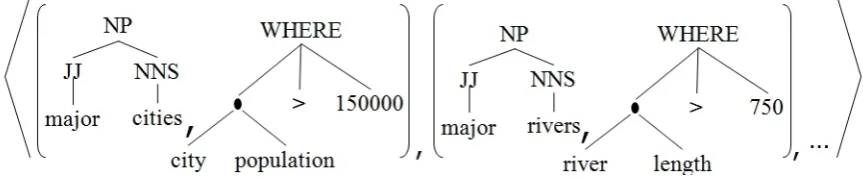
For example, the word major, referred to cities or rivers, have different implicit translation in SQL. Let us analyze the mapping between “Major cities in USA” and “Major rivers in US” and their associated queries. With respect to GeoQueries dataset, matching queries are the following ones:
SELECT city.city_name FROM city
WHERE city.population > 150000;
SELECT river.river_name FROM river
WHERE river.length > 750;
Motivating Example 33
In particular, exploiting the product kernel between their trees, we gen-erate a feature space that embeds pairing between substructures, e.g. the first fragment pair of the Figure 2.9 suggests that the noun phrase ma-jor cities expresses similar semantics of the syntactic construct WHERE city.population>150000. At the same time,major rivers is semantically similar to the syntactic constructWHERE river.length>750, with a simi-larity degree higher than the one with WHERE city.population>150000.
Chapter 3
State of the art
The numerous attempts to design models for automatically answering nat-ural language questions made in the past thirty years have shown that the task is much more difficult than was originally expected [Copestake and Sparck-Jones, 1990]. A huge variety of systems has been proposed, with increasing performances, but the task is still challenging.
While early systems were built to translate questions in Prolog language, in the last twenty years relational databases became very popular making Structured Query Language (SQL) the most widespread database language
1.
This translation usually takes place in three stages: a first step pro-duces a tree-like structure from the natural language input; a second one transforms the tree into an internal logical representation, which is finally translated into a statement in the target artificial language. The systems reviewed in this section can be classified into three categories: spoken lan-guage understanding, keyword-based searching and question answering in NLI (i.e. user interfaces that handle natural language sentence in text format).
1In this chapter we will give an overview of most recent systems; for a detailed review of systems
3.1
Spoken Language Understanding
In 1990, the Advanced Research Project Agency defined an application domain, called ATIS (Air Travel Information Service), for collaboration and comparison of the result in the area of speech language understanding. The following paragraph illustrates the techniques used by some spoken language systems that addressed this challenge, as discussed in Pallett et al. [1994].
Phoenix uses a bottom-up semantic parser to build trees from the sen-tences and then extract information into slots of frames. These frames, which describe semantic entities (e.g. flight, airport, time and other con-cepts), are then used to produce the corresponding SQL queries. Another system that uses this approach is SRI, which combines a syntactic parser with a template matcher. This matcher fills a set of semantic structures similar to frames using some domain keywords. Chronus, by AT&T, em-beds a conceptual statistical decoder that uses Hidden Markov Models to decode from an acoustic signal a list of concepts in order to build a bi-gram conceptual model. Also the BBN system represents concepts and sub-concepts with a tree structure, distinguishing between terminal and non terminal nodes to define a statistical model. The Chanel system uses instead a set of trees (called Semantic Classification Trees) to represent semantic rules. Such trees contain the list of all possible attributes of the SELECT statement and WHERE constraints.
Keyword Search 37
In 1993, an evaluation of these systems [Pallett et al., 1994] in the ATIS domain revealed that the ones performing better were Phoenix and BBN. The key feature of these approaches was the use of trees to represent the syntax of the sentences given in input and then identify semantic relations among leafs. However, this research program focused on handling continu-ous and spontanecontinu-ous speech recognition, rather than on natural language processing.
However, with the advent of the Web and search engines, people got used to express their information need in terms of keyword combinations in place of typing whole sentences. For this reason, the focus of natural language understanding shifted from speech recognition to keyword-based searching.
3.2
Keyword Search
In the past decade, question answering has been also addressed by keyword-based search. It retrieves requested information both from documents and from databases but with different techniques: while in the first case the keywords are to be searched on a unique source, in the second case the information is split across multiple tables due to normalization.
In order to understand to what extent our system differ from previous approaches, we will now review some state-of-the-art systems that perform keyword-based search only on top of relational databases.
This table is very useful to disambiguate terms, but although compres-sion methods to store the symbol table in the database are available, space and time requirements remain a critical factor. Anyway there is no need to maintain a symbol table if we can rely on the actual database and its underlying metadata.
The BANKS [Hulgeri et al., 2001] and ObjectRank [Balmin et al., 2004] systems apply ranking to keyword search over databases: results are ranked with respect to their relevance, computed using an approach similar to PageRank in BANKS while ObjectRank applies authority-based ranking. One beneficial feature of BANKS is that it also takes into account metadata while performing the search. Both these systems use graphs to model relational databases, where each node represents an object of the database. The ranked answer is a sub-graph where weighted nodes are ordered based on descending relevance. The same method is used in our approach to rank results in a way that reflects the correctness of the answers generated by the system with respect to the question, i.e. based on the number of matching substructures between the relational tree and the propositional tree.
Question Answering in NLI 39
3.3
Question Answering in NLI
The ultimate way to handle the problem and allow to query very large data is the implementation of natural language interfaces (NLI). In particular, natural language interfaces to database (NLIDBs) take natural language questions (whole sentences as well as keywords) and translate the user intent into machine-readable instructions to retrieve the answers.
One of the first attempts made towards this goal was made by Hen-drix [1977] with Lifer: A Natural Language Interface Facility. A parser contained within Lifer was able to translate sentences and requests into appropriate interactions with a database system. An interesting feature of
Lifer was that the language it could handle was defined in terms of pat-terns, which used semantic concepts in the domain of application. Lifer used a simplified augmented transition network to analyse thee input sen-tence. Each pattern defined by the grammar corresponded to a possible path in the transition network.
Lifer was used at SRI as the natural language component of a system called ”LADDER” for accessing multiple, distributed databases. In 1982, Hendrix left SRI to form Symantec and introduced its first commercial product, Q&A [Hendrix, 1986] that included an intelligent assistant to let users manipulate databases and produce reports by issuing commands or asking questions in English. Assuming a very simple database organization, English queries were translated into a hypothetical database query and then transformed into a series of actual database queries that took into account the actual organization of the database.
was guided by the syntactic structure of the query and was expressed as a logical formula. This formula was then transformed into the individ-ual queries of the database needed to answer the original question. The code of Chat-80 had widely circulated, giving the basis of several other experimental NLIs (e.g. MASQUE, i.e. Modular Answering System for Queries)
MASQUE/SQL[Androutsopoulos et al., 1993] is a modified version of the MASQUE system. It answers written English questions by generating SQL codes, while the original version generated Prolog queries. English questions are first transformed into expressions in a logical query language and then translated into SQL. The entity types of the world to which the database refers are organized in a hierarchical forest and the meaning of words is expressed as a logical predicate. As opposite to other inefficient approaches, where partial results are joined by the front-end, it uses DBMS specialized optimization techniques. It embeds a built-in domain editor that should be used by an expert to configure the system for new knowledge domains, to declare expected words and to define the meaning in terms of a logic predicate. Another disappointing aspect of this application is that if the SQL query fails, the system does not know which part of the query caused the failure.
The open-source natural language application SQ-HAL [Ruwanpura] needs to know the relationships between tables to create the SQL query. Besides having to manually enter these relationships, users are requested to suggest synonyms. An approach that requires user assistance defeats the original goal of building an NLIDB for na¨ıve users. Let us recall that, as far as we use relational databases, relationships between tables can be automatically derived.
EasyAsk2, also known as English Wizard, is a commercial
Question Answering in NLI 41
tion that offers both keyword and natural language search over relational databases. The system crawls the data to automatically construct a contex-tual dictionary used to identify words that correspond to values or catalog attributes and generate an SQL statement. It incorporates approximate word matching, stemming and synonyms.
EQ, which stands for English Query [R., 2004], is a NLIDB implemented by Microsoft Corporation, as a part of the SQL Server. It creates a model, collecting database objects (tables, fields, joins) and semantic objects (en-tities, additional dictionary entries, etc). However, it only extracts few basic relationships and, thus, requires refining the model manually.
ELF, English Language Front End 3, is another commercial system that generates a natural language processing system for a database. This interface works with Microsoft Access and Visual Basic. The parser builds the parse tree from the input, by swapping and substituting the words with the SQL keywords wanted in the final result. The basic model is built automatically, extracting most of the relationships from the database. A comparison between these two systems [R., 2004] illustrated the superiority of the ELF system over EQ. The reason is that EQ, like many other natural language systems except ELF, relies on context-free grammars.
A system that, instead, enables casual user to query XML database, without any knowledge of the underlying schema, is NaLIX [Li et al., 2005]. It allows to query XML databases relying on schema-free xQuery and asking the users to rephrase those questions not understood by the system, interacting with a feedback module. While no domain-specific knowledge is used, they provide ontology-based term expansion controlled by the user when term disambiguation is needed. The approach of map-ping grammatical proximity of tokens in the parsed tree into proximity of elements in the final xQuery statement is, to a certain extent, similar to
our technique.
Many multilingual interfaces have also been proposed and are typically more complex that those that deal only with English. For example the tourism NLIDB Tiscover [Dittenbach M. and Berger, 2003], takes as in-put both German and English and the language is automatically detected using an n-gram-based text classification approach. To compensate for or-thographic errors, a spell checker is used and word occurrence statistics from previous queries are taken. It uses language-dependent ontologies to identify relevant parts of the question and a domain-specific processing logic to define how these relevant parts are related to each other to build the appropriate database query. For each language they create a dictionary with concepts and synonyms, prepositions, adverbial and adjectival struc-tures, proper names (e.g. names of cities and states). This means that all domain-dependent words have to be stored for each language, increasing the size of the domain dictionary and, thus, decreasing the portability.
Edite [Filipe and Mamede, 2000] is another NLIDB that answers writ-ten Portuguese, French, English, and Spanish questions about tourism re-sources by transforming them into SQL queries. However this translation is inefficient, being based on several mapping tables which, as said before, are highly dependent on database organization, domain and language. Trans-lation is thus only possible in restricted domains with few proper names. The only beneficial feature of this system is the complete separation be-tween the linguistic component and the database knowledge, which leads to guaranteed portability.
Question Answering in NLI 43
question). It is domain independent, which means that the interface can be used with different databases, but this requirement complicates the task of achieving high translation success. Moreover the experimental evaluation of this system its not reliable, since when formulating their questions, the users were given the database schema and information contained in the database, while this is never the case when a NLIDB is used.
Authoring systems (e.g. CatchPhrase [Minock et al., 2008]) rely on semantic grammar specified by an expert user (i.e. the author) to interpret question over a database. The author has to name database elements, tailor entries and define additional concepts. Up to the 1980s, most NLP systems were based on complex sets of hand-written rules. Starting in the late 1980s, however, there was a revolution in NLP with the introduction of machine learning algorithms for language processing.
While previous work [Ge and Mooney, 2005; Zettlemoyer and Collins, 2005; Wong and Mooney, 2006] has explored how to learn a mapping from sentences to lambda-calculus meaning representations requiring supervi-sion such as manual labelling, the best performing state-of-the-art systems adopt instead machine learning approaches to induce a semantic grammar from data consisting of sentences paired with their meaning representa-tions.
For example, Krisp [Kate and Mooney, 2006] takes pairs of sentences and their computer-executable meaning representations as training input to find a mapping between sentences and Prolog assertions using an SVM classifier. For each production in the meaning representation language the model is built on top of SVM with string kernels. Then the classification is used to compositionally represent a natural language sentence in its mean-ing representation. While this approach performs well, it is constrained by learning a grammar that contains a fixed set of lexical items to model the meanings of input words and production rules to combine them in order to analyze the sentence meanings. In other words, it may fail to produce an answer to an unseen question since the grammar does not include the rules required to correctly parse it.
Question Answering in NLI 45
dependent knowledge and could be applicable to a wide range of different domains.
There exist other unsupervised semantic parsers, for example the USP system [Poon and Domingos, 2009], that tackle the problem of learning a semantic parser using Markov logic. The system transforms dependency trees into semi-logical forms, inducing lambda forms and clustering syntac-tic variations of the same meaning. However it is not able to handle deeper linguistic phenomena such as quantification, negation, and superlatives. Moreover the scope of this system is to perform question answering over text, while in this research we focus on question answering over databases.
Another system, called UBL [Kwiatkowski et al., 2010] induces a prob-abilistic CCG grammar to represent the meaning of individual words and define how to combine meanings in order to represent complete sentences. Starting from a restricted set of lexical items, using higher order unifica-tion along with the CCG combinatory rules they learn new lexical entries, defining the space of possible grammars in a language- and representation-independent manner.
Recent work focusing on compositional semantics [Liang et al., 2011] and semantic parsing [Clarke et al., 2010] avoid the need for annotation by considering the end-to-end problem of mapping questions to answers. In Liang et al. [2011] authors introduced a new semantic representation (DCS, dependency-based compositional semantics) to highlight the paral-lel between syntactical dependencies and evaluation of latent logical forms. They give semantically-scoped denotations to syntactically-scoped trees. In addition they extended the model with an augmented lexicon to handle prototype words.
relying on meaning representations and their annotation. The SemResp approach uses the syntactic information to build a semantic interpretation exploiting a binary classification problem to implement a feedback module. Additionally we used tree kernels. With respect to the other natural language tasks that employ tree kernels, in the literature [Collins and Duffy, 2002; Kudo and Matsumoto, 2003; Cumby and Roth, 2003; Culotta and Sorensen, 2004; Kudo et al., 2005; Toutanova et al., 2004; Kazama and Torisawa, 2005; Shen et al., 2003; Zhang et al., 2006; Zhang and Lee, 2003a], several models have been proposed and experimented.
The following table summarizes the features of the above mentioned question answering systems, highlighting the advantages and disadvantages of such approaches. A system is domain independent (Dom. I.) if it does not need to be re-configured when the domain changes while it is database independent (DB I.)if modifying the database it is not necessary to re-implement anything. Similarly, language independence (Lan.I.) reflects the ability of a system to answer questions of any language without having to implement different frameworks.
Chapter 4
Dataset Generation
The previous chapter introduced the reader to some basic knowledge in Natural Language, Databases and Machine Learning. Despite these three fields are separate worlds and have their own community, in the last fifteen years a lot of progress has been made in cross-disciplinary fields.
Nowadays, many successful interdisciplinary applications use NLP in Database and Information Systems (NLDB), Machine Learning (ECML) and Principles and Practice of Knowledge Discovery in Databases (PKDD) communities.
However, the idea of integrating databases, natural language and ma-chine learning in a unique framework is rather novel and there is a lack of ready-to-use corpora. Since our goal was the development of a new method to map NL questions into SQL queries based on a machine learn-ing approach, we needed trainlearn-ing data, i.e. a set of positive and negative examples, to learn our classification function.
query retrieves a correct answer for the question. Assuming the availabil-ity of negative examples is a more strong assumption since providing the correct query for an user information need is a more natural task than pro-viding the incorrect solution. Therefore, to create negative examples, we had to use the initial set of questions and queries in the correct pairs and randomly pair them. Unfortunately, this can generate false negatives since different questions may have more than one answer (and vice-versa), thus a manual verification of such pairs is required. To reduce such costly man-ual intervention, we exploited the semantic equivalence between the pairs’ members and its transitivity closure. This allowed us to extend the set of positive examples to all possible correct pairings, and label all remaining pairings as negative examples.
In the next sections, we describe our approach to automatically generate a gold standard dataset. The main steps are:
• Generalizing concept instances: substitute the involved concepts in
questions and their related field values in the SQL queries, e.g. WHERE condition, by means of variables expressing the category of such val-ues (e.g. What are the major cities in Texas becomes What are the major cities in VARstate).
• Clustering generalized pairs: each cluster represents the information need about a target semantic concept, e.g. “major cities in VarSTATE”, common to questions and queries. The clustering can be performed semi-automatically exploiting the semantic equivalence between the pairs’ members and its transitivity closure (requires a limited human supervision for validation).
• Pairing questions and queries of distinct clusters, i.e. the Cartesian
Generalizing Pairs 51
Figure 4.1: Example of an initial dataset.
• Final dataset annotation: consider all possible pairs, i.e. Cartesian
product between all the questions and queries of the dataset, and an-notate them as negatives if they have not been anan-notated as positives in the previous steps.
4.1
Generalizing Pairs
Therefore, we need techniques to generate negative examples from an initial set of correct pairs. Unfortunately, this is not a trivial task since when mixing a question and a query belonging to different pairs we cannot assume to only generate incorrect pairs, e.g. when swapping two different queries x with y in the two pairs:
hWhich states border Texas?, xi
hWhat are the states bordering Texas?, yi
we obtain other two correct pairs. Queries x with y could be two syntacti-cally different SQL queries that retrieve the same result set and be, indeed, semantically equivalent.
The aim of pair generalization is to make the detection of semantically equivalent questions and queries easy. Our approach consists in consider-ing questions or queries havconsider-ing similar structures instantiated by the same semantic concepts. The latter are generalizations of important domain terms occurring both in the question and in the related query. For exam-ple, terms like Texas, Iowa, Ohio, etc., are substituted with the concept VARstate while instances like Austin or Los Angeles etc., are substituted with the concept VARcity.
Note that: (a) concepts correspond to column names (in the database) that naturally stores domain terms; and (b) concepts are expressed in the WHERE condition of the given SQL queries. We identify concepts exploiting the latter fact since it is less time consuming that the first that would require to manage large keyword tables.
Generalizing Pairs 53
Figure 4.2: Example of the generalized dataset.
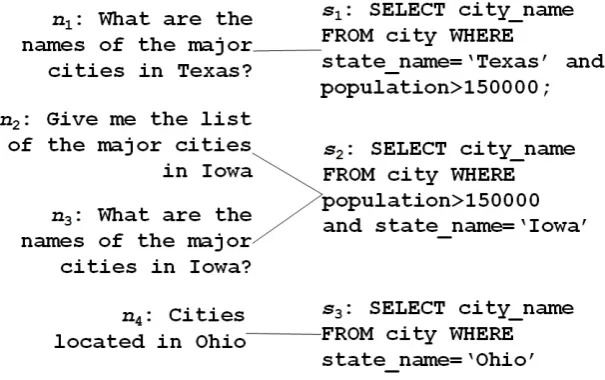
Typically these values are natural language terms so we substitute them with variables if they appear in both questions and queries. For exam-ple, consider s1 in Figure 4.1. The condition is WHERE state name = ’Texas’ and ’Texas’ is the value of the concept state name. Since ’Texas’ is also present in the related question we can substitute it with a variable VARstate (one variable for each different concept). Our assumption is that questions whose answer can be retrieved in a database tend to use the same terms stored in the database.
We apply the same rule to all given pairs of questions and queries of the initial dataset, and obtain a new generalized version. An example of a generalized dataset is shown in Figure 4.2. The initial pairs, consisting in a set of four pairs containing four distinct questions and three related queries (connected by the lines) whereas on the right four generalized pairs are shown in Figure 4.1. We note that, after substituting instances with variables, both n1 and n3 are generalized into n01, which is thus paired with
Figure 4.3: Discovering new positive examples inside the same cluster.
s01 ≡ s02. At the same time it is possible to write many NL questions that map to the same query.
It is worth noting that with the generalization process, we introduce re-dundancy that we eliminate by removing duplicated questions and queries. Thus, the output dataset is usually smaller than the initial one. However the number of training examples will be larger, not only because of the introduction of negatives but also due to the automatic discovering of new positives.
4.2
Pair Clustering and Final Dataset Annotation
Pair Clustering and Final Dataset Annotation 55
test their equivalence by simply executing the