Faculty of Mechanical Engineering, Department of Automation and Production Systems, University of Žilina, Univerzitná 1, 010 26 Žilina, Slovak Republic, e-mail: [email protected], nadezda.cubonova@ fstroj.uniza.sk, [email protected]
ABSTRACT
The article deals with the application of workshop programing system - Sinumerik Operate 840D SL in technological preparation of production. Application of the sys-tem in real situation pointed out on several problems and disadvantages of the syssys-tem.
The article contains a comparison of the effectiveness between workshop program -ming, ISO program-ming, and CAM system programming. Sinumerik Operate was used as a control system at a milling machine EMCO Concept Mill 105.
Keywords: Sinumerik Operate 840D SL, workshop programing, EMCO machine tool.
INTRODUCTION
At present, three types of programming meth-ods are used to develop NC programs, ISO pro-gramming, workshop programming and CAM programming. All these types impose require-ments for operators at a machine or programmers in the CAM system. Writing a program manually requires a good knowledge of the ISO code. For complicated shapes CAM system can be used, but the programmer must know how to work with a chosen system. Workshop programing allows to create NC programs for complex but simple components. Workshop programing is also called “conversational programming” [1–4].
After a purchase of Sinumerik Operate 840D SL control system applying this system for ma-chine tool EMCO Concept Mill 105 was neces-sary. This machine tool is used for teaching in Laboratory of Machine Tools Programming De-partment of Automation and Production Systems (DAPS). The article deals with the application of workshop programming in manufacturing pro-cess. The solution includes verification of the control system Sinumerik Operate 840D SL for the production of components through experi-mental components. Part of verification is also a
comparison of the effectiveness of the use of this method for creation of NC programs [5–8].
DESCRIPTION OF EQUIQMENT MACHINE
TOOL
Machine EMCO Concept MILL 105 (Fig. 1A) is a training machine designed to teach pro-gramming and operation of CNC machines. The tool change is done by a tool turret equipped with 10 stations. The work area allows to use a work piece with dimensions in X-axis 200 mm, in Y-axis 150 mm, effective height of Z Y-axis is 150 mm. The machine tool can be controlled by sev-eral control systems, e.g. Sinumerik 810D/840D, Heidenhain TNC 426/430, Sinumerik Operate 840D SL and others. WinNC serves like host for emulation control systems and allows to install up to nine control system. All systems are controlled with interchangeable control panels (Fig. 1B) and control keyboards [8–11].
INTERCHANGEABLE CONTROL PANEL
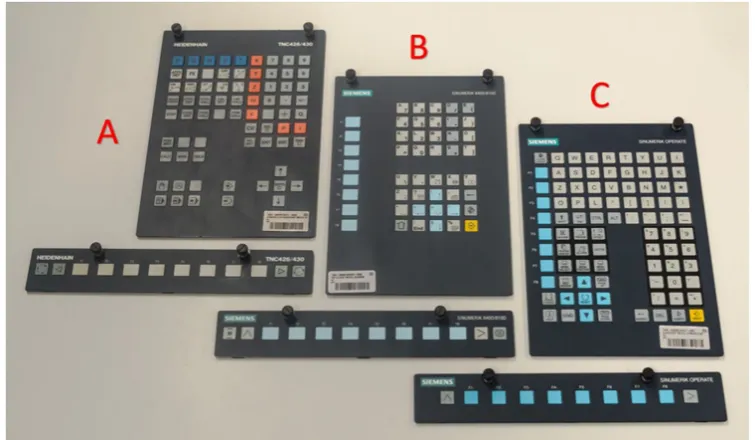
Interchangeable control panel (Fig. 1B) al-lows user to change the control keyboardsing to the selected control system. Change can be made quickly and it takes only a few seconds. In-terchangeable panel can be connected to any Con-cept machine or PC. In Figure 2 all control key-board owned by Department of Automation and Production Systems are shown, A – Heidenhain TNC 426/430, B – Sinumerik 840D, C – Sinumer-ik Operate 840D SL. Each keyboard has specific layout and keys with specific functions.
WORKSHOP PROGRAMMING
Workshop programming allows users to eas-ily program complex components, even without
knowledge of ISO codes. This type of program-ming is encountered mainly for lathes and milling machines. It is most suitable for a wide range of components with simple shapes in pieces or small series production.
Basic features and characteristics workshop programming can be separate into several groups:
• Efficiency and intuitiveness – dialogue be -tween operator and system,
• User friendly interface – inputs fields includ -ing animated elements,
• Simulation of the machining process – simu-lation of the machining process, toolpath and collision between tool and work piece.
Fig. 1. EMCO Concept Mill 105 and interchangeable control panel
APPLICATION AND VERIFICATION
OF WORKSHOP PROGRAMMING
AT EXPERIMENTAL MILLED PART
PRODUCTION
For verification of Sinumerik Operate 840D SL was used a group of components with similar shapes. From this group were selected three com-ponents for further experimentation - component no. 1, 2, 3. The experimental components were designed to verify the accuracy and effectiveness of using different cycles in their production. The main purpose of verification was to verify func -tionality of the available cycles.
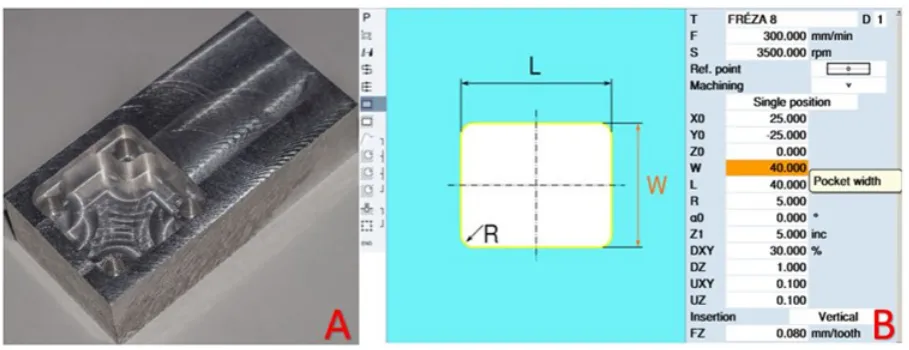
The first component (Fig. 3A) represents a group of components which use more machin-ing cycles, e.g. the cycles for machinmachin-ing spigots, pockets and drilling holes. Geometric properties of pockets are entered inside of the cycles. There is no need to define a contour of pockets. In Fig
-ure 3B is shown the NC program with all cycles. The second type of component (Fig. 4A) includes machining cycle for pocket and drilling. Manu-facturing process was created in order to verify the functionality of both cycles. In Figure 4B is shown machining cycles for pockets with defining dimensions of pocket. The third type of compo-nent (Fig. 5A) contains different cycle for machin -ing pocket. This cycle requires the definition of contour and it was verified in the production of circular spigots. In Figure 5A is shown in NC pro-gram with defined contour for milling of spigots.
All experimental components contain cycles for drilling holes. Patterns of holes are different e.g. on first component a circular pattern was used, On second and third components square and rectangular patterns were used. The experi-mental components were created by using work-shop programming Sinumerik Operate 840D SL. They were further used to compare the efficiency Fig. 3. First component and NC program in Sinumerik Operate 840D
between ISO programing and CAM programing (Chapter Comparison of efficincy between types of programming).
COMPARISON OF EFFICINCY BETWEEN
TYPES OF PROGRAMMING
Four systems were chosen for a comparison of the effectiveness of creation of NC programs. Spe -cifically, Sinumerik 840D and Sinumerik Operate 840D SL, which are part of the training interface WinNC from EMCO Group and two CAD/CAM systems Edgecam 2013 and PTC Creo 2 (Both CAD/CAM systems are used on DAPS).
It is necessary to consider a few facts at com-parison between systems:
• appropriateness of the system – shape com-plexity of components,
• knowledge and skills of the operator or pro-grammer,
• limits of the system – it can influence the func -tionality of the final NC program
• step of generating NC program (within the CAD/CAM – model, design, code generation optimization program).
Based on these facts, two comparative methods were selected:
• The time required for preparation of the NC program.
• The number of steps needed to create the NC program.
The time required for preparation of the NC program
The comparison was made in the two groups. In first group ISO programing and workshop programing were compared, so workshop
pro-graming can be used as a replacement for ISO programing.
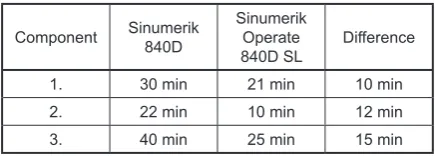
From table (Table 1) and graph (Fig. 6), it can be seen that the system of workshop pro-gramming needs less time for NC program preparation. From the perspective of the knowl-edge of the ISO code Sinumerik Operate 840D SL is less demanding for an operator than Sinu-merik 840D. Second comparison is a compari-son between workshop programing and CAD/ CAM systems.
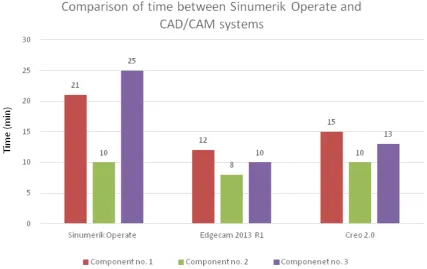
In Figure 7 it can be seen that CAD/CAM sys-tem Edgecam allows a programmer to create NC program faster, but it requires greater demands on the knowledge and experience of programmer.
The number of steps needed to create the NC program
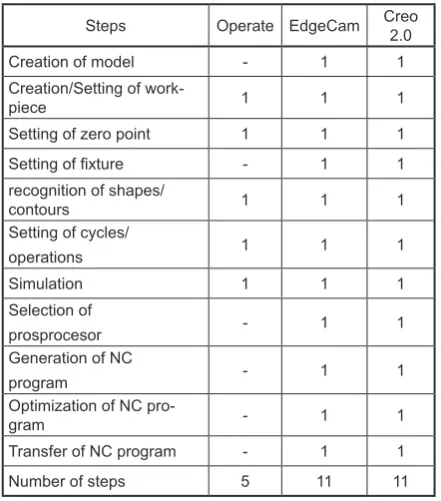
This comparison compares the number of steps required to create NC program. (Initial state – draft of the parts). Comparison contains of the workshop programming and CAD/CAM systems Edgecam 2013 and Creo 2.0. Principle of creat-ing NC program, for all programmcreat-ing methods, is consisted of the same steps as: setting the zero point, face milling, drilling holes, roughing and finishing operations.
A comparison between workshop program-ming and CAD/CAM systems (Fig. 7 and Tab. 2)
Table 1. Time for preparation NC programs in Sinu-merik Operate and SinuSinu-merik 840D
Component Sinumerik 840D Sinumerik Operate
840D SL Difference
1. 30 min 21 min 10 min
2. 22 min 10 min 12 min
illustrates the difference in the preparation of the NC program with regard to the degree of chosen systems but it disregarded shape-complexity of components. It is also needed to take into con-sideration the level difficulty of working with CAD/CAM systems. Although work in CAD/ CAM systems Creo 2.0 and Edgecam required less time (Fig. 7) for preparing the NC program, these systems increase the demands on the pro-grammer, compared to the workshop program-ming Sinumerik Operate 840D SL, which can use the operator of the machine tool.
Fig. 6. Comparison between ISO programming and workshop programming on three experimental components
CONCLUSIONS
The results include verification of the control system Sinumerik Operate 840D SL for the pro-duction of components. During creation of NC programs by using workshop programing Sinu-merik Operate 840D SL some drawbacks have been found. These drawbacks have influence the development of NC programs and they must be considered in the course of work with system.
number of available cycles compared Sinumerik Operate 4.5 by Siemens AG. After consultation with the distributor of the EMCO machines it has been found that the current version of Sinumerik Operate 840D SL does not support same cycles. The limited number of cycles available may have an impact on the preparatory times mentioned in chapter Comparison of efficincy between types of programming. These drawbacks can be elimi-nated with additional system updates.
After verification of workshop programing Sinumerik Operate 840D SL during producing of experimental components, were defined the cur -rent system capabilities. Also they were specified current limits of system for further experimental research thesis and projects. The comparison be-tween different types of programming and systems shows the differences in creation of NC programs. The comparison of results points to a principle and possibilities of this type of programming.
Acknowledgement
This article was made under support projects KEGA 037ŽU-4/2014 – The Development of Complex Interactive Educational Portal for Sup-port the Teaching of CNC Production Machines Programming.
2012, 115.
4. Litvaj, I.; Stančeková, D.: Knowledge manage -ment embed-ment in company, knowledge
reposi-tories, knowledge management significance and
usage in company. In decision – making. Procedia Economics and Finance, 2015.
5. Legutko, S.: Materials for Cutting Tools. In. De-velopment of Mechanical Engineering as a Tool for the Enterprise Logistics progress, published by Poznan University of Technology, Poznan 2006, 33–49.
6. Rudawska, A.: Selected aspects of the construction adhesive connections homogeneous and hybrid. (Wybrane zagadnenia konstruowania polaczen nadhezyjnych jednorodnych i hybrydowych – in Polish), Politechnika Lubelska, 2013, 26–6, 181. 7. Stuchlý, V.; Poprocký, R.: Údržba strojov a zari
-adení, 1. vyd. Žilina: Žilinská univerzita, 2013.
359.
8. Čuboňová, N.; Náprstková, N. NC Verification,
Machine Simulation and NC Optimization in CAM Systems. In: 1st edition Advanced Methods and
Trends in Production Engineering. Scientific Bul -letin, Serie C, Volume XVIII, 5th edition The Inter-national Meeting of the Carpathian Region
special-ists in the field of Gears, Baia Mare, Romania, May
21-22, 2004, 57–62.
9. Kapustová, M.; Görögová, I.: Application of com-puter simulation for optimization of technological
parameters of precision forging. Tehnički Vjesnik
- Technical Gazette 2016, 23, 2, 357–361.
10. Rengevič, A.; Kumičakova, D.: New possibilities
of robot arm motion simulation. Communications:
scientific letters of the University of Žilina. 2016,
18, 1A, 81–86.
11. Kumicakova, D.; Jakubcik, M.: Specialised robot-ic hand designing and object grasping simulation. Applied Mechanics and Materials, vol. 282/2013, 90–98.
Selection of
prosprocesor - 1 1
Generation of NC
program - 1 1
Optimization of NC
pro-gram - 1 1
Transfer of NC program - 1 1