PROFESSIONAL LEARNING COMMUNITIES AND TEACHER SELF-EFFICACY
by Tim Porter
Dissertation Committee: Gary Tiffin Ph.D. Chair
Scot Headley Ph.D. Committee Member Gary Kilburg Ph.D. Committee Member
Presented to the Education and Leadership Foundations Department George Fox University
In partial fulfillment of the requirement for the degree of Doctor of Educational Leadership
ii ABSTRACT
PROFESSIONAL LEARNING COMMUNITIES AND TEACHER SELF EFFICACY The purpose of this research is to see if there is a correlation between the implementation of professional learning communities and teacher self-efficacy. This quantitative study involved 86 certified staff members from a low SES school district in the Willamette Valley of Oregon. Survey data was analyzed from two different surveys, the Professional Learning Communities Survey – Revised (PLCA-R) and the Teacher Sense of Efficacy Scales (TSES). Participants were asked an open-ended question: “Has the implementation of professional learning communities changed the teachers’ beliefs about teaching and learning?”
The findings from this study revealed a significant relationship between six of the
eighteen components of professional learning communities and teacher self-efficacy. The six components from greatest correlation to least were shared personal practice to efficacy in student engagement, supportive conditions – relationships to efficacy in student engagement, shared and supportive leadership to efficacy in student engagement, shared personal practice to efficacy in instructional strategies, shared and supportive leadership to efficacy in
iii
DEDICATION
This work is dedicated to my beloved wife and best friend, Traci, and to my three
iv
ACKNOWLEDGEMENTS
I would like to thank the staff in the Sweet Home School District for allowing me to work with a wonderful group of dedicated people who are always willing to go above and beyond in their pursuit of educating our students. I would especially like to thank Dr. Larry Horton for encouraging me during those times when it seemed like there was no end in sight. Thank you also to Keith Winslow who has been a great colleague and friend and allowed me to vent whenever I needed to. I can only hope that you know how much the times we have spent together have meant to me.
Thank you to Dr. Gary Tiffin, Dr. Gary Kilburg, and Dr. Scot Headley for being a great committee to work with. Your support and advice were invaluable and appreciated.
To my parents, Joyce Kraling and Charles Porter, thank you for always supporting and believing in me.
To my wife’s parents, Jan and Larry Sharp, you have been so much more than in-laws to me and I will never be able to express my gratitude for everything you have done for me.
v
Table of Contents
ABSTRACT ... ii
DEDICATION ... iii
ACKNOWLEDGEMENTS... iv
Chapter One ...1
Definition of the Problem ...4
Research Questions ...5
Key Terms ...6
Limitations and Delimitations ...8
Chapter Two ...9
Professional Development for Teachers ...9
Professional Learning Communities ... 12
Teacher Efficacy and Student Achievement ... 16
Chapter Three ... 19
Setting ... 19
Participants ... 20
Human Subjects Safeguarding ... 21
Research Design ... 21
Instrumentation/Materials ... 21
Data Analysis and Coding ... 23
Role of the Researcher ... 24
Potential Contributions of the Research ... 24
Chapter Four ... 25
Research Questions ... 25
Descriptive Statistics ... 25
Results for research question 1. ... 26
Results for research question 2. ... 28
Results for research question 3. ... 31
Summary ... 33
vi
Analysis of the Findings ... 35
Research question 1: What is teachers’ perception of how well professional learning communities have been implemented? ... 35
Research question 2: What is the relationship between participation in PLC’s and a teachers’ sense of efficacy? ... 37
Research question 3: Has the implementation of professional learning communities changed the teachers’ beliefs about teaching and learning? ... 40
Implications and Recommendations for Future Research ... 42
Conclusions ... 44
References ... 46
Appendices ... 53
Appendix A: Exempt Consent Form ... 54
Appendix B: Permission to Use PLCA-R ... 55
Appendix C: Professional Learning Communities Assessment-Revised ... 57
Appendix D: Permission to use Teachers’ Sense of Efficacy Scale ... 61
Appendix E: Teachers Sense of Efficacy Scale ... 62
1 Chapter One Introduction
We have entered a time in education in the United States in which our educators and the students in our educational system have had unprecedented expectations placed on them. As Dufour and Marzano state,
Contemporary American educators confront the most daunting challenge in the history of public schooling in the United States: they are called upon to raise academic standards to the highest level in history with common core standards that are so rigorous and include such challenging cognitive demands that they align with the highest international benchmarks (DuFour & Marzano, Leaders of Learning, 2011, p. 5).
Having standards that align with the highest international benchmarks is an admirable goal; however, all students are being asked to achieve these benchmarks. This is no small change since historically our most gifted students have been the ones asked to achieve these highest of standards. “In fact, the prevalent assumption that has driven public education throughout the history of the United States is that few students are capable of high levels of learning” (DuFour, DuFour, Eaker, & Karhanek, 2010, p. 13). In addition, this call for increased rigor in our public schools comes at a time when public education is in the midst of one of the most austere times in our history. For example, according to a report by the Confederation of Oregon School
2
One of the ways in which we can reach these demands is through continuous professional development of our educators. Ernest Boyer once stated that, “When you talk about school improvement, you are talking about people improvement. That is the only way to improve schools…” (Sparks, 1984, p. 9). There is a great deal of evidence that the classroom teacher is the most important factor when it comes to student learning (McCaffrey, Lockwood, Koretz, & Hamilton, 2003; Rivkin, Hanushek, & Kain, 2005; Rowan, Correnti, & Miller, 2002; Wright, Horn, & Sanders, 1997). According to Wright, Horn and Sanders (1997, p. 63),
The results of this study well document that the most important factor affecting student learning is the teacher. In addition, the results show wide variation in effectiveness among teachers. The immediate and clear implication of this finding is that seemingly more can be done to improve education by improving the effectiveness of teachers than by any other single factor.
Unfortunately, there has been a long history of unsuccessful professional development in education in the United States. For too long we have relied on the stand-alone professional development model that most public schools in the United States still use. For example, in the district in which I work we have brought in multiple presenters for a single day but there has been very little follow-up to those one-day trainings. This issue has been addressed in an Education Week article, “Historically, administrators have favored the workshop approach, in which a district or school brings in an outside consultant or curriculum expert on a
staff-development day to give teachers a one-time training seminar on a garden-variety pedagogic or subject-area topic” (Education Week, 2011, p. 1). This use of stand-alone professional
3
professional development in education. In fact, according to Joyce and Showers (2002), stand-alone training has a less than 5% chance of improving instructional practices in the classroom. In this arena of demands placed on educators and the realities of the economics and the state of stand-alone professional development a better solution for increasing student learning and increasing the effectiveness of teachers should be implemented. As asserted by Darling-Hammond, “The time and opportunities essential to intense, sustained professional development with regular follow-up and reinforcement are simply not in place in most contexts, as evidenced
by the short duration of most professional development activities (Darling-Hammond, Wei,
Andree, Richardson, & Orphanos, 2009, p. 27).
Professional Learning Communities are the integration of several concepts, that when taken together, hold great promise for improving teacher quality and therefore student
achievement. In a report from the Annenberg Institute it states, “We support and encourage the use of professional learning communities (PLCs) as a central element for effective professional development and a comprehensive reform initiative” (Annenburg Institute for School Reform, 2012, p. 3). Louis and Marks (1998) found that when a school is organized into a professional learning community, the following occurs: 1. Teachers set higher expectations for student
achievement. 2. Students can count on the help of their teachers and peers in achieving ambitious learning goals. 3. The quality of classroom pedagogy is considerably higher. 4. Achievement levels are significantly higher.
4
critical questions that educators need to ask. 1. What exactly do we want students to learn at each level? 2. How will we know when each student has learned what we intended them to learn? 3. What will we do when the student has not learned what we intended them to learn? 4. How will we enrich and extend the learning of those students that have already learned what we intended them to learn?
The second big idea is that in order for all students to learn the teachers will have to work in collaboration. The idea is that no single teacher can ensure learning for all students.
Therefore, teachers need to collaborate in order to ensure that all students learn. This is a big culture change from how schools have typically operated in the past.
The third big idea is that effective schools must operate with a results orientation. Results will be used to decide how students are doing with their learning, what interventions need to be used and whether or not they are successful, how individual teachers are doing at teaching the content, and what needs to be done for those students that need enrichment (DuFour, DuFour, Eaker, & Karhanek, 2010).
Definition of the Problem
The problem that will be addressed by this research is whether the implementation and use of professional learning communities increase the efficacy of teachers. Professional learning communities are an established process in which teachers work more collaboratively on their professional practice, which in turn should lead to increased student learning. Darling-Hammond has asserted “Enabling educational systems to achieve on a wide scale the kind of teaching that has a substantial impact on student learning requires much more intensive and
5
Andree, Richardson, & Orphanos, 2009, p. 2). Given the amount of time and resources that go into professional development and the lack of results from this professional development it would seem that the use of professional learning communities would lead to an increase in the effectiveness of professional development and in turn an increase in teacher effectiveness. In a status report from the National Staff Development Council, the preface contains a warning about the lack of highly effective professional learning and the consequences that follow.
For many years, Title I of the Elementary and Secondary Education Act has required low-performing schools to set aside ten percent of their allocations for schoolwide
professional development. Title II funding has resulted in the allocation of more than
three billion dollars to professional development. More than 40 states have adopted
standards calling for effective professional development for all educators accountable for
results in student learning. In addition, several national studies on what distinguishes
high-performing, high-poverty schools from their lower performing counterparts
consistently identify effective schoolwide collaborative professional learning as critical to
the school’s success. Yet as a nation, we have failed to leverage this support and these
examples to ensure that every educator and every student benefits from highly effective
professional learning (Darling-Hammond, Wei, Andree, Richardson, & Orphanos, 2009, p. 3).
Research Questions
6
Teachers’ sense of efficacy has been shown to be a powerful construct related to student outcomes such as achievement, motivation, and sense of efficacy. Teachers with a strong sense of efficacy are open to new ideas and more willing to experiment with new
methods to better meet the needs of their students; they also exhibit greater levels of planning and organization (Tschannen-Moran, Woolfolk Hoy, & Hoy, 1998, p. 222). The research questions I attempted to answer in this study include:
1. What is teachers’ perception of how well professional learning communities have been implemented?
2. What is the relationship between participation in PLC’s and a teachers’ sense of efficacy? 3. Has the implementation of professional learning communities changed the teachers’
beliefs about teaching and learning?
For research question #1 I use the PLCA-R instrument developed by Dianne Olivier and Kristine Hipp that was included in the book Assessing and Analyzing Schools as Professional Learning
Communities (Olivier & Hipp, 2008). For question #2, I used the Teachers’ Sense of Efficacy Scale developed by Ohio State University. For question #3, I used a self-developed
questionnaire that simply asks an open-ended question about how being a part of a professional learning community has changed the teachers’ beliefs or classroom practices if at all.
Key Terms
1. Professional Learning Community (PLC): Educators committed to working
7
under the assumption that they key to improved learning for students is continuous job-embedded learning for educators. (DuFour, DuFour, Eaker, & Many, 2006)
2. Professional Development: A comprehensive, sustained, and intensive approach to improving teachers’ and principals’ effectiveness in raising student achievement. (National Staff Development Council, 2007)
3. Teacher Efficacy: Teachers’ belief or conviction that they can influence how well students learn. (Guskey, 1998)
4. Collective Inquiry: The process of building shared knowledge by clarifying the questions that a group will explore together. In PLCs, collaborative teams engage in collective inquiry into both best practices regarding teaching and learning as well as the reality of the current practices and conditions in their schools or districts. (DuFour, DuFour, Eaker, & Many, 2006)
5. Formative Assessment: An assessment for learning used to advance and not merely monitor each student’s learning. Formative assessments are used to ensure any student who experiences difficulty reaching or exceeding proficiency is given additional time and support as well as additional opportunities to demonstrate his or her learning. Formative assessments are also used to help students monitor their own progress toward an intended standard of proficiency. (DuFour, DuFour, Eaker, & Many)
8
7. Collaboration: A systematic process in which people work together, interdependently, to analyze and impact professional practice in order to improve individual and collective results. (DuFour, DuFour, Eaker, & Many, 2006)
Limitations and Delimitations
The limitations of this research center on the fact that surveys were used for all of the data obtained. Using a survey as an instrument for gathering data has the disadvantage of not being completely accurate. It is difficult to know how people view levels of agreement or disagreement on a survey. Another limitation is that response rates, which are typically low, might skew the data. This issue was minimized to a great extent because the people who answered the surveys were colleagues. This study assumed that all participating schools used a similar approach to the implementation of professional learning communities. Finally, this research did not control for instructional differences.
9 Chapter Two Review of the Literature
In looking at the literature on this research topic, as to whether or not implementing professional learning communities increases teacher efficacy, it was apparent that there were a few areas that need to be reviewed. The history and current thoughts around professional learning communities and their relationship to effective professional development were also reviewed. Finally, a review of the literature regarding teacher efficacy and student achievement was included.
Professional Development for Teachers
10
should be that it is high quality. In addition, professional development should be guided by research and provide teachers both the time and space to collaborate to improve all aspects of their professional knowledge.
High quality staff development: Focuses on deepening teachers’ content knowledge and pedagogical skills; includes opportunities for practice, research, and reflection; is
embedded in educators’ work and takes place during the school day; is sustained over time; and is founded on a sense of collegiality and collaboration among teachers and between teachers and principals in solving important problems related to teaching and learning (Sparks, 2002, p. 5).
Teachers cannot be expected to improve the craft of teaching unless they are given the type of professional development described above. Given the limited resources that education currently has in the United States this type of professional development will only occur if it is
job-embedded and occurs for an extended period of time.
Included in the above description is the need for collegiality and collaboration among teachers. This is a huge concern given that the typical teacher has very little history
collaborating with other teachers or administrators. This may have more to do with how schools have been structured than with the desire of the teachers to work alone. More needs to be done to help teachers increase their opportunities for collaboration. Research by Newman and Wehlage showed that in schools that formed professional learning communities academic
11
teachers that observed other teachers and then provided constructive feedback became more student centered and focused on ensuring that their students mastered the material as opposed to simply covering the material. It was also found that these teachers had a greater desire to continuously improve than did teachers that did not participate (Dunne, Nave, & Lewis, 2000). This needed increase in collaboration can certainly be achieved with the use of professional learning communities since one of the tenants of a professional learning community is
developing high performing collaborative teams. Hattie concluded that the best way to improve schools is to organize teachers into collaborative teams that clarify what each student must learn (Hattie, 2008).
Another aspect of high quality professional development is that it should be focused on solving important problems related to teaching and learning. This is again an important part of any professional learning community. Research has shown that “professional development tends to be more effective when it is an integral part of a larger school reform effort, rather than when activities are isolated” (Darling-Hammond, Wei, Andree, Richardson, & Orphanos, 2009, p. 10). Teachers also view professional development that helps them build their academic content knowledge and how to reach students with this new knowledge as being the most valuable (Garet, Porter, Desimone, Birman, & Yoon, 2001). As can be seen from the literature review on professional development, the one-shot workshops need to be transformed into intensive ongoing professional development that is relevant to the teachers and helps them increase student
12 Professional Learning Communities
In the late eighties and early nineties work from Peter Senge and Susan Rosenholtz converged to identify “a workplace where students and learning were the undeviating focus and the staff worked collegially to achieve the desired results” (Hord, Meehan, Orletsky, & Sattes, 1999, p. 1). Rosenholtz described effective schools as being places in which the teachers were encouraged to collaborate, share ideas and solutions to problems and learn about educational practice. She also found that as the teachers’ practice improved, the students also benefited from this (Rosenholtz, 1989). Senge wrote the Fifth Discipline in 1990 and it promoted the ideas of developing shared visions, working in teams and collaborating to produce a better product. While this was intended for the corporate world, it also caught on in education circles. In 1992, Milbrey McLaughlin identified seven areas by which strong professional communities were characterized. They were; a) shared norms and beliefs, b) collegial relations, c) collaborative cultures, d) reflective practice, e) ongoing technical inquiry regarding effective practice, f) professional growth, and g) mutual support and mutual obligation (McLaughlin, 1992). In 1995, Newmann and Wehlage found that,
The most successful schools are those that use restructuring to help them function as ‘professional communities.’ These schools find ways to channel staff and student efforts toward a clear, commonly shared purpose for student learning. They create opportunities for teachers to collaborate and help one another. Teachers in these schools take
13
In 1997, Shirley Hord wrote a publication entitled Professional Learning Communities:
Communities of Continuous Inquiry and Improvement in which she espoused five different attributes of professional learning communities: a) Supportive and Shared Leadership, b) Collective Inquiry, c) Shared Values and Vision, d) Supportive Conditions, and e) Shared Personal Practice (Hord S. , 1997). Finally in 1998 DuFour and Eaker wrote a book entitled:
Professional Learning Communities at Work: Best Practices for enhancing Student Achievement
in which they identified six characteristics of professional learning communities: a) Collectively pursue shared mission, vision, values and goals, b) Work interdependently in collaborative teams focused on learning, c) Engage in ongoing collective inquiry into best practice and the current reality of student achievement and the prevailing practices of the school, d) Demonstrate an action orientation and experimentation, e) Participate in systematic processes to promote continuous improvement, and f) Maintain an unrelenting focus on results (DuFour & Eaker, 1998).
Following these works, the majority of research around PLC’s has come from Rick DuFour, Rebecca DuFour, and Robert Eaker. They have written numerous books detailing how to implement and sustain professional learning communities and tour the United States giving presentations on professional learning communities.
14
addition the six essential characteristics are: 1. Shared Mission, Vision, Values, and Goals 2. Collaborative teams focused on learning 3. Collective inquiry 4. Action Orientation and experimentation. 5. Commitment to continuous improvement and 6. Results orientation.
Ensuring that students learn is the first “big idea” for PLC’s. It is broken down into four questions that when followed and answered help to insure that all students are learning at a high level. The questions are: 1. What do we want students to learn? What should each student know and be able to do as a result of each unit, grade level, and/or course? 2. How will we know if they have learned? Are we monitoring each student’s learning on a timely basis? 3. What will we do if they do not learn? What systematic process is in place to provide additional time and
support for students who are experiencing difficulty? 4. What will we do if they already know it? Question #1 looks at what we want students to know and be able to do. Robert Marzano stated, “The first school level factor is a guaranteed and viable curriculum. I rank this as the first factor, having the most impact on student achievement” (Marzano, 2003, p. 22). Marzano identified five action steps that can be taken to make sure that a guaranteed and viable curriculum is implemented: 1. Identify and communicate the content considered essential for all students versus that considered supplemental or necessary only for those seeking postsecondary
15
How will we know if they have learned? Are we monitoring each student’s learning on a timely basis? These two questions really point to the use of formative assessments in
conjunction with summative assessments. We can know what a student has learned by using a summative assessment but then that student has no chance to learn concepts that they may not have understood the first time. If you use formative assessments, the student will know at a much earlier stage of their learning whether or not they understand a concept and the teacher and student can then do something about the learning. Paul Black and Dylan Wiliam (1998, p. 61) analyzed over 250 studies on formative assessment and concluded, “The research reported here shows conclusively that formative assessment does improve learning. The gains in achievement appear to be quite considerable, and as noted earlier, amongst the largest ever reported for educational interventions.” Douglas Reeves states, “Formative assessment – accompanied by data analysis, use of the assessment to improve teaching practices, and careful application of those improved teaching practices to student learning – will, in combination, have a strong probability of improving student results” (Reeves D. B., 2011, p. 27).
16
a school creates a systematic pyramid of interventions, it is able to guarantee students that they will be given additional time and support if they struggle...” (DuFour, DuFour, Eaker, & Karhanek, 2010, p. 224). In a report on the world’s best performing school systems Michael Barber and Mona Mourshed concluded that: “The best systems take these processes inside schools, constantly evaluating student performance and constructing interventions to assist individual students in order to prevent them from falling behind” (Barber & Mourshed, 2007, p. 59). The best schools are constantly identifying students that are struggling and doing whatever it takes to make sure that they are successful.
What will we do if they already know it? Educators still need to be concerned with those students that already understand the concepts so that they do not get bored or conclude that learning is no fun. According to DuFour and Marzano (2011) there are several options for enrichment for those students that have already learned the material: 1. Provide students with the specific criteria they must achieve in order to demonstrate advanced proficiency. 2. Build
enrichment activities into each unit of instruction. 3. Provide students with access to more rigorous curriculum. 4. Allow participation in cocurricular programs. 5. Provide the option of independent study related to the topic. 6. Use students as tutors. 7. Provide internships and mentorships.
Teacher Efficacy and Student Achievement
17
self-efficacy there are four sources of efficacy: Mastery experiences, vicarious experiences, social persuasion, and reduced stress and negative emotions. Teachers can increase their sense of efficacy if they have experiences that are successful for them and lead them to believe they are capable of doing the job. They can observe other teachers or coaches and through this vicarious experience determine that they are capable of doing the same thing. They can be a part of a group of teachers where the majority believes a certain way that has been successful for them and the teacher can increase their efficacy due to social persuasion. This happens to be one of the major ways in which professional learning communities can improve teacher efficacy. Through these four sources, teachers begin to develop an understanding of their competence and their beliefs in themselves are shaped. “Although all four sources of information play roles in the creation of efficacy beliefs, it is the interpretation of this information that is critical” (Tschannen-Moran, Woolfolk Hoy, & Hoy, 1998, p. 230).
18
19 Chapter Three
Methodology
The purpose of this study is to examine how participating in a professional learning community affects the efficacy of teachers in the classroom. Specifically I used three survey instruments in order to answer three questions:
1. What is teachers’ perception of how well professional learning communities have been implemented?
2. What is the relationship between participation in PLCs and a teachers’ sense of efficacy? 3. Has the implementation of professional learning communities changed the teachers’
beliefs about teaching and learning?
This chapter looks at several different aspects of this research: the setting of the investigation, the participants, human subjects safeguarding, research design,
instrumentation/materials, data collection and analysis procedures, role of the researcher, and potential contributions of the research.
Setting
20
school was the first school to begin using professional learning communities and is currently entering the third year of implementation. The other five schools in the district are entering their second year of implementation.
Participants
Each school site was invited to participate in this study and all certified teachers along with principals will be asked to complete the suite of surveys. Each survey had an identifying number with participants receiving the same number for all three surveys. In this way the researcher can compare the answers from each survey without identifying which participant received which survey. The identities of all participants were protected through anonymous surveys. Anonymity was essential in order to get accurate statements from the participants since the researcher works in the district. A consent form was provided for all invited participants and no demographic data will be requested from the teachers or administrators.
Participants were asked to complete three surveys. The first survey was the Professional Learning Communities Assessment – Revised (PLCA-R) that assesses the perceptions of
21 Human Subjects Safeguarding
All George Fox University Safeguarding of Human Subjects guidelines were followed during this research project.
Research Design
This study used a survey design. “A survey design provides a quantitative or number description of trends, attitudes, or opinions of a population by studying a sample of that population. From sample results, the researcher generalizes or makes claims about the population” (Creswell, 2008, p. 234). The survey’s are the correct design for this research because we are looking for opinions of teachers as to how well they believe professional learning communities have been implemented and whether or not that has had any impact on their self-efficacy or classroom practices or beliefs. The survey design also allows for very rapid collection of needed data without being overly intrusive into the educators already busy lives.
The first survey helped identify how well teachers believe that professional learning communities were implemented in their district. The second survey measures the teachers’ sense of self-efficacy. This allowed a correlation study to see if the implementation of professional learning communities had any significant correlation to a teacher’s sense of efficacy. Finally, the additional open-ended question allowed teacher’s to describe if and how their beliefs and
practices had changed due to the implementation of professional learning communities.
Instrumentation/Materials
22 1. Shared and Supportive Leadership
2. Shared Values and Vision
3. Collective Learning and Application 4. Shared Personal Practice
5. Supportive Conditions – Relationships
6. Supportive Conditions – Structures (Southwest Educational Development Laboratory) The Southwest Educational Development Laboratory reviewed the dimensions for internal consistency resulting in the following Cronbach Alpha reliability coefficients:
· Shared and Supportive Leadership (.94) · Shared Values and Visions (.92)
· Collective Learning and Application (.91) · Shared Personal Practice (.87)
· Supportive Conditions – Relationships (.82) · Supportive Conditions – Structures (.88)
In addition, the tool has gone through construct validity and yielded satisfactory internal consistency for reliability. (SEDL)
23 Long Form
Alpha
TSES .94
Engagement .87 Instruction .91 Management .90
All staff members were asked to complete a one-question survey that asked: “Please explain how being part of a professional learning community has changed your beliefs about teaching or classroom practices if at all.” This is my own question that I will use to compare with how they answered the other surveys.
The three different surveys were bundled together and given a unique six-digit code so that each participant had only one code for all of their surveys. This helped ensure that the surveys were attached to only one participant and helped ensure anonymity for each of the participants.
Data Analysis and Coding
24 Role of the Researcher
The role of the author was that of a researcher to analyze the data and draw conclusions from the data in a logical and objective manner. I work in the district in which this research took place and was interested to see how the process of implementing PLCs had changed teacher behavior and to what degree.
Potential Contributions of the Research
25 Chapter Four
Findings
The findings presented in this chapter include a quantitative analysis of the survey results from the PLCA-R instrument developed by Dianne Olivier and Kristine Hipp and the TSES developed by Ohio State University. For the PLCA-R survey results, I used an analysis of the mean and standard deviation for the six subscale scores to determine the teachers’ perception of PLC implementation. I used the SPSS Statistics version 21 to do a Pearson’s correlation analysis between the PLCA-R and the TSES results. Finally, I analyzed the results from the open-ended question to see if teachers have changed their beliefs in regards to teaching and learning due to the implementation of PLC’s.
Research Questions
The research questions I attempted to answer in this study were:
1. What is teachers’ perception of how well professional learning communities have been implemented?
2. What is the relationship between participation in PLC’s and a teachers’ sense of efficacy? 3. Has the implementation of professional learning communities changed the teachers’
beliefs about teaching and learning?
Descriptive Statistics
26
both instruments. Of the 86 that responded to both instruments 95.3% (n=82) responded to the open-ended question which is 84.5% (n=82) of those invited to participate in this study.
Results for research question 1. The first research question asked: “What is teachers’
perception of how well professional learning communities have been implemented?”
The PLCA-R survey measures six components of a professional learning community through a series of 52 questions. The six components examined were:
1. Shared and supportive leadership, 2. Shared values and vision,
3. Collective learning and application 4. Shared personal practice,
5. Supportive conditions – relationships, and 6. Supportive conditions – structures.
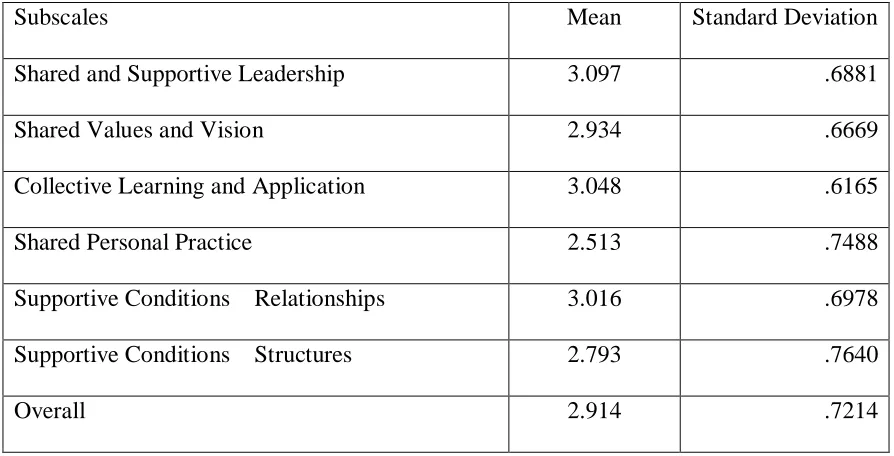
27 Table 1
Professional Learning Communities Assessment – Revised Subscale Mean and Standard Deviation Scores (N=86)
Subscales Mean Standard Deviation
Shared and Supportive Leadership 3.097 .6881
Shared Values and Vision 2.934 .6669
Collective Learning and Application 3.048 .6165
Shared Personal Practice 2.513 .7488
Supportive Conditions – Relationships 3.016 .6978
Supportive Conditions – Structures 2.793 .7640
Overall 2.914 .7214
Given the data above it would appear that five of the six components of the professional learning community survey were seen as being implemented with fidelity. The one component that would be questionable is Shared Personal Practice with a mean of 2.513. Given that a 2 in this survey represented a disagree and a 3 represented an agree this component is fairly evenly split between those two choices. Looking into the data a little further shows that 4 of the 7 statements within this component had a mean below 2.5, which would indicate a general level of disagreement. Those four statements were:
1. Opportunities exist for staff members to observe peers and offer encouragement at 2.198.
28
3. Opportunities exist for coaching and mentoring at 2.282.
4. Staff members regularly share student work to guide overall school improvement 2.377.
One statement in this component had a mean of 3.209 and that was:
1. Staff members informally share ideas and suggestions for improving student learning.
Overall, it appears that the participants believed that professional learning communities were implemented with fidelity although there would be some area for improvement in the area of “Shared Personal Practice.”
Results for research question 2. The second question asked was “What is the
relationship between participation in PLC’s and a teachers’ sense of efficacy?”
As with the PLCA-R results, the mean and standard deviation for the TSES subscales were calculated. The Teachers’ Sense of Efficacy Scale measures three components:
1. Efficacy in Student Engagement 2. Efficacy in Instructional Strategies 3. Efficacy in Classroom Management
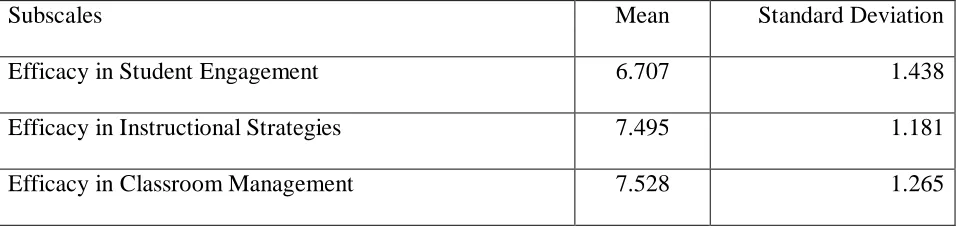
29 Table 2
Teacher Sense of Efficacy Scale Mean and Standard Deviation Subscale Scores (N=86)
Subscales Mean Standard Deviation
Efficacy in Student Engagement 6.707 1.438
Efficacy in Instructional Strategies 7.495 1.181
Efficacy in Classroom Management 7.528 1.265
Given that this survey has a scale of 1 – 9 in regards to how much a teacher believes they can do given 24 questions grouped into the three components above it appears the teachers believe they have quite a bit of influence with these different components. A 5 on this scale indicates that they have “Some Influence”; while a 7 indicates they have “Quite a Bit” of
influence. The means would indicate that the teachers’ sense of efficacy is quite strong in regards to student engagement, instructional strategies, and classroom management. The lowest
individual question pertained to “How much can you assist families in helping their children do well in school” with a mean of 6.058 which still indicates that they feel they have decent influence. The highest individual question pertained to “To what extent can you make your expectations clear about student behavior” with a mean of 8.116, which indicates that they feel a great deal of influence.
30
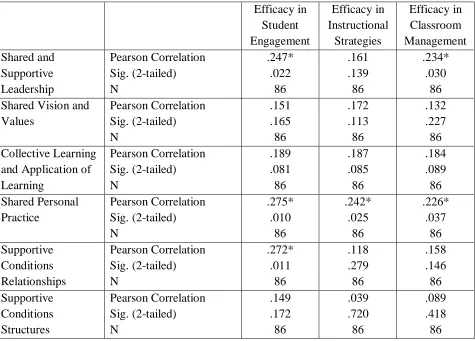
relationship among the subscales of both the PLCA-R and TSES subscales. The subscales for the PLCA-R were: a) shared and supportive leadership, b) shared vision and values, c) collective learning and application, d) shared personal practice, e) supportive conditions – relationships, and f) supportive conditions – structures. The subscales for the TSES were: Efficacy in student engagement, Efficacy in instructional strategies, and Efficacy in classroom management. Table 3 contains the results of the analysis at p<.05.
Table 3
Pearson Correlation of PLCA-R and TSES Subscales Scores (N=86) Efficacy in Student Engagement Efficacy in Instructional Strategies Efficacy in Classroom Management Shared and Supportive Leadership Pearson Correlation Sig. (2-tailed) N .247* .022 86 .161 .139 86 .234* .030 86 Shared Vision and
Values Pearson Correlation Sig. (2-tailed) N .151 .165 86 .172 .113 86 .132 .227 86 Collective Learning
31
Six of the eighteen relationships among factors indicated a positive significant relationship. The six relationships include shared personal practice to efficacy in student
engagement, supportive conditions – relationships to efficacy in student engagement, shared and supportive leadership to efficacy in student engagement, shared personal practice to efficacy in instructional strategies, shared and supportive leadership to efficacy in classroom management, and shared personal practice to efficacy in classroom management.
Results for research question 3. The third question asked was “Has the implementation
of professional learning communities changed the teachers’ beliefs about teaching and learning?” Of the 82 participants that answered this open-ended question 80.5% (N=66) indicated that the implementation of professional learning communities had changed their beliefs about teaching and learning. As an example of how PLC’s changed some teachers’ perceptions I have included a few quotes from teachers and a complete list can be found in appendix F.
Mainly, PLC's have helped me to be more intentional and purposeful in my teaching. The structure and accountability of the team keeps me more focused on formative assessment and adjusting instruction/interventions as we go through the units rather than just at the end. So far, our PLC's have been mostly focused on data as we continue to learn the system. As we become better at that part, we are able to spend more time discussing instructional strategies. That part has become the most valuable to me. PLC's provide a regular scheduled time to collaborate.
32
accountable for following through. Mostly I feel that it's given a bigger focus on finding alternative ways to teach and help students gain a better comprehension for each of their academic areas.
Professional learning communities have served to provide the training, leadership, time and respect that allow teachers to collaborate for the improved learning of all students. SHSD has highly educated and trained teachers that have been supported (through the implementation of PLC's) to finally be able to combine their talents and strengths. This allows all staff to continue to learn and become better teachers.
My beliefs have changed in that I think data should drive decision making about what I should do in the classroom to help students learn. Data can also help decide the most effective interventions when a student is not being successful. Collaborative teams are more powerful to make change than one person going it alone. What we do in education should be based on research not on what we have always done or on anecdotal stories that may not apply to the majority. Lastly, it takes time to do things right.
This is just a sampling of the quotes listed in appendix F. Some of the themes from the quotes are that the implementation of PLC’s has been helpful especially in regards to
collaboration and looking at data. It would appear from many of the quotes that it has made teachers more aware of looking at the data related to their students’ academic success and
33
staff in a building is so small and there are only one or two teachers who are teaching in the same content area or the same courses.
Summary
An analysis of all the data indicates that the teachers in our district have a strong sense of efficacy and that professional learning communities have been implemented with fidelity. In addition, an overwhelming majority of the teachers have seen a positive change in their practices in regards to teaching and learning due to the implementation of professional learning
communities. In regards to the correlation study, six of the eighteen possible relationships had positive significant correlations. Shared personal practice had positive significant correlations in all three areas of teacher efficacy and shared and supportive leadership had positive significant correlations in two areas of teacher efficacy. The four areas that scored lowest in shared personal practice were in opportunities for staff members to observe peers and offer
34 Chapter Five Analysis and Implications
This chapter includes a summary of the study; an analysis of the findings; limitations of the study; implications and recommendations; possible areas of future research and a final summary.
This study was developed out of a concern for the fidelity of implementation of professional learning communities and the effect of professional learning communities on teacher efficacy. A recent study on the research into teaching teams and collaboration concluded, “Overall, the studies show us that when teachers are given the time and tools to collaborate they become life-long learners, their instructional practice improves, and they are ultimately able to increase student achievement far beyond what any of them could accomplish alone” (Carroll, 2010, p. 10). Teacher efficacy is also paramount to increasing student learning as Rick DuFour stated, “This sense of efficacy is also critical to schoolwide improvement efforts. If those within the school believe that the causes of student learning lie outside their spheres of influence school improvement efforts will be viewed as futile” (DuFour R. &., 1995, p. 5).
PLCA-35
R; Shared and Supportive Leadership; Shared Values and Vision; Collective Learning and Application of Learning; Shared Personal Practice; Supportive Conditions – Relationships; and Supportive Conditions – Structures that have been shown to be valid indicators of professional learning communities (The Center for Comprehensive School Reform and Improvement, 2009) (DuFour, DuFour, Eaker, & Many, 2006) (DuFour & Eaker, 1998). The Teacher Sense of
Efficacy Scales survey was used to gauge the level of efficacy with which teachers self-identified their level of efficacy in three component areas; efficacy in student engagement; efficacy in instructional strategies; and efficacy in classroom management. Finally, this study used a one-question survey to gauge if professional learning communities had influenced the teachers beliefs in regards to teaching and learning.
This information was gathered from participants using the PLCA-R survey, the TSES survey, and an open-ended question in regards to changes in their beliefs or practices due to the implementation of professional learning communities.
Analysis of the Findings
The following section analyzes the study’s findings from Chapter Four. This analysis is centered on the three major research questions from this study.
Research question 1: What is teachers’ perception of how well professional learning communities have been implemented?
36
fidelity. All certified staff was asked to participate in this survey. The PLCA-R uses a Likert scale from 1 to 4 to determine fidelity of implementation. The Likert Scale is 1 = Strongly Disagree, 2 = Disagree, 3 = Agree, and 4 = Strongly Agree. This is a 52-item survey that measures six components of PLC’s: shared and supportive leadership, shared vision and values, collective learning and application, shared personal practice, supportive conditions –
relationships, and supportive conditions – structures. Of the 97 certified staff that were invited to participate 88.7% (n=86) responded to the survey.
Analysis of the data from the PLCA-R indicates that professional learning communities were implemented with fidelity in this district with one possible exception. Of the six
components identified with the PLCA-R five had mean scores around 3. The mean scores for all six are: Shared and Supportive Leadership – 3.097, Shared Values and Vision – 2.934, Collective Learning and Application – 3.048, Shared Personal Practice – 2.513, Supportive Conditions – Relationships – 3.016, and Supportive Conditions – Structures – 2.793. As can be seen from these numbers shared personal practice had the lowest mean and would be the one possible exception of being implemented with fidelity. However, given the overall numbers it is safe to conclude that professional learning communities were implemented with fidelity in this district.
The one area that educators in this district could spend some additional time
37
Research conducted by Reeves (2011) has indicated that when PLC’s are implemented with fidelity there is an increase in teacher knowledge, an increase in teacher efficacy,
improvements in student achievement and improved instructional practices. This is especially important given the fact that shared personal practice has the potential to lead to definite increases in instructional practices. Blasé and Blasé (2006, p. 22) found that consultation with peers
…enhanced teachers’ self-efficacy (teachers’ belief in their own abilities and capacity to successfully solve teaching and learning problems) as they reflected on practice and grew together, and it also encouraged a bias for action (improvement through collaboration) on the part of teachers.
Combining this with research that has identified teacher effectiveness as having a substantial impact on student achievement (Marzano, 2003) (Reeves D. , 2011) it would benefit educators to put a stronger emphasis on shared personal practice.
Research question 2: What is the relationship between participation in PLC’s and a teachers’ sense of efficacy?
38
were: 6.707 for Efficacy in Student Engagement, 7.495 for Efficacy in Instructional Strategies, and 7.527 for Efficacy in Classroom Management. Given these numbers, it appears that teachers in this district have a strong sense of efficacy.
To determine if there is a correlation between PLC’s and teachers’ sense of efficacy, a Pearson’s correlation analysis was conducted. The six subscales from the PLCA-R survey were compared to the three subscales from the TSES survey. This analysis indicated that there was a positive significant relationship with six of the eighteen factors. The six factors having a positive significant relationship were Shared Personal Practice with Efficacy in Student Engagement; Shared Personal Practice with Efficacy in Instructional Strategies; Shared Personal Practice with Efficacy in Classroom Management; Shared and Supportive Leadership with Efficacy in Student Engagement; Shared and Supportive Leadership with Efficacy in Classroom Management; and Supportive Conditions – Relationships with Efficacy in Student Engagement.
39
concentrated on helping individual teachers become part of a larger picture with the help of their peers which I would posit leads to an increase in teacher self-efficacy.
It is interesting to note that while shared personal practice was the area of PLC implementation with the lowest fidelity it was the only area that had a significant positive relationship with all three subscales of the TSES survey. This would indicate again that some attention would need to be paid to making sure that teachers in this district are given the opportunity to share personal practice.
The second area with two out of three subscales of efficacy having a significant positive relationship was shared and supportive leadership. This component had a significant relationship with efficacy in student engagement and efficacy in classroom management. One question within this area that had the most positive correlations in regards to the area of teacher efficacy was around stakeholders assuming shared responsibility for student learning without evidence of imposed power and authority. I would suggest that this has such a strong positive correlation because teachers feel like they are part of the process without the process dictated to them. This in turn gives them a greater sense of self-efficacy.
Out of the three subscales on the TSES the one that had the three highest positive
significant relationships with implementation of professional learning communities was Efficacy in Student Engagement.
The question naturally arises as to why these six areas had a strong positive correlation and the other twelve did not. In regards to the three components that showed no positive
40
posit that all of these areas while being implemented have taken a back seat to the other areas in importance within this district. While shared values and vision are discussed, they are not at the forefront of our discussions as shared personal practice has been. The same can be said for collective learning and application. Finally, while the structures for supportive conditions are in place, I would posit that they are simply a prerequisite to increasing teacher self-efficacy but does not necessarily lead to increased teacher self-efficacy itself.
Research question 3: Has the implementation of professional learning communities changed the teachers’ beliefs about teaching and learning?
This question was answered by 84.5% (N = 82) of the respondents and of those 82, 80.5% (N = 66) indicated that the implementation of professional learning communities had changed their beliefs about teaching and learning. This number would indicate that the implementation of professional learning communities has been successful in changing in a positive manner how teachers perceive their own teaching.
Some of the comments from the teachers would also indicate why there seemed to be a strong positive correlation with student engagement. While there were several quotes presented in chapter 4, I have included some additional quotes at this point. These quotes again highlight some of the increased beliefs and practices the teachers have acquired through the
implementation and use of PLC’s.
Sharing different teaching strategies to help struggling students has been very helpful.
41
can focus on the most needy and use tools, games, one on one help - that is the most effective.
Implementing PLC's has helped me learn how to use specific data to drive my instruction. I tend to assess more regularly since taking part in PLC's. I also appreciate the time to work with my grade level team to further our student’s growth. It has been difficult to form cohesive teams because there are many blended classrooms. These blends are a result of loss of staff over the years and are a necessity, but they do make collaborating more difficult.
I think the PLC's have made me take a closer look at being more aware of each child's ability level, their level of understanding and the additional support each child needs. It's definitely been nice to collaborate goals with others to hold each other and myself
accountable for following through. Mostly I feel that it's given a bigger focus on finding alternative ways to teach and help students gain a better comprehension for each of their academic areas.
The PLC's, especially this year, have increased communication between all grade levels. We are able to review data to help guide our teaching. We are more aware of how students are doing in different settings. I think standards are raised because data is more available. Teachers are more able to share strategies and ideas. It gives us the feeling that we are all in this together for the benefit or our students.
42
comments from the teachers indicates that there has been a focus on helping struggling students. This has arisen due to the emphasis in the PLC’s of looking at data on the students. As the teachers look at the data, questions naturally arise as to how to address the areas of struggle the individual students are having. This leads to teachers sharing their best ideas as to how to address struggling students. This collaboration around student learning and teaching strategies has strengthened individual teachers’ beliefs in their own abilities and has given them a stronger sense of community.
Implications and Recommendations for Future Research
This study explored the relationship between implementation of professional learning communities and teacher efficacy. While there were some areas in which there was a strong positive relationship between the two there were more areas that did not show a strong positive relationship. Further research into the area of shared personal practice would yield insights into why that was the area with the strongest positive relationships and at the same time was weakest when it came to PLC implementation. Given the size of the district, this could be controlled for on a school-by-school basis to see if there would be any relationships between student
43
The second strongest relationship existed with shared and supportive leadership with student engagement and classroom management. Reeves (2011) supports these findings,
Although teachers have an undeniably large influence on student results, they are able to maximize that influence only when they are supported by school and system leaders who give them the time, the professional learning opportunities, and the respect that are essential for effective teaching (p. 70).
This would indicate that shared and supportive leadership are vitally important for teacher efficacy and further for increased student achievement. Further study could be done to explore why there was not a strong positive relationship between leadership and instructional strategies. This area would seem to go hand-in-hand with professional learning communities given many of the teacher quotes in appendix F. It would appear from teacher statements that they see a correlation between the implementation of PLC’s and instructional strategies but that was not seen in the data.
Given the data from this particular district it might benefit teachers to establish professional learning communities in order to increase student engagement and classroom
management. Since there was only one positive relationship with instructional strategies it might be wise to find other avenues for that area. For example, having an in-service on Marzano’s instructional strategies might benefit teachers’ instructional strategies more than discussing them in their PLC’s. However, as stated earlier, there were many indicators from teacher statements that would lead one to believe that this area may also be beneficial even though the data did not show a strong positive relationship in regards to PLC’s and instructional strategies.
44
1. Further research into the categories of professional learning communities might offer more insight into which areas within the categories actually have the largest impact on teacher efficacy. This was a 52-question survey that had six components. Each of those six components could be explored further.
2. Given the limited size and scope of this study, a larger sample size could yield different results that would give further insight into the relationship between professional learning communities and teacher efficacy.
3. Given that this was a one-moment-in-time study it would be beneficial to have a longitudinal study completed to see if the effects persist over time.
4. The demographics in this particular district limit the scope to which this study can be generalized. Therefore, a study, or studies, that contained many demographics would be useful.
Conclusions
45
There were no strong positive relationships between three of the PLC subscales and any of the teacher self-efficacy subscales. Those were Shared Vision and Values, Collective
Learning and Application, and Supportive Conditions – Structures. These findings indicate that while the professional learning community structure can definitely impact teacher efficacy in the area of shared personal practice and shared and supportive leadership there may need to be other structures in place to address other areas of teacher efficacy.
Through this research study I have come to see how valuable our PLC time is in our district. The data from the first survey helped me see that the implementation of our PLC’s was somewhat fragmented and could have been implemented in a more systematic manner.
However, given the data the implementation was successful overall. As is the case with anything there is room for improvement. The data from the second survey on efficacy showed me that our teachers have strong beliefs in their ability to influence the learning that occurs in their
classrooms. While this belief didn’t necessarily correlate strongly with all areas of PLC
implementation it would appear from the comments to the final survey question that our teachers do see a strong correlation between the implementation of PLC’s and positive changes to their teaching. Many of the comments centered on how PLC’s had changed their emphasis to
individual students and how best to identify their areas of struggle and then implement strategies to address those struggles. Since this is the essence of PLC’s I would say that the
46 References
Definition: Education.com. (2012). Retrieved from Education.com:
http://www.education.com/definition/collegiality/
Annenburg Institute for School Reform. (2012). Professional learning communities:
Professional development strategies that improve instruction. Retrieved from Annenburg
Institute: http://annenberginstitute.org/pdf/proflearning.pdf
Ashton, P. (1984). Teacher efficacy: A motivational paradigm for effective teacher education.
Journal of Teacher Education 35(5), pp. 28-32.
Bandura, A. (1986). Social foundations of thought and action: A social cognitive theory. Englewood Cliffs: Prentice-Hall.
Bandura, A. (1997). Self-efficacy: the exercise of control. New York: Freeman.
Barber, M., & Mourshed, M. (2007). How the best performing school systems come out on top. Retrieved from McKinsey & Company:
http://www.mckinsey.com/locations/UK_Ireland/~/media/Reports/UKI/Education_report .ashx
Black, P., & Wiliam, D. (1998). Assessment and classroom learning. Assessment in Education
5(1), 7-75.
Blase, J. &. (2006). Teachers bringing out the best in teachers: A guide to peer consultation for
47
Carroll, T. F. (2010). Team up for 21st century teaching and learning: What research and
practice reveal about proessional learning. Washington, DC: National Commission on Teaching and America's Future.
Confederation of Oregon School Administrators. (2012). About COSA: COSA Website. Retrieved from COSA Web site:
http://www.cosa.k12.or.us/downloads/aboutcosa/FCMeetings/EdAdvocacyGraphs201112 .pdf
Creswell, J. W. (2008). Research design: Qualitative, quantitative, and mixed methods
approaches. Los Angeles: Sage Publications.
Darling-Hammond, L., Wei, R. C., Andree, A., Richardson, N., & Orphanos, S. (2009).
Professional learning in the learning profession: A status report on teacher development
in the United States and abroad. Dallas: National Staff Development Council.
DuFour, R. &. (1995). The Principal as Staff Developer. Journal of Staff Development.
DuFour, R. (1991). The principal as staff developer. Bloomington: Solution Tree.
DuFour, R. (2004). What is a professional learning community? Educational Leadership 61(8), 6-11.
DuFour, R., & Eaker, R. (1998). Professional learning communities at work: Best practices for
enhancing student achievement. Bloomington: Solution Tree.
48
DuFour, R., DuFour, R., Eaker, R., & Karhanek, G. (2010). Raising the Bar and Closing the
Gap. Bloomington: Solution Tree Press.
DuFour, R., DuFour, R., Eaker, R., & Many, T. (2006). Learning by doing: A handbook for
professional learning communities at work. Bloomington: Solution Tree .
Dunne, F., Nave, B., & Lewis, A. (2000). Critical friends: Teachers helping to improve student learning. Phi Delta Kappa International Research Bulletin (CEDR) (28), 9-12.
Education Week. (2011). Issues: Education Week. Retrieved from Education Week: http://www.edweek.org/ew/issues/professional-development/
Garet, M. S., Porter, A. C., Desimone, L., Birman, B. F., & Yoon, K. S. (2001). What makes professional development effective? Results from a national sample of teachers.
American Educational Research Journal, 38(4), 915-945.
Guskey, T. (1998). Teacher Efficacy Measurement and Change. Annual Meeting of the American
Educational Research Association. San Diego.
Hattie, J. (2008). Visible learning: A synthesis of over 800 meta-analyses relating to
achievement. New York: Routledge.
Hord, S. (1997). Professional learning communities: Communities of continuous inquiry and
improvement. Retrieved from Southwest Regional Development Laboratory: http://www.sedl.org/pubs/change34/plc-cha34.pdf
Hord, S. M., Meehan, M. L., Orletsky, S., & Sattes, B. (1999). Assessing a school staff as a
49
Retrieved from Southwest Educational Development Laboratory:
http://www.sedl.org/change/issues/issues71/Issues_Vol7_No1_1999.pdf
Joyce, B., & Showers, B. (2002). Student achievement thorugh staff development. Alexandria: Association for Supervision and Curriculum Development.
Klassen, R. M., Tze, V. M., Betts, S. M., & Gordon, K. A. (2011). Teacher efficacy research 1998-2009: Signs of progress or unfulfilled promise? Educational Psychology Review
23(1), pp. 21-43.
Loucks-Horsley, S., Hewson, P., Love, N., & Stiles, K. (1998). Designing professional
development for teachers of science and mathematics. Thousand Oaks: Corwin Press.
Louis, K., & Marks, H. (1998). Does professional community affect the classroom? Teachers' work and student experiences in restructuring schools. American Journal of Education, 532-575.
Marzano, R. (2003). What works in schools: Translating research into action. Alexandria: Association for Supervision and Curriculum Development.
McCaffrey, D., Lockwood, J., Koretz, D., & Hamilton, L. (2003). Evaluating Value-Added
Models for Teacher Accountability. Santa Monica: RAND Corporation.
McLaughlin, M. W. (1992). What matters most in teachers' workplace context. Center for Research on the Context of Secondary School Teaching. Retrieved from:
50
Multon, K., & Brown, S. (1991). Relations of self-efficacy beliefs to academic outcomes: A meta-analytic investigation. Journal of Counseling Psychology, 38, pp. 30-38.
National Staff Development Council. (2007). Stand For: Learning Forward. Retrieved from Learning Forward: http://www.learningforward.org/standfor/definition.cfm
Newmann, F. M., & Wehlage, G. G. (1997). Successful school restructuring: A report to the
public and educators by the center on Organization and Restructuring of Schools.
Madison: Document Service, Wisconsin Center for Education Research.
Olivier, D., & Hipp, K. (2008). Assessing and analyzing schools as PLCs. In K. Hipp, & J. Huffman, Professional learning communities: Purposeful actions, positive results. Lanham: Rowman & Littlefield.
Reeves, D. (2011). Transforming professional learning into student results. Thousand Oaks: Corwin Press.
Reeves, D. B. (2011). Finding your leadership focus: What matter most for student results. New York: Teachers College Press.
Rivkin, S., Hanushek, E., & Kain, J. (2005). Teachers, Schools, and Academic Achievement.
Econometrica, 417-458.
51
Rowan, B., Correnti, R., & Miller, R. (2002). What Large-Scale, Survey Research Tells Us about Teacher Effects on Student Achievement: Insights from the "Prospects" Study of
Elementary Schools. Teachers College Record, 1525-1567.
Southwest Educational Development Laboratory. (2010). Professional learning communities
assessment-revised: Validity and reliability. Retrieved from Southwest Educational Development Laboratory: http://www.sedl.org/plc/assessment_validity_reliability.html
Sparks, D. (1984). Staff Development and School Improvement: An Interview with Ernest Boyer. Journal of Staff Development, 32-39.
Sparks, D. (2002). Designing powerful professional development for teachers and principals. Oxford: National Staff Development Council.
The Center for Comprehensive School Reform and Improvement. (2009). Professional learning
communities. Retrieved from http://www.centerforcsri.org/plc/elements.html
Tschanned-Moran, M., & Hoy, W. (2001). Teacher efficacy: Capturing an elusive construct.
Teaching and Teacher Education, 17, 783-805.
Tschannen-Moran, M., Woolfolk Hoy, A., & Hoy, W. (1998). Teacher Efficacy: Its Meaning and Measure. Review of Educational Research, 202-248.