RFID Tag Ownership Transfer Protocol of owner and
Multi-tag Based on EPC C1G2 Protocol
MENG Ke
1, HUANGXincheng
1,CHEN Shun’er
1*, HUANG Hongbing
1, LIU Weiping
1, 2 1(College of information science and technology,Jinan University,Guangzhou,China,)
2
(ZhongshanAiscent Technologies Ltd,Zhongshan,Guangdong,528437,China) *(Corresponding author: CHEN Shun’er)
---
************************
---Abstract:
The mutual authentication and ownership transfer are the core issues in the protocols of Regarding RFID tag, especially those based on EPC C1G2 protocol. At present, most of the multi-owner multi-tag ownership transfer cannot be able to deal with the problem of part ownership transfer. To solve this problem, we here integrate the mutual authentication and ownership transfer of tag to propose an effective multi-owner multi-tag protocol by storing the tags related information into the server. Our protocol characters with low resource consumption and high security compared with now existed protocols.
Keywords —RFID tag,C1G2 protocol, Multi-ownership tag, Transfer of ownership.
---
************************
---I. INTRODUCTION
With the development of Internet of Things, radio frequency identification (RFID) is widely applied in many areas such as supply chain system, military surveillance and medical care [1][2].Due to itscontactless character,RFIDalternates the traditional bar code and QR code, providing an automatic acquisition of related data with low cost. A complete RFID tag system includes three parts: tag, reader and server database. In 2006, the well-known EPC C1G2 protocol is introduced officially. EPC C1G2 is targeted at low-power and resource-limited RFID tags [3][4], and has been extensively applied in Mobile IoT since then.
As the outdoor deployment of RFID device and wireless transmittance of its radio signal, presently it is lack of sufficient security means to prevent RFID system from illegal access and hostile attack [5]. Thus, a lot of security protocols regarding RFID tag, including security authentication protocol and ownership transfer protocol, are proposed to avoid the disclosure of relevant information [6][7]. However, those protocols are based on traditional encryption technology, such as RSA, Hash function and ECC, and thus not competent with passive C1G2 protocol tag [8]. In
one hand, for example, the number of gate circuits for the encryption of RFID system is at most 3000 under the limit of the power dissipation, which is far less than that needed for the traditional Hash algorithm (80,000 to 100,000), ECC (8,200 to 15,000) and the simpler AES algorithm (3,400 gate circuits at least). In other hand, early C1G2 protocol mainly concentrates on the problems related with a single tag[9][12], and is proved to be with various security defects, and would be more complicated in a practical situation if related protocols focus on only a single tag. However, in complex commercial problems, such as the problem of supply chain where for instance the ownership of a commodity may belong to multiple owners or one owner has the ownerships of multiple commodities, there must be a multi-owner multi-tag ownership transfer agreement to tackle the transference of the ownership between the owners.
Tosolve problems above-mentioned, a
systematical multi-owner and multi-tag ownership transfer agreement is proposed in this paper, with the factors, such as limited resources of C1G2 standard tag, protocol security and possible partial ownership transfer, being entirely considered. This paper is arranged as following: in the first chapter we illustrate relevant background knowledge about
RFID; the second chapter we introduce current research work in this area; the third chapter we explain the regulations of the protocol raised in this paper; and the fourth chapter we discuss protocol security and compares it with on-going work.
II. RELATEDWORK
Currently, there are two categories of transfer agreements:1. with trusted party(TTP);2. without trusted party. They all need a safe environment to ensure that the process of key updating is in an absolute safe environment. Many protocols [14] assume that TTP directly communicate with tag, but in fact the effective communication distance of RFID tag is within 2-10m and only applicable to indoor scenes. However, the confinement of its indoor deployment imposes great restriction to its application in the case of the well-developed mobile IoT.
As demonstrated by Kapoor [14] where the concept of ownership transfer of owner multi-tag with TTP was first proposed, the ownership transfer agreements was completed by mutual confirmation of an encrypted message between the current and the new owners after the tags being transferred from the current owners to new owners.
Another version protocol proposed by Sundaresan[15] also adopts TTP strategy with an assumption that TTP could directly communicate with tags and owners. The ownership is transferred by four steps: 1.the current users send a transfer request to TTP, 2.TTP creates a key for each of the new owners and send it to them together with relevant tag information in an encrypted way. Then after, new owners will verify the encrypted information and successively send it to TTP, 3.TTP rechecks this returned information and sends a key back to tags. After being decoded, tags will subsequently send a confirmation message back to TTP, 4.TTP confirms this received information from tags and then sends a transfer completion information to all the current owners. Different from Kapoor’s protocol which is based on the repeated operation on a single tag, the Sundaresan’s protocol is based on a group strategy that groups tags according to whether they are to be transferred or not.
However, by analyzation, we find that both Kapoor’s and Sundaresan’s protocols cannot fit the application scene of part ownership transfer where part owners of one tag give up their ownership but the rest do not, due to the potential loss of some ownership for some owners.
III. PROTOCOLSOFTHISPAPER
Unlike that as in the relevant protocols mentioned above, our version protocol raises four participants: user, tag, reader and server database. Among them, user carries out operations related to protocol by using reader as an entrance.
A. Introduction of Symbols
The symbols used in this paper are as follows:
• Tid: tag id, EPC code in the actual use
• Tr: The last record time that the reader visited
• Kj, K , j: the new and old access key of tag j
• Ks, K ,s: the new and old shared key between the server database and the tag
• Rid: reader id
• t: current time
• Oid: owner id
• pwd:the owner's password, the owner’s
password is assumed to bepwd
• H(*):cryptographic relevant data of Hash
function
• M*:cryptographic relevant data of Hash
function
• PRNG(*):128-bit pseudo-random number
generator
• ⊕: XOR operation
B. Introduction of the Protocol
In this paper, the implementation of our version protocol is divided into three stages: initialization; mutual authentication; and ownership transfer.
1.Initialization
We storeTid, Ki, Ks, K ,sfor each tag and setRid for
the reader. On the server, storesTid, Kj, K , j , Ks for
each tag and storesRid, Tr for each reader, as well as
storesOid, Tid(1…n)pwdfor each owner, Tid(1…n) is all
the tagsTid owned by the owner.
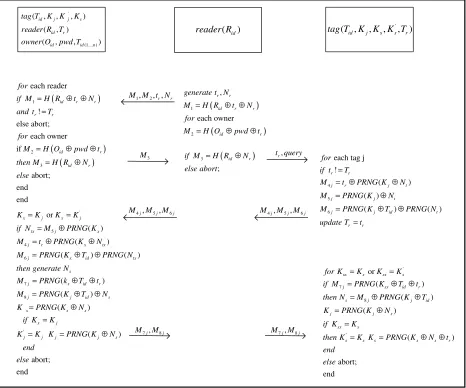
2. Mutual Authentication
At the beginning of the certification, the reader first generates a current time and a random number for the calculation of , that is
(
)
1 id r r
M =H R ⊕N ⊕t (1)
(
)
2 id r
M =H O ⊕pwd⊕t (2)
Then, it sendsM1, M2together withNr, trto the
server.
2) Server → Reader: M3
First, after receiving the information sent by the reader, the server traverses the database store to obtain the Rid of each reader, and judges whether
the formula (1) is valid or not with the help of Nr, tr.
If it is valid, the reader is legal and the0 process will go on, otherwise it will be terminated.And then according to the storage time Trof the reader, if
tr<Tr, and the process will go on, otherwise it will
be terminated. And last determining the formula (2) to be valid or not according to each user’sOid and
the received Nr. If it is valid, the user is legal and
the process will go on, otherwise it will be terminated. If both the judgments are valid, M3will be calculated as
(
)
3 id r
M =H R ⊕N (3)
and subsequently returned to the reader.
3) Reader→ Tag: tr, query
After the returned message from the server being received by the reader, it will be used to judge the legality of formula (3). If the formula (3) is valid, which means that the server database is legal, the reader will send a request message and its reader time to the tag.
4) Tag→ Reader: M4j, M5j, M6j
For each tagj, after it receiving the request messagefrom the reader, a random numberNtwill be
generated to calculateM4j, M5j, M6j as
(
)
4j r j t
M =t ⊕PRNG K ⊕N (4)
( )
5j j t
M =PRNG K ⊕N (5)
(
)
6j ( j id) t
M =PRNG K ⊕T ⊕PRNG N (6)
which will be sent back to the reader. And last, the stored will be updated
r r
T =t (7)
5) Reader → Server: M4j, M5j, M6j
After receiving the returned messages sent back by the tag, the reader forwards them to the server.
6) Server → Reader: M7j, M8j
The information received by the Server will be again sent to readers by which the readers determine whether the formula (9) is valid or not according toTid, Kj andNtx stored in the database
after traversing each tag in the database. The variableNtx is got by the formula (8). If the formula
(10) is invalid,Kj will be replaced byK , j and the above steps will be repeated. If it is invalid, the certification will be terminated. However, if the formula (10) is valid, that isKj orK , j is valid, it still needs to specify whether there is a corresponding owner. If the answer is yes, the server will generate a random number Ns, work out M7j, M8j from the
formula (11) and (12) and send them to the reader. And the access keys KsandK , j will be updated by formula (13) and (14) if necessary.
( )
5
tx j j
N =M ⊕PRNG K (8)
(
)
4j r j tx
M =t ⊕PRNG K ⊕N (9)
(
)
(
)
6j j id tx
M =PRNG K ⊕T ⊕PRNG N (10)
(
)
7j s id r
M =PRNG k ⊕T ⊕t (11)
(
)
8j j id s
M =PRNG K ⊕T ⊕N (12)
(
)
s s s
K =PRNG K ⊕N (13)
(
)
j j j j s
K,=K K =PRNG k ⊕N
(14)
7) Reader→Tag: M7j, M8j
Again, the reader will forward what it receives to the corresponding tag.
8) Tag
After the tag receives the relevant information from the reader, it will use the stored keyKs to judge
whether formula (11) is valid. If not, replacingKs
withK ,s and repeat the judgement. If it is still invalid, just terminate the process. Note thatNs can be
obtained through the formula (12), and the keysKs,
'
(1.... )
( , , , ) ( , )
( , , )
id j j s
id r
id id n
tag T K K K
reader R T
owner O pwd T
( id)
reader R tag T( id,K K K Tj, s, s', r)
( ) ( ) ( ) 1 2 3 each reader ! else abort; each owner if abort; end end
id r r
r r
id r
id r
for
if M H R t N
and t T
for
M H O pwd t
then M H R N
else = ⊕ ⊕ = = ⊕ ⊕ = ⊕ ' 5 4 6 7 8 ' or ( ) ( ) ( ) ( ) ( ) ( ) ( ) ( ) abort; end
x j x j
tx j x
j r x tx
j x id tx
s
j s id r
j j id s
s s s
x j
j j j j s
K K K K
if N M PRNG K
M t PRNG K N
M PRNG K T PRNG N
then generate N
M PRNG k T t
M PRNG K T N
K PRNG K N
if K K
K K K PRNG K N
end else = = = ⊕ = ⊕ ⊕ = ⊕ ⊕ = ⊕ ⊕ = ⊕ ⊕ = ⊕ = = = ⊕ ( ) ( ) 1 2 , each owner r r
id r r
id r
generate t N
M H R t N
for
M H O pwd t
= ⊕ ⊕ = ⊕ ⊕ ( ) 3 ; id r
if M H R N
else abort
= ⊕
4
5
6
each tag j !
( )
( )
( ) ( )
r r
j r j t
j j t
j j id t
r r
for
if t T
M t PRNG K N
M PRNG K N
M PRNG K T PRNG N
update T t
= = ⊕ ⊕ = ⊕ = ⊕ ⊕ = ' 7 8 ' or ( ) ( ) ( ) ( ) abort; end
sx s sx s
j sx id r
s j j id
j j s
sx s
s s s s s r
for K K K K
if M PRNG K T t
then N M PRNG K T
K PRNG K N
if K K
then K K K PRNG K N t
end else = = = ⊕ ⊕ = ⊕ ⊕ = ⊕ = = = ⊕ ⊕
1, 2, ,r r
M M t N
3
M
4j, 5j, 6j
M M M
,
r
t query
4j, 5j, 6j
M M M
7j, 8j
M M M7j,M8j
Fig. 1 Authentication Phase
3. Ownership Transfer
Ownership Transfer is implemented after completing the confirmation of the validness of all the tag, reader, server and current owner.
1)Reader → Server: M9, tr
The reader first generates a current time tr,works
outM9 after each new owner enters his own Oid,
pwd, and then sends it to the server.
(
)
9 id r
M =H O ⊕pwd⊕t (15)
2) Server→Reader: M10j, M11j
After receiving the information sent by the reader, the server judges whether formula (15) is valid based on the storedOid, pwdof each user and receipt
time tr.If the stored timeTr of the reader is the same
as tr,the protocol will be terminated. If not, a new
random numberNs will be generated.ThenM10j, M11j
for each tagj that needs to be transferred will be worked out from formula (16) and (17) and sent back to the reader. The access key Kj will be
updated thereafter by the formula (18).
(
)
10j s r s
M =PRNG K ⊕t ⊕N (16)
(
)
11j s id s
M =PRNG K ⊕T ⊕N (17)
(
)
j j s
K =PRNG K ⊕N (18)
3) Reader→Tag: M10j, M11j, tr
When the reader receives the information of the server, it will send the information along with its time reader trto the tag.
After receiving the relevant information, the tag first judgestr by the method mentioned above. Then
it uses its ownKsto work outNsx by the formula (19),
and then assesses whether the formula (20) is established. If not, replaceKswithK ,s to repeat the above steps.If still not, the protocol will be terminated. Otherwise, it works outM12j and sends
it to the reader, updates Kj,Ks andK ,s if necessary.
(
)
10
sx j s r
N =M ⊕PRNG K ⊕t (19)
(
)
11j s id sx
M =PRNG K ⊕T ⊕N (20)
(
)
12j j s id r s
M =PRNG K ⊕K ⊕T ⊕t ⊕N (21)
(
)
j j sx
K =PRNG K ⊕N (22)
(
)
s s s s sx
K,=K K =PRNG K ⊕N
(23)
5) Reader →Server: M12j
After the reader receivesM12j from the tag, it will
forward it to the server.
6) Server
First, judge whether the formula (21) is established according to the storedKj,Ks, Tid and the
random number Ns. If it is right,updateKs.
9
10
11
each owner
if ( )
! generate each tag j
( )
( )
( )
abort; end
id
r r
s
j s r s
j s id s
j j s
for
M H O pwd t
and t T
then N
for
M PRNG K t N
M PRNG K T N
update K PRNG K N
else
= ⊕ ⊕
=
= ⊕ ⊕
= ⊕ ⊕
= ⊕
12
'
( )
for old owner remove
for each new owner insert
update =PRNG(K N )
( )
j j s id r s
id
id
j j s
s s s
if M PRNG K K T t N
then
T
T K
K PRNG K N
= ⊕ ⊕ ⊕ ⊕
⊕
= ⊕
10
'
11
12
'
'
( )
or
( )
( )
( )
( )
if
( )
sx j s r
x s x s
j s id sx
j j x id r s
j sx j
x s
s s s sx s
x s
s x s
N M PRNG K t
for K K K K
if M PRNG K T N
then M PRNG K K T t N
update K PRNG N K
if K K
K K K PRNG N K
else K K
K PRNG K N
end end
= ⊕ ⊕
= =
= ⊕ ⊕
= ⊕ ⊕ ⊕ ⊕
= ⊕
=
= = ⊕
=
= ⊕
9
(
)
r
id r
generate t
M
=
H O
⊕
pwd
⊕
t
9, r
M t
12j
M M12j
10j, 11j,r
M M t
sever
reader
tag
10j, 11j
M M
Fig. 2 Ownership Transfer Phase
IV. SAFETY ANALYSIS AND PERFORMANCE
COMPARISON
In this part, we mainly discuss how our version protocol in this paper deals with all kinds of malicious attacks, and analyze its characteristics in
the computation and storage under the limit of limited resource.
A. Safety Analysis
1)Replay Attack
as is seen in Sundaresan[15]. To avoid the Replay-Attack, we assume that the current timetr must be
after the last access time Tr to ensure the access
efficiency. In the authentication stage, if the attacker conducts a replay attack to the server or the tag, his reader timetr obviously does not always
meet the condition tr!= Trdue to the existence of the
reader time Tr.Thus, the judgment of M1, M4jby the
server cannot be completed that leads to the failure of the authentication of tag M7j.Also if the
Replay-Attack occurs in the transfer stage, the server can prevent Replay-Attack using M9, M12j.
2) Desynchronization Attack
Desynchronization attack is a common threat to RFID tag and exists in many of the current RFID
security protocols. The principle of
desynchronizing attack is to make the tag and server out of synchronization with the keys, resulting in all subsequent failures in authentication. The simple way to prevent is to block an authentication conversation so that the server or the tag updates its key while the other party doesn’t complete the update. The protocols proposed by Kapoor [14] and Sundaresan [15] are vulnerable to the desynchronization attack. In this paper, we use two keys (the old key and the new key) to prevent the desynchronization attack. It saves the old and new keys of tagKj, K , jin the server and stores the old and new shared keys in the tag. The old key is always equal to the last successful key and the new key will be updated according to a random number. In this way, even if the attacker blocks the protocol, it can’t hinder the next round of authentication because we use both the old and the new key to try in the new authentication process. So even if the current update is blocked, the old key can still be authenticated.
3) Tag Imitation
As the tag information is transmitted through an encrypted way, the attacker needs to imitate a tag and get the variablesTid, Kj, Ks, K ,sof the tag. However, as our related information is transmitted through the encrypted way, he needs to use the violent crack pseudo-random number generator to crack the tag which greatly reduces his probability of success. In addition, as we know, more bits mean more cracked number. So, the advanced128-bit
PRNG of C1G2 with its cracked number 2127 is recommended instead of the 16-bit standard PRNG of C1G2 with its cracked number 215. Sundaresan et al also proposed that 128-bit PRNG resources required only 1500 logic gates. Therefore, in this paper, we adopt the 128-bit pseudo-random number generator.
4) Forward Security and Backward Security
Forward security and backward security are crucial to the ownership transfer protocol because it is necessary to ensure that the previous owner can’t access the tag and the later owner can’t get the information of the previous owner. The access keyKj and shared keyKs will be automatically
updated in the process of each authentication and transfer. Neither the previous owner nor the current owner can get the next round of key or the last round of key.
B. Authentication Efficiency
1)Expansibility of Protocol
We assume a situation where a part of the owners of the tag have transferred ownership while the rest haven’t. It is obvious that Kapoor or Sundaresan version protocol can’t meet this requirement because partially updating the keys of the owners will lead to that the owners who haven’t transferred the ownership will lose his authority to the tag. Our version protocol in this paper solve this problem by updating all the keys that all the owners got meanwhile by storing both the access key and shared key of the tag in the database. So, it well deals with the part transfer of ownership while Kapoor or Sundaresan version protocols can’t.
2) Storage of Tags
The information of a tag needed to store in our protocol only are Tid, Kj, K , j, Ks, Tr,regardless of the
number of owners of tag. However, there are at least 2Nt + No keys and ID information needed to
store if there areNt tags andNo owners for the
Sundaresan version protocol, and at leastNog+ 2
shared keys for the Kapoor version protocol if there areNog owners. So, by comparison, we can see that
C. Comparison of Protocols
Through the above analysis, we conclude that our version protocol is better than others not only in its security and the effective dissipation of resources,but also in its functionality of the transfer of part ownership. Different from the previous protocols, our protocol doesn’t require that the tag communicate directly with the TTP. The tag only needs to communicate with the reader, which is more in line with the concepts of Internet of Things with strong practical significance.
TABLE 1COMPARISON OF RELATED PROTOCOLS
Protocol in this paper
Kapoor protocol
Sundaresan protocol Prevent replay
attack Y N N
Prevent
desynchronization Attack
Y N N
Forward security and backward security
Y Y Y
Prevent tag
imitation Y Y Y
Transfer of part of
ownership Y N N
Storage of tags 5 N
og + 2 2Nt + No
V.CONCLUSIONS
The development of Internet of Thing has driven the development of RFID, but its security problems have always plagued scholars. Currently, security protocols of tags based on the EPC C1G2 standard are mostly based on a single tag, which has great limitations in the shared resources society. This paper proposes a multi-owner multi-tag ownership transfer protocol for RFID tags based on the C1G2 standard, which uses the traditional reader connecting the tag and TTP communication so that the tag doesn’t need to directly connect to the TTP. As the key information of owners and tags are stored in the serve, this ownership transfer protocol is more adaptive to the outdoor scene r. Besides, it also can be a good solution to the transfer of part
ownership and can reduce the requirement to the operation and storage of tags, which more fits low power dissipation characteristics of C1G2 tag.
ACKNOWLEDGMENT
This work is supported by National High Technology Research and Development Program of China (863 Program, No. 2015AA015501).
REFERENCES
[1] Li H, Hu J, He L, et al. Mutual Authentication and Ownership Transfer Scheme Conforming to EPC-C1G2 Standard[C]// Eighth International Conference on Computational Intelligence and Security. IEEE, 2012:678-682.
[2] Pokala J P, Reddy C M, Abdul J S, et al. A secure RFID protocol for Telecare Medicine Information Systems using ECC[C]// International Conference on Wireless Communications, Signal Processing and NETWORKING. 2016:2295-2300.
[3] Zhang J, Wang W, Ma J, et al. A Novel Authentication Protocol suitable to EPC Class 1 Generation 2 RFID system[J]. Journal of Convergence Information Technology, 2012, 7(3).
[4] Xiao F, Zhou Y, Zhou J, et al. Security protocol for RFID system conformin0g。12 to EPC-C1G2 standard[J]. Journal of Computers,
2013, 8(3).。
[5] Chien H Y, Chen C H. Mutual authentication protocol for RFID, conforming to EPC, Class 1 Generation 2 standards[J]. Computer Standards & Interfaces, 2007, 29(2):254-259.
[6] Kulseng L, Yu Z, Wei Y, et al. Lightweight mutual authentication and ownership transfer for RFID systems[C]// Conference on Information Communications. IEEE Press, 2010:251-255.
[7] Cong, ZHANG, Zi-jian, et al. A novel secure group RFID authentication protocol[J]. Journal of China Universities of Posts & Telecommunications, 2014, 21(1):94-103.Osaka K, Takagi T, Yamazaki K, et al. An Efficient and Secure RFID Security Method with Ownership Transfer[C]// Computational Intelligence and Security. Springer-Verlag, 2007:778-787.
[8] Sundaresan S, Doss R, Zhou W, et al. Secure ownership transfer for multi-tag multi-owner passive RFID environment with individual-owner-privacy[J]. Computer Communications, 2015, 55(C):112-124. [9] Mohammadi M, Hosseinzadeh M, Esmaeildoust M. Analysis and
Improvement of the Lightweight Mutual Authentication Protocol under EPC C-1 G-2 Standard[J]. Advances in Computer Science An International Journal, 2016, 3(2):E417-E423.
[10] Wu K, Bai E, Zhang W. A Hash-Based Authentication Protocol for Secure Mobile RFID Systems[C]// International Conference on Information Science and Engineering. IEEE, 2009:2440-2443. [11] Chen C L. An Ownership Transfer Scheme Using Mobile RFIDs[J].
Wireless Personal Communications, 2013, 68(3):1093-1119. [12] Huang Y C, Jiang J R. Efficient Ultralightweight RFID Mutual
Authentication[C]// Internet of Things. IEEE, 2014:102-108. [13] Munilla J. Cryptanalaysis of an EPCC1G2 Standard Compliant
Ownership Transfer Scheme[J]. Wireless Personal Communications, 2013,72(1):245-258.
[14] Kapoor G, Zhou W, Piramuthu S. Multi-tag and multi-owner RFID ownership transfer in supply chains[J]. Decision Support Systems, 2012,52(1):258-270.