Investigating the Causes for Failures in Construction by
Taking a Case Study
Y og e n Sa da shi v M a s ur k a r1, Abdulrashid Chand Attar 2
Post Graduate Student1, Dean (Quality Assurance)2, Dep a r tm en t of C i vi l E n gin eer in g Ra ja r a m ba p u I n sti t u t e of T e ch n ol og y, I sl a m p u r , Ma h ar a sh tr a , In d i a.
[email protected],[email protected]
Abstract - Civil engineering structures are used for various purposes like residential, industrial, transportation, commercial, etc. and are thus classified into various types. Any of construction project involves huge amount funds been invested in them. As India is expected to be next ruling nation there is great scope for construction industry in coming years.
But in recent years there have been great numbers of construction failures which occurred in India which gave rise to utmost need to investigate the causes for these failures and to determine the preventive measures to prevent such failures from occurring in future by taking few learning lessons. The structural and construction safety is still an issue which exists with all the construction projects.
This paper emphasizes on the types of failures and responsible causes for constructional failures in today’s construction industry. For this purpose an analysis of collapse of G+3 storey building in Khed has been done. Various test were conducted on site to identify the cause behind the collapse. The main aim is to minimize the problem of failure from civil engineering field by taking learning lessons from these devastating incidences.
Keywords - failure, construction, causes.
1. I
NTRODUCTIONThe field of engineering mainly comprises of investigating the solutions for avoiding the failures which the mankind comes across. In it we identify the principle causes for the failure along with the other causes which complement the principle causes along with their respective remedial measures and precautions to be taken prior the failure. There is now a need to understand the various situations or conditions whose existence gave rise to such failures. This job is very important to be done in order to reduce the consequences caused by such failures. In this research the various historical failures were studied along with live case studies to determine their causes for different types of failure. Failure can be broadly defined under two types which would be erection failure and design failure.
The Technical Council on Forensic Engineering of the American Society of Civil Engineers has defined a construction failure as ―an unacceptable difference between expected and observed performance‖[10]
. Thus
construction failures would include all those failures caused to the assets at the time of construction or which have collapsed post construction prior to the end of their design life. The main reason behind this is that information related to failures and there causes are kept confidential from the fear of embarrassment and legal issues. The best way to tackle these failures is to fight it by facing them gravely identifying the causes for this and to determine the preventive measures to prevent those failures from occurring in future.
1.1 Types Of Failure[11]
a. Failure during construction b. Failure due to failure of services c. Failure due to improper maintenance
2. C
AUSES OFF
AILURE2.1. Broad Classification of Causes of Failure
-The broad classification of causes for failure can be done in two type’s i.e. controllable and uncontrollable causes. Controllable causes are the causes which can be controlled by taking proper preventive measures and through inspection during the construction of the structure. Uncontrollable causes are those which are out of control of human beings. The best example is failure caused due to earthquake, tsunamis, etc which are termed as unpredictable causes of failure.
Controllable Causes of construction failures are as follows[11]:
I. Error in Design-
Design error can be easily determined as the design data and all the evidence are all included in the contract documents, i.e. the drawings and specifications. Thus any error committed by the designer or architect can readily is established.
II.Improper Detailing and drafting–
The job of proper detailing and drafting acts as an important link between the planning and engineering processes in any of the construction project. Many of the structures which have been properly designed and executed have failed due to poor detailing work. In some of the cases the shop drawings are prepared by persons having non technical background thus important engineering decisions are taken by non professionals.
III. Improper selection of Materials-
to determine whether this material is fulfilling the standard specifications or not.
IV. Poor Workmanship-
Workmanship is a manual aspect of skill. This skill would develop more with more practice and experience. In past, the quality of workmanship was excellent and it used to determine the quality of construction. There are no written standards for measuring this skill of workmanship. In recent years we are lacking in good quality workmanship.
V. Lack of proper Inspection-
The proper execution of the contract as per the requirements and design depends on continuous monitoring the construction process. There are various types of inspection been done such as periodical inspection, spot inspection, progress inspection and full time inspection
VI. Formwork failure-
Such type of failure is caused due to improper fixing of formwork or lack of providing proper bracing during erection of form work. The collapse of Sawantwadi fish market slab is an example of formwork failure.
VII. Geotechnical failure-
The failure caused due to lack of proper soil investigation done prior to construction of structure, wrong type of foundation provided can result into settlement of structure, when deep excavations are made near the existing foundation the possibility for settlement is high etc.
VIII.Technical failure-
Many times structural members are cut down or altered without any technical knowhow, the capacity is crane is limited but it is used to lift loads higher that the capacity is also a technical failure. The failure caused in building which collapsed in Mazgaon dock area is an example of technical failure.
IX. Failure Due To Errors-
Errors are also committed during the course of the project which are caused unintentionally leading to deviations from correct and acceptable practice and thus can be avoided. There are three basic types of human errors: i. Errors of knowledge (ignorance)
ii. Errors of performance (carelessness and negligence) iii. Errors of intent (greed)
X. Maintenance failure-
Building maintenance can be defined as: work done in order to keep an existing building in, or restore it to, a condition where it can perform its functions as per plan. It can be divided into:
Preventive maintenance -carried out to a predetermined plan to reduce the risk of failure. This can be achieved by:
Scheduled maintenance, preventive maintenance done at regular intervals.
Condition-based maintenance, preventive maintenance done when deemed necessary through regular inspections of the building.
Corrective maintenance, carried out after failure has occurred.
Emergency maintenance which necessary immediately to avoid serious consequences.
Uncontrollable causes for construction failures are as follows:
I. Unpredictable[11]-
Unpredictable causes include the failures which are caused due to the accidents such as explosions or an impact caused by a vehicle oraircraft. The collapse of the structure which is caused by hurricane or earthquake which results in subjecting the building to the forces which it has not designed for leading to failure of the building.
3
.C
ASES
TUDY-K
HEDB
UILDINGC
OLLAPSE3.1 Introduction
The building was under construction when the buildings collapse. The G+3 storey building was constructed already when the incident occurred.
3.2 Observations found on site visit-
I. There was use of stone grit in place of sand for making of concrete. The building was collapsed entirely.
II. There was complete failure of concrete seen on site as the ingredients of concrete were separated and concrete was crushed entirely. This clearly indicated that proper concreting practices were not performed on site.
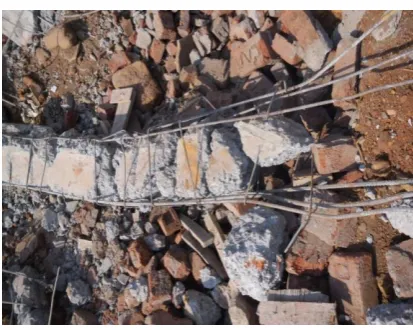
III. There was also presence of cobbles for manufacturing of concrete which could be clearly seen in the photograph below.
IV. This also clearly indicated that proper sieve analysis was not done for design mix which ultimately resulted into poor concrete.
V. From informal sources it was known that insufficient curing time was also one of the reasons for collapse.
3.3 Analysis of case study-
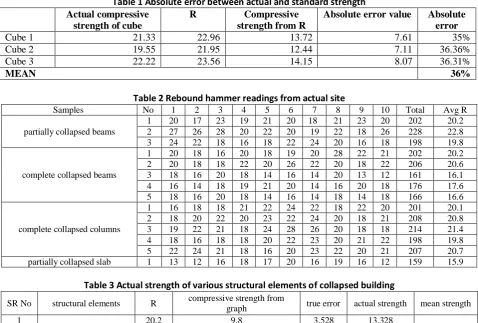
In order to check the quality of concrete rebound hammer test and concrete core sample was taken from the site. For the purpose of carrying out NDT on site it was necessary to calibrate the instrument. For this purpose it was necessary to take readings on the cube of M20 concrete. For this purpose readings were taken on 3 cubes on different faces of cube and 10 readings on each face were taken. The average was taken of these readings. The results were compared with the standard graph provided by the manufacturers of the instrument. This graph provided by the manufacturers was upto rebound number 20 but this graph was extended upto rebound number 10. As per the values of rebound number the values of compressive strength of cube were determined.
collapsed members as well as the members which were partially collapsed. We have conducted NDT on site by use of rebound hammer. The results from rebound hammer are discussed below.
Core samples from site were also taken with the help concrete core cutter. 3 samples were tested of concrete by subjecting them against compressive load. There were few samples which were collected during the site visit which were tested after dressing them properly in order to make the surface plain on which the load would be applied. The results from the test have been formulated below.
In the below table the compressive strength of cubes is compared with rebound number and corresponding graph
values. Thus the absolute error is calculated. This absolute error would be added to compressive strength derived from NDT to calculate actual strength of samples. There is great difference in compressive strength from NDT and from core samples only in case of slabs as compared to Beam and Column. This because the NDT readings were taken on partially collapsed slab and core was taken on completely collapsed slab. Absolute error value = (actual compressive strength of cube) – (compressive strength from R)
Absolute value =
Table 1 Absolute error between actual and standard strength
Actual compressive strength of cube
R Compressive
strength from R
Absolute error value Absolute error
Cube 1 21.33 22.96 13.72 7.61 35%
Cube 2 19.55 21.95 12.44 7.11 36.36%
Cube 3 22.22 23.56 14.15 8.07 36.31%
MEAN 36%
Table 2 Rebound hammer readings from actual site
Samples No 1 2 3 4 5 6 7 8 9 10 Total Avg R
partially collapsed beams
1 20 17 23 19 21 20 18 21 23 20 202 20.2
2 27 26 28 20 22 20 19 22 18 26 228 22.8
3 24 22 18 16 18 22 24 20 16 18 198 19.8
complete collapsed beams
1 20 18 16 20 18 19 20 28 22 21 202 20.2
2 20 18 18 22 20 26 22 20 18 22 206 20.6
3 18 16 20 18 14 16 14 20 13 12 161 16.1
4 16 14 18 19 21 20 14 16 20 18 176 17.6
5 18 16 20 18 14 16 14 18 14 18 166 16.6
complete collapsed columns
1 16 18 18 21 22 24 22 18 22 20 201 20.1
2 18 20 22 20 23 22 24 20 18 21 208 20.8
3 19 22 21 18 24 28 26 20 18 18 214 21.4
4 18 16 18 18 20 22 23 20 21 22 198 19.8
5 22 24 21 18 16 20 23 22 20 21 207 20.7
partially collapsed slab 1 13 12 16 18 17 20 16 19 16 12 159 15.9
Table 3 Actual strength of various structural elements of collapsed building
SR No structural elements R compressive strength from
graph true error actual strength mean strength
1
partial collapsed beam
20.2 9.8 3.528 13.328
14.59
2 22.8 12.7 4.572 17.272
3 19.8 9.7 3.492 13.192
4
collapsed beams
20.2 10.03 3.6108 13.6408
12.284
5 20.6 10.5 3.78 14.28
6 16.1 7.88 2.8368 10.7168
7 17.6 8.62 3.1032 11.7232
8 16.6 8.13 2.9268 11.0568
9
collapsed columns
20.1 9.91 3.5676 13.4776
14.288
10 20.8 10.74 3.8664 14.6064
11 21.4 11.56 4.1616 15.7216
12 19.8 9.7 3.492 13.192
13 20.7 10.62 3.8232 14.4432
Table 4 Compressive strength of concrete samples Sr
no Sample
Area of sample in mm2
Sample Failure load in N
Compressive strength in N/mm2
1 Sample 1 5941.665 80932.5 13.62
2 Sample 2 13200 94176 7.134
3 Sample 3 19200 220136.4 11.4654
Table 5 Comparison of NDT results with compressive strength results Comparison of strength of NDT test and core testing results
Elements Strength derived from NDT test Strength from core testings Difference % variation
Beam 12.28 11.46 0.82 6.71
Column 14.28 13.62 0.66 4.62
Slab 10.60 7.13 3.47 32.74
4. O
UTCOMESA
NDD
ISCUSSIONI. From the test results it was clear that collapse of structure was because of concrete failure as the observed strength of concrete was less as compared to the designed strength.
II. The concrete mix used was M20 but the strength obtained from rebound hammer test and core test were 12.94 N/mm2 and 10.73 N/mm2 which is very less as compared to what the required should be.
III. The difference between actual compressive strength of collapsed beam, collapsed slab and partially collapsed slab and the results from NDT was found to be 0.82, 0.66 and 3.47N/mm2. IV. The average concrete strength found after
compressive test results was also 10.73N/mm2 which is very less as compared to design strength of concrete i.e. 20 N/mm2.
V. There was use of cobbles in manufacturing of concrete which can be clearly seen in the photographs below.
VI. There were no standard practices adopted on site such as sufficient curing times, sieve analysis, etc. from the presence of cobles in the concrete. VII. There was no use of vibrators on site at the time of
construction of building resulting into poor column and beam joints.
VIII. Thus it is observed that this failure is caused due to lack of proper inspection and poor workmanship.
Fig 1 compressive strength vs structural elements
5.
C
ONCLUSIONDepending on the research carried out on live case studies the prominent causes responsible for failure of structures have been determined. The prominent cause in this case was concrete failure use of non-standard practices on site like insufficient curing times, absence of proper sieve analysis, use of cobbles in concrete. Thus it is very much important to carry out inspection test on site in order to check the quality of concrete used in construction and the reports of the test must certified from engineer in order to stop such malpractices occurring during concreting activity.
Fig 2 Presence of Cobbles In Concrete
Fig 3 Presence of cobbles and boulders in concrete of beam
Fig 4 Destruction of concrete can be seen
R
EFERENCES1. Dr. Akhil Ahmed, Prof. MehtabAlam, and Dr. Asif Husain.-Investigation of Structural Failure of a RC Hotel under Construction(2013), International Journal of Chemical, Environmental & Biological Sciences (IJCEBS) Volume 1, Issue 3, 458-462
2. Emilio M. Morales-Failures in Design and Construction and Their Investigation – Case Studies,1-9.
3. Ilías Ortega and SørenBisgaard (2000) - Quality Improvement in the Construction Industry: Three Systematic Approaches,Quality Management and Technology Report No. 10, 1-10.
4. Ilías Ortega (2000)-Systematic Prevention of Construction Failures,Quality Management and Technology Report No. 9, 1-13.
5. Ir.Dr.Gue See Sew and Ir.Tan Yean Chin- Prevention of Failure of Bridge Foundation and approach Embankment on Soft ground
6. Janet K.Yates and Edward E.Lckley (2002)-Documenting and analyzing construction failures, Journal of Construction Engineering and Management, 8-17.
7. KumalasariWardhana And Fabian C.Hadipriono(2003)-Analysis Of Recent Bridge Failures In The United States, Journal Of Performance Of Constructed Facilities, 144-150 8. S.K.kong -Preventive Measures of foundation
Failures (1997) – Case Studies, International Conference of Foundation Failures, 551-557. 9. ZiadA.Eldukair and Bilal M.Ayyub
(1991)-Analysis of recent U.S. Structural and construction failures, Journal of Performance of Constructed Facilities, vol 5, 57-73.
10. Dr.V.V.S.Rao (2009)- International Society for Soil Mechanics and Geotechnical Engineering Forensic Geotechnical Engineering
11. Dov Kaminetzky- Design and construction failures- lessons from forensic investigations, Galgotia publications.
R
EFERREDIS
C
ODE12. IS 456:2000, Indian standard plain and reinforced concrete code of practice, fourth revision, eight reprint Nov 2005.
13. IS 13920:1993 Indian standard code for ductile detailing of reinforced concrete structures subjected to seismic forces — code of practice clause number