© 2019, IRJET | Impact Factor value: 7.34 | ISO 9001:2008 Certified Journal
| Page 1381
Effect of Curing Temperature on the Strength Properties of M30 Grade
GPC made with M-Sand
Manivannan.S
1, Gayathri.S
2, Umanambi.J
31
P.G Student, Department of Civil Engineering, Paavai Engineering College,
2
Assistant Professor,
3Head of Department, Department of Civil Engineering, Paavai Engineering College,
Tamil Nadu, India.
---***---Abstract –
The cement industry is one of the mainproducers of greenhouse gases. Therefore, efforts are needed to make the concrete more environmentally friendly by using fly ash, which helps to overcome global warming and the problems arises in the disposal of fly ash. This article deals with the development of intermittent connection materials in the construction industry. Fly ash based Geopolymer Concrete is a reliable choice, but requires thermal hardening for the polymerization process. In this work we try to investigate the influence of temperature and type of curing on the strength properties of fly ash based geopolymer concrete, with the fine aggregate being replaced by M-sand. Geopolymer concrete grade M30 was prepared with chemically activated treated fly ash using alkaline solutions such as sodium silicate (Na2SiO3)
and sodium hydroxide (NaOH). In this study, a concentrated solution of 16 M sodium hydroxide is used. All samples were cured at different temperatures in an oven at 60°C, 80°C, 100°C, 120°C and 1400C for 16 hours and tested for 7 days. It
was concluded that GPC blends cured at 100°C give better results than specimens treated at other curing temperatures.
Key Words: Geopolymer Concrete, Oven Curing, M-Sand, Alkaline Solution
1. INTRODUCTION
Concrete is the most commonly used building material, consisting of a mixture of cement, sand, coarse aggregates and water. Ordinary portland cement (OPC) is conventionally used as a primary binder for concrete production. Producing one ton of cement requires about 2 tons of raw materials, shale and limestone, and releases a large amount of carbon dioxide (CO2) into the atmosphere, which contributes significantly to the greenhouse effect. The amount of CO2 released during the manufacturing process of OPC is of one ton per ton of OPC produced. Worldwide, OPC production accounts for about 7% of global CO2. That brings about 1.6 billion tons of CO2 into the atmosphere.
Therefore, it is necessary to find another type of binder to make a greener concrete. The use of industrial by-products in this sector could become an important way for the large-scale and safe disposal of industrial waste and the reduction of construction costs.
1.1 Geopolymer Concrete
Davidovitts completed a very important study in 1978 by discovering geopolymer concrete, which was concrete without cement. This has attracted many attentions, where fly ash has completely replaced the cement. He had his own qualities and left extraordinary impressions in research studies.
The geopolymer is an inorganic alumina-silicate compound made from materials of geological origin or derived materials such as fly ash, rice husk, etc., which are rich in silicon and aluminum. Geopolymers technology could reduce the atmospheric CO2 emissions of the cement and aggregates industry by about 80%. Direct alkaline activation of industrial waste, such as fly ash, can produce a geopolymer that can be used to construct new concrete for construction. This can be considered as a sustainable approach to construction, as the internal energy content of these new concretes is much lower than that of ordinary Portland cement concrete (OPCC), making Portland cement, one of the largest contributors to the greenhouse, completely eliminate gas emissions.
1.2 Fly Ash Based Geopolymer Concrete
Fly ash is one of the most abundant materials on earth. Due to its role in geopolymerization, it is also a crucial component in the production of geopolymer concrete. Fly ash is a pozzolan powder. A pozzolan is a material that has cementing properties in combination with calcium hydroxide. Fly ash is the major by-product of coal combustion in coal power plants.
© 2019, IRJET | Impact Factor value: 7.34 | ISO 9001:2008 Certified Journal
| Page 1382
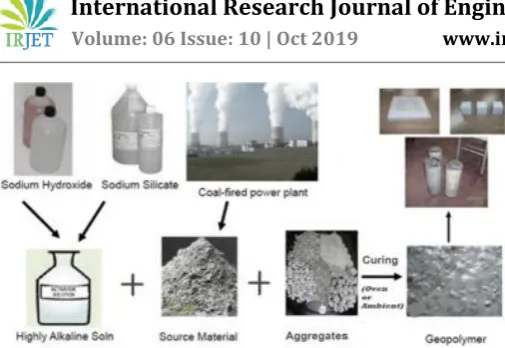
Fig -1: Geopolymer Concrete1.3 Manufactured Sand
In emerging countries, the need for natural sand is crucial. In India, natural sand deposits are degraded and pose a major threat to the environment. In order to sustainably grow the infrastructure, replacement material is required that meets the technical requirements for fine aggregates and must be available in abundance. Treated sand provides a viable option to replace natural river sand. It is a fine design granulates made of crushing stones and stones.
2. REVIEW OF LITERATURES
A literature review or narrative review is a type of review article. A literature review is a scholarly paper, which includes the current knowledge including substantive findings, as well as theoretical and methodological contributions to a particular topic.
Pradeepkumar et al. (2017) submitted an article on the development of GPC strength by employing M-sand instead of river sand. The results showed that M-Sand replacement reduced hydration as well as an increase of 4.08% and 9.51% in compressive strength for 5M and 10M were noted. An increase of 9% and 2% of the tensile strength for 5M and 10M respectively were noted.
Sreenivasulu et al. (2016) replaced sand with granite sludge by 0%, 20%, 40% and 60%. The GPC cubes were cast from 8M using fly ash and 50:50 GGBS. The test results show that the optimal replacement percentage of the granite slurry is 40%.
Kalaivani (2015) studied the flexural strength of fly ash based geopolymer concrete and compare it with conventional concrete. Geopolymer concrete is manufactured by cement fully replacing fly ash which is chemically activated by alkaline solutions like sodium silicate and sodium hydroxide. The concentration of sodium hydroxide was 8M, 10M & 12M. The specimens were cast for each molarity and tested at 7, 14 & 28 days. It was observed that the compressive, split tensile and flexural strength increases with increase in molarity and curing days. It was also observed that flexural strength of geopolymer concrete is lower than the conventional concrete.
Ghosh et al. (2015) studied the effects of synthetic parameters on setting time and ease of workability fly ash based geopolymer paste. It has been witnessed that the development of setting time and workability capacity as well as the microstructure depend mainly on the alkali content, the silica content and the water to binder ratio. To dissolve fly ash during the geopolymerization process, strong alkaline solutions are required. Water plays a vital role in the hardening of geopolymer, dissolution and polycondensation. The water content should be adjusted to a minimum by taking into account of the desired workability of the geopolymer mixture.
George et al. (2011) highlighted the mechanical properties of activated fly ash concrete and compare the results with fly ash concrete. Calcium oxide and sodium silicate in the ratio 1:8 was used for the activation of fly ash. Concrete mixture was prepared by replacing the cement with fly ash at 10%, 20%, 30%, 40%, 50% & 60% with water binder ratio 0.45. Specimens were cast for both activated fly ash concrete and fly ash concrete. It was observed that activated fly ash concrete has better mechanical properties.
Adam A. A et al. (2010) made a study on the influence of the molarity of alkali activator on the strength, sorption capacity and carbonation of GPC based on activated alkaline slag (AAS) and fly ash (FA). Replacing with 30%, 50% and 70% OPC is replaced by GGBS and control concrete. Their report showed that the alkaline modulus had high impact on the sorption capacity of AAS and geopolymer. The phenolphthalein indicator did not give a clear indication between non-carbonate and carbonated areas in the GPC samples, and the sorption capacity of the mixed concrete decreased, but carbonation increased with the level of replacement.
Davidovits (2004) suggested that the binders could be produced by a polymeric reaction of alkaline liquids with the silicon and the aluminum in source materials of geological origin or by-product materials such as fly ash and rice husk ash it is termed as geopolymer.
Naik et al., (2003) investigated that long-term performance test for compressive strength, and density was performed using base samples. It is perceived that the Class F Fly Ash (FA) strength has a more enormous pozzolanic contribution than Class C FA. In general, Class F FA concrete mixtures have a greater resistance to fly ash than Class C FA.
[image:2.595.36.289.52.226.2]© 2019, IRJET | Impact Factor value: 7.34 | ISO 9001:2008 Certified Journal
| Page 1383
high-volume fly ash mixture incorporating 67% Class F flyash at the age of 7 years and visual observations revealed that the pavement sections containing high volumes of Class F fly ash (35 to 67% FA) concrete performed well in the field with only minor surface scaling. All other pavement sections have experienced very little surface damage due to the scaling.
Malhotra et al., (2002) predicted that the global impact of OPC production on greenhouse gas emissions would be around 1.35 billion tonnes per year. Greenhouse lies in the environment of the Earth. Cement is the most energy exhaustive building material after aluminium and steel.
Sahu et al (2003) have examined the significant increase in compressive strength, modulus of rapture and split tensile strength for both the concrete mixes when sand is partially replaced by stone dust.
3. MATERIAL PROPERTIES & MIX DESIGN
3.1 Fly Ash
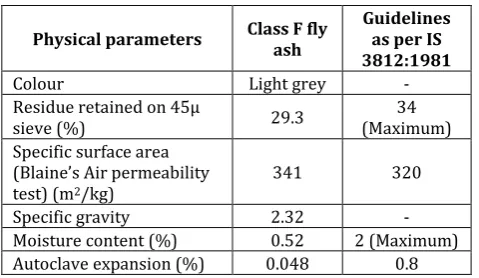
[image:3.595.362.506.228.322.2]Fly ash is the alumino silicate source material used for the synthesis of geopolymeric binder. Class F fly ash obtained from the Mettur Thermal power plant of Tamil Nadu was used for this study.
Table -1: Physical Properties of Fly Ash
Physical parameters Class F fly ash Guidelines as per IS 3812:1981
Colour Light grey -
Residue retained on 45µ
sieve (%) 29.3 (Maximum) 34
Specific surface area (Blaine’s Air permeability test) (m2/kg)
341 320
Specific gravity 2.32 -
Moisture content (%) 0.52 2 (Maximum)
Autoclave expansion (%) 0.048 0.8
Table -2: Chemical Composition of Fly Ash
Chemical
Composition Class F fly ash Guidelines as per IS 3812:1981
SiO2 55.1 35 (Minimum)
Al2O3 27.8 -
Fe2O3 7.85 -
SiO2 + Al2O3 + Fe2O3 90.75 70 (Minimum)
MgO 1.42 5 (Maximum)
SO3 1.22 2.75 (Minimum)
Na2O 0.89 1.5 (Minimum)
CaO 0.09 5 (Maximum)
LOI 2.33 12 (Maximum)
3.2 Manufactured Sand
Manufactured sand is made by crushing rock depositions to create fine aggregate of angular in shape and has rougher surface texture than river sand particles. The shape and texture of crushed sand particles could lead to improvements in the strength of concrete due to greater interlocking between particles. Fine aggregate properties were evaluated as per the IS 383-1970 methods.
Table -3: Properties of Manufactured Sand
Property Value
Type Crushed
Shape Spherical
Maximum Size 4.75mm
Fineness modulus 2.92
Bulk Density (kg/m3) 1814
Water absorption 1.6
Specific Gravity 2.85
3.3 Coarse Aggregate
[image:3.595.43.283.421.560.2]Coarse aggregates comprising of max size 20mm. Aggregates were in saturated surface dry condition. The obtained properties on the coarse aggregate used in this investigation are illustrated in table 4.
Table -4: Properties of Coarse Aggregate
Property Value
Type Crushed
Shape Angular
Maximum Size 20mm
Fineness modulus 6.4
Bulk Density (kg/m3) 1654
Water absorption 0.85
Specific Gravity 2.72
3.4 Alkaline solution
A combination of sodium hydroxide (NaOH) and sodium silicate (Na2SiO3) solutions were used for the activation of fly ash.
Table -5: Properties of sodium hydroxide pellets
Flakes size Specific gravity Purity
3 mm 2.13 98%
Table -6: Properties of sodium silicate
Composition % by mass
Na2O 7.5 - 8.5
SiO2 25– 28
Water 65.3– 37.5
Specific gravity 1.53
[image:3.595.364.505.428.523.2]© 2019, IRJET | Impact Factor value: 7.34 | ISO 9001:2008 Certified Journal
| Page 1384
3.5 Super plasticizer
[image:4.595.302.567.175.273.2]In this project super plasticizer CONPLAST – SP 430 in the form of sulphonated Napthalene polymers complies with IS 9103-1999 is used to improve the workability of concrete. It is formulated to produce high quality concrete of reduced permeability. The table 4.6 shows the properties of CONPLAST – SP 430.
Table -7: Properties of conplast-SP430
Physical tests Analysis
Appearance Brown liquid
Specific gravity 1.224
Chloride content NIL
Air entrainment 1%
3.6 Preparation of GPC
Sodium Hydroxide pellets are taken and dissolved in water at the rate of 10 molar concentrations. It is strongly recommended that the sodium hydroxide solution and sodium silicate gel must be mixed and prepared 24 hours prior to use and also if it exceeds 36 hours it terminate to semi solid liquid state. So the prepared solution should be used within this time.
3.7 MIX PROPORTIONING
Mix design for M30 grade geopolymer concrete is done based on the guidelines mentioned in IS 10262:2009. The various parameters considered for the mix design is shown below
Type of fly ash : Class F fly ash
Characteristic compressive strength of Geopolymer
Concrete (fck) = 30MPa
Type of alkaline activators used: NaOH & Na2SiO3
Concentration of Sodium hydroxide (Molarity): 10M
Solution-to-fly ash ratio by mass: 0.35
Sodium silicate-to-sodium hydroxide ratio by mass: 2.5
[image:4.595.306.564.314.576.2] Type of Curing: Oven Curing
Table -8: Mix Proportioning
Material
description Quantity (kg/m3) Proportion
Total Weight of GPC (kg/m3)
Fly ash 404 1
2528
NaOH 101 2.5 0.35
Na2SiO3 40.4
Fine aggregate 658.39 1.63
Coarse aggregate 1257.99 3.11
Water 66.22 0.16
4. EXPERIMENTAL INVESTIGATION
The effect of curing temperature on the strength properties of geopolymer concrete made with fly ash was assessed
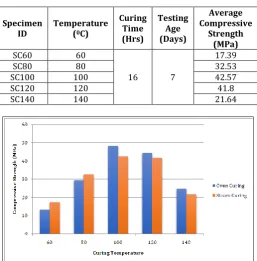
under varying curing methods such as oven and steam curing and curing temperature such as 60°C, 80°C, 100°C, 1200C and 140°C.
Table -9: Effect of Curing Temperature on GPC by Oven Curing
Specimen
ID Temperature (0C)
Curing Time (Hrs)
Testing Age (Days)
Average Compressive
Strength (MPa)
OC60 60
16 7
13.18
OC80 80 29.41
0C100 100 48.15
OC120 120 44.37
OC140 140 24.72
Table -10: Effect of Curing Temperature on GPC by Steam Curing
Specimen
ID Temperature (0C)
Curing Time (Hrs)
Testing Age (Days)
Average Compressive
Strength (MPa)
SC60 60
16 7
17.39
SC80 80 32.53
SC100 100 42.57
SC120 120 41.8
SC140 140 21.64
Chart -1: Effect of Curing Temperature on Compressive Strength of GPC
Based on the preliminary investigation, the curing temperature that can be adopted in curing for GPC is 1000C which could provide optimum results than the lower temperatures and oven curing will provide the effective and economical results than the steam curing. Then the M-Sand was replaced in the GPC mixes at an interval of 20% from 0 to 100.
Table -10: Compressive Strength Test Results
Specimen ID Average Compressive Strength (N/mm3 days 14 days 28 days 2)
[image:4.595.29.295.603.704.2]© 2019, IRJET | Impact Factor value: 7.34 | ISO 9001:2008 Certified Journal
| Page 1385
GPC20MS 16.53 36.02 40.99
GPC40MS 17.59 37.96 43.16
GPC60MS 18.47 38.31 44.6
GPC80MS 19.66 39.77 45.15
GPC100MS 20.38 40.14 45.93
[image:5.595.294.562.54.240.2]Chart -2: Compressive Strength Test Results
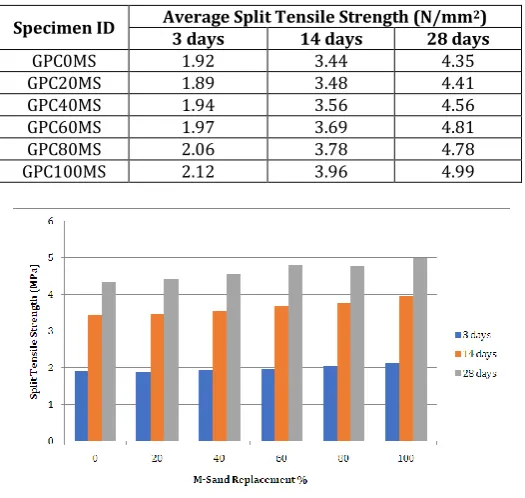
Table -11: Split Tensile Strength Test Results
Specimen ID Average Split Tensile Strength (N/mm3 days 14 days 28 days 2)
GPC0MS 1.92 3.44 4.35
GPC20MS 1.89 3.48 4.41
GPC40MS 1.94 3.56 4.56
GPC60MS 1.97 3.69 4.81
GPC80MS 2.06 3.78 4.78
GPC100MS 2.12 3.96 4.99
Chart -3: Split Tensile Strength Test Results
Table -12: Flexural Strength Test Results
Specimen ID Average Flexural Strength (N/mm2)
3 days 14 days 28 days
GPC0MS 3.11 6.56 7.64
GPC20MS 3.22 6.84 7.91
GPC40MS 3.28 7.01 8.16
GPC60MS 3.36 7.18 8.45
GPC80MS 3.51 7.47 8.79
GPC100MS 3.69 7.62 8.95
Chart -4: Flexural Strength Test Results
5. CONCLUSIONS
The following are the conclusions are drawn from the experimental investigation done on the M30 grade GPC under varying curing conditions and partial replacement of river sand with M-Sand.
GPC made with fly ash can be effectively used instead of conventional concrete to minimize the global cement production, consumption.
Oven curing provides better results than the steam curing when economical and strength parameters are taken into account.
Curing temperature of 1000C was considered as the optimum curing temperature whereas heating of GPC specimens beyond this limit retards the strength properties abruptly.
Full replacement of fine aggregate by M-Sand in GPC is feasible with increment in strength properties. At 28 days, the strength properties of GPC100MS are
19.11%, 14.71% and 17.15% than GPC0MS.
REFERENCES
[1] M.I. Abdul Aleem& P. D. Arumairaj, “Optimum mix for
the geopolymer concrete”, Indian Journal of Science & Technology, vol 5, No3, March 2012.
[2] Abhishek c. Ayachit, Pranav b. Nikam, Siddharth n. Pise,
Akash d. Shah, Vinayak h. Pawar, “mix design of fly-ash based geopolymer concrete”, International Journal of Scientific and Research Publications, Volume 6, Issue 2, February 2016 381 ISSN 2250-3153.
[3] Amnon K., and Hadassa B., (2006), Effect of high levels of
fines content on concrete properties, ACI Material Journal, 103, pp 474-481.
[4] R. Anuradha, v. sreevidya, r. venktasubramani and B. V
Rangan “Modified guidelines for geopolymer concrete mix design using Indian Standards” Asian Journal of Civil Engineering, Vol 13 No 3, 2012, page 353-364.
[5] BS EN 12390. Testing hardened concrete. Compressive
strength of test specimen. European Standards; 2002.
[6] Dali Bondar, “Geo-polymer Concrete as a New Type of
[image:5.595.31.294.357.606.2]© 2019, IRJET | Impact Factor value: 7.34 | ISO 9001:2008 Certified Journal
| Page 1386
[7] Davidovits J. Chemistry of Geopolymeric
Systems,Terminology. In: Joseph Davidovits, Davidovits R, JamesC, editors. Geopolymer '99 International Conference;1999 June 30 to July 2, 1999; France; 1999. p. 9-40.
[8] Djwantoro Hardjito, Steenie E. Wallah, D. M. J. Sumjouw
and B.V. Rangan, “Fly ash-Based Geopolymer Concrete, Construction Material for Sustainable Development”, Invited paper, Concrete World: Engineering and Materials, American Concrete Institute, India Chapter, Mumbai, India, 9-12 December 2004.
[9] Hardjito D, Wallah SE, Sumajouw DM, Rangan BV.
Factors influencing thecompressive strength of fly ash-based geopolymer concrete. Civil EnggDimension 2004;6(2):88–93.
[10] Hardjito D, Wallah SE, Rangan BV. Study on Engineering
Properties of Fly Ash-Based Geopolymer Concrete. Journal of the Australasian Ceramic Society2002;38(1):44-47.
[11] Hudson B.P., (1997), Manufactured sand for concrete,
The Indian concrete Journal, pp 237-240.
[12] Jaarsveld, J. G. S., J. S. J. van Deventer, G.C. Lukey (2003).
"The Characterisation of Source Materials in Fly Ash-based Geopolymers." Materials Letters 57(7): 1272-1280
[13] Kolli Ramujee, Member, IACSIT and M. Potharaju,
“Development of Low Calcium Fly ash Based Geopolymer Concrete”, IACSIT International Journal of Engineering and Technology, Vol. 6, No. 1, February 2014
[14] C. Marthong and T. P. Agrawal (2012), “Effect of Fly Ash
Additive on Concrete Properties”, International Journal of Engineering Research and Applications (IJERA)”, ISSN: 2248-9622, Volume 2, Issue 4, pp. 1986-1991.
[15] Madheswaran C. K, Gnanasundar G, Gopalakrishnan. N
“Effect of molarity in geopolymer concrete” International journal of civil and structural engineering volume 4, no 2, 2013.
[16] Monita Olivia & Hamid R. Nikraz, “ Strength& Water
Penetrability of fly ash based geopolymer concrete”, ARPAN Journal of Engineering & Applied Sciences, vol 6 ,No 7, July 2011,pp70 to 78.
[17] Nimitha Vijayaraghavan, A S Wayal ,"Effects of
manufactured sand on compressive strength and workability of concrete", International. Journal of structural & civil engineering research, 2(4), 2013.
[18] Dr. S L Patil, J N Kale and S Suman (2012), “Fly Ash
Concrete: A Technical Analysis for Compressive Strength”, International Journal of Advanced Engineering Research and Studies, E-ISSN: 2249–8974, Volume 2, Issue 1, pp. 128-129.
[19] Prakash R. Vora, Urmil V. Dave, “Parametric Studies on
Compressive Strength of Geopolymer Concrete”, Procedia Engineering 51 (2013) 210 – 219, Published by Elsevier Ltd.
[20] N.P. Rajmane, M.C. Nataraja & N. Lakshmanan“ An
introduction to geopolymer concrete ”, The Indian Concrete Journal November 11 vol 85, No 11, pp 25 to 28.
[21] Salvador Villalobos, Lange D.A. and Roesler J.R.,
Evaluation, testing and comparison between crushed manufactured sand and natural sand”, Technical Note pp. 1-6.
[22] Dr. Suresh G Patil, Ram Panth and Feroz, "Experimental
Investigation on Geopolymer Concrete", International Journal for Scientific Research & Development (IJSRD), 2015, e-ISSN: 2321-0613, Volume 3, Issue 4, pp. 894-896.
[23] C. Sashidhar, J. Guru Jawahar, C. Neelima, D. Pavan
Kumar, "Preliminary Studies On Self Compacting Geopolymer Concrete Using Manufactured Sand", Asian Journal Of Civil Engineering (BHRC), 2016, VOL. 17, no.3, pp 277-288.
[24] Satpute Manesh B., Wakchaure Madhukar R., Patankar
Subhash V. “Effect of Duration and Temperature of Curing on Compressive Strength of Geopolymer Concrete” International Journal of Engineering and Innovative Technology (IJEIT) Volume 1, Issue 5, May 2012.
[25] B. Siva Konda Reddy, K. Naveen Kumar Reddy and J.
Varaprasad (2011), “Influence of Curing Conditions on Compressive Strength of Cement added Low Lime Fly Ash based Geopolymer Concrete”, Journal of Engineering Research and Studies, E-ISSN : 0976-7916, Volume 2, Issue 4, pp. 103-109.
[26] Suresh Thokchom, Dr.Partha .Ghosh and Dr. Somnath
Ghosh. “ACID RESISTANCE OF FLY ASH BASED GEOPOLYMER MORTARS”. International Journal of Recent Trends in Engineering, Vol. 1, No. 6, May 2009.
[27] K.Vijai, R.Kumutha&B.V.Rangan , “ Effect of types of
curing on strength of geopolymer concrete”, International Journal of the Physical Sciences, vol 5(9), 18 August 2010, pp 1419 to 1423.
[28] P. Vignesh and K. Vivek, "An Experimental Investigation
on Strength Parameters of Fly ash based Geopolymer Concrete with GGBS", International Research Journal of Engineering and Technology (IRJET), 2015, e-ISSN : 2395-0056, p-ISSN : 2395-0072, Volume 2, Issue 2, pp. 135-142.
[29] 34. Vinod Kumar Gupta,Prof Akhil Khare “Geopolymer
concrete” SSRG International Journal of Civil Engineering –volume 2 Issue 4 April 2015