Copyright © 2014 CTTS.IN, All right reserved
Mobile Application Development Framework:
Exploring and Discussion
Dr Adnan Mustafa AlBar
Assistant Professor,Information Systems Department, Faculty of Computing and Information Technology, King Abdulaziz University, Kingdom of Saudi Arabia
Abstract —Mobile computing technology allows people to access data and information from where ever they are through a variety of devices. Mobile devices are now able to operate complicated applications from different sectors/domains that could run only in servers.
Mobile devices are enabling organizations to perform business more effectively. Mobile applications are increasingly becoming a main concern across all business sectors as companies look to extend their services to people that is using smartphones. They can be used to support e-commerce with customers and suppliers, and to conduct e-business within and across organizational boundaries. These trends make it possible to increase business agility, individual productivity and job satisfaction by release people to choose the best time, place and device to get their work done.
In this paper we will introduce the enterprise business applications and how it moved towards mobility. We take a look on mobile applications development and enterprise mobile applications framework and models. In addition, we will investigate about the architecture of enterprise mobile applications and the importance of securing the mobile applications.
Keyword — Mobile applications, Application Development, Development Framework, Enterprise Mobile Applications
1. I
NTRODUCTIONWhether it is the domain of personal life, professional work or collective society, everyone and everything is dominated by Mobile technology; it has crept in our lives in the form of computers, cell phones, desktops, laptops, notebook computers, palmtops, PDAs, GPS, smart phones, pagers and many more. In the fast paced world of today, enterprises cannot compete without mobile technology; applications specifically developed for enterprises are largely being used for ease of communication, real-time data and information access, better responsiveness and low costs.
Some of the major advantages of using enterprise mobile application development framework are enhancement in productivity, cost cuts, make earnings, shorter development cycles and problem solving among others [1]. However, not all enterprise mobile applications are equally beneficial; it is important to target the right application development to yield maximum benefit in the form of high pay off.
One way of enhancing the application experience of enterprise employees is to allow the trend of Bring Your Own Device (BYOD) where the employees receive a set budget and have to manage their own device within it; organization can provide them with their preferred applications for specific functions, but every person can use specialized applications based on their needs [2]. The diversity that comes with this trend is hard to manage and so are the security concerns that arise. This trend is also commonly known as employee-liable devices [3]. As the variety of applications for each instance of business operation is multiplying manifold, it is hard to assess the mobile applications that are being supported on company‟s expense. Also if the organization decides to offer its licensed applications to its employees, how will they manage installing the same application on diverse devices? If the same development platform is used, it will be easier to share data among applications and devices [3]. The demand curve for enterprise mobility is moving with the pull trend because the end users have realized the great utility of these applications and are asking for more convenience [4].
2.
E
NTERPRISEB
USINESSA
PPLICATIONSEnterprises are largely using software applications to make their routine tasks easier. Developers have also targeted this niche area and developed software applications that are specific to business users. In the past, the IT developers used to create applications and when people found them useful, the applications gained popularity. The trend has changed tremendously now; today, the demand is being „pulled‟ from the consumer end and they are asking for applications related to specific functions.
perform specific functions for an organization. This is similar to the concept where an application is built to perform a function or a set of functions for an individual; enterprise applications fulfill the requirements of a whole organization.
Since the early days of application development, enterprises have recognized the usefulness of developing applications to serve their business functions to improve daily business operations and keep track of everyday business transaction. Since then, business applications have been widely designed and used in various business domains
such as finance, accounting, inventory, human resources and many more.
3.1
B
USINESSF
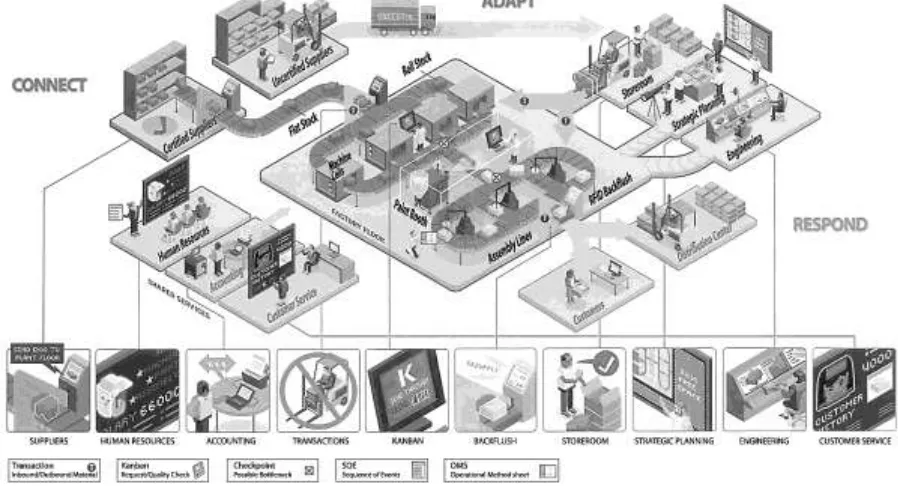
UNCTIONSThe domain covered by Enterprise Mobile Applications has broadened a lot; today they cover every imaginable aspect of business operations. Business functions performed by these applications can be broadly classified into two categories: core businesses and support businesses. Figure 1.1 depicts some important functions in both categories.
Fig. 1. The interaction among core and support business functions within an organization
3.1.1 Core Business Functions
Core business functions are the ones that are related to the central function that is performed by an organization. Enterprises pay special attention to procure applications to aid their main functions. Core business function applications can include but are not limited to Research and Development, Business Intelligence, Supply Chain Management, Strategic Planning, Marketing, Inventory Management, Customer Relationship Management and Assembly Line.
3.1.2 Support Business Functions
Support business functions are the routine functions performed in an organization that keep it working. Generic application can be procured for support functions as they are easily available in the market. Example of support business function applications include Human Resource Management, Accounting, Billing System/Finance, Communication, Payroll Processing, Enterprise Resource
Planning, Payment Processing, Security, Project Management and many more.
3.1.3 Mobile Applications Development
Mobile Applications denote the use of softwares that can be used from any place, at any time, using any device. This gives complete independence in terms of time, location and device constraints. Integrated Development Environments (IDEs) are largely being used to write mobile applications for generic and specific purposes.
Copyright © 2014 CTTS.IN, All right reserved great demand because they provide an extra edge in the
form of rich user experience.
Today, the competition between the mobile application developers has increased so tremendously that majority of developers are floating their application for free to gain user acceptance; very few developers opt for paid apps; yet others go for free trials, free limited versions, advertisements in applications and other models to generate revenue from their apps. The market share is not yet captured by huge companies, so pull demand is being catered by independent developers.
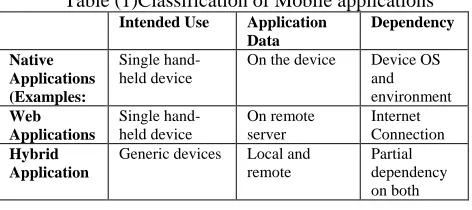
Table (1)Classification of Mobile applications
Intended Use Application Data Dependency Native Applications (Examples: Single hand-held device
On the device Device OS and environment Web Applications Single hand-held device On remote server Internet Connection Hybrid Application
Generic devices Local and remote
Partial dependency on both
4.1
F
RAMEWORKThe rationale behind implementation of a mobile application development platform is that there should be a common ground for development so that scalability, sharing and transfer of data become easier; it also makes management of devices and applications much easier. There is no standard definition for an ideal framework because it varies according to the scope and needs of an enterprise.
Mobile Application Development is the process which is used to develop application software for handheld devices like Personal Digital Assistants (PDAs) or mobile phone. These applications are usually developed using mobile application development frameworks that are targeted towards development of applications ranging from responsive websites to Mobile Web Applications, Native Applications and Hybrid Applications.
The suitability of a development framework can be judged by the development language (such as PHP, Java, Ruby on Rails, Action Script, C#, Lua, HTML, CSS, Java Script, C++ etc) it supports, hardware features (such as Accelorometer, Camera, Capture, Compass, Connection, Contacts, Device, Native Events, File, Geolocation, Notification, Storage, Gestures & Multitouch, Messages & Telephone, Bluetooth, Near Field Communication and Vibration) it enables the developer to interact with,and required user interface capabilities (such as Responsiveness, UI Widgets and Accessibility). Availability of additional features (like SDK, Encryption and Advertisement) along with licensing options (e.g. Free, Open Source) also influences the selection of a mobile application development framework.
A number of mobile application development frameworks are in wide-spread use these days. They are judged on suitability criterion like platform, potential users, available languages, supported hardware features, user interface, encryption and licensing. The table shows a comparison of different mobile frameworks for a thorough analysis.
Table (2)Comparison Chart for Mobile Application Development Frameworks Framew ork Pl atfor m Targe t Lan guage Har dw are fe
ature User
inter fac e En cr yption Lic ense Apache Flex[6] iOS, Android, Blackberry Mobile websites, Web Apps, Native Apps, Hybrid Apps Action Script, C++ Accelerometer, Camera, Capture, Compass, Connection, Device, Native Events, File, Geo Location, Storage, Gestures &Multitouch, Messages & Telephone
Corporate Design, Widgets, Accessibility
Yes Free,
Open Source Applicati on Craft[7] iOS, Android, Windows Mobile, Windows Phone, Blackberry, Symbian, Meego, WebOS Mobile Website, Web App, Hybrid App HTML, CSS, JS
Hardware features are supported via plug ins
Corporate Design, Widgets, Accessibility
No Free
Framew ork Pl atfor m Targe t Lan guage Har dw are fe
ature User
inter fac e En cr yption Lic ense
e Chip – UI[8] Android, Windows Phone Web App, Hybrid App
CSS, JS Open
Source DHTML X Touch[9] iOS, Android, BlackBerry Mobile Website, Web App HTML, CSS, JS
Storage Corporate
Design, Widgets
No Free,
Open Source iWebKit
[10]
iOS Mobile Website,
Web App HTML, CSS, JS Accelerometer, Device, Geolocation, Storage, Gestures &Multitouch, Messages & Telephone
Corporate Design is partially supports
No Partial
ly Free, Open Source Mono for Android[ 11]
Android Native App,
Hybrid App
Java, C# Accelerometer, Camera,
Capture, Compass, Connection, Contacts, Device, Native Events, File, Geo Location, Notification, Storage, Gestures &Multitouch, Messages & Telephone, Bluetooth, NFC, Vibration Corporate Design, Widgets, Accessibility
Yes -
MonoTo uch[12]
iOS Native App,
Hybrid App
C# Accelerometer, Camera,
Capture, Compass, Connection, Contacts, Device, Native Events, File, Geo Location, Notification, Storage, Gestures &Multitouch, Messages & Telephone, Bluetooth, NFC, Vibration Corporate Design, Widgets, Accessibility
Yes -
Wink[13 ] iOS, Android, Blackberry, Bada Mobile website, Web App HTML, CSS, JS Accelerometer, Geo Location, Storage, Gestures & Multitouch
Corporate Design, Widgets
No Free,
Open Source
4.2 Mobile Application Development Technologies There are many new technologies that are emerging in the field of Mobile Application Development; but developers like to stick with the few popular ones. Among the widely used technologies, the most favored ones are:
Native applications using iOS, Android, Mac, Windows Java-script platforms like jQuery Mobile, Sencha Touch, Appcelerator Titanium
Frameworks like PhoneGap, Bootstrap, Meteor, Corona, iPhone, Java
4.3 Limitation and Issues
Application development for mobile devices and enterprises in not a smooth sailing, there are a number of limitations and issues that come its way. Top five of these are discussed below:
Security
Mobile application can be accessed from anywhere, using any devices; this brings in ease but also introduces security concerns. Not every data is intended for being shared with public. The same is true for enterprise applications that aim at protecting enterprise‟s data from people outside the enterprise. Most applications used by enterprise users have security features embedded in them. The basic security features of mobile and enterprise applications are password protection and encryption; however, if further security is required, enhanced security applications are also available off the shelf or for customization[14].
Privacy
Copyright © 2014 CTTS.IN, All right reserved become available to public at large and hence become
prone to misuse. In order to prevent this situation, every application developer should sign the privacy agreement with the user before using it.
Performance
Another significant issue with applications is their performance decline. The normal trend is that applications perform well when they start working, but as the user load increases, their performance starts declining. Many mobile and enterprise applications do not have the ability to improve their performance as their usage load increases.
Usability
It is of utmost importance to ensure that the application performs the desired function effectively and efficiently. In real world, there are usability issues with applications as they fail to deliver up to the mark.
Reliability
In normal circumstances, most applications perform well; but under unforeseen circumstances, the applications fail. Reliability is a considerable issue where the developers fail to assess the scenarios where the application may crash down. As the application is modified to bring new versions, the consistency in certain performance features may also decline, thus damaging its reliability.
1. Enterprise Mobile Applications
Decision makers in today‟s fast paced world need enterprise applications that are available on the go. Everyone needs to stay connected in order to transfer information in real-time. Enterprise employees may be using different mobile applications to perform their routine and specialized functions, but they need to integrate data for effective and timely decision making. The business need for enterprise mobility is also evident from the fact that if the organizations need to cater to over two hundred million potential customers who are using smart phones and tablets, then they need software solutions that can travel with these people.
The dilemma with enterprise mobile application development is to create such applications that are mobile from the end user‟s point of view (he or she can carry it and use it from anywhere) and still manageable from the enterprise‟s point of view (tracked and administered from the business servers). Enterprise applications have moved towards mobility where the application is stored on the remote server or using cloud computing, and the data resides on the user device, thus providing access of use from any location. This enterprise mobility has its own disadvantages but has given a huge leap to the application features.
Enterprise Mobile Applications took a huge leap from an old era where the IT department of any organization had complete hold on the mobile devices that were used and how they were used. As mobility improved in mobile
devices, there came the trend of “Bring Your Own Device”. Along with many of its benefits, there also came certain drawbacks in the form of security issues, standardization and cost concerns among many others. Tracking these devices is vital but today it is considered as an attack on personal liberty. With this greater independence came a variety of mobile applications that are being used for work functions. Previously only the IT managers approved the applications to be used and purchased them on the behalf of the organization; now everyone can use any additional applications that they deem useful. The competition in every work domain also calls for out-of-box applications that can provide something more than what competitors are doing.
5.1
P
LATFORMIn the realm of enterprise wide mobile applications, it is nearly impossible to manage a single platform for business applications. There should be a framework in place that combines diverse work formats from different persons/work teams/departments and yields the results in a single format. It is of critical importance to have a defined layout for the final results. It is best practice to have a single development platform throughout the organization, but an organization can have more than one platforms (on department, geographic basis, may be) if needed.
In 2008, a Mobile Enterprise Application Platform (MEAP) came to surface which aimed at bringing uniformity among the diverse mobile devices and handling varied networks. MEAP was used by companies to develop a multi-purpose mobile application that can later be deployed on multiple devices using the same logic.
There is a variety of platforms that a development framework needs to support for mobile application development such as iOS, Android, Windows Mobile, Windows Phone, Blackberry OS, Symbian, MeeGo, Maemo, WebOS, Bada and JavaME. All the development frameworks do not support all the platforms therefore there is a need to analyze the requirements of the application and select a suitable framework for development of a mobile application under any platform.
International Data Corporation published a research according to which the percentage of platforms used in 2016 for mobile application development will be as follows:
Table (3)Mobile Platform Percentage Use As Anticipated In 2016
Mobile Platform Percentage Use
Android 68.8%
iOS 19.1%
Windows Phone 11.4%
BlackBerry OS 4.1%
5.2 Enterprise Mobility Framework
In order to manage the enterprise mobility factors and keep a check on the drawbacks that come with it, every organization needs a framework. A reference framework sets a pattern on which the enterprise employees are supposed to act. If the organization desires to have consistency and effective collaboration, there should be a single distinct reference framework in operation.
Any framework and infrastructure chosen for achieving enterprise mobility should be able to provide the following functionalities:
24/7 connectivity
Tendency to adapt with changing technology Independence of place, product and time Capability to perform simple and complex tasks
Flexibility regarding mobile infrastructure Strategic security planning
Access across multiple channels Compliance with industry standards Generic and adaptable business model Cross browser support
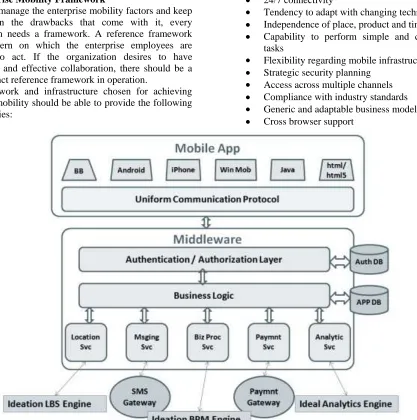
Fig. 2. A framework of Mobile Application development
Figure shows an enterprise mobility framework that shows the interaction among various components. The „Mobile App‟ is the part where the actual development takes place in development languages like Action Script, HTML/HTML 5, CSS, JS, C, C++, CSS, Android, jQuery, Lua, VB.Net, XML, Pascal, Python, QML and many others. Middleware is the part where security features are implemented on the application that surrounds all its core functionalities. The actual business logic is also implemented here.
Cross platform frameworks are preferred for mobile application development so that the application can be supported on various platforms and does not remain
specific to a native solution. Some of the renowned cross platform frameworks include Titanium SDK, Xamarin, PhoneGap, Oracle ADF Mobile,
1.3 Software Architecture
Copyright © 2014 CTTS.IN, All right reserved
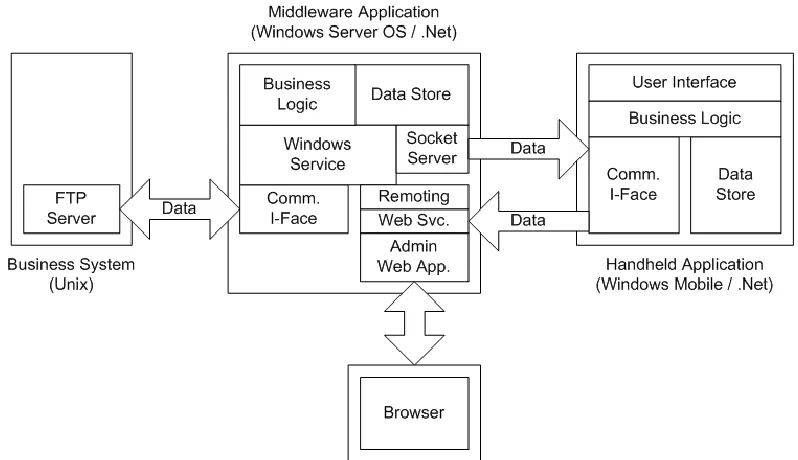
Fig. 3. Architecture of Windows Mobile development Framework
Figure shows software architecture at work. The data is residing at FTP server; application layer consists of all the functions and logics that are performed on the data; user can interact with the mobile application through mobile (handheld) devices or via a browser.
5.4 Building Enterprise Mobile Applications
With the fast influx of mobile applications that are hitting the market, the development cycle of the application development has become smaller and smaller. There are many platforms, technologies and languages that provide built-in features that can be used to further speedup the development process. Software distribution channels have also advanced to accommodate newer applications, thus reducing the time-to-market for new developers. This advancement has its own merits and demerits.
Mobile enterprises rely on the concept of cloud computing and network infrastructure that supports every concept of enterprise mobility. According to a research, 71% people believe that security is the top most priority of any mobility endeavor; so no building block of mobile application can ever be complete without some protocol for security. The framework used for enterprise mobile application development should also focus on complexity and integration issues to avoid any issues that arise later on. A proper, well-thought and detailed strategy must be available at hand that lists all the detail of how mobility will be implemented in the organization.
5.5 Securing Enterprise Mobile Applications
Enterprise Mobile Applications took a huge leap from an old era where the IT department of any organization had complete hold on the mobile devices that were used and how they were used. As mobility improved in mobile devices, there came the trend of “Bring Your Own Device”.
Along with many of its benefits, there also came certain drawbacks in the form of security issues, standardization and cost concerns among many others. Tracking these devices is vital but today it is considered as an attack on personal liberty. With this greater independence came a variety of mobile applications that are being used for work functions. Previously only the IT managers approved the applications to be used and purchased them on the behalf of the organization; now everyone can use any additional applications that they deem useful. The competition in every work domain also calls for out-of-box applications that can provide something more than what competitors are doing.
6.
D
ISCUSSION7.
C
ONCLUSIONThis paper explores Enterprise Application Development Frameworks and its related concepts. This paper contributes to the existing study material in this field by highlighting the comparison of these frameworks. It also adds by jotting together all the related concepts of this field.
A
CKNOWLEDGMENTI would like to thank my MSc students for her initial work on this paper. Also, I am very grateful to my colleague Dr DanialGhazawi and Eng. Mohamed Saleem for their proof reading and editing feedback.
R
EFERENCE[1] K. Narasimhan, "10 Steps to Developing a Mobile
Application Strategy for the Enterprise," 2012.
[2] SAP, "Managing mobile devices in a device-agnostic
world," [Online]. Available: www.sap.com/mobile/mdm.
[3] SAP, "Mobile application may be running the business,
but who's running the apps?," [Online]. Available: www.sap.com/mobile/mdm.
[4] L. Wilkes, "Developing an Enterprise Mobility
Framework," 25 June 2012. [Online]. Available: http://everware-cbdi.com/emf.
[5] Intel Research, "Mobile Computing Trends:Insight into
Today‟s Workforce," Intel IT Center, 2013.
[6] "Adobe, Mobile App Development," [Online]. Available:
http://www.adobe.com/devnet/devices/mobile-apps.html.
[7] "Application Craft," [Online]. Available:
http://www.applicationcraft.com/.
[8] "Chocolate Chip - UI," [Online]. Available:
http://www.chocolatechip-ui.com/.
[9] "DHTMLX Touch - JavaScript Mobie Framework for
Building HTML5 Web Apps," [Online]. Available: http://www.dhtmlx.com/touch/.
[10] "Snippet Space - iWebKit," [Online]. Available: http://snippetspace.com/portfolio/iwebkit/.
[11] "Xamarin Android," [Online]. Available:
http://xamarin.com/android.
[12] "Xamarin iOS," [Online]. Available:
http://xamarin.com/ios.
[13] "Wink Tool Kit," [Online]. Available:
http://www.winktoolkit.org/.
[14] Intel Research, "Enterprise Mobility: Increasing
Productivity for Mobile Users," Intel IT Center, 2013. [15] S. Muneer and C. Sharma, "Enterprise mobile product
strategy using scenario planning," Information Knowledge Systems Management, p. 211–224, 2008.
[16] J.-J. Dubray, "Challenges and Opportunities in Mobile Application Development and Mobile DSLs," 17 May
2011. [Online]. Available:
http://www.infoq.com/articles/mobile-dsl/.
[17] G. I. Priyadarshini, Introduction to J2ME & J2ME Profiles.
[18] B. Unhelkar and S. Murugesan, "The Enterprise Mobile Application Development Framework," IEEE Computer Society, 2010.
[19] C. Sandler and T. Badgett, Enterprise Mobility for Dummies, Mississauga, Ontario: John Wiley & Sons Canada, Ltd, 2012.
[20] S. Hoogendoorn, "How Frameworks Can Kill Your Projects and Patterns to Prevent Getting Killed," 12 April
2014. [Online]. Available:
http://www.infoq.com/presentations/dependency-framework.
[21] I. R. L. -. TechNavio, "Global Mobile Enterprise Applications Platforms (MEAPS) 2010-2014," 24 March
2011. [Online]. Available:
http://www.marketresearch.com/Infiniti-Research- Limited-v2680/Global-Mobile-Enterprise-Applications-Platforms-6206411/.
[22] L. Jordan, "MOBILE DEVELOPMENT: PLATFORM OPTIONS AND FRAMEWORK CHOICES," 16 April
2013. [Online]. Available:
http://www.effectiveui.com/blog/2013/04/16/mobile-development-platform-and-framework/.
[23] M. A. D. |. A. D. Connection, "Adobe," [Online]. Available: http://www.adobe.com/devnet/devices/mobile-apps.html.