Hy-Com Cryptographic Technique for
Efficient Data Transmission
Sindhuja S.
Assistant Professor, Department of Computer Science, Auxilium College, Vellore, India
Abstract
—
Hy-Com Cryptographic technique is an acronym for Hybrid Compressive Cryptographic technique. This research uses two main cryptographic techniques like Symmetric key cryptography and Asymmetric key cryptography and with a lossless compression algorithm. The Symmetric Key cryptographic technique uses single key for both encryption and decryption. The Asymmetric key cryptographic technique uses two separate keys for encryption and decryption.Advanced Encryption Standards (AES) algorithm is used for imparting Symmetric key cryptographic technique and Rivest-Shamir-Adleman(RSA) algorithm is used for imparting Asymmetric key cryptographic technique. The compression algorithm is used to compress the encrypted text before sending it. This reduces the size of the encrypted file and abets in fast file transmission. Therefore by compression of the encrypted file increases the efficiency of data transmission. Compression technique is of two types, lossy compression and lossless compression. This research deals with the lossless compression.
The plain text is first encrypted using Symmetric technique. The symmetric key which is used to encrypt the data is encrypted using Asymmetric technique. The encrypted key and the encrypted text are compressed and sent to the receiver. The integrity of the data that is transmitted can be checked by subjecting the plaintext to the MD5 Hash algorithm. The Message Digest obtained by this process is also encrypted using Asymmetric technique. The public key of the RSA technique is also encrypted before transmitting to the other end. This makes the Hy-Com technique more robust. The key is encrypted using the rail fence technique, in which the plaintext is written down as a sequence of diagonals and then read off as a sequence of rows. This increases the security in the key distribution. Therefore the sender sends the compressed modes of cipher text of the message, cipher text of the key and cipher text of the message digest. The receiver uncompresses the file first and decrypts it. The original file is checked with the digest. If both are equal the message is accepted else rejected.
Keywords— Hycom, Hybrid compressive technique, Secured data transmission, AES, RSA, LZW, MD5, Rail Fence Technique.
I. INTRODUCTION
The Hy-Com cryptographic technique is the hybrid
of Symmetric, Asymmetric, Compressing and
authentication techniques. Advanced Encryption Standards (AES) algorithm is used for imparting Symmetric key cryptographic technique and Rivest-Shamir-Adleman (RSA) algorithm is used for imparting Asymmetric key cryptographic technique. For compressing the encrypted text Lossless compression technique is used. Data compression
increases the speed of data traversal. This increases the efficiency of the data transmission. Message is authenticated by MD5 Hashing algorithm. Thus formed Message Digest is checked with the original message for its integrity.
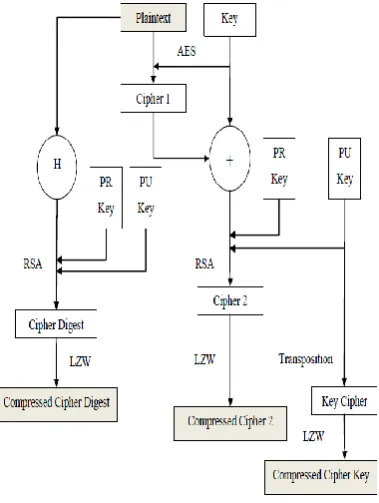
The plaintext is first subjected to Hash algorithm to get the message digest. The message digest is encrypted with the RSA algorithm. The plaintext is encrypted to cipher text using AES. The encrypted text and the key which is used for AES are then encrypted using RSA algorithm. The encrypted plaintext, encrypted message digest and along with the encrypted public key is send to the receiver end. The receiver first decrypts the cipher key using the Transposition technique. Using the obtained public key and with his own private key the receiver decrypts the second cipher text using the RSA algorithm to get the first cipher text and the symmetric key. So obtained cipher text is decrypted with the Symmetric key and AES algorithm.
Cipher message digest is decrypted using RSA algorithm with the public and private key. The message digest is compared with the plain text which was obtained earlier. If both are equal the message is accepted else rejected.
II. HY-COM ARCHITECTURE FOR ENCRYPTION The main issues of cryptographic algorithm are the security and authenticity. The Hy-Com technique uses the combination of both Symmetric and Asymmetric Techniques and its protocol architecture is shown below.
The compressed and the encrypted form of the text, key and message digest is send to the receiver side.
Fig. 1 Hy-Com Architecture for Encryption
III.HY-COM ARCHITECTURE FOR DECRYPTION
The decryption is done in the reverse order on encryption. The receiver receives the compressed and the encrypted form of plain text, the public key of the RSA algorithm and the message digest. First Decompression is done using the LZW algorithm to obtain cipher2. The decompressed cipher text is decrypted first by the RSA algorithm to obtain cipher1. The cipher1 is then decrypted by AES algorithm to obtain the plaintext. The plaintext is compared with message digest. If both are same the message is accepted else rejected.
Fig. 2 Hy-Com Architecture for Decryption
IV.DIAGRAMMATIC REPRESENTATION OF HY-COM CRYPTOGRAPHY
The diagrammatic representation of the original and the final image is presented here. Figure 3 (i) represents the original image that has to be encrypted and compressed using Hy-Com technique. The original image is then subjected to the converter, to convert each and every pixel to its corresponding Binary Values. The image with binary code is depicted in the Figure 3 (ii). Encryption technique is used to make the Binary code unreadable so as to protect the image from hacking. The Encrypted form of the Binary Code is depicted in the Figure 3 (iii). The encrypted image is the compressed and shown in Figure 3 (iv). Thus formed image is the final image that is to be transferred to the other end on the network.
Fig. 3 Diagrammatic Representation of Hy-Com
(i) Original Image (ii) Binary Code Image
(iii) Encrypted Binary Code (iv) Compressed Code
V. RESULT
Performance of encryption algorithm is evaluated considering the following parameters.
i. Computation Time
ii. Memory usage
iii. Output Bytes
The performance of the algorithm comparison this section is the results obtained from the cryptography library Crypto++.
A. Comparison of Performance on the Aspect of Computational Time
TABLE I
COMPARISON TABLE ON ENCRYPTION TIME
Data Algorithm Time (sec)
File 1 (68 KB)
ECC 8.9
RSA 9.4
Hy-Com 10.02
File 2 (105 KB)
ECC 9.2
RSA 10.5
Hy-Com 10.98
File 3 (124 KB)
ECC 10.3
RSA 11.67
Hy-Com 11.9
File 4 (255 KB)
ECC 15.4
RSA 16.2
Hy-Com 17.42
File (435 KB)
ECC 23.12
RSA 24.4
Hy-Com 25.72
Fig. 4 Comparison Chart on Encryption Time
TABLE II
COMPARISON TABLE ON DATA ENCRYPTION AND TRANSMISSION TIME
Data Algorithm Time (sec)
File 1 (68 KB)
ECC 11.2
RSA 12.3
Hy-Com 10.52
File 2 (105 KB)
ECC 13.3
RSA 13.7
Hy-Com 12.09
File 3 (124 KB)
ECC 14.6
RSA 15.42
Hy-Com 12.98
File 4 (255 KB)
ECC 22.3
RSA 23.5
Hy-Com 20.5
File (435 KB)
ECC 34.47
RSA 36.03
Fig. 5 Comparison Chart on Data Encryption and Transmission Time
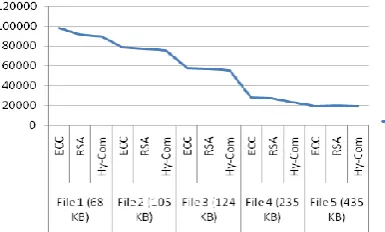
B. Comparison of Performance on the Aspect of Memory Usage
TABLEIII
COMPARISONTABLEONMEMORYUSAGE
Data Algorithm Memory
Usage (KB)
File 1 (68 KB)
ECC 98113
RSA 91814
Hy-Com 89671
File 2 (105 KB)
ECC 78490
RSA 77117
Hy-Com 75372
File 3 (124 KB)
ECC 58012
RSA 57178
Hy-Com 55173
File 4 (255 KB)
ECC 27912
RSA 26891
Hy-Com 23006
File (435 KB)
ECC 19239
RSA 19802
Hy-Com 19511
Fig. 6 Comparison Chart on Memory Usage
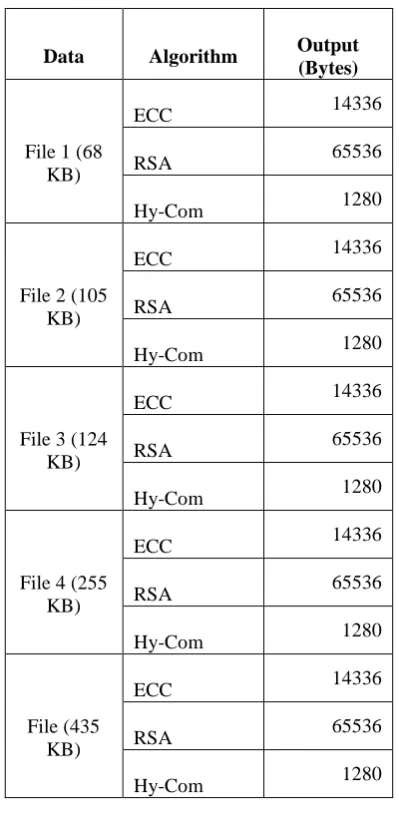
C. Comparison of Performance on the Aspect of Memory Bytes
TABLEIV
COMPARISONTABLEONMEMORYBYTES
Data Algorithm Output
(Bytes)
File 1 (68 KB)
ECC 14336
RSA 65536
Hy-Com 1280
File 2 (105 KB)
ECC 14336
RSA 65536
Hy-Com 1280
File 3 (124 KB)
ECC 14336
RSA 65536
Hy-Com 1280
File 4 (255 KB)
ECC 14336
RSA 65536
Hy-Com 1280
File (435 KB)
ECC 14336
RSA 65536
Hy-Com 1280
VI.CONCLUSIONS
At present, Internet and network applications are growing very fast, so the need to protect such applications has increased. Encryption algorithms play an immense role in information security systems. This research has presented the optimization of attacks for text encryption and its performance analysis. All essential and collateral parameters are systematically determined to satisfy the specific cryptographic security requirements. This technique solves at least some of the drawbacks suffered by existing cryptographic algorithms such as AES and RSA. In this research, the Hy-Com cryptographic technique is fully described and validated with functional and load tests. Then, appropriate metrics for performance measurements are identified; the performance of the algorithm was measured and compared with such existing cryptographic algorithms as RSA and ECC. The test results show that the designed algorithm works as required, that is, the data enciphered and compressed by the Hy-Com process is fully recovered by the deciphering and uncompressing process. The
test and security analysis prove that the cipher is not prone to threat or statistical attack, and the key is
secure. The performance of the Hy-Com
cryptographic technique is by far better than the ECC and RSA. It has less encryption time, less power consumption, and higher throughput than ECC and RSA. The RSA cipher is longer than the Hy-Com cipher causing more resource consumptions and congestion in memory and bandwidth. Comparing Hy-Com with AES, AES has better performance only for relatively smaller data sizes. Hy-Com encryption has another advantage over RSA and AES in that it’s key.
Thus the Hy-Com technique ensures the
confidentiality, effectiveness, integrity and
authentication. The AES and RSA algorithm provides confidentiality, the hash function provides the integrity, LZW algorithm provides effectiveness and RSA will ensure the authentication.
REFERENCES
[1] Willaim Stallings, ―Cryptography and network Security Principles and Practices‖, Prentice Hall, 2005.
[2] J. Daemen and V. Rijmen, ―AES Proposal: Rijndae‖l, AES Algorithm Submission, September 3, 1999. [3] Menezes, P. van Oorschot, and S. Vanstone, ―Handbook
of Applied Cryptography‖, CRC Press, New York, 1997. [4] D. Boneh and G. Durfee, ―Cryptanalysis of RSA with private key d less than N ‖, IEEE Trans. Inf. Theory, vol. 46, no. 4, pp. 1339–1349, Jul. 2000.
[5] B. den Boer and A. Bosselaers, ―Collisions for the compression function of MD5‖, Advances in Cryptology, Eurocrypt „07, pages 293-304, Springer-Verlag, 2007.
[6] J. Ziv and A. Lempel, "Compression of Individual Sequences via Variable-Rate Coding", IEEE Transactions on Information Theory, Sept. 1978.
[7] National institute of standards and technology, ―Digital signature standard‖, FIPS Publication, February 2000. [8] R. Rivest, A. Shamir, and L. Adleman, ―A method for
obtaining digital signatures and public-key cryptosystems‖, Communications of the ACM, 1978. [9] T. El Gamal, ―A Public-Key Cryptosystem and a
Signature Scheme Based on Discrete Logarithms‖, IEEE Transactions on Information Theory.
[10] Sayood K., ―Introduction to Data Compression‖, Academic Press, San Diego, 1996.
[11] Ravindra Kumar Chahar, ―Design of a new Security Protocol‖, IEEE International Conference on Computational Intelligence and Multimedia Applications, pp 132 – 134, 2007.