Łukasz Kołtowski
1, Anna Drohomirecka
2, Mateusz Palczewski
2, Romuald Cichoń
2Short-Term Improvement of Patients’ Quality of Life
After Coronary Artery Bypass Grafting
– a Prospective Single-Center Study Based on the EQ-5D
Assessment Tool
Poprawa jakości życia w perspektywie krótkoterminowej u pacjentów
po pomostowaniu aortalno-wieńcowym – prospektywne,
jednoośrodkowe badanie kliniczne oparte na kwestionariuszu EQ-5D
1 1st Department of Cardiology, Medical University of Warsaw, Poland2 Medinet Heart Center, Wrocław, Poland
Abstract
Background. Most cardiac patients believe that a heart operation will considerably improve their daily activities and quality of life (QoL). The question is how quickly it will happen. As the answer to this question is not strictly tied to medical outcomes, the authors decided to turn to the patients as a source.
Objectives. To determine the health-related QoL of heart surgery patients before surgery and to evaluate the change of QoL over the first month after operation.
Material and Methods. The study involved 86 coronary artery bypass grafting (CABG) patients (59 male; mean age = 63.3, SD = 8.93). Their QoL was measured by the EQ-5DVAS, which records the respondent’s self-rated health status on a vertical visual analogue scale (VAS) of 0–100, in which 0 represents the worst imaginable state of health and 100 is the best imaginable. The patients’ QoL was assessed at three points in time: on the day of admission (P1), 6 days after surgery (P2) and in the fourth week after the procedure (P3).
Results. The average QoL just before surgery (P1) was 61.9 (SD = 18.85). No major improvement in the QoL was achieved after 6 days (P2) (61.97, p > 0.05), but in the following 4 weeks the QoL increased dramatically (P3) (67.93, p > 0.05). It was observed that the QoL was associated with the patient age. In older patients there was a temporary drop at P2, whereas in younger patients there was a constant rise through the 4th post-operative week. Neither the type of procedure (on-pump vs off-pump) nor gender had any significant influence on the level of the QoL.
Conclusions. The quality of life significantly improves in the first 4 weeks after cardiac surgery. There is a rela-tion between the patient’s age and their reported QoL in the very early post-operative period. Further studies are needed to determine which areas of post-operative care of older patients require greater attention (Adv Clin Exp Med 2011, 20, 4, 447–453).
Key words: CABG, QoL, EQ-5D, EuroQol, EuroScore.
Streszczenie
Wprowadzenie. Pacjenci poddani pomostowaniu aortalno-wieńcowemu (CABG) oczekują poprawy jakości życia (QoL), nie mają jednak pewności, jak szybko mogą się jej spodziewać. Aby odpowiedzieć na to pytanie, przeprowa-dzono prospektywne, jednoośrodkowe badanie w Dolnośląskim Centrum Chorób Serca Medinet.
Celpracy. Ocena jakości życia we wczesnym okresie pooperacyjnym u pacjentów poddanych zabiegowi CABG.
Materiał i metody. Do badania włączono 86 pacjentów poddanych CABG (59 mężczyzn; średni wiek [SD]: 63,3 [8,93]). Ocenę jakości życia przeprowadzono na podstawie kwestionariusza EQ-5D i skali VAS (visual analogue scale) o wartościach od 0 (najgorszy wyobrażalny stan zdrowia) do 100 (najlepszy wyobrażalny stan zdrowia). Jakość życia była mierzona w trzech punktach czasowych: dzień przed zabiegiem (P1), 6 dni po zabiegu (P2) i w 4. tygodniu po zabiegu (P3).
Wyniki. Średnia QoL w P1 wyniosła 61,9 (SD: 18,85), nie odnotowano istotnej poprawy w P2, QoL = 61,97 (p > 0,05), QoL istotnie poprawiła się natomiast w P3 – do poziomu 67,93 (p > 0,05). Czynnikiem wpływającym
Adv Clin Exp Med 2011, 20, 4, 447–453 ISSN 1230-025X
ORIGINAL PAPERS
A review of the literature evaluating the results of coronary artery bypass grafting (CABG) reveals that most of the studies focus on strictly clini-cal dimensions such as the mortality, morbidity and intensiveness of postoperative drug therapy, rather than on patient-reported outcomes such as the quality of life (QoL) [1–4]. The bottom line of reports on CABG is that the procedure prevents deaths and prolongs life [5–6], but there is still limited data on the quality of life after cardiotho-racic surgery [7–8]. The emerging need for local studies combined with a shortage of such papers among Polish publications spurred the authors to conduct a prospective observatory study measur-ing the quality of life in patients after CABG.
Material and Methods
The study was performed at the Medinet Heart Center in Wroclaw, Poland – a tertiary cardiac sur-gery center. A total of 121 patients who underwent isolated coronary artery bypass grafting during the 5 consecutive months of the duration of the study were invited to participate. The main exclusion criterion was a lack of informed consent from the patient, but patients who missed more than one of the three QoL measurements were also excluded from the statistical analysis. As a result 86 patients were ultimately included in the study. Nearly 70% were male (n = 59). The age range extended from 42 to 81 years, with a mean of 63.3 (SD = 8.93). The age variations in relation to gender, procedure type and number of vessels grafted are provided in Table 1. The majority of patients were treated with
a classic on-pump CABG, whereas 20.9% (n = 18) underwent off-pump coronary artery bypass graft-ing (OPCAB). The decision about whether or not to use the pump was made individually by the sur-geon in charge and depended on the nature of the lesions and the skills of the surgeon. The patients were assigned to surgeons randomly; no physician could choose which patient to operate on.
The risk of operative mortality was estimated using the European System for Cardiac Opera-tive Risk Evaluation (EuroSCORE) [9]. The Euro-SCORE profiles is presented in Fig. 1.
Firstly, informed consent was obtained from each patient scheduled for the CABG. The self-ad-ministered questionnaire was completed by each patient at three points in time. The first question-naire was given to the patient by the registering nurse on the day of admission to the hospital. In most cases this was one day before the scheduled treatment. The second one was given to the patient on day 6 after the surgery, which was 2 days before the patient was discharged from the surgical ward. The third time, the questionnaire was given to the patient at the rehabilitation ward during week 4 after the operation. Each time, the questionnaire was collected by the nursing staff, and if the pa-tient had difficulties filling it out, assistance was provided on individual basis.
The five-dimensional three-level EQ-5D ques-tionnaire with a visual analogue scale (referred to as VAS) was used to assess the health-related QoL [10]. The 5 domains in the EQ-5D tool are: physical status, based on assessment of mobility (I); inde-pendence, assessed in terms of the level of self-care (II); everyday functioning, in terms of the ability
na QoL był wiek, u osób starszych rejestrowano przejściowe pogorszenie QoL w P2. Na QoL nie wpływały: rodzaj zabiegu (z lub bez użycia krążenia pozaustrojowego) ani płeć.
Wnioski. QoL zmienia się w okresie okołooperacyjnym i istotnie poprawia się w pierwszych 4 tygodniach po zabie-gu. Istnieje zależność między starszym wiekiem a postrzeganym poziomem QoL w 6. dniu po zabiezabie-gu. Być może przyszłe badania odpowiedzą na pytanie, czy starsi pacjenci wymagają odmiennej opieki w pierwszych tygodniach po zabiegu (Adv Clin Exp Med 2011, 20, 4, 447–453).
Słowa kluczowe: CABG, jakość życia, EQ-5D, EuroScore, choroba wieńcowa.
Table 1. Age distribution in three subgroups
(by gender, type of procedure and number of vessels grafted) Tabela 1. Rozkład wiekuwtrzech podgrupach
(według płci, rodzaju zabiegu, liczbypomostowanych naczyń)
Mean age in years (Średni wiek – lata)
gender type of procedure number of vessels
Male Female CABG OPCAB I II III IV
to perform listed commonplace activities (III); the level of pain and discomfort (IV); and mental condition, in terms of anxiety and depression (V). Each domain consists of three levels, level one rep-resenting the best possible outcome and level three the worst one. For example, in the mobility do-main the levels are: 1) “I have no problems walking about”, 2) “I have some problems walking about” and 3) “I am confined to bed”. The answers were coded as 5 digit profiles in which each digit was equal to the level of answer given by the patient; for example 11121 meant a medium-level answer for domain IV and the highest level for domains I, II, III and V.
The Visual Analogue Scale consists of a verti-cal “thermometer” with a sverti-cale from 0 to 100. Each point of the scale represents the perceived level of quality of life at the given moment. The lowest score (0) represents the worst imaginable state of health, while the highest value (100) represents the best imaginable health. The patient’s task was to draw a line intersecting the “thermometer” at the point describing his/her current perceived state of health.
The statistical analysis was performed us-ing SPSS statistical software version 12.0. For the group characteristics exploratory data analysis was performed and descriptive statistics obtained.To test for the significance of a difference between two normally distributed averages the Student’s t-test was used [11]. A linear regression analysis was used to establish the variables that influence the predefined QoL outcomes [12, 13].
Results
The mean baseline (pre-operative) level of quality of life was 61.9 (SD = 18.85) on the VAS. Regarding mobility, only one patient reported be-ing bedridden; 41.4% of the patients had some difficulties walking around; and more than half (57.1%) had no problems with mobility. The vast majority of the patients (91.3%) reported no trou-ble with self-care. Everyday activity was impaired in 35.3% of the cases. Pain and discomfort were re-ported by 78% of the respondents. Depression or anxiety were noted by 67.6% of them. The complete baseline characteristics are presented in Table 2.
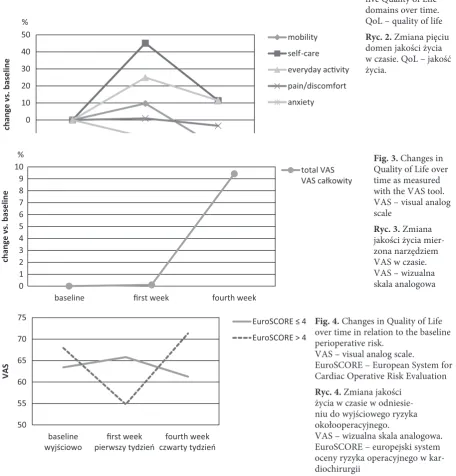
As shown in Fig. 2, the results collected in each domain of the EQ-5D have a diverse pattern in comparison to the VAS curve. The pre-operative outcomes were used as the baseline measurements against which to compare the data collected at later stages. The reported quality of life for all domains but depression and anxiety improved during the first post-operative week. The greatest increases between the pre-operative levels and the first post-operative outcomes were 45% for “self-care” and 24% for “everyday activity”.
The deterioration in the levels of anxiety (–10%) continued, dropping by another 3% by the end of the fourth week – and the mean values in the remaining domains worsened as well. After 4 weeks only the “self-care” and “everyday activity” domains were assessed above the baseline, while the averages of the patients’ reports for “mobility”,
Fig. 1. Distribution of EuroSCORE values. EuroSCORE – European System for Cardiac Operative Risk Evaluation
Ryc. 1. Rozkład ilościowy według EuroSCORE. EuroSCORE – europe-jski system oceny ryzyka operacyjnego w kardiochirurgii
0 2 4 6 8 10 12 14 16 18
0 1 2 3 4 5 6 7 8 9 10 11
number
EuroScore value wartość EuroScore
Table 2. Baseline quality of life characteristics Tabela 2. Podstawowe cechy jakości życia
Mobility % Self-care % Everyday activity % Pain/Discomfort % Anxiety/Depression % 1 (good)
2 (average) 3 (bad)
57.1 41.4 1.4
91.3 8.7 0
64.6 33.8 1.5
22.1 70.6 7.4
“pain/discomfort” and “anxiety” all worsened. Full data are provided in Table 3.
During the first week after the procedure, the mean level of quality of life expressed as a VAS score did not show any significant change compared to the baseline level (61.97 vs. 61.90, p > 0.05). How-ever, during the following four weeks the mean QoL
level rose dramatically: an increase of 9.5%, reach-ing the level of 67.93 points (Fig. 3).
Theinfluence of various factors on the report-ed quality of life was assessreport-ed. The patients were divided into 2 groups depending on their Euro- -SCORE values. The first group included patients with 4 points and below on the EuroSCORE scale
Fig. 2. Changes in the five Quality of Life domains over time. QoL – quality of life
Ryc. 2. Zmiana pięciu domen jakości życia w czasie. QoL – jakość życia. – 20 –10 0 10 20 30 40 50 baseline wyjściowo first week pierwszy tydzień fourth week czwarty tydzień change vs . b as el in e mobility self-care everyday ac�vity pain/discomfort anxiety %
Table 3. VAS (visual analog scale) characteristics over time Tabela 3. Cechy VAS (wizualnej skali analogowej) w czasie
Mobility % Self-care % Usual activities % Pain/Discomfort % Anxiety % Total VAS % Baseline First week Fourth week – 9.66 –16.10 – 45.08 11.37 – 24.93 11.47 – 0.93 –3.43 – –10.17 –13.61 – 0.11 9.42
Fig. 3. Changes in Quality of Life over time as measured with the VAS tool. VAS – visual analog scale
Ryc. 3. Zmiana jakości życia mier-zona narzędziem VAS w czasie. VAS – wizualna skala analogowa 0 1 2 3 4 5 6 7 8 9 10 baseline wyjściowo first week pierwszy tydzień fourth week czwarty tydzień change vs . b as el in e total VAS VAS całkowity %
Fig. 4. Changes in Quality of Life over time in relation to the baseline perioperative risk.
VAS – visual analog scale.
EuroSCORE – European System for Cardiac Operative Risk Evaluation
Ryc. 4. Zmiana jakości życia w czasie w odniesie-niu do wyjściowego ryzyka okołooperacyjnego.
VAS – wizualna skala analogowa. EuroSCORE – europejski system oceny ryzyka operacyjnego w kar-diochirurgii 50 55 60 65 70 75 baseline wyjściowo first week pierwszy tydzień fourth week czwarty tydzień VA S
EuroSCORE ≤ 4
and was considered a low perioperative risk group. The patients with 5 points or more constituted the high perioperative risk group [14]. The baseline VAS for both groups were comparable; no statis-tically significant differences were found (Fig. 4). In general the low-risk group demonstrated less fluctuation in the VAS values for the duration of the study. In contrast, the high-risk group pre-sented a sharp decrease in their reported quality of life in the first week. This was followed by a clear improvement by the end of the fourth week after surgery, when their VAS level was 10 points higher than the low-risk group.
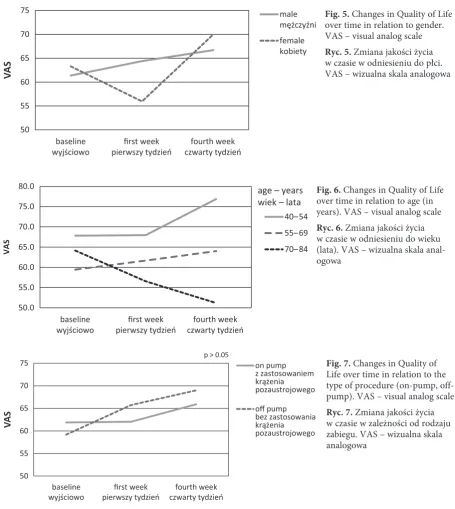
The pattern of the VAS curves was different for males and for females (Fig. 5). In both groups
the baseline level of the perceived quality of life was similar, but in the female group it went down in the first week after the procedure and then picked up in the fourth week, reaching a relatively high level of 70 points. In contrast, the male pa-tients reported no drop in the quality of life during the entire postoperative period; constant improve-ment was reported. However, this tendency was more subdued, leading to a level of 66.7 points by the fourth week.
The perceived quality of life also varied in different age groups. The patients were divided into three subgroups based on age: young (40–54 years), middle-aged (55–69 years) and old (70–84 years) (Figure 6). The older patients’ reported level
Fig. 5. Changes in Quality of Life over time in relation to gender. VAS – visual analog scale
Ryc. 5. Zmiana jakości życia w czasie w odniesieniu do płci. VAS – wizualna skala analogowa
50 55 60 65 70 75
baseline wyjściowo
first week pierwszy tydzień
fourth week czwarty tydzień
VA
S
male mężczyźni female kobiety
Fig. 6. Changes in Quality of Life over time in relation to age (in years). VAS – visual analog scale
Ryc. 6. Zmiana jakości życia w czasie w odniesieniu do wieku (lata). VAS – wizualna skala anal-ogowa
50.0 55.0 60.0 65.0 70.0 75.0 80.0
baseline wyjściowo
first week pierwszy tydzień
fourth week czwarty tydzień
VA
S
40–54 55–69
70–84 age – years wiek – lata
Fig. 7. Changes in Quality of Life over time in relation to the type of procedure (on-pump, off-pump). VAS – visual analog scale
Ryc. 7. Zmiana jakości życia w czasie w zależności od rodzaju zabiegu. VAS – wizualna skala analogowa
50 55 60 65 70 75
baseline
wyjściowo pierwszy tydzieńfirst week czwarty tydzieńfourth week
VA
S
on pump z zastosowaniem krążenia pozaustrojowego
off pump bez zastosowania krążenia pozaustrojowego
of quality of life decreased throughout the study period. The opposite was true the middle-aged and young groups, who reported improvements in both the first and the fourth post-operative weeks.
The health-related quality of life scores after CABG surgery improved for both on-pump and off-pump patients; no statistically significant dif-ference between the groups was found (Fig. 7).
Discussion
The authors came to 4 conclusions on the ba-sis of this study. Firstly, perceptions of the QoL in the first week after the operation correlate with the patients’ gender. In male patients the improve-ment in quality of life appears immediately after the procedure, whereas women need up to 4 weeks to recover. This phenomenon has been observed in other studies, but the underlying cause has not yet been established [15]. The divergence might, however, be explained by the fact that the male patients were more anxious before the procedure, which improved immediately following it. On the other hand the women’s quality of life was influ-enced more by pain and by everyday activities, which need more time to improve.
Secondly, although the patients are in pain and have limited mobility throughout the first post-operative week, their perceived quality of life, measured with the VAS, is not lower than before the procedure (Fig. 3), even though before the procedure they were more mobile and had no sur-gery-related pain. This observation suggests that psychological factors play an important role in the pre-operative perception of the quality of life, and may be even of greater importance than physical ones. This observation has been reported in some papers [16], but larger studies that assessed short-term quality of life post-CABG did not report this phenomenon [8].
Thirdly, there is a relationship between age and perceived quality of life after the operation. The younger patients not only had a higher base-line QoL, but their perceived QoL also tended to improve more quickly.This was clearly visible af-ter the first week afaf-ter the procedure. In contrast, the older patients tended to report lower VAS val-ues, and their score on day 6 was 20% lower than the pre-operative one.The cause of this observa-tion remains uncertain, but has also been reported in the literature [8]. The younger age groups suf-fer from less comorbidity, which might explain the higher pre-surgical VAS scores [17]. Also, heart disease – often the main medical issue in the younger age groups – is a relatively serious burden to these age groups’ perceived quality of life. Per-haps the operation is regarded as a release and this
is proportionally reflected in the improvement in their reported QoL.
Lastly, when the authors looked at the relation-ship between quality of life and perioperative risk, in the high-risk group (above 4 EuroSCORE points) a decrease in QoL was noted in the first week af-ter the procedure. This was, however, followed by a much larger increase during the next weeks, and in this group the VAS value in the fourth week was greater than before operation. A high EuroSCORE rank is usually a sign of multiple comorbidities, a significant medical history, poor cardiac status and older age. This might explain why the reported quality of life was lower than in the low-risk group (with EuroSCOREs equal to or below 4 points).
It is not really clear why there was such a large dip in the low-risk group’s VAS in the first week after the procedure. The authors speculate that people in this group, who have fewer comorbidities and less experience with diseases and hospitalizations than those in the high-risk group, may be more sensitive to any changes in their health and may therefore report them as having greater impact.
The autors concluded that this study high-lighted some issues that might require review and further investigation as a follow-up. Although the number of individuals included in the statistical analysis was nearly 90, the established significance level of p < 0.05 was not obtained. This may be due to poor inclusion criteria, as well as too small a sample. It might be relevant to take this fact into consideration when designing future studies, mak-ing sure that the study group is big enough.
One other interesting observation emerged from this study. The changes in the VAS values indicate that patients perceived their quality of life to be better after the procedure than on the day before it. One might conclude that the procedure helped them, except that not all of the QoL domains were rated higher in the fourth week – in fact, three out of five deteriorated as compared to the pre-operative levels. The only do-mains that improved were self-care and everyday activity. Surprisingly, anxiety was also among the do-mains that got worse. This finding was not analyzed any further in the present study, but it seems note-worthy. The mechanisms responsible for short-term improvements in quality of life seem to be extremely interesting and worthy of further investigation.
References
[1] Chait LO: Use of select mortality tables to reevaluate CABG. Circulation 1982, 65, 1286.
[2] McDonald CJ, Fitzgerald JF: CABG surgical mortality in different centers. JAMA 1992, 267, 932–933.
[3] Choudary J, Arif I, Helmy T: Multivessel pci versus CABG, One-year outcomes and cost analysis. J Invasive Cardiol 2007, 19, 476–477.
[4] Bross W, Bross T, Koltowski R, Kustrzyski A, Olejak B, Dymala L, Masiak M, Crzereda T, Kibler J, Krupacz R, Ostapczuk S, Michel AJ: Treatment of cerebral embolism in heart surgery. Ann Chir Gynaecol Fenn 1975, 64, 280–283.
[5] Hoffman SN, TenBrook JA, Wolf MP, Pauker SG, Salem DN, Wong JB: A meta-analysis of randomized con-trolled trials comparing coronary artery bypass graft with percutaneous transluminal coronary angioplasty. One- to eight-year outcomes. J Am Coll Cardiol 2003, 41, 1293–1304.
[6] Long-term results of prospective randomized study of coronary artery bypass surgery in stable angina pectoris. European coronary surgery study group. Lancet 1982, 2, 1173–1180.
[7] Fox NL, Hoogwerf BJ, Czajkowski S, Lindquist R, Dupuis G, Herd JA, Campeau L, Hickey A, Barton FB, Terrin ML: Quality of life after coronary artery bypass graft: results from the POST CABG Trial. Chest 2004, 126, 487–495.
[8] Ross AC, Ostrow L: Subjectively perceived quality of life after coronary artery bypass surgery. Am J Crit Care 2001, 10, 11–16.
[9] Nashef SA, Roques F, Hammill BG, Peterson ED, Michel P, Grover FL, Wyse RK, Ferguson TB: Validation of european system for cardiac operative risk evaluation (euroscore) in north american cardiac surgery. Eur J Cardiothorac Surg 2002, 22, 101–105.
[10] Williams A: University of York. Centre for Health Economics, York Health Economics Consortium, University of York. NHS Centre for Reviews & Dissemination. The role of the euroqol instruments in qaly calculations [York, England: Centre for Health Economics, University of York], 1995.
[11] Gosset W: The probable error of a mean. Biometrika 1908, 6, 25.
[12] Mogull RG: Second-semester applied statistics. Kendall/Hunt Publishing Company, 2004.
[13] Galton F: Kinship and correlation (reprinted 1989). Statist Sci 1989, 4, 80–86.
[14] Roques F, Nashef SA, Michel P, Gauducheau E, de Vincentiis C, Baudet E, Cortina J, David M, Faichney A, Gabrielle F, Gams E, Harjula A, Jones MT, Pintor PP, Salamon R, Thulin L: Risk factors and outcome in euro-pean cardiac surgery: analysis of the euroscore multinational database of 19030 patients. Eur J Cardiothorac Surg 1999, 15, 816–822, discussion 822–813.
[15] Favarato ME, Hueb W, Boden WE, Lopes N, Nogueira CR, Takiuti M, Gois AF, Borges JC, Favarato D, Aldrighi JM, Oliveira SA, Ramires JA: Quality of life in patients with symptomatic multivessel coronary artery disease: a comparative post hoc analysis of medical, angioplasty or surgical strategies-MASS II trial. Int J Cardiol 2007, 116, 364–370.
[16] Najafi M, Sheikhvatan M, Montazeri A: Quality of life-associated factors among patients undergoing coronary artery bypass surgery as measured using the whoqol-bref. Cardiovasc J Afr 2009, 20, 284–289.
[17] Maggioni AP, Dahlstrom U, Filippatos G, Chioncel O, Leiro MC, Drozdz J, Fruhwald F, Gullestad L, Logeart D, Metra M, Parissis J, Persson H, Ponikowski P, Rauchhaus M, Voors A, Nielsen OW, Zannad F, Tavazzi L:
Eurobservational research programme: The heart failure pilot survey (esc-hf pilot). Eur J Heart Fail 2010, 12, 1076–1084.
Address for correspondence:
Łukasz Kołtowski
1st Department of Cardiology Medical University of Warsaw SPCSK
Banacha 1a 02-097 Warszawa Poland
E-mail: [email protected]
Conflict of interest: None declared