Copyright © 2015 IJECCE, All right reserved
Energy Consumption Development Based on Gene
Expression Programming model in Hebei Province
Hui-fang CHENG, Jian-li ZHAO, Hai-hua Qing
Abstract – This paper explorers the causal relationship between energy consumption and economic growth using data of Hebei Province. The study covers the period of 1980 to 2011. We have applied gene expression programming to analyses how they evolved together. Two ways adopted in the forecast, the one is based on the total energy consumption, and the other is based on energy intensity per GDP. Respectively, we build the GEP models for evolution. Two groups of predicted value and the actual value of the data fitting is good. It is found that the model can fit the variation trend of energy consumption and energy intensity per GDP by simulation. The model can reflect the actual status of the energy consumption and economic relations, which can provide scientific basis for policy makers to make a decision. The impact of economic growth and energy consumption is found to be positive.
Keywords – Energy Consumption, Gene Express Programing, Evolution and Analysis.
I.
I
NTRODUCTIONEnergy and environment have been the common concerned problem for humankind. It is also an important problem during social and economic development so it is significant to study about the relationship between energy consumption and economic growth. Energy consumption and economic growth is influenced by macroeconomic situations, policy regulation, economic development patterns, technological progress, industrial structure, energy structure and so on in a long span of the study period. Therefore, modeling energy consumption with good accuracy has become even more complex in such a complex environment. So a model can self-learning, without assumes parameters is more naturally than a fixed parameter one used by the existing energy economics literature(for example, see [1]Y Zhang, 2011; [2] Pedroni, 2004; [3] Ozturk, 2010; [4] Payne, 2010), and which play a vital role in understanding the dynamic relationship between energy consumption and economic growth, formulating reasonable strategies and policies for energy and environment and avoid costly mistakes. And because of this energy consumption models are developed specific to the area of Hebei Province.
In recent years, evolutionary algorithms have been used in various energy research because of their ability to self-learn and solve complicated problems [5-12]. By using genetic algorithms, Ceylan and Ozturk [12] have conducted an estimation study up to the year 2025 in Turkey’s long-term energy demand forecasting. Ozturk and Ceylan presented some linear and nonlinear models based on GA to estimate electricity consumption in Turkish industrial sector. Based on their findings, the use of import and export variables leads to the improvement of the results [3]. Particle Swarm Optimization (PSO) and
Genetic Algorithms (GAs) are applied to attain parameters of the models. Those models have been used in order to forecast and analyze energy in the Iranian metal industry[7]. In a similar study, Canyurt and Ozturk forecast fossil fuel consumption demand using GA [6]. Lee and Tong combine residual modification with genetic programming sign estimation to minimize gray forecasting errors [11]. As a promising variant of genetic programming, gene expression programming (GEP) is a kind of general adaptive random search algorithm, without any prior knowledge, do not understand things internal mechanism, only under the condition of the experimental data develop more accurate formula [13]. Therefore it has very good mapping ability to manage complicated nonlinear problems with more input and uncertainty. And researchers have made use of this advantage in predicting [13-14] , data mining [15-16]and have made very good progress. Therefore, based on gene expression programming algorithm to energy consumption evolution model is established.
The rest of the paper is organized as follows: Section 2 gives energy consumption status and data sources of study area, Section 3 presents GEP model and simulation, Section 4 reports the empirical analysis of results and finally, Section 5 concludes the study.
II.
E
NERGYC
ONSUMPTIONC
URRENTS
ITUATION ANDD
ATAS
OURCESIn recent years, China has a wide range, long haze pollution weather affects hundreds of millions of people, Beijing-Tianjin-Hebei has become "heavy disaster area". Energy market in Hebei province has a rapidly developing due to heavy industrial structure, rapid urbanization and enormous population. However, energy sources in Hebei are quite scarce. In present situation, authorities is necessary to accurately reproduce the relationship between economic growth and energy consumption by using an accurate model.
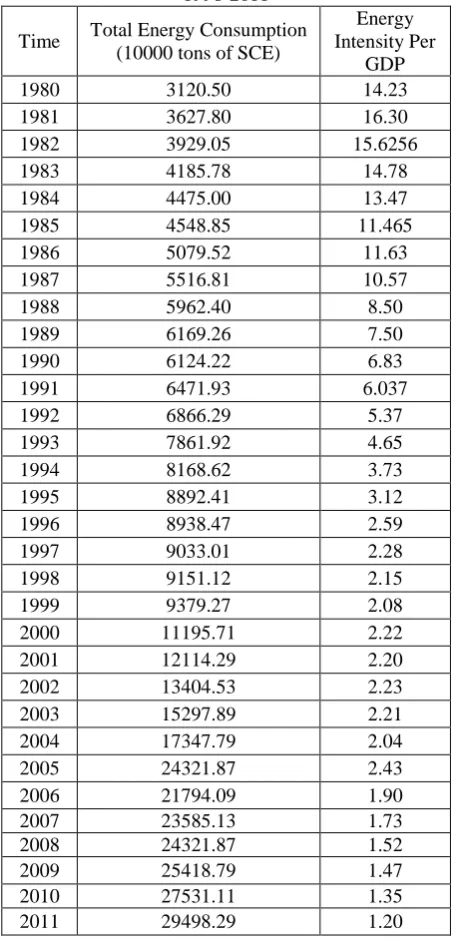
The data used in this study are taken from the Hebei Statistical Yearbook, and cover 1998–2011. The variables used are total energy consumption (measured in 10000 tons of SCE), and Gross domestic product (measured in one hundred million yuan) in Hebei province. The specific district selected for the study and the timeframe was dictated by data availability.
Table I: Primary consumption in Hebei province from 1998-2011
Time Total Energy Consumption (10000 tons of SCE)
Energy Intensity Per
GDP
1980 3120.50 14.23
1981 3627.80 16.30
1982 3929.05 15.6256
1983 4185.78 14.78
1984 4475.00 13.47
1985 4548.85 11.465
1986 5079.52 11.63
1987 5516.81 10.57
1988 5962.40 8.50
1989 6169.26 7.50
1990 6124.22 6.83
1991 6471.93 6.037
1992 6866.29 5.37
1993 7861.92 4.65
1994 8168.62 3.73
1995 8892.41 3.12
1996 8938.47 2.59
1997 9033.01 2.28
1998 9151.12 2.15
1999 9379.27 2.08
2000 11195.71 2.22
2001 12114.29 2.20
2002 13404.53 2.23
2003 15297.89 2.21
2004 17347.79 2.04
2005 24321.87 2.43
2006 21794.09 1.90
2007 23585.13 1.73
2008 24321.87 1.52
2009 25418.79 1.47
2010 27531.11 1.35
2011 29498.29 1.20
Once the data are ready, the next step is to apply model to learn the different influence for the given input data.
III.
G
ENEE
XPRESSIONP
ROGRAMMINGE
VOLUTIONM
ODEL AND THES
IMULATIONE
XPERIMENT FORE
NERGYC
ONSUMPTION ANDE
CONOMICD
EVELOPMENTIn addition to the traditional way of training the relationship between total energy consumption and economic growth, we applied gene expression programming algorithm (a machine learning mechanism) to our system. Gene Expression Programming (GEP), first introduced by (Ferreira 2001)[18], is an evolutionary algorithm that evolves computer programs and predicts mathematical models from experimental data. GEP begins
with a random population of candidate solutions in the form of chromosomes. The chromosomes are evaluated based on a fitness function and selected by fitness to reproduce with modification via genetic operations. The new generation of solutions goes through the same process until the stop condition is satisfied. The fittest individual serves as the final solution. GEP has been used to solve symbolic regression, sequence induction, and classification problems efficiently ([19] Ferreira 2002; [20] Zhou 2003).
A. Build selection environment
On the basis of the research GEP schema theory[21], our GEP model consists of a well-balanced set in order to avoid the creation of models that can only solve a partial, and often marginal, aspect of the overall problem.
The individuals of gene expression programming are encoded in linear chromosomes (19 Ferreira, 2002)that store expressions in breadth-first form. GEP genes are composed of a head and a tail. The head may contains both function and terminal symbols. The tail may contain terminal symbols only. For each problem the head length (denoted h) is chosen by the user. The tail length (denoted by t) is evaluated by:
t = (nmax−1)h + 1,
Where, nmax is the number of arguments of the function with more arguments.
Function sets are chosen and shown in table 2, then we learn nmax =2. We choose h=7, then we get t=8, and the length of the gene is 7+8=15. Number of genes=4. Then the length of a chromosome is 60. Parameters for the energy consumption problem is shown in table 3; Max. fitness :1000. During the experiments sampling data of 31 cases are used, 12 -30cases were used for training, the rest cases for testing.
Table II: function set for the energy consumption problem Representation Definition Representation Definition
+ x+y x3 x3
- x-y Exp ex
* x*y log logx
/ x/y Abs |x|
sin Sin(x) sqrt x1/2
Tan Tan(x) x2 x2
Cos Cos(x) Not (1-x)
Table III: Parameters for the energy consumption problem
Parameter Value Parameter Value
Number of
generations 10000
Population
size 30
Number of fitness cases
30 (Table
1) Function set
(Table 2)
Terminal set (-10,10) Head length 7
Number of
genes 4
Linking
function +
Mutation 0.044 One-point
recombination 0.3
Inversion 0.1 two-point
recombination 0.3 IS
transposition 0.1
Gene
Copyright © 2015 IJECCE, All right reserved RIS
transposition 0.1 Precision 0.0001
Fitness
function Eq(1)
Gene
recombination 0.1
B. The choice of fitness function
Fitness function is applied to every training individual and produces a score accordingly. Then all individuals in the same training are ranked according to their scores, and individuals with top scores have greater probability to be selected to the next generation. When we speak of the fitness of an individual, on the one hand, it is always relative to a particular environment and, in the other, it is also relative to the measure (the fitness function) we are using to evaluate them. Consequently, the success of a problem not only depends on the way the fitness function is designed but also on the quality of the selection environment [19 p65].
Then the square of multiple correlation coefficient is used as the fitness to evaluate all the individuals and is expressed by equation (1).
R2=1-SSE/SST (1)
2 1ˆ ,
m
j j
j
SSE y y
2
1
,
m
j j
j
SST y y
Refer to “(1),”, every individual’s forecast is denoted by ˆj
y and the mean value of the generation byyj.
As it stands, R2 cannot be used directly to measure the fitness of the evolved models, for fitness proportionate selection, the fitness must increase with efficiency. Thus, the following equation is used to evaluate the fitness of an individual i:
Fitness = R2*1000 (2)
C. The simulation of energy consumption and
economic evolution model
In the training stage, two set of training data (1998-2010 data set of Total Energy consumption and energy intensity per GDP) are provided, then they are ranked and evolved with their scores by GEP using GeneXproTools. In the testing stage, another two data set (1980-2011 data set of Total Energy consumption and energy intensity per GDP) are supplied to test the similarity between the twice evolutionary processes.
Fig.1. The evolution curve of Total Energy consumption with genetic algorithm 1998-2010
Fig.2. The evolution curve of Total Energy consumption with genetic algorithm 1980-2011
Fig.4 Performance comparison in terms of GEP model validation parameters (Total Energy consumption with genetic algorithm 1980-2011)
Fig.5. The evolution curve ofenergy intensity per GDP with genetic algorithm 1998-2010
Fig.6. The evolution curve of energy intensity per GDP with genetic algorithm 1980-2011
Copyright © 2015 IJECCE, All right reserved
Fig.8. Performance comparison in terms of GEP model validation parameters (energy intensity per GDP with genetic algorithm 1980-2011)
The simulation results are shown in Fig.1-Fig. 8, where it becomes obvious that the GEP algorithm fits these values well. In addition, the validation indexes RMSE, MSE, RAE, MAE,RSE, RRSE and R2 were compared with a part of experimental data and the estimated values for the test set given in Fig.3, Fig.4and Fig.7, Fig.8. The results also show that the greater the amount of given data, the model is more powerful. As given in Fig.1-Fig.8, the proposed model for the period1980–2011 have the best fitness than the propose model fortheperiod1998–2010.
IV.
C
ONCLUSIONGEP model has attractive features, such as the ability to self-learning without any prior knowledge, do not understand things internal mechanism, only under the condition of the experimental data develop more accurate model. However, a proper set of parameters for specific problem is essential for good performance and efficiency of GEP model in estimation real numbers. GEP model is developed by getting the relationship between energy consumption and economic development, such as energy intensity per GDP. When a robust GEP model with high fitting and reliability was constructed, statistical data of different period used in the training stage are shown to be accurately estimated. The experiment results show that the proposed method is feasible and available.
Compared with the whole economic development speed and level in Hebei province, the energy consumption growth rate maintained a positive relationship. Namely as the growth of the economy, energy consumption will increase, and there exists a long-term consistency. Industrial proportion is larger in the economy in Hebei province. Industry is one of the major energy-consuming sectors using energy as a production factor for developing
the economy. The increase of the energy input will lead to the increase of economic output, by the same token, when the economy expanded; lead to demand for energy elements will increase. Therefore, Hebei is in urgent need of development of green energy, developing low-carbon economy, the sustainable development of the scientific road. Actually it is so.
A
CKNOWLEDGMENTThis research has been made possible through financial support by youth fund in Hebei province department of education (No. 20130020).
R
EFERENCES[1] Y Zhang. Interpreting the dynamic nexus between energy consumption and economic growth: Empirical evidence from Russia Int. Energy Policy. Volume 39, Issue 5, May 2011, Pages 2265–2272. http://www.sciencedirect.com/science/article/pii/ S0301421511000346. (2011)
[2] Pedroni.P. Panel cointegration: asymptotic and finite samples properties of pooled time series tests with an application to the ppp hypothesis. Econometric Theory 20, 597-625.
https://ideas.repec.org/a/cup/etheor/v20y2004i03p597-625_20.html, (2004)
[3] Ozturk, I.. A literature survey on energy-growth nexus. Energy Policy 38 340-349. http://wenku.baidu.com/link?url=
w52BuDaTjBggeliK267s7ZTkQq8X3Me2-zAMCJCMqaBUQ7PXNAVugjgDjTfBsSNM0ZELlqGORYMC d0-Adm9pZh6knJXrfDITcskhS4g0HSW , (2010).
[4] Payne, J.E. Survey of the international evidence on the causal relationship between energy consumption and growth.J.Eco. Stud.37,53-95. http://www.docin.com/p-650544320.html. (2010)
[6] Canyurt OE, Ozturk HK. Application of genetic algorithm (GA) technique on demand estimation of fossil fuels in Turkey.
Energy Policy (2008); 36(7): 2562–9.
https://ideas.repec.org/a/eee/enepol/v36y2008i7p2562-2569.html
[7] Azadeh A, Ghaderi SF, Tarverdian S, Saberi M. Integration of artificial neural networks and genetic algorithm to predict electrical energy consumption. Appl Math Compute (2007); 186(2):1731–41.
http://link.springer.com/chapter/10.1007%2F11427391_123
[8] AlRashidi MR, EL-Naggar KM. Long term electric load forecasting based on particle swarm optimization. Appl Energy (2010);87(1):320–6.
https://ideas.repec.org/a/eee/appene/v87y2010i1p320-326.html
[9] E. Assareh, M. A Behrang, A. Ghanbarzdeh. Forecasting energy demand in Iran using Genetic Algorithm(GA) and Particle Swarm Optimization (PSO) Methods. Energy Sources, Part B: Economics, Planning, and Policy, vol. 7, no. 4, pp. 411-422, (2012). http://academic.research.microsoft.com/Publication/ 57705171/forecasting-energy-demand-in-iran-using-genetic-algorithm-ga-and-particle-swarm-optimization
[10] Canyurt OE, Ozturk HK, Hepbasli A, Utlu Z. Estimating the Turkish residential–commercial energy output based on genetic algorithm (GA) approaches. Energy Policy (2005);33(8):1011–9. https://ideas.repec.org/a/eee/enepol/v33y2005i8p1011-1019.html
[11] Lee Y-S, Tong L-I. Forecasting energy consumption using a grey model improved by incorporating genetic programming. Energy Convers Manage (2011);52(1):147–52. http://www. sciencedirect.com/science/article/pii/S0196890410002748.
[12] Ceylan H, Ozturk HK. Estimating energy demand of Turkey based on economic indicators using genetic algorithm approach. Energy Convers Manage (2004);45:2525–37. http://www. sciencedirect.com/science/article/pii/S0196890403003479.
[13] Li Y, Chen X, He D .J. Research on GEP algorithm and its applications in foodstuff yield prediction from Shaanxi province[c]//Advanced Computer Theory and Engineering.
(2008). ICACTE08. International Conference on.
IEEE.2008:690-693.
[14] S SS Hosseini, A H Gandomi. Short-term load forecasting of power systems by gene expression programming. Neural Computing and Applications. (2012).21(2):377-389. http://link.springer.com/article/10.1007%2Fs00521-010-0444-y.
[15] S Xue, J Wu. Gene expression programming based on symbiotic evolutionary algorithm. International Conference on Artificial Intelligence, Management Science and Electronic Commerce - AIMSEC, (2011).
[16] K A Eldrandaly, A Negm. Performance Evaluation of Gene Expression Programming for Hydraulic Data Mining. The International Arab Journal of Information Technology, (2008).5(2): 126-131.
[17] Data source: Hebei province Statistical Yearbook, 2000-2014, China statistical publishing house
[18] Ferreira, C. Gene expression programming: anew adaptive algorithm for solving problems. Complex Systems, (2001).13(2): 87-129. http://www.gene-expression-programming.com/ webpapers/GEPfirst.pdf
[19] C. Ferreira,. Gene expression programming mathematical modeling by an artificial intelligence. (2nd Ed.) (2006, Jul 20). http://link.springer.com/chapter/10.1007%2F978-3-642-12842-4_33.
[20] Zhou, C., Xiao, W., Tirpak, T. M., and Nelson, P. C. Evolving classification rules with gene expression programming. IEEE Transactions on Evolutionary Computation, (2003).7(6):519 – 531. http://d.wanfangdata.com.cn/NSTLQK_NSTL_QKJJ02132 45933.aspx.
[21] H. Cheng, J. Zhao, H. Wang. Research of exact schema theorems of programming. Journal of computer and Information systems. submitted for publication
A
UTHOR’
SP
ROFILEHuifang Cheng
was born in Wei Zhuang Village, XingTai City, in 1980. She received the B.S. in Hebei Normal University, ShiJiaZhuang, in 2002, and M.S. degrees in computer application technology from Hebei University of Engineering, Handan, China, in 2009. From 2002 to 2007, she was an Assistant with information and electricity-engineering institute, Hebei University of Engineering. Since 2007, he has been a lecturer with information and electricity-engineering institute, Hebei University of Engineering. She is the author of three books, more than 15 articles. Her research interests include evolutionary algorithm and data mining and applications.