Daniela Ardalić
1, D, Aleksandra Stefanović
2, A, Jelena Kotur-Stevuljević
2, E,
Ana Vujović
2, G, Slavica Spasić
2, F, Vesna Spasojević-Kaliomanvska
2, A, Zorana
Jelić-Ivanović
2, C, Vesna Mandić-Marković
1,3, B, Zeljko Miković
1, 3, B,
Nikola Cerović
1, BThe Influence of Maternal Smoking Habits
Before Pregnancy and Antioxidative Supplementation
During Pregnancy on Oxidative Stress Status
in a Non-Complicated Pregnancy*
1 Narodni Front Clinic of Gynecology and Obstetrics, Belgrade, Serbia2 Department of Medical Biochemistry, Faculty of Pharmacy, University of Belgrade, Serbia 3 Faculty of Medicine, University of Belgrade, Serbia
A – research concept and design; B – collection and/or assembly of data; C – data analysis and interpretation;
D – writing the article; E – critical revision of the article; F – final approval of article; G – other
Abstract
Background. As a physiological condition closely linked with increased susceptibility to oxidative stress, preg-nancy can be further compromised by cigarette smoking. Inadequate nutrition and reduced intake of antioxidants can also disrupt the prooxidant/antioxidant relationship and contribute to oxidative stress. Increased oxidative stress during pregnancy may be involved in several complications of pregnancy, such as preterm labor, fetal growth restriction, preeclampsia and miscarriage.
Objectives. The aim of this study was to investigate the influence of maternal smoking habits before pregnancy on the parameters of oxidative stress and the antioxidative defense system, lipid profile parameters and paraoxo-nase-1 (PON1) activity during the third trimester of uncomplicated pregnancies.
Material and Methods. Healthy pregnant women (n = 86) were divided into non-smoking and smoking groups, and into groups taking vitamin supplements and not taking them. Oxidative damage was measured through the levels of thiobarbituric acid-reacting substances (TBARS) and plasma antioxidant status was evaluated by measur-ing total antioxidant capacity (TAC).
Results. TBARS concetration was significantly higher (p < 0.05) and PON1 activity was significantly lower (p < 0.05) in the smokers’ group. No significant differences were found in the investigated parameters in relation to vitamin supplement intake.
Conclusions. Habitualsmoking before pregnancy is associated with increased oxidative stress. Vitamin supple-mentation has no effect on the oxidative stress status of healthy pregnant women (Adv Clin Exp Med 2014, 23, 4, 575–583).
Key words: pregnancy, oxidative stress, habitual maternal smoking, antioxidative supplementation.
Adv Clin Exp Med 2014, 23, 4, 575–583 ISSN 1899–5276
ORIGINAL PAPERS
© Copyright by Wroclaw Medical University
Pregnancy is a physiological condition close-ly linked with increased susceptibility to oxidative stress [1]. Oxidative stress is an imbalance between the systemic manifestation of reactive oxygen spe-cies (ROS) and the antioxidative system’s ability
to readily detoxify reactive intermediates [2]. In-creased oxidative stress during pregnancy could be involved in several complications of pregnancy, such as preterm labor, fetal growth restriction and preeclampsia [2].
It is well known that tobacco smoke may in-voke oxidative stress [3]. In pregnant women, the nicotine and carbon monoxide components of cig-arette smoke may cause damage to both the moth-er and the fetus, crossing the placental barrimoth-er [3]. A number of studies suggest a relationship between maternal smoking and not only intrauterine fetal growth retardation or low birth weight [4], but also with disturbances in postnatal growth and devel-opment [5]. As pregnancy is a period of increased metabolic demands, insufficient supplies of essen-tial vitamins and micronutrients can lead to a state of biological competition between the mother and fetus [6]. In such a situation, inadequate nutrition and a reduced intake of antioxidants may also dis-rupt the prooxidant/antioxidant relationship and contribute to oxidative stress.
In addition, it is well known that lipid metab-olism is altered during pregnancy by the effects of estrogen, progesterone, and human placental lac-togen [7]. These alterations are characterized by normal concentrations of total cholesterol dur-ing early pregnancy, and by hypertriglyceridemia and hypercholesterolemia in late pregnancy [7]. An increase in low-density lipoprotein cholesterol (LDL-C) and its oxidative modification are impor-tant steps in the development of atherosclerosis. Higher LDL-C concentrations during late preg-nancy followed by intensive oxidative stress could be initial reasons for an increased risk of develop-ing cardiovascular disease in later life.
Paraoxonase-1 (PON1) is part of the enzyme antioxidant potential of the organism, and is re-lated to high-density lipoprotein (HDL) particles. The defensive role of PON1 is the metabolism of oxidative LDL-C particles [8], and lower PON1 ac-tivity is connected with cardiovascular disease.
The aim of this study was to investigate the in-fluence of maternal smoking habits before preg-nancy on the parameters of oxidative stress and the antioxidative defense, lipid profile parameters and PON1 activity during the third trimester of un-complicated pregnancies. The influence of antiox-idative vitamin supplementation during pregnan-cy on oxidative stress status was also examined.
Material and Methods
For the study, 86 healthy pregnant Caucasians were recruited during their regular gynecological check-ups at the Narodni Front Gynecology and Ob-stetrics Clinic in Belgrade. The median week of preg-nancy was 34 (range 31–38), and none of the partici-pants had any identifiable risk factors for the current pregnancy. A full medical history was taken, includ-ing notinclud-ing the presence of any systemic disorders
before pregnancy, smoking status, alcohol intake, an-tioxidant supplementation and family history of car-diovascular disease and diabetes mellitus. The medi-an age of the subjects was 26 years (rmedi-ange 20–35).
Non-smokers were defined as women who had never smoked either before or during pregnancy. Smokers were defined as those who reported that they had smoked habitually before pregnancy and gave up smoking during pregnancy. In the study population 42 women (48.8%) had been active smokers before pregnancy.
All the participants were specifically advised to consume a variety of foods to get all the nutrients they needed. Sparing use of fats and sweets was rec-ommended. Prenatal vitamin and mineral supple-ments were provided for 42 of the women (48.8%), who were instructed to take them once a day. The supplements included approximately 200–300 mg calcium, 15 mg zinc, 17 mg iron, 400 mcg folic ac-id, 400 IU vitamin D, 70 mg vitamin C, 3 mg thia-mine, 2 mg riboflavin, 20 mg niacin, 6 mcg vitamin B12 and 10 mg vitamin E.
The exclusion criteria for participation in the study were pregnancy-induced hypertension, over-weight before pregnancy, a non-singleton preg-nancy, gestational diabetes or the presence of any other complication of pregnancy.
All the women underwent a complete clinical and biochemical examination. The study protocol also included height and weight measurement for body-mass index calculation (BMI = weight [kg]/ /height squared [m2]). Replies to a standard
ques-tionnaire were collected in person by trained inter-viewers. Individuals were considered overweight when their body mass index (BMI) was > 25 kg/m2
and < 30 kg/m2 [9].
Ethical Considerations
The study was planned according to the ethi-cal standards detailed in the Declaration of Helsin-ki (as revised in 1983) and according to local insti-tutional guidelines. The local instiinsti-tutional review committee approved the research proposal and in-formed consent was obtained from all the individ-uals involved in the study.
Analytical Methods
–80 0C in aliquots until analysis (one month after
the blood sampling). To measure total oxidant sta-tus (TOS), plasma from heparinized blood samples was used immediately.
Lipid status parameters (total cholesterol [T-C], LDL-C, HDL-C, triglyceride [TG], apolipoprotein A-1 [apo A-1], apolipoprotein B [apo B]), fasting glucose, uric acid and total protein were measured in serum using an Ilab 300 Plus autoanalyzer employ-ing commercial kits (Bioanalytica, Belgrade, Serbia). The concentration of high sensitive C-reactive pro-tein (hsCRP) was measured in serum by an immu-noturbidimetric assay (Dade-Behring, BN II, Mar-burg, Germany). The Atherogenic Index of Plasma (AIP) was calculated according to the following equation: AIP = log (TG/HDL-c), with units for TG and HDL-c in mmol/L [10]. The concentration of thiobarbituric acid-reactive substances (TBARS) was measured using the molar absorption coeffi-cient of 1.56 × 10⁵ M–1 at 535 nm, as described by
Girotti [11]. The intra-assay and inter-assay coeffi-cients of variance were 4.8% and 7.2% respective-ly. Concentrations of lipid hydroperoxides (LOOH) were measured in serum by the ferric-xylenol orange method [12]. The concentration of advanced oxida-tion protein products (AOPP) was measured as de-scribed by Witko-Sarsat [13], employing spectro-photometry at 340 nm. AOPP concentrations were expressed as chloramine-T equivalents. Total oxida-tive status (TOS) was determined using Erel’s meth-od [14], based on the oxidation of ferrous ion to fer-ric ion in the presence of various oxidant species in serum. Ferric ion was measured using xylenol or-ange. The assay was calibrated with hydrogen perox-ide (H2O2) and was measured using the Ilab 300 plus
autoanalyzer. The intra-assay and inter-assay coeffi-cients of variance were 5.6% and 9.5% respectively. The results were expressed in terms of micromolar H2O2 equivalent per liter (umol H2O2 Equiv/L).
To-tal antioxidant capacity (TAC) was determined using an automated method developed by Erel [15], based on the de-coloration of 2.2’-azinobis-(3-ethylbenzo-thiazoline-6-sulphonic acid radical cation (ABTS) by antioxidants present in serum. The color change was measured using the Ilab 300 Plus autoanalyzer. The reaction rate was calibrated with Trolox (a water-sol-uble analogue of vitamin E, 6-hydroxy-2.5.7.8-tetra-methylchroman-2-carboxylic acid) and sample TAC values were expressed as mmol Trolox equivalent/L. The intra-assay and inter-assay coefficients of vari-ance were 4.3% and 8.8% respectively.
Plasma superoxide dismutase (SOD) activity was measured according to the method described by Misra and Fridovich [16]. SOD-mediated inhibi-tion of adrenalin auto-oxidainhibi-tion to adrenochrome was monitored. One unit of SOD activity was de-fined as the activity that inhibits the auto-oxidation
of adrenalin by 50%. The intra-assay and inter-assay coefficients of variance were 6.3% and 9.2% respec-tively. The pro-oxidant/antioxidant balance (PAB) was measured using a method described by Alam-dari et al.[17], in which 3,3’,5,5’-tetramethyl benzi-dine and its cation are used as redox indicators par-ticipating in two simultaneous reactions. PAB values were expressed in arbitrary HK units, which corre-spond to the percentage of H2O2 in the standard
so-lution. The concentration of sulfhydryl (SH) groups in plasma was determined using 0.2 mmol/L 5,5’- -dithiobis (2-nitrobenzoic acid) (DTNB) as described by Ellmann [18]. DTNB reacts with aliphatic thiols (at pH 9.0), producing 1 mole of p-nitrophenol per mole of thiol. p-Nitrophenol was measured by spec-trophotometry at 412 nm. Paraoxonase-1 (PON1) activity was measured as the rate of diazoxone hy-drolysis and was measured spectophotometrcal-ly in serum using a continuous spectrophotometer (Pharmacia LKB, Cambridge, UK) as described by Richter and Furlong [19].
Statistical Analysis
Data are shown as mean ± standard deviation for normally-distributed variables and as relative or absolute frequencies for categorical variables. Com-parisons of continuous variables were performed us-ing Student’s t-test. The analyses of categorical vari-ables used the chi-square test for contingency tvari-ables. A logarithmic transformation of TG levels, hsCRP and POase activity were performed because of the skewed distribution in the analysis using Student’s t-test [20]. Spearman’s nonparametric correlation analysis was employed to determine the correlations between the parameter of oxidative stress (TBARS) and lipid profile, and the oxidative stress status pa-rameters. A multiple regression analysis was used to estimate the independent contribution of predictors to the variance in TBARS levels. Spearman’s rho cor-relation test was used to screen the independent vari-ables. If the P values were < 0.10, the variables were included in a further regression analysis. Weight gain, triglyceride, uric acid and hsCRP concentrations, as well as TAC (a representative parameter of the an-tioxidative defense status) and TOS (representative of oxidative stress) were included in the primary re-gression model. As smoking habits and vitamin in-take could influence the TBARS concentration, those variables were also included in the regression model. The tolerance option was used to prevent multicol-linearity among the independent variables [21].
Results
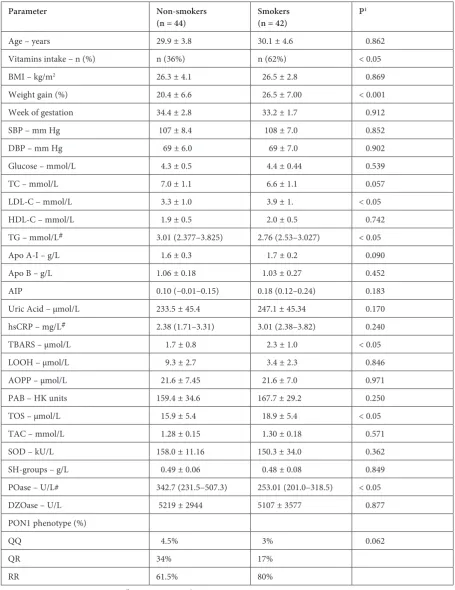
Table 1 shows the clinical and laboratory pa-rameters of lipid status and oxidative stress status
parameters in pregnant women grouped according to their smoking habits before pregnancy.
A significantly higher percentage of women who received (antioxidative) vitamin supplementation
Table 1. Clinical and laboratoryparameters, oxidative stress/antioxidative defense parameters, PON1 activities and PON1 phenotypes distribution in the two study groups according maternal smoking habits before pregnancy
Parameter Non-smokers
(n = 44) Smokers(n = 42) P
1
Age – years 29.9 ± 3.8 30.1 ± 4.6 0.862
Vitamins intake – n (%) n (36%) n (62%) < 0.05
BMI – kg/m2 26.3 ± 4.1 26.5 ± 2.8 0.869
Weight gain (%) 20.4 ± 6.6 26.5 ± 7.00 < 0.001 Week of gestation 34.4 ± 2.8 33.2 ± 1.7 0.912
SBP – mm Hg 107 ± 8.4 108 ± 7.0 0.852
DBP – mm Hg 69 ± 6.0 69 ± 7.0 0.902
Glucose – mmol/L 4.3 ± 0.5 4.4 ± 0.44 0.539
TC – mmol/L 7.0 ± 1.1 6.6 ± 1.1 0.057
LDL-C – mmol/L 3.3 ± 1.0 3.9 ± 1. < 0.05 HDL-C – mmol/L 1.9 ± 0.5 2.0 ± 0.5 0.742 TG – mmol/L# 3.01 (2.377–3.825) 2.76 (2.53–3.027) < 0.05 Apo A-I – g/L 1.6 ± 0.3 1.7 ± 0.2 0.090
Apo B – g/L 1.06 ± 0.18 1.03 ± 0.27 0.452
AIP 0.10 (–0.01–0.15) 0.18 (0.12–0.24) 0.183 Uric Acid – μmol/L 233.5 ± 45.4 247.1 ± 45.34 0.170 hsCRP – mg/L# 2.38 (1.71–3.31) 3.01 (2.38–3.82) 0.240 TBARS – μmol/L 1.7 ± 0.8 2.3 ± 1.0 < 0.05 LOOH – μmol/L 9.3 ± 2.7 3.4 ± 2.3 0.846 AOPP – μmol/L 21.6 ± 7.45 21.6 ± 7.0 0.971 PAB – HK units 159.4 ± 34.6 167.7 ± 29.2 0.250 TOS – μmol/L 15.9 ± 5.4 18.9 ± 5.4 < 0.05 TAC – mmol/L 1.28 ± 0.15 1.30 ± 0.18 0.571
SOD – kU/L 158.0 ± 11.16 150.3 ± 34.0 0.362
SH-groups – g/L 0.49 ± 0.06 0.48 ± 0.08 0.849 POase – U/L# 342.7 (231.5–507.3) 253.01 (201.0–318.5) < 0.05
DZOase – U/L 5219 ± 2944 5107 ± 3577 0.877
PON1 phenotype (%)
QQ 4.5% 3% 0.062
QR 34% 17%
RR 61.5% 80%
was present in the smokers’ group (Table 1). Also, weight gain was significantly higher in that group compared with the non-smokers (p < 0.001). LDL-c concentrations were significantly higher and trig-lyceride concentrations significantly lower in the smokers’ group. No other significant differences in lipid profile parameters were present between the two groups, but those parameter concentrations were close to high risk levels.
In this study only non-complicated pregnan-cies were investigated, so it is not surprising that no significant differences in glucose levels, uric ac-id levels and hsCRP concentrations were found be-tween the two groups.
TBARS and TOS concentrations were significant-ly higher in the smokers’ group, while PON1 activity was significantly lower (Table 1). The other oxidative stress status parameters were similar in both groups.
Table 2. Clinical and laboratoryparameters, oxidative stress/antioxidative defense parameters, PON1 activities and PON1 phenotype distribution in the two study groups according to maternal vitamin supplementation during pregnancy
Parameter No vitamin supplementation
(n = 44) Vitamin supplementation(n = 42) P
1
Age – years 30.1 ± 3.2 29.8 ± 4.1 0.906
Smoking – n (%) n (36%) n (62%) < 0.05
BMI – kg/m2 26.6 ± 3.6 26.3 ± 3.4 0.711
Weight gain (%) 23.2 ± 6.4 23.6 ± 8.4 0.803 Week of gestation 34.4 ± 2.9 34.5 ± 2.9 0.891
SBP – mm Hg 107 ± 10.1 108 ± 8.3 0.762
DBP – mm Hg 69 ± 7.1 68 ± 6.9 0.915
Glucose – mmol/L 4.4 ± 0.6 4.3 ± 0.4 0.727
TC – mmol/L 6.7 ± 1.0 6.9 ± 1.1 0.447
LDL-C – mmol/L 3.6 ± 1.0 3.7 ± 1.1 0.958 HDL-C – mmol/L 1.9 ± 0.4 2.0 ± 0.5 0.690 TG – mmol/L# 2.4 (2.18–2.65) 2.7 (2.49–2.94) 0.112 Apo A-I – g/L 1.6 ± 0.3 1.7 ± 0.3 0.788
Apo B – g/L 1.04 ± 0.18 1.07 ± 0.17 0.443
AIP 0.11 (0.021–0.140) 0.17 (0.100–0.218) 0.284 Uric Acid – μmol/L 235.9 ± 17.6 244.9 ± 13.4 0.368 hsCRP – mg/L# 2.9 (2.26–3.75) 2.5 (1.79–3.39) 0.790 TBARS – μmol/L 1.9 ± 0.3 1.9 ± 0.1 0.979 LOOH – μmol/L 9.1 ± 2.6 9.5 ± 2.3 0.343
AOPP – μmol/L 22.4 ± 7.5 20.7 ± 6.8 0.270
PAB – HK units 163.5 ± 31.8 163.4 ± 32.9 0.970
TOS – μmol/L 16.9 ± 5.9 17.6 ± 5.2 0.591
TAC – mmol/L 1.31 ± 0.16 1.28 ± 0.16 0.497
SOD – kU/L 147.9 ± 17.8 160.8 ± 17.9 0.128
SH-groups – g/L 0.49 ± 0.07 0.48 ± 0.08 0.529 POase – U/L# 257.0 (198.4–332.9) 334.0 (231.5–484.2) 0.239
DZOase – U/L 5145 ± 3040 5186 ± 3479 0.955
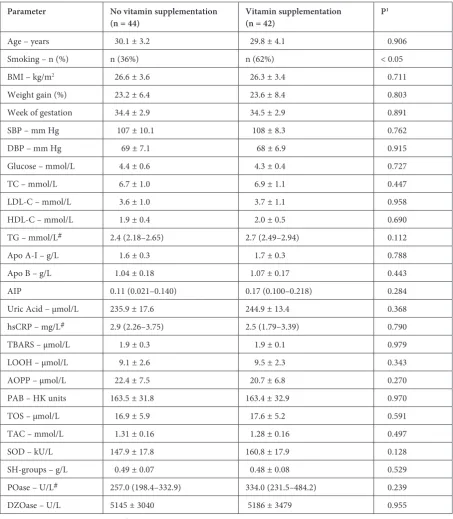
Table 2 shows the same parameters for wom-en with or without (antioxidative) vitamin supple-mentation. No significant differences were found in any parameter between the two vitamin-supple-mentation groups (Table 2).
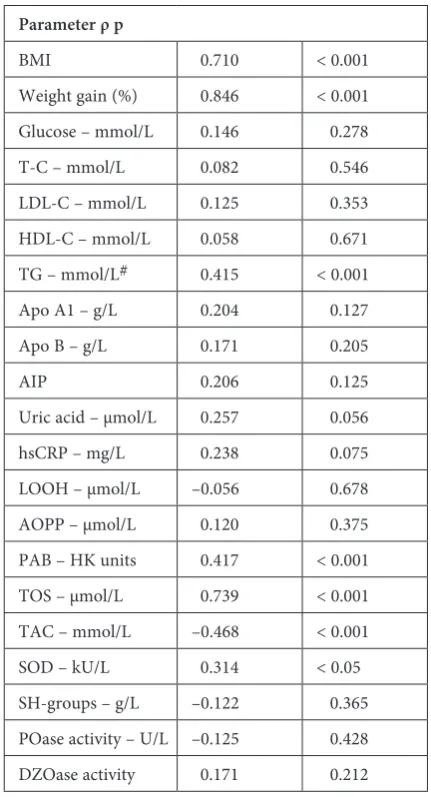
Spearman’s correlation analyses were per-formed to test for associations between oxidative stress parameters and other parameters. (Table 3). TBARS was significantly positively correlated with BMI, weight gain, triglyceride, TOS, PAB concen-trations and SOD activity, and significantly nega-tively correlated with TAC (Table 3).
Table 4 summarizes the multiple regression analysis to examine the influence of weight gain, smoking, TG, vitamin intake, uric acid, hsCRP, TAC and TOS as independent variables on TBARS. Weight gain, TAC and TOS concentrations were independently associated with the concentration of TBARS. Unexpectedly, habitual maternal smok-ing before pregnancy was not independently asso-ciated with the concentration of TBARS.
To prevent multicolinearity, TAC and TOS concentrations as parameters of oxidative stress status were excluded from Model 2 (Table 5). This showed that weight gain was independently associ-ated with the concentration of TBARS.
Discussion
Pregnancy is a physiological condition with changed lipid profile parameters [1] and increased susceptibility to oxidative stress [2]. During preg-nancy, increased production of ROS exceeding the mother’s antioxidant potential leads to oxida-tive stress, which can negaoxida-tively affect the health of both the mother and the fetus, leading to compli-cations in pregnancy, as well as adverse pregnan-cy outcomes [2]. It is well known that smoking is followed by intense oxidative stress [3]. Pregnancy
Table 3. Spearman’s non-parametric correlations between TBARS and biochemical and oxidative status parameters
Parameter ρ p
BMI 0.710 < 0.001 Weight gain (%) 0.846 < 0.001 Glucose – mmol/L 0.146 0.278 T-C – mmol/L 0.082 0.546 LDL-C – mmol/L 0.125 0.353 HDL-C – mmol/L 0.058 0.671 TG – mmol/L# 0.415 < 0.001 Apo A1 – g/L 0.204 0.127 Apo B – g/L 0.171 0.205
AIP 0.206 0.125
Uric acid – μmol/L 0.257 0.056 hsCRP – mg/L 0.238 0.075 LOOH – μmol/L –0.056 0.678 AOPP – μmol/L 0.120 0.375 PAB – HK units 0.417 < 0.001 TOS – μmol/L 0.739 < 0.001 TAC – mmol/L –0.468 < 0.001 SOD – kU/L 0.314 < 0.05 SH-groups – g/L –0.122 0.365 POase activity – U/L –0.125 0.428 DZOase activity 0.171 0.212
Table 4. Multiple regression analysis for the association of various parameters with TBARS – Model 1
TBARS R2 = 0.814 adjusted R2 = 0.813
β SE (β) P
Weight gain (%) 0.525 0.011 < 0.001 Smoking 0.110 0.124 0.116 Vitamin supplementation –0.064 0.112 0.306 TG – mmol/L 0.014 0.087 0.848 Uric acid – μmol/L –0.131 0.002 0.145 hsCRP – mg/L 0.081 0.015 0.195 TOS – μmol/L 0.367 0.016 < 0.001 TAC – mmol/L –0.342 0.715 < 0.001
Table 5. Multiple regression analysis for the association of various parameters with TBARS – Model 2
TBARS R2 = 0.788 adjusted R2 = 0.762
β SE (β) P
complications can arise due to the increased free radical damage caused by smoking [4]. Cigarette smoking leads to increases in the concentrations of serum TC, LDL-c and TG, and decreases in the level of anti-atherogenic HDL-c [22]. It is pre-sumed that, as Jeeyar et al. wrote, “nicotine stim-ulates the sympathetic adrenal system leading to increased secretion of catecholamines resulting in increased lipolysis and increased concentration of plasma-free fatty acids, which results in increased synthesis of hepatic TG, along with VLDL-c in the blood stream” [22].
High levels of LDL-c, VLDL-c, and TG are strongly associated with the development of coro-nary artery disease [22].
Tobacco smoke contains a large number of free radicals that are capable of initiating or pro-moting oxidative injury [5]. Smokers have higher concentrations of oxidatively modified lipid prod-ucts than non-smokers [22]. The current study showed that pregnant women who smoked had significantly higher LDL-c (p < 0.05) than preg-nant non-smokers (Table 1). LDL-c from smok-ers was more susceptible to peroxidative modifica-tion when compared with that from non-smokers [23], and oxidation of LDL-c might be an impor-tant mechanism whereby cigarette smoking can accelerate atherogenesis [22].
PON1 (aryldialkylphosphatase, EC 3.1.8.1) is an esterase binding to HDL that metabolizes oxi-dative LDL-c particles and has strong antioxidant potential [8]. Min et al. reported that low levels of PON1 in preeclamptic women lead to lipid per-oxidation and increased susceptibility to the ox-idation of LDL-cholesterol [24]. Low PON1 ac-tivities could be associated with an increased risk of developing CVD [24]. Significant reduction in PON1 activity during uncomplicated pregnan-cies has been described by Ferre et al. [25]. In the present study, pregnant women who smoked had significantly lower PON1 activity (p < 0.05) than pregnant non-smokers. Although PON1 activity differed significantly between smokers and non-smokers, no difference was found in the distribu-tion of PON1 phenotypes between those groups. The PON1 polymorphism phenotype appears to be involved in the pathogenesis of some diseases, especially CVD and diabetes mellitus type 2 [8].
Pregnancy has been described in numerous studies [1, 2, 6] as a physiological state with a pro-atherogenic effect, an altered lipid profile and in-creased oxidative stress. The results of the present study show that pregnant smokers are at a great-er risk of developing athgreat-erosclgreat-erosis than pregnant non-smokers, as they have significantly higher lev-els of LDL-c and TBARS, as well as lower PON1 enzyme activity. Pregnant women who smoked
before pregnancy had higher TOS values (p < 0.05) compared with women who were non-smok-ers (Table 1). Also, their concentration of TBARS was significantly higher, while PON1 activity was significantly lower compared with non-smokers. These results indicate that pregnant smokers are in a state of increased oxidative stress. This is com-patible with the findings of Aycicek et al. [26], who reported that TOS was significantly higher in the active and passive smoker groups than in the non-smoking controls. TBARS includes MDA and re-lated aldehydes, which are by-products of lipid peroxidation and which are responsible for some of the damaging effects of free radicals on DNA and on cell membranes [27]. According to Devasa-gayam et al., the damage to some cellular structures caused by lipid peroxidation “is highly detrimental to the functioning of the cell and its survival” [27].
Higher concentrations of hydroperoxides have been found in pregnant smokers than in non-smok-ers [5]. Chelchovska et al. also found a positive cor-relation between MDA and cotinine concentrations (the major metabolite of nicotine in body fluids), both in smoking mothers and in their children [5].
Regarding the effects of smoking on antioxida-tive markers, a linear relationship has been found between smoking duration, daily cigarette con-sumption, lipid peroxidation, and nitric oxide for-mation both in plasma and erythrocytes [28]. In that study, when smokers stopped smoking for six months, plasma levels of vitamin C and E, beta-carotene, erythrocyte superoxide dismutase, cata-lase and glutathione peroxidase were higher than in those who continued to smoke, but remained significantly lower than those of a matched non-smoking group [28].
As a further step, the authors of the current study wanted to establish whether smoking was the primary reason for increased concentrations of TBARS, the main indicator of oxidative stress. For this purpose, multiple regression analysis was used as a test model in which smoking and other pa-rameters that showed a significant correlation with TBARS were included. The results unexpectedly showed that weight gain during pregnancy, but not smoking, was an independent positive predictor of an increased concentration of TBARS (Table 5).
Among the participants in the current study, pregnant smokers had a significantly higher weight gain during pregnancy (p < 0.001) than non-smok-ers (Table 1). Since cigarette smoking decreases ap-petite [29], it seems likely that the gains in weight were a consequence of stopping cigarette smoking during pregnancy.
diabetes have been associated with increased ox-idative stress in a number of studies, the finding that obesity, as measured by BMI, is independent-ly associated with oxidative stress is relativeindependent-ly new [30]. In view of the results of the present study it can be said that pregnant smokers who have a sig-nificantly higher weight gain than pregnant non-smokers undergo greater oxidative stress. Although all the pregnant women who smoked in the pres-ent study finished their pregnancies without com-plications, the results suggest that weight gain is an independent risk factor for the development of ox-idative stress. However, the pregnant women who had smoked before pregnancy had higher TACs than pregnant non-smokers, suggesting that these women preserved their antioxidant potential, and this may explain why they brought their pregnan-cies to term without complications.
Pregnant women who took vitamin supple-ments showed no significant differences in the lev-els of antioxidant defense parameters in compar-ison with women who did not use supplements (Table 2). This may be explained by the fact that all the pregnant women were advised to include a lot of fruits and vegetables in their diets and thus they could have had a sufficient intake of antioxidants.
In the present study there was a significantly higher percent of smokers in the group of wom-en who received antioxidative supplemwom-entation
(62%). Cigarette smoke decreases antioxidant po-tential, which may explain the lack of any demon-strable effect of supplementation on the parame-ters of antioxidant defense. All the women were healthy with an intact antioxidant potential that was not compromised by any complications of pregnancy.
Studies have shown lower α-tocopherol retin-ol, and β-carotene levels in maternal plasma and cord plasma in smokers [5], though another study showed no differences between smokers and non-smokers in antioxidant vitamin levels in maternal plasma and cord plasma [3].
Some authors have shown that taking vita-mins, especially vitamin C and vitamin E, may have a positive effect on pregnancy and birth out-come [6]. On the other hand, a healthy diet rich in fruits and vegetables can also provide enough vita-mins and minerals [7] for a normal pregnancy.
The present study confirmed that smoking habits before pregnancy were associated with in-creased oxidative stress, lipid changes expressed through the creation of increased LDL-c, and de-creased PON1 activity. A multiple regression anal-ysis showed that weight gain during pregnancy, not smoking, increases TBARS. In addition, the results indicate that vitamin supplementation has no effect on the parameters of oxidative stress sta-tus in healthy pregnant women.
References
Aksoy H, Aksoy AN, Ozkan A, Polat H:
[1] Serum lipid profile, oxidative status, and paraoxonase 1 activity in hyper-emesis gravidarum. J Clin Lab Anal 2009, 23, 105–109.
Saker M, Mokhtari NS, Merzouk SA, Merzouk H, Belarbi B, Narce M:
[2] Oxidant and antioxidant status in mothers and their newborns according to birthweight. Eur J Obst Gynecol Reprod Biol 2008, 141, 95–99.
Orhon FS, Ulukol B, Kahya D, Cengiz B, Baskan S, Tezcan S:
[3] The influence of maternal smoking on maternal and newborn oxidant and antioxidant status. Eur J Pediatr 2009, 168, 975–981.
Bizon A, Milnerowicz NE, Zalewska M, Zimmer M, Milnerowicz H:
[4] Changes in pro/antioxidant balance in smok-ing and non-smoksmok-ing pregnant women with intrauterine growth restriction. Reprod Toxicol 2011, 32, 360–367.
Chelchowska M, Ambroszkiewicz J, Gajewska J, Laskowska-klita T, Leibschang J:
[5] The effect of tobacco smoking during pregnancy on plasma oxidant and antioxidant status in mother and newborn. Eur J Obstet Gynecol Reprod Biol 2011, 155, 132–136.
Mistry HD, Williams PJ:
[6] The importance of antioxidant micronutrients in pregnancy. Oxid Med Cell Longev 2011, doi:10.1155/2011/841749
King JC:
[7] Physiology of pregnancy and nutrientmetabolism: Am J Clin Nutr 2000, 71, 1218–1225.
Stefanovic A, Ardalic D, Kotur SJ, Vujovic A, Spasic S, Kalimanovska SV:
[8] Longitudinal changes in PON1 activi-ties, PON1 Phenotype distribution and oxidative status throughout pregnancy. Reprod Toxicol 2012, 33, 20–26.
World Health Organization. WHO document:
[9] Measuring obesity-classification and description of antropomet-ric data. Copenhagen: WHO Regional Office for Europe, 1998.
Dobiasova M, Frohlich J:
[10] The plasma parameter log (TG/HDL-c) as atherogenic index: correlation with lipopro-tein particle size and esterefication rate in apo B-lipoprolipopro-tein-depleted plasma (FERHDL). Clin Biochem 2001, 34, 583–588.
Girotti MJ, Khan N, Mc Lellan BA:
[11] Early measurement of systemic lipid peroxidation products in plasma of major blunt trauma patients. J Trauma 1991, 31, 32–35.
Gay CA, Gebicki JM:
[12] Measurement of protein and lipid hydroperoxides in biological systems by ferric-xylenol orange method. Anal Biochem 2002, 30, 65–74.
Witko-Sarsat V, Nguyen M, Capeillere-Blandin C, Nguyen AT, Zingraff J:
Erel O:
[14] A new automated colorimetric method for measuring total oxidant status. Clin Biochem 2005, 38, 1103– –1111.
Erel O:
[15] A novel automated direct measurement method for total antioxidant capacity using a new generation, more stable ABTS radical cation. Clin Biochem 2004, 37, 277–285.
Misra HP, Fridovich I:
[16] Chemistry and metabolism of substances of lowmolecular weight: The role of superoxide anion in the Autoxidation of Epinephrine and a Simple Assay for Superoxide Dismutase. J Biol Chem 1972, 247, 3170–3175.
Alamdari DH, Paletas K, Pegiou T, Sarigianni M, Befani C, Kaliakos G:
[17] A novel assay for the evaluation of the prooxidant-antioxidant balance, before and after antioxidant vitamin administration in type II diabetes patients. Clin Biochem 2007, 40, 248–254.
Ellman GI:
[18] Tissue sulfhydril groups. Arc Biochem Biophys 1952, 82, 70–77.
Richter RJ, Furlong CE:
[19] Determination of paraoxonase (PON1) status requires more than genotyping. Pharmacogenetics 1999, 9, 745–753.
Bland JM, Altman DG:
[20] Statistics notes: transformations, means and confidence intervals. BMJ 1996, 312, 1079– –1080.
SYSTAT for Windows.
[21] Statistics, Version 5 Edition. Systat Inc., Evanston, IL 1992, 210–379. Jeeyar, Hemalatha, Silvia CRWD:
[22] Evaluationof effect of smoking and hypertension on serum lipid profile and oxidative stress. Asian Pacific J Trop Dis 2011, 289–291.
Hayase T, Ayaori M, Hiroki S, Tanaka N, Ohashi K, Harumi UK:
[23] Impact of low- and high-density lipoprotein cholesterol levels on carotid intima-media thickness differs by smoking statut in middle-aged men. J Atheroscler Tromb 2012, 19, 664–672.
Min J, Park H, Park B, KimJY, Park J, Lee H:
[24] Paraoxonase gene polymorphism and vitamin levels during preg-nancy: Relationship with maternal oxidative stress and neonatal birthweights. Reprod Toxicol 2006, 22, 418–424.
Ferre N, Camps J, Fernandez BJ, Arija V, Murphy MM, Marsilach J:
[25] Longitudinal changes in serum paraoxo-nase-1 activity throughout normal pregnancy. Clin Chem Lab Med 2006, 44, 880–882.
Aycicek A, Varma M, Ahmet K,Abdurrahim K, Erel O:
[26] Maternal active or passive smoking causes oxidative stress in placental tissue. Eur J Pediatr 2011, 170, 645–651.
Devasagayam TPA, Boloor KK, Ramasarma T:
[27] Methods for estimating lipid peroxidation: An analysis of merits and demerits. Indian J Biochem Biophys 2003, 40, 300–308.
Elsayed MN, Bendich A:
[28] Dietary antioxidants: potential effect on oxidative products in cigarette smoke. Nutr Res 2001, 21, 551–567.
Cogsvell EM, Weisberg P, Spong C:
[29] Cigarette smoking, alcohol use and adeverse pregnancy outcomes: implica-tions for micronutrient supplementation. J Nutr 2003, 133, 1722–1731.
Stefanovic A, Kotur SJ, Vujovic A, Spasic S, Spasojevic K V, Jelic IZ, Martinović J, Ardalić D, Mandić MV, [30]
Miković Ž, Cerović N: Assotiation of the atherogenic index of plasma and oxidative stress status with weight gain during non-complicated pregnancy. Clin Chem Lab Med 2012, 50, 2019–2025.
Address for correspondence:
Aleksandra Stefanović
Department of Medical Biochemistry University of Belgrade
Vojvode Stepe 450 11000 Belgrade Serbia
E-mail: [email protected]
Conflict of interest: None declared