Volume 7, Issue 4 (2018) pp. 341-352
341 | Page Original Article
Recognition of the Physical Structure and Characteristics
of Islamic City
Mehdi Pirhayati
1*, Milad Torkjazi
2, Iman Tazikeh Lemeski
3, Monireh
Karimi
41MSc in Architecture, Sama Technical and Vocational Training College, Islamic Azad
University, Boroujerd Branch, Boroujerd, Iran
2MSc in Architecture, Lecturer of Architecture Department in Golestan Non-profit Institute
of Gorgan, Iran
3Departmant Of Architecture, Gonbad Kavous Branch, Islamic Azad University, Gonbad
Kavous,Iran
4MSc in Architecture
Received: 24 October 2018, Revised: 05 December 2018, Accepted: 20 December 2018 ABSTRACT
Cities and habitations are among the most prominent and tangible effects of human culture, which express many mental and subjective components affected by and resulting from it, by providing objective and perceivable spaces. Islamic cities also were not (and are not) an exception. Islamic cities represent a special concept of city. In this concept, Islamic values and attitudes are manifested. Such values and attitudes are evident in construction of urban elements. The results indicate that formation of design principles of Islamic city mainly depend on Islamic values and cultural beliefs rooted in nature of Islamic rules, which also affect various aspects of lives the Muslims, including construction of habitations. In this study, it is tried to investigate the characteristics and physical structure of Islamic city in various periods by a combined library and analytical-descriptive method. Finally, it is concluded that such factors as economic development and social characteristics influenced (and influence) the physical structure of Islamic cities in addition to the attitude of the rulers of each period and the ideology resulting therefrom.
Keywords: Mosque, Identity of Islamic City, Islamic Entity, Islam, Islamic Urban
Development.
Introduction
Islamic city became a serious subject of research in the first quarter of twentieth century for the first time. Since then, various studies have been formed and many papers have been published in this field. In 1960s,
distinct quantitative approaches and
342 | Page true religion of Islam in all aspects (Rahimi,
2007). There is a special relationship between Islam and urban life, and
popularization of Islam has been
intermingled with development and
promotion of urban life. For recognition of the characteristics of Islamic city, first it is necessary to get acquainted with Islamic ideology. Among others, influence of worldview and religious values on construction and production of urban spaces, especially in Islamic era, is very important. City is constructed based on worldview and the highest representation of occupation and possession is in the belief and idea. In this concept, Islamic values and attitudes are manifested. Such values and attitudes are evident in construction of urban elements. Islamic city creates a special landscape for itself (Gharakhloo, 2004). In fact, views of Islamic city are the interpretation of religious beliefs and social life of the people, which has been developed through collective life and cooperation with each other towards preservation and survival of the society. In general, given the relationship between worldview and culture and architecture and Urbanizationin any society, including a society with and relying on Islamic thought, although growth and excellence of this culture and promotion of its values and establishment of identity of the society against aliens and attention to the status and preservation of natural environment and creation of an appropriate relationship between human and the environment and such spiritual and materials affairs are concerned, It is completely necessary to pay attention to Islamic architecture and
Urbanizationand structure of its
characteristics (Naghizadeh, 2009).
Materials and Methods
Research Methodology
This research article is a fundamental study, which is analysis-based in all sections, but
description and data comparison tools have also been used. In expression of historical background of Islamic city, descriptive-analytical procedure has been used, and in expression of the physical structure and characteristics of Islamic city, comparative-analytical procedure has been used, and finally some points have been deduced from it and analyzed.
Questions of Study
The main purpose of the present article is to find an answer to the following questions: Can a definition be provided for Islamic architecture and urban development? May some criteria be proposed for recognition of the physical structure and characteristics of Islamic architecture, city and environment?
How to Attribute Architecture and City to Islam?
The adjective “Islamic” may be attributed to a manmade object when it is created according to Islamic instructions and recruited by human in such a way to guide him towards Islamic values while meeting his material needs. In order to recognize “architectural” and “urban” or “life environment” indications and characteristics from the viewpoint of Islam, there are various ranks:
343 | Page physical and material model from the Koran
for buildings and cities as Islamic architecture and city for all times and places. In contrast, it is possible and necessary to recognize the characteristics and especially qualitative constructional and urban features. In summary, it can be said that Islam instructs how to live and it is natural for the living space to be compliant with the lifestyle defined by Islam.
In the next phase, we should refer to
“Sunnah” (the practice of Prophet of Islam (PBUH)), who accepted to change the name of “Yasreb” to “Medina Al Nabi” after entering the city, and it was maybe the first that an adjective related to Islam was applied to a city.
Imam Ali Ibne Abitaleb
(PBUH) also recommended appropriate and necessary points to his companions and followers regarding various subjects related to city and living environment and building, when necessary, the most prominent of which is reflected in his order to Malik Ashtar: “This is an order from God’s servant, Ali, Amirolmomenin, to Malik Ashtar, in a contract concluded with him, when he granted the rule of Egypt to collect its tax and battle against its enemies and improve its cities” (Nahjolbalagheh, Letter 53: 719). Here, Imam Ali (PBUH) finds improvement of land more important than collection of tax.
In his prayer for border
guards, Imam Zinolabedin (PBUH) expressly refers to the boards of the Muslims (Sahifeh Sajadieh, Prayer 27, Phrase 1: 180). In Phrase 7 of the same prayer, he asks soundness of the cities of the Muslims from God (Va Has be Diarehem).
Scholars and philosophers, for
example Farabi, also described here and there, and even in some cases accurately and in detail, a utopia, whose characteristics have
undoubtedly been obtained and/or
interpreted from Islamic texts. “In Farabi’s opinion, earthly city and house should be a
reflection of heaven. In spite of considering the city independent from religion and creed of the people, Ibne Khaldoon knows important the effect of religious beliefs in construction of cities and effect of order and structure of city” (Davari Ardakani, 1996).
By scrutinizing these discussions, it can be concluded that Islamic thought firstly and inherently does not know it necessary to attribute the adjective “Islamic” to the products of its followers, because 1) there is no other right religion and correct thought other than Islam from the viewpoint of this ideology, and 2) it has not used the adjective “Islamic” in any science and art (even those specific to it). But, by observing the difference between their knowledge, sciences and arts and what existed in Islamic societies, those who lived out of Islamic society recognized that this difference results from thought, religion, worldview and culture, and consequently attributed the adjective “Islamic” to them, which is very controversial and is out of the scope of this article (Naghizadeh, 2004).
Discussion
Concept of Islamic City
344 | Page instructions. The Holy Koran is among the
original and fundamental resources
describing attitude of Islam towards characteristics of a desirable city. What are the characteristics of an Islamic city? Is it a city with numerous domes and minarets, numerous religious places, historical and ancient view like early cities of Islam or is it a city with monotheist people? Yet, no complete definition has been provided for Islamic city and its characteristics, and the qualified intellectuals, those interested and specialists are required to try to consolidate the theoretical fundamentals and provide a comprehensive definition in this regard. Undoubtedly, the most genuine and comprehensive Islamic reference is the Holy Koran; an ocean, from whose blessings humans benefited during different centuries and eras, and to which no defect has occurred while remaining refresh and up-to-date. In the Koran, the word “Al Medina” was cited 14 times, the word “Balad” in three forms totally for 14 times, and “Al Balad” for 5 times. In some verses, a special city was concerned; in other, the main subject and message of the verse is not related to any characteristic of a city; and other verses are directly related to a characteristic of a city. Regarding respect and security of the city, as expressed in the Koran, the city may be respected and God, the Almighty, swears on city two times:
Naml Sura, Verse 91: “I was ordered to worship creator of this city. A city, whose lordship and everything belongs to Him, I shall respect it and I am to be from Muslims”.
Balad Sura, Verses 1 and 2: “Swear on this city and you who settled there in”.
Tin Sura, Verse 4: “And swear on this secure city”.
In the above verses that came down in Mecca, it is observed that a city may be so sacred that God swears on it, and we know that Mecca was respected from a long time ago. In addition to these swears, two characteristics also added its sacredness:
A- Settlement of the Prophet in Mecca makes it sacred. The city, where the elites, pious people and scholars live, is sacred. Even the memories, works and tombs of the elites make a city sacred, which is more or less true in most places in the world.
B- As a characteristic of the city, security also makes Mecca sacred. As mentioned earlier, security of the city has been stated in some cases, one of which is swear on “secure city”.
Physical Structures of Islamic Cities
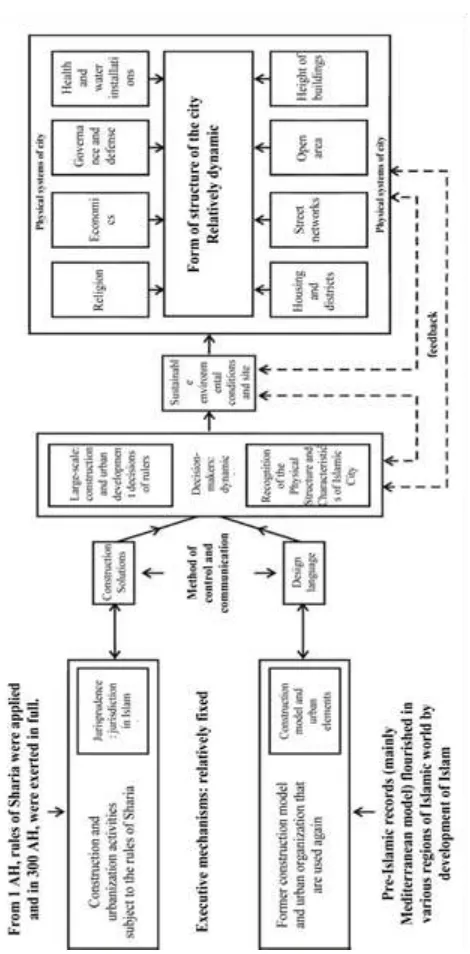
Introduction of Islam to various cities of Asia, Africa and Europe had a prominent and dynamic effect. According to Fischel (1956) and Hassan (1972), Islam, in fact, was a religious city (Sanbar, 2006). Furthermore, providing the grounds for a prosperous civilization, Islam embraced extensive part of the discovered habitable world from Pyrenees to Himalaya at a miraculous speed within less than a century (Saeidi Rezvani, 1993). Maybe, Islam is the only religion formed in a city, and its development was (and is) directly related to development of city in various periods. Islamic ideology highly influenced not only emergence of the cities but also their physical structure. This structure witnessed various changes and evolutions during various periods by introduction of new governments and ideologies. Among the most important factors forming the map and shape of Islamic city are the influence of local topography, former morphologies of the city and in fact Islamic city, a reflection of economic, political, social and cultural structures, including:
A-Natural Rules: The first principle
345 | Page
B-Religious and Cultural Beliefs:
Formed religious beliefs and experiences are live cultural heritages. Cultural- Islamic beliefs have separated public life from private one, so design of the city includes narrow streets, and religious thought separated public and private limits, while the land usages emphasize on separation of women and men. As a result, business activities, including exchange and presence in public places and main streets, have been separated from private places.
C-The principles rooted in Sharia (Religious Laws): Islamic city is a reflection
of Sharia; defined physical and social relations of private and public limits between the neighbors and social groups. Principles of privacy have created the walls higher than cameleer. Such principles have also affected property rights (Hakim, 1986).
D-Social Principles: Social organization
of urban society is grouped based on cultural attitude of blood or race origin. Therefore, physical development of the city is directly related to familial relationship, religious, social and defense characteristics.
Components of Physical Structure of Islamic City
There are a lot of debates about what constitutes an Islamic city or whether Islamic city existed or not. La pirus believes that: “Arab Muslims did not exclusively live in new cities, but some settled in cities and villages”.
He adds: “Arabs prompted urban
development in the Middle East without
causing general increase in urban
development level and without giving Islamic identity to the cities”. However, among such authors as Hamdan (1962), Alikman (1981), Hakim (1876) and Al-seyed (1991), there is a consensus that an Islamic city has the following characteristics:
A-Main Mosque: Located at the heart of
the city, which is typically surrounded by
Soogh or market; for example, Zeitooneh Mosque in Tunisia and Central Mosque in Esfahan.
B-Soogh (Markets): Being located in the
periphery of the main mosque, it was where the economic activities were provided. Spatially, goods were distributed and sold with respect to their nature. Sacred items such as candle, incense, perfume and the articles supplied by booksellers and bookbinders were sold in the vicinity of the mosque, and other goods were in the farther distances. Central area was the place where other public activities such as social,
administrative, business, artistic and
346 | Page
C-Citadel (Arg): Being Famous to
“Qasaba”, it is the representation of the ruler. Surrounded by a wall, Qasaba included an
area with mosques, gardens and offices of its dwellers, usually located in upper part of the city in the vicinity of the wall.
Figure 3. The model provided by Hakim by depiction of the components effective in formation of Islamic
city (Hakim, 2002).
D-Residential Areas: It has been
described as a set of households, whose special quality of life was based on closeness and intimacy, which is evident in personal linkage, common interests and common ethical unity. These residential areas were
347 | Page residential areas in Algeria and Tunisia.
These areas were organized ethnically.
E-Street Network: It was formed through
linkage between the residential areas and main place through a narrow network of meandering streets, which were divided into the pseudo-private, private and public streets and dead-ends.
F-Wall: A fortified wall with some gates
that surrounded the city.
G-Exterior Aspect: In outer part of the
walls, there were graveyards (Muslims and Jews). There was a weekend market outside of the main gate.
Main Elements of Islamic Cities:
1) Wall, 2) gate, 3) Citadel (Arg), 4) Roads, 5) Suburbs, 6) Highways (Public Street), 7) Mosque, 8) Administrative Organizations, 9) School, 10) Market, 11) Caravansary, 12) Residential District
Investigation of Formation of Islamic Cities and their Characteristics
In order to recognize and analyze the process of formation of Islamic city and its characteristics, it is first necessary to study the principles controlling the texture and skeleton of Iranian cities.
Skeleton of Pre-Islamic Iranian Cities
Before emergence of Islam, Iranian cities were composed of three main parts: Sharistan (Shahrestan), Kohandej or Arg (Citadel) and Prost (outer part). The
constituents of each part of the said three parts may be summarized as follows:
Sharistan (Shahrestan) Including:
A-Main passageways: that connect city gates to each other and to main elements of the city such as market, citadel (Arg) and etc.
B-Gardens and Green Area: where the nobles and dignitaries lived.
348 | Page D-Connection joints: created at the junction
of passageways, delimitating urban and district divisions.
E-Residential districts: where the public lived.
Kohandej or Arg (Citadel): base of
governance, where Zoroastrian temple and reception halls located.
Prost (Outer Part) including:
A-Connection Road: for connecting the city with other settlements and provinces.
B-Farms and Gardens: for supplying agricultural products to the city.
C-Sacred Places: is Zoroastrian temple or tomb of a noble or sacred person, which represents the city and its identity.
D-Graveyard: where the public was buried. E-Caravansary(inn): There was a Barandaz (square) behind the wall, where the caravans could rest and the merchants could do their deals before the goods enter the city (Farivar Sadri, 2001).
Therefore, it seems that given the protective and defensive elements of the city such as trench, wall, gates and their doors and etc., the most significant mental space controlling the texture and spatial structure of pre-Islamic cities is the security and its preservation, and such formation has been summarized on material space of human being.
General Skeleton of Post-Islamic Iranian Cities
Development of the cities of this period has continued based on the infrastructures and apparent skeleton of pre-Islamic cities, and there always was three main and basic parts in a completely distinct form in Iranian cities preserved after Islam, except that they were combined with a kind of spirituality, so that Friday Mosque become a main element in urban life, characterizing the city (Shafaghi, 1984). Here, in order to clarify the
predominance of spirituality in Islamic cities, we investigate the components of main domains of Islamic city.
Theoretical Fundamentals in Formation of Islamic City
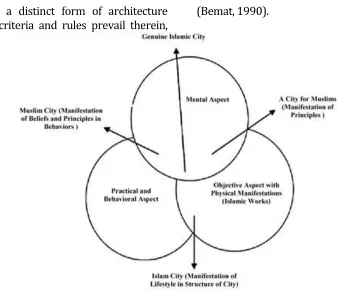
In general, three elements contribute to creation of physical space of city: “human”, “behavior” and “physique”. But in Islamic cities, three elements contributing to their formation include “monotheistic worldview”, “Islamic ethics and behavior” and “Islamic interaction and communication with world”. If we depict these three elements by intersecting circles, the best form is when the three circles overlap. In this form, four types of city may be identified for Islamic society on overlapping surfaces. First is the city where humans believing in basic principles of Islam live and act based on Islamic instructions, which is called “Muslims’ City”. The second one is the city where the Muslims live in an Islamic structure constructed according to Islamic instructions, which can be called “A City for Muslims”. The third one called “Islam City” indicates a city where Islamic behavior is practiced and the structure of the city has been constructed according to Islamic principles and values. Finally, the surface shared by three circles is called “Genuine Islamic City”, where monotheist Muslims behave and act according to Islamic instructions and ethics and could create an appropriate structure manifesting Islamic values and helping them live as Muslims.
Principles Controlling Spatial- Functional Structure of Islamic Cities
349 | Page represents a distinct form of architecture
while life criteria and rules prevail therein, (Bemat, 1990).
Figure 5. Relationship among “mental aspect”, “practical and behavioral aspect” and “objective aspect” in
formation of “Genuine Islamic City”, “A City for Islam”, “A City for Muslims”, and “Muslims’ City” (Naghizadeh, 1999: 47)
Aside from all diversities in place, climate and weather, city in Islam is inundated with a single faith, and it represents a distinct form of architecture while life criteria and rules prevail therein, (Bemat, 1990). In order to find Islamic origin, nature of Islam that is based on path and has clarified its reality should be referred. This internal aspect is inseparably linked with Islamic spirituality (Nasir, 2004). Thus, it is observed that in formation and constitution of Islamic city and the relationship among its constituents, there are some principles, the most important of which include:
A-Hierarchy Principle
According to this principle, urban space is defined in relation to the spaces located at the levels higher or lower than it, having no sense without this spatial level. By this principle,
each urban space or building and architecture, in fact, has interior and exterior. It forms its sublevels within the interior and it is influenced by its superior levels in the exterior (Ahari, 2001).
B-Plurality Principle
In its expansion, urban space tends to
plurality and diversity, tends to
disintegration and variety; in this plurality and variety, each component and element has its own identity, character and sense, independent from other components and elements. Each component becomes a whole at the scale related to it (Habibi, 2003).
Among other important principles
controlling the structure of functional space of Islamic cities, we can enumerate “unity
principle, centralization principle,
350 | Page connection principle, balance principle,
proportionality principle, continuity
principle, domain principle, simplicity
principle, complicatedness principle,
composition principle, constitution principle, time principle, and briefness principle”.
Conclusion
Considering the foregoing, it can be said that formation of design principles of Islamic city mainly depend on Islamic values and cultural beliefs, principally rooted in nature of Islamic rules, which affects various aspects of lives of the Muslims. This is why Islam is recognized more as “lifestyle” than as spiritual faith, and its habitations have been stated as civilization (Elaraby, 1966). Briefly, it should be said that the main resource of the principles controlling all actions of the Muslims, including their urban development, is the Holy Koran and “Sunnah” (Practice of the Prophet (PBUH)). Physical manifestation and emergence of Islamic “architecture” and “city” is not possible only with instruction, circular and code, but what is important is growth, presence and predominance of religious (Islamic) thought in the society and its lifestyle. On the other hand, the decisions of governors and rulers are considered as main factors in formation and morphology of city. Decisions of governors were provided at macro level; i.e. its effects manifested in the planned cities; but the decisions of citizens were applied at micro level, being less effective than those of governors in urban morphology. Islamic city is, therefore, a city that has the manifestations of Islamic civilization and specific spatial, cultural and historical identity, the characteristic of which has been inspired by Islam, the Koran and “Sunna” (Practice of the Prophet (PBUH)), and in urban development, a kind of inherent general and structural relationship among each element and artificial urban space and
individual and social connections.
Furthermore, hierarchy, plurality, unity,
centralization and decentralization,
accumulation, distinction, connection,
balance, proportionality, continuity, domain, simplicity, complicatedness, composition, constitution, time, and briefness principles contribute to formation and constitution of Islamic city and the relationship among its constituents (Naghizadeh, 2002).
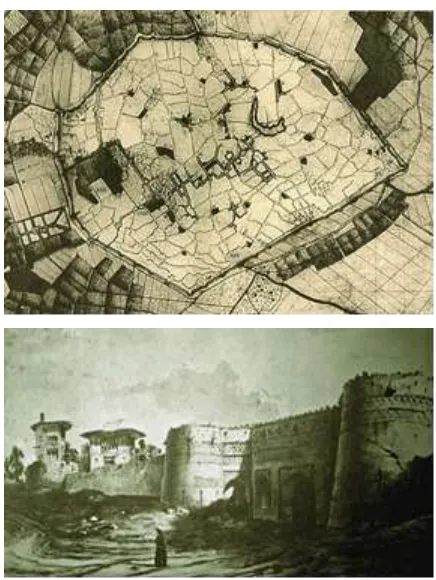
Figure 6 & 7. Physical structure of Boroujerd
(19th century, top) and wall and towers of Boroujerd in Islamic period (Century 10 AH, bottom) (Authors).
References
Annas, J. (2000). Ancient Philosophy, a Very Short Introduction, Oxford, New York.
Asil H. (2002). Utopia in Iranian Thought, Tehran, Ney Press, 2nd Ed.
Augustine (1998). City of God against the Pagans, Cambridge University Press, First Published.
351 | Page Eslambolchi, Tehran, Press and Publication
Organization of Ministry of Culture and Islamic Guidance.
Brown, L.C. (1973). Introduction in L.C. Brown (Ed.) From Madina to Metropolis: Heritage and Change in the Near Eastern City, Princeton, New Jersey, Darwin Press, 15-50.
Bukhart, T. (1986). Islamic Art: Language and Expression, Translated by Masoud Rajabnia, Tehran, Soroush.
“Comprehensive” Koran Software CD, Koran Translation and Interpretation Application.
Farooq, H. (2006). Islam: Environmental Protection (Presidential Address to the Pakistan Ecology Council at the Karachi Hall, Lahore High Court Bar Association).
Fischel, I.W. (1956). The City in Islam, in Middle Eastern Affairs.
Galantay, E.Y. (1986). The City: Organism or Artifact? in R. Berger (Ed.), Art and Technology, New York, Paragon House.
Galantay, E.Y. (1977). The Labyrinth and the Grid: Basic Types of Urban Form, Swissair Gazette, No. 10.
Gorringe, T.J. (2002). A Theology of the Built
Environment: Justice, Empowerment,
Redemption, Cambridge, Cambridge
University Press.
Habibi, M. (1996). From Shar to Shahr, Tehran, University of Tehran.
Hakim, B. (1986). Arabic Islamic cities: Building and Planning Principles.
Hakimi, M. (2001). Sun of the West, Tehran, Islamic Culture Press Office, 18th Issue.
http://www.7setareh.ir/Religion/view1511 7.asp.
Ibne Khaldoon, A.B.M. (1429 Lunar Hegira), “Introduction by Ibne Khaldoon”, Beirut, Sida, Almaktabah Alasriah.
Karim, Fazlul, 1938/9, Al-Hadis: An English Translation and Commentary of “Mishkat-ul-Masabih”: Vols. 1 and 2, Calcutta, East Pakistan.
Koneo P. (2005). History of Urban Development in the World of Islam, Translated by Saeid Zonoozi, Tehran, Civil and Improvement Co.
Koorani, A. (1992). Age of Manifestation, Translated by Abbas Jalali, Press and Publication Center of Islamic Development Organization, 2nd Ed.
Naghizadeh, M. (1999). Resources and Method of Recognition of Theoretical Fundamentals of Sacred Architecture and Islamic City, Honar Quarterly, New Release, Vol. 40, Specific for Sacred Art; 99-116.
Sabiq, al-Saiyed, (1969/71), Fiqh al-sunna, Vols. 2 and 3, Dar al-Kitab, Al- Arabi, Beirut.
Sattari Sarbangholi, H. Unpublished Article “Modern Procedures in Age of Manifestation”.
Stern, S.M. (1967). The Constitution of the Islamic City in A.H. Hourani and S.N. Stern (Eds.), The Islamic City: A Colloquium, Oxford, Bruno Cassirer, 25-50.
Turner, B.S. (1976). Weber and Islam: A Critical Study, London, Routledge and Kegan Paul.
Von Grunebaum, G.E. (1961). Islam: Essays in the Nature and Growth of a Cultural Tradition, London, Routledge and Legan Paul, (2nd Ed.).
352 | Page Weber, M. (1968). Economy and Society,
Translated by G. Roth and C. Wittich, Berkeley, University of California Press.
Weber, M. (1968). The City, Translated by G. Roth and C. Wittich, Berkeley, University of California Press.
Wheatly, P. (1976). Levels of Space Awareness in the Traditional Islamic City, Ekistics, Vol. 42, No. 253, 354-66.