137
Isocratic Reverse Phase High Performance Liquid Chromatographic Estimation of Ramipril and Amlodipine in Pharmaceutical Dosage Form
Manikanta Kumar. A, P. Vijay Kumar*, Mahesh Nasare, Venkateswar Rao, V.V.L.N.
Prasad, Prakash V. Diwan
Department of Pharmaceutical Analysis and Quality Assurance, School of Pharmacy, Anurag
Group of Institutions, Venkatapur (V). Ghatkesar (M), Rangareddy (D), Hyderabad, Andhra
Pradesh, India
*Corresponding author: [email protected]
ABSTRACT
A new simple, rapid, specific, accurate, precise and novel reverse phase High Performance
Liquid Chromatography (RP-HPLC) method has been developed for the simultaneous
estimation of Ramipril and amlodipine besylate in the combined pharmaceutical dosage
form. The chromatographic separation for ramipril and amlodipine besylate were achieved
with mobile phase containing mixed phosphate buffer (0.02 M potassium di-hydrogen
orthophosphate and 0.002 M di-potassium hydrogen phosphate anhydrous, pH 6.8) and
acetonitrile (60:40 % v/v), phenomenex C18 column (150 × 4.6mm i.d, particle size of 5µ)
at 5⁰ C and UV detection at 237 nm. The compounds were eluted in the isocratic mode at a
flow rate of 1 ml min-1. The retention times of Ramipril 2.13 ± 0.09 min and amlodipine
besylate at 5.18 ± 0.12 min. The above method was validated in terms of linearity, accuracy,
precision, LOD, LOQ etc. in accordance with ICH guidelines.
Keyword:Ramipril, Amlodipine Besylate, RP-HPLC, Validation.
INTRODUCTION
Ramipril, chemically (2-[N-[(S)-1-(ethoxycarbonyl)-3- phenylpropyl)] - L-alanyl]-(1S, 3S,
5S)-2-azabicyclo [3-3-0] octane carboxylic acid (Fig.1), is an angiotensin-converting enzyme
(ACE) inhibitor[1]. It acts on the renin–angiotensin aldosterone system by inhibiting the
conversion of the inactive angiotensin I to the highly potent vasoconstrictor, angiotensin II,
138
(2-[(2- aminoethoxy) methyl]-4-(2-chlorophenyl)-1, 4-dihydro- 6-methyl-3, 5-
pyridinedicarboxylic acid 3-ethyl, 5-methyl ester)[2] (Fig.2). It is an anti-hypertensive and
an antianginal agent in the form of the besylate salt, Amlodipine besylate. It is not official in
any Pharmacopoeia.
Literature survey reveals that there are several analytical methods for the estimation of
amlodipine besylate and ramipril individually or in combination with other drugs [3-10].
Although the combination use of amlodipine besylate and ramipril is continuously
increasing, there is no simple and economical RP-HPLC method for the determination of
these drugs in the combined pharmaceutical dosage form. The purpose of present study is
to investigate a simple, precise, accurate and economic RP-HPLC method in simultaneous
determination of amlodipine besylate and ramipril in the combined pharmaceutical dosage
form.
Fig. 1. Structure of Ramipril Fig. 2. Structure of Amlodipine
MATERIALS AND METHODS
Ramipril and Amlodipine besylate gift samples were obtained from Taj Pharmaceuticals Ltd.
India. Acetonitrile (HPLC grade) and dipotassium hydrogen phosphate (AR grade) were
purchased from Merck Ltd, India. Water for HPLC was obtained from Qualigen fine
chemicals, Mumbai, India. Analytical reagent potassium dihydrogen orthophosphate (AR
grade) was obtained from Rankem Pvt. Ltd, Mumbai. Chromatographic separation was
performed on Waters® HPLC system equipped with Waters 2489 UV/Visible detector and
Empower software. Phenomenex C18 Column (150 × 4.6 mm i.d, particle size of 5μ) and
constant flow pump and Auto injector with 20 μL loop were used. The composition of the
mobile phase was in the ratio of mixed phosphate buffer (0.02 M potassium di-hydrogen
orthophosphate and 0.002 M di-potassium hydrogen phosphate anhydrous, pH 6.8) and
139
phase was filtered through a 0.45 μ membrane filter and sonicated for 15 min. Analysis was
performed at 5⁰ C temperature.
Preparation of standard solutions
5 mg of Ramipril and 5 mg of amlodipine besylate were accurately weighed and dissolved in
50 ml of mobile phase to obtain standard stock solution of 50 μg mL-1 and 100 μg mL-1
respectively. Further working standard solutions of Ramipril and amlodipine besylate, 1.25
-7.5 μg mL-1 and 2.5–15 μg mL-1 respectively, were prepared by suitable dilution of the stock
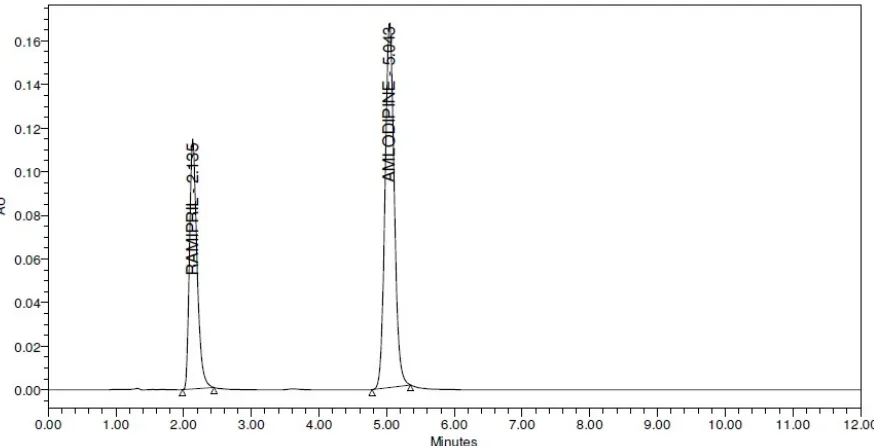
solution with mobile phase. A typical chromatogram obtained from the analysis of drugs
using the developed method was shown in Fig. 3.
Fig.3: A typical chromatogram of standard Ramipril (2.5 μg ml-1) and amlodipine
besylate (5 μg ml-1) measured at 237 nm
Preparation of capsules for assay
For analysis of commercial formulations, 20 capsules were weighed and average weight
was calculated. Weight equivalent to 2.5 mg and 5 mg of Ramipril and amlodipine besylate
was taken and transferred into 100 ml volumetric flask and dissolved with mobile phase,
filtered through a whatman filter paper. This solution was further diluted stepwise with
140
RESULTS AND DISCUSSION
Phenomenex c18 (150 × 4.6 mm i.d, particle size of 5μ), column maintained at ambient
temperature 5⁰ C was used for the separation and the method was validated for the
estimation of Ramipril and amlodipine besylate in capsules. The composition, pH and the
flow rate of the mobile phase were optimized. A mobile phase consisting of mixture of 0.02
M potassium dihydrogen phosphate and 0.002 M dipotassium hydrogen phosphate (pH
6.8): acetonitrile (60:40 % v/v) set at a flow rate of 1 ml min-1 was selected for use of
further studies after several preliminary investigatory chromatographic runs. Under the
described experimental conditions, all peaks were well defined and free from tailing. The
effects of small deliberate changes in the mobile phase composition, and flow rate were
evaluated as a part of testing for method robustness.
Method validation:
The proposed method was validated as per International Conference on Harmonization
(ICH)guidelines.
Linearity and Range
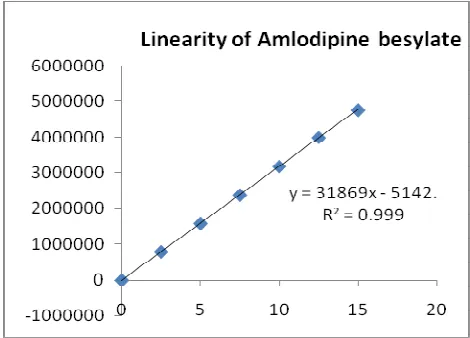
Linearity was established by least squares linear regression analysis of the calibration
curve. The calibration curves were linear over the concentration range of 1.5-7.5 μg mL-1
for Ramipril, 2.5-15 μg mL-1 for amlodipine besylate. Peak areas were plotted versus
respective concentrations and linear regression analysis was performed on the resultant
curves. Correlation coefficient values were found to be 0.999 and 0.999 for Ramipril and
Amlodipine besylate respectively, (Fig. 4 and Fig. 5). The results are given in Table 1.
141
Fig. 5: Calibration curve of Amlodipine besylate
Precision
Intra-day precision was investigated by injecting six replicate samples of each of the
samples on the same day. The % RSD obtained for ramipril and amlodipine besylate were
found to be 0.32 and 0.31 respectively. Inter-day precision was assessed by injecting the
same two samples over six consecutive days. The % RSD obtained for ramipril and
amlodipine besylate were found to be 0.28 and 0.32 respectively. The results are given in
Table 1.
Accuracy
Recovery studies were carried out by applying the method to drug sample to which known
amount of standard corresponding ramipril and amlodipine besylate to 50, 100 and 150%
of label claim had been added. At each level of the amount six determinations were
performed. The mean recoveries obtained for ramipril and amlodipine besylate were
100.01 and 100.5%, respectively. The results are given in Table 1.
Specificity
The method specificity was assessed by comparing the chromatograms obtained from the
142
(excipients solution in water without drug). The method was specific as none of the
excipients interfered with the analytes of interest.
LOD and LOQ
LOD and LOQ of ramipril and amlodipine besylate were determined by calibration curve
method. LOD and LOQ for ramipril were 0.46 and 1.42 μg mL-1,for amlodipine besylate were
1.05 and 3.18 μg mL-1 . The results are given in Table 1.
Robustness
The robustness of an analytical procedure is a measure of its capacity to remain unaffected
by small, but deliberate variations in method parameters and provides an indication of its
reliability during normal usage. Robustness of the method was investigated under a variety
of conditions including changes of composition of buffer in the mobile phase and flow rate.
% RSD of assay was calculated for each condition. The degree of reproducibility of the
results obtained as a result of small deliberate variations in the method parameters has
proven that the method is robust.
Ruggedness
The ruggedness of the method was assessed by comparison of the intra-day and inter-day
assay results for ramipril and amlodipine besylate that has been performed by two analysts.
The % RSD values for assays performed in the same laboratory by two analysts did not
exceed 2, indicating the ruggedness of the method
Analysis of marketed formulation
The proposed RP-HPLC method was applied to the simultaneous estimation of ramipril and
amlodipine besylate in Stamace plus capsules. Satisfactory results were obtained which is
given in Table 2, for compound in good agreement with label claims. No interference due to
excipients was detected in the chromatograms produced (Fig.6).
143
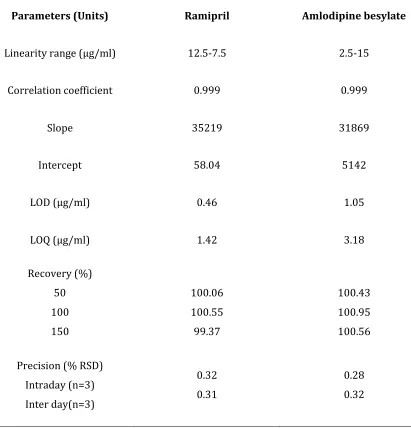
Table 1: Summary of validation parameters
Parameters (Units) Ramipril Amlodipine besylate
Linearity range (µg/ml) 12.5-7.5 2.5-15
Correlation coefficient 0.999 0.999
Slope 35219 31869
Intercept 58.04 5142
LOD (µg/ml) 0.46 1.05
LOQ (µg/ml) 1.42 3.18
Recovery (%)
50
100
150
100.06
100.55
99.37
100.43
100.95
100.56
Precision (% RSD)
Intraday (n=3)
Inter day(n=3)
0.32
0.31
0.28
0.32
Table 2: Analysis of marketed formulation
Drugs Labelled amount, mg
capsule-1
Amount found, mg
capsule-1 % *RSD
Ramipril 2.5 2.49 0.521
Amlodipine besylate 5 4.975 0.362
144
Fig. 6: A typical chromatogram of formulation Ramipril (2.5 μg ml-1) and amlodipine
besylate (5 μg ml-1) measured at 237 nm
CONCLUSION
The proposed RP-HPLC method is simple, reliable and selective providing satisfactory
accuracy and precision with lower limits of detection and quantification. Moreover the
shorter duration of analysis for ramipril and amlodipine besylate make the reported
method suitable for routine quantitative analysis in pharmaceutical dosage forms.
ACKNOWLEDGEMENT
I am very much thankful to School of Pharmacy, Hyderabad, for giving permission to carry
out my work.
REFERENCES
1. http://www.drugbank.ca/drugs/DB00381
2. http://www.drugbank.ca/drugs/DB00178
3. Hans H.M, Thomas K, Joachim W.A. Screening for the detection of
Angiotensin-Converting Enzyme Inhibitors, their metabolites, and AT II receptor Antagonists.
Therap. Drug Monitor. 1998; 20:706-713.
4. Motofumi I, Takeo K, Junichi G, Toshio N. Separation of Ramipril optical isomers by High
145
5. Argekar A.P, Powar S.G. Simultaneous determination of Atenolol and Amlodipine in
tablets by High performance thin layer chromatography. J.Pharm.Biomed.Anal. 2000;
21: 1137-1142.
6. Patki R.V, Tamhanker C.P, Tipnis H.P. Simple and rapid High performance liquid
chromatographic estimation of Amlodipine in pharmaceutical dosage forms. Indian
Drugs. 1994; 31:560.
7. Shang F, Shang K. Determination of Amlodipine by HPLC. Zhoggno Yiyao Gangye Zazhi.
1996; 27:411.
8. Avadhanulu A.B, Srinivas J.S, Anjaneyulu Y. Reversed phase HPLC determination
Amlodipine in drugs and its pharmaceutical dosage forms. Indian Drugs. 1996; 33: 36.
9. Sanka S.R, Nanjan M.J, Vasudevan M. Simultaneous estimation of atenelol and
Amlodipine in formulations by reversed phase HPLC. Indian J. Pharm. Sci. 1997; 59: 171.
10.Dhorda V.J, Shetkar N.B. Reversed phase HPLC determination of Ramipril and