-492-
An Interventional Study To Decrease Central ………
AN INTERVENTIONAL STUDY TO DECREASE CENTRAL VENOUS CATHETER
RELATED BLOOD STREAM INFECTION IN INTENSIVE CARE UNITS AT ZAGAZIG
UNIVERSITY HOSPITAL
Wafaa A. El Nemr, Hoida H. Fahmy, Ghada M. Abed El Razek * and Noha M. Abed El Salam
Departments of Public Health and Ansethiology & Intensive Care *, Faculty of Medicine, Zagazig University
ABSTRACT
Background: Catheter related blood stream infection (CRBSI) is a complication of central venous catheter (CVC) use.
This Infection particularly in the ICU population results in higher levels of morbidity and mortality coupled with greater costs in terms of care and increased duration of hospital stay. Aim &Objectives: The aim of this study is to improve the safety of patients with CVC via decreasing the incidence of CRBSI in ICUs patients at Zagazig University Hospital through the following objectives: 1- Calculation the incidences of CRBSI in ICUs patients over six months before and after intervention through active surveillance. 2- Assessment the level of the knowledge and adherence of health care providers in ICUs to evidence based guidelines recommended by CDC to decrease the incidences of CRBSI in ICUs patients before and after intervention. 3- Implementation of health education program on ICUs health care providers i.e. providing them by information about evidence based guidelines recommended by CDC to decrease the incidence of CRBSI in ICUs patients.
Subjects &Methods: An interventional study was conducted in surgical and emergency ICUs at Zagazig University
Hospital during the academic year between 2011 and 2012. All patients with CVC in the studied ICUs were consecutively enrolled in the study and all health care providers working in the studied units and involved in insertion, maintenance and care of CVC during the period of study were included in the study. The study was carried out through 3 phases. Results: Statistically, there is a significant improvement in physician practice in both ICUs after intervention. The incidence of CRBSI decreased after intervention in surgical ICU but in comparison with that before intervention it was found no significant difference. In emergency ICU, the incidence of CRBSI after intervention is 0% and in comparison with that before intervention it was found a significant difference. Incidence of CRBSI decreased from 6.01/1000 catheter-days to 3.9/1000 catheter-days after intervention in surgical ICU. In emergency ICU, the incidence of CRBSI was 0% after intervention. Conclusion: This study revealed that, implementation of simple education program increased adequacy of knowledge, improved the practice of healthcare providers and reduced CVC blood stream infection rates in ICUs by almost 50%, during the intervention period.
Keywords: Central venous catheter, Blood stream infection, Intensive care unit
INTRODUCTION
atheter related blood stream infections (CRBSIs) are associated with significant morbidity, mortality, and costs (1). Risk factors for CRBSI include the introduction of bacteria into the circulation through invasive central venous and arterial catheter, tunneled central catheters, and peripherally inserted central lines and intravenous lines. Additionally, multiple factors can lead to primary infection with secondary bacteremia including head injury, sedation, malnutrition, immuno- suppression, mechanical ventilation and surgery(2).
Patients in intensive care units (ICUs) are at an increased risk for CRBSIs because 48% of ICU patients have indwelling central venous catheters (CVC), accounting for 15 million central catheter days per year in United States ICUs (3).
According to the report from the National Healthcare Safety Network (NHSN) of the U.S and Centers for Disease Control and Prevention (CDC), CRBSI occurs at a mean rate of 2.9 per 1000 catheter days for medical ICUs in American hospitals (4). Mortality attributable to CRBSI has been estimated to be as high as 35%, and the
length of hospital stay is increased among infected patients (5). The average cost of care for a patient with this infection is $45,000 such infections could cost up to $2.3 billion annually(6).
Therefore, interventions aimed to decrease the infection rate are necessary to reduce serious public health consequences of this nosocomial infection. Many studies have shown reductions in the rates of CRBSI by various interventional efforts, including education and surveillance (7-9). The CDC, the Society of Critical Care Medicine, the Society of Healthcare Epidemiologists of America, the Infectious Disease Society of America and several other societies have recently developed evidence based guidelines for the prevention of catheter related blood stream infection (3). These recommended guidelines are educating and training healthcare personnel who insert and maintain catheters; using maximal sterile barrier precautions during CVC insertion; using 2% aqueous chlorhexidine skin preparation for antisepsis; and replacement of CVC with aseptic measures. (10).
The aim of this study is to improve the safety of patients with CVC via decreasing the
-493-
An Interventional Study To Decrease Central ………
occurrence incidence of CRBSI in ICUs patients at Zagazig University Hospital through the following objectives: 1- Calculation the occurrence incidences of CRBSI in ICUs patients over six months before and after intervention through active surveillance. 2- Assessment the level of the knowledge and adherence of health care providers in ICUs to evidence based guidelines recommended by CDC to decrease the incidences of CRBSI in ICUs patients before and after intervention. 3- Implementation of health education program on ICUs health care providers i.e. providing them by information about evidence based guidelines recommended by CDC to decrease the incidence of CRBSI in ICUs patients. SUBJECTS AND METHODS
I.Technical design:
Study design: An interventional study was conducted in two ICUs [surgical ICU (25 beds) and emergency ICU (14 beds)] at Zagazig University Hospital during the academic year between 2011 and 2012. the These selected two ICUs fulfilled inclusion criteria which are the following:
1- Have high percentage of patients with CVC. 2- Patients admitted for duration suitable for acquiring CRBSI.
3- Studied units have good recording system. Target groups:
(A) All patients with CVC of both ICUs were consecutively enrolled during the period of study (6 months before and after intervention).
1- In surgical ICU, 435 patients before intervention and 336 patients after intervention were included in the study.
2- In emergency ICU, 306 patients before intervention and 381 after intervention were included in the study.
(B) All health care providers (nurses and physicians) who were working in the studied units and involved in insertion, maintenance and care of CVC during the period of study were included in the study. They were 52 health care providers, 40 of them were nurses and 12 were physicians in surgical ICU and 32 health care providers, 24 of them are nurses and 8 physicians in emergency ICU.
II. Operational design: A. Data collection: 3 phases 1st phase (Pre-intervention):
Duration: 6 months (from November 2011 to May 2012).
Activities:
***A- Active surveillance for calculating the incidence of CRBSI (CVC-related BSI).
Incidence of CVC –related BSI =number of CVC related BSIs / number of CVC-days (12).
Surveillance Methodology
The collection of infection data for BSIs and their corresponding denominator data was performed using active, patient-based, prospective surveillance of the population at risk (i.e. patients who have central lines). This means that the infection was sought out during a patient’s stay by screening a variety of data sources, such as microbiology reports, patient records, clinical notes, temperature charts.
Denominator
Central venous catheter – days (CVC-days) At the same time every day, the number of patients with central venous catheter was counted, if a patient with central lines is temporarily off the unit for testing, the central line day is counted. If patient with CVC has been discharged or transferred to another unit, the central line day is not counted. The sum of these daily counts was recorded at the end of the study period.
Specimen collection:
For clinically suspected CR -BSI: the central line was aseptically removed, the distal 5 cm of the catheter was amputated and cultured using a standardized semi-quantitative method. In addition to another blood sample from a peripheral vein was taken on blood culture bottles, subcultured on blood agar plates (12).
Laboratory-confirmed CR–BSI is laboratory confirmed as a patient with a central venous catheter in place has a recognized microorganism that isolated from another peripheral vein blood cultures after at least 48 hours of central venous catheterization and is not related to an infection at another site (12).
B- Extra period of ICU stay was calculated by subtracting the average period of ICU stay of patients without CRBSI from that of patients with CRBSI in this study (13).
C- Observation of catheter insertion by health care providers using catheter insertion checklist which include items about procedure (site used, hand washing, sterilization procedure site, use maximal sterile precaution and if sterile dressing was applied to site after procedure) (14).
D- Assessment of health care providers' knowledge about nosocomial infection and CVC through a constructed questionnaire that covers the following areas:
-494-
An Interventional Study To Decrease Central ………
2- Training courses on infection control and obstacles confronting infection control practice in ICUS.
3- Knowledge about nosocomial infection (definition, causes, sources, mode and route of transmission).
4- Knowledge about CVC (uses, measures taken during insertion, time of replacement, frequency of dressing change, etc.
E-Assessment of infection control infrastructure in both ICUs (15,16).
2nd phase (Intervention phase): Duration:1 month
Activities: Evidence Based guidelines recommended by CDC was disseminated in intensive care units as
1- Arabic booklet to all health care providers in intensive care units to improve practice within institution. It covered the following items:
A- Nosocomial infection (definition, causes, mode of transmission, route of transmission and sources of infection).
B- Infection control (hand washing and protective equipments).
C- CVC (uses, measures taken during insertion, time of replacement, frequency of dressing change, symptoms of catheter related blood stream infection and factors affecting its occurrence). 2-group discussion.
3rd phase (Post intervention):
Duration: 6months (from June 2012 to December 2012).
Activities: A-active surveillance for recalculating incidence rate of CVC –related BSI after intervention.
B- Extra length of ICU stay was calculated
C- Re-observation of catheter insertion by health care providers using catheter insertion checklist to assess adherence to guidelines after intervention. D- Reassessment of health care providers' knowledge about nosocomial infection and central venous catheter after intervention.
E- Reassessment of infection control infrastructure in both ICUs.
III. Administrative design and Ethical issues: An official permission from Zagazig University, Faculty of medicine was taken to both intensive care units. The title and objectives of this study was explained to them to insure their cooperation. The local authority and manager of ICUs at Zagazig university hospital was informed about the nature and steps of the study and written consent was taken. The study group was informed about the nature and the purpose of the study and verbal consent was taken before interview. The study
group was not exposed to any harm or risk. Patient’s data was confidential.
IV. Statistical analysis of the recorded data: The collected data were computerized and statistically analyzed using SPSS program (Statistical Package for Social Science) version 16 (17)
. For the statistical calculations Data coding was done, and Qualitative data were represented as frequencies and percentages, Chi-square test ( 2), Mc Nemar test and Fisher Exact test was carried out for testing the association between the qualitative data whenever possible. Quantitative data were compared using student’s t-test and Mann-Whitney test. The test results were considered significant when p-value <0.05.
RESULTS
The mean age of studied sample was 26.28 ± 3.9 years old in surgical ICU and 28.063±5.2years oldin emergency ICU. More than half of nurses in surgical ICU had general diploma while only 15% of them had BSC Nursing. In emergency ICU, 45.8% of nurses had general diploma and 20.9% had BSC Nursing. The experience duration of nearly half of healthcare providers in surgical ICU ranged from 5-10 years, while in nearly half of studied health care providers in emergency ICU was less than 5 years. Training courses on infection control was received by 34.6% and 37.5% of health care providers in surgical and emergency ICU respectively (Table 1).
Infection control obstacles in both ICUs
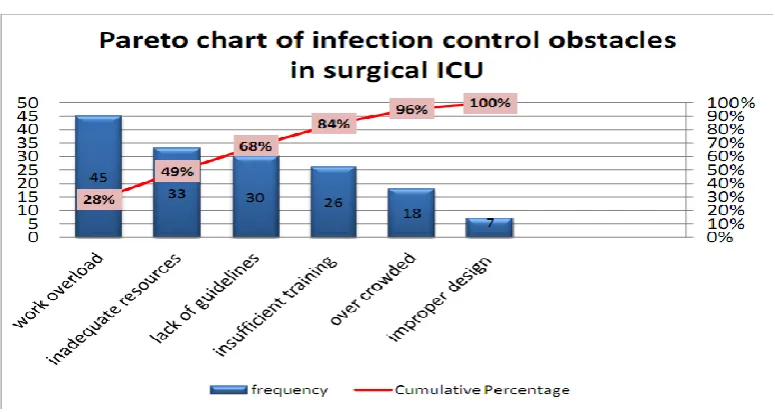
The main obstacles to implement infection control program in surgical ICU were work overload, inadequate resources and lack of infection control guidelines application, while in emergency ICU, these were inadequate resources, improper design, lack of guidelines and insufficient training (Figures 1,2).
Healthcare providers' knowledge about nosocomial infection and CVC:
The majority of healthcare providers in both ICUs had adequate knowledge about nosocomial infection which increased to 96.15% and 96.9% in surgical ICU and emergency ICU respectively after intervention without significant difference between them. 34.6% and 18.6% of healthcare providers in surgical and emergency ICU respectively had adequate knowledge about CVC which increased to 81.8% and 88.5% in surgical ICU and emergency ICU respectively after intervention with highly statistically significant difference (Table 2).
Patients' characteristics in both ICUs.
-495-
An Interventional Study To Decrease Central ………
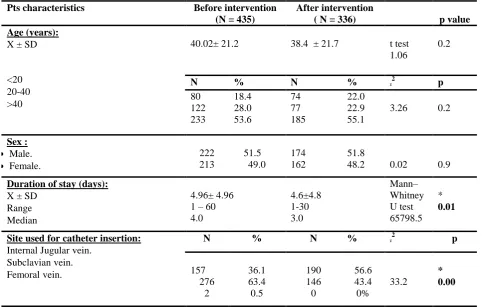
emergency ICU, mean age of patients was 39.3±20.1 years old before intervention and 39 ± 20.4. years old after intervention (Table 3, 4). Duration of stay was 4.96 days before intervention and 4.6 days after intervention in surgical ICU , while it was 4.8 before intervention and 4.07 after intervention in emergency ICU.
The most frequent used site for catheter insertion in emergency ICU was internal jugular vein, with no use of femoral vein. Internal jugular vein was used in 54.2% and 60.1% of emergency ICU cases before and after intervention respectively. In surgical ICU, the most frequent used site before intervention was subclavian vein (63.4% of cases) , while internal jugular vein was the most used site after intervention (56.6% of cases) with no use of femoral vein (Table 3,4). Physician attitude during CVC insertion in both ICU.
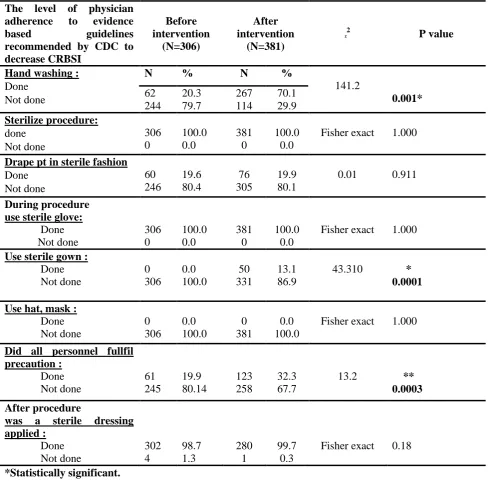
Before intervention 63% of health care providers in surgical ICU performed hand washing preceding CVC insertion with significant improvement in performance after intervention. In emergency ICU, only 20% of health care providers performed hand washing.
Before CVC insertion, all healthcare providers in both ICUs used povidone iodine for sterilization the site of insertion . In both ICUs of this study chlorhexidine was not used.
Before intervention, less than half of health care providers in both ICUs draped patients in a sterile fashion preceding catheter insertion with significant improvement after intervention in surgical ICU (Table 5, 6).
All healthcare providers in both ICUs wore sterile gloves during central venous catheter insertion before and after intervention, while none of them used hat and mask. Also there is highly significant improvement in physician practice in surgical ICU after intervention regarding use of sterile gown and fulfilling precaution by all personnel (Table 5, 6).
In surgical and emergency ICUs, 89.5% and 98.7% of the studied healthcare providers
respectively, applied a sterile dressing after procedure.
Catheter related blood stream infection in both ICU before and after intervention
CRBSI was clinically suspected in 3.9 % and 2.08% of surgical ICU cases before and after intervention respectively. It was confirmed by blood culture test in 3.0% and 1.8% of surgical ICU cases before and after intervention respectively
Although the incidences of CRBSI after intervention were numerically less than those before intervention but statistically, there was no significant differences (Figure 3).
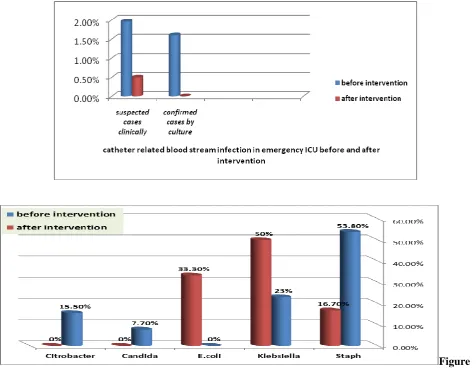
CRBSI was clinically suspected in 1.96 % and 0.05% of emergency ICU cases before and after intervention respectively. It was confirmed by blood culture in 1.6% and 0.0% of emergency ICU cases before and after intervention respectively with statistically significant decrease in CRBSI after intervention (Figure 4).
The most common organism in pre intervention phase in surgical ICU was Staph followed by klebsiella and citrobacter while candida albicans represented 7.7% of all detected organisms. However after intervention the most detected organism was klebsiella followed by E.choli and Staph (Figure 5). The most common organism in pre intervention phase in emergency ICU was Staph followed by klebsiella and citrobacter After intervention catheter related blood stream infection reached zero (Figure 6).
The incidence of CRBSI decreased from 6.01/1000 catheter-days to 3.9/1000 catheter-days after intervention in surgical ICU , while it decreased from 4.01/1000 catheter-days to 0/1000 catheter-days after intervention in emergency ICU (Table 7) .
-496-
An Interventional Study To Decrease Central ………
Table (1): Sociodemographic characteristics of the studied sample from health care providers in surgical and emergency ICUs.
Items Surgical ICU
(N=52)
Emergency ICU (N=32)
p value
Age (years)
X± SD
20-30 >30
26.28 ± 3.9 28.063±5.2
t test
1.8 .07
N % N % ᵡ2 p
47 5
90.4 9.6
23 9
71.8
28.2 3.64 .06
Education:
* Nurses
General diploma
Technical institute
BSC Nursing
*Physicians
Resident
Assistant lecturer
25 9 6
6 6
48.1 17.3 11.5
11.5 11.5
11 8 5
4 4
34.4 25.0 15.6
12.5 12.5
1.73 0.8
Duration of experience in ICU (years):
< 5
5 – 10
> 10
14 28 10
26.9 43.9 29.2
15 10 7
46.9 31.3 21.8
4.59 0.1
Training courses on infection control :
Yes
No
18 34
34.6 65.4
12 30
37.5 62.5
0.16 0.7
*Statistically significant
-497-
An Interventional Study To Decrease Central ………
Figure (2): Pareto chart shows the most frequent obstacles to implement infection control program in emergency ICU.
Table (2): Level of knowledge of health care providers about nosocomial infection and CVC before and after intervention in both ICUs.
Level of knowledge
Before intervention
After intervention
p value
Surgical ICU:
Level of knowledge about nosocomial infection:
Adequate. Inadequate.
N=52
N %
N=52
N %
0.298 46
6
88.5 11.5
50 2
96.15 3.85
Adequacy of knowledge about CVC :
Adequate. Inadequate.
18 34
34.6 65.4
42 10
81.8
19.2 0.0001* Emergency ICU:
Level of knowledge about nosocomial infection:
Adequate. Inadequate.
N=32
N %
N=32
N %
0.625 29
3
90.6 9.4
31 1
96.9 3.1
Level of knowledge about CVC :
Adequate.
Inadequate. 6
26
18.6 81.4
28 4
88.5 11.5
0.000*
-498-
An Interventional Study To Decrease Central ………
Table (3): Patients' characteristics before and after intervention in surgical ICU.
Pts characteristics Before intervention
(N = 435)
After intervention
( N = 336) p value
Age (years):
X ± SD
<20
20-40
>40
40.02± 21.2 38.4 ± 21.7 t test
1.06
0.2
N % N % ᵡ2 p
80 122 233 18.4 28.0 53.6 74 77 185 22.0 22.9 55.1
3.26 0.2
Sex :
Male. Female.
222 213 51.5 49.0 174 162 51.8
48.2 0.02 0.9
Duration of stay (days):
X ± SD
Range
Median
4.96± 4.96 1 – 60 4.0 4.6±4.8 1-30 3.0 Mann– Whitney U test 65798.5 * 0.01
Site used for catheter insertion:
Internal Jugular vein.
Subclavian vein.
Femoral vein.
N % N % ᵡ2 p
157 276 2 36.1 63.4 0.5 190 146 0 56.6 43.4 0% 33.2 * 0.00 *Statistically significant.
Table (4): Patients' characteristics before and after intervention in emergency ICU.
Patient characteristics
Before intervention (N = 306)
After intervention
( N = 381) p value
Age (years):
X±SD
<20
20-40
>40
39.3±20.1 39± 20.4 t test
0.17 0.9
N % N % ᵡ2 p
41 145 120 13.4 47.4 39.2 71 161 149 18.6 42.2 39.2
3.9 0.14
Sex :
Male female
173 133 56.6 43.5 212 169 55.6
44.4 0.02 0.8
Duration of stay (days)
X ± SD
Range
Median
4.8±4.16 1 – 23
3
4.07±4.14 1 - 20
2
Mann– Whitney U test 49486.5
*
0.001
Site used for catheter insertion
Internal Jugular vein.
Subclavian vein.
Femoral vein.
N % N % ᵡ2 p
166 140 0 54.2 45.8 0 229 152 0 60.1 39.9 0
2.15 0.14
-499-
An Interventional Study To Decrease Central ………
Table (5): The level of physician adherence to evidence based guidelines recommended by CDC to decrease CRBSI during CVC insertion before and after intervention in surgical ICU.
Level of physician adherence to evidence based guidelines recommended by CDC to decrease CRBSI.
Before intervention
(N=435)
After intervention
(N=336)
ᵡ2 P value
Before procedure Hand washing:
Done Not done
N % N %
12.16 0.000* 275
160
63.2 36.8
252 84
75.0 25.0
Sterilize procedure:
Done Not done
435 0
100.0 100.0
336 0
100.0 100.0
Fisher exact 1.000
Drape pt in sterile fashion:
Done Not done
155 280
35.6 64.4
150 168
44.6 55.4
9.67 0.002*
During procedure use sterile glove :
Done Not done
435 0
100.0 0.0
336 0
100.0 0.0
Fisher exact 1.000
Use sterile gown :
Done
Not done
85 350
19.5 80.5
92 244
27.4 72.6
6.59 0.01*
Use hat, mask :
Done Not done
0 435
0.0 100.0
0 336
0.0 100.0
Fisher exact 1.000
Did all personnel fulfill precaution:
Done
Not done
130 305
29.9 70.1
135 201
40.2 59.8
8.9 0.003*
After procedure
was a sterile dressing applied:
Done
Not done
430 5
89.5 1.5
336 0
100.0 0.0
Fisher exact 0.07
-500-
An Interventional Study To Decrease Central ………
Table (6): The level of physician adherence to evidence based guidelines recommended by CDC to decrease CRBSI during CVC insertion before and after intervention in emergency ICU.
The level of physician adherence to evidence
based guidelines
recommended by CDC to decrease CRBSI
Before intervention
(N=306)
After intervention
(N=381)
ᵡ2 P value
Hand washing :
Done Not done
N % N %
141.2 0.001* 62
244
20.3 79.7
267 114
70.1 29.9 Sterilize procedure:
done Not done
306 0
100.0 0.0
381 0
100.0 0.0
Fisher exact 1.000
Drape pt in sterile fashion
Done Not done
60 246
19.6 80.4
76 305
19.9 80.1
0.01 0.911
During procedure use sterile glove:
Done Not done
306 0
100.0 0.0
381 0
100.0 0.0
Fisher exact 1.000
Use sterile gown : Done Not done
0 306
0.0 100.0
50 331
13.1 86.9
43.310 * 0.0001
Use hat, mask : Done Not done
0 306
0.0 100.0
0 381
0.0 100.0
Fisher exact 1.000
Did all personnel fullfil precaution :
Done Not done
61 245
19.9 80.14
123 258
32.3 67.7
13.2 ** 0.0003
After procedure
was a sterile dressing applied :
Done Not done
302 4
98.7 1.3
280 1
99.7 0.3
Fisher exact 0.18
*Statistically significant.
0.00% 5.00%
susp ecte
d... conf
irmed ...
cathe ter
before intervention after intervention
Figure (3): Incidences of CRBSI before and after intervention in surgical ICU.
-501-
An Interventional Study To Decrease Central ………
Figure (4): Incidences of CRBSI before and after intervention in emergency ICU. (Statistically before
intervention, the incidence CRBSI is significantly less than that after intervention).
Figure (5): The most common isolated microorganisms from Catheter in surgical ICU befo
Figure (5): The most common isolated microorganisms from catheter before and after intervention in surgical ICU
-502-
An Interventional Study To Decrease Central ………
Table (7): Incidences of CRBSI before and after intervention in both ICU.
ICUs Number of
cases
Number of
catheter-days
Incidence of CRBSI
Surgical ICU before intervention
13 2160 6.01/1000 catheter-days
Surgical ICU after intervention
6 1554 3.9/1000 catheter-days
Emergency ICU before intervention
5 1246 4.01/1000 catheter-days
Emergency ICU after intervention
0 1823 0/1000 catheter-days
Table (8): Stay period and extra-period of patient with CRBSI in both ICUs (values are represented in mean±SD).
ICUs
Stay period (days)
Stay extra-period (days)
Surgical ICU before intervention
23.8±5.0 19.1±0.5
Surgical ICU after intervention
21.6±13.0 17.0±8.5
Emergency ICU before intervention
17.3±2.9 12.23±2.5
DISCUSSION
Catheter related blood stream infection (CRBSI) is a complication of central venous catheter use. (18).
From the present study, the detected sociodemographic characteristics of the studied health care providers sample in surgical and emergency ICUs were nearly similar to the reported sociodemographic characteristics of the studied health care providers samples by other workers.(13, 19 - 21)
The present study showed that, the main obstacles to implement infection control program in surgical ICU were work overload, inadequate resources and lack of infection control guidelines application, while in emergency ICU these were inadequate resources, improper design, lack of guidelines and insufficient training. These obstacles can be solved by focusing on increasing infection control budget, intense training for health care providers and adapting standard infection control guidelines will solve 80% of the problem of CRBSI. This was in agreement with the finding of other workers (22).
From this study it was found that, majority of healthcare providers in both ICUs had adequate
knowledge about nosocomial infection which increased to 96.15% and 96.9% in surgical and emergency ICUs respectively after intervention without significant difference. These findings were in agreement with the reported findings of Qayyum et al (9), Ahmed (19), Abd EL-Aziz (23), and Adebimpe et al., (25)..
The present study showed also that, only 34.6% and 18.6% of healthcare providers in both ICUs had adequate knowledge about CVC which increased to 81.8% and 88.5% in surgical and emergency ICUs respectively after intervention with highly significant difference between them. This was attributed to effective health education message delivered during the intervention phase. These findings were opposite to that reported by Ahmed (19). He reported that, more than half of his studied group from healthcare providers had adequate knowledge about CVC.
-503-
An Interventional Study To Decrease Central ………
From the present study it was found that, the most frequent used site for catheter insertion in emergency ICU was internal jugular vein 54.2% and 60.1% of cases before and after intervention respectively with no use of femoral site. In surgical ICU, the most frequent used site before intervention was subclavian vein (63.4%) , while internal jugular vein was the most used site after intervention (56.6%) with no use of femoral site. These findings were nearly similar to that reported by other workers. (26, 28)
From the present study it was found that, 63% of health care providers in surgical ICU performed hand washing preceding central venous catheter insertion before intervention with significant improvement in performance after intervention . This finding was similar to that of Sean et al. (3). In emergency ICU, only 20% of health care providers performed hand washing , This finding is in partial accordance with Ahmed (19) who reported that half of healthcare providers didn't wash their hands before catheter insertion.
The detected low percent of health care providers who performed hand washing in emergency ICU may be attributed to inadequate resources in that ICU beside healthcare providers' attitude regarding hand washing, This attitude had been improved significantly in post intervention phase after dissemination of CDC guidelines and the significant improvement in infection control infrastructure .
From the present study it was found that, all healthcare providers in both ICUs performed skin sterilization by povidone iodine before CVC insertion In both ICUs of the present study, chlorhexidine was not used for skin sterilization. A meta-analysis of 4,143 catheters suggested that chlorhexidine preparation reduced the risk of catheter related infection by 49% relative to povidone iodine (29)
.
The present study clarified that less than half of health care providers in both ICUs draped patients in sterile fashion preceding catheter insertion with significant improvement after intervention in surgical ICU .This result was in accordance with Ahmed (19) reported findings but in contrast with Sean et al. (3) reported findings. They reported that, 85% of healthcare providers draped patients in a sterile fashion.
This present study also clarified that, all healthcare providers in both ICUs wore sterile gloves during central venous catheter insertion before and after intervention, while none of them used hat and mask . Also it showed that there is highly significant improvement in physician practice in surgical ICU after intervention
regarding use of sterile gown and fulfilling precaution by all personnel. These finding were similar to that reported by Taylor et al. (30) but against to thast reported by Sean et al. (3). They found that 92% of healthcare providers used hat, mask, and sterile gown and 100% of them used sterile gloves.
From the present study it was found that 89.5% and 98.7% of studied healthcare providers in surgical ICU and emergency ICU respectively applied a sterile dressing after procedure .These findings were similar to that reported by Sean et al. (3) , Ahmed (19) , Abd El-Aziz (24) and Gillies et al (31).
Also from this study, it was found that, the incidences of CRBSI based on clinical suspicion in surgical ICU were 3.9 % before and 2.08% after intervention while the incidences of CRBSI that was confirmed by blood culture test were 3.0% before and 1.8% after intervention . Although the incidences of CRBSI after intervention were numerically less than that before intervention but statistically, there was no significant differences. The incidences of CRBSI that had been detected in the present study were higher than that reported by Sallam et al. (32), and similar to that of van der Kooi et al(33) and lower than that reported by El Nakera et al. (13)
which was 12.0%.
Also from this study, it was found that that, the incidences of CRBSI based on clinical suspicion in emergency ICU patients were 1.96 % before and 0.05% after intervention respectively while the incidences of CRBSI that was confirmed by blood culture test were 1.6% before and 0.0% after intervention. Statistically, the incidences of CRBSI after intervention were significantly less than those after intervention. The incidences of CRBSI that had been detected in the present study were similar to those reported by Sallam et al. (32), Dogru et al. (34) and Sood (35).
-504-
An Interventional Study To Decrease Central ………
During the intervention period, there was a decrease in the percentage of gram-negative bacterial isolates and a relative increase of gram-positive bacterial isolates. This phenomenon persisted until the period after the intervention, except for the increase of CA-BSI by Acinetobacter species. I
From the present study, it was found that, the incidence of CRBSI decreased from 6.01/1000 catheter-days to 3.9/1000 catheter-days after intervention in surgical ICU , while it decreased from 4.01/1000 days to 0/1000 catheter-days after intervention in emergency ICU These finding were in accordance with the reported findings of Longmate et al. (25) , Pronovost et al.
(35)
and Sunmi et al. (5)
From the present study, it was found that, the stay of patient with CRBSI before and after intervention, in both ICUs was prolonged and hence long hospital stay of these infected patients compared with others This result was similar to El Nakera et al. (13). The prolonged stay in ICU augments the risk and danger of catheter related blood stream infection (36) .
In conclusion, This study revealed that, implementation of simple education program increased adequacy of knowledge, improved the practice of healthcare providers and reduced CVC blood stream infection rates in ICUs by almost 50%, during the intervention period.
ACKNOWLEDGEMENTS
We wish to thank all patients and health care providers in the studied intensive care units for their cooperation and help.
REFERENCES
1. Peter J, Cristine A, Elizabeth C, et al. (2010): Sustaining reductions in catheter related bloodstream infections in Michigan intensive care units:
observational study.BMJ; 340:c309
.doi:10.1136/bmj.c309.
2. Gonzalo ML, Bearman M, Michael I, et al. (2010): A Clinical Predictive Model for Catheter Related Bloodstream Infections from the Electronic Medical Record.The Open Epidemiology Journal; 3: 24-28. 3. Sean M, Berenholtz MD, Peter J, et al. (2004):
Eliminating catheter-related bloodstream infections in the intensive care unit.Crit Care Med; 32(10):2014-2020.
4. Edwards JR, Peterson KD, Andrus ML, et al.
(2007): National healthcare safety network (NHSN) report data summary for 2006.Am J Infect Control; 35:290-301.
5. Sunmi Y, Sook IG, Gwang SK, et al. (2010):
Interventions to Prevent Catheter-Associated Blood stream Infections: A Multicenter Study in
Korea.Infect Chemother; 42(4):216-222.
6. Grady NP, Alexander M, Dellinger EP, et al. (2002):
Guidelines for the prevention of intravascular
catheter-related infections. The Hospital Infection Control Practices Advisory Committee Center for Disease Control and Prevention, U.S. Pediatrics; 110:e51.
7. Lobo RD, Levin AS, Gomes LM, et al. (2005):
Impact of an educational program and policy changes on decreasing catheter-associate
bloodstream infections in a medical intensive care unit in Brazil. Am J Infect Control; 33:83-7.
8. Warren DK, Cosgrove SE, Diekema DJ, et al.
(2006): Prevention Epicenter Program.A multicenter
intervention to preventcatheter-associated
bloodstream infections.Infect Control Hosp
Epidemiol; 27:662-9
9. Qayyum S, Sattar A, ,Waqas B (2010):Hospital
acquired infections; Knowledge about it and its prevention. Professional Med J; 17(2):168- 173. .
10.Centers for Disease Control and Prevention (CDC)
(2011): Guidelines for the Prevention of
Intravascular Catheter-Related Infections.CDC:1-83. 11.Association for Professionals in Infection Control and Epidemiology (2009): Guide to the Elimination of Catheter-Related Blood stream Infections. 12.Clinical and Laboratory Standards Institute (2007):
Performance standards for antimicrobial
susceptibility testing; Seventeenth informational supplement Antimicrobial Susceptibility Testing (AST) Recommendations M100-S17.
13.El Nakera A, Meawed T, Aboserea M (2012): Base
line surveilance of device associated infection (SAIS) in a surgical-medical intensive care units at Zagazig University hostpital, Egypt Egypt. J. Microbiol; 32(60).
14.Heitmiller G (2009): Checklists in Healthcare.PP:2 15.Rational Pharmaceutical Management Plus (2006):
Infection Control Assessment Tool.pp:227.
16.World Health Organization (2010): Hand Hygiene Self-Assessment Framework 2010.Available at http://www.who.int/gpsc/country_work/hhsa_frame work.pdf.
17. SPSS Inc. (2007): SPSS for Windows, Version
16.0. Chicago, SPSS
Inc.available:http://www.unimuenster.de/imperia/md /content/ziv/service/software/spss/handbuecher/engli sch/spss_brief_guide_16.0.pdf
18. Pratt R C, Pellowe J, Wilson H, et al. (2007): National evidence-based
guidelines for preventing healthcare-associated infections in NHS hospitals in England." J Hosp Infect;65(Suppl 1): S1-64.
19.Ahmed SH (2007): Study of nurse'peformance
regarding infection control for patients with central venous catheter. Master thesis in Medical-Surgical nursing. Faculty of nursing, Zagazig university.
20.Tantawy NM (2000): Nurses Knowledge and
Practice Related to Infection Control in Operating
Room at Zagazig Emergency University
Hospital.Master Thesis. HihgInstitue of
-505-
An Interventional Study To Decrease Central ………
21.Sliman WM (2005): Assessment of Intensive Care Units Nurse’s Knowledge and Practice of Infection Control Precautions. Master Thesis.Faculty of Nursing .Zagazig University. PP:89,93-100.
22.Madani N, Victor D, Rosenthal V , et al. (2009): Health-care associated infections rates, length of stay, and bacterial resistance in an intensive care unit
of Morocco: Findings of the International
Nosocomial Infection Control Consortium (INICC). International Archives of Medicine 2: 29, 1-7.
23.Abd El-Aziz EM (2003): Assessment of Nurse’s
Knowledge and Practice Related to Nosocomial Infection Control Measures at Intensive Care Unit, Zagazig University Hospital. Master Thesis. Faculty of Nursing. Zagazig University.
24.Adebimpe, Olalekan W, Olufunmilayo A et al.
(2011): A comparative study of awareness and attitude to nosocomial infections among levels of health care workers in south western Nigeria. Continental J. Tropical Medicine 5 (2): 5 – 10.
25.Longmate A, Ellis K, Boyle L et al.
(2011):Elimination of central-venous-catheter
related blood stream infections from the intensive care unit.BMJ Qual Saf; 20:174e180.
26.Cherry-Bukowiec JR, Denchev K, Dickinson SH (2011):Prevention of Catheter-Related Blood Stream
Infection:Back to Basics? .SURGICAL
INFECTIONS; 12(1):27-32.
27.Moretti EW, Ofstead CL, KristyRM, et al. (2005): Impact of central venous catheter type and methods on catheter-related colonization and bacteraemia. J Hosp Infect; 61:139–45.
28.Chaiyakunapruk N, Veenstra DL, Lipsky BA, et al. (2004):Vascular catheter sitecare: the clinical and economic benefits of chlorhexidine gluconate compared with povidone iodine. Clin Infect Dis; 37:764–71.
29.Taylor C, Lillis C, Lemone P (2006): Fundamentals of Nursing: The Art and Science of Nursing Care.9th ed.Lippincott William, Wilkins Co. PP: 535-561, 1303-1320.
30.Gillies D, O’Riordan E, Carr D et al. (2003): Central venous catheter dressings: A systemic review. J. Adv Nur.44(6):623-632.
31.Sallam SA, Arafa MA, Razek AA, et al. (2005): Device-related nosocomial infection in intensive care units of Alexandria University Students Hospital. East Mediterr Health J; 11(1-2):52-61. 32.van der Kooi, Tjallie II , Annette S , et al. (2007):
Incidence and risk factors of device-associated infections and associated mortality at the intensive care in the Dutch surveillance system. Intensive Care Med (2007) 33: 271–278.
33.Dogru A, Sargin F, Celik M, et al. (2010): The Rate of Device-Associated Nosocomial Infections in a Medical Surgical Intensive Care Unit of a Training and Research Hospital in Turkey: One-Year Outcomes Jpn. J. Infect. Dis., 63 (2), 95-98.
34.Sood S, Joad SH, Yaduvanshi D, et al. (2011): Device associated nosocomial infections in a medical intensive care unit of a tertiary care hospital in Jaipur, India From International Conference on
Prevention & Infection Control (ICPIC 2011) Geneva, Switzerland. 29 June – 2 July 2011. BMC Proceedings 2011, 5(Suppl 6): O16.
35.Pronovost PJ, Goeschel CA, Colantuoni E, etal. (2010): Sustaining reductions in catheter related blood stream infections in Michigan intensive care units: observationalstudy. BMJ;340:c309.
-506-
An Interventional Study To Decrease Central ………
-507-
An Interventional Study To Decrease Central ………
8 -ةدج ْٕ بي مك ٍع كةيبلحنا خعيبج دبيفشزسًث ححكرًنا خةبُعنا دادحٕث خيحصنا خيد نا ٗيدمًن خيجةلدزنا جيارجنا حلبةي ٗهع مًعنا حلٔرض د
خةلٔل خفصث ٗجطنا كةرفنا دبيٕهعي ىييمر عي ٖٔدعنا خحفبكي ٗف 9 -رطسمنا لبًعزئا ٗعأل ٍع ٗجطنا كةرفهن رًزسًنا تةلدزنأ ىيهعزنا خدحفبكي داءاردجا كنادكٔ بدٓث خدةبُعنأ بدٓجيكرزن خًيهدسنا قردطنأ خةدةلٕنا ح
بُٓع خئشبُنا ودنا ٖٔدعث خثبص ا ميهمزن خييلانا ٖٔدعنا 7 بٓث خةبُعنا دُع كناكٔ حرطسمنا تيكرر دُع خةيارزح ا داءارج بث واحزن ا كناكٔ ٗجطنا كةرفنا دبيٕهعًن رًزسًنأ ٖلٔدنا ىييمزنا
8 -كأزنا ححكرًنا خةبُعنا دادحٔ مخال ءال ا ٗهع ِلٔدث رصؤة ٖانأ خةبُعنا دادحٔ مخال اةرًزنا ٍي تئبُي لدع لٕجٔ ٍي د
9 خةحكرًنا خةدةلٕنا حرطسمنا تيكرر ٍي عفُنأ حلٕط نا ٖدي سبيل
41 واد زئا 5 حرطسمنا تيكرر ٌبكي ىيمعر ٗف ٍةدسكيْلٕهكنا ٍي %
44 بح دصرزن خصبخ حدحٔ مًع ٍيدث ٖٔددعنا لبدشزَا ٍي دحهن ويلانا مًعٔ حدةدجنا د بحنا دصرر ٗنا فدٓر دبيفشزسًنبث خجسزكًنا ٖٔدعنا د