UNIVERSITI TEKNIKAL MALAYSIA, MELAKA
FAKULTI KEJURUTERAAN PEMBUATAN
BMFG 4924
FINAL YEAR PROJECT II
SIMULATION OF INTELLIGENT PID TEMPERATURE
CONTROLLER
Student's Name
: ANG LING YUEN
Course
: 4BMFA
SIMULATION OF INTELLIGENT PID TEMPERATURE
CONTROLLER
UNIVERSITI TEKNIKAL MALAYSIA, MELAKA
SIMULATION OF INTELLIGENT PID TEMPERATURE
CONTROLLER
This report submitted in accordance with requirement of the Universiti Teknikal Malaysia Melaka (UTeM) for the Bachelor Degree of Manufacturing Engineering
(Robotics and Automation) (Hons.)
by
ANG LING YUEN B050910211 890105075533
DECLARATION
I hereby, declared this report entitled “Simulation of Intelligent PID Temperature Controller” is the results of my own research except as cited in references.
APPROVAL
This report is submitted to the Faculty of Manufacturing Engineering of UTeM as a partial fulfillment of the requirements for the degree of Bachelor of Manufacturing Engineering (Robotics and Automation) (Hons.). The member of the supervisory committee is as follow:
ABSTRAK
ABSTRACT
The objectives of the project are to simulate linear Mamdami type fuzzy temperature controller and non-linear Takegi-Sugeno type fuzzy temperature controllers using MATLAB and Simulink, and to compare the performance between the two controllers. Two case studies were created to test the controllers. Case study I involved a water boiler, where the system is modelled using Joule’s Law and Law of Thermodynamics, and case study II involved a hair dryer, where the system is modelled using ARX method. In both cases, a Proportional-Integral-Derivative (PID) controller was tuned and the PID parameters were then used to obtain the gain of the fuzzy controllers. Simulation results confirmed that non-linear fuzzy controller has smaller overshoot and faster settling time compared to the linear fuzzy controller and PID controller, although an extra derivative gain may be needed for the non-linear fuzzy controller if the integral term is huge enough to affect the stability of the system.
DEDICATION
ACKNOWLEDGEMENT
I would like to thanks Dr Fairul Azni for the supervision of my final year project. His help and support plays a crucial role in doing the project, which I am forever grateful for.
I would also like to thanks Dr Omid Motlagh for providing valuable inside to fuzzy logic systems, which make understanding of the principle of fuzzy controller easier to grasp.
I would also like to thanks my fellow classmates for the supports and knowledges they provided me for all these years. I am very happy to be on the same class with you guys.
TABLE OF CONTENT
Abstrak i
Abstract ii
Dedication iii
Acknowledgement iv
Table of Content v
List of Figures vii
List of Tables ix
List of Abbreviations, Symbols and Nomenclatures x
CHAPTER 1: INTRODUCTION 1
1.1 Background 2
1.2 Problem Statement 2
1.3 Objectives 2
1.4 Scope 3
1.5 Report Structure 3
CHAPTER 2: LITERATURE REVIEW 5
2.1 PID Controller 5
2.2 Fuzzy Logic 7
2.3 Summary 11
CHAPTER 3: METHODOLOGY 12
3.1 Overview 12
CHAPTER 4: RESULTS & DISCUSSION 32
4.1 Case Study I: Water boiler 32
4.2 Case Study II: Hair Blower 34
4.3 Limitations 37
4.4 Summary 37
CHAPTER 5: CONCLUSION 38
5.1 Conclusion 38
5.2 Suggestion for future work 38
REFERENCES 41
APPENDICES
A MATLAB code for case study I simulation. 43 B MATLAB code for case study II simulation. 45 C SK40C Schematics (Credit: Cytron) 48
D Gantt Chart for PSM I 49
E Gantt Chart for PSM II 50
LIST OF FIGURES
2.1 PID block diagram (Credit: Arturo Urquizo, CC-BY-SA-3.0) 7 2.2 Block diagram of a typical FL control system (Feng, 2006). 8 2.3 Block diagram of gain scheduling type fuzzy PID controller. (Tomizuka
& Isaka, 1993)
10
2.4 Types of direct action PID controller. (Mann, Hu, & Gosine, 1999) 10
3.1 Flow chart for the overall project 13 3.2 The visualised model of the water boiler, where blue box is the water
container, red box is the heating element, and the brown background is the surrounding.
15
3.3 Membership function graph of input E for the linear fuzzy PID controller. 17 3.4 Membership function graph of input CE for the linear fuzzy PID
controller.
17
3.5 Membership function graph of output u for the linear fuzzy PID
controller. 18
3.6 Control surface of the linear fuzzy PID controller 18 3.7 Fuzzy PID template from Simulink Fuzzy Logic Toolbox. 20 3.8 Membership function graph of input E for the linear fuzzy PID controller. 21 3.9 Membership function graph of input CE for the linear fuzzy PID
controller.
22
3.10 Control surface of the non-linear fuzzy controller 22 3.11 Block diagram, showing the relationship between u(k), y(k) and hair
dryer ARX model. 24
3.12 The block diagram of the linearised ARX model, where G is the transfer function for measured component, and H is the transfer function of noise component.
24
4.3 Scope data for case study II 36
5.1 Schematic of the controller using SK40C. Detailed schematic of SK40C can be referred in Appendix C. 39
LIST OF TABLES
2.1 Zeigler-Nichols method in PID Standard Form 6
3.1 Fuzzy rules for the fuzzy linear PID controller 16 3.2 Fuzzy rules for the non-linear fuzzy controller 21
LIST OF ABBREVIATIONS, SYMBOLS AND
NOMENCLATURES
FL - Fuzzy Logic
PID - Proportional, Integral and Derivative Z-N - Zeigler-Nichols
CHAPTER 1
INTRODUCTION
In this chapter, the background and the objectives of the final year project would be discussed. Problem statement and scope of the project would also be stated. Lastly, a brief summary of the report structure is done at the end of the chapter.
1.1 Background
This project is inspired by the Type 1a V20 automatic butt welding machine created by AUGUST STRECKER GmbH & Co.KG. (STRECKER, 2012) The controller was created to control the annealing temperature during the welding process to archive the desired tensile strength. The purpose is to prevent the welded wires from becoming too brittle and break easily during processing such as drawing and galvanization. The company where the author interned before, RCI Wire Tech Sdn. Bhd., wished to procure the equipments and lamented of the fact that no local companies are capable of making controllers of the same kind, which inspired the author to attempt a project with the objective of creating such controller.
project is further encouraged by the lack of studies on rather general fuzzy controllers for well defined classes of systems such as heating, cooling and air conditioning (HVAC) system (Precup & Hellendoorn, 2011), which encouraged more studies to propose general fuzzy PID controller for HVAC purposes.
This project is aimed to create a fuzzy temperature controller to overcome the weakness of the PID controller. One of the method is to create a non-linear version of the fuzzy controller, so that the rate of change of the output will vary according to the amount of error and the rate of error itself, which in theory will give faster responses and lower overshoot. Simulation using MATLAB was done to validate the hypothesis.
1.2 Problem Statement
Is it possible to construct a non-linear fuzzy PID controller for temperature control with better performance than the PID controller, which is linear in nature? In theory, a non-linear controller should have smaller overshoot and faster transient response compared to its linear equivalent, and this project was done to prove this hypothesis.
1.3 Objectives
(a) To simulate linear Mamdami type fuzzy controller and non-linear Takegi-Sugeno type fuzzy controller using MATLAB and Simulink.
(b) To compare the performance between the fuzzy controllers and PID controller.
1.4 Scope
The main scope of this project is to test the performance of the control algorithms by comparing the transient response, steady-state error and stability of the controlled process via various analytical tools.
PID controller requires mathematical modelling of the system to simulate and design. For this project, the accuracy of the system modelling is not within the scope of the study; instead, the mathematical modelling was taken and modified from related literatures.
This project also limited its scope to only studying the temperature control. In theory, however, the control algorithms should works fine in other non-linear models, such as chemical plant control.
1.5 Report Structure
Chapter 1 is the introduction for the project. The background and problem statement of the project is described here. The objectives and scopes are also elaborated in this chapter.
Chapter 2 is the literature review, where the basic introduction of PID algorithm and its limitations is discussed. After that, various methods used to tune the PID parameters is elaborated and analysed, which included fuzzy logic.
Chapter 4 is the result and discussion., where results of the MATLAB simulations are shown and discussed.
Chapter 5 is the conclusion, where the report is concluded based on the results and findings of Chapter 4. Recommendation and possible future projects based on the current project are also discussed.
CHAPTER 2
LITERATURE REVIEW
In this chapter, a review of PID controller is observed, where discussion regarding the limitations of PID controller is carry out. Next, brief introduction of FL and how it is used to solve the limitations of PID was done. A brief summary of the literature review can be found at the end of this chapter.
2.1 PID Controller
PID controller is a controller, which the ideal form of the control algorithm can be defined as:
u(t)=Kpe(t)+Ki
∫
0t
e(τ)dτ+Kd d
dte(t) (1)
where e(t) is the function of error at time t, while τ is the variable of integration, which takes on value from time 0 to the time t. Kp, Ki and Kd is the tuning parameters
u(t)=Kp[e(t)+ 1 Ti
∫
0t
e(τ)dτ +Td d
dte(t)] (2)
where Ti is the integral time, and Td is the derivative time. In this format, the PID
algorithm is more intuitive for the user, as the standard form shows that users can eliminate past and future errors by manipulating the desired times, Ti and Td, for the
respective errors, while the remaining errors can be scaled using Kp, allowing easier
transient response design.
It is well known in literature that PID controller has a very stable and robust performance if the controlled system is a linear model. It is also easy to understand the algorithm, as modifying the PID control algorithm only involves changing the three tuning parameters to the appropriate values to gain the desired output. However, it is also well known that PID suffers in performance when it attempts to control a non-linear model, as PID is a linear and symmetrical equation and performance will vary if the system is non-linear (such as in HVAC systems). Manually tuning the parameters is also inefficient and time consuming process, as this method requires operator's experience and prone to human errors and misjudgement. Methods to heuristically tuning the PID parameters had been developed, and one of the popular one is the Ziegler-Nichols (Z-N) method. Ziegler & Nichols (1942) proposed a set of equations to tune various types of PID controller, which is summarised in Table 2.1. To tune the PID using Z-N method, first a user eliminates the integral and derivative part by setting Ki and Kd to zero, and raise the
value of Kp until the output starts to oscillate. This ultimate gain, Ku, is noted and the
rest of the parameters are tuned according to the desired oscillation period, Pu.
Table 2.1: Zeigler-Nichols method in PID Standard Form
Control type Kp Ti Td
P 0.50Ku -
-PI 0.45Ku 1.2/Pu
-PID 0.60Ku 2.0/Pu Pu/8
Z-N method is a mathematically proven method, but it's not a fool-proof method. Additional modifications to the parameters are often required to archive the desired performance, which involves some amount of trials and errors.
Figure 2.1: PID block diagram (Credit: Arturo Urquizo, CC-BY-SA-3.0)
2.2 Fuzzy Logic
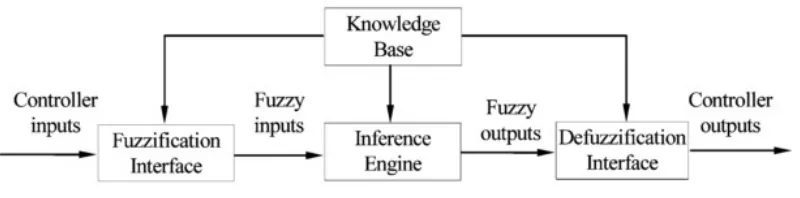
(c) Inference engine calculates the fuzzy output based on the information on the knowledge base and the fuzzy input.
(d) Defuzzification interface converts the inferred fuzzy output back to crisp outputs, which is used to control the system.
Fuzzy logic can be classified into three types (Sugeno, 1999). First is the Mamdami type, or Type I as classified by Sugeno, uses the following format for fuzzy rules construction:
If x1 is G1i , x2 is Gi2,..., xm is Gmi
Then y=Hi, i
=0,1,2,3,. .. where Gi and Hi are fuzzy sets.
Second type is the simpleton Mamdami type, or Type II as classified by Sugeno, which uses the following format for fuzzy rules construction:
If x1 is G1i , x2 is Gi2,..., xm is Gmi
Then y=hi, i
=0,1,2,3,. .. where hi is a real number.
Lastly, Takagi-Sugeno (T-S) type, or Type III as classified by Sugeno, uses the following format for fuzzy rules construction:
If x1 is G1i , x2 is Gi2,..., xm is Gmi
Then y=fi(x1, x2,..., xm), i=0,1,2,3,. ..
where fi is a function, usually expressed as a monomial equation:
[image:23.595.120.520.185.284.2]8
fi
(x1, x2,..., xm)=a0i+a1i x1i+ai2x2i+...+ami xim (3)
There are a few ways to create PID controller using fuzzy logic system, and one of more popular one is gain scheduling, first created by Tomizuka & Isaka (1993). Gain scheduling uses fuzzy inference to calculate the PID tuning parameters and send the parameters back to the PIC controller. Another popular method is direct action, where instead of tuning parameters, the result of the fuzzy inference is the complete PID control signal, which can be used directly to control the system. More papers focused on direct control type, although Feng (2006) argued that gain scheduling would gain more support and adoption from the industry. Direct action method requires a complete rewrite of the control algorithms, which is costly to implement compared to the implementation method of gain scheduling (by adding an additional FL module to the original control algorithm). However, direct action is easier to design for non-linear models compared to gain scheduling for situations such as “zero control for zero error” and “maximum control for maximum errors”. (Hu, Mann, & Gosine, 2001)
The difference between direct action and gain scheduling can be summarised using the following linguistic representation (Hu et al., 2001):
DA: If (“process error” is …) then (“control action” is …) GS: If (“process gain” is …)
then (“control gain” is …)