Commun
ficaft
fion
Faunafl
d
fivers
fifty off
Saftara
D
fisftr
ficft
,
Maharashftra
,
Ind
fia
Am
fift
Sayyed
26
November
2016
|
Vo
fl
.
8
|
No
.
13
|
Pp
.
9537–9561
10
.11609/
joft
.3162
.8
.13
.9537
-9561
fiona
fl
L
ficense
un
fless
oftherw
fise
menfioned
.
JoTT
a
fl
flows
unres
ftr
ficfted
use
o
ff
arfic
fles
fin
any
med
fium
,
reproducfion
and
d
fis
ftr
fibufion
by
prov
fid
fing
adequafte
cred
fift
fto
fthe
aufthors
and
fthe
source
o
ff
pub
fl
ficafion
.
Parftner
www
.
fthrea
ftenedftaxa
.org
ISSN
0974
-7907
(On
fl
fine
)
|
ISSN
0974
-7893
(Pr
finft
)
The
finfternafiona
fl
journa
fl
o
ff
conservafion
and
ftaxonomy
Journa
fl
o
ff
Threaftened
Taxa
Pub
fl
fisher/Hosft
For
Focus
,
Scope
,
A
fims
,
Po
fl
fic
fies
and
Gu
fide
fl
fines
v
fis
fift
hftp
://fthrea
ftenedftaxa
.org/Abouft_
JoTT
.asp
For
Arfic
fle
Subm
fiss
fion
Gu
fide
fl
fines
v
fis
fift
hftp
://fthrea
ftenedftaxa
.org/Subm
fiss
fion_Gu
fide
fl
fines
.asp
Communica
tion
LOGOs
DOI: http://dx.doi.org/10.11609/jott.3162.8.13.9537-9561 | ZooBank: urn:lsid:zoobank.org:pub:8E565297-1A9D-49F9-81EE-F982FAC1BE87
Editor: C. Srinivasulu, Osmania University, Hyderabad, India Date of publication: 26 November 2016 (online & print)
Manuscript details: Ms # 3162 | Received 01 April 2016 | Final received 05 November 2016 | Finally accepted 07 November 2016
Citation: Sayyed, A. (2016). Faunal diversity of Satara District, Maharashtra, India. Journal of Threatened Taxa 8(13): 9537–9561; http://dx.doi.org/10.11609/ jott.3162.8.13.9537-9561
Copyright: © Sayyed 2016. Creative Commons Attribution 4.0 International License. JoTT allows unrestricted use of this article in any medium, reproduction and distribution by providing adequate credit to the authors and the source of publication.
Funding: This work was supported by Wildlife Protection and Research Society.
Conflict of Interest: The author declares no competing interests.
Author Details: Amit Sayyed is head of research department at Wildlife Protection and Research Society. He works on faunal diversity, ecology, taxonomy, distribution and evolution of Reptiles and Amphibians.
Acknowledgements: I am sincerely thankful to the following persons and Institutions for their kind support for making this data on biodiversity possible - Dr. Hemant Ghate (Retired Professor, Department of Zoology, Modern College, Pune), Dr. Anil Mahabal (Retd. Scientist, Zoological Survey of India, Pune), Dr. Neelesh Dahanukar (Indian Institute of Science Education and Research, Pune), Dr. Anand Padhye (Department of Zoology, Abasaheb Garware College, Pune), Mr. Pradeep Kumkar (Modern college of Arts, Science and Commerce, Shivajinagar, Pune), Mr. Nikhil Modak (Department of Biodiversity, Abasaheb Garware College, Karve Road, Pune), Dr. Varad Giri (National Centre For Biological Sciences, Bangalore), Dr. Manju Siliwal (Wildlife Information & Liaison Development Society, Coimbatore, Tamil Nadu), Mr. Shrikant Jadhav (Scientist, Zoological Survey of India, Pune), Mr. Anilkumar Khaire (Zoo Incharge, Akurdi, Pune), Mr. Subhash Shelke (Deputy Conservator of Forests, Satara), Mr. M.N. Pawar (Asst. Conservator of Forests, Satara), Mr. T.J. Gayakwad and Mr. K.R. Potdar (Range Forest Officers, Satara), Mr. V.S. Chorge (Round Forest Officer, Satara), Mr. S.P. Shinde, Mr. G.M. Bhosale, Mr. R. I. Inamdar, Mr. D.D. Gayakwad, Mr. P.D. Padwal, Forest Guards of Satara Dist. I am also thankful to the Principal and Science Department of L.B.S College, Satara who allowed me to use the Science Lab for my scientific work. Dr. Satish Pande, and Mr. Rajkumar Pawar, for helping me on the study of birds. Dr. Milind Bhakare for helping me on the study of butterflies, Mr. Vivek Sharma for the support; my wife Anjum Sayyed and my other family members for their moral support. I am grateful to Mr. Aman Adsul, Atul Rajmane, Pratibha Shinde, Abhijit Nale, Rohit Katke, Akshay Bhagwat, Vinay Chavan, Jitendra Patole, Nikhil Mutha and Rahul Thombre the members of Wildlife Protection and Research Society of Satara, Maharashtra for helping me in field work.
Faunal diversity of Satara District, Maharashtra, India
Amit Sayyed
Wildlife Protection and Research Society, 40, Rajaspura Peth, Satara, Maharashtra 415002, India
[email protected]
ISSN 0974-7907 (Online) ISSN 0974-7893 (Print)
OPEN ACCESS
Abstract: Satara District of Maharashtra State is a part of northern Western Ghats and Deccan Plateau biogeographic zones. The data on
various faunal groups was collected from the extensive study carried out during the period between 2007 and 2010, covering different
parts of the district. The present study reports faunal diversity of the district with 677 species under 150 families belonging to 11 different
groups. Overall, the district has substantial faunal diversity. Out of the total species, 94 are recorded as endemic species, 35 species are
listed as threatened under the IUCN Red List of Threatened Species, and 38 species are listed in the different schedules of Indian Wildlife
(Protection) Act 1972 (as amended up to 2013). The information on geographical distribution pattern of mammalian species in the district
is also provided.
INTRODUCTION
Biodiversity means the variability among living
organisms from all sources and the ecological complexes
of which they are part. The enumeration of life forms
helps to adapt conservation strategies (Glowka et
al. 1994). With this idea an attempt was made to
enumerate and update the faunal diversity in Satara
District, Maharashtra State, India. Satara District forms
a part of the northern Western Ghats and the Deccan
Plateau biogeographical zones. Earlier studies on
fauna of various national parks, wildlife sanctuaries of
northern Western Ghats and Deccan Plateau, pertaining
to various faunal groups including urban areas from
Maharashtra and state fauna as a whole are available
(Kunte 1974; Gole 1998, 2001; Jagtap 1998; Pande 2005;
Anonymous 2002, 2004, 2005, 2006a,b, 2008, 2009,
2012, 2014), but there is no comprehensive account of
faunal diversity of Satara District. Therefore, an attempt
has been made to present the comprehensive account
of some faunal diversity of Satara District.
Satara District is the western limit of the Deccan
tableland and it lies between 16
050’–18
010’N & 73
045’–
75
003’E with an area of 10,484km
2. The district is divided
into 11 talukas, namely: Satara, Koregaon, Jawli, Wai,
Mahabaleshwer, Patan, Karad, Phaltan, Khataw, Maan
and Khandala. The Sahyadri range (Western Ghats)
runs from north to south along the western edge of the
district and Mahadev Hills (northern Western Ghats),
which are off-shoots of Shyadris, run eastwards and
sends several minor ranges in southeast and southward
directions across the district in Deccan area (Rao 1963).
Western part of the district is under Western Ghats
mountain province (5B) of Western Ghats biogeographic
zone, whereas, the rest of the district lies is in Central
Plateau Province (6D) of Deccan Plateau biogeographic
zone (Pande 2005).
The entire land of the district encompasses major
river systems between Sahyadri range, Mahadev Hills
and its minor hill ranges. There are four river basins
in the district; Yerla on south, Maan on southeast, Nira
on north, whereas Krishna being the largest drainage
system with many tributaries such as Kundali, Urmodi,
Tarli and Koyna covers the entire land of the district.
The whole of the district falls within the Deccan trap
area with greater portion covered by the basaltic
lava rocks, tapped with laterite. Trappean country is
800 mm. The type of the forest is mainly based on the
climatic factors particularly rainfall, temperature and
altitude. Tropical semi-evergreen forest is seen on high
Sahyadri ranges, moist deciduous forest on slopes of
the Sahyadris and dry deciduous mixed with shrubs and
grasses in the remaining parts of the district (Rao 1963).
The present study deals with the inventory of some
faunal groups pertaining to Satara District, Maharashtra,
India. Conservation status, endemicity, distribution
pattern of mammals in the district, comparison of
faunal diversity between the district and the state of
Maharashtra are also discussed in this communication.
STUDY AREA
d
fifferenft
areas
beftween
January
2007
and
December
2010
cover
fing
summer
,
ra
finy
and
w
finfter
seasons
.
For
mak
fing
observafions
and
record
fing
fthe
dafta
,
var
fious
equ
fipmenfts
finc
flud
fing
d
fig
fifta
fl
camera
,
b
finocu
flars
7x10
,
ftorch
fl
fighfts
,
GPS
,
sftereo
b
finocu
flar
m
ficroscope
(LABOMEDSM
-2
)
,
vern
fier
ca
fl
fiper
,
eftc
.
were
used
fin
fthe
fie
fld
.
Idenfificafion
o
ff
var
fious
ftaxa
was
carr
fied
ouft
by
us
fing
ava
fi
flab
fle
fl
fifterafture
-
mamma
fls
(A
fl
ffred
eft
a
fl
.
2006
)
,
b
firds
(A
fl
fi
&
R
fip
fley
1987
;
Rasmussen
&
Anderfton
2005
)
,
repfi
fles
(Sm
fifth
1935
;
T
fikader
&
Sharma
1992
;
Dan
fie
fl
2002
;
Wh
fiftaker
&
Capfta
fin
2008
)
,
amph
fib
fians
(Chanda
2002
)
,
fishes
(Ta
flwar
&
Jh
fingran
1991
;
Jayaram
2010
,
)
,
scorp
fions
(T
fikader
&
Basftawade
1983
)
,
bufterfl
fies
(Kunfte
2000
;
Keh
fimkar
2008
)
,
and
ffor
fthe
compar
fison
o
ff
ffauna
o
ff
Maharashftra
w
fifth
fthe
presenft
sftudy
fthe
ffo
fl
flow
fing
fl
fifterafture
was
used
-
mamma
fls
(Pradhan
&
Ta
flma
fle
2012a
)
,
b
firds
(Mahaba
fl
eft
a
fl
.
2012
)
,
repfi
fles
(Dasgupfta
eft
a
fl
.
2012
)
,
amph
fib
fians
(Padhye
&
Ghafte
2012
)
,
fishes
(Karmakar
eft
a
fl
.
2012
)
,
scorp
fions
(Basftawade
2012
)
,
bufterfl
fies
(Sharma
2012
)
,
dragonfl
fies
(Ku
flkarn
fi
eft
a
fl
.
2012
)
,
anfts
(Shee
fla
&
Chaftopadhyay
2012
)
,
and
cenfipede
(Yadav
2012
)
. Furfther
fto
fforfi
ffy
,
consu
flfted
experfts
and
compared
our
sftudy
w
fifth
fthe
experfts
and
fthe
co
fl
flecfions
aft
Zoo
flog
fica
fl
Survey
o
ff
Ind
fia
,
WRC
,
Pune
;
Deparftmenft
o
ff
Zoo
flogy
,
Modern
Co
fl
flege
and
Garware
Co
fl
flege
,
Pune
,
Maharashftra
.
The
check
fl
fisfts
o
ff
var
fious
ffauna
fl
groups
,
presenfted
as
Append
fices
1–11
,
are
based
on
persona
fl
and
fteam
-based
observafions
.
The
spec
fies
finc
fluded
fin
fth
fis
paper
fis
fto
fthe
besft
o
ff
my
know
fledge
and
any
spec
fies
fthaft
have
been
fleft
ouft
fis
on
fly
due
fto
fthe
reason
fthaft
fift
was
noft
encounftered
dur
fing
fthe
presenft
sftudy
.
RESULTS
AND
D
ISCUSS
ION
The
sftudy
resu
flfted
fin
fthe
fidenfificafion
and
enumerafion
o
ff
677
spec
fies
under
150
ffam
fi
fl
fies
spread
over
11
ffauna
fl
groups
(Tab
fle
1
)
.
The
ftab
fle
a
flso
find
ficaftes
ftofta
fl
number
o
ff
Ind
fian
endem
fic
spec
fies
aft
a
g
flance
.
Append
fices
1–11
g
five
defta
fi
fls
o
ff
ftofta
fl
number
o
ff
spec
fies
recorded
ffrom
each
ffauna
fl
group
a
flong
w
fifth
fthe
fir
order
and
ffam
fi
fly
-w
fise
c
flass
fificafion
,
common
name
,
endem
ficfty
sftaftus
and
conservafion
sftaftus
(wherever
app
fl
ficab
fle
)
.
Furfther
,
fthe
F
fig
.
2
and
F
fig
.
3
shows
fthe
compar
fison
beftween
fthe
ftofta
fl
number
o
ff
spec
fies
observed
fin
each
verftebrafte
group
and
some
finverftebrafte
groups
,
respecfive
fly
ffrom
Saftara
D
fisftr
ficft
and
fthose
a
flready
recorded
ffrom
sftafte
o
ff
Maharashftra
parficu
flar
fly
fthe
mamma
fls
(Pradhan
&
Ta
flma
fle
2012a
)
,
b
firds
(Mahaba
fl
eft
a
fl
.
2012
)
,
repfi
fles
(Dasgupfta
eft
a
fl
.
2012
)
,
amph
fib
fians
(Padhye
&
Ghafte
2012
)
,
fishes
(Karmakar
eft
a
fl
.
2012
)
,
scorp
fions
(Basftawade
2012
)
,
bufterfl
fies
(Sharma
2012
)
,
dragonfl
fies
(Ku
flkarn
fi
eft
a
fl
.
2012
)
,
anfts
(Shee
fla
and
Chaftopadhyay
2012
)
and
cenfipedes
(Yadav
2012
)
.
F
figures
2
and
3
find
ficafte
fthaft
ffauna
such
as
bufterfl
fies
(71
.4%
)
,
repfi
fles
(65
.0%
)
and
amph
fib
fians
(50
.9%
)
fis
we
fl
fl
represenfted
fin
fthe
d
fisftr
ficft
ffo
fl
flowed
by
fishes
(41
.2%
)
and
b
firds
(37
.4%
)
.
Resft
o
ff
fthe
ffauna
fl
groups
are
poor
fly
F
figure
1
.
Sftudy
areas
fin
Saftara
D
fisftr
ficft
,
Maharashftra
,
Ind
fia
:
represented in the district as compared to the state.
Indian endemic species from vertebrate and some
invertebrate groups have been plotted in Fig. 4. It
indicates that endemicity of avian and reptilian species
is higher than other faunal groups; this could probably
be due to the fact that the western part of the Satara
District falls under Western Ghats mountain province.
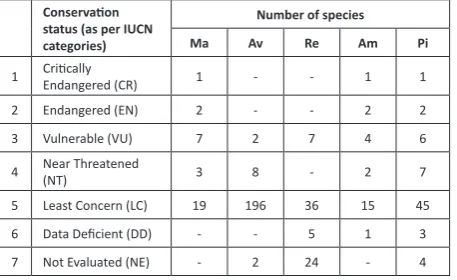
A comparative account of conservation status (as
per IUCN Red List of Threatened Species) for all the
vertebrate groups has been summarized in Table 2.
It indicates that 35 species from different vertebrate
groups are listed under threatened categories, like -
Critically Endangered, Endangered and Vulnerable.
Similarly, various species from all the vertebrate groups
and butterflies included under various schedules of the
Indian Wildlife (Protection) Act, 1972 (as amended upto
2013; IWPA) are listed in Table 3. It shows that a total
of 23 and 15 species are listed under SchedulesI and II,
from various faunal groups except the amphibians and
the fishes. In general, there is need to conserve and
protect all these species on priority basis.
The Appendix 1, Table 2 and 3 indicates that out of 32
mammalian species recorded in the district, 21 species
(65.6%) are listed under Schedule I and II of IWPA and
10 species (31.3%) are listed in threatened categories of
the Red List. These species need to be conserved.
Animals like the Gray Langur Semnopithecus
hypoleucos, Indian Hare Lepus nigricollis, Indian Grey
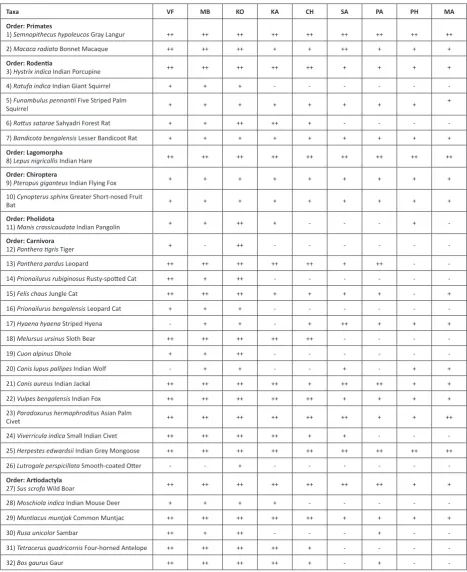
and Indian Jackal Canis aureus (Table 4). Mammals
like Sahayadri Forest Rat Rattus satarae, Sloth Bear
Melurus ursinus and Four-horned Antelope Tetracerus
Class Group Order Family Species Endemic
Mammalia Mammal 7 18 32 4
Aves Birds 16 60 208 25
Reptilia Reptiles 3 15 74 25
Amphibia Amphibians 2 9 27 3
Pisces Fishes 8 20 89 21
Arachnida Scorpions 1 3 11 3
Spiders 2 15 42 9
Insecta Butterflies 1 5 153 4
Dragonflies 1 2 10
-Ants 1 1 24
-Chilopoda Centipede 2 2 7
-Total 8 11 44 150 677 94
Table 1. Faunal diversity of various groups of animals and percent
endemicity of animals occurring in Satara Dsitrict, Maharashtra,
India
Figure 2. Comparison of total number of species recorded in each
vertebrate group from Satara District and Maharashtra, India
Figure 3. Comparison of total number of species recorded in some
invertebrate groups from Satara District and Maharashtra, India
part of the district. The Tiger Panthera tigris tigris was
seen occasionally at Vasota Fort and Koyna area.
Endemic and threatened species, like Indian Wolf
Canis lupus pallipes, Tiger Panthera tigris tigris, Sahyadri
Forest Rat Rattus satarae, Nilgiri Wood Pigeon Columba
elphinstonii, Leith’s Softshell TurtleNilssonia leithii,
Humayun’s Wrinkled Frog Nyctibatrachus humayuni
and Short-legged FrogIndirana barchytarsus warrants
serious attention for protection and conservation.
THREATS AND CONSERVATION MEASURES
As elsewhere, the fauna of Satara District is under
threat due to various anthropogenic activities like
expansion of windmills, mining, removal and erosion of
soil, forest fire, deforestation, uncensored tourism and
construction activities in Kaas, Panchgani-Mahableshwar
belt and unethical practices on wildlife. There is need of
strict implementation of various conservation oriented
steps for the areas to help ecosystem in recovering
from such human activities and so th at damage of the
faunal elements can be minimized. The involvement
of the locals in citizen-science will be a key to achieve
conservation.
REFERENCES
Alfred, J.R.B., A.K. Das & A.K. Sanyal (2006). Animals of India:
Mammals.ENVIS- Zoological Survey India, Kolkata, 236pp.
Ali, S. & S.D. Ripley (eds.) (1987). Compact Handbook of the Birds of
India and Pakistan, 2nd Edition. Oxford University, Delhi, 73+pls.
Bastawade, D.B. (2012). Arachnida: Scorpionida, pp. 671–673. In:
Director, ZSI (eds.). Fauna of Maharashtra, State Fauna Series 20
(Part - 2).Director, Zoological Survey of India, Kolkata.
Chanda, S.K. (2002). Hand Book of Indian Amphibians.Zoological
Survey of India, Kolkata, 335pp.
Daniel, J.C. (2002). The Book of Indian Reptiles and Amphibians.
Bombay Natural History Society, Oxford University Press, Mumbai,
238pp.
Dasgupta, G., B.H.C.K. Murthy & S. Raha (2012). Reptilia, pp. 189–238.
In: Director, ZSI (eds.). Fauna of Maharashtra, State fauna Series 20
(Part-1).Director, Zoological Survey of India, Kolkata.
Anonymous (2002). Fauna of Sanjay Gandhi National Park. Part I.
Vertebrate. Conservation Area Series 12: 1–54. Zoological Survey
of India, Kolkata
Anonymous (2004). Fauna of Pench National Park, Maharashtra,
Conservation Area Series 20: 1–312. Zoological Survey of India,
Kolkata.
Anonymous (2005). Fauna of Melghat Tiger Reserve, Maharashtra,
Conservation Area Series 24: 1–500. Zoological Survey of India,
Kolkata.
Anonymous (2006a). Fauna of Sanjay Gandhi National Park. Part-II.
Invertebrate, Conservation Area Series 26: 1–188. Zoological Survey
of India, Kolkata.
Anonymous (2006b). Fauna of Tadoba - Andhari Tiger Reserve,
Maharashtra, Conservation Area Series 25: 1–309. Zoological
Survey of India, Kolkata.
Anonymous (2008). Fauna of Lonar Wildlife Sanctuary, Maharashtra,
Conservation Area Series, 37: 1–208. Zoological Survey of India,
Kolkata.
Anonymous (2009). Fauna of Bhimashankar Wildlife Sanctuary,
Maharashtra, Conservation Area Series, 42: 1–284. Zoological
Survey of India, Kolkata.
Anonymous (2012). Fauna of Maharashtra, State Fauna Series, 20
(Part 1: 480) and (Part 2: 673). Zoological Survey of India, Kolkata.
Anonymous (2014). Fauna of Radhanagari Wildlife Sanctuary,
Maharashtra, Conservation Area Series, 52: 1-132. Zoological
Survey of India, Kolkata.
Glowka, L., F. Burhenne-Guilmin, & H. Synge (1994). A Guide to
the Convention on Biological Diversity. International Union for
Conservation of Nature and Natural Resources (IUCN), Gland,
Switzerland, and Cambridge, UK, xii+161pp.
Gole, P. (1998). The Sahyadri special.Birds, Snakes, Mammals, Turtles,
Lizards and Rare and Endemic Plants of the Sahyadri. Journal of
Ecological Society 11: 1–47.
Gole, P. (2001). Bio-diversity profile of an Urban area. Special double
Conservationstatus (as per IUCN categories)
Number of species
Ma Av Re Am Pi
1 Critically Endangered (CR) 1 - - 1 1
2 Endangered (EN) 2 - - 2 2
3 Vulnerable (VU) 7 2 7 4 6
4 Near Threatened (NT) 3 8 - 2 7
5 Least Concern (LC) 19 196 36 15 45
6 Data Deficient (DD) - - 5 1 3
7 Not Evaluated (NE) - 2 24 - 4
Table 2. Conservation status (as per IUCN categories) of vertebrate
groups from Satara District (as per Appendices 1 to 5)
Ma - Mammals; Av - Aves; Re - Reptiles; Am - Amphibians; Pi - Pisces
IWPA Schedules
Number of species
Ma Av Re Am Pi Bu
1 Schedule I Part I 10 - - - -
-2 Schedule I Part II - - 4 - -
-3 Schedule I Part III - 4 - - -
-4 Schedule I Part IV - - - 5
5 Schedule II Part I 3 - 1 - -
-6 Schedule II Part II 8 1 2 - -
-7 Schedule III 4 - - - -
-8 Schedule IV 3 201 44 1 -
-9 Schedule V 4 2 - - -
-Ma - -Mammals; Av - Aves; Re - Reptiles; Am - Amphibians; Pi - Pisces; Bu - Butterflies
Taxa VF MB KO KA CH SA PA PH MA
Order: Primates
1) Semnopithecus hypoleucos Gray Langur ++ ++ ++ ++ ++ ++ ++ ++ ++
2) Macaca radiata Bonnet Macaque ++ ++ ++ + + ++ + + +
Order: Rodentia
3) Hystrix indica Indian Porcupine ++ ++ ++ ++ ++ + + + +
4) Ratufa indica Indian Giant Squirrel + + + - - -
-5) Funambulus pennantii Five Striped Palm
Squirrel + + + + + + + + +
6) Rattus satarae Sahyadri Forest Rat + + ++ ++ + - - -
-7) Bandicota bengalensis Lesser Bandicoot Rat + + + + + + + + +
Order: Lagomorpha
8) Lepus nigricollis Indian Hare ++ ++ ++ ++ ++ ++ ++ ++ ++
Order: Chiroptera
9) Pteropus giganteus Indian Flying Fox + + + + + + + + +
10) Cynopterus sphinx Greater Short-nosed Fruit
Bat + + + + + + + + +
Order: Pholidota
11) Manis crassicaudata Indian Pangolin + + ++ + - - - +
-Order: Carnivora
12) Panthera tigris Tiger + - ++ - - -
-13) Panthera pardus Leopard ++ ++ ++ ++ ++ + ++ -
-14) Prionailurus rubiginosus Rusty-spotted Cat ++ + ++ - - -
-15) Felis chaus Jungle Cat ++ ++ ++ + + + + - +
16) Prionailurus bengalensis Leopard Cat + + + - - -
-17) Hyaena hyaena Striped Hyena - + + - + ++ + + +
18) Melursus ursinus Sloth Bear ++ ++ ++ ++ ++ - - -
-19) Cuon alpinus Dhole + + ++ - - -
-20) Canis lupus pallipes Indian Wolf - + + - - + - + +
21) Canis aureus Indian Jackal ++ ++ ++ ++ + ++ ++ + +
22) Vulpes bengalensis Indian Fox ++ ++ ++ ++ ++ + + + +
23) Paradoxurus hermaphroditus Asian Palm
Civet ++ ++ ++ ++ ++ ++ + + ++
24) Viverricula indica Small Indian Civet ++ ++ ++ ++ + + - -
-25) Herpestes edwardsii Indian Grey Mongoose ++ ++ ++ ++ ++ ++ ++ ++ ++
26) Lutrogale perspicillata Smooth-coated Otter - - + - - -
-Order: Artiodactyla
27) Sus scrofa Wild Boar ++ ++ ++ ++ ++ ++ ++ + +
28) Moschiola indica Indian Mouse Deer + + + + - - - -
-29) Muntiacus muntjak Common Muntjac ++ ++ ++ ++ ++ + + + +
30) Rusa unicolor Sambar ++ + ++ - - - + -
-31) Tetracerus quadricornis Four-horned Antelope ++ ++ ++ ++ + - - -
-32) Bos gaurus Gaur ++ ++ ++ ++ + - + -
-Table 4. Distribution of mammals in Satara District
Key: - = Not Observed, + = 1-5 ightings during the study, ++ = 5-10 sightings during the study.
issue. Journal of Ecological Society 13/14: 1–80.
IUCN (2014). The IUCN Red List of Threatened Species. Version 2014.2.
<www.iucnredlist.org>. Downloaded on 21 August 2014.
Jagtap, A.P. (1998). Biodiversity of the Western Ghats Maharashtra.
WWF for Nature India, BHPC, Pune, 287pp.
Jayaram, K.C. (2010). Freshwater Fishes of the Indian Region. Narendra
Publishing House, New Delhi, 616pp.
Karmakar, A.K., B.E. Yadav, N. Bairagi, A. Das, P.K. Banerjee & S.S.
Jadhav (2012). Freshwater fishes, pp. 247 –367. In: Anonymous
(ed.). Fauna of Maharashtra State Fauna Series 20 (Part-1).
Zoological Survey of India, Kolkata.
Kehimkar, I. (2008). The Book of Indian Butterflies. Bombay Natural
History Society Oxford University Press, Mumbai, 497pp.
Kulkarni, P.P., R. Babu, S.S. Talmale, C. Sinha & S.B. Mondal (2012).
Insecta: Odonata, pp. 397–428. In: Anonymous (ed.). Fauna of
Maharashtra, State Fauna Series 20 (Part-2). Zoological Survey of
India, Kolkata.
Kunte, B.G. (ed.) (1974). Gazetteer of India.Maharashtra State
Gazetteers. General Series: Fauna. The Director, Govt. Printing,
Stationary and Publications, Maharashtra State, Bombay, 432pp.
Kunte, K. (2000). Butterflies of Peninsular India. University Press,
Hyderabad, 254pp.
Mahabal, A., S. Pande, P. Pandit & A. Ponkshe (2012). Aves, pp.
147–188. In: Anonymous (ed.). Fauna of Maharashtra, State Fauna
Series 20 (Part- 1). Director, Zoological Survey of India, Kolkata.
Padhye, A.D. & H.V. Ghate (2012).Amphibia, pp. 239–246. In:
Anonymous (ed.). Fauna of Maharashtra, State Fauna Series 20
(Part- 1). Director, Zoological Survey of India, Kolkata.
Pande, P. (2005). National Parks and Sanctuaries in Maharashtra.
Reference Guide Vol. 1(A State Profile), 212pp and Vol. 2 (Individual
Profile and Management Status). Bombay Natural History Society,
Mumbai, 531pp.
Pradhan, M.S. & S.S. Talmale (2012a). Indian Mammals: Checklist
with Comments on Type Locality, Distribution, Conservation Status
and Taxonomy. Nature Books India, Kolkota, 488pp.
Pradhan, M.S. & S.S. Talmale (2012b). Mammalia, pp. 21–145. In:
Director, ZSI (ed.). Fauna of Maharashtra, State Fauna Series 20
(Part- 1). Director, Zoological Survey of India, Kolkata.
Rao, P.S.M. (ed.) (1963). Satara District Gazetteer (Revises Edition).
Maharashtra State Gazetteer. Govt. of Maharashtra, Bombay,
1128pp.
Rasmussen, P.C. & J.C. Anderton (2005). Birds of South Asia. The
Ripley Guide Vol. 1 and 2. Smithsonian Institute and Lynx Edicion,
Washington D.C. and Barcelona, 683pp.
Sharma, R.M. (2012). Insecta: Lepidoptera: Rhopalocera and
Grypocera, pp. 551–562. In: Anonymous (ed.). Fauna of
Maharashtra, State Fauna Series 20 (Part-2). Director, Zoological
Survey of India, Kolkata.
Sheela, S. & A. Chattopadhyay (2012). Insecta: Hymenoptera:
Vespoidea: Formicidae, pp. 567–586. In: Anonymous (ed.). Fauna
of Maharshtra, State Fauna Series 20 (Part-2). Zoological Survey of
India, Kolkata.
Smith, M.A. (1935). The Fauna of British India including Ceylon and
Burma: Reptilia and Amphibia. Volume II. Sauria, Taylor and Francis,
London, 440pp.
Talwar P.K. & A.G. Jhingran (1991). Inland Fishes of India and Adjacent
Countries. Vols I & II. Oxford & IBH Publishing Co. Pvt. Ltd, 1158pp.
Tikader, B.K. & D.B. Bastawade (1983). Fauna of India, Scorpionida -
Volume 3. Zoological Survey of India, Kolkata, 671pp.
Tikader, B.K. & R.C. Sharma (1992). Handbook of Indian Lizards.
Zoological Survey of India, Kolkata, xv+250pp+42pls.
Whitaker, R. & A. Captain (2008). Snakes of India. The Field Guide.
Draco Books, Chennai, India, xiv+385pp.
Yadav, B.E. (2012). Chilopode: Scolopendromorpha: Scolopendridae,
pp. 637–659. In: Anonymous (ed.). Fauna of Maharashtra, State
Appendix 1. Check list of Mammals of Satara District, Maharashtra, India as observed between January 2007 and December 2010. Indian
endemic species are marked with an asterisk.
Order Family Species name Common name Red List IWPA
1) Primates 1) Cercopithecidae 1) *Semnopithecus hypoleucos Blyth, 1841 Gray Langur LC Sch II Part I
2) *Macaca radiata (É. Geoffroy, 1812) Bonnet Macaque LC Sch II Part I
2) Rodentia 2) Hystricidae 3) Hystrix indica Kerr, 1792 Indian Porcupine LC Sch IV
3) Sciuridae 4) *Ratufa indica (Erxleben, 1777) Indian Giant Squirrel LC Sch II Part II
5) Funambulus pennantii Wroughton, 1905 Five Striped Palm Squirrel LC Sch IV
4) Muridae 6) *Rattus satarae Hinton, 1918 Sahyadri Forest Rat VU Sch V
7) Bandicota bengalensis Gray, 1835 Lesser Bandicoot Rat LC Sch V
3) Lagomorpha 5) Leporidae 8) Lepus nigricollis F. Cuvier, 1823 Indian Hare LC Sch IV
4) Chiroptera 6) Pteropodidae 9) Pteropus giganteus (Brunnich, 1782) Indian Flying Fox LC Sch V
10) Cynopterus sphinx (Vahl, 1797) Greater Short-nosed Fruit Bat LC Sch V
5) Pholidota 7) Manidae 11) Manis crassicaudata E. Geoffroy, 1803 Indian Pangolin NT Sch I Part I
6) Carnivora 8) Felidae 12)Panthera tigris tigris (Linnaeus, 1758) Tiger EN Sch I Part I
13) Panthera pardus (Linnaeus, 1758) Leopard NT Sch I Part I 14)Prionailurus rubiginosus (Geoffroy Saint-Hilaire,
1831) Rusty-spotted Cat VU Sch I Part I
15)Felis chaus Schreber, 1777 Jungle Cat LC Sch II Part II
16)Prionailurus bengalensis (Kerr, 1792) Leopard Cat LC Sch I Part I
9) Hyaenidae 17)Hyaena hyaena (Linnaeus, 1758) Striped Hyena NT Sch III
10) Ursidae 18)Melursus ursinus (Shaw, 1791) Sloth Bear VU Sch I Part I
11) Canidae 19) Cuon alpinus (Pallas, 1811) Dhole EN Sch II Part I
20) Canis lupus pallipes Sykes, 1831 Indian Wolf CR Sch I Part I
21) Canis aureus Linnaeus, 1758 Indian Jackal LC Sch II Part II
22) Vulpes bengalensis (Shaw, 1800) Indian Fox LC Sch II Part II
12) Viverridae 23) Paradoxurus hermaphroditus (Pallas, 1777) Asian Palm Civet LC Sch II Part II
24) Viverricula indica (Geoffroy Saint-Hilaire, 1803) Small Indian Civet LC Sch II Part II
13) Herpestidae 25) Herpestes edwardsii (Geoffroy Saint Hilaire, 1818) Indian Grey Mongoose LC Sch II Part II
14) Mustelidae 26) Lutrogale perspicillata (Geoffroy Saint Hilaire, 1826) Smooth-coated Otter VU Sch II Part II
7) Artiodactyla 15) Suidae 27) Sus scrofa Linnaeus, 1758 Wild Boar LC Sch III
16) Tragulidae 28) Moschiola indica (Gray, 1852) Indian Mouse Deer LC Sch I Part I
17) Cervidae 29) Muntiacus muntjak (Zimmermann, 1780) Common Muntjac LC Sch III
30) Rusa unicolor (Kerr, 1792) Sambar VU Sch III
18) Bovidae 31) Tetracerus quadricornis (Blainville, 1816) Four-horned Antelope VU Sch I Part I
Appendix 2. Check list of Birds of Satara District, Maharashtra, India as observed between January 2007 and December 2010. Indian endemic
species are marked with an asterisk.
Order Family Species name Common name Red List IWPA
1) Pelecaniformes 1) Phalacrocoracidae 1) Phalacrocorax fuscicollis Stephens, 1826 Indian Shag LC Sch IV 2) Phalacrocorax niger (Vieillot, 1817) Little Cormorant LC Sch IV
2) Anhingidae 3) Anhinga melanogaster Pennant, 1769 Oriental Darter NT Sch IV 2) Ciconiiformes 3) Ardeidae 4) Bubulcus coromandus (Boddaert, 1783) Western Cattle Egret LC Sch IV 5) Egretta garzett (Linnaeus, 1766) Little Egret LC Sch IV 6) Egretta alba (Linnaeus, 1758) Great Egret LC Sch IV
7) Egretta intermedia (Wagler, 1827) Intermediate Egret LC Sch IV 8) Egretta gularis (Bosc, 1792) Western Reef Heron LC Sch IV
9) Ardea cinerea Linnaeus, 1758 Grey Heron LC Sch IV
10) Ardeola grayii (Sykes, 1832) Indian Pond Heron LC Sch IV
11) Ardea purpurea Linnaeus, 1766 Purple Heron LC Sch IV 4) Ciconiidae 12) Anastomus oscitans (Boddaert, 1783) Asian Openbill LC Sch IV 13) Mycteria leucocephala (Pennant, 1769) Painted Stork NT Sch IV 14) Ciconia episcopus (Boddaert, 1783) White-necked Stork LC Sch IV
5) Threskiornithidae 15) Threskiornis melanocephalus (Latham, 1790) Black-headed Ibis NT Sch IV 16) Plegadis falcinellus (Linnaeus, 1766) Glossy Ibis LC Sch IV 17) *Pseudibis papillosa (Temminck, 1824) Indian Black Ibis LC Sch IV 18) Platalea leucorodia Linnaeus, 1758 Eurasian Spoonbill LC Sch IV
3) Anseriformes 6) Anatidae 19) Anas crecca Linnaeus, 1758 Common Teal LC Sch IV 20) Anas poecilorhyncha Forster, 1781 Indian Spot Billed
Duck LC Sch IV
21) Tadorna ferruginea (Pallas, 1764) Ruddy Shelduck LC Sch IV 4) Falconiformes 7) Accipitridae 22) Aquila rapax (Temminck, 1828) Tawny Eagle LC Sch IV 23) Hieraaetus pennatus (Gmelin, 1788) Booted Eagle LC Sch IV
24) *Nisaetus cirrhatus (Gmelin, 1788) Crested Hawk- Eagle LC Sch IV 25) Spilornis cheela (Latham, 1790) Crested Serpent Eagle LC Sch IV 26) Aquila heliacal Savigny, 1809 Eastern Imperial Eagle VU Sch IV
27) Hieraaetus fasciatus (Vieillot, 1822) Bonelli’s Eagle LC Sch IV 28) Aquila nipalensis Hodgson, 1833 Steppe Eagle LC Sch IV 29) Milvus migrans (Boddaert, 1783) Black Kite LC Sch IV 30) Milvus lineatus (Gray, 1831) Black Eared Kite LC Sch IV
31) Elanus caeruleus (Desfontaines, 1789) Black WingedKite LC Sch IV 32) Haliastur indus (Boddaert, 1783) Brahminy Kite LC LC Sch IV 33) Buteo buteo (Linnaeus, 1758) Common Buzzard LC LC Sch IV 34) Accipiter trivirgatus (Temminck, 1824) Crested Goshawk LC LC Sch IV
35) Circus cyaneus (Linnaeus, 1766) Hen Harrier LC LC Sch IV
36) Accipiter badius (Gmelin, 1788) Shikra LC Sch IV
37)Accipiter nisus (Linnaeus, 1758) Eurasian Sparrowhawk LC Sch IV 8) Pandionidae 38) Pandion haliaetus (Linnaeus, 1758) Osprey LC Sch I
partIII 9) Falconidae 39) Falco tinnunculus Linnaeus, 1758 Common Kestrel LC Sch IV
Order Family Species name Common name Red List IWPA
43) Falco peregrinus Tunstall, 1771 Peregrine Falcon LC Sch I partIII 5) Galliformes 10) Phasianidae 44) *Pavo cristatus Linnaeus, 1758 Indian Peafowl LC Sch I
partIII 45) Gallus gallus (Linnaeus, 1758) Red Junglefowl LC Sch IV 46) *Gallus sonneratii Temminck, 1813 Grey Junglefowl LC Sch II Part II 47) *Francolinus pondicerianus (Gmelin, 1789) Grey Francolin LC Sch IV 48) *Francolinus pictus (Jardine & Selby, 1828) Painted Francolin LC Sch IV 49) Coturnix coromandelica (Gmelin, 1789) Rain Quail LC Sch IV
50) Coturnix coturnix (Linnaeus, 1758) Common Quail LC Sch IV 51) Perdicula asiatica (Latham, 1790) Jungle Bush Quail LC Sch IV 52) Perdicula argoondah (Sykes, 1832) Rock Bush Quail LC Sch IV 53) Perdicula erythrorhyncha (Sykes, 1832) Painted Bush Quail LC Sch IV
54) *Galloperdix spadicea (Gmelin, 1789) Red Spurfowl LC Sch IV 6) Gruiformes 11) Rallidae 55) Amaurornis phoenicurus (Pennant, 1769) White Breasted
Waterhen LC Sch IV
56) Porphyrio poliocephalus (Linnaeus, 1758) Purple Swamphen LC Sch IV 57) Fulica atra Linnaeus, 1758 Eurasian Coot LC Sch IV 7)
Charadriiformes 12) Jacanidae 58) Hydrophasianus chirurgus (Scopoli, 1786) Pheasant-tailed Jacana LC Sch IV 59) Metopidius indicus (Latham, 1790) Bronze-winged Jacana LC Sch IV
13) Charadriidae 60) *Vanellus malabaricus (Boddaert, 1783) Yellow-wattled
Lapwing LC Sch IV
61) Vanellus indicus (Boddaert, 1783) Red-wattled Lapwing LC Sch IV 62) Charadrius alexandrinus Linnaeus, 1758 Kentish Plover LC Sch IV
63) Charadrius dubius Scopoli, 1786 Little Ringed Plover LC Sch IV 14) Recurvirostridae 64) Himantopus himantopus (Linnaeus, 1758) Black-winged Stilt LC Sch IV 15) Scolopacidae 65) Limosa limosa (Linnaeus, 1758) Western Black-tailed
Godwit NT Sch IV
66) Tringa glareola (Linnaeus, 1758) Wood Sandpiper LC Sch IV
67) Tringa stagnatilis (Bechstein, 1803) Marsh Sandpiper LC Sch IV 68) Calidris minuta (Leisler, 1812) Little Stint LC Sch IV 69) Actitis hypoleucos (Linnaeus, 1758) Common Sandpiper LC Sch IV 16) Glareolidae 70) *Cursorius coromandelicus (Gmelin, 1789) Indian Courser LC Sch IV
17) Laridae 71) Larus ridibundus Linnaeus, 1766 Common Black-headed
Gull LC Sch IV
18) Sternidae 72) Sterna aurantia Gray, 1831 River Tern NT Sch IV
73) Sterna albifrons Pallas, 1764 Little Tern LC Sch IV 8) Columbiformes 19) Columbidae 74) Columba livia Gmelin, 1789 Rock Pigeon LC Sch IV
75) Treron phoenicopterus (Latham, 1790) Yellow-footed Green
Pigeon LC Sch IV
76) *Columba elphinstonii (Sykes, 1832) Nilgiri Wood Pigeon VU Sch IV
77) Streptopelia chinensis (Scopoli, 1768) Spotted Dove LC Sch IV 78) Streptopelia orientalis (Latham, 1790) Oriental Turtle Dove LC Sch IV
Order Family Species name Common name Red List IWPA
84) Psittacula cyanocephala (Linnaeus, 1766) Plum-headed Parakeet LC Sch IV 85)Loriculus vernalis (Sparrman, 1787) Vernal Hanging Parrot LC Sch IV 10) Cuculiformes 21) Cuculidae 86) Clamator jacobinus (Boddaert, 1783) Jacobin Cuckoo LC Sch IV 87) *Cacomantis passerinus (Vahl, 1797) Grey-bellied Cuckoo LC Sch IV
88) Cacomantis sonneratii (Latham, 1790) Banded Bay
Cuckoo LC Sch IV
89) Cuculus canorus Linnaeus, 1758 Common Cuckoo LC Sch IV 90) Surniculus lugubris (Horsfield, 1821) Square-tailed
Drongo-Cuckoo LC Sch IV
91) Centropus sinensis (Stephens, 1815) Crow Pheasant LC Sch IV 92) Eudynamys scolopaceus (Linnaeus, 1758) Asian Koel LC Sch IV 11) Strigiformes 22) Tytonidae 93)Tyto alba (Scopoli, 1769) Common Barn Owl LC Sch IV
23) Strigidae 94) *Bubo bengalensis (Franklin, 1831) Indian Eagle Owl LC Sch IV 95) Ketupa zeylonensis (Gmelin, 1788) Brown Fish Owl LC Sch IV 96) Otus bakkamoena Pennant, 1769 Indian Scops Owl LC Sch IV 97) *Otus scops (Linnaeus, 1758) Eurasian Scops Owl LC Sch IV
98) *Strix ocellata (Lesson, 1839) Mottled Wood Owl LC Sch IV 99) Glaucidium radiatum (Tickell, 1833) Jungle Owlet LC Sch IV 100) Athene brama (Temminck, 1821) Spotted Owlet LC Sch IV
12)
Caprimulgiformes 24) Caprimulgidae 101)Caprimulgus asiaticus Latham, 1790 Indian Nightjar LC Sch IV 13) Apodiformes 25) Apodidae 102) Apus affinis (Gray, 1830) Little Swift LC Sch IV 103) Cypsiurus balasiensis (Gray, 1829) Asian Palm Swift LC Sch IV 14) Coraciiformes 26) Alcedinidae 104) Halcyon smyrnensis (Linnaeus, 1758) White-throated
Kingfisher LC Sch IV
105) Ceryle rudis (Linnaeus, 1758) Lesser Pied
Kingfisher LC Sch IV
106) Alcedo atthis (Linnaeus, 1758) Common Kingfisher LC Sch IV 27) Meropidae 107) Merops orientalis Latham, 1802 Little Green Bee-eater LC Sch IV 28) Coraciidae 108) Coracias benghalensis (Linnaeus, 1758) Indian Roller LC Sch IV
29) Upupidae 109) Upupa epops Linnaeus, 1758 Common Hoopoe LC Sch IV 15) Piciformes 30) Bucerotidae 110) Buceros bicornis Linnaeus, 1758 Great Pied Hornbill NT Sch IV 111) *Ocyceros birostris (Scopoli, 1786) Indian Grey Hornbill LC Sch IV
31) Capitonidae 112) Megalaima haemacephala (S. Muller, 1776) Coppersmith Barbet LC Sch IV 113) Psilopogon zeylanicus (Gmelin, 1788) Brown Headed Barbet LC Sch IV 32) Picidae 114) Leiopicus mahrattensis (Latham, 1801) Yellow-crowned
Woodpecker LC Sch IV
115) Yungipicus nanus (Vigors, 1832) Indian Pygmy
Woodpecker LC Sch IV
116) *Dinopium benghalense (Linnaeus, 1758) Black-rumped
Flameback LC Sch IV
16) Passeriformes 33) Pittidae 117) *Pitta brachyura (Linnaeus, 1766) Indian Pitta LC Sch IV 34) Alaudidae 118) Galerida deva (Sykes, 1832) Sykes’ Lark LC Sch IV
119) Mirafra erythroptera Blyth, 1845 Indian Bush Lark LC Sch IV 120) Eremopterix griseus (Scopoli, 1786) Ashy-crowned
Finch-Lark LC Sch IV
121) *Galerida malabarica (Scopoli, 1786) Malabar Lark LC Sch IV 122) Calandrella brachydactyla (Leisler, 1814) Greater Short-toed
Lark LC Sch IV
Order Family Species name Common name Red List IWPA
125) Hirundo daurica Laxmann, 1769 Red-rumped Swallow LC Sch IV 126) Hirundo smithii Leach, 1818 Wire-tailed Swallow LC Sch IV 127) Hirundo fluvicola Blyth, 1855 Streak-throated
Swallow LC Sch IV
36) Motacillidae 128) Motacilla maderaspatensis Gmelin, 1789 White-browed Wagtail LC Sch IV
129) Motacilla flava Linnaeus, 1758 Western Yellow
Wagtail LC Sch IV
130) Motacilla alba Linnaeus, 1758 White Wagtail LC Sch IV 131) Anthus trivialis (Linnaeus, 1758) Tree Pipit LC Sch IV 132) Anthus rufulus Vieillot, 1818 Paddyfield Pipit LC Sch IV 133) Anthus similis (Jerdon, 1840) Long-billed Pipit LC Sch IV
37) Campephagidae 134) Pericrocotus flammeus (J.R. Forster, 1781) Orange Minivet LC Sch IV 135) Pericrocotus erythropygius (Jerdon, 1840) White-bellied Minivet LC Sch IV 136) Pericrocotus cinnamomeus (Linnaeus, 1766) Small Minivet LC Sch IV 137) Coracina melanoptera (Ruppell, 1839) Black-headed
Cuckooshrike LC Sch IV
138) Hemipus picatus (Sykes, 1832) Pied Flycatcher-Shrike LC Sch IV
139) Coracina macei (Lesson, 1830) Large Cuckooshrike LC Sch IV 38) Monarchidae 140) Terpsiphone paradisi (Linnaeus, 1758) Asian Paradise
Flycatcher LC Sch IV
141) Hypothymis azurea (Boddaert, 1783) Black-naped Blue
Monarch LC Sch IV
39) Rhipiduridae 142) Rhipidura albogularis (Lesson, 1831) White-spotted Fantail NE Sch IV 143) Rhipidura aureola Lesson, 1830 White-browed Fantail LC Sch IV 40) Pycnonotidae 144) Pycnonotus jocosus (Linnaeus, 1758) Red-whiskered Bulbul LC Sch IV
145) Pycnonotus cafer (Linnaeus, 1766) Red-vented Bulbul LC Sch IV 146) Pycnonotus luteolus (Lesson, 1841) White-browed Bulbul LC Sch IV 147) Iole indica (Jerdon, 1839) Yellow-browed Bulbul LC Sch IV 148) *Hypsipetes ganeesa Sykes, 1832 Square-tailed Bulbul NE Sch IV
41) Aegithinidae 149) Aegithina tiphia (Linnaeus, 1758) Common Iora LC Sch IV 42) Chloropseidae 150) Chloropsis cochinchinensis (Gmelin, 1789) Blue-winged Leafbird LC Sch IV 151) Chloropsis aurifrons (Temminck, 1829) Gold-fronted Leafbird LC Sch IV 43) Irenidae 152) Irena puella (Latham, 1790) Asian Fairy Bluebird LC Sch IV
44) Laniidae 153) Lanius excubitor Linnaeus, 1758 Great Grey Shrike LC Sch IV 154) Lanius schach Linnaeus, 1758 Long-tailed Shrike LC Sch IV 155) Lanius vittatus Valenciennes, 1826 Bay-backed Shrike LC Sch IV 156) Tephrodornis pondicerianus (Gmelin, 1789) Common Woodshrike LC Sch IV
45) Turdidae 157) Zoothera citrina (Latham, 1790) Orange-headed Thrush LC Sch IV 158) Myophonus horsfieldii Vigors, 1831 Malabar Whistling
Thrush LC Sch IV
159) Turdus merula Linnaeus, 1758 Common Blackbird LC Sch IV 46) Muscicapidae 160) Cyornis tickelliae Blyth, 1843 Tickell’s Blue Flycatcher LC Sch IV
161) *Cyornis pallipes (Jerdon, 1840) White-bellied Blue
Flycatcher LC Sch IV
162) Culicicapa ceylonensis (Swainson, 1820) Grey-headed Canary
Flycatcher LC Sch IV
Order Family Species name Common name Red List IWPA
167) Copsychus malabaricus (Scopoli, 1788) White-rumped Shama LC Sch IV 168) Monticola solitarius (Linnaeus, 1758) Blue Rock Thrush LC Sch IV 169) Saxicoloides fulicata (Linnaeus, 1766) Indian Black Robin LC Sch IV
170) Copsychus saularis (Linnaeus, 1758) Oriental Magpie-Robin LC Sch IV 171) Saxicola caprata (Linnaeus, 1766) Pied Bushchat LC Sch IV 172) Saxicola torquatus (Linnaeus, 1766) Common Stonechat LC Sch IV 47) Timaliidae 173) Turdoides striata (Dumont, 1823) Jungle Babbler LC Sch IV
174) Turdoides malcolmi (Sykes, 1832) Large Grey Babbler LC Sch IV 175) Chrysomma sinense (Gmelin, 1789) Yellow-eyed Babbler LC Sch IV 176) *Turdoides subrufa (Jerdon, 1839) Indian Rufous Babbler LC Sch IV 177) Dumetia hyperythra (Franklin, 1831) Tawny-bellied Babbler LC Sch IV
48) Cisticolidae 178) Prinia inornata Sykes, 1832 Plain Prinia LC Sch IV 179) Prinia socialis Sykes, 1832 Ashy Prinia LC Sch IV 180) Orthotomus sutorius (Pennant, 1769) Common Tailorbird LC Sch IV 181) Prinia hodgsonii Blyth, 1844 Grey-breasted Prinia LC Sch IV
182) Prinia sylvatica Jerdon, 1840 Jungle Prinia LC Sch IV
49) Paridae 183) Parus major Linnaeus, 1758 Great Tit LC Sch IV
184) Parus xanthogenys Vigors, 1831 Black-lored Yellow Tit LC Sch IV
50) Nectariniidae 185) Cinnyris asiaticus (Latham, 1790) Purple Sunbird LC Sch IV 186) *Cinnyris lotenius (Linnaeus, 1766) Loten’s Sunbird LC Sch IV 187) *Leptocoma zeylonica (Linnaeus, 1766) Purple-rumped
Sunbird LC Sch IV
188) *Leptocoma minima (Sykes, 1832) Crimson-backed
Sunbird LC Sch IV
51) Zosteropidae 189) Zosterops palpebrosus (Temminck, 1824) Oriental White-eye LC Sch IV 52) Emberizidae 190) Melophus lathami (Gray, 1831) Crested Bunting LC Sch IV
53) Fringillidae 191) Carpodacus erythrinus (Pallas, 1770) Common Rosefinch LC Sch IV 54) Estrildidae 192) Euodice malabarica (Linnaeus, 1758) Indian Silverbill LC Sch IV 193) Lonchura punctulata (Linnaeus, 1758) Scaly-breasted Munia LC Sch IV 194) Lonchura striata (Linnaeus, 1766) White-rumped Munia LC Sch IV
195) Amandava amandava (Linnaeus, 1758) Red Avadavat LC Sch IV 55) Passeridae 196) Passer domesticus (Linnaeus, 1758) House Sparrow LC Sch IV 56) Ploceidae 197) Ploceus philippinus (Linnaeus, 1766) Baya Weaver LC Sch IV 57) Sturnidae 198) Temenuchus pagodarum (Gmelin, 1789) Brahminy Starling LC Sch IV
199) Acridotheres fuscus (Wagler, 1827) Jungle Myna LC Sch IV 200) Acridotheres tristis (Linnaeus, 1766) Common Myna LC Sch IV 58) Oriolidae 201) Oriolus kundoo Sykes, 1832 Indian Golden Oriole LC Sch IV 59) Dicruridae 202) Dicrurus macrocercus Vieillot, 1817 Black Drongo LC Sch IV
203) Dicrurus paradiseus (Linnaeus, 1766) Greater Racket-tailed
Drongo LC Sch IV
204) Dicrurus leucophaeus Vieillot, 1817 Ashy Drongo LC Sch IV 205) Dicrurus aeneus Vieillot, 1817 Bronzed Drongo LC Sch IV 60) Corvidae 206) Dendrocitta vagabunda (Latham, 1790) Rufous Treepie LC Sch IV 207) Corvus culminatus Sykes, 1832 Indian Jungle Crow LC Sch V
Appendix 3. Check list of reptiles (Class Reptilia) of Satara District, Maharashtra, India as observed between January 2007 and December
2010. Indian endemic species are marked with an asterisk.
Order Family Species name Common name Red List IWPA
1) Crocodylia 1) Crocodylidae 1) Crocodylus palustris Lesson, 1831 Mugger Crocodile VU Part IISch I
2) Testudines 2) Trionychidae 2) Lissemys punctata (Lacepede, 1788) Indian Flapshell Turtle NE Part IISch I
3) *Nilssonia leithii Gray, 1872 Leith's Softshell Turtle VU
-3) Squamata 3) Gekkonidae 4) Cnemaspis girii Mirza, Pal, Bhosale & Sanap, 2014 Giri’s Day Gecko -
-5)*Geckoella deccanensis (Gunther, 1864) Deccan Banded Gecko LC
-6) Hemidactylus brookii Gray, 1845 Brook’s House Gecko LC
-7) Hemidactylus flaviviridis Ruppell, 1835 Yellow-Green House Gecko LC
-8) Hemidactylus frenatus Schlegel, 1836 Asian House Gecko LC
-9) *Hemidactylus gracilis Blanford, 1870 Graceful Leaf-toed Gecko LC
-10) Hemidactylus leschenaultii Dumeril &
Bibron, 1836 Leschenault's Leaf-toed Gecko LC
-11) Hemidactylus triedrus Daudin, 1802 Termite Hill Gecko LC -12) *Hemidactylus satarensis Giri & Bauer,
2008 Satara Rock Gecko VU
-13) Hemidactylus maculatus Dumeril & Bibron,
1836 Spotted Leaf-toed Gecko LC
-14) *Hemidactylus prashadi Smith, 1935 Bombay Leaf-toed Gecko LC
-4) Agamidae 15) Calotes versicolor (Daudin, 1802) Indian Garden Lizard NE -16) *Calotes rouxii Dumeril & Bibron, 1837 Roux’s Forest Lizard LC
-17) Sitana laticeps Deepak & Giri, 2016 Broad-headedFan-throated Lizard NE
-5) Chamaeleonidae 18) Chamaeleo zeylanicus Laurenti, 1768 Indian Chameleon VU Sch IIPart I
6) Lacertidae 19) *Ophisops beddomei (Jerdon, 1870) Beddome's Snake-Eye LC
-20) Ophisops jerdonii (Blyth, 1853) Jerdon's Snake-Eye LC
-7)Scincidae 21) Eutropis carinata (Schneider, 1801) Keeled Grass Skink LC -22) Eutropis macularia (Blyth, 1853) Bronze Grass Skink LC -23) *Eutropis trivittata (Hardwicke & Gray,
1827) Three Lined Grass Skink LC
-24) Lygosoma lineata (Gray, 1839) Lined Supple Skink LC
-25) Lygosoma punctata Gmelin, 1799 Suppel Skink LC -26) Lygosoma guentheri (Gunther, 1864) Snake Skink LC
-8) Varanidae 27)Varanus bengalensis (Daudin, 1802) Bengal Monitor VU Part IISch I
9) Typhlopidae 28) Ramphotyphlops braminus (Daudin, 1803) Brahminy Worm Snake NE Sch IV
29) *Grypotyphlops acutus (Dumeril & Bibron,
1844) Beaked Worm Snake LC Sch IV
30) *Typhlops beddomii Boulenger, 1890 Beddomc’s Worm Snake DD Sch IV
10) Uropeltidae 31) *Uropeltis ellioti (Gray, 1858) Elliot’s Shieldtail LC Sch IV
32) *Uropeltis macrolepis (Peters, 1862) Large-scaled Shieldtail LC Sch IV
Order Family Species name Common name Red List IWPA 37) Eryx whitakeri Das, 1991 Whitaker’s Boa NE Sch IV 13) Colubridae 38) Ahaetulla nasuta (Lacepede, 1789) Common Vine Snake NE Sch IV
49) Ahaetulla pulverulenta (Dumeril & Bibron,
1854) Brown Vine Snake LC Sch IV
40) *Amphiesma beddomei (Gunther, 1864) Beddome’s Keelback LC Sch IV
41) Amphiesma stolatum (Linnaeus, 1758) Buff-Striped Keelback NE Sch IV
42) Argyrogena fasciolata (Shaw, 1802) Banded Racer NE Sch IV 43) Boiga beddomei (Wall, 1909) Beddome’s Cat Snake DD Sch IV 44) Boiga ceylonensis (Gunther, 1858) Ceylon Cat Snake NE Sch IV 45) Boiga trigonata (Schneider, 1802) Common Indian Cat LC Sch IV 46) Boiga forsteni (Dumeril, Bibron & Dumeril,
1854) Forsten’s Cat Snake LC Sch IV
47) *Psammophis longifrons Boulenger, 1896 Stout Sand Racer LC Sch IV 48) *Coronella brachyura (Gunther, 1866) Indian Smooth Snake LC Sch IV
49) Coelognathus helena (Daudin, 1803) Common Indian Trinket Snake NE Sch IV
50) Coluber gracilis (Günther, 1862) Slender Racer DD Sch IV
51) Dendrelaphis tristis (Daudin, 1803) Common Bronzeback Tree Snake NE Sch IV
52) Liopeltis calamaria (Gunther, 1858) Calamaria Reed Snake DD Sch IV
53) Lycodon aulicus (Linnaeus, 1758) Common Wolf Snake NE Sch IV
54) *Lycodon flavomaculatus Wall, 1907 Yellow Spotted Wolf Snake LC Sch IV
55) Lycodon striatus (Shaw, 1802) Barred Wolf Snake NE Sch IV
56) *Lycodon travancoricus (Beddome, 1870) Travancore Wolf Snake LC Sch IV
57) Macropisthodon plumbicolor (Cantor,
1839) Green Keelback NE Sch IV
58) Oligodon arnensis (Shaw, 1802) Common Kukri Snake NE Sch IV 59) Oligodon taeniolatus (Jerdon, 1853) Streaked Kukri Snake NE Sch IV 60) Ptyas mucosa (Linnaeus, 1758) Indian Rat Snake NE Sch IV
61) *Rhabdops olivaceus (Beddome, 1863) Olive Forest Snake LC Sch IV 62) Sibynophis subpunctatus (Duméril, Bibron
& Duméril, 1854) Duméril’s Black- headed Snake NE Sch IV 63) Xenochrophis piscator (Schneider, 1799) Checkered Keelback NE Sch IV 14) Elaphidae 64) Bungarus caeruleus (Schneider, 1801) Common Indian Krait NE Sch IV 65) Bungarus sindanus walli (Wall, 1907) Wall’s Sind Krait DD Sch IV
66) *Calliophis melanurus (Shaw, 1802) Slender Coral Snake NE Sch IV 67) *Calliophis nigrescens (Gunther, 1862) Striped Coral Snake LC Sch IV 68) Calliophis castoe Smith, Ogale, Deepak &
Giri, 2012 Castoe’s Coral Snake - Sch IV
69) Naja naja (Linnaeus, 1758) Spectacled Cobra NE Sch IIpartII
15) Viperidae 70) Daboia russelii (Shaw & Nodder, 1797) Russell’s Viper NE Sch IIpartII
71) Echis carinatus (Schneider, 1801) Indian Saw-scaled Viper VU Sch IV
72) *Hypnale hypnale (Merrem, 1820) Hump-nosed Pit Viper LC Sch IV
Appendix 4. Checklist of amphibians (Class Amphibia) of Satara District, Maharashtra, India as observed between January 2007 and
December 2010. Indian endemic species are marked with an asterix.
Order Family Species name Common name Red List IWPA
1) Anura 1) Bufonidae 1) Duttaphrynus stomaticus (Lütken, 1864) Marbled Toad LC
-2) Duttaphrynus melanostictus (Schneider, 1799) Common Indian Toad LC
-3) Xanthophryne koynayensis (Soman, 196-3) Koyna Toad EN
-4) Xanthophryne tigerinus (Biju, Van Bocxlaer, Giri,
Loader & Bossuyt, 2009) Konkan Tiger Toad CR
-2) Dicroglossidae 5) Hoplobatrachus tigerinus (Daudin, 1802) Indian Bull frog LC Sch IV
6) Euphlyctis cyanophlyctis (Schneider, 1799) Indian Skipper Frog LC
-7) Zakerana sahyadrensis (Annandale, 1919) Sahyadri Cricket Frog LC
-8) Zakerana rufescens (Jerdon, 1854) Rufescent Burrowing Frog LC
-9) Sphaerotheca breviceps (Schneider, 179-9) Indian Burrowing Frog LC
-10) Sphaerotheca dobsoni (Boulenger, 1882) Dobson’s Burrowing Frog LC
-3) Microhylidae 11) Microhyla ornata (Duméril & Bibron, 1841) Ornamented Pygmy Frog LC
-4) Nyctibatrachidae 12) *Nyctibatrachus humayuni (Bhaduri and Kripalani, 1955) Humayun’s Wrinkled Frog VU
-13) *Nyctibatrachus danieli (Biju et al., 2011) Daniel's Night Frog LC
-5) Ranidae 14) Hydrophylax bahuvistara (Tschudi, 1838) Fungoid Frog LC
-15) Hylarana aurantiaca (Boulenger, 1904) Golden Frog VU
-16) Hylarana temporalis (Günther, 1864) Bronzed Frog NT
-17) Clinotarsus curtipes (Jerdon, 1853) Bicolored Frog NT
-6) Ranixalidae 18) Indirana leithii (Boulenger, 1888) Leith's Leaping Frog VU
-19) Indirana beddomii (Günther, 1876) Beddome's Leaping Frog LC
-20) Indirana semipalmata (Boulenger, 1882) Small-handed Leaping Frog LC
-21) *Indirana brachytarsus (Günther, 1876) Short-legged Frog EN
-7) Rhacophoridae 22) Raorchestes bombayensis (Annandale, 1919) Konkan Bush Frog VU -23) Raorchestes ghatei (Padhye, Sayyed, Jadhav &
Dahanukar, 2013) Ghate's Shrub Frog -
-24) Polypedates maculatus (Gray, 1830) Indian Tree Frog LC
-2) Gymnophiona 8) Caeciliidae 25) Indotyphlus maharashtraensis (Giri, Gower & Wilkinson, 2004) Humbarli Caecilian DD
-26) Gegeneophis spp. - -
-Appendix 5. Checklist of fishes (Class Pisces) of Satara District, Maharashtra, India as observed between January 2007 and December 2010.
Indian endemic species are marked with an asterisk; exotic species are marked with †.
Order Family Species name Common name Red List IWPA
1) Osteoglossiformes 1) Notopteridae 1) Notopterus notopterus (Pallas, 1769) Bronze Featherback - -2) Anguilliformes 2) Anguillidae 2) Anguilla bengalensis (Gray, 1831) Indian Mottled Eel NT
-3) Cypriniformes 3) Cyprinidae 3) Barilius barna (F. Hamilton, 1822) Barna Barila - -4) Barilius bendelisis (F.Hamilton, 1807) Hamilton’s Barila -
-5)*Barilius gatensis (Valenciennes, 1844) Malabar Baril - -6) Cirrhinus fulungee (Sykes, 1839) Deccan White Carp NE
-7) Cirrhinus mrigala (Bloch, 1795) Mrigal Carp VU
-8) Cirrhinus cirrhosus (Bloch, 1795) Cauvery White Carp VU -9)Chela cachius (F. Hamilton, 1822) Neon Hatchet Fish -
-10) Ctenopharyngodon idella (Cuvier & Valenciennes,
1844) Grass Carp -
-11)†Cyprinus carpio (Linnaeus, 1758) Wild Common Carp VU
-12) Catla catla (F. Hamilton, 1822) Catla LC
-13) Crossocheilus cf. latius (Hamilton, 1822) Gangetic Latia LC
-14) Devario aequipinnatus (Mc Clelland, 1839) Giant Danio DD
-15) * Garra bicornuta Narayan Rao, 1920 Tunga Garra NT
-16) Garra gotyla (Gray, 1830) Gotyla LC
-17) *Garra mullya (Sykes, 1839) Garra Mullya LC
-18) Hypselobarbus curmuca (Hamilton, 1807) Curmuca Barb EN
-19) *Hypselobarbus kolus (Sykes, 1839) Kolus Barb VU
-20) Labeo boga (F. Hamilton, 1822) Boga Labeo LC
-21) Labeo boggut (Sykes, 1839) Minor Carp LC
-22) Labeo calbasu (Hamilton, 18-22) Orange-fin Labeo LC
-23) Labeo porcellus (Heckel, 1844) Bombay Labeo LC
-24) Labeo rohita (F. Hamilton, 1822) Rohu LC
-25) Labeo ariza (Hamilton, 1807) Ariza Labeo LC
-26) *Osteobrama vigorsii (Sykes, 1839) Godavari Osteobrama LC
-27) Osteobrama cotio (Hamilton, 1822) - LC
-28)*Osteochilichthys nashii (Day, 1869) Chandkas Barb LC
-29) *Puntius cf. amphibius (Valenciennes, 1842) Scarlet-banded Barb DD
-30)Hypselobarbus jerdoni (Day, 1870) Jerdon's Carp LC
-31)*Puntius deccanensis Yazdani & Babu Rao, 1976 Deccan Barb CR
-32) *Puntius sahyadriensis Silas, 1953 Khavli Barb LC
-33) Pethia conchonius (Hamilton, 1822) Rosy Barb LC
-34) Systomus sarana (Hamilton, 1822) Olive Barb -
-35) Puntius sophore (Hamilton, 1822) Spotfin Swamp Barb LC
-36) Pethia ticto (Hamilton, 1822) Two-spot Barb LC
-37) Pethia narayani (Hora, 19-37) Narayan’s Barb LC
-38) Rasbora daniconius (Hamilton, 1822) Common Rasbora LC
-39) Salmophasia balookee (Sykes, 18-39) Bloch Razorbelly Minnow LC
-40) *Salmophasia boopis (Day, 1874) Boopis Razorbelly Minnow -
-41) Salmophasia novacula (Valenciennes, 1840) NovaculaRazorbelly Minnow -
-42) *Schismatorhynchos nukta (Sykes, 1839) Nukta EN
-44) *Tor mussullah (Sykes, 1839) High-Backed Mahseer -
-45) Aspidoparia morar (Hamilton, 1822) Aspidoparia - -46) Salmophasia bacaila (Hamilton, 1822) Garss Carp -
-47) Cirrhinus reba (Hamilton, 1822) Reba Carp -
-48) Hypophthalmichthys molitrix (Valenciennes, 1844) Silver Carp NT
-49) Danio sp. Hamilton, 1822 - -
-4) Parapsilorhynchidae 50)*Parapsilorhynchus discophorus Hora, 1921 Ratnagiri Minnow VU
-51) Parapsilorhynchus tentaculatus (Annandale, 1919) Khandalla Minnow LC
-5) Balitoridae 52)*Nemacheilus mooreh (Sykes, 1839) Murangi -
-53) Indoreonectes evezardi (Day, 1872) - LC
-54) *Nemachilichthys rueppelli (Sykes, 1839) Mongoose Loach LC
-55) Schistura denisonii (Day, 1867) - LC
-56) *Nemacheilus anguilla (Annandale, 1919) Chikli Loach -
-57) Acanthocobitis botia (Hamilton, 1822) Mottled Loach LC
-6) Cobitidae 58) *Botia striata Narayan Rao,1920 Zebra Loach EN
-59) Lepidocephalus guntea (Hamilton, 1822) Peppered Loach LC -60) Lepidocephalus thermalis
(Valenciennes, 1846) Malabar Loach -
-4) Siluriformes 7) Bagridae 61) Mystus bleekeri (Day, 1877) Day’s Mystus -
-62) *Mystus malabaricus (Jerdon, 1849) Jerdon's Mystus -
-63) Mystus seengtee (Sykes, 1839) - LC
-64) Mystus cavasius (Hamilton, 1822) Gangetic Mystus LC
-65) Mystus vittatus (Bloch, 1794) Striped Dwarf Catfish LC
-66) Sperata seenghala (Sykes, 1839) Giant River-Catfish LC -8) Siluridae 67) Ompok bimaculatus (Bloch, 1794) Butter Catfish LC
-68) Wallago attu Bloch & Schneider, 1801 Fresh Water shark NT
-9) Schilbeidae 69) *Neotropius khavalchor Kulkarni, 1952 Khavalchor Catfish DD
-10) Sisoridae 70) Glyptothorax lonah (Sykes, 1839) Mountain Catfish LC
-71) *Glyptothorax cf. poonaensis Hora, 1938 Rock Sucker EN
-72) *Glyptothorax trewavasae Hora, 1938 - VU
-11) Clariidae 73) Clarias batrachus (Linnaeus, 1758) Walking Catfish NE
-12) Heteropneustidae 74) Heteropneustes fossilis (Bloch, 1794) Asian Stinging Catfish LC -5) Beloniformes 13) Belonidae 75) Xenentodon cancila (Hamilton, 1822) Freshwater Gar Fish LC -6) Cyprinodontiformes 14) Poeciliidae 76)†Gambusia affinis (Baird & Girard, 1853) Western Mosquitofish LC
---77)†Poecilia reticulata W.K.H. Peters, 1859 Guppy LC -7) Perciformes 15) Ambassidae 78) Chanda nama Hamilton, 1822 Elongate Glass Perchlet LC
-79) Pseudambassis ranga (Hamilton, 1822) Indian Glassy Fish LC
-80) Parambassis baculis (Hamilton, 1822) - NT
-16) Cichlidae 81)†Oreochromis mossambicus (W.K.H. Peters, 1852) Mozambique Tilapia NT -17) Gobiidae 82) Glossogobius giuris (Hamilton, 1822) Fresh Water Goby LC
-18) Channidae 83) Channa gachua (Hamilton, 1822) Dwarf Snakehead LC -84) Channa marulius (Hamilton, 1822) Giant Snakehead LC
-85) Channa striatus (Bloch, 1793) Striped Snakehead LC -8) Synbranchiformes 19) Synbranchidae 86) Monopterus albus (Zuiew, 1793) Asian Swampeel -