DOI: 10.7324/JAPS.2018.8114 ISSN 2231-3354
© 2018 Fedorovska Maryana Ivanivna et al. This is an open access article distributed under the terms of the Creative Commons Attribution License -NonCommer-cial-ShareAlikeUnported License (http://creativecommons.org/licenses/by-nc-sa/3.0/).
*Corresponding Author
Maryana Fedorovska; Organization and Economics in Pharmacy and Drug Technology Department, Ivano-Frankivsk National Medical Uni-versity, 124 k, Galytska Str., Ivano-Frankivsk, Ukraine, 76008. E-mail: maryana @ fedorovska.com
Study of Vasodilating and Regenerative Effect of the Gel with Nettle
Juice intended for Telogen Effluvium Treatment
Fedorovska Maryana Ivanivna1, Polovko Natalia Petrivna2, Fedenko Svitlana Mykolaivna1, Antymys Olga Vasylivna3 1
Organization and Economics in Pharmacy and Drug Technology Department, Ivano-Frankivsk National Medical University, Ukraine. 2
Pharmaceutical Technology of Drugs Department, National University of Pharmacy, Kharkiv c., Ukraine. 3
Human Anatomy Department, Ivano-Frankivsk National Medical University, Ukraine.
ARTICLE INFO ABSTRACT
Article history: Received on: 21/11/2017 Accepted on: 08/01/2018 Available online: 28/01/2018
Telogen effluvium remains the most common diffuse hair loss in women which influences the quality of their life. Stinginag nettle leaves and stems contain a wide range of biologically active substances which stimulate the metab -olism and trophic processes in hair follicle cells. The purpose of the research was to study the vasodilating effect and follicle-stimulating activity of the gel with nettle juice in rats under conditions of wool shedding induced by orally administered boric acid. Thus, conducted pharmacological studies indicated that the gel in comparison with the untreated animals accelerated the wool growth in rats, improved its quality by increasing the weight and reducing the percentage of dystrophic hairs. Histological studies confirmed that cutaneous application of the gel significantly dilated the vessels in the dermis reticular layer. The intensification of blood supply was confirmed by an increase in the number of mast cells and their active degranulation. Strengthening of blood circulation caused the increase of the hair follicle quantity in the active anagen phase.
Key words:
Telogen effluvium, gel with nettle juice, vasodilating effect, follicle-stimulating activity.
INTRODUCTION
The prevention and treatment of Telogen effluvium (TE)
remains the important task of modern medicine. TE is the most
common diffuse hair loss in women of reproductive age, which is due to concomitant somatic pathology (disorders and diseases
of the gastrointestinal tract and the endocrine system, infectious
diseases, etc.) and/or negative exogenous factors (inappropriate nutrition, drug intoxication, stress, inappropriate hair care, etc.) (Shrivastava, 2009). Hair follicles (HF) affected by harmful fac
-tors are characterized with anagen (active growth) termination, which results in the onset of catagen (hair involution) and subse
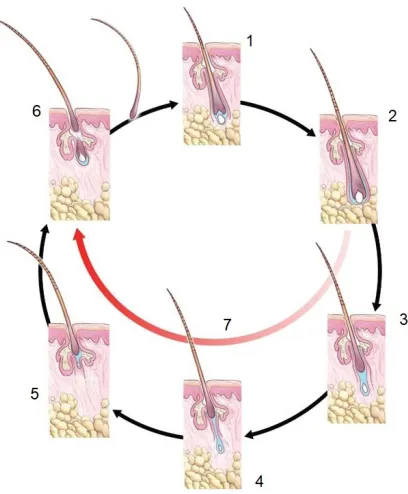
-quently 2-3 months telogen (resting phase) finishing with exogen – dead hair shedding (Figure 1) (Harrison and Bergfeld, 2009).
In the TE therapy plants remedies occupy the important
place (Patil et al., 2010; Kaushik et al., 2011). Plant biologically active substances (BAS) with vasodilation, capillary protective,
epithelial cells regenerating effects, microelements, amino acids,
vitamins and other nutrients for HF tissues saturation are widely used (Lourith and Kanlayavattanakul, 2013; Semwal et al., 2015).
From olden times in medicine and cosmetology stinging
nettle (Urtica dioica L.) was used for renovation and hair growth stimulation. Nettle leaves and stems contain a wide range of BAS: organic (formic, pantothenic) and hydroxy cinnamic (chlorogenic, сaffeic, ferulic) acid, flavonoids (routine, quercetin, campherol), chlorophyll, organically bound silicon, a complex of vitamins (K1, carotenoids, vitamins C, B1, B2, B6, etc.) and other BAS (amines, amino acids, macro and microelements). The listed BAS enhance
blood circulation in the skin capillary system, stimulate the
metab-olism and trophic processes, exhibit regenerative properties of HF cells, therefore the remedies with stinging nettle (infusions, tinc
-tures, lotions, masks, juices, etc.) are used for the TE prevention and treatment (Gülçin et al., 2004; Bhuwan et al., 2014; Mal Ait
Fig. 1: The hair cycle and telogen effluvium (Harrison and Bergfeld, 2009; med -ical illustrator: William Garriott). 1,2 – anagen phase (active hair growth, 2-8 years), 3,4 – catagen phase (involution, 4-6 weeks), 5 – telogen phase (resting, 2-3 months), 6 – exogen phase (release of dead hair), 7 – telogen effluvium (anagen termination, noticeable increase in hair shedding occurs 2 to 3 months after hair was affected).
The technological, rheological and microbiological
studies were carried out, which resulted in the development of the medical cosmetic gel with nettle juice intended for TE therapy (Fedorovska et al., 2015; Fedorovska and Polovko, 2016). Pur
-pose of the given research was to study the vasodilating effect and follicle-stimulating activity of the developed gel with nettle juice in rats under conditions of wool shedding induced by orally administered boric acid (Belenichev et al., 2008).
MATERIAL AND METHODS
Preparation of nettle juice
Nettle fresh upper parts of the stems with 5-6 leaves were collected at the end of May in Ivano-Frankivsk region (Ukraine). Technological process of nettle juice preparation included the fol
-lowing stages: grinding of fresh raw materials, pressing, re-grind
-ing and press-ing, inactivation of enzymes in raw juice with 20 min heating in a water bath at 40-60ºС, preservation with 96% ethanol in quantity of 15% by weight, sedimentation at 2-4ºC in a refrigerator for 10 days, filtration, packaging, labeling. Obtained juice was a dark brown transparent liquid with a specific smell; density ranging from 0.994 to 1.106 g/ml; pH from 6.5 to 7.0; dry residue at least 3.5%; identification (thin layer chromatography method) and quan
-titative determination (spectrophotometric method): hydroxyl cin
-namic acids at least 0.01%, carotenoids at least 0.002%, chlorophyll at least 0.003% (Fedorovska et al., 2015).
Preparation of gel with nettle juice
The remedy containing 15% per weight of the nettle juice in a gel base was prepared. Briefly, combine carbopol-so
-dium alginate gel base was prepared firstly. Potassium sorbate was used as a carbopol neutralizer as well as a gel preservative, glycerol was used as a sodium alginate solubilizer as well as a moisturizer, purified water was used as a solvent (Fedorovska and Polovko, 2016). After weighing, the nettle juice was added in the gel base by continuous mixing at room temperature.
Experimental animals
White non-linear rats of both sexes with weight range of 200-250 g were obtained from the vivarium of Ivano-Frankivsk State Medical University. All experimental protocols were approved by the Ethical Committee of the University (Minutes No. 69/13, dated 2013.12.03). Animals were kept under standard vivarium conditions, they received food and water ad libitum. Experimental design
All 28 rats were weighed and tagged; growth destruc
-tion of animal wool was induced with oral administra-tion of boric acid (5 mg/kg) during 14 days, then wool was completely shaved on the back section (3 × 7 cm). After that all rats were randomly divided into four groups of seven animals each as followed: 1st
group – intact animals; 2nd group – untreated; 3rd group – treated with a comparison drug (Alloton spray: complex tincture (1:5) from a mixture of Arctium lappa L. roots – 5.6 g, Sophora japon -ica L. fruit – 5.6 g, Acorus calamus L. rhizome – 3.2 g, Urt-ica
dioica L. leaves – 2.8 g; Humbus lupulus cones – 2.8 g); 4th group – treated with the prepared gel. The developed medical cosmetic remedy and the comparison drug were applied on the shaved back of the rats at the maximum technically spreading dose (app. 1.0 g of the developed gel; 3-4 pulverizations of Alloton spray) during next 14 days.
Analytical methods
According to the experiment, the wool length was daily monitored during 14 days. After that period, new wool was com
-pletely cut and weighed on scales. The percentage of dystrophic wool (presence of hairs with pointed tip) was observed and deter
-mined with help of a microscope “Delta Optical Genetic Pro” with built-in camera: lens 40/0.65 160/0.17; eyepiece WF 10×/18). Additionally, from each group one animal was randomly selected and subjected to euthanasia with compliance of the bioethics; skin biopsy was applied to the chosen animals. The vascular net in dif
-ferent layers of the skin, follicular density (number of follicles per unit area) and hair growth phase (anagen) were estimated.
The study of the vascular net was carried out by the injection method using an ether-chloroform mixture of Paris blue (10 g of substance per 100 ml of a solvent consisting of ether and chloroform in a ratio of 3:1). Fuchseline-picrofuchsine was used for histological examination of the vascular wall, the study of skin structures was carried out with the hematoxylin and eosin staining. The number of hair follicles was determined by mor
-phometric analysis. All histological experiments were performed
at the Human Anatomy Department of Ivano-Frankivsk State
Medical University according to standard techniques (Bagrij,
2016; Titford, 2009; Kiernan, 2015). The electronic microscopic
-graphs were made with the microscope “Delta Optical Genetic Pro”.
Statistical analysis
The data of external estimations (given in Tables 1-2) were analyzed as the mean ± SEM for seven animals in each group. The data of histological studies (vascular lumen diameter,
the number of hair follicles per 1 mm2) were studied as the mean ± SEM for ten skin samples of each selected animal. Statistical analyses were performed using one-way analysis of variance (ANOVA). Differences were considered to be statistically signif
-icant when P was < 0.05. All statistical analyses were performed with MS Excel.
RESULTS AND DISCUSSION
The results of the developed gel influence on the growth stimulating activity of the rats’ wool are presented in Tables 1-2.
According with the data in Table 1, the developed gel stimulated the recovery of damaged HF growth and slightly exceeded “Alloton” in terms of regenerative action. Thus, wool began to grow on the 3rd day of the experiment in the 1st, 3rd and
4th groups, but in the 2nd group (untreated animals) – on the 4th day. Intensive wool growth in the intact (1st group) and the treated (3rd and 4th group) animals was observed on the 5-8th days of the
research. On the 14th day of the experiment, the difference in the wool length in the experimental 4th group was exceeded 3 mm in comparison with the untreated 2nd group.
On the 15th day of the experiment (Table 2) the wool weight from the shaved area of 4th group (experimental animals) was ≈ 480 mg, which significantly exceeded the wool weight of the
non-treated 2nd group (≈371 mg). The wool weight of the healthy animals in the 1st group was slightly higher (≈500 mg), and in the
3rd group (rats treated with “Alloton”) at approximately the same level (≈472). The experimental 4th group also showed a decrease in the percentage of dystrophic wool compared to the untreated
animals. So the amount of dystrophic wool in the healthy animals was ≈ 10%, in the experimental 4th group – ≈ 17%, and in the untreated animals – ≈38% (Table 2).
Table 1: The influence of the developed gel with nettle juice on the experimental animal wool growth (mm).
Day Intact rats (1st group)
Untreated rats (2nd group)
Rats treated with “Alloton”
(3rd group)
Rats treated with developed gel
4th group)
2 - - -
-3 1.0 ± 0.07 - 1.0 ± 0.06 1.0 ± 0.05
4 2.0 ± 0.07 1.0 ± 0.07 1.8 ± 0.06 2.0 ± 0.04
5 3.1 ± 0.07 1.9 ± 0.01 2.7 ± 0.06 3.1 ± 0.04
8 6.6 ± 0.06 3.7 ± 0.10 6.4 ± 0.01 6.7 ± 0.06
10 7.7 ± 0.07 5.3 ± 0.07 7.2 ± 0.06 7.8 ± 0.04
14 9.8 ± 0.05 6.5 ± 0.05 8.9 ± 0.05 9.7 ± 0.06
* – (р ˂ 0.05) in relation to the 2nd group (untreated rats).
Table 2: Influence of the developed gel on the quality and structure of the rat wool.
Characteristic Intact rats(1st group)
Untreated rats (2nd group)
Rats treated with “Alloton”
(3rd group)
Rats treated with developed gel
(4th group)
Wool weight
from shaved
area, mg 499.2 ± 6.8 370.5 ± 9.8 472.0 ± 8.7 480.3 ± 9.3*
% of the dystro
-phic wool 10.32 ± 0.38 37.72 ± 2.15 19.51 ± 1.05 16.87 ± 0.90*
* – (р ˂ 0.05) in relation to the 2nd group (untreated rats).
The performed studies confirmed that the external appli
-cation of the developed gel caused the significant changes in both
histological and ultrastructural organization of subcapillary and
dermal arterial nets. However, changes in the dermal arterial net
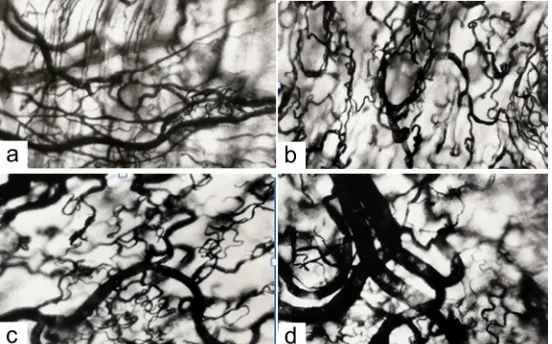
-work were more distinct and accompanied by enlargement of the capillary lumen and by the vascular wall thickening (Figure 2).
Fig. 2: Dermal arterial net of white rats’ skin samples: a – 1st group; b – 2nd group; c – 3rd group; d – 4th group. Vessels injection with Paris blue; an increase in 400.
The widest vascular lumen (diameter = 76.45 ± 0.42 μm) was in the skin samples of the 4th group after developed gel application (Figure 2 d). The vessels in the skin samples of 1st
Near the dermal vessels of the 4th experimental group the number of mast cells significantly increased, which were in a state of strong degranulation (Figure 3). Particularly strongly degran
-ulated mast cells were seen in the reticular layer of the dermis. On the ultrastructure level it was observed a significant decrease of the mast cells size and granules that went beyond their edges (Figure 3 b). High degranulation of mast cells and their functional activity is a factor of changes in blood vessels, which indicate the intensification of blood circulation in the skin.
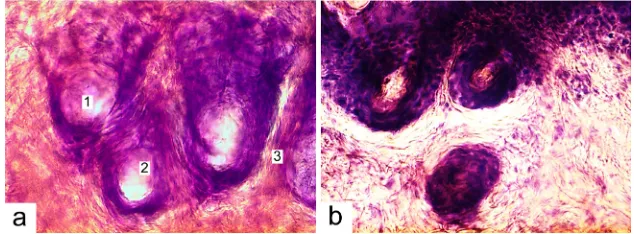
When applying the gel with nettle juice, a significant increase in the number of new hair follicles was noted (Figure 4).
The number of follicles in the stage of anagen in skin
samples of 4th group was 93% (compared with: 1st group – 87%;
2nd group – 74%; 3rd group – 88%). Also, the intensification of the HF epithelial cells proliferative activity was observed (Figure 5).
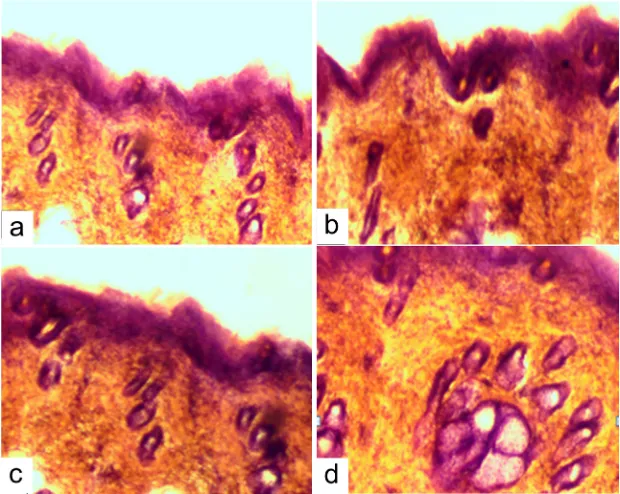
HF density per unit area (1 mm2) in the skin samples was determined with the morphometric analysis. The HF number in
the 1st group was 36.34 ± 0.14, in the 2nd group – 21.98 ± 0.23, in
the 3rd group – 34.56 ± 0.21, in the 4th group – 37.23 ± 0.19. As can
be seen from the study results, the application of the developed
gel in the experimental animals strongly stimulated HF genesis
compared to the untreated rats. The samples of rats’ skin tissues from each group are represented in Figure 6 for visual comparison
of the HF quantity.
Fig. 3: Ultrastructure of the rats’ skin mastocytes in the dermal papillary layer (1, 2 – granules of different maturity degrees): a – 1st group; b – 4th group. Electronic microscopic photographs; an increase in 10000.
Fig. 4: A significant amount of hair follicles in the skin of the white rat after the application of gel with nettle juice: 1 – epidermis, 2 – dermis, 3 – hair follicles. Coloring with hematoxylin and eosin; microscopic photograph; an increase in 100.
Fig. 6: Hair follicles in the skin of white rats: a – 1st group; b – 2nd group; c – 3rd group; d – 4th group. Coloring with hematoxylin and eosin; microscopic photographs; an increase in 200.
CONCLUSION
Thus, conducted pharmacological and histological
stud-ies indicated that the developed gel with nettle juice in comparison with the untreated animals accelerated the wool growth renovation in rats, improved its quality by increasing the weight and reducing
the percentage of dystrophic hairs.
It was proved that cutaneous application of the gel had biological effect that significantly dilated the vessels in the retic
-ular layer of the dermis. The intensification of HF blood supply was confirmed by an increase in the number of mast cells and their
active degranulation. Strengthening of blood circulation caused
the increase of the epithelial cells growth and HF number in the active phase (anagen).
REFERENCES
Shrivastava SB. Diffuse hair loss in an adult female: Ap-proach to diagnosis and management. Indian Journal of Dermatol. Ve-nereol. Leprol, 2009; 1: 20-28.
Harrison S, Bergfeld W. Diffuse hair loss: its triggers and management. Cleveland Clinic Journal of Medicine, 2009; 76 (6): 361-367.
Patil SM, Sapkale GN, Surwase US, Bhomble BT. Herbal medicines as an effective therapy in hair loss – a review. Research Journal of Pharmaceutical, Biological and Chemical Sciences, 2010; 1: 773-781.
Kaushik R, Gupta D, Yadav R. Alopecia: herbal remedies. Intern. Journal of Pharmaceutical Science and Research, 2011; 2(7): 1631-1637.
Lourith N, Kanlayavattanakul M. Hair loss and herbs for treatment. Journal of Cosmetic Dermatology, 2013; 12: 210-222.
Semwal D, Kotiyal R, Chauhan A et al. Alopecia and the herbal drugs: an overview of the current status. Advances in Biomedi -cine and Pharmacy, 2015; 2 (6): 246-254.
Gülçin I, Küfrevio ÖI, Oktay M, Büyükokuro ME. Antioxi -dant, antimicrobial, antiulcer and analgesic activities of nettle (Urtica dioica L.). Journal of Ethnopharmacology, 2004; 90: 205–215.
Bhuwan CJ, Minky M, Ajudhia NK. Pharmacognostical review of Urtica dioica L. International Journal of Green Pharmacy, 2014; October-December: 201-209.
Mal Ait Haj Said, Ibrahim Sbai el Otmani, Sanae Derfoufi, Adnane Benmoussa. Highlights on nutritional and therapeutic value of stinging nettle (Urtica dioica). International Journal of Pharmacy and Pharmaceutical Sciences, 2015; 7 (10): 8-14.
Fedorovska M, Polovko N, Kovpak L. Technological re-search and standardization of nettle juice in the process of the herbal remedy development for hair loss treatment. Clinical Pharmacy, Phar-macotherapy and Medical Standardization, 2015; 3-4: 114-119.
Fedorovska M, Polovko N. Development of the composition of the gel base for treating telogen effluvium. News of Pharmacy, 2016; 4 (88): 38-42.
Belenichev IF, Gladyshev VV, Abramov AV, Burlaka BS, Pavlov SV, Gorbachova SV. The study of groth stimulative and follicle protection actions of parapharmaceutical gel with bishofit. Zaporozhs -kiy Meditsins-kiy Zhurnal, 2008; 3: 105-108.
Bagrij MM. Methods of morphological research. Nova kny -ga, 2016; 295.
Titford M. Progress in the development of microscopical techniques for diagnostic pathology. The Journal of Histotechnology, 2009; 32 (1): 9-19.
Kiernan JA. Histological and Histochemical Methods: Theo-ry and Practice. 5th edition. Scion Publishing, 2015; 571.
How to cite this article:
Ivanivna FM, Petrivna PN, Mykolaivna FS, Vasylivna AO.