C O M M E N T A R Y
Open Access
Suitable test substances for proof of concept
regarding infochemical effects in surface waters
Monika Nendza
1, Ursula Klaschka
2*and Rüdiger Berghahn
3Abstract
Background:Infochemical effects have been defined as the manipulation of the odour perception of organisms by anthropogenic substances which may result in ecologically relevant behavioural disorder. However, the
environmental relevance of infochemical effects has not yet been confirmed by experimental observations. This project aims to test for infochemical effects on chemical communication in water bodies with systematic experimental investigations. The first crucial step is to select suitable test substances. Repellents (PT 19 biocides) and odourants may be assumed to affect the response of aquatic populations and communities. These mostly polar and stable compounds may disturb chemical communication between organisms and may cause organismic effects like drift (downstream dislocation of e.g. crustacean and insect larvae in streams). Repellents enter surface waters mainly indirectly via wastewater discharges from sewage treatment plants or directly by being washed off from the skin and clothes of bathers.
Results:In this literature study, suitable chemicals were selected for confirmatory assessments of suspected infochemical effects by laboratory tests in a subsequent second part of the project. The use pattern and physico-chemical properties of the substances selected, in combination with their limited biological degradability, indicate potential aquatic relevance with possible chronic impact caused by disturbed communication. After due
consideration of advantages and limitations, three PT 19 repellents appear suitable test compounds for proof of concept in the subsequent experimental part of the project:
DEET (CAS 134-62-3)
Icaridine (CAS 119515-38-7)
EBAAP (CAS 52304-36-6)
Another promising candidate for infochemical effects is isophorone (CAS 78-59-1), a natural attractant and an anthropogenic high production volume solvent.
Conclusions:Four chemicals were selected with the expectation that they may be suitable test substances for experimental proof of concept of infochemical effects in the subsequent part of the project. The experimental results may then help to answer the question of whether PT 19 biocides and other odourants entering aquatic ecosystems give rise for concern about potential infochemical effects.
Keywords:Biocides; Chemical communication; Drift; Infochemicals; Non-target organisms; Odourants; Repellents; Surface water
* Correspondence:[email protected] 2
University of Applied Sciences Ulm, Prittwitzstraße 10, Ulm D-89075, Germany
Full list of author information is available at the end of the article
Background
The infochemical effect: misled by pollutants?
Most organisms live in an odourous environment and perceive their biotic and abiotic environment via specific and dynamic blends of odourants called infochemicals [1-6]. They are defined as ‘a chemical that carries infor-mation that mediates an interaction among two individ-uals and results in an adaptive response in the receiver. Either the sender or the receiver, or both, benefit from the infochemical’ [1]. Infochemicals play an important role in life history (e.g. such as mate choice, voltinism, generation time, clutch size), habitat finding, food recog-nition and survival (e.g. response to predation threats). Infochemicals are major means of communication in aquatic ecosystems because other senses, e.g. vision and mechanical senses, may become less efficient in nature under turbid and turbulent conditions [1-7]. Clouds of odours from various sources can overlap and lead to different perceptions. A comprehensive compilation of current knowledge about infochemicals in aquatic eco-systems was published by Brönmark and Hansson in 2012 [7]. However, as has been demonstrated for various invertebrates and fish, this sensitive system for commu-nication and detection may be disturbed by discharges of pollutants such as fragrances, metals or pesticides [8]. This disturbance is referred to as the infochemical effect [8] or infodisruption [9,10]. The consideration of infoche-mical effects of anthropogenic substances means transfe-rring knowledge gained in chemical ecology to the field of ecotoxicology.
The current testing strategies for ecotoxicological end-points do not consider effects on chemical communica-tion at the populacommunica-tion and biocoenosis level. Effective concentrations of anthropogenic infochemicals are in the range of micrograms per litre [11]. Infochemicals are mostly released in dynamic gradients at sites where the local concentrations of microenvironments are relevant for the receiver of a chemical cue [11,12].
Ecological relevance of infochemical effects
Since chemical communication is very important for aquatic organisms, it is likely that the disturbance of this sensitive system may have effects on populations and ecosystems. However, experimental evidence of infoche-mical effects of anthropogenic substances in surface wa-ters is weak as yet. Testing for infochemical effects in the laboratory is a challenge for two reasons: (1) suitable test chemicals which are true positives need to be antici-pated and (2) test systems must be adapted to discrimin-ate infochemical effects from other subacute toxicities like avoidance reactions. A systematic analysis will help to answer the question whether and to what extent an-thropogenic chemicals may interfere with chemical com-munication in natural ecosystems [13].
Testing strategy
The number of potential anthropogenic infochemicals is large, as is the number of test designs [7,13,14]. Since experimental testing is time-consuming and costly, we took great care beforehand to select promising test sub-stances with potential infochemical effect. We started with repellents (biocides product type (PT) 19) for which smell is the primary mode of action. Furthermore, we fo-cussed on odourants used in e.g. cosmetics and indus-trial chemicals. In the second part of this project, the selected candidate substances will be subjected to alrea-dy established behavioural assays addressing possible infochemical effects, namely, vertical migration of daph-nids, aggregation of aquatic pulmonates and organismic drift in artificial streams [14-18].
Selection of test substances
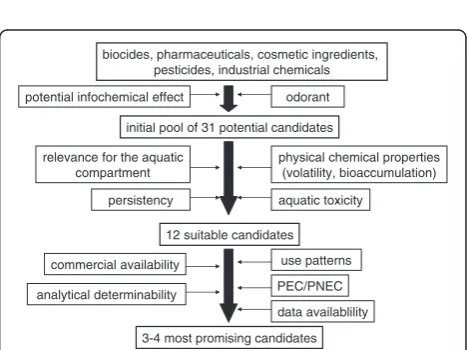
The search for potent infochemicals started with the large number of chemicals that can possibly interfere with odour perception in water [7,8,13]. We used a step-wise approach to identify suitable test compounds among olfactory receptor-binding substances (Figure 1). Realistic infochemical potential can be assumed for three groups of substances:
1. Repellents and attractants belonging to product group 19 (PT 19) according to the Biocides Regulation (1451/2007) [19]. These substances are used to keep away or attract target organisms, e.g. invertebrates such as midges or fleas or vertebrates such as birds or boars. The common mode of action is the smelling of the active ingredients. Repellents and attractants are usually non-toxic to the target organisms. They can be natural compounds, e.g. essential oils, or synthetic compounds, such as N,N-diethyl-3-methylbenzamide (DEET), icaridine
relevance for the aquatic compartment
initial pool of 31 potential candidates
12 suitable candidates
data availablility
physical chemical properties (volatility, bioaccumulation)
aquatic toxicity
commercial availability
3-4 most promising candidates persistency
use patterns
analytical determinability PEC/PNEC biocides, pharmaceuticals, cosmetic ingredients,
pesticides, industrial chemicals
potential infochemical effect odorant
Figure 1Stepwise approach to identify suitable test substances for proof of concept regarding infochemical effects in
or ethyl-N-acetyl-N-butyl-ß-alaninate (EBAAP). It is likely that repellents and attractants can influence also the behaviour and communication of non-target organisms. In the risk assessment of repellents, specific effects on non-target organisms in surface waters are not yet considered. We hypothesize that (1) repellents are potential candidates of
anthropogenic infochemicals since their mode of action aims at misleading the chemical
communication of the target organisms. Thus, (2) repellents may be involved in unwanted effects such as organismic drift of non-target species. Major effects on downstream drift [18] are especially relevant for animals that pupate or hatch only once per year or even after multiannual larval stages (e.g. dragonflies or some caddy fly species). Catastrophic downstream drift may strongly affect the size and the recovery potential of populations [20,21]. Based on current knowledge, it is impossible to say whether and to what extent organismic drift may be induced by infochemical effects of PT 19 biocides at relevant field concentrations. The following questions summarize the issue: may repellents disturb communication between aquatic non-target organisms? May this affect the structure (e.g. biodiversity) and function (e.g. predator–prey interactions) of ecosystems?
2. Natural infochemicals are substances that, for example, signal sites for egg deposition or food availability, alarm substances and pheromones. The chemical cues are usually blends of compounds released by organisms. Only few natural
infochemicals have been chemically identified, and clear concentration-effect relationships for individual substances are rarely described. Natural
infochemicals can be positive controls of test setup, procedures and results. Furthermore, structural similarities between natural infochemicals and anthropogenic substances may support the identification of suitable test substances.
3. Potential anthropogenic infochemicals may also be found among cosmetic ingredients, pesticides, pharmaceuticals and industrial chemicals that affect the olfactory reaction cascade. Fragrances used in scented products are further candidates for the infochemical effect; some of them are even chemically identical with natural infochemicals [8,22]. Anthropogenic infochemicals may disturb chemical communication by imitating or modulating natural cues.
We conducted a literature study in order to find out, based on available information on quantities used, fate and effects, which substances out of these three groups
might be relevant candidates for the testing of infoche-mical effects in the aquatic environment.
Methods
The literature and database searches for the identifica-tion of candidate substances drew on publicly available literature, software and databases. The list of repellents and attractants belonging to product group 19 (PT 19) was taken from the Biocides Regulation (1451/2007) [19] and its implementing rules in Commission Regulations 1048 (2005) and 1849 (2006). Lists of natural and an-thropogenic substances were taken from the literature [5,10,22,23]. Assessments of exposure to the substances and their relevance for the water compartment were performed using monitoring data (concentrations and loads in surface water), considering different entry paths (e.g. direct and indirect discharge via water and air, run-off, drainage, wastewater treatment plants, rainwater re-tention, bathers) and the distribution of the substances in the environment (percentage in water, sediment, soil, air [24]).
Inherent properties of the substances relevant to expo-sure (water solubility, log Kow, Henry constant, persist-ency) as well as indications of aquatic toxicities (EC/LCx, predicted no-effect concentration(PNEC) values, classifica-tion and labelling, e.g. as R50/53) were compiled from multiple sources [24-33]. Monitoring data were taken from [25,27,28,30,34-44]. In cases where experimental in-formation was insufficient, estimations were made using EpiSuite 4.1 [24].
The aquatic exposure assessments made here should ex-clusively be used for the prioritization of candidate sub-stances and are not intended for regular risk assessments.
The complete data sets are open to the public in
the UBA report FKZ 3712 67 417.1 ‘Relevance of
ef-fects of repellents (product type 19) and other info-chemicals for non-target organisms in surface waters, part I: literature study’ (in German: Wirkungsrelevanz von Repellentien (Produktart 19) und anderen Infoche-mikalien für Nichtzielorganismen in Oberflächengewässern, Teil I: Literaturstudie).
Discussion
In the first selection step (Figure 1), we started with several pragmatic criteria to focus on possible test substances:
Repellents were preferred over substances with other modes of action.
subject to classification and labelling (R50-R53, H400-H412) or showing other indications of environmental toxicity were excluded.
Substances used as repellents against insects were preferred to substances used as repellents against vertebrates, as the non-target organisms in the aquatic environment are mainly invertebrates.
Single substances were preferred to mixtures of natural substances for two reasons. In the case of natural substances, monitoring data may be obscured by background concentrations, and experimental tests with single substances are more likely to produce clear concentration-response curves.
Substances discharged into surface waters via wastewater or bathers by being washed off from human skin or clothes were preferred to substances emitted to air or soil, since the focus of this study was on aquatic non-target organisms.
This first selection step was very efficient and yielded 31 compounds, which are listed with their CAS numbers below:
PT 19 biocides: icaridine (119515-38-7), EBAAP (52304-36-6), DEET (134-62-3), citriodiol (42822-86-6), lauric acid (143-07-7), linalool (78-70-6), lavender (91722-69-9), pelargonic acid (112-05-0), methyl-n-nonylketone (112-12-9), methyl
anthranilate (134-20-3), garlic extract (8008-99-9), geraniol (106-24-1), naphthalene (91-20-3), margosa extract (84696-25-3), pyrethrins and pyrethroids (8003-34-7), n-decanoic acid (334-48-5), carbon dioxide (124-38-9), 1-octen-3-ol (3391-86-4), cis-9-tricosene (27519-02-4), trimethyloctanamide (105726-67-8), 9,12-tetradecadienyl acetate (30507-70-1), piperonyl butoxide (51-03-6).
Natural infochemicals: microcystin LR
(101043-37-2), hypoxanthine-3-N-oxide (19765-65-2), isophorone (78-59-1).
Anthropogenic infochemicals: metalochlor (51218-45-2), copper compounds (various speciations), carbaryl (63-25-2), D-limonene (5989-27-5), benzaldehyde (100-52-7), tridecanone (593-08-8).
The criteria applied in the second selection step (Figure 1) focussed on physico-chemical properties of the selected substances and preliminary screening for expos-ure indicating relevant concentrations in aquatic compart-ments. The intention was to identify a small subset of substances with possible relevance for surface waters:
Substances used in consumer products or detected in surface waters.
Substances not likely to be phased out in the near future.
Substances with substantial water solubility (>1 mg/L).
Substances for which exposure modelling indicates that at least 20% of the amount discharged into the environment ends up in the water compartment.
Substances of low volatility from the water compartment (small Henry constant).
Substances of medium lipophilicity (logKow <4), indicating minor to medium bioaccumulation potential and favourable properties for the conduct of laboratory tests (i.e. low adsorption to test vessels and appliances).
Substances with sufficient stability to ensure uniform concentrations during laboratory tests.
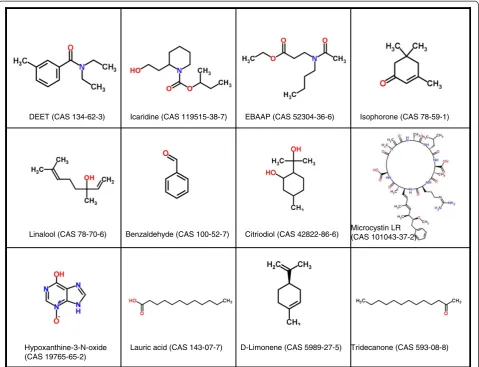
Twelve substances (Figure 2) mostly complied with the criteria in this second prioritization step.
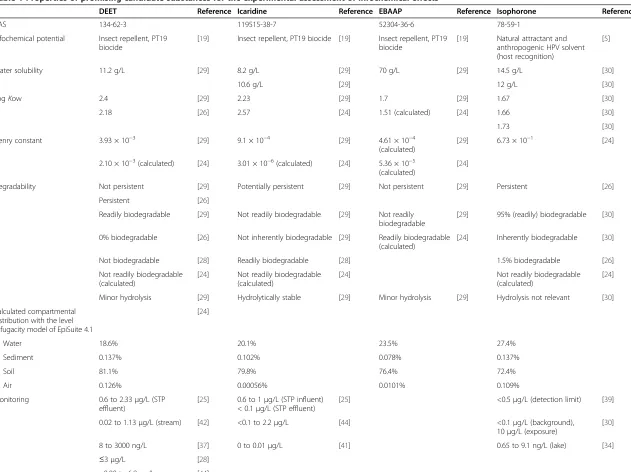
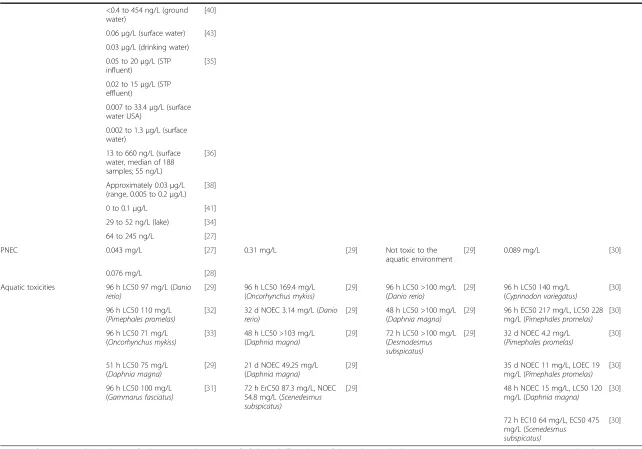
In the third selection step, we identified the most promising test substances (Table 1) after a ranking of the 12 candidate substances with regard to:
Infochemical potential.
Relevance to aquatic compartments.
Minor direct toxicities at low doses.
Physico-chemical suitability for testing.
Available data for the 12 compounds were used to evaluate their persistence and relevance for aquatic eco-systems, their bioavailability and aquatic toxicities, as well as their technical amenability to laboratory testing including analytical methods, commercial availability of testing material and analytical standards. These consi-derations are discussed here in more detail (see Table 1 for the relevant data):
adaptation of the sludge organisms. Icaridine is cha-racterized as a readily degradable substance and was detected in influents but not in effluents of sewage treat-ment plants [25].
According to the Canadian Categorization Results [26], water is an important environmental compartment for all 12 substances selected in step 2 (Figure 2). Ex-ceptions are D-limonene and tridecanone. Calculations using the level III fugacity model of EpiSuite 4.1 [24] in-dicated that the candidate substances partition into the water phase at rates of about 20% or more (Table 1). The only remarkable exception is the water-soluble nat-ural algal toxin microcystin LR.
Monitoring data are available only for some of the candidate substances. For most of these, measured con-centrations in water bodies indicate a low risk compared with published PNEC values. For DEET, measured con-centrations in North American surface waters are in the same range as the standard PNEC values of 0.043 [27] or 0.076 mg/L [28] and indicate a potential risk for US
waters. Concentrations detected in Europe are about one order of magnitude lower (Table 1). Since 1998, the readily degradable icaridine (Bayrepel®) has been used as substitute for DEET and, as expected, its monitoring values with negligible concentrations in STP effluents re-flect the ready degradability in sewage treatment plants [25]. No monitoring data for German or European sur-face waters could be found for EBAAP (IR3535®), an agent in modern consumer products. It is worthwhile to mention that some monitoring data on PT19 biocides and other contaminants were said to be biased due to contamination of samples by insect repellents applied by field workers during sampling campaigns [46]. The de-tection of DEET in field blanks as well as the contamin-ation of reagents with isophorone prompted the authors [46] to exclude the respective values.
The assessment of the stability of the candidate sub-stances was not straightforward. The available infor-mation on the biological degradability of the candidate substances (Table 1) is heterogeneous and sometimes
Tridecanone (CAS 593-08-8) Benzaldehyde (CAS 100-52-7)
DEET (CAS 134-62-3)
Linalool (CAS 78-70-6)
Isophorone (CAS 78-59-1) EBAAP (CAS 52304-36-6)
Icaridine (CAS 119515-38-7)
D-Limonene (CAS 5989-27-5) Lauric acid (CAS 143-07-7)
Hypoxanthine-3-N-oxide (CAS 19765-65-2)
Microcystin LR (CAS 101043-37-2) Citriodiol (CAS 42822-86-6)
Infochemical potential Insect repellent, PT19 biocide
[19] Insect repellent, PT19 biocide [19] Insect repellent, PT19 biocide
[19] Natural attractant and anthropogenic HPV solvent (host recognition)
[5]
Water solubility 11.2 g/L [29] 8.2 g/L [29] 70 g/L [29] 14.5 g/L [30]
10.6 g/L [29] 12 g/L [30]
LogKow 2.4 [29] 2.23 [29] 1.7 [29] 1.67 [30]
2.18 [26] 2.57 [24] 1.51 (calculated) [24] 1.66 [30]
1.73 [30]
Henry constant 3.93 × 10⁻³ [29] 9.1 × 10⁻⁴ [29] 4.61 × 10⁻⁴
(calculated)
[29] 6.73 × 10⁻¹ [24]
2.10 × 10⁻³(calculated) [24] 3.01 × 10⁻⁶(calculated) [24] 5.36 × 10⁻⁵ (calculated)
[24]
Degradability Not persistent [29] Potentially persistent [29] Not persistent [29] Persistent [26]
Persistent [26]
Readily biodegradable [29] Not readily biodegradable [29] Not readily biodegradable
[29] 95% (readily) biodegradable [30]
0% biodegradable [26] Not inherently biodegradable [29] Readily biodegradable (calculated)
[24] Inherently biodegradable [30]
Not biodegradable [28] Readily biodegradable [28] 1.5% biodegradable [26]
Not readily biodegradable (calculated)
[24] Not readily biodegradable (calculated)
[24] Not readily biodegradable
(calculated)
[24]
Minor hydrolysis [29] Hydrolytically stable [29] Minor hydrolysis [29] Hydrolysis not relevant [30]
Calculated compartmental distribution with the level III fugacity model of EpiSuite 4.1
[24]
Water 18.6% 20.1% 23.5% 27.4%
Sediment 0.137% 0.102% 0.078% 0.137%
Soil 81.1% 79.8% 76.4% 72.4%
Air 0.126% 0.00056% 0.0101% 0.109%
Monitoring 0.6 to 2.33μg/L (STP effluent)
[25] 0.6 to 1μg/L (STP influent) < 0.1μg/L (STP effluent)
[25] <0.5μg/L (detection limit) [39]
0.02 to 1.13μg/L (stream) [42] <0.1 to 2.2μg/L [44] <0.1μg/L (background),
10μg/L (exposure)
[30]
8 to 3000 ng/L [37] 0 to 0.01μg/L [41] 0.65 to 9.1 ng/L (lake) [34]
≤3μg/L [28]
<0.08 to 6.9μg/L [44]
Environme
ntal
Sciences
Europe
2013,
25
:21
Page
6
o
f
1
0
e.com/conten
0.06μg/L (surface water) [43]
0.03μg/L (drinking water)
0.05 to 20μg/L (STP influent)
[35]
0.02 to 15μg/L (STP effluent)
0.007 to 33.4μg/L (surface water USA)
0.002 to 1.3μg/L (surface water)
13 to 660 ng/L (surface water, median of 188 samples; 55 ng/L)
[36]
Approximately 0.03μg/L (range, 0.005 to 0.2μg/L)
[38]
0 to 0.1μg/L [41]
29 to 52 ng/L (lake) [34]
64 to 245 ng/L [27]
PNEC 0.043 mg/L [27] 0.31 mg/L [29] Not toxic to the
aquatic environment
[29] 0.089 mg/L [30]
0.076 mg/L [28]
Aquatic toxicities 96 h LC50 97 mg/L (Danio rerio)
[29] 96 h LC50 169.4 mg/L (Oncorhynchus mykiss)
[29] 96 h LC50 >100 mg/L (Danio rerio)
[29] 96 h LC50 140 mg/L (Cyprinodon variegatus)
[30]
96 h LC50 110 mg/L (Pimephales promelas)
[32] 32 d NOEC 3.14 mg/L (Danio rerio)
[29] 48 h LC50 >100 mg/L (Daphnia magna)
[29] 96 h EC50 217 mg/L, LC50 228 mg/L (Pimephales promelas)
[30]
96 h LC50 71 mg/L (Oncorhynchus mykiss)
[33] 48 h LC50 >103 mg/L (Daphnia magna)
[29] 72 h LC50 >100 mg/L (Desmodesmus subspicatus)
[29] 32 d NOEC 4.2 mg/L (Pimephales promelas)
[30]
51 h LC50 75 mg/L (Daphnia magna)
[29] 21 d NOEC 49.25 mg/L (Daphnia magna)
[29] 35 d NOEC 11 mg/L, LOEC 19
mg/L (Pimephales promelas) [30]
96 h LC50 100 mg/L (Gammarus fasciatus)
[31] 72 h ErC50 87.3 mg/L, NOEC 54.8 mg/L (Scenedesmus subspicatus)
[29] 48 h NOEC 15 mg/L, LC50 120
mg/L (Daphnia magna)
[30]
72 h EC10 64 mg/L, EC50 475 mg/L (Scenedesmus subspicatus)
[30]
Properties of promising candidate substances for the experimental assessment of infochemical effects due to infochemical potential, relevance to aquatic compartments, minor direct toxicities at low doses and physico-chemical liability for testing. The data are experimentally determined unless explicitly marked (calculated) [24].
al.
Environme
ntal
Sciences
Europe
2013,
25
:21
Page
7
o
f
1
0
e.com/conten
even contradictory. Evidence indicates that DEET [28,29] and isophorone [26,30] are likely more persistent than icaridine [28,29] and EBAAP [29]. Pseudo-persistence may be relevant for some of the candidates which are dis-charged continuously into surface waters. All candidate substances, but benzaldehyde, do not hydrolyze or hy-drolyze slowly and are therefore sufficiently stable in la-boratory tests.
Experimental data on aquatic toxicity was found for all candidate substances, with the exception of citriodiol. Missing data for hypoxanthine-3-N-oxide, microcystin LR and tridecanone were supplemented by calculated values [24]. The toxicity values reported are usually results from conventional tests. The only quantitative result for an infochemical effect was found for hypoxanthine-3-N-oxide with short-term exposure (7 min) leading to a concentration-dependent alarm reaction in zebra fish [47]. As expected, erratic movements and jumps occurred at low concentrations (LOEC 0.23 mg/L [47]) while conven-tional endpoints are likely affected at much higher levels (LC50 >100 mg/L [24]). However, measured LC50 data for hypoxanthine-3-N-oxide could not be retrieved, and the comparison of estimated effect levels is subject to major uncertainties. Data on long-term effects could only be found for icaridine, isophorone and lauric acid. The derived PNEC values are <0.1 mg/L for DEET and iso-phorone and 0.3 mg/L for icaridine [27-30]. No conven-tional toxic effects on aquatic environments are expected for EBAAP [29].
One of the aspects to consider when suggesting suit-able chemicals for experimental investigations is that testing material is available in sufficient amounts with high purity at reasonable prices. Preferably, reliable analytical methods should be in place, and quantita-tive standards should be commercially available. These preconditions are generally fulfilled for the candidate substances.
Comparative assessment of the available data revealed that there is no ideal substance with the potential to act as the one and only reference compound to test for pos-sible anthropogenic infochemical effects on chemical communication in aquatic systems (Table 1). The three repellents DEET (134-62-3), icaridine (119515-38-7) and EBAAP (52304-36-6) complied best with the require-ments. Isophorone, a natural attractant and at the same time an industrial chemical produced at more than 1,000 tonnes/year in Europe, may be an interesting fourth candidate. Isophorone is also used as solvent, just as was DEET. However, isophorone acts as attractant not as repellent [5], which would affect the experimental test design including the potential to act as positive control.
The data compiled in Table 1 for the four candidate substances show that they meet most of our criteria well,
with the exception of the degradability criterion where the heterogeneity of the data did not allow us to come to a consistent conclusion. The four selected candidate chemicals all have substantial infochemical potential due to the fact that smell is the active principle of their re-pellent or attractant effects. They have minor-to-moderate direct toxicities at low doses, and their physico-chemical properties indicate good handling under laboratory testing conditions. Furthermore, they are relevant to the environ-ment since they occur in surface waters in considerable amounts. It is recognized though that modern repellents are readily degradable in sewage treatment plants. To make it very clear, it was not our intention to assess these chemicals per se. Instead, the data were only used for the ranking of substances to find promising candi-dates to detect infochemical effects under controlled laboratory settings.
Conclusions
We have identified potential test compounds with a high probability that their infochemical effects can be mea-sured in suitable test systems. The selected four sub-stances are odourants and act as attractants or repellents for target organisms, are moderately or non-toxic, are suitable for laboratory testing, and are relevant for the aquatic environment. The candidate chemicals are re-commended for use in the subsequent part of the pro-ject, in which infochemical effects will be measured in established behavioural assays with invertebrates. Based on available data, we regard these substances as useful keys to open the first door to an under-standing of infochemical effects from an ecotoxico-logical perspective.
The project consisting of the literature study presented here and the follow-up experimental work intends to contribute to the transfer of findings gained in chemical ecology to the practical assessment of infochemical ef-fects in the field of ecotoxicology. This will be the first step to find out whether and to what extent anthropo-genic substances might be responsible for infochemical effects on aquatic organisms. It also lays the groundwork for a strategy to identify potential infochemicals and to quantify their effects. This ambition can be regarded as comparable with the development of test and assess-ment strategies for endocrine disruptors when these effects were discovered two decades ago. The results obtained here with mostly biocides may also be useful for the analysis of the infochemical effect in other regulatory areas, such as pesticides, industrial chemi-cals and pharmaceutichemi-cals.
Competing interests
Authors’contributions
All authors (MN, UK and RB) drafted the manuscript together. MN did the data research. All authors read and approved the final manuscript.
Acknowledgements
This study was financed by the German Federal Environment Agency (FKZ 3712 67 417.1). The authors thank Gabriele Coan for improving the English language of the manuscript.
Author details
1Analytisches Laboratorium, Bahnhofstraße 1, Luhnstedt D-24816, Germany. 2University of Applied Sciences Ulm, Prittwitzstraße 10, Ulm D-89075,
Germany.3Umweltbundesamt, Versuchsfeld Marienfelde, Schichauweg 58, Berlin D-12307, Germany.
Received: 30 April 2013 Accepted: 1 August 2013 Published: 8 August 2013
References
1. Brönmark C, Hansson LA:Chemical communication in aquatic systems: an introduction.Oikos2000,88:103–109.
2. Burks RI, Lodge DM:Cued in: advances and opportunities in freshwater chemical ecology.J Chem Ecol2002,28:1901–1917.
3. Chivers DP, Mirza RS:Predator diet cues and the assessment of predation risk by aquatic vertebrates: a review and prospectus.InChemical Signals in Vertebrates 9.Edited by Marchlewska-Koj A, Lepri JJ, Müller-Schwarze D. New York: Plenum Press; 2001:277–284.
4. Ferrari MCO, Wisenden BD, Chivers DP:Chemical ecology of predator–prey interactions in aquatic ecosystems: a review and prospectus.Canad J Zoology2010,88:698–724.
5. von Elert E:Information conveyed by chemical cues.InChemical Ecology in Aquatic Systems.Edited by Brönmark C, Hansson LA. New York: Oxford University Press; 2012:19–38.
6. Dicke M, Sabelis MW:Infochemical terminology: based on cost-benefit analysis rather than origin of compounds?Funct Ecol1988,2:131–139. 7. Brönmark C, Hansson LA:Chemical ecology in aquatic systems.New York:
Oxford University Press; 2012.
8. Klaschka U:The infochemical effect: a new chapter in ecotoxicology. Environ Sci Pollut Res2008,15:448–458.
9. Lürling M, Scheffer M:Info-disruption: pollution and the transfer of chemical information between organisms.Trends Ecol Evol2007, 22:374–379.
10. Lürling M:Infodisruption: pollutants interfering with the natural chemical information conveyance in aquatic systems.InChemical Ecology in Aquatic Systems.Edited by Brönmark C, Hansson LA. New York: Oxford University Press; 2012:250–271.
11. Pohnert G:How to explore the sometimes unusual chemistry of aquatic defence chemicals.InChemical Ecology in Aquatic Systems.Edited by Brönmark C, Hansson LA. New York: Oxford University Press; 2012:184–195. 12. Atema J:Aquatic odour dispersal fields: opportunities and limits of
detection, communication, and navigation.InChemical Ecology in Aquatic Systems.Edited by Brönmark C, Hansson LA. New York: Oxford University Press; 2012:1–18.
13. Klaschka U:A new challenge: development of test systems for the infochemical effect.Environ Sci Pollut Res2009,16:370–388. 14. Werth C:Neue Testorganismen für die Immissionsüberwachung von
Fließgewässern mit kontinuierlichen Biotestverfahren–Untersuchungen zur Sensitivität von Daphnia magna, Eudiaptomus vulgaris und Gammarus roeseli auf Insektizide (New test organisms for the early warning test systems for streams with continuous bio tests–Analysis of the sensitivity of Daphnia magna, Eudiaptomus vulgaris and Gammarus roeseli to insecticides), Dissertation. University Karlsruhe; 2006:75.
15. Berghahn R, Mohr S, Hübner V, Schmiedliche R, Schmiedling I, Svetich-Will E, Schmidt R:Effects of repeated insecticide pulses on macroinvertebrate drift in indoor stream mesocosms.Aquat Toxicol2012,122–123:56–66. 16. Beketov MA, Liess M:Potential of 11 pesticides to initiate downstream drift of stream macroinvertebrates.Arch Environ Contam Toxicol2008, 5:247–253.
17. von Elert E, Pohnert G:Predator specificity of kairomones in diel vertical migration of Daphnia: a chemical approach.Oikos2000,88:119–128.
18. Lauridsen RB, Friberg N:Stream macroinvertebrate drift response to pulsed exposure of the synthetic pyrethroid lambda-cyhalothrin. Environ Toxicol2005,20:513–521.
19. The Commission of the European Communities:Commission Regulation (EC) No 1451/2007 of 4 December 2007 on the second phase of the 10-year work programme referred to in Article 16(2) of Directive 98/8/EC of the European Parliament and of the Council concerning the placing of biocidal products on the market.Official Journal of the European Communities2007:3–65.
20. Sibley PK, Kaushik NK, Kreutzweiser DP:Impact of a pulse application of permithrin on the macroinvertebrate community of a headwater stream. Environ Pollut1991,70:35–55.
21. Breneman DH, Pontasch KW:Stream microcosm toxicity tests: predicting the effects of fenvalerate on riffle insect communities.Environ Toxicol Chem1994,13:381–387.
22. Klaschka U, Kolossa-Gehring M:Fragrances in the environment: pleasant odours for nature?Environ Sci Pollut Res2007,14:44–52.
23. Chivers DP, Brown DE, Ferrari MCO:The evolution of alarm substances and disturbance cues in aquatic animals.InChemical Ecology in Aquatic Systems.Edited by Brönmark C, Hansson LA. New York: Oxford University Press; 2012:127–139.
24. US EPA. EPI Suite v4.1. Environmental Protection Agency. 2011. http://www.epa.gov/oppt/exposure/pubs/episuitedl.htm
25. Knepper TP:Analysis and fate of insect repellents.Water Sci Technol2004, 50:301–308.
26. OECD. eChemPortal.2012. http://www.echemportal.org/echemportal/ index?pageID=0&request_locale=en
27. Rüdel H, Knopf B:Vorbereitung eines Monitoring-Konzepts für Biozide in der Umwelt. IME Bericht zu FKZ 360 04 036, Schmallenberg.Dessau-Roßlau: Umweltbundesamt; 2012.
28. Bürgi D, Knechtenhofer L, Meier I, Giger W:Projekt BIOMIK: Biozide als Mikroverunreinigungen in Abwasser und Gewässern. Teilprojekt 1: Priorisierung von bioziden Wirkstoffen. Objekt-Nr. 04.102. Zürich, Schweiz: FRIEDLIPARTNER AG.http://www.bafu.admin.ch/gewaesserschutz/ 03716/11216/?lang=fr&download=NHzLpZeg7t,lnp6I0NTU042l2Z6ln1ae2IZ n4Z2qZpnO2Yuq2Z6gpJCFeH16fmym162epYbg2c_JjKbNoKSn6A 29. European Commission:CIRCABC Communication and Information
Resource Centre for Administrations, Businesses and Citizens.https:// circabc.europa.eu/w/browse/de862b97-4d42-40cc-82e2-51c6acb09bec 30. ECHA:Information on Chemicals.2012. http://echa.europa.eu/web/guest/
information-on-chemicals/registered-substances
31. Pesticideinfo. PAN Pesticides Database. 2012. http://www.pesticideinfo. org/Search_Chemicals.jsp
32. Umweltbundesamt. ETOX.2012. http://webetox.uba.de/webETOX/index.do 33. US EPA. ECOTOX Database. 2012. http://cfpub.epa.gov/ecotox/ 34. Alvarez DA, Rosen MR, Perkins SD, Cranor WL, Schroeder VL, Jones-Lepp TL:
Bottom sediment as a source of organic contaminants in Lake Mead, Nevada, USA.Chemosphere2012,88:605–611.
35. Aronson D, Weeks J, Meylan B, Guiney PD, Howard PH:Environmental release, environmental concentrations, and ecological risk of N, N-diethyl-m-toluamide (DEET).Integr Environ Assess Manag2012,8:135–166. 36. Brausch JM, Rand GM:A review of personal care products in the aquatic
environment: Environmental concentrations and toxicity.Chemosphere 2011,82:1518–1532.
37. Costanzo SD, Watkinson AJ, Murby EJ, Kolpin DW, Sandstrom MW:Is there a risk associated with the insect repellent DEET (N, N-diethyl-m-toluamide) commonly found in aquatic environments?Sci Tot Environ 2007,384:214–220.
38. FGG Elbe. Datenportal der Flussgebietsgemeinschaft Elbe.2012. http:// 176.28.42.206/FisFggElbe/content/start/BesucherUnbekannt.action 39. Focazio MJ, Kolpin DW, Barnes KK, Furlong ET, Meyer MT, Zaugg SD,
Barber LB, Thurman ME:A national reconnaissance for pharmaceuticals and other organic wastewater contaminants in the United States—II) untreated drinking water sources.Sci Tot Environ2008,402:201–216. 40. Loos R, Locoro G, Comero S, Contini S, Schwesig D, Werres F, Balsaa P, Gans O, Weiss S, Blaha L, Bolchi M, Gawlik BM:Pan-European survey on the occurrence of selected polar organic persistent pollutants in ground water.Water Res2010,44:4116–4126.
42. Sandstrom MW, Kolpin DW, Thurman M, Zaugg SD:Widespread detection of N, N-diethyl-m-toluamode in U.S. streams: comparison with concentrations of pesticides, personal care products, and other organic wastewater compounds.Environ Toxicol Chem2005,24:1029–1034. 43. Schriks M, Heringa MB, van der Kooi MME, de Voogt P, van Wezel AP:
Toxicological relevance of emerging contaminants for drinking water quality.Water Res2010,44:461–476.
44. Terzic S, Senta I, Ahel M, Gros M, Petrovic M, Barcelo D, Müller J, Knepper T, Martí I, Ventura F, JovancićP, Jabucar D:Occurrence and fate of emerging wastewater contaminants in Western Balkan Region.Sci Tot Environ2008, 399:66–77.
45. IKSR. Anlage zum IKSR-Bericht Nr. 183. 1–22. 2011. www.iksr.org/uploads/ media/IKSR_Bericht_Nr._183_Anlage.DE.pdf
46. Kingsbury JA, Delzer GC, Hopple JA:Anthropogenic organic compounds in source water of nine community water systems that withdraw from streams.U.S. Geological Survey Scientific Investigations Report2008, 2008–5208:1–66.
47. Parra KV, Adrian J, Gerlai R:The synthetic substance hypoxanthine 3-N-oxide elicits alarm reactions in zebrafish (Danio rerio).Behav Brain Res2009,205:336–341.
doi:10.1186/2190-4715-25-21
Cite this article as:Nendzaet al.:Suitable test substances for proof of concept regarding infochemical effects in surface waters.Environmental Sciences Europe201325:21.
Submit your manuscript to a
journal and benefi t from:
7Convenient online submission 7Rigorous peer review
7Immediate publication on acceptance 7Open access: articles freely available online 7High visibility within the fi eld
7Retaining the copyright to your article