Volume 2007, Article ID 84376,8pages doi:10.1155/2007/84376
Research Article
A Low Delay and Fast Converging Improved Proportionate
Algorithm for Sparse System Identification
Andy W. H. Khong,1Patrick A. Naylor,1and Jacob Benesty2
1Department of Electrical and Electronic Engineering, Imperial College London, Exhibition Road, London SW7 2AZ, UK 2INRS-EMT, Universit´e du Qu´ebec, Suite 6900, 800 de la Gaucheti`ere Ouest, Montr´eal, QC, Canada H5A 1K6
Received 4 July 2006; Revised 1 December 2006; Accepted 24 January 2007
Recommended by Kutluyil Dogancay
A sparse system identification algorithm for network echo cancellation is presented. This new approach exploits both the fast convergence of the improved proportionate normalized least mean square (IPNLMS) algorithm and the efficient implementation of the multidelay adaptive filtering (MDF) algorithm inheriting the beneficial properties of both. The proposed IPMDF algorithm is evaluated using impulse responses with various degrees of sparseness. Simulation results are also presented for both speech and white Gaussian noise input sequences. It has been shown that the IPMDF algorithm outperforms the MDF and IPNLMS algorithms for both sparse and dispersive echo path impulse responses. Computational complexity of the proposed algorithm is also discussed.
Copyright © 2007 Andy W. H. Khong et al. This is an open access article distributed under the Creative Commons Attribution License, which permits unrestricted use, distribution, and reproduction in any medium, provided the original work is properly cited.
1. INTRODUCTION
Research on network echo cancellation is increasingly im-portant with the advent of voice over internet protocol (VoIP). In such systems where traditional telephony equip-ment is connected to the packet-switched network, the echo path impulse response, which is typically of length 64– 128 milliseconds, exhibits an “active” region in the range of 8–12 milliseconds duration and consequently, the impulse response is dominated by regions where magnitudes are close to zero making the impulse response sparse. The “inactive” region is due to the presence of bulk delay caused by network propagation, encoding, and jitter buffer delays [1]. Other applications for sparse system identification include wavelet identification using marine seismic signals [2] and geophysi-cal seismic applications [3,4].
Classical adaptive algorithms with a uniform step-size across all filter coefficients such as the normalized least mean square (NLMS) algorithm have slow convergence in sparse network echo cancellation applications. One of the first algo-rithms which exploits the sparse nature of network impulse responses is the proportionate normalized least mean square (PNLMS) algorithm [5] where each filter coefficient is up-dated with an independent step-size which is proportional to the estimated filter coefficient. Subsequent improved
ver-sions such as the IPNLMS [6] and IIPNLMS [7] algorithms were proposed, which achieve improved convergence by in-troducing a controlled mixture of proportionate (PNLMS) and nonproportionate (NLMS) adaptation. Consequently, these algorithms perform better than PNLMS for sparse and, in some cases, for dispersive impulse responses. To reduce the computational complexity of PNLMS, the sparse partial up-date NLMS (SPNLMS) algorithm was proposed [8] where, similar to the selective partial update NLMS (SPUNLMS) al-gorithm [9], only taps corresponding to theM largest ab-solute values of the product of input signal and filter co-efficients are selected for adaptation. An optimal step-size for PNLMS has been derived in [10] and employing an ap-proximate μ-law function, the proposed segment PNLMS (SPNLMS) outperforms the PNLMS algorithm.
e(n) −+ y(n)
Σ Σ
y(n)
x(n)
w(n) +v(n)
h(n)
h(n)
Figure1: Schematic diagram of an echo canceller.
mitigate this problem, Soo and Pang proposed the multidelay filtering (MDF) algorithm [15] which uses a block lengthN independent of the filter lengthL. Although it has been well-known, from the computational complexity point of view, thatN=Lis the optimal choice, the MDF algorithm never-theless is more efficient than time-domain implementations even forN < L[16].
In this paper, we propose and evaluate the improved pro-portionate multidelay filtering (IPMDF) algorithm for sparse impulse responses.1The IPMDF algorithm exploits both the
improvement in convergence brought about by the propor-tionality control of the IPNLMS algorithm and the efficient implementation of the MDF structure. As will be explained, direct extension of the IPNLMS algorithm to the MDF struc-ture is inappropriate due to the dimension mismatch be-tween the update vectors. Consequently, in contrast to the MDF structure, adaptation for the IPMDF algorithm is per-formed in the time domain. We then evaluate the perfor-mance of IPMDF using impulse responses with various de-grees of sparseness [18,19]. This paper is organized as fol-lows. In Section 2, we review the PNLMS, IPNLMS, and MDF algorithms. We then derive the proposed IPMDF al-gorithm inSection 3whileSection 3.2presents the compu-tational complexity.Section 4shows simulation results and
Section 5concludes our work.
2. ADAPTIVE ALGORITHMS FOR SPARSE SYSTEM IDENTIFICATION
With reference to Figure 1, we first define filter coefficients and tap-input vector as
h(n)=h0(n),h1(n),. . .,hL−1(n)
T ,
x(n)=x(n),x(n−1),. . .,x(n−L+ 1)T, (1)
whereLis the adaptive filter length and the superscriptTis defined as the transposition operator. The adaptive filter will model the unknown impulse responseh(n) using the
near-1An earlier version of this work was presented at the EUSIPCO 2005 special
session on sparse and partial update adaptive filters [17].
end signal
y(n)=xT(n)h(n) +v(n) +w(n), (2)
wherev(n) andw(n) are defined as the near-end speech sig-nal and ambient noise, respectively. For simplicity, we will temporarily ignore the effects of double talk and ambient noise, that is,v(n)= w(n)= 0, in the description of algo-rithms.
2.1. The PNLMS and IPNLMS algorithms
The proportionate normalized least mean square (PNLMS) [5] and improved proportionate normalized least mean square (IPNLMS) [6] algorithms have been proposed for network echo cancellation where the impulse response of the system is sparse. These algorithms can be generalized using the following set of equations:
e(n)=y(n)−hT(n−1)x(n), (3)
h(n)=h(n−1) + μQ(n−1)x(n)e(n)
xT(n)Q(n−1)x(n) +δ, (4) Q(n−1)=diagq0(n−1),. . .,qL−1(n−1)
, (5)
whereμis the adaptive step-size andδ is the regularization parameter. TheL×L diagonal control matrixQ(n) deter-mines the step-size of each filter coefficient and is dependent on the specific algorithm as described below.
2.1.1. PNLMS
The PNLMS algorithm assigns higher step-sizes for coeffi -cients with higher magnitude using a control matrix Q(n). Elements of the control matrix for PNLMS can be expressed as [5]
ql(n)=L−κl1(n)
i=0 κi(n)
,
κl(n)=maxρ×maxγ,h0(n),. . .,hL−1(n),hl(n) (6)
withl=0, 1,. . .,L−1 being the tap-indices. The parameter γ, with a typical value of 0.01, preventshl(n) from stalling during initialization stage whereh(0) = 0L×1 whileρ
pre-vents coefficients from stalling when they are much smaller than the largest coefficient. The regularization parameterδ in (4) for PNLMS should be taken as
δPNLMS=δNLMSL , (7)
whereδNLMS =σx2 is the variance of the input signal [6]. It
2.1.2. IPNLMS
An enhancement of PNLMS is the IPNLMS algorithm [6] which is a combination of PNLMS and NLMS with the rel-ative significance of each controlled by a factor α. The ele-ments of the control matrixQ(n) for IPNLMS are given by
ql(n)= 1−α
2L + (1 +α)
hl(n) 2h1+
, (8)
whereis a small value and · 1 is thel1-norm operator.
It can be seen from the second term of (8) that the magni-tude of the estimated taps is normalized by thel1norm ofh.
This shows that the weighting on the step-size for IPNLMS is dependent only on the relative scaling of the filter coeffi -cients as opposed to their absolute values. Results presented in [6,17] have shown that good choices ofαvalues are 0, −0.5, and−0.75. The regularization parameterδin (4) for IPNLMS should be taken [6] as
δIPNLMS=
1−α
2L δNLMS. (9)
This choice of regularization ensures that the IPNLMS al-gorithm achieves the same asymptotic steady-state normal-ized misalignment compared to that of the NLMS algorithm. It can be seen that IPNLMS is equivalent to NLMS when α= −1 while, forαclose to 1, IPNLMS behaves like PNLMS.
2.2. The frequency-domain MDF algorithm
Frequency-domain adaptive filtering has been introduced as a form of improving the efficiency of time-domain algo-rithms. Although substantial computational savings can be achieved, one of the main drawbacks of frequency-domain approaches is the inherent delay introduced [13]. The multi-delay filtering (MDF) algorithm [15] was proposed to miti-gate the delay problem by partitioning the adaptive filter into Kblocks each having lengthNsuch thatL=KN. The MDF algorithm can be summarized by first lettingmbe the frame index and defining the following quantities:
x(mN)=x(mN),. . .,x(mN−L+ 1)T, (10)
X(m)=x(mN),. . .,x(mN+N−1), (11)
y(m)=y(mN),. . .,y(mN+N−1)T, (12)
y(m)=y(mN),. . .,y(mN+N−1)T=XT(m)h(m), (13)
e(m)=y(m)−y(m)=e(mN),. . .,e(mN+N−1)T. (14)
We note thatX(m) is a Toeplitz matrix of dimensionL×N. Defining k as the block index andT(m−k) as anN×N
Toeplitz matrix such that
T(m−k)
= ⎡ ⎢ ⎢ ⎢ ⎢ ⎢ ⎣
x(mN−kN) · · · x(mN−kN−N+ 1) x(mN−kN+ 1) . .. ...
..
. . .. ...
x(mN−kN+N−1) · · · x(mN−kN) ⎤ ⎥ ⎥ ⎥ ⎥ ⎥ ⎦,
(15)
it can be shown using (13) and (15) that the adaptive filter output can be expressed as
y(m)=
K−1
k=0
T(m−k)hk(m), (16)
where
hk(m)=hkN(m),hkN+1(m),. . .,hkN+N−1(m)
T
(17)
is thekth subfilter ofh(m) fork=0, 1,. . .,K−1.
It can be shown that the Toeplitz matrixT(m−k) can be transformed, by doubling its size, to a circulant matrix
C(m−k)=
T(m−k) T(m−k) T(m−k) T(m−k)
(18)
with
T(m−k)
= ⎡ ⎢ ⎢ ⎢ ⎢ ⎢ ⎣
x(mN−kN+N) · · · x(mN−kN+ 1) x(mN−kN−N+ 1) . .. ...
..
. . .. ...
x(mN−kN−1) · · · x(mN−kN+N) ⎤ ⎥ ⎥ ⎥ ⎥ ⎥ ⎦.
(19)
The resultant circulant matrix C can then be decomposed [20] as
C=F−1DF, (20)
whereF is a 2N×2N Fourier matrix andD is a diagonal matrix whose elements are the discrete Fourier transform of the first column ofC. Note that the diagonal ofT is arbi-trary, but it is normally equal to the first sample of the previ-ous blockk−1 [16]. We now define the frequency-domain quantities:
y(m)=F
0N×1
y(m)
, hk(m)=F
hk(m)
0N×1
,
e(m)=F
0N×1
e(m)
, G01=FW01F−1,
W01=
0N×N 0N×N 0N×N IN×N
, G10=FW10F−1,
W10=
IN×N 0N×N 0N×N 0N×N
.
The MDF adaptive algorithm is then given by the following equations:
e(m)=y(m)−G01×K− 1
k=0
D(m−k)hk(m−1), (22)
SMDF(m)=λSMDF(m−1) + (1−λ)D∗(m)D(m), (23)
hk(m)=hk(m−1) +μG10D∗(m−k) ×SMDF(m) +δMDF
−1
e(m), (24)
where∗denotes complex conjugate, 0λ <1 is the forget-ting factor, andμ=β(1−λ) is the step-size with 0< β≤1 [16]. It has been found through simulation that this value of μexhibits stability in terms of convergence for speech signals. Letting σ2
x be the input signal variance, the initial regular-ization parameters [16] areSMDF(0) = σx2/100 andδMDF =
20σ2
xN/L. For a nonstationary signal, σx2 can be estimated in a piecewise manner at each iteration byxTs(n)xs(n)/(2N) wherexs(n) is the first column of the 2N ×2N matrix C. Convergence analysis for the MDF algorithm is provided in [21].
3. THE IPMDF ALGORITHM
3.1. Algorithmic formulation
The proposed IPMDF algorithm exploits both the fast con-vergence of the improved proportionate normalized least mean square (IPNLMS) algorithm and the efficient imple-mentation of the multidelay adaptive filtering (MDF) algo-rithm inheriting the beneficial properties of both. We note that direct use ofQ(n), with elements as described by (8), into the weight update equation in (24) is inappropriate since the former is in the time domain whereas the latter is in the frequency domain. Thus our proposed method will be to update the filter coefficients in the time domain. This is achieved by first defining the matrices
W10=I
N×N 0N×N
,
G10=W10F−1. (25)
We next define, fork=0, 1,. . .,K−1,
qk(m)=qkN(m),qkN+1(m),. . .,qkN+N−1(m)
(26)
as the partitioned control elements of thekth block such that each element in this block is now determined by
qkN+j(m)=
1−α
2L + (1 +α)
hkN+j(m) 2h1+
, (27)
where k = 0, 1,. . .,K −1 is the block index while j = 0, 1,. . .,N−1 is the tap-index of eachkth block. The IPMDF algorithm update equation is then given by
hk(m)=hk(m−1) +LμQk(m)G10D∗(m−k) ×SIPMDF(m) +δIPMDF
−1
e(m), (28)
δIPMDF =(1−α)σ 2
x20N
2L
λ =1− 1
3L
N
μ =β(1−λ), 0< β≤1
SIPMDF(0) =(1−α)σ 2
x
2×100
h(0) =0L×1
hk(m) =hkN(m),hkN+1(m),. . .,hkN+N−1(m)T
j =0, 1,. . .,N−1
qkN+j(m) =12−Lα+ (1 +α)
hkN+j(m) 2h1+
qk(m) =qkN(m),qkN+1(m),. . .,qkN+N−1(m)
Qk(m) =diagqk(m)
G01 =FW01F−1
G10 =W10F−1
hk(m) =F
hk(m)
0N×1
e(m) =y(m)−G01
K−1
k=0
D(m−k)hk(m−1)
SIPMDF(m) =λSIPMDF(m−1) + (1−λ)D∗(m)D(m)
hk(m) =hk(m−1) +LμQk(m)G10D∗(m−k) ×SIPMDF(m) +δIPMDF
−1
e(m).
Algorithm1: The IPMDF algorithm.
where the diagonal control matrixQk(m) = diag{qk(m)}. The proposed IPMDF algorithm performs updates in the time domain by first computing the gradient of the adaptive algorithm given byD∗(m−k)[SIPMDF(m) +δIPMDF]−1e(m)
in the frequency domain. The matrixG10then converts this
gradient to the time domain so that multiplication with the (time-domain) control matrix Qk(m) is possible. The esti-mated impulse responsehk(m) is then transformed into the frequency domain for error computation given by
e(m)=y(m)−G01K− 1
k=0
D(m−k)hk(m−1). (29)
The IPMDF algorithm can be summarized as shown in
Algorithm 1.
3.2. Computational complexity
described by the following relations:
IPNLMS: 4L, FLMS: 8 + 10 log2L, MDF: 8K+ (4K+ 6) log2N, IPMDF: 10K+ (4K+ 6) log2N.
(30)
It can be seen that the complexity of IPMDF is only mod-estly higher than MDF. However, as we will see inSection 4, the performance of IPMDF far exceeds that of MDF for both speech and white Gaussian noise (WGN) inputs.
4. RESULTS AND DISCUSSIONS
The performance of IPMDF is compared with MDF and IPNLMS in the context of network echo cancellation. This performance can be quantified using the normalized mis-alignment defined by
η(m)=h−h(m)
2 2
h2 2
, (31)
where · 2
2 is defined as the squared l2-norm operator.
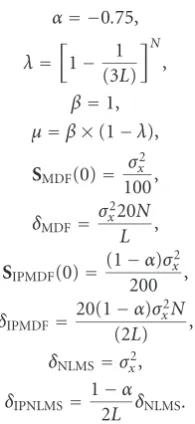
Throughout our simulations, we assume that the length of the adaptive filter is equivalent to that of the unknown sys-tem. Results are presented over a single trial and the follow-ing parameters are chosen for all simulations:
α= −0.75,
λ=
1− 1 (3L)
N ,
β=1, μ=β×(1−λ),
SMDF(0)= σ 2
x 100,
δMDF=σ 2
x20N L , SIPMDF(0)=
(1−α)σ2
x 200 ,
δIPMDF=
20(1−α)σ2
xN (2L) , δNLMS=σx2,
δIPNLMS=1−α
2L δNLMS.
(32)
These choices of parameters allow algorithms to converge to the same asymptotic value ofη(m) for fair comparison.
4.1. Recorded impulse responses
In this first experiment, we investigate the variation of the rate of convergence with frame size N for IPMDF using an impulse response of a 64 milliseconds network hybrid recorded at 8 kHz sampling frequency as shown inFigure 2.
Figure 3shows the convergence with various frame sizesN for IPMDF using a white Gaussian noise (WGN) input se-quence. An uncorrelated WGN sequencew(n) is added to
0
−0.08
100 200 300 400 500
−0.06
−0.04
−0.02
0.02 0.04
0
A
m
plitude
Samples
Figure2: Impulse response of a recorded network hybrid.
0
−40
1 2 3 4
−30
−20
−10
0
N=256
N=128
N=64
Time (s)
η
(dB)
Figure3: IPMDF convergence for differentNwith sparse impulse response. SNR=30 dB.
achieve a signal-to-noise ratio (SNR) of 30 dB. It can be seen that the convergence is faster for smallerNsince the adaptive filter coefficients are being updated more frequently. Addi-tional simulations forN <64 have indicated that no further significant improvement in convergence performance is ob-tained for lowerNvalues.
We compare the relative rate of convergence of the IP-MDF, IP-MDF, IPNLMS, and NLMS algorithms using the same impulse response. As before,w(n) is added to achieve an SNR of 30 dB. The frame size for IPMDF and MDF was chosen to beN = 64 while the step-size of IPNLMS and NLMS was adjusted so that its final misalignment is the same as that for IPMDF and MDF. This corresponds toμIPNLMS =μNLMS =
0 0.5 1 1.5 2 2.5 3
−40
0
−30
−20
−10
Time (s)
η
(dB)
NLMS (μ=0.15) MDF
IPNLMS (μ=0.15)
IPMDF
Figure 4: Relative convergence of IPMDF, MDF, IPNLMS, and NLMS using WGN input. SNR=30 dB.
0
−45
1 2 3 4 5 6
−40
−30
−25
−20
−15
−10
−5
0
−35
NLMS IPNLMS
MDF
IPMDF IPMDF
NLMS MDF IPNLMS
Time (s)
η
(dB)
Figure 5: Relative convergence of IPMDF, MDF, IPNLMS, and NLMS using WGN input with echo path change at 3 s. SNR=30 dB.
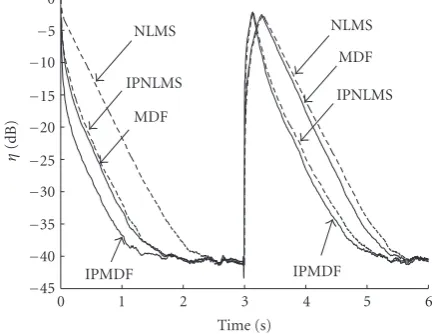
We compare the tracking performance of the algorithms as shown inFigure 5using a WGN input sequence. In this simulation, an echo path change, comprising an additional 12-sample delay, was introduced after 3 seconds. As before, the frame size for the IPMDF and MDF algorithms isN = 64 while for IPNLMS and NLMS, μIPNLMS = μNLMS =
0.15 is used. We see that IPMDF achieves the highest ini-tial rate of convergence. When compared with MDF, the IPMDF algorithm has a higher tracking capability follow-ing the echo path change at 3 seconds. Compared with the IPNLMS algorithm, a delay is introduced by block process-ing the data input for both the MDF and IPMDF algo-rithms. As a result, IPNLMS achieves a better tracking ca-pability than the MDF algorithm. The tracking caca-pability of NLMS is slower compared to IPNLMS and IPMDF due to its relatively slow convergence rate. Although delay ex-ists for the IPMDF algorithm, the reduction in delay due to the multidelay structure allows the IPMDF algorithm to
0
−30
5 10 15 20 25 30
−25
−20
−15
−10
−5
0
Speech
IPNLMS MDF
IPMDF
Time (s)
η
(dB)
Figure6: Relative convergence of IPMDF, MDF, and IPNLMS using speech input with echo path change at 3 seconds.
achieve an improvement of 2 dB over IPNLMS after echo path change.
Figure 6 compares the convergence performance of IPNLMS, IPMDF, and MDF using the same experimental setup as before but using a speech input from a male speaker. An echo path change, comprising an additional 12-sample delay, is introduced at 16 seconds. It can be seen that IP-MDF achieves approximately 5 dB improvement in normal-ized misalignment during initial convergence compared to the MDF algorithm.
4.2. Synthetic impulse responses with various degrees of sparseness
We illustrate the robustness of IPMDF to impulse response sparseness. Impulse responses with various degrees of sparse-ness are generated synthetically using anL×1 exponentially decaying window [18] which is defined as
u=p1e−1/ψ,e−2/ψ,. . .,e−(Lu−1)/ψT, (33)
where theLp×1 vectorpmodels the bulk delay and is a zero mean WGN sequence with varianceσ2
p andLu =L−Lp is the length of the decaying window whileψ∈Z+is the decay
constant. Defining anLu×1 vectorbas a zero mean WGN se-quence with varianceσ2
b, theL×1 synthetic impulse response can then be expressed as
B=diag{b}, h=
ILp×Lp 0Lp×Lu 0Lu×Lp B
u. (34)
The sparseness of an impulse response can be quantified using the sparseness measure [18,19]
ξ(h)=L L −√L
1−√h1 Lh2
. (35)
It has been shown in [18] thatξ(h) reduces withψ.Figure 7
shows an illustrative example set of impulse responses gen-erated using (34) with σ2
A
m
plitude
0 100 200 300 400 512
Samples
−2
−1.5
−0.5
−1
0 0.5 1 1.5 2
(a)
A
m
plitude
0 100 200 300 400 512
Samples
−2
−1.5
−0.5
−1
0 0.5 1 1.5 2
(b)
A
m
plitude
0 100 200 300 400 512
Samples
−2
−1.5
−0.5
−1
0 0.5 1 1.5 2
(c)
A
m
plitude
0 100 200 300 400 512
Samples
−2
−1.5
−0.5
−1
0 0.5 1 1.5 2
(d)
Figure7: Impulse responses controlled using (a)ψ=10, (b)ψ=50, (c)ψ=150, and (d)ψ=300 giving sparseness measure (a)ξ=0.8767, (b)ξ=0.6735, (c)ξ=0.4216, and (d)ξ=0.3063.
L=512, andLp=64. These impulse responses with various degrees of sparseness were generated using decay constants (a)ψ =10, (b)ψ =50, (c)ψ =150, and (d)ψ =300 giv-ing sparseness measures of (a)ξ =0.8767, (b)ξ =0.6735, (c) ξ = 0.4216, and (d)ξ = 0.3063, respectively. We now investigate the performance of IPNLMS, MDF, and IPMDF using white Gaussian noise input sequences for impulse re-sponses generated using 0.3 ≤ ξ ≤ 0.9 as controlled byψ. As beforew(n) is added to achieve an SNR of 30 dB.Figure 8
shows the variation in time to reachη(m) = −20 dB nor-malized misalignment with sparseness measureξcontrolled using exponential windowψ. Due to the proportional con-trol of step-sizes, significant increase in the rate of conver-gence for IPNLMS and IPMDF can be seen as the sparseness of the impulse responses increases for highξ. For all cases of sparseness, the IPMDF algorithm exhibits the highest rate of convergence compared to IPNLMS and MDF hence demon-strating the robustness of IPMDF to the sparse nature of the unknown system.
0
0.4 0.5 0.6 0.7 0.8 0.9 0.2
0.4 0.6 0.8 1
(c) (b) (a)
Sparseness measure (ξ) T20
(
s
)
Figure8: Time to reach−20 dB (T20) normalized misalignment for
5. CONCLUSION
We have proposed the IPMDF algorithm for echo cancella-tion with sparse impulse responses. This algorithm exploits both the improvement in convergence brought about by the proportionality control of IPNLMS and the efficient imple-mentation in the frequency domain of MDF. Simulation re-sults, using both WGN and speech inputs, have shown that the improvement in initial convergence and tracking of IP-MDF over IP-MDF for both sparse and dispersive impulse re-sponses far outweighs the modest increase in computational cost.
REFERENCES
[1] J. Radecki, Z. Zilic, and K. Radecka, “Echo cancellation in IP networks,” inProceedings of the 45th Midwest Symposium on Circuits and Systems, vol. 2, pp. 219–222, Tulsa, Okla, USA, August 2002.
[2] M. Boujida and J.-M. Boucher, “Higher order statistics applied to wavelet identification of marine seismic signals,” in Proceed-ings of European Signal Processing Conference (EUSIPCO ’96), Trieste, Italy, September 1996.
[3] Y.-F. Cheng and D. M. Etter, “Analysis of an adaptive technique for modeling sparse systems,”IEEE Transactions on Acoustics, Speech, and Signal Processing, vol. 37, no. 2, pp. 254–264, 1989. [4] E. A. Robinson and T. S. Durrani,Geophysical Signal
Process-ing, Prentice-Hall, Englewood Cliffs, NJ, USA, 1986.
[5] D. L. Duttweiler, “Proportionate normalized least-mean-squares adaptation in echo cancelers,”IEEE Transactions on Speech and Audio Processing, vol. 8, no. 5, pp. 508–518, 2000. [6] J. Benesty and S. L. Gay, “An improved PNLMS algorithm,”
inProceedings of IEEE International Conference on Acoustics, Speech and Signal Processing (ICASSP ’02), vol. 2, pp. 1881– 1884, Orlando, Fla, USA, May 2002.
[7] J. Cui, P. A. Naylor, and D. T. Brown, “An improved IPNLMS algortihm for echo cancellation in packet-switched networks,” inProceedings of IEEE International Conference on Acoustics, Speech and Signal Processing (ICASSP ’04), vol. 4, pp. 141–144, Montreal, Que, Canada, May 2004.
[8] H. Deng and M. Doroslovaˇcki, “New sparse adaptive algo-rithms using partial update,” inProceedings of IEEE Interna-tional Conference on Acoustics, Speech and Signal Processing (ICASSP ’04), vol. 2, pp. 845–848, Montreal, Que, Canada, May 2004.
[9] K. Doganc¸ay and O. Tanrikulu, “Adaptive filtering algorithms with selective partial updates,”IEEE Transactions on Circuits and Systems II: Analog and Digital Signal Processing, vol. 48, no. 8, pp. 762–769, 2001.
[10] H. Deng and M. Doroslovaˇcki, “Improving convergence of the PNLMS algorithm for sparse impulse response identification,”
IEEE Signal Processing Letters, vol. 12, no. 3, pp. 181–184, 2005. [11] J. W. Cooley and J. W. Tukey, “An algorithm for the machine calculation of complex Fourier series,”Mathematics of Com-putation, vol. 19, no. 90, pp. 297–301, 1965.
[12] S. Haykin,Adaptive Filter Theory, Information and System Sci-ence Series, Prentice-Hall, Englewood Cliffs, NJ, USA, 4th edi-tion, 2002.
[13] J. J. Shynk, “Frequency-domain and multirate adaptive filter-ing,”IEEE Signal Processing Magazine, vol. 9, no. 1, pp. 14–37, 1992.
[14] E. H¨ansler and G. U. Schmidt, “Hands-free telephones - joint control of echo cancellation and postfiltering,”Signal Process-ing, vol. 80, no. 11, pp. 2295–2305, 2000.
[15] J.-S. Soo and K. K. Pang, “Multidelay block frequency domain adaptive filter,”IEEE Transactions on Acoustics, Speech, and Sig-nal Processing, vol. 38, no. 2, pp. 373–376, 1990.
[16] J. Benesty, T. G¨ansler, D. R. Morgan, M. M. Sondhi, and S. L. Gay,Advances in Network and Acoustic Echo Cancellation, Springer, New York, NY, USA, 2001.
[17] A. W. H. Khong, J. Benesty, and P. A. Naylor, “An improved proportionate multi-delay block adaptive filter for packet-switched network echo cancellation,” inProceedings of the 13th European Signal Processing Conference (EUSIPCO ’05), An-talya, Turkey, September 2005.
[18] J. Benesty, Y. A. Huang, J. Chen, and P. A. Naylor, “Adap-tive algorithms for the identification of sparse impulse re-sponses,” inSelected Methods for Acoustic Echo and Noise Con-trol, E. H¨ansler and G. Schmidt, Eds., chapter 5, pp. 125–153, Springer, New York, NY, USA, 2006.
[19] P. O. Hoyer, “Non-negative matrix factorization with sparse-ness constraints,”Journal of Machine Learning Research, vol. 5, pp. 1457–1469, 2004.
[20] R. Gray, “On the asymptotic eigenvalue distribution of toeplitz matrices,”IEEE Transactions on Information Theory, vol. 18, no. 6, pp. 725–730, 1972.