
The Thirty-Third AAAI Conference on Artificial Intelligence (AAAI-19)
Goal-Oriented Dialogue Policy Learning from Failures
Keting Lu,
1Shiqi Zhang,
2Xiaoping Chen
11School of Computer Science, University of Science and Technology of China
2Department of Computer Science, SUNY Binghamton
[email protected], [email protected], [email protected]
Abstract
Reinforcement learning methods have been used for learn-ing dialogue policies. However, learnlearn-ing an effective dia-logue policy frequently requires prohibitively many conver-sations. This is partly because of the sparse rewards in dia-logues, and the very few successful dialogues in early ing phase. Hindsight experience replay (HER) enables learn-ing from failures, but the vanilla HER is inapplicable to dia-logue learning due to the implicit goals. In this work, we de-velop two complex HER methods providing different trade-offs between complexity and performance, and, for the first time, enabled HER-based dialogue policy learning. Exper-iments using a realistic user simulator show that our HER methods perform better than existing experience replay meth-ods (as applied to deep Q-networks) in learning rate.
Introduction
Goal-oriented dialogue systems aim at assisting users to ac-complish specific goals using natural language, and have been used in a variety of applications (Zhang and Stone 2015; Su et al. 2016b; Li et al. 2017). Goal-oriented
dia-logue systems usually aim atconciseconversations.1 Such
dialogue systems typically include a language understand-ing component for recognizunderstand-ing and parsunderstand-ing the language in-puts into inner representations, a belief state tracking com-ponent for predicting user intent and updating the dialogue history, and a dialogue management component that gener-ates dialogue actions. The dialogue actions can be converted into spoken or text-based language using a language gener-ator. Goal-oriented dialogue managers are frequently mod-eled as a sequential decision-making problem (Young et al. 2013), where reinforcement learning (RL) (Sutton and Barto 1998) can be used for learning an optimal dialogue policy from user experiences. While a variety of RL methods have been developed for learning dialogue policies (Williams and Zweig 2016; Cuay´ahuitl 2017), the methods typically re-quire a large amount of dialogue experience until one can learn a good-quality dialogue policy. In particular, success-ful dialogues are rare in early learning phase, making it a
Copyright c2019, Association for the Advancement of Artificial Intelligence (www.aaai.org). All rights reserved.
1
In comparison, the Chatbots that want to maximize social en-gagement, such as Microsoft XiaoIce, frequently result in extended conversations.
challenge for many dialogue systems to learn much at the beginning and producing poor user experiences. This paper focuses on runtime dialogue data augmentation (DDA) for speeding up the process of learning goal-oriented dialogue policies.
The idea of data augmentation for RL tasks is not new. Existing research on hindsight experience replay (HER) has shown that, in robotic manipulation tasks, an RL agent’s learning rate can be improved by changing goals to gener-ate “successful” instances (Andrychowicz et al. 2017). How-ever, their HER approach is not directly applicable to di-alogue domains, because a didi-alogue agent has to interact with people to identify the desired goal state (whereas the goal state is explicit in manipulation tasks). We develop two complex HER methods for runtime DDA problems. The first method is called Trimming-based HER (T-HER), where failed dialogues are trimmed to generate successful dialogue instances. While T-HER enables the agent to significantly augment the training data, the generated instances are rela-tively short. The other method is Stitching-based HER (S-HER) that enables an agent to analyze the similarity be-tween dialogue belief states, and stitch together dialogue segments to form relatively long, successful dialogues.
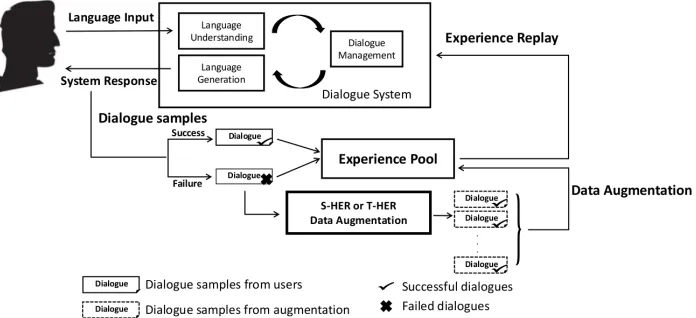
Figure is an overview of our DDA framework, illustrat-ing the role of our HER methods. Like standard experience replay, we add user dialogues to the experience pool. Unlike existing methods, when incoming dialogues are unsuccess-ful, we use our HER methods to generate new, successful dialogues, enabling our agent to learn from failures.
We have applied our DDA framework, including T-HER and S-HER, to Deep Q-Networks (DQNs) (Mnih et al. 2015) for learning dialogue policies. Results collected using a real-istic user simulator (Li et al. 2016) suggest that our methods perform better than competitive experience replay baselines, including prioritized experience replay (Schaul et al. 2015). Finally, our two HER methods can be combined to further improve the performance. To the best of our knowledge, this is the first work on HER-based dialogue policy learning.
Related Work
Figure 1: Overview of our dialogue data augmentation (DDA) framework, and our two complex hindsight experience replay (HER) methods.
Deep Q-Network (DQN) has enabled an agent to achieve human-level performance on playing Atari games (Mnih et al. 2015). RL algorithms, such as DQN, are generally data intensive and frequently require huge numbers of interac-tions with the environments. To better use the interaction experience, experience replay (ER), that suggests storing and reusing samples at training time, has been widely used for speeding up the RL agent’s training process (Nair et al. 2015; Wang et al. 2016). Prioritized ER (PER) further accel-erates training by assigning a weight based on temporal dif-ference error (TD-error) to each sample (Schaul et al. 2015), so as to increase the likelihood of selecting samples with a high TD-error. While PER enables more effective sample selections (Han and Sung 2017), the applicability of PER is limited when very few successful samples are available. We develop HER methods that generate artificial “successful” samples to improve the learning rate of dialogue agents.
Reward shaping has been used for speeding up the learn-ing of dialogue policies by addlearn-ing a new dense reward func-tion (Ferreira and Lefevre 2015). It has been proved that a well designed (dense) reward function does not alter the op-timal policy (Ng, Harada, and Russell 1999). Recently, Su et al. applied Recurrent Neural Networks (RNNs) to pre-dict the intermediate rewards for dialogues to reduce training time, and developed an on-line learning framework where dialogue policy and reward function were jointly trained via active learning (Su et al. 2016b). However, generating such complex reward functions require either considerable human effort or large datasets.
Another line of research focuses on developing effec-tive exploration strategies for RL algorithms, enabling more sample-efficient dialogue learning. For instance, Pietquin et al. integrated Least-Squares Policy Iteration (Lagoudakis and Parr 2003) and Fitted-Q (Chandramohan, Geist, and Pietquin 2010) for dialogue policy optimization (Pietquin et al. 2011). Other examples include Gaussian Process (GP)-based sample-efficient dialogue learning (Gaˇsi´c and Young 2014), the Bayes-by-Backprop Q-network (BBQN) (Lip-ton et al. 2017), and trust-region and gradient-based algo-rithms (Su et al. 2017). Our HER methods have the potential to be combined with the above sample-efficient RL methods
to produce a more efficient learning process.
Pre-training has been used in dialogue learning for com-puting an initial policy from a corpus using supervised learn-ing (SL) (Su et al. 2016a; Peng et al. 2017). After that, a dia-logue agent can further improve the policy via learning from interactions with users. In line with past research on dia-logue systems (as listed above), we use pre-training in this work (unless stated otherwise) to give our dialogue agent a “warm start”.
Work closest to this research is the original HER method (Andrychowicz et al. 2017) that manipulates goals based on resulting states. But that method is only applicable to domains where goals are explicit to the agents, e.g., target positions in manipulation tasks. In dialogue domains, goals are not fully observable and must be identified via language actions, which motivates the development of complex HER methods in this work.
Background
In this section, we briefly introduce the two building blocks of this work, namely Markov decision process (MDP)-based dialogue management, and Deep Q-Network (DQN).
MDP-based Dialogue Management
Dialogue control is modeled using MDPs in this work. An MDP-based dialogue manager (Lipton et al. 2017) can be described as a tuplehS,A, T, s0,Ri.Sis the state set, where
s∈ Srepresents the agent’s current dialogue state including
the agent’s last action, the user’s current action, the
distribu-tion of each slot, and other domain variables as needed.Ais
the action set, wherea∈ Arepresents the agent’s response.
Tis the stationary, probabilistic transition function with con-ditional densityp(st+1|st, at)that satisfies the (first-order)
Markov property.s0∈ Sis the initial state.R:S×A →Ris
the reward function, where the agent receives a big bonus in successful dialogues, and has a small cost in each turn.
Solving an MDP-based dialogue management problem
produces π, a dialogue policy. A dialogue policy maps a
dialogue state to an action, π: S → A, toward
Rt=P∞i=tγ i−tr
i, whereγ∈[0,1]is a discount factor that specifies how much the agent favors future rewards.
Deep Q-Network
Deep Q-Network (DQN) (Mnih et al. 2015) is a model-free RL algorithm for discrete action space. DQN uses a neu-ral network as an approximation of the optimal Q-function,
Q∗ = Q(s, a;θ), where ais an action executed at states,
andθis a set of parameters. Its policy is defined either in
a greedy way: πQ(s) = arg maxa∈AQ(s, a;θ)or being
−greedy, i.e., the agent takes a random action in
proba-bility and actionπQ(s)otherwise. The loss function for
minimization in DQN is usually defined using TD-error:
L=Es,a,r,s0[(Q(s, a;θ)−y)2], (1)
wherey=r+γmaxa0∈AQ(s0, a0;θ).
Naive DQNs often suffer from overestimation and insta-bility, and two techniques are widely used to alleviate the
is-sues. One is calledtarget network(Mnih et al. 2015) whose
parameters are updated byθ once every many iterations in
the training phase. The other technique is experience
re-play(Lin 1993; Mnih et al. 2015), where an experience pool
E stores samples, each in the form of (st, at, rt, st+1). In
training the DQN, a mini-batch is uniformly sampled from
E. Experience replay desensitizes DQN to the correlation
among the samples, and increases the data efficiency via reusing the (potentially expensive) samples. Both techniques improve the performance of DQN and are used in this paper.
Dialogue Segmentation
In this section, we introduce the concept ofdialogue
sub-goal, and present a segmentation algorithm that efficiently
outputsvaliddialogue segments, which are later used in our
complex HER methods.
Definition of Dialogue Subgoal
Goal-oriented dialogue systems help users accomplish their
goals via dialogue, where a goal Gincludes a set of
con-straintsCand a set of requestsR(Schatzmann and Young
2009):G= (C, R).
Consider a movie booking domain. A user may ask about
thenameandtimeof a movie starringJackie Chan, of genre
action, and runningtoday, where the goal is in the form of:
Goal= C=
actor=J ackie Chan genre=action
date=today
,
R=
movie name=
start time=
!
Definition 1 Subgoal2 Given G = (C, R) and G0 =
(C0, R0), we sayG0is a subgoal ofG, orG0@G, ifC0⊂C andR0⊂R, whereG06=∅.
2
Our definition ofsubgoalis different from that in the dialogue learning literature on hierarchical reinforcement learning (Tang et al. 2018) and state space factorization (Thomson 2013).
Subgoal 1= C=
actor=J ackie Chan genre=action
, R=∅
! .
Subgoal 2= C=∅, R=
movie name=
start time=
! .
Subgoal 3= C=
actor=J ackie Chan date=today
,
R=
movie name=
start time=
! .
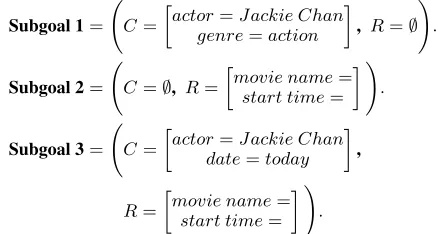
Figure 2: Example subgoals in the movie booking
do-main. For instance, Subgoal 3corresponds to the request
of “Please tell me the name and start time of the movie that is playing today and stars Jackie Chan.”
In successful dialogues, the agent must correctly identify all constraints and requests inG, so as to correctly provide the requested information via querying a database. Figure 2 shows three example subgoals (out of many) in the movie booking example.
It should be noted that some subgoals do not make sense to humans, but can be useful for dialogue learning. For
in-stance, Subgoal 2 corresponds to a query aboutmovie name
and start time without any constraints. Real users do not have such goals, but an agent can still learn from the ex-perience of achieving such subgoals.
Continuing the “Jackie Chan” example, if the agent misidentifiesgenre,start time, or both, the dialogues will be deemed unsuccessful, meaning that the agent cannot learn much from it, even though the agent has correctly identified the other entries ofmovie name,actor, etc. In this work, we make use of such unsuccessful dialogues in the training pro-cess, leveraging the fact that the agent has achieved subgoals (not all) in these dialogues.
Dialogue Segment Validation
Given dialoguesD0andD, we sayD0 is a segment ofD, if
D0includes a consecutive sequence of turns ofD. We
intro-duce an assessment function3,success(G,D), that outputs
trueorfalserepresenting whether dialogueDaccomplishes
goal (or subgoal)Gor not. Using the assessment function,
we define the validity of dialogue segments.
Definition 2 Validityof dialogue segments: Given dialogue
D, goalG, and dialogue segmentD0(ofD), we sayD0is a
valid dialogue segment ofD, iff there exists a subgoalG0@ G, andsuccess(G0,D0)istrue.
Using Definitions 1 and 2, one can assess the validity
of dialogue segment D0, using the entire dialogue D, the
goal of this dialogueG, and the provided subgoalG0.
How-ever, there exist many subgoals of the ultimate goal (com-binatorial explosion), and it soon becomes infeasible to as-sess the validity of a dialogue segment. Formally, given
3
Algorithm 1Dialogue Segmentation
Input:
GoalGthat includes constraint setCand request setR; Assessment functionsuccess(·,·);
Output:
A collection of pairs of a valid (head) dialogue segment and a corresponding subgoal,Ω;
1: InitializeΩ =∅
2: InitializeP=∅andQ=C∪R 3: whileDialogueDis not endeddo
4: Outcome flagsegment outcome=F alse 5: forq∈Qdo
6: Construct a subgoalG0=P∪q 7: ifsuccess(G0,D)then 8: segment outcome=T rue 9: P←P∪qandQ←Q\q 10: end if
11: end for
12: ifsegment outcome==T ruethen 13: Ω←Ω∪<D,P>
14: end if 15: end while
goalG = (C, R), the number of subgoals isP|C|
i=0
i
|C|
·
P|R|
j=0
j
|R|
−2, where we subtract the two extreme cases
of the subgoal being∅andG. If|C|= 5and|R| = 5, the number of subgoals is 1598.
Dialogue Segmentation Algorithm
Instead of assessing the validity of a dialogue segment using
allsubgoals, we aim at using only the ones with the
so-far-highest “cardinality”. The intuition comes from the follow-ing two observations. In line with previous research on di-alogue policy learning, e.g., (Schatzmann et al. 2007) , we assume users are cooperative and consistent in dialogues.
1. During a dialogue, the number of constraints and requests that have been identified is monotonically increasing; and
2. When a subgoal is accomplished, all its “subsubgoals” are automatically accomplished.
Leveraging the above two observations, we develop a
di-alogue segmentationalgorithm to efficiently identify valid
dialogue segments. First, we initialize two collectionsPand
Q.Pstores the constraints and requests that have been
iden-tified during the dialogues, andQstores the ones that have
not been identified. Therefore, at the very beginning of
di-alogues,Pis an empty set, andQstores all constraints and
requests. After each dialogue turn, we generate a subgoal set
Gwhere all subgoals share the same (so far highest)
cardi-nality. Formally,G={G0|G0=P∪q,∀q∈Q}. IfG0 ∈G is accomplished by the current dialogue segment, the
corre-spondingqis removed fromQand added intoP, which is
used to generate the subgoal set for the next dialogue seg-ment. So at each dialogue turn, only a small set of subgoals (i.e.,G) is used to assess a dialogue segment. More detailed procedure is shown in Algorithm 1. Compared to exhaustive subgoal identification that suffers from combinatorial explo-sion, our dialogue segmentation algorithm hasO(|C|+|R|)
time complexity.
Building on our dialogue segmentation algorithm, we next introduce our runtime data augmentation methods for effi-cient dialogue policy learning.
Our Complex HER Methods for Dialogue
Data Augmentation
In this section, we introduce two complex hindsight expe-rience replay (HER) methods for dialogue data augmenta-tion (DDA). The original HER method (Andrychowicz et al. 2017) is not applicable to dialogue domains, because goals in dialogues are not explicitly given (c.f., path planning for robot arms) and must be identified in dialogue turns. We say our HER methods are “complex”, because our methods manipulate dialogue experiences based on the resulting dia-logue states (which is more difficult than goal manipulation). The HER methods generate successful, artificial dialogues using dialogues from users (successful or not), and are par-ticularly useful in early learning phase, where successful di-alogues are rare.
Trimming-based HER (T-HER)
The idea of T-HER is simple: we pair valid dialogue seg-ments (from Algorithm 1) and their corresponding subgoals to generate successful dialogue instances for training.
It requires care in rewarding the success of the generated dialogues (c.f., the ones from users). We want to encourage the agent to accomplish subgoals (particularly the challeng-ing ones) uschalleng-ing positive rewards, while avoidchalleng-ing the agent
sticking to accomplishing only the subgoals. Given Rmax
andRmin being the reward and penalty to successful and
unsuccessful dialogues with users, we design the following (simple) reward function for the successful, artificial dia-logues from T-HER.
R(D) =α· |G0|, ensuring α· |G0|< Rmax (2)
whereαis a weight,G0 is a subgoal,Dis a dialogue
seg-ment, and|G0|is the number of entries ofG0 that must be identified. The agent receives a small penalty (-1 in our case) at each turn to encourage short dialogues.
T-HER enables a dialogue agent to learn from the expe-rience of completing imaginary, relatively easy tasks, and is useful while accomplishing ultimate goals is challenging (e.g., in early learning phase). However, as a relatively sim-ple strategy for DDA, T-HER cannot generate dialogues that are more complex that those from users.
Stitching-based HER (S-HER)
S-HER is relatively more complex than T-HER, while both need valid dialogue segments from Algorithm 1. T-HER uses the segments as successful dialogues that accomplish subgoals, whereas S-HER uses them as parts to construct new, successful dialogues. The key questions to S-HER are
what dialogue segments are suitable for stitching,andhow they are stitched together. Next, we define stitchability of
dialogue segments usingKL Divergence:
DKL(s0||s1) = n
X
i=0
s0(i)·log
s0(i)
Algorithm 2Stitching-based HER
Input:
DialogueD, and its goalG
A collection of pairs of a valid (tail) dialogue segment and a corresponding subgoal,Γ
KL-divergence threshold,ε Assessment function,success(·,·)
Output:
A set of newly generated dialogues,M 1: InitializeM← ∅
2: Assess input dialogue:success flag=success(G,D)
3: Call Algorithm 1 to computeΩ, usingD,G, andsuccess(·,·), whereΩis a collection of pairs of a valid (head) dialogue seg-ment and a corresponding subgoal
4: for<D0, G0>∈Ωdo
5: if success flag is True then 6: Γ←Γ∪<D D0
, G0>, where is a dialogue subtrac-tion operator
7: else 8: for<D00
, G00>∈Γdo
9: ifG0isG00and DKL(D0||D00
)≤εthen
10: Dstitched
=concatenate(D0 ,D00
)
11: M←M∪ Dstitched
12: Break
13: end if 14: end for 15: end if 16: end for 17: ReturnM
wheres0ands1are two probability distributions.
Definition 3 Stitchability:Consider two dialogue segments
D= (s0, a0, s1),(s1, a1, s2),· · · ,(sM−1, aM−1, sM),
D0= (s00, a00, s10),(s01, a01, s02),· · · ,(s0N−1, a0N−1, s0N), where M and N are turn numbers (dialogue segment lengths) ofDand D0, and each turn includes initial state,
dialogue action, and resulting state.
If the dialogues’ corresponding (sub)goals areGandG0, we sayDandD0are stitchable, if and only ifG=G0, and
DKL(sM ||s00)≤ε,
whereε∈Ris a stitchability threshold.
We usehead (tail) dialogue segment to refer to the
seg-ment that includes the early (late) turns in the resulting
dia-logue. In Definition 3,DandDare head and tail segments
respectively.
The key idea of S-HER is to use unsuccessful user
dia-logues to generate validheaddialogue segments (stored in
setΩ), use successful user dialogues to generate validtail
dialogue segments (stored in setΓ), and stitch dialogue seg-ments from the two sets (one from each set) to form new successful artificial dialogues, only if their connecting dia-logue states are similar enough.
Algorithm 2 presents S-HER. Given a new user dialogue
D, S-HER first calls Algorithm 1 to generate all valid
di-alogue segments that start from the beginning of D, and
stores them in setΩ. After that, S-HER assesses D’s
suc-cessfulness using its associated goal, and stores the result in
success flag. If successful, S-HER subtracts segments inΩ
fromDto generate the tail segments that eventually lead to
successful dialogues. The tail segments are used to augment
Γ. in Line 6 is a dialogue subtraction operator, i.e.,D D0
produces a dialogue segment by removingD0fromD, and
this operation is valid, only ifD0 is a segment ofD. If the new user dialogue is unsuccessful, S-HER concatenates one
head segment fromΩto one tail segment from Γ to form
a new, successful dialogueDstitched, and add it into set M, which is used for storing the algorithm output.
Remarks: S-HER uses KL divergence (Line 9 in
Algo-rithm 2) to measure the similarity between dialogue states. If their divergence is lower than a threshold, S-HER stitches the corresponding two dialogue segments together to gener-ates a new dialogue. S-HER is more effective than T-HER, when there are very few successful dialogues in the expe-rience replay pool. This is because S-HER is able to gen-erate many successful dialogues, even if there is only one successful dialogue from user, which significantly augments the dialogue data for accelerating the training process.
Experiment
Experiments have been conducted to evaluate the key hy-pothesis of T-HER and S-HER being able to improve the learning rate of DQN-based dialogue policies. We have combined the two methods with prioritized experience re-play (Schaul et al. 2015) to produce better results, and com-pared T-HER and S-HER under different conditions.
Dialogue Environment
Our complex HER methods were evaluated using a dialogue simulation environment, where a dialogue agent
communi-cates with simulated users on movie-booking tasks (Li et
al. 2016; 2017). This movie-booking domain consists of
29 slots of two types, where one type is on search
con-straints(e.g., number of people, and date), and the other is onsystem-informableproperties that are needed for database queries (e.g., critic rating, and start time).
A dialogue state consists of five components: 1) one-hot
representations of the current user actionactand mentioned
slots; 2) one-hot representations of last system action act
and mentioned slots; 3) the belief distribution of possible values for each slot; 4) both a scalar and one-hot tion of the current turn number; and 5) a scalar representa-tion indicating the number of results which can be found in a database according to current search constraints.
The system (dialogue agent) has 11 dialogue actions rep-resenting the system intent. These actions can be mapped into a natural language response according to the dialogue belief states and heuristic rules. Once a dialogue reaches the
end, the system receives a big bonus 80, if it successfully
helps users book tickets. Otherwise, it receives−40. In each
turn, the system receives a fixed reward −1 to encourage
Sheet2
Page 3
Failure Success
T0-U Can I get tickets for zootopia? Can I get tickets for zootopia? T0-U T1-S night is available. What movie are you interested in? T1-S T2-U Could you help me to book The tickets? I want to watch zootopia. T2-U T3-S What time would you like to see it? What time would you like to see it? T3-S T4-U I want to watch at 9:10 pm. I want to watch at 9:10 pm. T4-U T5-S Which city would you like? Which city would you like? T5-S T6-U I want to watch at seattle. I want to watch at seattle. T6-U T7-S What movie are you interested in? What date would you like to watch it? T7-S T8-U I want to watch zootopia. I want to set it up tomorrow T8-U
T9-S What movie are you interested in? Which theater would you like? T9-S
T10-UI want to watch zootopia. I want to watch at regal meridian 16. T10-U T11-SWhat movie are you interested in? How many tickets do you need? T11-S T12-UI want to watch zootopia. I want 2 tickets please! T12-U T13-SWhat movie are you interested in?
T13-S T14-UI want to watch zootopia.
T15-SWhat movie are you interested in?
T16-UI want to watch zootopia. Thank you T14-U T17-SWhat movie are you interested in? Thank you T15-S T18-UI want to watch zootopia.
T19-SWhat movie are you interested in?
...
I was able to purchase 2 tickets for you to see Zootopia tomorrow at regal Meridian 16 theater in seattle At 9:10 pm.
Figure 3: Examples of an unsuccessful dialogue and a
suc-cessful dialogue, where we use “U” and “S” to indicateuser
andsystemturns respectively.
and higher QA costs result in less accurate, shorter conver-sations (Zhang and Stone 2015).
The DQN architecture used in this paper is a single-layer neural network of size 80. Its output layer has 11 units cor-responding to the 11 dialogue actions. The techniques of tar-get network and experience replay are applied (see Section ).
The size of experience pool is100k, and experience replay
strategy is uniform sampling. The value ofαin Equation 2
is 1.0, and−greedypolicy is used, whereis initialized
with 0.3, and decayed to 0.01 during training.
Each experiment includes 1000 epochs. Each epoch in-cludes 100 dialogue episodes. By the end of each epoch, we update the weights of target network using the current behavior network, and this update operation executes once every epoch. Every data point in the figures is an average of 500 dialogues from 5 runs (100 dialogues in each run). For instance, a data point of 0.6 success rate at episode 70 means that 60% of the 70th dialogue episodes (500 in total) were successful. In line with previous research (Su et al. 2016a; Peng et al. 2017), we use supervised learning to give our dia-logue agent a “warm start” in each set of experiments, unless specified otherwise.
Case Illustration
Before presenting statistical results, we use two example di-alogues to illustrate how T-HER and S-HER augment dia-logue data, as shown in Figure 3. The goal of the unsuccess-ful dialogue (Left) includes three constraints ofstart time,
city, andmovie name, and one request ofticket. The goal of
successful dialogue (Right) includes six constraints ofstart
time,city,movie name,theater,date, andnumber of people,
and one request ofticket. Next, we demonstrate how T-HER
and S-HER use the two dialogues to generate artificial, suc-cessful dialogues.
T-HER selects valid dialogue segments according to achieved subgoals. On the left, the dialogue segment in blue
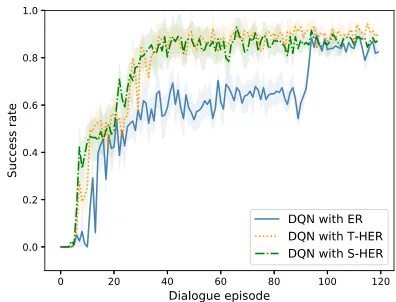
Figure 4: Learning to dialogue to accomplish tasks of book-ing movie tickets. Our two complex HER strategies improve the learning rate, c.f., naive DQN with standard experience reply (ER).
color achieves the subgoal that includes three constraints (start time, city, and movie name), and also its “subsub-goals”. Accordingly, T-HER can generate three valid dia-logue segments (new, successful diadia-logues), including the ones fromT0toT4, fromT0toT5, and fromT0toT8. Turns
afterT8are not considered, because our assessment function
does not allow the agent asking useless questions.
S-HER generates new successful dialogues by stitching head and tail dialogue segments. In this example, the two di-alogue segments in blue color achieved the same subgoal, al-though the two dialogue segments have very different flows. S-HER enables our agent to generate a new successful dia-logue by stitching the diadia-logue segment in blue color on the left, and the dialogue segment in green color on the right. The newly generated, successful dialogue achieves the goal that is originally from the dialogue on the right.
Experimental Results
Experiments have been extensively conducted to evaluate the following hypotheses. I) Our HER methods perform better than standard experience reply; II) Our HER meth-ods can be combined with prioritized ER for better perfor-mance; III) Our HER methods perform better than existing ER methods in cold start; and IV) T-HER and S-HER can be combined to produce the best performance.
DQN with our HER strategies Since the original HER
method (Andrychowicz et al. 2017) is not applicable to di-alogue systems, we compare our complex HER methods with a standard DQN-based reinforcement learner. Figure 4 shows that both T-HER and S-HER significantly accelerate the training process, which supports our key hypothesis. The KL divergence threshold of S-HER is 0.2 in this experiment. Next, we study the effect this parameter to the performance of S-HER.
KL divergence level of S-HER Stitching is allowed in
Figure 5:Stitchabilityin S-HER: KL divergence thresholdε
in [0.2, 0.5] performs the best.
Figure 6: Incorporating prioritized experience replay to im-prove the performances of T-HER and S-HER.
be very few dialogue segments being stitched (though the newly generated dialogues are of very good quality). If the threshold is too big, many dialogue segments are stitched, but the quality of generated, artificial dialogues will be poor, producing negative effects to the learning process.
Figure 5 depicts the influences of different thresholds. As
expected, when the threshold is too high (e.g.,ε = 2.0),
the RL agent failed to converge to a good policy; when the threshold is too small (e.g.,<= 0.1), the improvement to the learning rate is not as good as using a threshold within the range of[0.2,0.5]. Results here can serve as a reference to S-HER practitioners.
Integration with PER The first two sets of experiments
used uniform sampling in experience replay. We further evaluate the performance of integrating our complex HER methods with prioritized experience replay (PER) that pri-oritizes selecting the potentially-valuable samples (in terms of TD-error) (Schaul et al. 2015). Figure 6 shows the re-sults. We can see T-HER and S-HER perform better than PER-only, and that incorporating PER into T-HER and S-HER further improved the performances. It should be noted that all five learning strategies converge to policies that are of similar qualities.
Figure 7: In extreme situations (cold start and small expe-rience pool), S-HER performs better than T-HER, and their combination performs the best.
Learning with a cold start T-HER and S-HER produced
similar results in previous experiments. In this set of exper-iments, we removed the warm-start policy (from supervised learning) that has been widely used in the literature (Li et al. 2017; Lipton et al. 2017), and reduced the experience replay pool from100kto1k, resulting in an extremely challenging task to the dialogue learners.
Figure 7 shows the results. We can see that uniform expe-rience replay (ER) (Mnih et al. 2015), and PER (Schaul et al. 2015) could not accomplish any task. Under such
chal-lenging settings, our complex HER methods achieved>0.5
success rates. In particular, S-HER outperforms T-HER, by generating significantly more successful dialogues. Finally, combining T-HER and S-HER produced the best perfor-mance.
Conclusions and Future Work
In this work, we developed two complex hindsight experi-ence replay (HER) methods, namely Trimming-based HER and Stitching-based HER, for dialogue data augmentation (DDA). Our two HER methods use human-agent dialogues to generate successful, artificial dialogues that are particu-larly useful for learning when successful dialogues are rare (e.g., in early learning phase). We used a realistic dialogue simulator for experiments. Results suggest that our methods significantly increased the learning rate of a DQN-based inforcement learner, and incorporating other experience re-play methods further improved their performance.
Acknowledgements
This work is supported in part by the National Natural
Sci-ence Foundation of China under grant number U1613216
and Double-First Class Foundation of University of Science and Technology of China.
References
Andrychowicz, M.; Wolski, F.; Ray, A.; et al. 2017.
Hind-sight experience replay. InAdvances in Neural Information
Processing Systems.
Chandramohan, S.; Geist, M.; and Pietquin, O. 2010. Opti-mizing spoken dialogue management with fitted value
iter-ation. InEleventh Annual Conference of the International
Speech Communication Association.
Cuay´ahuitl, H. 2017. Simpleds: A simple deep
reinforce-ment learning dialogue system. In Dialogues with Social
Robots. Springer.
Ferreira, E., and Lefevre, F. 2015. Reinforcement-learning based dialogue system for human–robot interactions with
socially-inspired rewards.Computer Speech & Language.
Gaˇsi´c, M., and Young, S. 2014. Gaussian processes for
pomdp-based dialogue manager optimization. IEEE/ACM
Transactions on Audio, Speech, and Language Processing. Han, S., and Sung, Y. 2017. Multi-batch experience replay for fast convergence of continuous action control.
Lagoudakis, M. G., and Parr, R. 2003. Least-squares policy
iteration.Journal of machine learning research.
Li, X.; Lipton, Z. C.; Dhingra, B.; et al. 2016. A user simu-lator for task-completion dialogues.
Li, X.; Chen, Y.-N.; Li, L.; et al. 2017. End-to-end
task-completion neural dialogue systems. InProceedings of the
Eighth International Joint Conference on Natural Language Processing (Volume 1: Long Papers).
Lin, L.-J. 1993. Reinforcement learning for robots using neural networks. Technical report, Carnegie-Mellon Univ Pittsburgh PA School of Computer Science.
Lipton, Z.; Li, X.; Gao, J.; Li, L.; et al. 2017.
Bbq-networks: Efficient exploration in deep reinforcement learn-ing for task-oriented dialogue systems.
Mnih, V.; Kavukcuoglu, K.; Silver, D.; et al. 2015.
Human-level control through deep reinforcement learning.Nature.
Nair, A.; Srinivasan, P.; Blackwell, S.; Alcicek, C.; et al. 2015. Massively parallel methods for deep reinforcement learning.
Ng, A. Y.; Harada, D.; and Russell, S. 1999. Policy invari-ance under reward transformations: Theory and application
to reward shaping. InICML.
Peng, B.; Li, X.; Li, L.; et al. 2017. Composite
task-completion dialogue policy learning via hierarchical deep
reinforcement learning. InProceedings of the 2017
Confer-ence on Empirical Methods in Natural Language Process-ing.
Pietquin, O.; Geist, M.; Chandramohan, S.; and Frezza-Buet, H. 2011. Sample-efficient batch reinforcement
learn-ing for dialogue management optimization. ACM
Transac-tions on Speech and Language Processing (TSLP).
Schatzmann, J., and Young, S. 2009. The hidden agenda
user simulation model.IEEE transactions on audio, speech,
and language processing.
Schatzmann, J.; Thomson, B.; Weilhammer, K.; et al. 2007. Agenda-based user simulation for bootstrapping a pomdp
dialogue system. InHuman Language Technologies 2007:
The Conference of the North American Chapter of the Asso-ciation for Computational Linguistics; Companion Volume, Short Papers. Association for Computational Linguistics. Schaul, T.; Quan, J.; Antonoglou, I.; and Silver, D. 2015. Prioritized experience replay.
Su, P.-H.; Vandyke, D.; Gasic, M.; et al. 2015. Reward shap-ing with recurrent neural networks for speedshap-ing up on-line
policy learning in spoken dialogue systems. InProceedings
of the 16th Annual Meeting of the Special Interest Group on Discourse and Dialogue.
Su, P.-H.; Gasic, M.; Mrksic, N.; et al. 2016a. Continuously learning neural dialogue management.
Su, P.-H.; Gasic, M.; Mrkˇsi´c, N.; et al. 2016b. On-line active reward learning for policy optimisation in spoken dialogue
systems. InProceedings of the 54th Annual Meeting of the
Association for Computational Linguistics (Volume 1: Long Papers).
Su, P.-H.; Budzianowski, P.; Ultes, S.; Gasic, M.; and Young, S. 2017. Sample-efficient actor-critic reinforcement learning
with supervised data for dialogue management. In
Proceed-ings of the 18th Annual SIGdial Meeting on Discourse and Dialogue.
Sutton, R. S., and Barto, A. G. 1998. Reinforcement
learn-ing: An introduction. MIT press Cambridge.
Tang, D.; Li, X.; Gao, J.; et al. 2018. Subgoal discovery for hierarchical dialogue policy learning.
Thomson, B. 2013.Statistical methods for spoken dialogue
management. Springer Science & Business Media.
Ultes, S.; Rojas Barahona, L. M.; Su, P.-H.; Vandyke, D.; Kim, D.; Casanueva, I. n.; Budzianowski, P.; Mrkˇsi´c, N.; Wen, T.-H.; Gasic, M.; and Young, S. 2017. PyDial: A
Multi-domain Statistical Dialogue System Toolkit. In
Pro-ceedings of ACL 2017, System Demonstrations. Association for Computational Linguistics.
Wang, Z.; Bapst, V.; Heess, N.; Mnih, V.; et al. 2016. Sample efficient actor-critic with experience replay.
Williams, J. D., and Zweig, G. 2016. End-to-end lstm-based dialog control optimized with supervised and reinforcement learning.
Young, S.; Gaˇsi´c, M.; Thomson, B.; and Williams, J. D. 2013. Pomdp-based statistical spoken dialog systems: A
re-view. Proceedings of the IEEE.
Zhang, S., and Stone, P. 2015. Corpp: commonsense rea-soning and probabilistic planning, as applied to dialog with
a mobile robot. InProceedings of the Twenty-Ninth AAAI
![Figure 5: Stitchability in S-HER: KL divergence threshold εin [0.2, 0.5] performs the best.](https://thumb-us.123doks.com/thumbv2/123dok_us/9673651.1950275/7.612.340.536.55.205/figure-stitchability-kl-divergence-threshold-ein-performs-best.webp)
