University of Southampton Research Repository
ePrints Soton
Copyright © and Moral Rights for this thesis are retained by the author and/or other
copyright owners. A copy can be downloaded for personal non-commercial
research or study, without prior permission or charge. This thesis cannot be
reproduced or quoted extensively from without first obtaining permission in writing
from the copyright holder/s. The content must not be changed in any way or sold
commercially in any format or medium without the formal permission of the
copyright holders.
When referring to this work, full bibliographic details including the author, title,
awarding institution and date of the thesis must be given e.g.
AUTHOR (year of submission) "Full thesis title", University of Southampton, name
of the University School or Department, PhD Thesis, pagination
October 1, 1999 / Vol. 24, No. 19 / OPTICS LETTERS 1373
Femtosecond cubic optical nonlinearity of thin nickel films
P. J. Bennett, V. Albanis, Yu. P. Svirko, and N. I. Zheludev
Department of Physics and Astronomy, University of Southampton, Southampton SO17 1BJ, UK
Received July 23, 1999
Transient pump – probe measurements of circular anisotropy in nickel f ilms induced by 38-fs optical pulses show an instantaneous response that is related to the optical orientation of the spins of free electrons. Measurements in a sample of variable thickness, performed in both transmission and ref lection, revealed that the surface signif icantly inf luences the degenerate cubic optical nonlinearity of the nickel f ilms to a depth of approximately 4 – 5 nm into the bulk. ©1999 Optical Society of America
OCIS codes: 190.7110, 190.4710, 190.4350, 160.3900, 320.2250, 320.7110.
It was recently established that the cubic optical non-linearity of metals associated with the optical orienta-tion of spins is one of several mechanisms1 – 6that play
a very important role in the femtosecond optical re-sponse of bulk metals,7 – 9in ferromagnetics in
particu-lar.10 – 13 The study of spin-related nonlinearity is of
fundamental interest and practical importance, in par-ticular for optical data storage. Here we report the results of a study of thin, semitransparent f ilms of nickel of various thicknesses, using femtosecond time-resolved polarimetry. For what is believed to be the f irst time, we have combined transmission and ref lec-tion measurements and studied glass and air inter-faces of nickel. We f ind that the ultrafast component of light-induced circular dichroism is insensitive to the optical anisotropy due to spontaneous magnetization of the f ilm.
We identify the importance of the surface contribu-tion to the f ilm nonlinearity and also observe that not only the magnitude of the nonlinearity in nickel but also its sign can be different, depending on the nature of the interface. We also show that the nonlinearity is very fast and put an upper limit of⬃40fs on its relax-ation time.
The nonlinearity of semitransparent nickel f ilms of variable thickness was studied by use of an ultrafast polarization-sensitive pump – probe polarimeter with a Ti:sapphire laser with a central wavelength at l 苷
810nm, an average power at the sample of ⬃50mW, a pulse duration of ⬃38fs, and a repetition rate of 82 MHz. A circularly polarized pump pulse induced circular birefringence and dichroism in the sample, which was then probed by a weaker linearly polarized pulse at the same wavelength. The probe propagated at a small angle to the pump, and both the probe and the pump were focused to a spot size of 130mm2. Using semitransparent nickel f ilms deposited upon a glass substrate, we performed experiments in four dif-ferent conf igurations, two ref lective and two transmis-sive, from the air and glass substrate sides (see Figs. 1 and 2). In all cases the pump (dashed lines) was ini-tially circularly polarized. The probe (solid lines) was initially linearly polarized, and its polarization azi-muth was monitored after interaction with the sample. Our technique had an accuracy in measuring the pump-induced probe polarization-azimuth rotation of better than 1026 rad and was based on continuous modulation of the probe polarization and the pump
in-tensity.14 Unlike other techniques in which the
cir-cular birefringence – dichroism is calculated from the data on ref lectivity for different polarizations,9 our
technique is directly sensitive to the pump-induced circular birefringence – dichroism in the sample. This technique is practically insensitive to the background change of the sample ref lectivity and the transmission. All these features make the technique particularly suitable for studying spin dynamics, as has been demonstrated in GaAs.14
Semitransparent nickel samples of variable thick-ness were deposited by electron-beam evaporation of 99.98% pure nickel onto a glass substrate in a vacuum with a growth rate of approximately1.5nm兾min. The substrates were glass microscope slides supplied by Chance Propper, Ltd. Measurements of the ref lectiv-ity at the air – nickel interface as a function of the trans-mission of the f ilms (see Fig. 2) gave good agreement with the values calculated for pure nickel [n苷2.501
i4.41 (Ref. 17)], indicating high quality and purity of the f ilms. Our measurement of the natural polariza-tion rotapolariza-tion of the sample owing to magneto-optical Kerr and Faraday effects (on ref lection and in trans-mission) as a function of the incident polarization orientation showed spontaneous magnetization in the plane of the f ilm and a slow variation of the magneti-zation direction along the sample.
The pump-induced polarization-azimuth rotation ap-peared on the background of the natural rotation owing to transverse spontaneous magnetization of the nickel sample. However, all our experiments showed that the pump-induced component of the rotation does not depend on the magnitude and the sign of the linear underlying (natural) polarization rotation. Within the available range of pump intensities, i.e., up to
16GW兾cm2, the rotation increased linearly with the pump intensity. We also observed that with the 38-fs pump and probe pulses the nonlinear response was almost instantaneous (inset of Fig. 1). The rotation direction was reversed with opposite handedness of the pump, but its magnitude was unaffected. This observation is consistent with a picture of the pump inducing transient circular birefringence, which is a perturbation to the linear birefringence – dichroism induced by transverse spontaneous magnetization. The pump-induced probe-azimuth rotation when the pump was circularly polarized was at least a factor of 30 larger than the probe-azimuth rotation with the
1374 OPTICS LETTERS / Vol. 24, No. 19 / October 1, 1999
Fig. 1. Pump-induced probe polarization-azimuth rota-tion at zero pump – probe delay observed in transmission experiments for opposite directions of propagation (䊉and 䊏) and the corresponding values of the optical nonlinearity
Dx共T兲in nickel, calculated from Eq. (1) (䊊and䊐). The in-set shows the normalized pump-induced probe polarization azimuth rotation as a function of the pump – probe delay in transmission through the sample. In all cases the re-sponse was instantaneous within the time resolution avail-able, with 38-fs optical pulses.
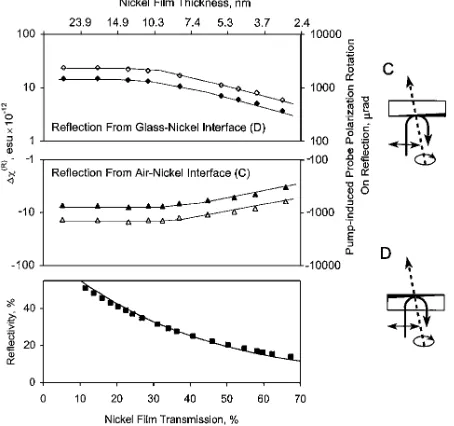
Fig. 2. Pump-induced probe polarization-azimuth rota-tion at zero pump – probe delay on ref lecrota-tion as a funcrota-tion of the transmission of the nickel f ilm. Note that the di-rection of the rotation at the nickel – air interface (䉱) is the opposite of that at the glass – air interface (䉬). The left-hand scale shows the corresponding effective nonlinearity
Dx共R兲, as calculated from Eq. (2) (䉭and䉫). The bottom graph shows a plot of the ref lectivity from the air – nickel interface (䊏). The solid curve is calculated from a numeri-cal model for a refractive index ofn苷2.502i4.41.15
pump linearly polarized at 45±to the probe. For the results reported below, the pump was always circularly polarized.
In transmission experiments we found that the sign of the pump-induced probe polarization is independent of the direction of propagation through the sample and depends only on the handedness of the pump
pulse. For a given pump intensity, the rotation tends to increase with the sample thickness and is slightly higher for propagation from the glass substrate into the nickel f ilm. Such a difference in rotation may be anticipated, as the ref lectivity of the two interfaces, and therefore the intensities inside the nickel f ilm, are different. Presuming that the f ilm is homogeneous, we can calculate the nonlinearity of the nickel layer from the following formula16:
QT苷6 32p3
cl Ç
11 n
n0
Ç2 Re
(
xxxyy2 xxyyx
n
)ZL
0
Ip共z兲dz.
(1) Here QT is the pump-induced probe polarization-azimuth rotation in transmission through a sample of lengthLand Ip共z兲is the intensity of the pump wave in the sample. Equation (1) is valid when the optical response is instantaneous, as was observed in our ex-periments. Equation (1) also assumes a weak depen-dence of the nonlinear susceptibilities and the complex refractive index on frequency within the laser pulse spectrum, which is the case in metals. Equation (1) neglects multiple ref lections, which is a reasonable as-sumption for a highly absorbing sample. This formula is suitable for propagation in both directions; however, if the light enters the nickel f ilm from the glass side,
n0 苷 1.50 should be assumed, but for the opposite
direction one has to use refractive indexn0 苷1. The plus and minus signs refer to right- and left-hand circular polarizations of the pump, respectively. Here the nonlinearity has been introduced in standard fashion by use of the nonlinear constitutive equation,
Pinl共v兲 苷 xijkl共v,v,v,2v兲Ej共v兲Ek共v兲Elⴱ共v兲. The
coherent contribution to the nonlinear rotation, which depends on the mutual phase between the pump and the probe, was neglected in Eq. (1), as in our experi-ments the coherent component was suppressed by use of the technique described in Ref. 17.
The effective nonlinearity that was recovered from the transmission experiment is presented in Fig. 1, in which the following notation is used: Dx共T兲 苷 Re
3 关共xxxyy 2 xxyyx兲兾n兴. One can see that the
non-linearity is practically independent of the f ilm thick-ness, Dx共T兲 ⬃ 2 3 10210 esu. Neglecting multiple ref lections and modeling the pump intensity as a decaying exponential across the f ilm lead to an error of less than 15% in the estimate of the nonlinearity. A small difference between the values of the non-linearities derived from the data for the opposite directions of preparations can be attributed to a surface contribution that we discuss below. Our transmission measurements suggest that the non-linearity,Dx共T兲 苷Re关共xxxyy 2 xxyyx兲兾n兴, in nickel can be approximated to be homogeneous within the range of thicknesses measured in our experiment, with the surface effects making only a small contribution.
The results of our measurements of the ref lected light suggest a very different picture for the non-linearity that is responsible for the ref lective effects:
[image:142.595.57.284.360.573.2]October 1, 1999 / Vol. 24, No. 19 / OPTICS LETTERS 1375
homogeneous nickel layer it would be expected that the induced rotation sign would be independent of which interface the light is ref lected from. However, this expectation was not conf irmed experimentally (see Fig. 2).
To our astonishment we observed the opposite sign of rotation when the sample was turned over and illumi-nated from the opposite side, for the same handedness of the pump polarization with the same experimental setup. We emphasize again that the pump-induced polarization rotation is independent of the spontaneous magnetization. If we again assume that the f ilm was homogeneous and calculate its nonlinearity by use of a formula derived with this assumption,16
QR苷6 32p2Ip
cn0
Ç
11 n
n0
Ç2Im
8 > > > > < > > > > :
xxxyy2 xxyyx
n ∑ 12 μ n n0
∂2∏ 9 † † † † = † † † † ; , (2)
we f ind that the nonlinearity on opposite sides of the f ilm will have different signs (see Fig. 2). This result shows that in nickel f ilms the nonlinearity, Dx共R兲 苷 Im共共共共xxxyy 2 xxyyx兲兾兵n关12共n兾n0兲2兴其兲兲兲, is very inhomoge-neous and that the surface strongly affects the optical properties of the medium. It is possible to estimate the depths,j1andj2, to which the two surfaces inf lu-ence the optical response of the material from our mea-surements. As nonlinearities at different interfaces have different signs, ifj1 艐j2苷j, the f ilm thickness at which the nonlinearity calculated from Eq. (2) starts to decrease is approximately2j, when the layers with opposite signs of nonlinearity start to overlap, giving
j艐4 5nm.
We believe that the bulk optical nonlinearity in nickel f ilms has the same origin as the ultrafast com-ponent of the polarization-sensitive optical response that was recently observed in CoPt3alloy f ilms.9 The
nonlinearity is related to the spin polarization of elec-trons excited with a circularly polarized pump. This nonlinearity was first discussed with relevance to met-als in Ref. 7. Following the impulse of photoexcitation with a circularly polarized pump, an electron-spin dis-tribution is created with f inite net spin polarization, giving rise to circular birefringence– dichroism in the sample. The net spin polarization decays through electron – electron scattering processes. As the in-duced birefringence– dichroism is instantaneous with-in the pulse duration, this puts an upper limit on the spin relaxation time of 艐40 fs. As the electron-collision time in nickel is⬃2fs, our results show that the spin-f lipping occurs on average at least every 20 collisions. The spin relaxation time can be com-pared with the electron-spin relaxation time that is due to exchange interaction and spin-orbit coupling, which was recently calculated to be a few femtosec-onds for nickel.18 The spin relaxation time, which
governs the observed nonlinearity response time, should be clearly distinguished from the much longer electron-thermalization time, which was measured
to be280630fs in nickel,13 and also from the
even-longer spin-lattice relaxation time, which is a few hundred picoseconds for nickel.18,19
The dramatic change of the nonlinearity at the interface from the bulk observed in our experiments, and in particular the change of the sign of the pump-induced rotation on ref lection from the nickel – air and the nickel – glass interfaces, is not completely under-stood. It may be related to specific surface states created by the presence of the interface or to interface contamination – oxidation, or it may be related to the local f ield effects owing to surface roughness. It is also known that the spin relaxation processes at the interface are considerably different from those in the bulk.20
The authors thank B. D. Rainford and V. V. Shuvalov for their discussions of this work and Goodfellow Cambridge, Ltd., and NATO (grant CRGP960274) for their f inancial support. N. I. Zheludev’s e-mail address is [email protected].
References
1. W. K. Burns and N. Bloembergen, Phys. Rev. B4,3437 (1971).
2. G. L. Eesley, Phys. Rev. B33,2144 (1986).
3. R. W. Schoenlien, W. Z. Lin, J. G. Fujimoto, and G. L. Eesley, Phys. Rev. Lett.58,1680 (1987).
4. X. Y. Wang and M. C. Downer, Opt. Lett. 17, 1450 (1992).
5. C. K. Sun, F. Vallee, L. H. Acioli, E. P. Ippen, and J. G. Fujimoto, Phys. Rev. B50,15337 (1994).
6. A. Liebsch, Surf. Sci.307/309,1007 (1994).
7. N. I. Zheludev, P. J. Bennett, H. Loh, S. V. Popov, I. R. Shatwell, Yu. P. Svirko, V. E. Gusev, V. F. Kamalov, and E. V. Slobodchikov, Opt. Lett.20,1368 (1995). 8. S. Dhanjal, S. V. Popov, I. R. Shatwell, Yu. P. Svirko,
N. I. Zheludev, and V. E. Gusev, Opt. Lett. 22,1879 (1997).
9. G. P. Ju, A. Vertikov, A. V. Nurmikko, C. Canady, G. Xiao, R. F. C. Farrow, and A. Cebollada, Phys. Rev. B 57,R700 (1998).
10. R. P. Pan, H. D. Wei, and Y. R. Shen, Phys. Rev. B39, 1229 (1989).
11. T. Rasing, M. G. Koerkamp, B. Koopmans, and H. Vander Berg, J. Appl. Phys.79,6181 (1996).
12. E. Beaurepaire, J. C. Merle, A. Daunois, and J. Y. Bigot, Phys. Rev. Lett.76,4250 (1996).
13. J. Hohlfeld, E. Matthias, R. Knorren, and K. H. Benneman, Phys. Rev. Lett.78,4861 (1997).
14. A. R. Bungay, S. V. Popov, I. R. Shatwell, and N. I. Zheludev, Phys. Lett. A234,379 (1997).
15. E. D. Palik, ed., Handbook of Optical Constants of Solids(Academic, London, 1985), p. 323.
16. Yu. P. Svirko and N. I. Zheludev,Polarization of Light in Nonlinear Optics(Wiley, New York, 1998), Chap. 7. 17. S. V. Popov, N. I. Zheludev, and Yu. P. Svirko, Opt.
Lett.19,13 (1994).
18. W. Hubner and G. P. Zhang, Phys. Rev. B58,R5920 (1998).
19. A. Scholl, L. Baumgarten, R. Jacquemin, and W. Eberhardt, Phys. Rev. Lett.79,5146 (1997).