irlfiSTER COPY
COMMUN. SOIL SCI. PLANT ANAL., 26(15&16), 2655-2666 (1995)
EFFECT OF ROOT SYSTEMS ON PREFERENTIAL FLOW IN SWELLING SOIL
A. R. Mitchell
Oregon State University, Central Oregon Agricultural Research Center, Madras, OR 97741
T. R. Ellsworth
University of Illinois, Urbana, IL 61801
B. D. Meek
USDA-ARS, Kimberly, ID 83341
ABSTRACT: Permeability problems on irrigated soils may be alleviated by root systems that increase water flow by creating macropores. Infiltration rates have been
shown to increase where plant roots decay and serve as preferential flow paths. For
low-organic-matter swelling soil, there is a question whether macropores are able to
resist the lateral swelling forces of the soil. The objective of this study was to observe
preferential water flow paths in a swelling soil under two cropping systems. A
Holtville silty clay (clayey-over-loamy, montmorillonitic Typic Torrifluvent) was
observed in situ. Two crops, alfalfa (Medicago saliva, L.) and wheat (Triticum turgidum, L.) provided sharply contrasting root systems, with wheat possessing fine, fibrous roots; alfalfa on the other hand, has a taproot system. Macropores were
observed after applying soil-adsorbing methylene blue dye to irrigation water.
Shrinkage cracks failed to conduct dye after 10 minutes into a flood irrigation.
Earthworm (Lubricus terrestris) channels were also not stable. However, decaying roots of alfalfa produced stable macropores, while wheat produced no such
macropores. The influence of alfalfa-root-induced macropores was demonstrated by to,
Copyright Q 1995 by Marcel Dekker, Inc.
2656 MITCHELL, ELLSWORTH, AND MEEK
the increase in final infiltration rate during alfalfa cropping which agreed with Meek
et al.'s (1989, 1990) findings on sandy loam soils.
INTRODUCTION
Many irrigated soils in the desert Southwest USA have poor permeability to
air and water that result in substantial economic consequences (Oster and Singer,
1984). Problems include inadequate soil moisture, inefficient water use, plant injury
due to water ponding, and salinity. Low permeability can restrict leaching and cause
salt accumulation, as much of the region is irrigated with water having a high salt
content. Plant water stress is a problem during summer months with high evaporative
demand. The smectite mineralogy of these soils allow them to intake water initially
through cracks, but then swelling reduces the final infiltration rate to nearly the 1.0
mm 11-' lower threshold for irrigability (Salinity Laboratory Staff 1954, p.22), as
shown in several field studies (Perrier et al., 1974; Mitchell and Donovan, 1991). The
water flow is dominated by shrinkage cracks (Mitchell and van Genuchten, 1993),
rather than surface crusts (Mitchell, 1986).
On non-swelling, sandy soils, the infiltration problems can be alleviated by the
formation of macropores by decaying roots. Vertically oriented macropores can
greatly increase water flow, as shown by Edwards et al. (1979) and Davidson (1985).
Field transport phenomena may be a direct consequence of root systems, even if the
soil is not cropped at the time of the study (e.g., Ellsworth et al., 1991). Barley
(1954) observed that root systems increased infiltration rate. Mannering and Johnson
(1969) compared infiltration rates under soybean (Glycine max, L.) and corn (Zea
mays, L.) cropping systems, and found greater infiltration under the soybean crop
during the late season and following harvest. Kidder et al. (1943) also observed
greater infiltration under soybeans than under corn at the end of the growing season,
when the prior crop history was the same. Gish and Jury (1983) found that when
plants were actively growing, the infiltration rate was reduced because root growth
for water flow. In general, decaying roots may leave long, continuous pores in the
soil that enhance the transport of water and influence solute movement. Furthermore,
infiltration rates have been observed to increase with greater root mass density when
rates were measured after decomposition (Disparte, 1987).
Not all roots have the same effect on preferential flow, with alfalfa being
exceptionally good at increasing water flow in field conditions. This ability to
enhance flow is attributable to its morphology and the practice of not tilling alfalfa
during a 3- to 5-year production cycle. The root system of alfalfa is characterized by
a large-diameter, long, almost-straight taproot. The mature taproot is joined to a
fleshy crown at the soil surface from which multiple stems originate. When the plant
dies and decays, it creates an extended flow path with access to the soil surface.
Barley (1954) observed that alfalfa may initially decrease infiltration rates, but later
the root decomposition leaves channels which result in increased infiltration rates.
Meek and his co-workers (Meek et al., 1989; 1990), in studies of cropping and tillage
systems on a sandy loam, observed yearly increases in infiltration rate which
corresponded to decreases in alfalfa stand density over a 4-year alfalfa trial. Their dye
studies showed that the decayed-root macropores extended to the soil surface and
increased infiltration even on plots that were frequently trafficked during multiple
harvests.
Addressing the problem of poor permeability of swelling soils, Meek et al.
(1990) raised the question of whether decaying root systems were effective in
producing stable macropores in spite of lateral swelling forces. An alfalfa traffic study
on a swelling soil in the Imperial Valley of California (Mitchell and Swain, 1987)
provided a good setting for examining root-induced macropore flow under trafficked
and non-trafficked alfalfa.
The objective was to compare macropore distribution (preferential water flow
paths) in a swelling soil under alfalfa and wheat crops. These two root systems
provided a sharp contrast with respect to morphology, with wheat providing a system
2658 MITCHELL, ELLSWORTH, AND MEEK
METHODS Dye Studies
Dying techniques have been previously used to identify micromorphological
properties that determine the locations of preferential flow in swelling soils (Ritchie
et al., 1972; Bouma and Wosten, 1979). A 1.0 g solution of methylene blue was
applied during flood irrigation of wheat-stubble and alfalfa at the USDA-ARS
Irrigated Desert Research Station, Brawley, CA in September, 1989. The soil was
a Holtville silty clay, classified as a clayey-over-loamy, montmorillonitic (calcareous)
typic Torrifluvent, which possessed an abrupt lower boundary at approximately 50 cm
below the surface. The organic matter content was 0.9% in the top 0.5 m of the soil
profile (Perrier et al., 1974). Wheat had been harvested in June 1989 and the field
was left undisturbed until the aforementioned September irrigation. Dye solution was
applied to three 1-m diameter single-ring infiltrometers that were surrounded by
ponded water. Dye application occurred to six infiltrometers at one of two times:
when the irrigation water stream first arrived (t=0), or 30 min later. The dye
application at the time of water arrival was designed to identify the depth of the soil
cracks prior to irrigation. The later application was to determine macropore
persistence at t=30 min. The total quantity of dye solution applied to the infiltrometer was 10 cm. Water was ponded around the infiltrometer and care was taken to
prevent the dye solution from escaping laterally.
Seven days later, on September 21, the infiltrometer ring was removed and the
soil was excavated by first carefully removing the dye from the soil surface. Then a
pit was dug adjacent to the plot surface to study the vertical continuity and horizontal
distribution of the macropores. Lastly, the soil was excavated from the top
downward in 5-cm increments. Dye-colored areas were observed and photographs
taken of each layer.
Next, a dye solution was applied in a similar manner to a nearby alfalfa field
at t=10 and t---30 minutes after ponding. The alfalfa field contained an experiment that
tested the effect of machinery traffic on soil physical parameters, including infiltration
September 22. The t=10 application was used to determine whether cracks persisted
10 min after the occurrence of ponding. Sampling took place six days later on
September 28.
The infiltration rate of the alfalfa-cropped soil was measured in situ several times between 1986 and 1989. Three infiltrometers (1-m diameter) were measured
on each of four replications on a machine-trafficked treatment (simulating grower
practice) and a no-traffic treatment. Water was ponded around the infiltrometers to
minimize divergent flow. The final infiltration rate was taken at the point in time
when changes were less than 10% per hour.
RESULTS AND DISCUSSION Dye Applied to Wheat Stubble Field
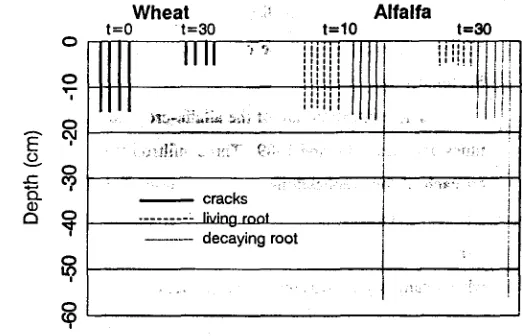
The t=0 dye application resulted in dye-stained cracks that, when observed by
looking directly down at the soil surface, appeared distributed in the horizonal plane.
The exposed, vertical face from the adjacent pit revealed that the dyed soil at 6-cm
depth contained short stained vertical lines of less than 3-cm length. The stained lines
were wide in several places, which gave the impression of cracks that had filled with
dye. Several of these dyed soil cracks were found at a depth of 12 cm, but none were
found below the 15-cm depth. The maximum depth of the cracks was quite uniform,
ranging between 12 and 15 cm (Fig. 1). The cracks were not as deep as was initially
expected, perhaps because of an earlier irrigation of the maturing wheat, which gave
insufficient time for the soil to dry.
The t=30 dye application did not generate dyed soil below the surface except
in 3-cm deep cracks which had formed in the time between the irrigation and sampling
events. These cracks received dry, dye-stained soil particles blown in by the wind.
We were able to verify that the dye was a consequence of wind, rather than of water
flow, by carefully peeling the soil peds and noting the lack of adsorbed dye. A less
concentrated dye solution might reduced the excess dye that accumulated as dry
particles at the soil surface. The high concentration of the dye at the soil surface was
I I II 11! 1 1 ; I !I! 11 !
11i.-cracks !
living rnnt decaying root
0
0
1
.c
a) 0
0
2660 MITCHELL, ELLSWORTH, AND MEEK
Wheat Alfalfa
t=0 t=30 t=10 t=30
FIGURE 1. Type and extent of dye-stained macropores per 0.1 m 2 as the average of three replicates.
There was no evidence of dye-stained macropores resulting from decayed root
channels in the wheat-stubble soil. The small wheat roots were ineffective in
producing macropores in swelling soil that persisted after a 3-month fallow period.
The wheat-stubble had preferential flow cracks 15-cm deep that closed within 30 min
of flooding. No root-induced preferential flow was found in the wheat.
Dye Applied to Alfalfa Field
In contrast to the single mechanism of dye transport in the wheat-cropped soil (i.e. cracks), the alfalfa-cropped soil had two additional mechanisms of transport.
Three types of soil staining were found in the alfalfa soil, which were associated to
their respective transport mechanisms as follows: dye-stained soil from cracks that eventually swelled shut, stained soil in earthworm tunnels, and stained soil along root
channels. Because no dye stains were found in cracks within 5 cm of the surface for both the t=10 and t=30 min applications, we concluded that any antecedent cracks
were either closed shut with 10 min of ponding or were isolated from water flow
Live earthworms were observed during sampling of the alfalfa soil, unlike the
wheat stubble soil. Dye was found coating small aggregates inside the earthworm
tunnels, but the tunnel walls were not stained. Rather, the dye was found only on the
aggregates, which were identified as earthworm casts. Evidently, earthworms
swallowed the dye, then excreted it as they tunnelled through the soil. None of the
tunnels had an abundance of dye that might have indicated a persistence of the channel
during irrigation. We concluded that earthworm channels were not stable macropores
for water flow for this soil, and that the observed dye in earthworm tunnels was from
excrement. The dye is not known to be toxic to earthworms.
Macropores near living roots were involved in preferential water flow near the
soil surface (Fig. 1). Dye residues were found in the soil bordering the bulky root top,
or crown, to a depth of 16 cm. More dye residues were observed on sides of the peds
that were bordered by the root crowns and lateral roots. The stained ped faces were
less than 5-cm long on a side. Below the 16-cm depth, no dye residue was found near
any living alfalfa roots. For the t=30 application, no dye was found below 5 cm (Fig. 1), which demonstrated the temporary state of cracks adjacent to living roots. Water
flow adjacent to living roots may be attributed to either (i) the presence of a saturated
film of water on the outside of roots, or (ii) preferential flow in stable pores caused
by the soil-aggregating influence of the roots, or (iii) the soil and root shrinkage prior
to irrigation that produced an adjacent void. Because Meek et al. (1989) found no
dye transport along living roots in a non-swelling soil (using the same dye), we
deduce that the third explanation--shrinkage was responsible for dye transport around
the tap roots. Also supporting this theory is the reduced length of living-root cracks
at t=30 (Fig. 1). Having established soil shrinkage to be the mechanism of dye
transport around living alfalfa roots, we now turn to decaying roots.
The decaying roots of alfalfa, unlike those of senescent wheat, provided
effective channels for the flow of water to lower depths during ponded soil conditions
on a swelling soil. Dye-stained, decaying alfalfa roots were found in all of the
infiltrometer plots. The dye appeared both within the epidermis of the decaying root
2662 MITCHELL, ELLSWORTH, AND MEEK
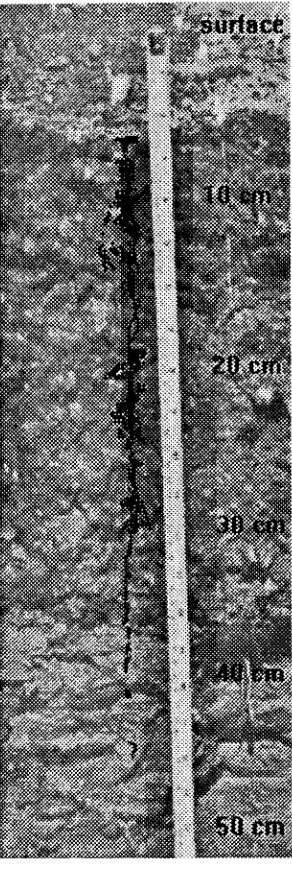
FIGURE 2. Horizontal view of alfalfa root with enhanced, blackened, images of the dye stains marking the macropore faces. The tape measure indicates
ped face, indicating that water flowed outward from the decaying taproot into soil
cracks. Transport of dye along decaying root channels was observed to depths in
excess of 55 cm, which was below the clay soil horizon into the silt layers of the
Holtville silty clay. The decaying alfalfa roots acted as stable macropores and
effectively transmitted both water and dye after 30 min of ponding.
Late summer root decay has been identified as the macropores involved in
preferential flow in other alfalfa cropping situations (Barley, 1954). Meek et al.
(1989) showed increased infiltration rates in late summer to correspond with the
presence of decaying roots. There is a major distinction between the soil properties
of this and the earlier studies cited. Whereas the decayed root holes persisted into the
next cropping cycle (Meek et al., 1990) for a non-swelling soil, this study's swelling,
labile, soil closed the cracks and worm holes during irrigation. Dye was only found
in root holes with woody decaying organic matter that stabilized them against the
pressures of the expanding soil. No pores devoid of root remains were found. Hence,
we deduce that the enhanced macropore flow caused by decaying roots is only
transitory in the Holtville silty clay, that is, until the root tensile strength is to weak
to resist swelling forces. This soil's instability results from low organic matter content
combined with a silty clay texture and the smectite mineralogy which induces
swelling.
In Situ Infiltration Rates under Alfalfa
The temporary decaying-root macropores can, however, have a large impact
on the soil final infiltration rate. Table 1 shows the October 1989 infiltration rate,
measured after dye sampling, compared to earlier infiltration rate measurements taken
under similar initial water content conditions. The final infiltration rate was not
significantly different between treatments. However, the infiltration rate for both
treatments was more than twice as high in October 1989 than for the previous
measurements. The increase in infiltration rate can be attributed to the decaying-root
macropores. Meek et al. (1989) found similar infiltration increases as alfalfa matured,
although the sandy loam soil in their study had much greater infiltration rates than the
2664 MITCHELL, ELLSWORTH, AND MEEK
TABLE 1. Final infiltration rates for grower and no traffic alfalfa treatments. Row
and column values followed by the same letter are not significantly different at the a=0.05 probability level.
Treatment
Date Grower No Traffic
--mm 11'
--1.36a 1.43a 1.58a 3.52b May 1986
Oct 1986 May 1987 Oct 1989
--mm h"'
1.52a 1.32a 1.33a 3.23b
CONCLUSIONS
The dissection of a dye-stained pores in swelling soil showed that cracks
enable macropore flow, but only with 10 min of the start of flood irrigation. Alfalfa
produced stable macropores along living roots and decaying root channels, while
wheat did not. Decaying alfalfa roots provided a temporary channel for macropore
flow. Cracks and earthworm channels did not remain open during irrigation because
of the lateral pressure of the swelling in the Holtville silty clay. To conclude, alfalfa
can influence water flow properties in both rigid and swelling soil, although the
magnitude of the effect will be greater for rigid soils, where swelling forces do not
close the macropores.
REFERENCES:
Barley, K.P. 1954. Effects of root growth and decay on the permeability of a synthetic sandy loam. Soil Sci. 78:205-210.
Davidson, M.R. 1985. Numerical calculation of saturated-unsaturated infiltration in a cracked soil Water Resour. Res. 21:709-714.
Disparte, A.A. 1987. Effects of root mass density on infiltration among four Mediterranean dryland forages and two irrigated legumes. M.S. Thesis, University of California, Riverside, CA.
Edwards, W.M., R.R. van der Ploeg, and W. Ehlers. 1979. A numerical study of the effects of non-capillary sized pores on infiltration. Soil Sci. Soc. Amer. J. 43 :851-856.
Ellsworth, T.R., W.A., Jury, F.R. Ernst, and P.J. Shouse. 1991. A three-dimensional field study of solute transport unsaturated, layered, porous media. 1. methodology, mass recovery and mean transport. Water Resour. Res. 27:951-965.
Gish, T.J., and W.A. Jury. 1983. Effect of plant roots and root channels on solute transport. Trans. ASAE 26SW:440-444,451.
Kidder, E.H., R.S. Staufter, and C.A. van Doren. 1943. Effect on infiltration of surface mulches of soybeans residues, corn stover, and wheat straw. Ag. Engineering 5:155-159.
Mannering, J.V. and C.B. Johnson. 1969. Effect of crop row spacing on erosion and infiltration. Agron. J. 61:902-905.
Meek, B.D., E.A. Rechel, L.M. Carter, and W.R. DeTar. 1989. Changes in infiltration under alfalfa as influenced by time and wheel traffic. Soil Sci. Soc.Amer. J. 53:238-241.
Meek, B.D., W.R. DeTar, D. Rolph, E.R. Rechel, and L.M. Carter. 1990. Infiltration rate as affected by an alfalfa and no-till cotton cropping system. Soil Sci. Soc. Amer. J. 54:505-508.
Mitchell, A.R. 1986. Polyacrylamide application in irrigation water to increase infiltration. Soil Sci. 141:353-358.
Mitchell, A.R., and R.V. Swain. 1987. Controlled traffic on alfalfa in the Imperial Valley -- a whole new ballgame? Proceedings, 17th California Alfalfa Symposium, Department of Agronomy and Range Science, Davis, CA.
2666 MITCHELL, ELLSWORTH, AND MEEK
Mitchell, A.R., and M. Th. van Genuchten. 1993. Flood irrigation of a cracked soil. Soil Sci. Soc. Amer. J. 57:490-497.
Oster, J.D. and M. J. Singer (eds.). 1984. Water penetration problems in California soils. Land Air and Water Resources Technical Report 10011. Davis, CA.
Perrier, E.R., A.J. MacKenzie, and R.P. Zimmerman. 1974. Physical and chemical properties of major Imperial Valley soils. Rep. ARS-W-17. USDA-ARS West. Reg., Berkeley, CA.
Ritchie, J.T., D.E. Kissel, and E. Burnett. 1972. Water movement in undisturbed swelling clay soil. Soil Sci. Soc. Amer. Proc. 36:874-879.