R E S E A R C H
Open Access
Three-axes error modeling based on
second order dual numbers
Michal Holub
1, Jaroslav Hrdina
2, Petr Vašík
2*and Jan Vetiška
1*Correspondence:
2Institute of Mathematics, Faculty of
Mechanical Engineering, Brno University of Technology, Brno, Czech Republic
Full list of author information is available at the end of the article
Abstract
The aim of the paper is to employ the dual numbers in the multi axes machine error modelling in order to apply the algebraic methods in computations. The calculus of higher order dual numbers allows us to calculate with the appropriate geometric parametrization effectively. We test the model on the phantom data based on the real machine tool. The results of our analysis are used for the geometric manufacturing accuracy description of the work space, together with the reduction of the measuring time.
MSC: 20H25; 15B10; 70B10
Keywords: matrices; dual numbers; kinematics; error modeling
1 Introduction
Machining centres (MCs) belong to the group of production machines, which require high performance, manufacturing accuracy, reliability, safety, etc. With growing demands on manufacturing quality of components for the aerospace, power and pharmaceutical (med-ical) industry, an increasingly greater emphasis is placed on control and growth of man-ufacturing eligibility. This is influenced by manman-ufacturing accuracy of the machine tool, i.e. mainly by its geometric accuracy. Geometric accuracy belongs to the group of quasi-static errors that constitute -% of the total error of the machine tool []. Apart from geometric errors, these quasi-static errors also include kinematic and thermal errors, []. For long-term sustainability of manufacturing accuracy (manufacturing eligibility), it is necessary to pay attention to the mount of MT on a suitably rigid base, to set up the machine to the required geometric accuracy and next, considering the needs and require-ments, to apply the appropriate software compensations. In the phase of machine tool use, various technologies for verification of machine tool eligibility are then deployed. For these measurements, the emphasis laid is on adequate measurement accuracy with the highest possible interpretation of the results and especially on short measurement times associated with the necessary MT shutdowns.
Different approaches to measurement, data processing and creation of models for gen-erating compensation tables are described in a number of scientific papers. For verification of the proposed models the most often used measuring instruments are the Ballbar-type apparatus [], the laser interferometer [–], the laser tracker [–], and the laser tracer [–]. Modelling of errors of machine tools is closely associated with the used instru-mentation. This implies a further procedure for the development of individual
ical models. A currently researched topic is modelling of volumetric accuracy of machine tools with various kinematic structures. The aim of this research is to use mathematical models to create the so-called map of machine tool accuracy and to utilize the acquired de-viations suitable for the relevant software compensation of machine tools. Error modelling of machine tools has been for long time subjected to intensive research. The most common approach to the model creation, based on rigid body kinematics and transformations of coordinates between the individual rigid bodies, is a homogeneous transformation matrix (HTM). HTM modelling is described for various kinematic chains of machining centres in publications [, –].
To achieve relevant results, it is necessary to obtain measurement data free of thermal influence because this influence caused by the change in internal and external ambient conditions may invalidate the measurement by thermal deformation of the machine, but also by the very process of measurement. For this reason, it is necessary to complete the measurements in the shortest possible time interval under stable conditions. In manufac-turing facilities, especially in large machining centres, it is almost unrealistic to maintain constant ambient conditions. Therefore the obtained results on the state of the machine may be distorted both due to thermal deformations of the machine and also due to tem-perature change of ambient air [].
Information on “geometric behaviour” of small and large CNC MTs can be obtained by various approaches. One of the variants is to machine a test component; this will enable an assessment of machine tool eligibility. The second variant is based on direct measurement of geometrical deviations. This variant is less desirable from the perspective of users; the reason is a necessary machine tool shutdown.
If we intend to analyse the entire working space of MT and obtain an error map, the mea-surements will be very time-consuming. To meet the requirement on minimum time de-mands with the aim to create a map of machine tool errors, it is recommended to propose a suitable methodology of measuring and processing of the obtained data. This method-ology is not only dependent on the size of MT working space, but also on the kinematic chain between the workpiece and the tool and also on the measuring device used.
2 Algebraic approach
In [] we discussed the methodology of multi-axis machines geometric error modelling in the context of modern theory of Weil algebras, []. When composing the kinematic chain containing geometric errors, we embed the error matrix corresponding to any kine-matic joint, i.e. the errors of the joint translation or rotation. In particular, for the transla-tion in the directransla-tion of vector (x,y,z) or for the rotation around thezaxis by the angleγ, the following error matrices apply, respectively, [, ].
⎛ ⎜ ⎜ ⎜ ⎝
–α β x
α γ y
–β –γ z
⎞ ⎟ ⎟ ⎟ ⎠
×
⎛ ⎜ ⎜ ⎜ ⎝
–αcos(θ+γ) –βsin(θ+γ) αsin(θ+γ) –βcos(θ+γ)
α cos(θ+γ) –sin(θ+γ)
–β sin(θ+γ) cos(θ+γ)
The parametersα,βandγ represent the error rotations around the axesz,yandx, respec-tively, andθgives the proper rotation around the axisz. The error matrices were derived from the rotation matrices around particular axes by approximation. More precisely, for the rotation around axisxthe error matrix is approximated as follows:
⎛ ⎜ ⎜ ⎜ ⎝
cosα –sinα sinα cosα
⎞ ⎟ ⎟ ⎟
⎠
⎛ ⎜ ⎜ ⎜ ⎝
–α α
⎞ ⎟ ⎟ ⎟ ⎠.
Thuscosα andsinαα. In the case that two approximations are multiplied, the whole term vanishes. This is caused by the assumption that the errors are by order smaller than the proper rotation parameters. The above mentioned representation is a standard description of the error matrices to be embedded into the kinematic chain and the corre-sponding kinematic equations which are to be solved within the error analysis. Generally, in the case of the system of linear equations, we proceed by Gauss elimination, for non-linear systems we use Gröbner bases. Thus in our matrix calculations we use the identities αiβj= ,αiγj= andβiγj= for alli,j∈ {, }, which resemble the identities for the imag-inary parts of the dual numbers. Thus it makes sense for the whole theory to work with so-called homogeneous matrices over the dual numbers as transformation matrices. More precisely, in error modelling the setSO(,D) of the special orthogonal matrices over the dual numbers are involved, see [].
From the algebraic point of view, the dual numbersDextend the real numbers by ad-joining one new elementιwith the propertyι= (ιis nilpotent). The set of dual numbers forms a particular two-dimensional commutative unital associative algebra over the real numbers. Every dual number can be represented as
z=a+bι
uniquely determined by real numbersa(real part) andb(imaginary part). Division of dual numbers is defined whenever the real part of the denominator is non-zero. The division process is analogous to complex division, i.e. the denominator is multiplied by its conju-gate in order to cancel the non-real part. In paper [] we proved the set of theorems about special orthogonal matrices over dual numbers. For example, in the case × matrices, we have the following theorem which describes the class of matrices involved in the error modelling:
Theorem . Let A+Bι∈SO(,D).Then A+Bιis in the following form:
cos(ϕ) –ksin(ϕ)ι –sin(ϕ) –kcos(ϕ)ι sin(ϕ) +kcos(ϕ)ι cos(ϕ) –ksin(ϕ)ι ,
whereϕ∈ , πand k∈R.
complexity in calculations, we recall the following concept: algebra of second order dual numbersD
is defined as a set
D =
a+aι+aι|ai∈R
together with the sum by parts and multiplication moduloι= . In particular,D can be defined as a factor space
D =R[ι]/
ι.
To apply this concept to the kinematic chain, the matrix representation ofDis used, see []. Note that in this setting the dual numbers can be understood as the dual numbers of the first orderD:=D
.
The theory of matrices over the algebraD
is much more sophisticated, some results can be found in [], e.g. the description of the relevant × matrix class equivalent to the one mentioned in Theorem . is the following:
Theorem . If A+Bι+Cι∈SO(,D)then
A=
cos(ϕ) –sin(ϕ)
sin(ϕ) cos(ϕ) , B=
–ksin(ϕ) –kcos(ϕ) kcos(ϕ) –ksin(ϕ) ,
C=
–k cos(ϕ) ksin(ϕ) –ksin(ϕ) –k cos(ϕ) .
Our results differ from the classical error modelling theory by admitting the second order errors, i.e. the terms of the formεxyεxzare considered as non-zero. The reason of neglecting the terms of the form εxyεxz but accepting the termsxεxyεxz in classical ap-proach comes from the unit analysis. Yet the computation itself is then provided in a non-associative algebra. Indeed,
= (xεxy)εxz= x(εxyεxz) =x· = .
Thus compared to classical theory, our approach considers more terms to be non-zero which makes the result even more accurate, furthermore, the calculations are modelled in associative algebra which is much more suitable for computer modelling.
3 Virtual three-axis machine
Figure 1 MCV 754 QUICK.
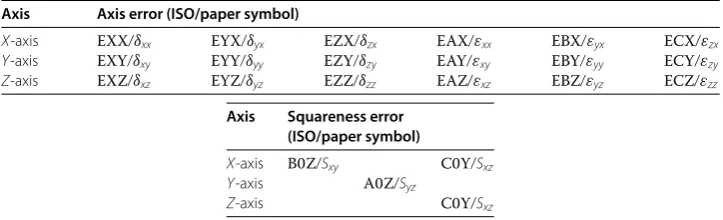
Table 1 Parametric errors for three-axis MT
Axis Axis error (ISO/paper symbol)
X-axis EXX/δxx EYX/δyx EZX/δzx EAX/εxx EBX/εyx ECX/εzx Y-axis EXY/δxy EYY/δyy EZY/δzy EAY/εxy EBY/εyy ECY/εzy Z-axis EXZ/δxz EYZ/δyz EZZ/δzz EAZ/εxz EBZ/εyz ECZ/εzz
Axis Squareness error (ISO/paper symbol)
X-axis BZ/Sxy CY/Sxz Y-axis AZ/Syz
Z-axis CY/Sxz
Working space of three-axis milling machine is defined by Cartesian coordinate sys-temX,Y,Zin the kinematic chain WXYZT (workpiece-tool, W - Workpiece, T - Tool). A computation of “virtual model” and error map is based on parametrization of the in-dividual geometric errors of the machine tool. A three-axis milling machine enables to identify a total of parameters of geometric errors (see Table ). These errors are defined for each translational axis where each of translational axes has six geometrical deviations. According to ISO, the deviations of theX-axis are designated as EXX, EYX, EZX, EAX, EBX, and ECX. These errors also take into account squareness deviations between two axes, e.g. betweenXandY- CY. This is a total of × errors for translational axes and three squareness errors of the individual axes.
When creating a virtual model, it was necessary to divide the working space WS into in-dividual parts of MS due to the non-linear behaviour of some geometric errors. A sample linear behaviour of EXX error and non-linearity of EZX on WS can be seen in Figure . The measured data were obtained on the test demonstrator with “tracking laser interfer-ometer”, Figure .
On the basis of determined non-linear behaviour of geometric errors of demonstrator, it was necessary to parametrize the working space of geometric errors. This model showed large deviations of error map caused by non-linearity of measured geometric er-rors. For this reason, the working space was divided into smaller segments (MS), see Ta-ble , where only seven of the assessed geometric errors (EYY, EAY, EZX, EYX, EZY, EXY, EXZ) exhibit non-linear behaviour. Such a number of geometric errors in the simulation further appear to be plausible.
Figure 2 Configurations of tracking laser interferometer.
Table 2 Adjusted space in the machine coordinate system with the start-CP
Axis Start-CP [mm] End [mm] Length [mm]
X-axis 300 450 150
Y-axis 200 300 100
Z-axis –200 –50 150
Figure 3 Error model on configuration space.
Figure 4 Phantom data.
Figure 5 X-Y,X-ZandY-Zprojection planes of the phantom data.
accuracy of our method, we use the phantom data generated on the configuration space ××. The appropriate error vectors with coordinates formed by the differences dx, dyand dzare shown on Figures and .
4 Error modelling
In order to calculate the parameters conversely, we have to proceed in several steps. First, for the machine in question we determine the kinematic chain and substituteδandεin the resulting matrix by the appropriate linear parametrizations. Then if we let the modified matrixTact on the vector
X=
⎛ ⎜ ⎜ ⎜ ⎝
⎞ ⎟ ⎟ ⎟ ⎠,
we obtain the real position of the vector ( )Twhich is consequently subtracted from the ideal image position, i.e. from the vector
X=
⎛ ⎜ ⎝
x y z
and thus the difference vector X= ⎛ ⎜ ⎝ x y z ⎞ ⎟ ⎠ is established.
In our particular case we use the following kinematic chain which contains error matri-ces corresponding to deviations caused both by the machine mechanics and by the ma-chine errors. Let us consider the following kinematic chain for three-axis mama-chines:
T = ⎛ ⎜ ⎜ ⎜ ⎝
x ⎞ ⎟ ⎟ ⎟ ⎠ ⎛ ⎜ ⎜ ⎜ ⎝
–εzxι εyxι δxxι εzxι –εxxι δyxι –εyxι εxxι δzxι ⎞ ⎟ ⎟ ⎟ ⎠ ⎛ ⎜ ⎜ ⎜ ⎝ y ⎞ ⎟ ⎟ ⎟ ⎠ × ⎛ ⎜ ⎜ ⎜ ⎝
–εzyι εyyι δxyι–Sxyy εzyι –εxyι δyyι –εyyι εxyι δzyι
⎞ ⎟ ⎟ ⎟ ⎠ ⎛ ⎜ ⎜ ⎜ ⎝ z ⎞ ⎟ ⎟ ⎟ ⎠ × ⎛ ⎜ ⎜ ⎜ ⎝
–εzzι εyzι δxzι–Sxzz εzzι –εxzι δyzι–Syzz –εyzι εxzι δzzι
⎞ ⎟ ⎟ ⎟ ⎠ ⎛ ⎜ ⎜ ⎜ ⎝ L ⎞ ⎟ ⎟ ⎟ ⎠.
The above mentioned parametrization is realized by the choice of constants of linear-ity for the expression of the displacement errors in the given direction and of the rotation errors. The displacement errors in the other directions than the one of the actual displace-ment are calculated by means of Abe principle. Thus we recall the following parametriza-tion:
δxx=ax, δyy=by, δzz=cz,
δyx= f x
, δ zy=
g y
, δ yz=
h z
,
δzx= f
x , δ
xy= g
y , δ
xz= h
z ,
εyx=fx, εxy=gy, εxz=hz,
εzx=fx, εzy=gy, εzz=hz,
εxx=fx, εyy=gy, εyz=hz.
In fact, our goal is to reconstruct the parameters from the phantom data measured on the axisx,y, andz. The first goal is to express the differences by means of the following parameters
which are to be calculated consequently by the least square method. By comparison of the result with the ideal values, the following three equations are given.
x= –Sxyy–Sxzz+
ax+L(fx+gy+hz) +z(fx+gy) –Syzz(–fx–gy)
–fxy–fx+ gy
–gy+ hz
–hz
ι+ [· · ·]ι,
y= –Syzz+
by+fx
–Sxzz(fx+gy) –fSxyxy+fx+L(–fx–gy–hz)
+z(–fx–gy) +gy+ hz
+hz
ι+ [· · ·]ι,
z=
cz–Sxzz(–fx–gy) +fSxyxy–fx+fx
–Syzz(fx+gy)
+fxy+fx+ gy
+gy–gy+hz–hz
ι+ [· · ·]ι.
In what follows, for the sake of simplicity, the coefficients ofι are omitted. Clearly, it is possible to handle the elements of different orders separately or jointly. Note that another advantage of our approach is that the errors of particular orders can be recognized and separated during the calculation.
If these equations are reformulated in the way that the parameters
a,b,c,f,f,f,g,g,g,h,h,h
are understood as the variables and the functions ofx,y,zform their coefficients. The valueLis given by the machine construction and the squareness errorsSxy,Syz andSxz are constant within the whole workspace and assumed to be known. Forxwe have the variables
h,h,g,g,f,f,a,gh,gh,gh,gh,fh,fh,
fg,fg,fh,fh,fg,fg,cg,cf,bf
with the appropriate coefficients. For instance, the coefficient offgis in the form xy and for fg the appropriate multiplier isSxzxyz. For the choice x∈, . . . , , y= and z= we obtain the matrix of the dimension ×, where the rows represent different choices ofxand the right hand side of the system is given by the actual differencexat (x,y,z). To this matrix, we find the Moore-Penrose inversion and calculate the coefficients in question consequently. The same procedure onyandzis applied and the resulting error parameters are used for graphical demonstration of the predicted deviations, see Fig. .
5 Conclusion
Figure 6 X-Y,X-ZandY-Zprojection planes of the results.
such part of the MS space where the errors are approximately linear. Consequently, we calculate the linear parameters in question classically by means of the Moore-Penrose in-verse matrix with the modification based on the calculus of the dual numbers formulated in []. Our aim is to both predict the machine tool behaviour and to use the measured data for the correct description of its possible states. The main contribution of our calcula-tion proposal is the reduccalcula-tion if the number of inputs that are necessary to measure within the machine working space. This leads to significant reduction of the machines shutdown time needed for the data collection. Furthermore, it is possible to use more elementary measurement tools like laser interferometer, the price of which is remarkably lower than that of the Laser TRACER, which was used within this publication. The disadvantage of the proposed algorithm is the assumption on the errors linearity behaviour. This ques-tions the suitability for small and middle-sized machines. On the other hand, the error linearity of particular geometric errors can be expected for large machines. We conclude that, based on the provided graphs, for such machines our results are highly applicable.
Competing interests
The authors declare that they have no competing interests.
Authors’ contributions
All authors contributed equally to the writing of this paper. All authors read and approved the final manuscript.
Author details
1Institute of Production Machines, Systems and Robotics, Faculty of Mechanical Engineering, Brno University of
Technology, Brno, Czech Republic.2Institute of Mathematics, Faculty of Mechanical Engineering, Brno University of
Technology, Brno, Czech Republic.
Acknowledgements
The authors were supported by the project NETME CENTRE PLUS (LO1202). The results of the project NETME CENTRE PLUS (LO1202) were co-funded by the Ministry of Education, Youth and Sports within the support programme “National Sustainability Programme I”.
Received: 11 May 2015 Accepted: 3 November 2015 References
1. Eman KF, Wu BT, DeVries MF. A generalized geometric error model for multi-axis machines. CIRP Ann. 1987;36(1):253-6.
2. Srivastava AK, Veldhuist SC, Elbestawlt MA. Modelling geometric five-axis and thermal CNC machine errors in a tool. Int J Mach Tools Manuf. 1995;35(9):1321-37.
3. Chen J, Lin S, He B. Geometric error measurement and identification for rotary table of multi-axis machine tool using double ballbar. Int J Mach Tools Manuf. 2014;77:47-55.
4. Ibaraki S, Sato G, Takeuchi K. ‘Openloop’ tracking interferometer for machine tool volumetric error measurement -two-dimensional case. Precis Eng. 2014;38(3):666-72.
5. Jung J-H, Choi J-P, Lee S-J. Machining accuracy enhancement by compensating for volumetric errors of a machine tool and on-machine measurement. J Mater Process Technol. 2006;174(1-3):56-66.
7. Knobloch J, Holub M, Kolouch M. Laser tracker measurement for prediction of workpiece geometric accuracy. In: Engineering Mechanics 2014 - 20th international conference; 2014. p. 296-300.
8. Aguado S, Samper D, Santolaria J, Aguilar JJ. Machine tool rotary axis compensation trough volumetric verification using laser tracker. Proc Eng. 2013;63:582-90.
9. Aguado S, Samper D, Santolaria J, Aguilar J. Identification strategy of error parameter in volumetric error compensation of machine tool based on laser tracker measurements. Int J Mach Tools Manuf. 2012;53:160-9. 10. Schwenke H, Schmitt R, Jatzkowski P, Warmann C. On-the-fly calibration of linear and rotary axes of machine tools
and CMMs using a tracking interferometer. CIRP Ann. 2009;58(1):477-80.
11. Brecher C, Flore J, Haag S, Wenzel C. High precision, fast and flexible calibration of robots and large multi-axis machine tools. In: 9th international conference on machine tools, automation, robotics and technology; 2012. 12. Schwenke H, Franke M, Hannaford J, Kunzmann H. Error mapping of CMMs and machine tools by a single tracking
interferometer. CIRP Ann. 2005;54(1):475-8.
13. Linares J-M, Chaves-Jacob J, Schwenke H, Longstaff A, Fletcher S, Flore J, Uhlmann E, Wintering J. Impact of measurement procedure when error mapping and compensating a small CNC machine using a multilateration laser interferometer. Precis Eng. 2014;38(3):578-88.
14. Brecher C, Flore J, Schwenke H, Wenzel C. Universal approach for machine tool testing independent of axis configuration. In: 9th international conference on machine tools, automation, robotics and technology; 2012. 15. Tian W, Gao W, Chang W, Nie Y. Error modeling and sensitivity analysis of a five-axis machine tool. Math Probl Eng.
2014;2014:745250.
16. Ibaraki S, Oyama C, Otsubo H. Construction of an error map of rotary axes on a five-axis machining center by static R-test. Int J Mach Tools Manuf. 2011;51(3):190-200.
17. Uddin MS, Ibaraki S, Matsubara A, Matsushita T. Prediction and compensation of machining geometric errors of five-axis machining centers with kinematic errors. Precis Eng. 2009;33(2):194-201.
18. Tian W, Gao W, Zhang D, Huang T. A general approach for error modeling of machine tools. Int J Mach Tools Manuf. 2014;79:17-23.
19. Lopez de Lacalle N, Lamikiz Mentxaka A. Machine tools for high performance machining. Berlin: Springer; 2009. 20. Lamikiz A, López de Lacalle LN, Ocerin O, Díez D, Maidagan E. The Denavit and Hartenberg approach applied to
evaluate the consequences in the tool tip position of geometrical errors in five-axis milling centres. Int J Adv Manuf Technol. 2008;37:122-39.
21. Tan B, Mao X, Liu H, Li B, He S, Peng F, Yin L. A thermal error model for large machine tools that considers environmental thermal hysteresis effects. Int J Mach Tools Manuf. 2014;82-83:11-20.
22. Hrdina J, Vašík P. Dual numbers approach in multiaxis machines error modeling. J Appl Math 2014;2014:261759. doi:10.1155/2014/261759.
23. Kureš M. Weil algebras associated to functors of third order semiholonomic velocities. Math J Okayama Univ. 2014;56:117-27.
24. Díaz-Tena E, Ugalde U, López de Lacalle LN, de la Iglesia A, Calleja A, Campa FJ. Propagation of assembly errors in multitasking machines by the homogenous matrix method. Int J Adv Manuf Technol. 2013;68(1-4):149-64. 25. Soons JA, Theuws FC, Schellekens PH. Modeling the errors of multi-axis machines: a general methodology. Precis
Eng. 1992;14(1):5-19.