R E S E A R C H A R T I C L E
Open Access
Bedside PDA ligation in premature infants
less than 28 weeks and 1000 grams
Mustafa Kemal Avsar
1*, Tolga Demir
2, Cem Celiksular
3and Cenap Zeybek
4Abstract
Background:PDA(Patent ductus arteriosus) is a common and clinically important condition which is presented with a number of hemodynamic and respiratory problems such as intraventricular hemorrhage, pulmonary hemorrhage and necrotizing enterocolitis due to increased pulmonary blood flow and stealing from systemic circulation. The incidence of PDA among the infants that were born before the 28th gestational week is as high as 70 %; and spontaneous closure rates in very-low-birth-weight premature neonates(VLBWPN) is around 34 %. The onset, duration, and repeat number of consecutive courses of the prostaglandin synthesis inhibitor medication for PDA closure are still issues of debate. Bed-side PDA closure is a safe surgical procedure in both mature and premature babies. Here we aim to retrospectively present our 26 cases which were less than 28 weeks and 1000 grams that underwent bed-side PDA ligation.
Methods:This retrospective study included 26 VLBWPN with PDA that underwent bed-side ligation between 2012 and 2015. Babies were born before the 28th gestational week (23–27 weeks) and less than 1000 grams (489–970 gr). Of the 26, 15 were female and 11 were male. Indomethacin was administered to all of the cases as the medical closing agent. The medication was stopped due to unwanted effects in 6 cases. All of the patients took medical treatment before surgery.
Results:No surgical mortality occurred during our study. One case of pneumothorax was recorded as late surgical complication. Five of the 26 patients were lost, and the most common cause of mortality was sepsis (in 3 cases). The remaining 21 cases were discharged on days 86–238. The follow-up periods of the patients were 2 moths - 3 years. The most frequent problems encountered after discharge was chronic lung problems.
Conclusions:Bed side PDA ligation surgery in the ICU is a safe method for VLBWPN with clinically significant PDA.
Keywords:Bedside surgery, Patent ductus arteriosus, Premature infant
Background
Patent ductus arteriosus (PDA) is a serious condition of premature low-birth-weight infants. The important con-sequences of increased pulmonary blood-flow and steal-ing from systemic circulation due to left-to-right shunt in PDA include numerous hemodynamic and respiratory problems, such as intraventricular hemorrhage, pulmon-ary hemorrhage, pulmonpulmon-ary edema, necrotizing entero-colitis, retinopathy, decreased renal functions and chronic lung disease [1]. The incidence of PDA among premature babies less than 28 weeks and 1000 grams is as high as 70 %, and the rate of spontaneous closure in
VLBWPN is about 34 %. The patency of arterial duct in prematurely born is brought about by several factors, including presence of lesser ductal medial muscles, rela-tive oxygen hyposensitivity of the immature tissues, and increased sensitivity to prostaglandins [2].
To achieve ductal closure, neonatologists administer several treatment approaches in preterm infants with symptomatic PDA, such as cautious fluid replacement, diuretics, and prostaglandin synthesis inhibitors like ibu-profen and indomethacin. In the cases of contraindica-tions for, or failure of medical treatment, surgical PDA ligation may be performed [3]. Timing of surgical inter-vention is still an issue of debate. Ko et al. advocate that ligation should be the treatment of choice for symptom-atic PDA because of the increased risks brought with * Correspondence:[email protected]
1Medicana International Istanbul Hospital Department of Cardiovascular
Surgery, Istanbul, Turkey
Full list of author information is available at the end of the article
indomethacin treatment and prolonged intubation in VLBWPN [4].
The pros and cons of bedside vs. operation room interventions were discussed in several literatures. Low-birth-weight premature infants are usually intubated, their thermoregulation systems are sensitive, and they need numerous monitorization and intravenous infusion implementations. Thus to eliminate the possible risks of transportation, many advanced institutions now prefer bedside PDA ligation [4–6].
Here, not without citing the relevant literature, we aim to present our bed-side PDA ligation experience in pre-mature infants less than 28 weeks and under 1000 grams with PDA, and related hemodynamic and pulmonary problems, in whom failure or complications of medical treatment had been encountered.
Methods
This study was conducted retrospectively, and in-cluded a total of 26 VLBWPN, who underwent bed-side PDA ligation between 2012 and 2015. Their birth weights were less than 1000 grams (480–970 gr), and the gestational ages at birth were less than 28 weeks (23–28 weeks).
Pre- and post-operative transthoracic echocardiog-raphy studies were performed by pediatric cardiologists. All infants were on mechanical ventilators, had cardiac failure, and received medication for cardiac failure. Cri-teria of clinically significant PDA were as follows: ductal diameter being above 1.5 mm, LA(left atrium)/Ao(aorta) ratio being above 1.4, presence of left-to-right shunt, reversal of end-diastolic blood flow in the aorta, and poor cardiac functions.
One indomethacin course included 0.2 mg/kg indo-methacin three times every 12 h. Following a single course of indomethacin, PDA closure was evaluated by echocar-diography. The cases without closure were given three additional courses of indomethacin. Side effects of indo-methacin were present in 6 cases, which thus did not re-ceive additional indomethacin medication after the first course. Those cases showed one or more of the following conditions: decreased urinary output (<0.5 ml/kg/h), high serum urea levels (>30 mg/dl), thrombocytopenia (<60,000/mm3), necrotizing enterocolitis, gastrointestinal bleeding, and intraventricular bleeding.
The bedside surgery team consisted of one cardiac sur-geon, one anesthesiologist, one neonatal intensive care specialist, one scrub nurse, and one circulating nurse. Operations were performed in neonatal incubators with removable side walls and roofs, which was important during the intervention. Head lamps and portable lamps provided the illumination. The room was heated to 37 Co preoperatively, and the head and extremities were covered to reduce heat loss. Following the anesthesia,
skin antisepsis was achieved appropriately with iodine solution, and soaking was avoided. The skin was covered with drape and limited left posterolateral thoracotomy was performed. The lungs were retracted anteriorly, and PDA was explored. PDA was ligatured with two 2-0 silk sutures using double ligation transfixion technique. One 8 FR drainage tube was placed in all cases. The ribs were adducted with 2-0 vicryl. The skin was closed separately with 5-0 prolene mattress sutures. No perioperative complication was encountered.
Results
The follow up duration of the patients were between 2 months and 3 years. Medical closure had been tried with one or more courses of ibuprofen of indomethacin in all of the patients. The cases in which either PDA was still open or medical treatment ceased due to complica-tions underwent surgery. No patient was operated with-out prior medical treatment.
Demographical characteristics of the patients are sum-marized in Table 1.
Inotropes were used in the cases with myocardial dys-function due to PDA and/or hypotension. The term sep-sis was used only for the cases confirmed by positive blood cultures. The babies with grade 3–4 intraventricu-lar bleeding were considered as severe intraventricuintraventricu-lar hemorrhage. Modified Bell criteria were used for the definition of necrotizing enterocolitis, and the cases being stage 2A or above were included in our analysis. Severe renal dysfunction was defined as having a blood urea nitrogen level of >150 μM/L, and having a urine output of <0.5 ml/kg/h during the last 12 h. Six of our
Table 1Demographical characteristics of the patients are summarized
Characteristic n= 26
Birth weight range 510–960
Gestational age weeks 23–28
Female 15 (57 %)
Respiratory distress syndrome 26 (100 %)
Inotropes 22 (84.6 %)
Mortality 5 (19.2 %)
Sepsis 20 (76.9 %)
Severe intraventricular hemorrhage 10 (38.4 %)
Necrotizing enterocolitis 7 (26.9 %)
Severe renal dysfunction 5 (19.2 %)
Retinopathy of prematurity 8 (30.7 %)
Another cardiac pathology 6 (23.0 %)
Chronic lung disease 16 (61.5 %)
Time on ventilator; days, minimum-maximum 1–181
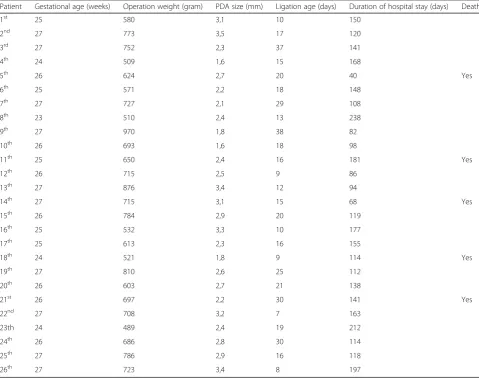
patients had another cardiac pathology (2 patients with complete atrioventricular canal defect, 2 patients with atrial septal defect, 2 patient with ventricular septal de-fect). Patent foramen ovale was not included in this group. All of the patients were intubated before the operation, thus preoperative intubation periods are not represented in our data. Similarly all of the babies had cardiac failure either compensated, or decompensated, which is also not included in our data on Table 1. PDA diameters, mortality data, operation times, and body weights on the operation day are shown separately on Table 2.
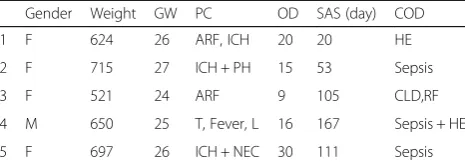
Only single courses of indomethacin were adminis-tered to the patients 1, 12, 16, 18, 22, and 26; and early PDA ligation operations were performed. The remaining cases were given three courses of indomethacin. Only PDA diameters are shown here, leaving out other rele-vant PDA criteria. Except five, no postoperative mortal-ity was observed among the 26 patients that underwent bedside PDA ligation. Causes of mortality were demon-strated on Table 3.
Two of the 5 cases with mortality had hypoxic enceph-alopathy and had been resuscitated for cardiac arrest several times during the preoperative period. Postopera-tive surgical complication was observed only in one pa-tient, who developed pneumothorax. Twenty-one of the 26 cases that had been operated bedside were discharged on days 86–238. The most common problems encoun-tered after the discharge were lung related.
Discussion
Patent ductus arteriosus, which leads to significant hemodynamic, pulmonary, gastrointestinal, cerebrovas-cular, and retinal problems, can be medically or surgi-cally treated; although, there has been an ongoing debate on which method should be preferred.
PDA ligation is generally performed in the cases in which indomethacin or ibuprofen medication is unsuc-cessful or contraindicated. However, studies show that PDA closure rates with medical treatment are still low in VLBWPN. In the study by Trust et al., which included
Table 2PDA diameters, mortality data, operation times, and body weights on the operation day are shown separately
Patient Gestational age (weeks) Operation weight (gram) PDA size (mm) Ligation age (days) Duration of hospital stay (days) Death
1st 25 580 3,1 10 150
2nd 27 773 3,5 17 120
3rd 27 752 2,3 37 141
4th 24 509 1,6 15 168
5th 26 624 2,7 20 40 Yes
6th 25 571 2,2 18 148
7th 27 727 2,1 29 108
8th 23 510 2,4 13 238
9th 27 970 1,8 38 82
10th 26 693 1,6 18 98
11th 25 650 2,4 16 181 Yes
12th 26 715 2,5 9 86
13th 27 876 3,4 12 94
14th 27 715 3,1 15 68 Yes
15th 26 784 2,9 20 119
16th 25 532 3,3 10 177
17th 25 613 2,3 16 155
18th 24 521 1,8 9 114 Yes
19th 27 810 2,6 25 112
20th 26 603 2,7 21 138
21st 26 697 2,2 30 141 Yes
22nd 27 708 3,2 7 163
23th 24 489 2,4 19 212
24th 26 686 2,8 30 114
25th 27 786 2,9 16 118
infants under 800 g, the failure rates for PDA closure with indomethacin was found to be as high as 40–50 % [7]. In addition, indomethacin treatment in VLBWPN has numerous side effects such as necrotizing entero-colitis, bowel perforation, pulmonary edema and bleed-ing, retinopathy, thrombocytopenia, and decrease in renal functions [8]. Also there is a risk of reopening of the medically closed ductus, after the treatment [9].
Ibuprofen is as effective as indomethacin in PDA closure, with lower side effects on intestinal, renal, and cerebral blood flow. However, this drug deterio-rates the renal functions in premature infants less than 26 weeks more prominently [10]. We chose indomethacin for medical closure of PDA in our study. Upon the side effects encountered, we stopped the medical treatment and performed surgery in 4 of our cases. The most common side effects were thrombocytopenia, necrotizing enterocolitis, and de-creased renal functions.
There are still arguments about the potential side effects of the drugs that are used to treat clinically sig-nificant PDA in the newborn, their doses, duration of the treatment, and how many courses of medication should be performed; and also there are different opin-ions regarding the timing of surgical intervention [1, 11]. Considering the fact that the side effects of the drugs are more prominent in VLBWPN, we advocate early surgical ligation may be a better approach. The results from pre-vious studies by Grosfeld et al. and Cassady et al. sup-port our opinion, in which it was underlined that early surgery should be the treatment of choice in very low birth weight premature babies [12, 13]. Similarly, in their 2009 study conducted with 41 premature children, Ko et al. suggested early surgical ligation of PDA without medical treatment in VLBWPN should be done, in order to reduce the complications of PDA and medications [4]. In another ongoing study of us, we aim to compare the VLBWPN that underwent early PDA ligation without prior medical treat-ment, that took medical treatment successfully, that under-went surgical ligation after unsuccessful medical treatment,
and that underwent surgical ligation after reopening of the medically closed PDA.
Mortality and morbidity rates of surgical closure of PDA in premature babies are low [14]. Mortier et al. reported their experience in 33 premature infants with PDA who have been operated in their NICU(neonate intensive care unit) over a six-year period and they observed no operative or immediate postoperative deaths and reported hospital mortality was 6 % [15]. Likewise Ko et al. showed no mortality in 42 VLBWPN [4]. No surgical mortality occurred in our patients. Sur-gical ligation is accomplished through posterolateral thoracotomy. This method can lead to serious morbidity and mortality such as pneumothorax, chilothorax, infec-tions, paralysis of laryngeal nerve, respiratory failure, hemodynamic instability, bronchopulmonary dysplasia, retinopathy of the premature, and death [16]. No surgi-cal complication occurred during our study, except pneumothorax in one case.
Transcatheter treatment of patent ductus arteriosus can be used for patients of varying ages, except small ba-bies under 5 kg and small PDA [17]. Despite the ad-vancement in the procedure, there are many problems during performance of transcatheter PDA closure in in-fants: relatively large sheath size for small vessels, stiff-ness of the delivery system with resultant hemodynamic instability during device deployment, risk of protrusion of the device into the aorta or pulmonary artery, poor anchoring or stability within the PDA, and difficult retrievability [18, 19].
Currently babies can be safely operated in NICU envir-onment. The operations include gastrostomy, PDA ligation, tracheostomy, repairment of trachea-esophageal fistulae, laparotomies, repairment of abdominal wall de-fects, stroma closure, posthemorrhagic hydrocephalus surgery, and several urinary interventions [20]. The re-sults of our study supports that PDA ligation can be suc-cessfully performed in NICUs. One important issue is the experience of and harmony among the team mem-bers, namely neonatologist, anesthesiologist, surgical team members, nurses, and surgical technologists. As the experience and harmony levels promote, better suc-cess rates and shorter operation times can be achieved. Our first bed-side PDA ligation performance took 63 min from initial positioning of the baby to the end of the operation, while the same window of time decreased to 30 min in our last case. Another important point is the physical conditions of NICU. The side walls and roof of the infant incubators must be completely removable. In our opinion, the operations that were performed in NICU after transferring the baby to an open bed because of the incompatibility of the infant incubator should not be deemed as bed-side, because in those cases the po-tential risks of transportation can’t be eliminated Table 3Causes of mortality among the babies that underwent
PDA ligation
Gender Weight GW PC OD SAS (day) COD
1 F 624 26 ARF, ICH 20 20 HE
2 F 715 27 ICH + PH 15 53 Sepsis
3 F 521 24 ARF 9 105 CLD,RF
4 M 650 25 T, Fever, L 16 167 Sepsis + HE
5 F 697 26 ICH + NEC 30 111 Sepsis
GWgestational week;PCpreoperative condition;ODoperation date;PH
pulmonary hemorrhage;Tthrombocytopenia;ICHintracranial hemorrhage;RF
completely. Our operations were performed with ease in Giraffe® Incubator by General Electric’s Company fully-removable incubators. Also led lights, radiant heater, led head-lamps, neonatal respirator, suction system, multi-parameter monitor (with ECG, pulse oximeter, invasive/ noninvasive arterial monitorization, central venous pres-sure monitorization, and temperature monitorization, etc.), appropriate surgical tools for VLBW premature in-fants, nitrogen dioxide cylinder, and sevoflurane must be readily available in the NICU. Our bed-side PDA ligation interventions in LBW premature babies reduced the risks of transportation. Several possible adverse events during transportation such as hypothermia, trauma, dis-location of the tracheal tube, disdis-location of the vascular lines, and hemodynamic instability may lead to an in-creased morbidity in the VLBW premature. In all of our cases, PDA was successfully closed bed-side through posterolateral thoracotomy under general anesthesia in NICU, with no surgical mortality.
Conclusion
Bedside PDA ligation in the NICU is a safe method for VLBWPN with physiologically significant PDA. Accord-ing to the results of our study and our clinical experi-ence, early surgical ligation shall be the treatment of choice in VLBWPN with PDA, in order to minimize the possible complications of indomethacin and ibuprofen medications, prolonged intubation, and PDA itself; al-though, medical closure with these drugs was attempted in all of the cases in our study. In addition, we would like to underline as a conclusion that, whenever appro-priate NICU conditions and an experienced team is available, bedside PDA ligation is definitely the best choice for the treatment of whether VLBWPN, or ma-ture neonates, in accordance with the results of our studies and the current literature.
Abbreviations
NICU:Neonate intensive care unit; PDA: Patent ductus arteriosus; VLBWPN: Very-low-birth-weight premature neonates
Acknowledgments
We have no financial interest or conflict of interest in association with this work. This manuscript has not been published previously and is not being considered for publication by another journal. All authors have read and approved the final manuscript.
Authors’contributions
MKA is the main author to design the study, write the article and submit the manuscript. CZ, CC, TD participated in reviewing the manuscript and helped the manuscript. All authors have read and approved the final manuscript.
Competing interests
The authors declare that they have no competing interests.
Author details
1
Medicana International Istanbul Hospital Department of Cardiovascular Surgery, Istanbul, Turkey.2Kolan International Hospital Department of
Cardiovascular Surgery, Istanbul, Turkey.3Medicana International Istanbul
Hospital Depratment of Anesthesiology, Istanbul, Turkey.4Medicana
International Istanbul Hospital Department of Pediatric Cardiology, Istanbul, Turkey.
Received: 17 February 2016 Accepted: 29 September 2016
References
1. Raval MV, Laughon MM, Bose CL, et al. Patent ductus arteriosus ligation in premature infants: Who really benefits, and at what cost? J Pediatr Surg. 2007;42:69–75.
2. Lago P, Bettiol T, Salvadori S, et al. Safety and efficacy of ibuprofen versus indomethacin in preterm infants treated for patent ductus arteriosus: a randomised controlled trial. Eur J Pediatr. 2002:161:202–7.
3. Lee LC, Tillett A, Tulloh R, Yates R, Kelsall W. Outcome following patent ductus arteriosus ligation in premature infants: a retrospective cohort analysis. BMC Pediatr. 2006;6:15.
4. Ko YC, Chang CI, Chiu IS, Chen YS, Huang SC, Hsieh WS. Surgical ligation of patent ductus arteriosus in very-low-birth-weight premature infants in the neonatal intensive care unit. J Formos Med Assoc. 2009;108(1):69–71. doi:10. 1016/S0929-6646(09)60034-6.
5. Eggert LD, Jung AJ, McGough EC, et al. Surgical treatment of patent ductus arteriosus in preterm infants—four year experience with ligation in the newborn intensive care unit. Pediatr Cardiol. 1982;2:15–8.
6. Metin K, Maltepe F, Kır M, Bilen Ç, Sökmen A, Oto Ö, Uğurlu B. Ligation of patent ductus arteriosus in low birth weight premature infants: timing for intervention and effectiveness of bed-side surgery. J Cardiothorac Surg. 2012;7:129.
7. Trus T, Winthrop AL, Pipe S, et al. Optimal management of patent ductus arteriosus in the neonate weighing less than 800 g. J Pediatr Surg. 1993;28: 1137–9.
8. Mercanti I, Boubred F, Simeoni U. Therapeutic closure of the ductus arteriosus: benefits and limitations. J Matern Fetal Neonatal Med. 2009;22: 14–20.
9. Sekar KC, Corff KE. Treatment of patent ductus arteriosus: indomethacin or ibuprofen? J Perinatol. 2008;28:60–2.
10. Bagnoli F, Rossetti A, Messina G, Mori A, Casucci M, Tomasini B. Treatment of patent ductus arteriosus (PDA) using ibuprofen: renal side-effects in VLBW and ELBW newborns. J Matern Fetal Neonatal Med. 2013;26(4):423–9. 11. Hansen TW. Patency of the ductus arteriosus in the newborn-Noyou w it,
want now you don’t. Pediatr Crit Care Med. 2007;8:302–3. 12. Grosfeld JL, Chaet M, Molinari F, et al. Increased risk of necrotizing
enterocolitis in premature infants with patent ductus arteriosus treated with indomethacin. Ann Surg. 1996;224:350–7.
13. Cassady G, Crouse DR, Kriklin JW, et al. A randomized controlled trial of very early prophylactic ligation of the ductus arteriosus in babies who weighed 1000 g or less at birth. N Engl J Med. 1989;320:1511–6.
14. Niinikoski H, Alanen M, Parvinen T, Aantaa R, Ekblad H, Kero P. Surgical closure of patent ductus arteriosus in very-low-birth-weight infants. Pediatr Surg Int. 2001;17:338–41.
15. Mortier E, Ongenae M, Vermassen F, Van Aken J, De Roose J, Van Haesebrouck P, et al. Operative closure of patent ductus arteriosus in the neonatal intensive care unit. Acta Chir Belg. 1996;96:266–8.
16. Clyman RI, Chome N. Patent ductus arteriosus: evidence for and against treatment. J Pediatr. 2007;150:216–9.
17. Quek SC, Santos D, Rajgor DD, Yu F, Grignani R. Comparison of outcomes and costs of transcatheter therapeuticıntervention and surgical ligation for the treatment of patent Ductus Arteriosus. Ann Acad Med Singapore. 2016; 45(6):256–8.
18. Ewert P. Challenges encountered during closure of patent ductus arteriosus. Pediatr Cardiol. 2005;26:224–9.
19. Dimas VV, Takao C, Ing FF, Mattamal R, Nugent AW, Grifka RG. Outcomes of transcatheter occlusion of patent ductus arteriosus in infants weighing⩽6 kg. JACC Cardiovasc Interv. 2010;3:1295–9.