Open Access
Research article
Can local application of Tranexamic acid reduce post-coronary
bypass surgery blood loss? A randomized controlled trial
Hosam Fawzy*, Elsayed Elmistekawy, Daniel Bonneau, David Latter and
Lee Errett
Address: Division of Cardiovascular and Thoracic Surgery, St. Michael's Hospital, University of Toronto, 30 Bond Street, Toronto, Ontario M5B 1W8, Canada
Email: Hosam Fawzy* - [email protected]; Elsayed Elmistekawy - [email protected];
Daniel Bonneau - [email protected]; David Latter - [email protected]; Lee Errett - [email protected] * Corresponding author
Abstract
Background: Diffuse microvascular bleeding remains a common problem after cardiac
procedures.
Systemic use of antifibrinolytic reduces the postoperative blood loss.
The purpose of this study was to examine the effectiveness of local application of tranexamic acid to reduce blood loss after coronary artery bypass grafting (CABG).
Methods: Thirty eight patients scheduled for primary isolated coronary artery bypass grafting were included in this double blind, prospective, randomized, placebo controlled study.
Tranexamic acid (TA) group (19 patients) received 1 gram of TA diluted in 100 ml normal saline. Placebo group (19 patients) received 100 ml of normal saline only. The solution was purred in the pericardial and mediastinal cavities.
Results: Both groups were comparable in their baseline demographic and surgical characteristics. During the first 24 hours post-operatively, cumulative blood loss was significantly less in TA group (median of 626 ml) compared to Placebo group (median of 1040 ml) (P = 0.04). There was no significant difference in the post-op Packed RBCs transfusion between both groups (median of one unit in each) (P = 0.82). Significant less platelets transfusion required in TA group (median zero unit) than in placebo group (median 2 units) (P = 0.03). Apart from re-exploration for excessive surgical bleeding in one patient in TA group, no difference was found in morbidity or mortality between both groups.
Conclusion: Topical application of tranexamic acid in patients undergoing primary coronary artery bypass grafting led to a significant reduction in postoperative blood loss without adding extra risk to the patient.
Published: 18 June 2009
Journal of Cardiothoracic Surgery 2009, 4:25 doi:10.1186/1749-8090-4-25
Received: 10 April 2009 Accepted: 18 June 2009
This article is available from: http://www.cardiothoracicsurgery.org/content/4/1/25
© 2009 Fawzy et al; licensee BioMed Central Ltd.
Introduction
Coagulopathy remains a common problem after coronary artery bypass Grafting (CABG) using cardiopulmonary bypass (CPB). It results from many factors like thrombo-cytopenia, acquired platelet dysfunction, clotting factors loss, free heparin, and increased fibrinolysis [1-3]. Lem-mer and Colleagues [4] found that extracorporeal circula-tion results in significant fibrinolysis, as reflected by increased concentrations of plasmin and fibrin degrada-tion products (FDP), both of which have deleterious effects on platelet function. Re-exploration for bleeding following cardiac surgery with CPB was reported to be in the range of 2–7%. Of these, 50–80% was found to be medical rather than surgical bleeding [5]. Fibrinolysis was found to be responsible for 25–45% of significant post bypass bleeding [6]. Many antifibrinolytic agents have been used to diminish post-bypass bleeding. These include ε Aminocaproic acid [5], aprotinin [7], and Tran-examic acid (TA) [8]. TranTran-examic acid has been found to bind to lysine binding sites of plasmin and plasminogen. Saturation of these sites displaces plasminogen from the fibrin surface thus inhibiting fibrinolysis [9]. TA has been used both systemically and topically. Intravenous TA administration increased the risk of thromoembolic com-plications and consequently early graft closure in coro-nary artery bypass grafting [10]. When used topically, TA was found effective in controlling bleeding in patients with hemorrhagic diathesis and in patients who were being treated with anticoagulants pre-operatively. Topical TA has also been successfully used in controlling bleeding in bladder, gynaecologic, oral, and otolaryngeal surgeries [11-13].
This prospective, double-blind, randomized, placebo-controlled study was designed to investigate the effect of topical TA in reducing postoperative blood loss after cor-onary artery bypass Grafting.
Methods
With institutional ethics committee approval, all patients scheduled for primary isolated elective CABG at North West Armed Forces Hospital, Tabuk, Saudi Arabia, during the period from March 2004 to November 2005, were scrutinized for eligibility enrolment. Our exclusions crite-ria included patients who had combined procedure; redo surgery, bleeding diathesis (Haemophilia or platelet count < 100 × 109 L-1), renal failure (Creatinine > 160 mg/
dl), known allergy to TA, recent (<7 days before surgery) intake of platelets (e.g. Aspirin, non-steroidal anti-inflammatory drugs) or Heparin administration within 48 hours of operation.
Thirty eight patients met the requirements for inclusion, and informed consent was obtained from all of them. The patients were randomly allocated into one of the two
groups. Group I (TA group) included 19 patients who received 1 gm of TA diluted in 100 ml normal saline. Group II (Placebo group) included 19 patients who received 100 ml normal saline as placebo. The solution was purred in the pericardial and mediastinal cavities before closure of the strenotomy while clamping the chest tubes. These clamps were released once the closure of the strenotomy was completed.
The study was carried out as a prospective randomized, double blind investigation. Randomization was carried out with random-number tables by a research pharmacist who prepared the two solutions in two identical bottles and delivered to the operating theatre. Neither the sur-geon, assistant, anaesthetist, scrub nurse nor the per-fusionist knew the composition of the solution administered. Only two cardiac surgeons were responsi-ble for the surgical haemostasis.
The anaesthetic management and conduct of CPB were standardized. The patients were premedicated using Nitrozepam 0.1 mg/kg tablet the night of the operation, and morphine 0.15 mg/kg intramuscular half an hour before operation. Induction was done using Fentanyl 2–5 ug/kg, Propofol 1–2 mg/kg, and Pancronium 0.1 mg/kg. Anaesthesia was maintained by using Sevoflurane 0.5– 1%, Pancronium 0.06 mg/kg, Fentanyl 1–2 ug/kg during cardiopulmonary bypass time. All patients received Heparin 300 units/Kg before CPB to achieve target acti-vated clotting time (ACT) of ≥ 480 seconds. During CPB, extra heparin was given as needed to maintain the target ACT. After separation from CPB, heparin was reversed using protamine sulphate in the dose of 1 mg/100 units of heparin to achieve target ACT 80–120 seconds.
After the patient was transferred to the intensive care unit (ICU), continuous low grade suction (10–15 cm H2O) was applied together with periodic milking of the drains. Haemoglobin level (Hb), Hematocrite value (Hct %), Platelet count, International Normalized Ratio (INR), Partial Thromboplastin time (PTT), and Fibrinogen level were measured before the operation and when the patients arrived at the intensive care unit. The drainage of the chest tubes was measured hourly and were removed when the total drainage volume of 80–100 ml over the previous12 hours and of serous color. Uniform transfu-sion protocol was applied to all patients. Blood and blood components were administered only when the hemat-ocrite level < 24% or the haemoglobin level ≤ 8.0 gm/dL in the postoperative period. Shed mediastinal blood was not transfused into any patient during this study.
ICU stay and the length of hospital stay (LOS) were recorded for all patients.
Statistical Analysis
Parametric data were analysed using 2-tailed unpaired stu-dent t test, and presented as mean ± standard deviation. Data analysis for blood loss and requirements for blood products was done using non-parametric tests (Mann-Whitney Rank Sum test) using Sigma Stat (v 3.5, Systat Software San Jose, California, USA), and expressed as median and range. Values of p less than 0.05 were consid-ered significant.
Results
Both groups were comparable with respect to baseline demographic data and there was no statistically signifi-cant difference in the prevalence of risk factors between both groups as shown in Table 1.
The two groups were matched with regard to intraopera-tive data; use of left internal mammary artery, average number of distal anastmoses, cross clamp time, cardiop-ulmonary bypass (CPB) time and duration of the opera-tion (Table 2). There was no bias in the distribuopera-tion of the anaesthesiologist and surgeons between the two groups. Pre and postoperative haemoglobin concentrations, hematocrit concentrations, platelet counts, international normalized ratio, partial thromboplastin times and fibrinogen level were not significantly different between the two groups (Tables 3 &4). Chest tube drainage in the
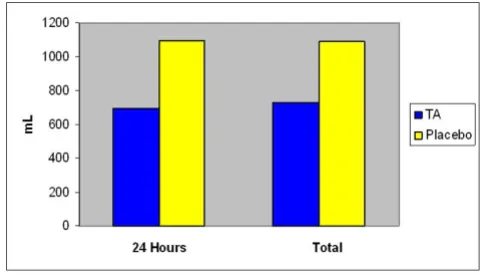
first 24 hours was significantly less in TA group (median of 626 ml) than in the placebo group (median of 1040 ml) (P = 0.04). This represented about 37% decrease in the blood loss. The median total post-operative chest tube drainage was 656 ml (range 248–2105) in TA group and 1056 ml (range 210–3010) in the placebo group, which represents 32% reduction in total bleeding (Figures 1 &2).
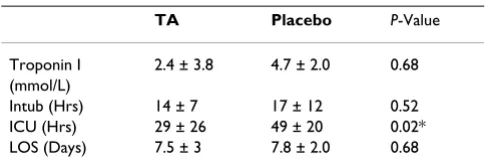
There was no significant difference in the post-op packed red blood cells (PRBCs) transfusion between both groups (median of one unit in each) (P = 0.82). Also there was no significant difference in regard Fresh Frozen Plasma (FFP) transfusion between both groups (median of zero unit in TA vs. two units in placebo) (P = 0.42). Significant more platelets transfusion required in the Placebo group (median 2 units) than in TA group (median zero unit) (P = 0.03) (Figure 3). Troponin I level recorded a lower level in TA group (2.4 ± 3.8) than Placebo group (4.7 ± 2.0) (P = 0.68). There was no post-op myocardial infarction encountered in either group. Although there was no dif-ference in intubation time between both groups, Placebo group patients stayed significantly longer in ICU (49 ± 20 Hrs) than the TA patients (29 ± 26) (P = 0.02). Total length of Hospital stay was comparable in both groups (Table 5). Apart from re-exploration for excessive surgical bleeding in one patient in the TA group (due to branch bleeding of one of the grafts), no difference was found in morbidity or mortality between the two groups. There were no deaths in either group.
Discussion
Intravenous use of aprotinin, tranexamic acid and amino-caproic acid has proved to be effective in decreasing post-operative bleeding in both primary and redo coronary artery bypass grafting. However, the risk of death is
con-Table 1: Patients' Demographics.
TA (n = 19) Placebo (n = 19) P-Value
Age (y) 55 ± 11 60 ± 7 0.17
M/F 18/1 18/1 1.0
Wt. (Kg) 73 ± 15 71 ± 14 0.74 BMI 27 ± 4 27 ± 4 1.0 Smoking 6 (31.5%) 6 (31.5%) 1.0 Diabetes 7 (37%) 10 (53%) 0.42 Hypertension 7 (37%) 12 (63%) 0.17 Hyperchol 3 (16%) 0 (0%) 0.08 COPD 1 (5%) 1 (5%) 1.0 RF 0 (0%) 1 (5%) 0.33 PVD 3 (16%) 0 (0%) 0.08 Previous MI 4 (21%) 6 (31.5%) 0.42 LVEF 48 ± 10 46 ± 10 0.49 Euroscore 2.3 ± 1.7 2.5 ± 1.6 0.58
Values are means ± SD or No.(%) where shown. M/F: Male/Female
Wt.: Weight BMI: Body Mass Index
COPD: Chronic Obstructive Pulmonary Disease RF: Renal Failure
Hyperchol: Hypercholesterolmia PVD: Peripheral Vascular Disease MI: Myocardial Infarction
LVEF: Left Ventricular Ejection Fraction
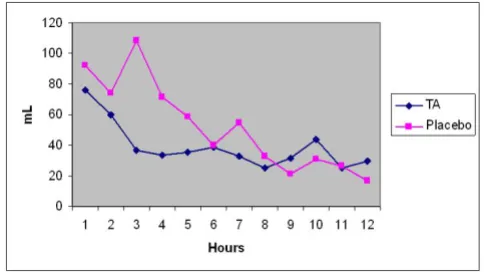
Post-op Blood Loss/Hour
Figure 1
sistently higher with use of aprotinin than with tran-examic acid or aminocaproic acid [14].
In the large International Multi-center Aprotinin Graft Patency Experience (IMAGE) study, no statistically signif-icant difference in graft occlusion could be found between patients given Aprotinin and controls when the results were adjusted for risk factors known to be associated with graft failure [15]. Therefore, the benefit of antifibrinolytic agents must be always weighted against a possible increase risk of thrombo-embolic complications that might lead to early graft closure. Moreover, these patients are at increase risk of cerebral, pulmonary, mesenteric and retinal thrombosis.
Following the success of systemic use of Aprotinin and Tranexamic acid in controlling post-CABG bleeding, trials for topical use were initiated by Tatar et al [16] in 1993, who reported reduced post-operative blood loss and the need for transfusion after topical Aprotinin use in CABG
patients. Similar results were described by O'Regan and his colleagues [17] and Khalil et al [18]. This encouraged De Bonis group [19] in 2000 to start topical use of TA. They conducted a prospective randomized, double blinded study on 40 patients who had primary CABG. They reported blood loss significantly diminished by 36% during the first 3 hours but not during the following 21 hours after operation compared to the placebo group. Our study demonstrates that pouring of one gram of TA into the pericardial cavity after CABG, significantly reduced post-operative blood loss in the first 24 hours after surgery (37%) with the maximum reduction at the 3rd hour (66%). Abdul Azem and his colleagues [20] in 2006 described similar results in 100 patients underwent vari-ous open heart procedures. In contradictory to our find-ings, Yasim and his group [21] did not find a statistically significant reduction in post-operative bleeding after top-ical application of Aprotinin and Tranexamic acid.
In our study the overall post-operative bleeding was mod-est in both groups and this could be explained by the tight inclusion criteria, meticulous surgical hemostasis, normo-thermic CPB and the use of LIMA alone as a pedicle graft in all patients. Therefore, despite the significant reduction of post-operative bleeding in TA group, the effect of its topical use might be masked by those factors. A greater
Post-op Blood Loss/24 hours and total
Figure 2
Post-op Blood Loss/24 hours and total. Chest tube drainage in the first 24 hours was significantly less in TA group (median of 626 ml) than in the placebo group (median of 1040 ml) (P = 0.04). This represented about 37% decrease in the blood loss. The median total post-operative chest tube drainage was 656 ml (range 248–2105) in TA group and 1056 ml (range 210–3010) in the placebo group, which represents 32% reduction in total bleeding.
Table 2: Intra-operative Data.
TA Placebo P-Value
Graft/pt 2.8 ± 1.1 2.9 ± 1.0 0.64 LIMA 100% 100% 1.0 CX time (min) 72 ± 17 75 ± 20 0.09 TBT (min) 100 ± 28 97 ± 28 0.07
Values are means ± SD or (%) where shown. LIMA: Left Internal Mammary Artery. CX Time: Cross Clamp time. TBT: Total Bypass time.
Table 3: Pre-operative Hematological Profile.
TA Placebo P-Value
Platelets 265 ± 119 156 ± 71 0.77 Hb (gm/dl) 14 ± 1.0 14 ± 1.3 0.08 Hct (%) 39 ± 2.8 41 ± 3.7 0.15 INR 1.1 ± 0.3 1.0 ± 0.2 0.23 PTT 31.2 ± 4.8 33.6 ± 3.5 0.34 Fibrinogen 362 ± 163 438 ± 158 0.46
Values are means ± SD where shown. Hb: Hemoglobin.
Hct: Hematocrite Value.
INR: International Normalized Ratio. PTT: Partial Thromoplastin Time.
Table 4: Post-operative Hematological Profile.
TA Placebo P-Value
Platelets 192 ± 64 196 ± 68 0.86 Hb (gm/dl) 10 ± 1.3 10 ± 1.3 0.39 Hct (%) 29 ± 3.8 30 ± 3.9 0.39 INR 1.3 ± 0.3 1.2 ± 0.4 0.18 PTT 41.2 ± 5.4 45.6 ± 7.4 0.22 Fibrinogen 239 ± 49 359 ± 202 0.15
Values are means ± SD where shown. Hb: Hemoglobin.
Hct: Hematocrite Value.
effect of topical TA in reducing blood loss could be possi-bly evident in more prolonged and complex procedures with a higher risk of bleeding.
The use of blood products was not significantly different between both De Bonis' groups [19], while we had a sig-nificant reduction only in platelet transfusion and Abdul Azm [20] had a significant reduction only in packed cells use in TA group. This difference in reports might be explained by the difference in number of patients, type of operations and transfusion protocols used in each study. The advantage of topical use of antifibrinolytic drugs after open heart surgery, in reducing post-operative bleeding and transfusion requirement, needs further clinical trials using larger number of patients [22].
Limitation of the study
We did not measure the level of TA in the serum or in the pericardial cavity. The number of the patients was rela-tively small and the inclusion criteria with strictly tight. Larger multi-center prospective control trials using larger dose of TA are needed to address its topical effect in pro-cedures with higher risk of bleeding.
Conclusion
Topical use of Tranexamic acid into the pericardial cavity in patients undergoing primary coronary artery bypass grafting significantly reduces postoperative bleeding and platelet transfusion without adding extra risk to the patient. Consequently Tranexamic acid could be advo-cated for routine use topically in patients undergoing cor-onary artery bypass grafting.
Competing interests
The authors declare that they have no competing interests.
Authors' contributions
HF participated in the study design, in analyzing the data, writing, reviewing and submitting the manuscript. EM conceived of the study, participated in its design and car-ried out the coordination, collecting the data. DB partici-pated in reviewing the manuscript. DL participartici-pated in reviewing the manuscript. LE participated in reviewing the manuscript. All authors read and approved the final man-uscript.
Acknowledgements
The authors are thankful to Ms. Alana Harrington, HBSc, Department of Anaesthesia and Critical Care3, Terrence Donnelly Heart Center, Keenan Research Center in the Li Ka Shing Knowledge Institute of St. Michael's Hospital, University of Toronto, for her valuable assistance in the statistical analysis. This work was presented as an oral presentation during the 14th annual conference of the Egyptian Society of Cardiothoracic Surgery May 2–4, 2007, Alexandria, Egypt. This study was not sponsored.
References
1. Kucuk O, Kwaan HC, Frederickson J, Wade L, Green D: Increased fibrinolytic activity in patients undergoing cardiopulmonary bypass operation. Am J Hematol 1986, 23:223-9.
2. Harker LA, Malpass TW, Branson HE, Hessel EA II, Slichter SJ: Mech-anism of abnormal bleeding in patients undergoing cardiop-ulmonary bypass: acquired transient platelet dysfunction associated with selective alpha-granule release. Blood 1980,
56:824-34.
3. Depotis GJ, Santoro SA, Spitznagel E, Kater KM, Cox JL, Barnes P:
Prospective evaluation and clinical utility of on-site monitor-ing of coagulation in patients undergomonitor-ing cardiac operation.
J Thorac Cardiovasc Surg. 1994, 107(1):271-279.
4. Lemmer JH Jr, Stanford W, Bonney SL, Breen JF, Chomka EV, Elderge WJ: Aprotonin for coronary bypass operations: efficacy, safety, and influence on early saphenous graft patency-a mul-ticenter, randomized, double blind, placebo-controlled study. J Thorac Cardiovasc Surg 1994, 107:543-53.
5. Daily PO, Lamphere JA, Dembitsky WP, Adamson RM, Dans NF:
Effect of prophylactic epsilon-aminocaproic acid on blood loss and transfusion requitments in patients undergoing first-time coronary artery bypass grafting: a randomized,
pro-Post-op Blood Products Transfusion
Figure 3
Post-op Blood Products Transfusion. There was no sig-nificant difference in the post-op packed red blood cells (PRBCs) transfusion between both groups (median of one unit in each) (P = 0.82). Also there was no significant differ-ence in regard Fresh Frozen Plasma (FFP) transfusion between both groups (Median of zero unit in TA vs. two units in placebo) (P = 0.42). Significant more platelets transfu-sion required in the Placebo group (median 2 units) than in TA group (median zero unit) (P = 0.03)
Table 5: Post-operative data.
TA Placebo P-Value
Troponin I 2.4 ± 3.8 4.7 ± 2.0 0.68 (mmol/L)
Intub (Hrs) 14 ± 7 17 ± 12 0.52 ICU (Hrs) 29 ± 26 49 ± 20 0.02* LOS (Days) 7.5 ± 3 7.8 ± 2.0 0.68
Values are means ± SD where shown. Intub: Intubation time.
Publish with BioMed Central and every scientist can read your work free of charge "BioMed Central will be the most significant development for disseminating the results of biomedical researc h in our lifetime."
Sir Paul Nurse, Cancer Research UK
Your research papers will be:
available free of charge to the entire biomedical community
peer reviewed and published immediately upon acceptance
cited in PubMed and archived on PubMed Central
yours — you keep the copyright
Submit your manuscript here:
http://www.biomedcentral.com/info/publishing_adv.asp
BioMedcentral
spective, double-blind study. J Thorac Cardiovasc Surg 1994,
108:99-105.
6. Kevy SV, Glickman RM, Bernhard WF, Diamond LK, Grass RE: The pathogenesis and control of the hemorrhagic defect in open heart surgery. Surg Gynecol Obstet 1966, 123:313-8.
7. Cosgrove DM III, Heric B, Lytle BW, Taylor PC, Novoa R, Golding LA: Aprotonin therapy for reoperative myocardial revascu-larization: a placebo-controlled study. Ann Thorac Surg 1992,
54:1031-8.
8. Horrow JC, Van Riper DF, Strong MD, Brodsky I, Parmet JL: Haemo-static effects of Tranexamic acid and Desmopressin during cardiac surgery. Circulation 1991, 84:2063-70.
9. Longstaff C: Studies on the mechanisms of action of Aprotonin and Tranexamic acid as plasmin inhibitors and antifibrino-lytic agents. Blood Coagul Fibrinolysis 1994, 5:537-42.
10. Ovrum E, Holen EA, Abdelnoor M, Oystese R, Ringdal ML: Tran-examic acid (Cyklokapron) in not necessary to reduce blood loss after coronary artery operations. J Thorac Cardivasc Surg 1993, 105:78-83.
11. Versraette M: Clinical application of inhibitors of fibrionolysis.
Drugs 1985, 29:236-61.
12. Valsecchi A: Further notes on the topical use of Tranexamic acid in the treatment of gynaecological haemorrhage. Min-erva Ginecol 1980, 32:825-30.
13. Sindet-Pedersen S, Ramtro G, Bernvil S, Blomback M: Haemostatic effect of tranexamic acid mouthwash in anticoagulant-treated patients undergoing oral surgery. N Engl J Med 1989,
320:840-3.
14. Henry D, Carless P, Fergusson D, Laupacis A: The safety of apro-tinin and lysine-derived antifibrinolytic drugs in cardiac sur-gery: a meta-analysis. CMAJ 2009, 180(2):183-93.
15. Alderman EL, Levy JH, Rich JB: Analyses of coronary graft pat-ency after Aprotinin use: results from the International Mul-ticenter Aprotinin Graft Patency Experience study (IMAGE) trial. J Thorac Cardiovasc Surg 1998, 116:716-730.
16. Tatar H, Ciçek S, Demirkiliç U, Ozal E, Süer H, Oztürk O, Is¸iklar H:
Topical use of Aprotonin in open heart operations. Ann Thorac Surg 1993, 55:659-61.
17. O' Regan DJ, Giannopoulos N, Mediratta N, Kendall SWH, Forni A, Pillai R: Topical Aprotonin in cardiac operations. Ann Thorac Surg 1994, 58:778-81.
18. Khalil PN, Ismail M, Kalmar P, von Knobelsdorff G, Marx G: Activa-tion of fibrinolysis in the pericardial cavity after cardiopul-monary bypass. Thromb Haemost 2004, 92:568-574.
19. De Bonis M, Cavaliere F, Alessandrini F, Lapenna E, Santarelli F, Moscato U, Schiavello R, Poosti GF: Topical use of Tranexamic acid in coronary artery bypass operations: A double-blind, prospective, randomized, placebo-controlled study. J Thorac Cardiovasc Surg 2000, 119:575-80.
20. Abdul-Azm A, Abdullah KM: Effect of topical Tranexamic acid in open heart surgery. Eur J Anaesthesiol. 2006, 23(5):380-384. 21. Yasim A, Asik R, Atahan E: Effects of topical applications of
Aprotinin and Tranexamic acid on blood loss after open heart surgery [abstract]. Anadolu Kardiyol Derg 2005, 5:36. 22. Abrishami A, Chung F, Wong J: Topical application of