R E S E A R C H A R T I C L E
Open Access
Methodology and reporting quality of
reporting guidelines: systematic review
Xiaoqin Wang
1,2,3,4†, Yaolong Chen
1,2,3†, Nan Yang
5, Wei Deng
6, Qi Wang
1,2,3, Nan Li
6, Liang Yao
1,2,3, Dang Wei
1,2,3,
Gen Chen
2,4*and Kehu Yang
1,2,3Abstract
Background:With increasing attention put on the methodology of reporting guidelines, Moher et al. conducted a review of reporting guidelines up to December 2009. Information gaps appeared on many aspects. Therefore, in 2010, the Guidance for Developers of Health Research Reporting Guidelines was developed. With more than four years passed and a considerable investment was put into reporting guideline development, a large number of new, updated, and expanded reporting guidelines have become available since January 2010. We aimed to systematically review the reporting guidelines published since January 2010, and investigate the application of the Guidance.
Methods:We systematically searched databases including the Cochrane Methodology Register, MEDLINE, and EMBASE, and retrieved EQUATOR and the website (if available) to find reporting guidelines as well as their accompanying documents. We screened the titles and abstracts resulting from searches and extracted data. We focused on the methodology and reporting of the included guidelines, and described information with a series of tables and narrative summaries. Data were summarized descriptively using frequencies, proportions, and medians as appropriate.
Results:Twenty-eight and 32 reporting guidelines were retrieved from databases and EQUATOR network, respectively. Reporting guidelines were designed for a broad spectrum of types of research. A considerable number of reporting guidelines were published and updated in recent years. Methods of initial items were given in 45 (75 %) guidelines. Thirty-eight (63 %) guidelines reported they have reached consensus, and 35 (58 %) described their consensus methods. Only 9 (15 %) guidelines followed the Guidance.
Conclusions: Only few guidelines were developed complying with the Guidance. More attention should be paid to the quality of reporting guidelines.
Keywords: Systematic review, Methodology quality, Reporting quality, Reporting guideline
Background
The main purpose of investments for health research is to promote scientific understanding and improve health [1]. However, insufficient reporting of the methodology and findings of a study block critical appraisal and limit effect-ive dissemination. In addition, insufficient reporting can
also impede the applicability and mislead results used by patients and practitioners [2].
For improving the quality of the research, experts developed reporting guidelines. Developed with expli-cit methodology, a reporting guideline is a checklist, flow diagram, or an explicit text guiding authors in reporting a specific type of research. Some reporting guidelines provide a flow diagram for users to report information of research following sequential stages. Reporting guidelines are important tools for improv-ing the quality of medical research. Since the develop-ment of the CONSORT (Consolidated Standards of Reporting Trials Statement for reporting randomized * Correspondence:[email protected]
†Equal contributors 2
Key Laboratory of Evidence Based Medicine and Knowledge Translation of Gansu Province, Lanzhou 730000, China
4
Institute of Pathogenic Biology of Lanzhou University, Lanzhou 730000, China
Full list of author information is available at the end of the article
controlled trials) Statement in 1996, several guidelines have been developed relating to other types of re-search [2]. Guidelines such as CONSORT, PRISMA (Transparent reporting of systematic reviews and meta-analysis) [3], STARD (Standards for Reporting of Diagnostic Accuracy Studies) [4], STROBE (Strength-ening the Reporting of Observational Studies in Epidemiology) [5], ARRIVE (Animal Research: Report-ing: In Vivo Experiments Guidelines) [6], and COGS (The Conference on Guideline Standardization) [7] have largely benefited research in respect to RCTs (randomized controlled trials), systematic reviews and meta-analyses, animal research, and clinical practice guidelines. Adoption of reporting guidelines is associ-ated with improved reporting quality of research [8]. Reporting guidelines can also act as handbooks for various people such as evidence developers and users, policy makers, editors, and patients, to play an opti-mistic role for regulating design and review of studies.
With increasing attention put on the methodology of reporting guidelines, Moher et al. [9] publishedGuidance for Developers of Health Research Reporting Guidelines (hereinafter refer to as “the Guidance”) in 2010, and conducted a review of 81 reporting guidelines up to December 2009 [10]. This review focused on guidelines using consensus-based methods and implemented deep analyses with the consensus method, where information gaps appeared within many aspects. For example, 28 % of the included guidelines reported no information about consensus, and 57 % were silent about how the feedback after consensus was dealt with. However, many of the reporting guidelines have not reported the implemen-tation plan and pilot test. Insufficient reporting of the reporting guidelines enterprise could lead to inappro-priate understanding and use. In addition to the methodology, only 31 % reported formal consensus method and 10 % applied the modified Delphi process [11], which indicated the methodology need to be im-proved. With considerable investment in the develop-ment of reporting guidelines, a large number of new, updated, and expanded reporting guidelines have be-come available since 2010. The number of reporting guidelines in the EQUATOR (Enhancing the QUAlity and Transparency Of health Research: www.equator-network.org) Network’s Library has increased from over 90 in December 2009 to over 200 in April 2014 on [12] and the EQUATOR also recommended the Guidance. Therefore, it is necessary to systematically review the reporting guidelines published since Janu-ary 2010, learn the status of reporting and method-ology quality, and investigate the application of the Guidance [9], so that we can know how well the im-provement is achieved as well as how well the Guidance is applied.
Methods
Search strategies for identification of studies
We aimed to conduct a similar search strategy to Moher et al. After reviewing their search strategy and consulting with a librarian, we decided to search Cochrane Methodology Register, MEDLINE, and EMBASE data-bases. Unlike Moher et al., we did not search the PSYCInfo database, because it mainly includes articles from journals about the field of psychology, and we did not expect to find a large number of methodologically relevant articles. We referred to the search methods of Moher et al. [10], and used keywords such as“guideline”,
“study design” in our search to identifying relevant evidence.
We made the following searches:
Systematic search of the Cochrane Methodology Register, MEDLINE, and EMBASE.
EQUATOR Library for health research reporting (www.equator-network.org).
Supplementary search of the website of each guideline (if available) to collect their accompanying documents including checklists, flowcharts, and explanation and elaboration (E&E).
The details of our search strategies are shown in Additional file 1.
Inclusion and exclusion criteria
We retrieved reporting guidelines for various fields of medical research. We only included the most recent versions and accompanying documents, including checklists, flowcharts, and explanation and elaboration (E&E) documents. We excluded the following types of guidelines: 1) how to report a specific research pro-ject, such as a guide for conducting a questionnaire survey; 2) instructions for authors; 3) guidelines for reporting diagnostic, treatment and prognostic infor-mation by clinical practitioners, such the results of imaging and pathological findings; 4) guidelines pub-lished before December 2009.
Identification of relevant studies
Measured outcomes
We collected the following outcomes from each included paper:
1. Basic information such as title, short name, specific website, year of publication, language, authors and reference list.
2. Summary statistics for the reporting outcomes of main interest in relevant reporting guidelines, including background information (version, scope and target research type, users), pre-meeting activities (member identification and recruitment, recruit methods, pre-planned endpoint of consensus process, inclusion criteria of items), the face-to-face consensus meeting (the format of meeting, number and backgrounds of experts, meeting agenda and materials), post-meeting activities (pilot test and feedback collection), other information (checklist, flow diagram, E&E documents, endorsement, translations, implementation plan, research gap, conflicts of interests (COIs)).
Data extraction
We designed our extraction protocol based on items from the Guidance and other relevant articles about reporting guidelines. Pairs of review authors (XQW and NL, QFW and CLW) independently performed the data extraction with a pre-designed extraction form which was pilot tested by all data extractors and modified accordingly before formally use. The review authors resolved discrepancies on the data extraction through discussion. A third review author (QW) was consulted to settle discrepancies.
We focused on the methodology and reporting quality of included guidelines and extracted the following data: 1) characteristics of the study including title, language, year of publication, authors, and guideline version, 2) back-ground information including time-consumption, research type, reporting scope, and target users, 3) whether the consensus was reported and whether consensus meeting was held and its relevant activities provided, 4) post-publication activities including implementation, evalu-ation, and endorsement, 5) whether the guidelines were compliant with the Guidance (this was judged by search-ing the text for a declaration of followsearch-ing the Guidance, and by checking the reference list), and 6) other informa-tion including research gaps, limitainforma-tions, funding, and COIs. If the consensus was reported, we also collected① pre-consensus activities including candidate items gener-ation, ② consensus activities including which consensus method was used and how the authors proceeded, and③ post-consensus activities including pilot test and feedback collection. Where the information was unclear, we con-tacted the authors to confirm it.
Data analysis
We described information with a series of tables and narrative summaries. Data was descriptively summarized using frequencies, proportions, and medians as appro-priate. We then explored items (especially the core items, including“7 Prepare for the face-to-face meeting; 8 Present and discuss results of pre-meeting activities and relevant evidence; 8.1 Discuss the rationale for in-cluding items in the checklist; 8.3 Discuss strategy for producing documents; identify who will be involved in which activities; discuss authorship; 9 Develop the guid-ance statement; 12 Seek and deal with feedback and criticism; 13 Encourage guideline endorsement” in the reporting guidelines that referred to Guidance, and con-ducted a comparison between guidelines refer to the Guidance with those that did not. We reported our study according to the PRISMA statement [3].
This study was not registered in advance because of its scope limitation, but it was presented in the 3rd International Society for Evidence-Based Health Care Conference (ISEHC) 2014 in Taipei, Taiwan, November 2014, as an oral presentation (OS05-03).
Results
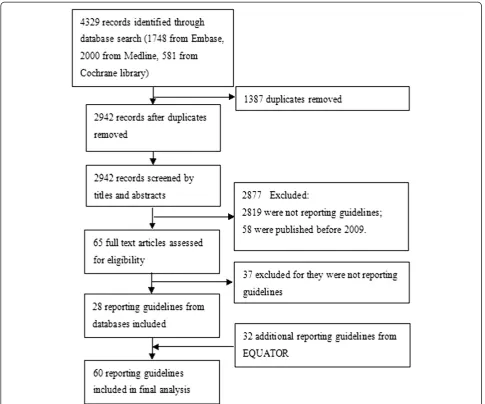
We identified 4329 records after screening the elec-tronic databases. Of these, 28 full-text articles were re-trieved. In addition, we found 32 relevant guidelines from the EQUATOR network that were not captured from databases. In total, 60 reporting guidelines for health research were included and were all used for data extraction (Fig. 1). Detailed information of the in-cluded reporting guidelines was presented in Additional file 2. We contacted the corresponding authors of five publications, of whom four helped us to confirm the in-formation, and one gave no response.
Characteristics of reporting guidelines
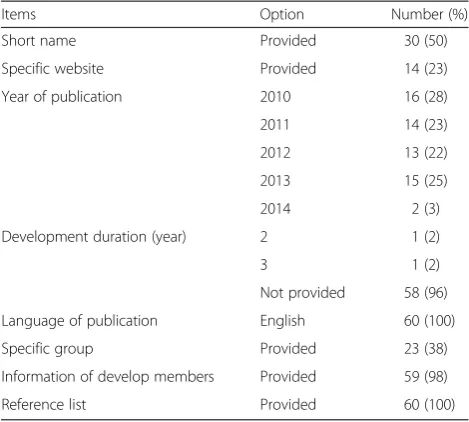
The basic information of the reporting guidelines is pre-sented in Table 1. Reporting guidelines were designed for a broad spectrum of research typologies. A consider-able number of reporting guidelines were published and updated and all of them were initially published in English.
Background of reporting guidelines
guidelines reported their target users, and nine (15 %) re-ferred to the Guidance [9].
The scope of different reporting guidelines varied a lot. Thirty-six (60 %) were designed for full text, three (5 %) were used for reporting the methods, two (3 %) were de-veloped for methods and discussion, and two (3 %) were designed for abstract, whereas, the remaining 17 (28 %) were unclear.
Forty (67 %) guidelines were designed for specific studies or multiple study designs. The most mentioned one cater-ing to a specific design were about observational studies (11, 18 %) and RCTs (9, 15 %). Forty-four (73 %) reporting guidelines were designed for specific health areas.
Thirty-five (58 %) guidelines reviewed the literature and 22 (37 %) identified previous relevant guidelines.
For search details, databases, terms, years, and languages were given in 12 (20 %), 10 (17 %), 11 (18 %) and seven (12 %) guidelines, respectively. Forty-five (75 %) guide-lines described the methods used to generate initial items, including literature review, referring to existing reporting guidelines or opinions from experts (Table 2).
Funding was obtained to assist the development of at least 36 (60 %) reporting guidelines. This information was not reported or unclear in 20 (33 %).
Pre-meeting activities
Thirty-eight (63 %) guidelines reported they have reached consensus and 35 (58 %) also described consensus methods, whereas no one gave the definition of consensus. For consensus methods, the formal methods was used in
23 (38 %) guidelines, in which eight (13 %) employed two methods. Delphi exercise was applied in 13 (22 %) guide-lines. An informal method was identified in five (8 %) (Table 2).
Among guidelines developed through consensus, 30 (50 %) reported group member identification and 31 (52 %) reported member recruitment. Of those who identified members, 27 (45 %) reported specialties of experts, 20 (32 %) described information of members, such as names and institutions, and four (7 %) gave the selection criteria. For those who recruited mem-bers, seven (12 %) described the recruit methods, for instance, through e-mail, study co-chairs, or group decision. In guidelines developed by a working group, 22 (37 %) reported the number of experts participating in guideline development (median 32, range 3–115). Eleven (18 %) guidelines reported the endpoint of con-sensus process, which were all terminated after a fixed number of rounds (Table 2). In addition, the inclusion criteria of items were given in eight (13 %) guidelines. For example, items meeting the median score of eight or higher in the final round were included [13].
The face-to-face consensus meeting
Consensus meeting was used in 24 guidelines. In 18 (30 %) guidelines only face to face meeting was held and in four (7 %) guidelines only a teleconference, and in two (3 %) guidelines, both face-to-face meeting and teleconference were held. Thirteen (22 %) guidelines reported the number of experts invited to a face-to-face meeting (median 23, range 9–51), and 15 (25 %) re-ported the number of experts attending the meeting in person (median 18, range 3–51). Five (8 %) reported Table 1Basic information of included reporting guidelines
Items Option Number (%)
Short name Provided 30 (50)
Specific website Provided 14 (23)
Year of publication 2010 16 (28)
2011 14 (23)
2012 13 (22)
2013 15 (25)
2014 2 (3)
Development duration (year) 2 1 (2)
3 1 (2)
Not provided 58 (96)
Language of publication English 60 (100)
Specific group Provided 23 (38)
Information of develop members Provided 59 (98)
Reference list Provided 60 (100)
Table 2Characteristics of reporting guidelines
Items Items Number
(%)
Study type(s) to
be reporteda Study design not specified 20 (33) Randomized controlled trials 9 (15)
Laboratory/preclinical studies 5 (8)
Prospective clinical trials 2 (3)
Observational studyb 11 (18)
Economic evaluation 3 (5)
Systematic review/meta-analysis/HTAc 5 (8)
Qualitative research 2 (3)
Cross-sectional studies 2 (3)
Other specific design or types specified (diagnostic accuracy studies, quality improvement research, Realist syntheses, clinical practice guideline, Systematic review/meta-analysis/HTA)
12 (20)
Methods for initial
itemsd Literature review 25 (42)
Refer to existing reporting guidelines 20 (33)
Opinions of experts or consensus of experts
16 (27)
Consensus methodse
Formal Delphi 13 (22)
Nominal group technique 3 (5)
Consensus meeting 21 (35)
Informal Questionnaire grade 1 (2)
Circulating several versions of the statement within the group of developers and an external circle of potential users.
2 (3)
Web-based survey rating the importance of each of the checklist items
1 (2)
Terminated after fixed round(s) of Delphi
1 2 (3)
2 5 (8)
3 4 (7)
Stakeholders in the consensus process
Content experts 25 (42)
Epidemiologists 7 (12)
Journal editors 14 (23)
Methodologists 19 (32)
Othersf 14 (23)
Funding Yes 36 (60)
No 4 (7)
Unclear 20 (33)
COI Yes 14 (23)
No 28 (47)
Unclear 18 (30)
a
Some reporting guidelines are designed for more than one type of research b
Including various kinds of observational studies, such as case report, cohort study, case–control study cross-sectional study
c
HTA: Health technology assessment d
Some reporting guidelines used two or more methods to generate initial items e
Some reporting guidelines used two methods f
developing a meeting agenda, nine (15 %) reported pre-paring materials that were sent to participants prior to meeting, and nine (15 %) detailed the duration of the meeting.
Guideline developers of the consensus process in-cluded stakeholders with various backgrounds (Table 2). The most commonly involved were content experts (25, 42 %), methodologists (19, 32 %), and journal editors (14, 23 %). However, activities of stakeholders for the de-velopment procedure and discussion during the consen-sus process were less commonly reported.
Post-meeting activities
After the meeting held and the checklist completed, pilot tests were conducted in 12 (20 %) guidelines. Among these, 11 (18 %) described the pilot methods, seven (12 %) described the feedback information re-quirement, and five (8 %) gave the methods for feedback collection.
Other information
The final items were presented in 58 (97 %) guidelines with a median of 22 (range: 5–106 items) items, and 44 (73 %) presented an explanation of each item. Items were summarized as a checklist in 54 (90 %) guidelines and seven (12 %) provided flow diagrams. Separate E&E documents were developed or under development in 16 (27 %) reporting guidelines. Eighteen (30 %) reported guideline endorsements with the mostly referred one as part of instruction to authors (13, 22 %). Publication strategies were reported in 12 (20 %) guidelines. Of those, 10 (17 %) were published in more than one jour-nal with translations being (or to be) available for four (7 %) guidelines. The implementation and dissemination plan was found in 22 (37 %) guidelines, while informa-tion on monitoring and evaluainforma-tion was given in 13 (22 %) guidelines. Sixteen (27 %) planned to deal with feedback after releasing the guidelines, and 15 (25 %) have updated or planned to update their guidelines. Four (7 %) guidelines elaborated the research gap and 21 (35 %) presented the limitations of reporting guidelines.
COIs were clearly reported in 42 (70 %) guidelines. Among these, 14 (23 %) declared they have COI, while 28 (47 %) did not give the information about COI (Table 2).
Analysis of the core items from the guidance in reporting guidelines
For the methodology of guideline development, we ana-lyzed the core items from the guidance in the included reporting guidelines (Fig. 2). Which showed poor report-ing in all the core items, every item was reported in less than 50 % reporting guidelines.
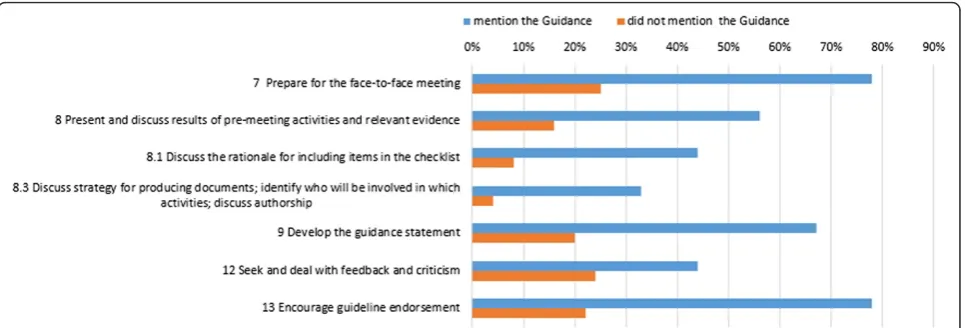
And then we conducted a comparison between the nine guidelines who said they have followed the Guidance [9]
with those that did not regarding to the core items pro-posed in the Guidance (Fig. 3). Which indicated better conducting and reporting but still poor in some aspect, es-pecially in“8.1 Discuss the rationale for including items in the checklist; 8.3 Discuss strategy for producing docu-ments, identify who will be involved in which activities, discuss authorship; and 12 Seek and deal with feedback and criticism”.
The PRISMA checklist with the page number where each item is reported was provided in Additional file 3.
Discussion
We identified 60 reporting guidelines for health research published since January 2010, most of which were new guidelines. Only few of the guidelines were developed in compliance with the Guidance [9]. More than half of the guidelines were developed for full texts and some for specific areas including methods, abstract, and discus-sion. However, a large portion did not state their target scope. Guidelines covered a broad spectrum of areas of health research. Previously, most guidelines were devel-oped for RCTs [10], but now we found increasing atten-tion was on other types of health research.
Only 37 % of the included guidelines searched the existing relevant reporting guidelines, and 58 % of the guidelines reviewed the literature. However, only few presented the search details. Since development of reporting guidelines is complex and time-consuming, developers should first consider whether a requirement exists for a new or extended reporting guidelines, or if the existing ones should continue to be used. Moreover, it is recommended to search for the relevant guidelines and evidence of the reporting quality of published arti-cles of the domain of interest [9].
developing clinical guidelines [14] and reporting guide-lines [9]. Consensus methods should be supported by developers, and the reporting of the methods should be improved.
Developers involved in the consensus process con-sisted of multidisciplinary teams of stakeholders, and most guideline development groups had the awareness about it. Among experts who participated in develop-ment, content experts were mostly referred, followed by methodologists and journal editors. This is in line with previous findings [10]. The expertise of developers should reflect the required skills of interest. Participants should include statisticians, epidemiologists, methodolo-gists, content experts, journal editors, and consumer representatives. Furthermore, at least a quarter of the developers should be content experts, and this number could be even larger depending on content areas under consideration [9]. Ideally, invitations should be offered 6 months before the meeting. However, the detailed
information on the participants, such as information about the members and the method applied for recruit-ment, was poorly reported.
Only few reporting guidelines tested the final check-list before formal publication, which was also found by Moher et al. [10]. As a small-scale trial, pilot testing provides a chance where a few examinees could take the test and comment on the object that was tested. They can point out any problems with the test instruc-tions, instances where items are not clear, formatting, and other typographical errors and/or issues [18]. Once the information of pilot tests becomes available, the guideline group could decide whether to make changes to improve the product effectively.
Only a few reporting guidelines developed E&E documents [10], which were intended to enhance the use, understanding, and dissemination of the guide-lines [19]. Developers are likely to publish guideguide-lines in a simplified form to help use them effectively.
Fig. 2The information of core items in reporting guidelines
Therefore, E&E documents are of critical importance to the rationale for including the items and the ne-cessary details. Lack of this document may make it difficult to understand the guidelines. Additionally, the most important method for guideline dissemin-ation was simultaneous publicdissemin-ation of an E&E docu-ment [9].
Many of the reporting guidelines included did not give the implementation, evaluation, and monitoring strategies, which was similar with the previous finding [10]. Strategies for result sharing such as endorsement by organizations or journals, websites for reporting guide-lines, and translations, have been recommended [9].
Although the reporting status was improved, the funding and COI were still not well reported. The pro-portion of reporting guidelines that acquired funding was also higher than before 2009 (60 vs 48 %) [10]. Conversely, the COI rules are designed to avoid poten-tially compromising situations that could affect, or otherwise undermine, the work by guideline group [20]. Although it is recommended that developers obtain funds from all sources including the pharmaceutical in-dustry, non-profit agencies, and governments [9], they need to clearly state the funding sources and their role during the process of declaration of interests.
Except for the above content, even for the core items was not conducted well in the reporting guide-lines. When it comes to the guidelines that mentioned the Guidance [9] vs those that did not, the results showed better results, which might suggest a positive effect of the Guidance. However, no matter followed the Guidance or not, some core aspects, including dis-cussion on the rationale for including items, strategy for producing documents, and the feedback require-ment, was still poorly conducted, which reminded us that there was still much work to do to improve the reporting and methodology of reporting guidelines.
More than 4 years after the systematic review con-ducted by Moher et al. [10], increasing numbers of reporting guidelines covering more and more study de-signs, such as animal research and case reports, were published. Unlike the previous review, we included reporting guidelines regardless of if the consensus were reached or not, in order to see the utilization of consen-sus process. This is the first research evaluating the ap-plication of the Guidance [9]. We did not limit the language when searching the reporting guidelines to minimize the undetected studies.
Our study also has some limitations. We did not search gray literature, which might miss some guidelines eligible for this review. But we encourage our readers to notify us if any possible eligible guidelines were missed. We abstracted data largely depending on the reporting information of guidelines, but we also asked the authors
to confirm the unclear information. We mainly com-pared the core items proposed in the Guidance [9] be-tween guidelines mentioned the Guidance vs those not, which could reflect the overall trend to some degree. We did not include all reporting guidelines listed on the EQUATOR because of the differences of the definition of reporting guidelines. For example, we excluded the Toolkit [21], which was included in EQUATOR, because it is not designed for reporting research.
Conclusions
Increasing attention was paid to develop reporting guide-lines other than for RCTs, including various observational studies and other types of study. Although some improve-ment was identified, details of consensus methods were also poorly reported, which were similar to previous findings [10]. From the comparison between guidelines which followed the Guidance with those did not, reporting guidelines mentioning the Guidance appeared to use more rigorous development methods, in line with the recommendations, than those that did not mention it. But only few guidelines were developed complying with the Guidance until now. Promoting the use of the Guidance might improve the development of reporting guidelines. The EQUATOR should also pay more attention to give some instructions for improving the quality of reporting guidelines as appropriate.
Additional files
Additional file 1:Search strategies.(PDF 75 kb)
Additional file 2:Detailed information of the included reporting guidelines.The information of the included reporting guidelines, including publication date, scope, focus, areas, version, and other relevant details. (PDF 161 kb)
Additional file 3:The PRISMA checklist with the page number where each item is reported.(PDF 204 kb)
Competing interests
The authors declare that they have no competing interests.
Authors’contributions
XQW, YLC and QW contributed to conception and design. XQW performed the analysis. All authors were involved in analysis and interpretation of the data. XQW and LY drafted the manuscript, which was critically revised for important intellectual content by YLC, KHY and GC. All authors read and approved the final manuscript.
Acknowledgments
We are grateful to Jinhui Tian for his help in executing the search strategy and Janne Estill for his advice in wording and polishing the manuscript. We also thank Qiongfang Wu, Cailiang Wu, Qiuyun Wang for helping data management. There is no funding to support this study.
Author details
1Evidence-Based Medicine Center, School of Basic Medical Sciences, Lanzhou
China.5The First Hospital of Lanzhou University, Lanzhou 730000, China.6The Second Affiliated Hospital of Lanzhou University, Lanzhou 730000, China.
Received: 17 April 2015 Accepted: 17 September 2015
References
1. Simera I, Moher D, Hoey J, Schulz KF, Altman DG. A catalogue of reporting guidelines for health research. Eur J Clin Invest. 2010;40(1):35–53. 2. Simera I, Altman DG, Moher D, Schulz KF, Hoey J. Guidelines for reporting
health research: the EQUATOR network’s survey of guideline authors. PLoS Med. 2008;5(6):e139.
3. Moher D, Liberati A, Tetzlaff J, Altman DG, the PRISMA Group. Preferred reporting items for systematic reviews and meta-analyses: the PRISMA statement. PLoS Med. 2009;6(7):e1000097.
4. Bossuyt PM, Reitsma JB, Bruns DE, Gatsonis CA, Glasziou PP, Irwig LM, et al. Standards for reporting of diagnostic accuracy. Towards complete and accurate reporting of studies of diagnostic accuracy: the STARD initiative. Clin Chem. 2003;49(1):1–6.
5. von Elm E, Altman DG, Egger M, Pocock SJ, Gøtzsche PC, Vandenbroucke JP, et al. The Strengthening the Reporting of Observational Studies in Epidemiology (STROBE) Statement: guidelines for reporting observational studies. PLoS Med. 2007;4(10):e296.
6. Kilkenny C, Browne WJ, Cuthill IC, Altman DG. Animal research: reporting in vivo experiments—the ARRIVE guidelines. J Cereb Blood Flow Metab. 2011;31(4):991–3.
7. Shiffman RN, Shekelle P, Overhage JM, Slutsky J, Grimshaw J, Deshpande AM. Standardized reporting of clinical practice guidelines: a proposal from the Conference on Guideline Standardization. Ann Intern Med. 2003;139(6):493–8.
8. Turner L, Shamseer L, Altman DG, Schulz KF, Moher D. Does use of the CONSORT Statement impact the completeness of reporting of randomized controlled trials published in medical journals? A Cochrane review. Syst Rev. 2012;1:60.
9. Moher D, Schulz KF, Simera I, Altman DG. Guidance for developers of health research reporting guidelines. PLoS Med. 2010;7(2):e1000217.
10. Moher D, Weeks L, Ocampo M, Seely D, Sampson M, Altman DG, et al. Describing reporting guidelines for health research: a systematic review. J Clin Epidemiol. 2011;64(7):718–42.
11. Custer RL, Scarcella JA, Stewart BR. The modified Delphi technique-a rotational modification. 1999.
12. Enhancing the QUAlity and Transparency Of health Research. http://www.equator-network.org/. Accessed 25 April 2014.
13. Chan AW, Tetzlaff JM, Altman DG, Laupacis A, Gøtzsche PC, Krleža-JerićK, et al. SPIRIT 2013 statement: defining standard protocol items for clinical trials. Ann Intern Med. 2013;158(3):200–7.
14. Murphy MK, Black NA, Lamping DL, McKee CM, Sanderson CF, Askham J, et al. Consensus development methods, and their use in clinical guideline development. Health Technol Assess. 1998; 2(3): i–iv, 1–88.
15. Fink A, Kosecoff J, Chassin M, Brook RH. Consensus methods: characteristics and guidelines for use. Am J Public Health. 1984;74(9):979–83.
16. Diamond IR, Grant RC, Feldman BM, Pencharz PB, Ling SC, Moore AM, et al. Defining consensus: a systematic review recommends methodologic criteria for reporting of Delphi studies. J Clin Epidemiol. 2014;67(4):401–9.
17. Boulkedid R, Abdoul H, Loustau M, Sibony O, Alberti C. Using and reporting the Delphi method for selecting healthcare quality indicators: a systematic review. PLoS One. 2011;6(6):e20476.
18. Pilot testing and field testing. http://www.2lti.com/test-development/pilot-testing-and-field-testing/. Accessed 25 April 2014.
19. Moher D, Hopewell S, Schulz KF, Montori V, Gøtzsche PC, Devereaux PJ, et al. CONSORT 2010 explanation and elaboration: updated guidelines for reporting parallel group randomised trials. J Clin Epidemiol. 2010;63(8):e1–37.
20. World Health Organization. WHO handbook for guideline development. Geneva: World Health Organization; 2011.
21. Drazen JM, Van Der Weyden MB, Sahni P, Rosenberg J, Marusic A, Laine C, et al. Uniform format for disclosure of competing interests in ICMJE journals. N Engl J Med. 2009;361(19):1896–7.
Submit your next manuscript to BioMed Central and take full advantage of:
• Convenient online submission
• Thorough peer review
• No space constraints or color figure charges
• Immediate publication on acceptance
• Inclusion in PubMed, CAS, Scopus and Google Scholar
• Research which is freely available for redistribution