A COMPARATIVE STUDY OF WATERMARKING TECHNIQUES IN SPATIAL AND FREQUENCY DOMAINS
ABDULADHIM MOHAMAD ALI ALAMARI
A thesis submitted in partial
Fulfilment of the requirements for the award of Master of Computer Science (Information Security)
Faculty of Computer Science and Information Technology Universiti Tun Hussein Onn Malaysia
ABSTRACT
The watermarking technique has served as a tool for the protection of Intellectual Property Rights (IPR) of multimedia contents. Due to the digital nature of multimedia documents, these documents can be duplicated, modified, transformed, and diffused very easily. As a result, a watermark that is embedded into the digital data cannot be distinguished from the data itself. Upon request, the watermark can be extracted to prove authorized ownership. In this research, an integration of two watermarking techniques; spatial Least Significant Bit (LSB), and frequency domains Discrete Wavelet Transform (DWT) in cover image, had been proposed. A simulation of the proposed method was done in order to determine the robustness and imperceptibility of the watermarked image when exposed to various attacks. The simulation of the proposed method was done in MATLAB, using the PSNR, MSE, and SSIM, as simulation parameters. The efficiency of the method that was based on the robustness and imperceptibility of the watermarked image was determined through the values of the PSNR, MSE, and SSIM. The PSNR of the LSB, the DWT, and the proposed method were 33.09%, 32.3%, and 34.6 respectively, and the MSE of the LSB, the DWT, and the proposed method were 34.4%, 44.9%, and 20.7% respectively. The findings showed that the proposed method was more efficient in terms of robustness and imperceptibility for the watermarked image, compared to LSB and DWT techniques.
ABSTRAK
CONTENTS
TITLE i
DECLARATION ii
DEDICATION iii
ACKNOWLEDGEMENT iv
ABSTRACT v
ABSTRAK vi
CONTENTS vii
LIST OF TABLES x
LIST OF FIGURES xi
ABBREVIATIONS xiv
CHAPTER 1 INTRODUCTION 1
1.1 Background of the Study 1
1.2 Problem Statement 2
1.3 Objectives 3
1.4 Scope 3
1.5 Significance of Research 4
1.6 Organization of Thesis 4
CHAPTER 2 LITERATURE REVIEW 5
2.1 Introduction 5
2.2 Host Signals 4
2.3 Digital Image Watermarking 7
2.4 Watermarking algorithm 8
2.5 Characteristics of Watermark 9
2.6 Watermark embedding technique 10
2.7 Watermark detection techniques 10
2.9 Techniques for Digital Image Watermarking 11 2.9.1 Spatial Domain Technique 11 2.9.2 Frequency Domain Technique 12
2.10 Removal attacks 13
2.10.1 Compression 13
2.10.2 Additive noise 14
2.10.3 Denoising 14
2.10.4 Filtering attacks 14
2.10.5 Statistical averaging 14
2.11 Evaluation 15
2.12 Watermarking Using Least Significant Bit (LSB) 17 2.12.1 Working Mechanism of Least Significant Bit 18
(LSB)
2.13 Watermarking Using Discrete Wavelet Transform 21 (DWT)
2.13.1 Working Mechanism of Discrete Wavelet 21 Transform (DWT)
2.14 Advantages of using Wavelet Transformed as 25 watermark technique
2.15 Summary 25
CHAPTER 3 METHODOLOGY 26
3.1 Introduction 26
3.2 General Watermarking approach 26
3.3 Research Watermarking Scheme 27
3.4 Spatial Domain Watermarking 27
3.4.1 Watermark Embedding 27
3.4.2 Watermark Extraction 29
3.5 Frequency Domain Watermarking 31
3.5.1 Watermark Embedding 31
3.5.2 Watermark Extraction 33
3.6 The Proposed Method 34
3.6.1 Watermark Embedding 35
3.7 Summary 37
CHAPTER 4 IMPLEMENTATION 38
4.1 Introduction 38
4.2 Implementation Equipment 38
4.3 Watermarking in spatial domain 40
4.3.1 The Embedding Process 40
4.3.2 The Extracting Process 41
4.4 Watermarking in frequency domain 42
4.4.1 The Embedding Process 42
4.4.2 The Extracting Process 43
4.5 Watermarking in proposed method 45
4.5.1 The Embedding Process 45
4.5.2 The Extracting Process 46
4.6 Attacks on the Watermarked Images 46
4.6.1 Compression attack 46
4.6.2 Noise attack 47
4.7 Summary 47
CHAPTER 5 RESULTS AND DISCUSSION 49
5.1 Introduction 49
5.2 Experimental Results 49
5.2.1 Evaluation of watermarked images 50 5.2.2 Evaluation of recovered watermarks 54 5.2.2.1 Recovered watermarks before the attack 54 5.2.2.2 Recovered watermarks after the attack 56 5.3 Summary of experimental result 64
5.4 Summary 66
CHAPTER 6 CONCLUSION AND FUTURE WORK 67
6.1 Introduction 67
6.2 Future work 68
REFERENCES 69
LIST OF TABLES
2.1 Illustration of LSB (Tilley, 2003; Lee et al., 2008) 20 5.1 Comparison of the MSE of the watermarked images between LSB, DWT 52 and LSB+DWT
5.2 Comparison of the PSNR of the watermarked images between LSB, DWT 53 and LSB+DWT
5.3 Comparison of the SSIM of the recovered watermark images between LSB, 56 DWT and LSB+DWT
5.4 Comparison of the SSIM of the recovered watermark images after JPEG 60 Compression between LSB, DWT and LSB+DWT
5.5 Comparison of the SSIM of the recovered watermark images after adding 64 Noise between LSB, DWT and LSB+DWT
LIST OF FIGURES
2.1 Example of traditional LSB and Lee et al.,’s algorithm 17
2.2 An example of one black and white pixel 19
2.3 One level wavelet domains 22
2.4 Two levels wavelet domains 22
2.5 Illustrating implementation of watermark using DWT (Asaad, 2005) 23
3.1 Flowchart illustrating embedding process in spatial domain 29
3.2 Flowchart illustrating extraction process in spatial domain 30
3.3 Flowchart illustrating embedding process in frequency domain 32
3.4 Flowchart illustrating extraction process in frequency domain 34
3.5 Division of the watermark 35
3.6 Flowchart illustrating embedding process in proposed method 36
3.7 Flowchart illustrating extraction process in proposed method 37
4.1 The cover images: (a) Peppers, (b) Girl, (c) Lena and (d) Jet 39
4.2 The watermark image 40
4.3 Code segment for reading the cover image and the watermark 40
4.4 Code segment for embedding the length of the watermark 41
4.5 Code segment for reading the watermarked image and the watermark 41
4.6 Code segment for extracting the length of the watermark 42
4.8 Code segment for embedding the watermark at HL and LH 43
4.9 Code segment for (IDWT) & Writing the watermark image in file 43
4.10 Code segment for reading the watermarked image and the watermark 44
4.11 Code segment for Decomposing, Initializing, Comparing and 45 Reverting Watermark
4.12 Code segment for reading the cover image and the watermark 46
4.13 Code segment for reading the watermarked image and the watermark 46
4.14 Code segment for writing the watermarked image in file 46
4.15 Code segment for reading the watermarked image and the second watermark 46
4.16 Code segment for reading the watermarked image and the first watermark 46
4.17 Code segment for JPEG compression in MATLAB 47
4.18 Code segment for adding noise in MATLAB 47
4.19 Watermarked image after noise 48
5.1 Watermarked image using LSB in Peppers image 50
5.2 Watermarked image using DWT in Peppers image 51
5.3 Watermarked image using LSB+DWT in Peppers image 51
5.4 Comparison chart of the MSE for watermarked images between LSB, DWT 53 and LSB+DWT
5.5 Comparison chart of the PSNR for watermarked images between LSB, DWT 54 and LSB+DWT
5.6 Recovered watermark from watermarked-LSB 55
5.7 Recovered watermark from watermarked-DWT 55
5.8 Recovered parts of watermarks from watermarked-LSB+DWT 55
5.9 Recovered watermark from compressed watermarked-LSB with quality (55) 57
5.10 Recovered watermark from compressed watermarked-DWT with quality (55) 57
5.11 Recovered parts of watermarks from compressed watermarked-LSB+DWT 57 with quality (55)
5.12 Recovered watermark from compressed watermarked-LSB with quality (75) 58
5.14 Recovered watermarks parts from compressed watermarked- LSB+DWT 58 with quality (75)
5.15 Recovered watermark from compressed watermarked-LSB with 59 quality (95)
5.16 Recovered watermark from compressed watermarked-DWT with 59 quality (95)
5.17 Recovered parts of watermarks from compressed watermarked- LSB+DWT 59 with quality (95)
5.18 Recovered watermark from watermarked-LSB after noise attack with 61 quality (0.02)
5.19 Recovered watermark from watermarked-DWT after noise attack with 61 quality (0.02)
5.20 Recovered parts of watermark from watermarked- LSB+DWT after noise 61 attack with quality (0.02)
5.21 Recovered watermark from watermarked-LSB after noise attack with 62 quality (0.05)
5.22 Recovered watermark from watermarked-DWT after noise attack with 62 quality (0.05)
5.23 Recovered parts of watermark from watermarked- LSB+DWT after noise 62 attack with quality (0.05)
5.24 Recovered watermark from watermarked-LSB after noise attack with 63 quality (0.08)
5.25 Recovered watermark from watermarked-DWT after noise attack with 63 quality (0.08)
ABBREVIATIONS
LSB Least Significant Bit
DWT Discrete Wavelet Transform DCT Discrete Cosine Transform FFT Fast Fourier Transform PSNR Peak Signal-to-Noise Ratio MSE Mean Squared Error
CHAPTER 1
INTRODUCTION
1.1 Background of the Study
Modern technological tools have served as time and energy saving mechanisms in assisting people to complete their jobs easily and successfully. Nevertheless, similar mechanisms are used by those who are fraudulent to commit crimes, such as illegal copying, modifying, and tampering of information contained in documents, thus, violating the integrity of the document (Pindar, 2014). In fact, the rapid usage of the internet has increased the rate of fraudulent activities (Bamatraf et al., 2010).
Besides, Albrecht (2013) asserts that in this current ICT age, there are several ways to proof the authenticity of information contained in a document, for example, initial discovery, interviews, search, and legal prosecution. According to Chapter XVIII of the laws of Malaysia Penal Code Act 574 2006, falsification of information is considered as a crime, and individuals caught in the act are punished under the law of the state (Malaysia, 2006).
that prevent unauthorised information modification and alteration include steganography and watermarking.
Bamatraf et al., (2010) describe steganography is the process of hiding information or embedding an imperceptible signal or signature into a given document. Bamatraf et al., (2010) further argue that the strength of steganography is measured based on its capacity to withstand malevolent alterations and attacks caused by fraudulent individuals. According to Bilal et al., (2013), the procedure for embedding data is done by manipulating and altering image pixels to hide the data.
In addition, watermarking is another mechanism that is used in protecting the integrity of intellectual property rights of digital media, such as texts, audios, videos, and images. A watermarking algorithm is made up of two main basic algorithms: the embedding and the extraction algorithms. The embedding algorithm embeds the signature or data on the document, while the extraction algorithm detects the signature and decodes its content (Zhang, 2009). There are two basic types of digital watermarking: visible watermarking, and invisible watermarking. Visible watermarks are illustrated using visible descriptions, such as logo or stamp, to identify the owner. The watermark signal is visible in the image, video, or text. Some well-known examples of visible watermark are the logos of CNN and Cartoon Network, which are found on the television set (Gopal, 2013). On the other hand, the invisible watermark is not visible to the naked eye, and through this method, images, and other documents, such as PDF files, are protected from being copied, modified, or printed (Gopal, 2013).
1.2 Problem Statement
Transform (DCT) and Discrete Wavelet Transform (DWT) are some of the transforms used for watermarking in the frequency domain.
Several watermarking algorithms have been proposed using DCT and DWT. The robust nature of a watermarking algorithm is a very important aspect when attacks on watermarks are considered. With much regards to this, a watermarking algorithm is regarded as robust if the watermark data embedded by that algorithm in an image or document cannot be damaged or removed without destroying or damaging the data itself. Hence, an attack is regarded successful if it can eliminate the watermark without distorting the image.
Hence, this research combined the two techniques of LSB and DWT to improve the digital watermarked image in terms of fidelity and resistance.
1.3 Objectives
The research aims were:
1. To investigate the existing watermarking techniques.
2. To compare these techniques by using PSNR and MSE; a good technique should have high PSNR value and low MSE value.
3. To test the recovered watermarks for these domains with several attacks, such as compression and noise attacks via SSIM.
1.4. Scope
1.5 Significance of Research
The main significances of this research are:
1. To identify the quality of the watermarked image retrieved from different domains by using MSE and PSNR and to determine the better technique.
2. To look at the robustness of these watermarked images and to identify the one that could hold up against attacks. Besides, SSIM was used to measure the recovered watermarks.
1.6 Organisation of Thesis
CHAPTER 2
LITERATURE REVIEW
2.1 Introduction
Watermarking can be described as the process of embedding data (logo or text) in a signal, such as video, image or audio, that identifies the copyright information of the file, such as author and rights (Cramer, 2005). Thus, watermarking is an approach to make sure that the data are protected. Besides, watermarking is designed to be completely invisible. The actual bits representing the watermark must be scattered throughout the file in such a way that they cannot be identified and manipulated.
According to Katzenbeisser and Petitcolas (2000), there are certain types of mechanisms in digital watermarking that are used to undetectably embed or transmit information by embedding the watermark into the cover data. However, certain issues arise in establishing the identity of the genuine owner of an object. Hence, in order to deal with this situation, a unique identity is created by stamping the name or logo of the owner on the item (image, audio, video, etc.). Thus, in the present technological age, where items are patented or copyrighted, sophisticated mechanisms are developed to establish the identity and leave the object unconstrained (Mandhani, 2004).
be easily altered or duplicated. Katzenbeisser, and Petitcolas (2000) argue that in digital watermarking, the actual bits are disseminated in the image in a way that demonstrate resistance against attempts to remove or damage the hidden information and the hidden itself can hardly be identified.
In addition, Al-Dharrab (2005) mentions that the use of watermarking has begun since a long time ago when it was used to stamp items with unique identities. In the present day, the watermarking technology has found its application in computing as it is used for embedding watermark into digital images, audio, video files, etc. Besides, Nagra et al., (2002) have outlined that in the late 80s, researchers focused on media research and digital image watermarking as an important protection mechanism, as researchers have implemented this mechanism for many security purposes and applications. Furthermore, Zheng et al., (2007) outline that watermarking can be used for copyright protection, content authentication, copy and usage control, and content description.
2.2 Host Signals
Host signal is the item or object that carries the watermark inside it. The host signals are used to transfer data from sender to receiver. Zheng et al., (2007) claim that there are different categories in digital watermarking based on the host signal. The major types are discussed below:
a) Digital Image
Currently, the researches on digital watermarking are concentrated on image watermarking. This is because images are most frequently used freely without any copyright protection.
b) Digital Video
frames in a video sequence, the watermarking algorithm will become defenceless against collusion attacks. If a singular key is used for every frame or shot in the video sequence, it would be very difficult to manage the key management and key distribution. Besides, a video watermark should be able to resist different
types of attacks, such as frame averaging, frame dropping, and frame swapping.
c) Digital Sound
In sound signals, watermarking is used to inaudibly transmit additional data. This mechanism is based on the psycho-acoustical approach of perceptual audio coding techniques. It examines the properties of the human ear by embedding one or more key-dependent watermark signals below the hearing threshold. d) 3D Virtual Objects
3D polygonal mesh is the most important component for embedding watermarking into VRML (Virtual Reality Modelling Language) and MPEG4. The outline of 3D polygonal mesh is described by two components: vertex coordinate and vertex topology. When a vertex coordinate is combined with vertex topology, it defines a more complex geometrical primitive, such as lines and polygons. Thus, the mentioned components are the most important targets for embedding in 3D mesh polygonal meshes.
2.3 Digital Image Watermarking
Zheng et al., (2007) describes digital image watermarking as a means of embedding a watermark into the host images in an imperceptible or perceptible way. Digital image watermarking is applied in many applications with different requirements, including copyright protection, content authentication, and content description. This form of water marking is said to be an effective solution to the arising issues of copyright infringement since the embedded watermark can be used as a proof of the genuine ownership.
cannot be detected after malignant transformations. On the other hand, a digital watermark is said to be robust if it resists a designated class of transformations.
Among the most important requirement of a watermark is that it should be robust against alterations or intentional/unintentional attacks based on the design requirement. Besides, Hartung, and Kutter (1999) state that an attempt to remove or destroy a watermark downgrades the quality of the host image. Watermarking can also be used to address the issue of tampering. For instance, if an image is used as evidence, it must be proven reliable beyond the benefit of doubt. Watermarking with such property is referred to as “fragile watermarking” or “semi fragile watermarking”, which can indicate
if the original image data has been damaged, or provide to more information about the attacks and the degradation of the host image (Zkeng et al., 2003).
Moreover, watermarking can be divided to be either invisible or visible. Visible is when the watermark is visible to the naked eyes and it occurs in visual patterns like signatures or names, which are embedded into or over images. This is good for identification purpose. The visible watermarking is the earliest form and the most traditional way of watermarking. Invisible watermark, unlike the visible watermark, is not visible to the naked eyes. Invisible watermarks occur in different patterns, like signatures or names, which are inserted in images without seeing the watermark on the image (Mandhani, 2004; Lee, & Jung, 2001). The watermarked image has to be similar with the original image and the human eyes should fail to identify any differences between them.
2.4 Watermarking algorithm
image. For comparison purpose, the original watermark is compared with the extracted watermark. Some algorithms may or may not require the use of original image, which is found in the comparison procedure. This is referred to as either blind or non blind watermarking.
2.5Characteristics of Watermark
According to Cox et al., (2008), Wang et al., (2009), and Luo, and Tian (2008), a watermark can be characterised as fidelity, payload, robustness, and security.
a) Fidelity or Imperceptibility
Fidelity refers to the perceptual similarity between the cover image and the
watermarked image. The embedded watermark should not reduce the quality of the cover image. This means that the cover image and the watermarked version should appear similar to the naked eye.
b) Data Payload
This refers to as the number of watermark bits that can be encoded in a cover image. The amount of data payload to be encoded relatively depends on the size of the cover image. It is said that the higher the data payload, the lesser the fidelity and robustness of the watermark. The volume of information that can be stored in the watermark is relatively dependent on the application and the quality of the embedding algorithm.
c) Robustness
The robustness of a watermarking algorithm is measured based on its capability of extracting watermark from a watermarked image, even after it has gone through attacks. The higher the robustness of a watermarking algorithm, the more valuable is the watermarked image.
d) Security
2.6 Watermark embedding techniques
Τhe methodologies for inserting a watermark can be categorised into visible or invisible.
Visible watermarking is a visible and a transparent image is overlaid on the cover image, for example, company name, copyright, website address, logo, or text. This allows the watermark to be visible, but it is still displayed as the property of the owning organization with the motive of copyrights authentication purpose. Besides, visible watermarks discourage the illegal copying of documents, but perpetrators can remove or alter them (Hu, Kwong, & Huang, 2004). On the other hand, the invisible watermark is described as the imperceptibly embedment of watermark information into a cover image. This method is mostly preferred by researchers, as it is invisible to the naked eye.
2.7 Watermark detection techniques
Watermark detection techniques can be classified into blind and non blind techniques. Blind techniques are deployed with watermarked image for watermark detection and do not require the application of an original image (Jun et al., 2007; Wang et al., 2009; Dorairangaswamy, 2009). On the other hand, non blind techniques require the original image (Liu et al., 2005; Nasir et al., 2007; El-Taweel et al., 2005).
2.8 Watermarking Applications
Watermarking has found its application in different fields. Below are some specific examples where watermarking is applied (Wang et al., 2008; Cox et al., 2008; Woo, 2007).
a) Copyright Protection
b) Fingerprinting
When a customer purchases a digital material, a unique identity, such as a serial number, is secretly embedded within the digital material. This method discourages customers from redistributing the content. The fingerprinting signature enables the intellectual property owner to identify which customer broke their license agreement.
c) Copy Control
Owners of a legitimate property can control the terms of use of their work with watermarking, either copying once, copying many or no copying at all.
d) Broadcast Monitoring
Media broadcast channels, such as TV and radio stations, are monitored through active monitoring techniques. This monitoring techniques investigate what content is transmitted and when. This assists in verifying advertising broadcasts and royalty payments, and also to catch instances of piracy.
e) Data Authentication
Watermark signatures are used to identify any illegal alteration applied on a cover work, for instance, checking for fake international passport used by fraudulent individuals.
2.9 Techniques for Digital Image Watermarking
According to Kamble et al., (2012), digital image watermarking techniques can be classified into spatial domain technique and transform domain technique.
2.9.1 Spatial Domain Technique
The LSB technique works by taking the most significant bits of the watermark image and embedding it into the least significant bits of the cover image. Hence, a rough estimate of the watermarked image can be identified by simply eliminating the LSB of the watermark image. Another algorithm was proposed by Bruyndonckx et al., (1995), which is based on pixel region classification technique. Zheng et al., (2007) state that pixels with grey levels follow a certain rule when embedding a signature into a watermark.
2.9.2 Frequency Domain Technique
Two techniques were introduced by Cox et al., (1997) and they are spread spectrum and transform domain watermarkings. The new approach that uses spread spectrum communication technique inserts a single bit into the image. Pickholtz et al., (1982) define spread spectrum communications as “a means of transmission in which the signal occupies a bandwidth in excess of the minimum necessary to send the information; and the band spread is accomplished by a code which is independent of the data, and a synchronized reception with the code at the receiver is used for dispreading and subsequent data recovery.”
Another approach based on spread spectrum watermarking was proposed by O’Ruanaidh, and Pun (1998). The approach uses a pseudo-random sequence to embed
watermark. A key is used as a seed to generate the pseudo-random sequence. The generated sequence is used to embed and detect the watermark. A most preferred spread spectrum is one with a combination of statistical properties and cryptographic security. Watermarking based on spatial domain is not difficult to implement, however, the consequences of this is that it is does not provide strong resistance against attacks. The transform spectral domain based watermarking, on the other hand, is more preferable because it is robust in nature.
coincidental attacks can be said to be unintentional. This occurs during common image processing and it is not an attempt to damage the watermark image. Besides, the most common form of attack is lossy image compression (Samˇcovic, & Turan, 2008). Some categories of attacks, which can be invoked to penetrate a watermarking system, include; removal attacks, geometrical attacks, cryptographic attacks, and protocol attacks.
2.10 Removal attacks
An attack is known as a “removal attack” if a perpetrator attempts to separate and remove the watermark. The method that is mostly deployed for this type of attack is filter models taken from statistical signal theory. Eliminating noise from a watermarked image can be done through the means of median or high pass filtering, as well as nonlinear truncation or spatial watermark prediction, has proven to be successful and efficient. According to Roma et al., (2008), the main purpose of the attack is to distort the host image in order to render the watermark undetectable or unreadable. However, the image is still good in shape and it can be used for other purposes. Below are some of the attack operations that have been proposed:
a)Lossy image compression (JPEG, and JPEG 2000) b)Addition of Gaussian noise
c) Denoising d)Filtering
e) Median filtering and blurring
f) Signal enhancement (sharpening, and contrast enhancement)
2.10.1 Compression
argue that the Discrete Cosine Transform (DCT) domain image watermarking is more robust towards Joint Photograph Expert Group (JPEG) compression than the spatial domain watermarking. Meanwhile, the Discrete Wavelet Domain (DWT) domain watermarking is robust towards JPEG 2000 compression.
2.10.2 Additive noise
This occurs when a random signal with a given distribution is added to the image unintentionally. In some applications, the additive noise is a result of conversion from Digital-to-Analog (D/A) and Analog-to-Digital (A/D) signals, or it is a result of transmission errors. According to Roma et al., (2008), a perceptually shaped noise with maximum unidentified strength can be introduced by a perpetuator, and this increases the threshold at which the correlation detector operates.
2.10.3 Denoising
According to Roma et al., (2008), this type of attack explores the idea that a watermark is an additive noise, which is relative to the original image, and thus, can be modelled statistically. Some of the attacks comprise of local median, midpoint, trimmed mean filtering, Wiener filtering, and hard and soft thresholds.
2.10.4 Filtering attacks
2.10.5 Statistical averaging
The main aim of these attacks is based on the attempt to retrieve the host image or watermark by statistical analysis of multiple marked data sets. The perpetuator makes an attempt to estimate the watermark, and then, “unwatermarks” the object by subtracting the estimation (Abdullah, 2013). However, the application of this method is not advisable if the watermark is not substantiated on the data. This stands as a purpose for using perceptual masks to create a watermark. This sort of attack belongs to the group of averaging and collusion attacks. Averaging attack consists of averaging many instances of a given data set when marked with a different watermark. Roma et al., (2008) claim that through this process, an estimate of the host data is computed, and each watermark is weakened. The resulting signal can potentially serve as an estimate of the watermark, which can further be used to remove it from the watermarked data.
2.11 Evaluation
The most reliable form of evaluation is through observation of the original host image and the watermark. The host images with an embedded watermark and an extracted watermark, under certain conditions, such as good lighting, quiet, and non distraction environment, would be presented to the observers for them to make judgements. Furthermore, Johnson et al., (2006) state that the results of the observation would de-test the trade-off concerning the robustness of the watermark, and if the watermark is apparent in the image. Besides, the two prominent error metrics used for comparing the techniques used in image watermarking are Mean Square Error (MSE) and the Peak Signal to Noise Ratio (PSNR).
except in comparison with each other. Given an image I (i, j) and an image K (i, j) of equal dimension. The mathematical equation (1) for calculating an MSE is defined as shown below:
1 0 1 0 2 )] , ( ) , ( [ * 1 m i n j j i K j i I n mMSE (1)
where “M” and “N” are denoted as the dimensions of the image, and the multiple energy difference between the images is the reason why MSE is often used.
The MSE of the square is as an average measurement of the “error”. The error is
the amount by which the estimator differs from the quantity to be estimated. Another performance measurement for watermarking efficacy is PSNR. In order to measure the results in this study, the PSNR was used. The quality of an N × M host image (I (i, j)) is compared to the N × M image containing the watermark (K (i, j)) using the formula below.
𝑃𝑆𝑁𝑅 = 10 ∗ 𝑙𝑜𝑔10 𝑀𝐴𝑋 𝐼 2
𝑀𝑆𝐸 (2)
As illustrated in the equation above, the MSE is embedded in the equation for PSNR beneath the square root symbol. The PSNR indicates a closer approximation between I (i, j) and K (i, j). A lower value for MSE means less error, and as seen from the inverse relationship between MSE and PSNR, this translates to a high value of PSNR. A higher value of PSNR is preferable due to the fact that the ratio of Signal to Noise is higher. Hence, understanding how the human visual system (HVS) works and how to emulate this programmatically has been some of the major research areas. Presently, the HVS seems to be too complex to be understood completely, but if even a simplified version can be modelled into objective measures, perhaps superior methods can be formulated that more closely simulate responses from human observers (Eskicioglu et al., 1995).
The main problem about the previous two criteria is that they are not similar to what similarity means to HVS. Thus, Structural Similarity (SSIM) is a function, as defined in equation (3) by Wang et al., (2004), that can be used to overcome this problem to a great extent.
𝑆𝑆𝐼𝑀 = 2𝜇𝑥 𝜇𝑦 + ∁1 2𝜎𝑥𝑦 + ∁2 𝜇𝑥2+ 𝜇
𝑦2+ ∁1 𝜎𝑥2+ 𝜎𝑦2+ ∁2
Where μ, σ, and 𝜎𝑥𝑦 are mean, variance, and covariance of the images, and C1 and C2
are the stabilizing constants. SSIM has a value between 0 - 1. Similar images have SSIM near to 1.
2.12 Watermarking Using Least Significant Bit (LSB)
A self-embedding watermarking algorithm for digital images was proposed by Luo et al., (2008). In their algorithm, the cover image is used as the watermark. The watermark is generated by half toning the host image into a half-toned image. Thus, the watermark is then permuted and inserted into the LSB of the host image. The watermark can be retrieved from the LSB of the image and then be permutated inversely.
Another watermarking testing and verification technique using Public Key Infrastructure (PKI) was introduced by Yang et al., (2008). Their algorithm combines the strength of Public Key Cryptography and watermark techniques to achieve a novel testing and verifying method.
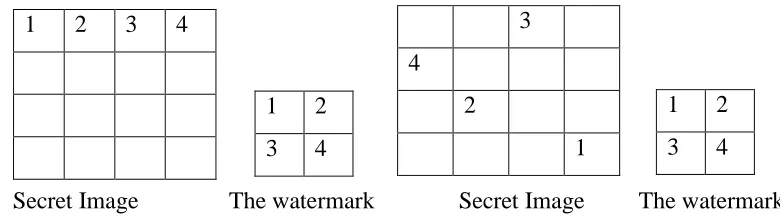
In addition, Lee et al., (2008) proposed a new LSB digital watermarking algorithm that uses the concept of Random Mapping Function. The concept of the algorithm is to insert random watermarks in the coordinates of the image using random mapping function. This technique has been proven more robust than the traditional LSB technique. Figure 2.1 illustrates the traditional LSB technique and the algorithm mechanism proposed by Lee et al., (2008).
Secret Image The watermark Secret Image The watermark
[image:28.612.122.512.537.646.2]The coordinate of Cover image in LSB The coordinate of Cover image in Lee’s Algorithm
Figure 2.1 Example of traditional LSB and Lee’s et al., (2008) algorithm 1 2 3 4
3 4
2
1 1 2
3 4
Besides, Low et al., (2008) proposed a novel watermarking scheme known as “biometric watermarking”. It has been designed to embed handwritten signature invisibly in the host as an indication of legitimate ownership. Their proposed algorithm integrates the LSB and DWT techniques into a unison framework, which is known as a LSB-DWT scheme. The performance of LSB-DWT scheme is validated against simulated frequency and geometric attacks, specifically JPG compression, low pass filtering, median filtering, noise addition, scaling rotation and cropping through visual inspection, PSNR, and watermark distortion rate.
2.12.1 Working Mechanism of Least Significant Bit (LSB)
According to Tilley (2003), and Lee et al., (2008), information can be inserted directly into every bit of image information into less perceptible parts of an image. The LSB provides a better and a less perceptible location to insert information. The section elaborates the working mechanism of a 24-bit colour image and the possible effects of altering the image. A 24-bit true colour bitmap image is used in this instance. The file is first read, and then, the information is inserted into the LSB of each colour component.
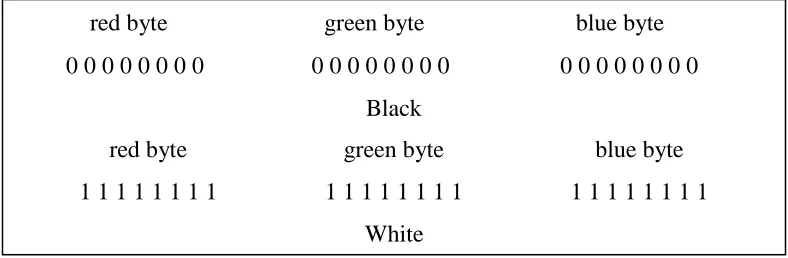
Every true colour (RGB) image is made up of a basic component called “PIXEL”. Pixels are represented by 3 bytes. Each byte in a pixel is 8-bit long, and thus, explains the reason it is called a 24-bit image.
Figure 2.2 An example of black and white pixels
The principle of encoding for each of this byte, i.e. the bit on the far right hand side, uses the LSB. As the LSB is used as the mechanism for encoding information, it is possible to apply more bits to encode the data. However, actions lead to trade off, as with more bits used, more colours are added, and the image becomes altered in a way that it becomes perceptible to the human eye. Tilley (2003), and Lee et al., (2008) argue that the perceptibility of the watermark depends on the image itself. However, they mention that the last four LSBs of a colour component are the largest number of bits that can be used to insert information before the created noise becomes evident to the observer. However, information inserted into at the least two significant bits of each colour component is unlikely to be noticed. This is because the retina of the human eye has a limiting factor of viewing bit pictures. Two pixels that slightly differ in the 24-bit palette are not visible to the human eye, hence named true colour.
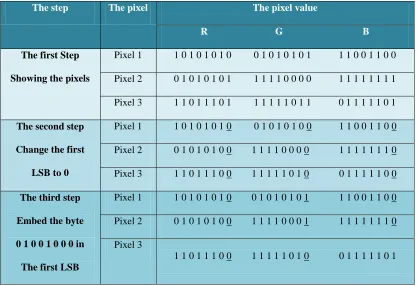
Furthermore, Table 2.1 illustrates the procedure of embedding a watermark into the LSB. In the illustration given, the LSB of each colour component is used to insert the information. The information, which might be in the form of text and image, is first converted into a binary format. Then, each byte is spread over 3 pixels. Thus, the last byte is used to encode the start of the next byte of the hidden file.
The three basic steps of embedding information into LSB are given in Table 2.1. The first step is to assemble the pixels of the image, which are represented in binary format. Second, the values of the first LSB are changed to “0”. Lastly, the watermark, which is represented in bytes, is used to replace the first LSB. In the final byte, the blue component of pixel 3 is used at the start of the next byte of the hidden information.
red byte green byte blue byte
0 0 0 0 0 0 0 0 0 0 0 0 0 0 0 0 0 0 0 0 0 0 0 0
red byte
Black
green byte blue byte 1 1 1 1 1 1 1 1 1 1 1 1 1 1 1 1 1 1 1 1 1 1 1 1
Table 2.1: Illustration of LSB (Tilley, 2003; Lee et al., 2008)
The step The pixel The pixel value
R G B
The first Step
Showing the pixels
Pixel 1 1 0 1 0 1 0 1 0 0 1 0 1 0 1 0 1 1 1 0 0 1 1 0 0
Pixel 2 0 1 0 1 0 1 0 1 1 1 1 1 0 0 0 0 1 1 1 1 1 1 1 1
Pixel 3 1 1 0 1 1 1 0 1 1 1 1 1 1 0 1 1 0 1 1 1 1 1 0 1
The second step
Change the first
LSB to 0
Pixel 1 1 0 1 0 1 0 1 0 0 1 0 1 0 1 0 0 1 1 0 0 1 1 0 0
Pixel 2 0 1 0 1 0 1 0 0 1 1 1 1 0 0 0 0 1 1 1 1 1 1 1 0
Pixel 3 1 1 0 1 1 1 0 0 1 1 1 1 1 0 1 0 0 1 1 1 1 1 0 0
The third step
Embed the byte
0 1 0 0 1 0 0 0 in
The first LSB
Pixel 1 1 0 1 0 1 0 1 0 0 1 0 1 0 1 0 1 1 1 0 0 1 1 0 0
Pixel 2 0 1 0 1 0 1 0 0 1 1 1 1 0 0 0 1 1 1 1 1 1 1 1 0
Pixel 3
1 1 0 1 1 1 0 0 1 1 1 1 1 0 1 0 0 1 1 1 1 1 0 1
Table 2.1 above gives an illustration of how a watermark is embedded using the LSB. However, the method used has certain limitations. Manipulation of the image, which certainly alters the pixel values of the image, results in irretrievable loss of hidden information. However, lossy compression techniques, such as JPEG, cannot be used on the image. This would result in an approximation of the image rather than a full reconstruction of the information hidden within. This also applies to cropping or scaling of the image. Thus, operations, such as rotations, reflections, or negative images can be done; however, reversing the process will restore the original bit values (Tilley, 2003).
[image:31.612.121.535.134.419.2]image in an uncompressed format, such as BMP. This is in an attempt to retain the quality of images in their high resolution.
2.13 Watermarking Using Discrete Wavelet Transform (DWT)
He et al., (2006) proposed a new approach, which uses wavelet-based fragile watermarking scheme to secure image authentication. In their mechanism, the watermark is generated and embedded using DWT, and then, a security framework is integrated into their proposed technique that scrambles the encryption embedded into the LSB of the host image. Besides, another algorithm was proposed by Bhatnagar, and Raman (2008), which uses a semi blind reference watermarking scheme based on DWT and Singular Value Decomposition (SVD). Their proposed mechanism is intended for copyright protection and authenticity, and the watermark contains a grey scale logo image.
Their proposed mechanism embeds a watermark by transforming the original image into wavelet domain. Through this procedure, a reference sub image is formed using directive contrast and wavelet coefficients. Thus, the watermark is embedded into reference image by modifying the singular values of reference image using the singular values of the watermark.
2.13.1 Working Mechanism of Discrete Wavelet Transform (DWT)
Wavelet transform is described as a time domain localized analysis method with the window’s size fixed and forms convertible. The working mechanism of the DWT in
low frequency district is DWT transformed. Figure 2.3 illustrates how DWT is decompressed in a single level.
Figure 2.3 One level wavelet domains
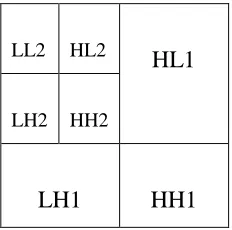
1. LL : Approximation coefficients matrix 2. HL: Horizontal details coefficients matrix 3. LH : Vertical details coefficients matrix 4. HH : Diagonal details coefficients matrix
Approximation coefficients LL can be further transformed to obtain two-layer approximation coefficients: LL2, and horizontal, vertical, and diagonal details coefficients: HL2, LH2, and HH2 respectively. Figure 2.4 illustrates the disintegration of DWT into two levels.
LL2 HL2
HL1
LH2 HH2
LH1 HH1
Figure 2.4 Two levels wavelet domains
In a two-dimensional separable dyadic DWT, every level of disintegration produces four bands of data. One of the bands corresponds to the low pass band LL, and the other three correspond to horizontal HL, vertical LH, and diagonal HH high pass bands. The disintegrated image illustrates an abrasive approximation of the image in the lowest possible resolution of the low pass band, and the three-detailed information of the image
LL HL
[image:33.612.270.386.442.557.2]in the higher bands. The low pass band can further be disintegrated to obtain another level of lower pass band. Thus, the procedure can be continued until the number of wanted levels is obtained (Wu, & Liu, 1998).
Among the many advantages of the DWT is that it has been understood to
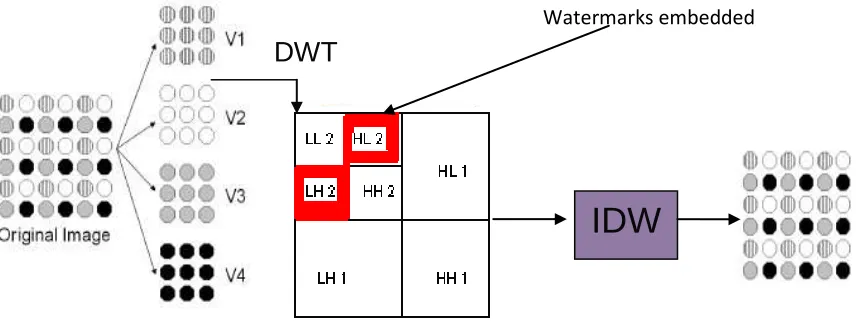
possess more accurate model image LL, as well as horizontal HL, vertical LH, and diagonal HH detail components. Figure 2.5 illustrates the mechanism of 2 scales DWT.
[image:34.612.115.545.214.380.2]Watermarks embedded
Figure 2.5 Implementation of watermark using DWT (Asaad, 2005)
According to Asaad (2005), the aspects of HVS, compared to FFT or DCT, allow the use of higher energy watermarks in regions that the HVS is known to be less sensitive to, such as the high resolution detail bands LH, HL, and HH. By embedding watermarks into these regions, it can certainly allow the increase of the robustness of the watermark, at little to no additional impact on the quality of the image.
Besides, the image is decomposed into four sub images through sub sampling,
and then, they are transformed via DWT to obtain the sets of coefficients Vi [n1, n2]. One pair of coefficients from two different sub images situated in the same DWT domain location is used to insert one watermark sample. The watermark insertion order sequence is that four consecutive numbers in the sequence must be different. When the pair of coefficients is Vi and Vj, the following operations are performed.
V= (Vi+Vj)/2
DWT
If abs [(Vi-Vj)/V] < 6a,
Then Vi’ = V (1 +aW), Vj’=V (1-aW); where positive constant (a) is alpha and it has a
value between 0 and 1.
At the decoder stage, a similar process is followed. If the recovered watermark is W’ [n], and each selected pair of coefficients is Ui and Uj, U= (Ui+Uj)/2;
If (Ui-Uj)/U < 6a, then
W’= (Ui-Uj)/(a*(Ui+Uj).
Tsun et al., also proposed a watermarking algorithm using DWT. The proposed idea consists of the following steps:
a) Perform n level at the 2D DWT decomposition level, on the input image, and generate the output image X.
b) Generate a binary matrix A with the same dimension and the structure of the matrix X using a secret key. The secret key is shared between the embedder and the authenticator.
c) Generate a binary matrix B with the same dimension as matrix X, so that all its pixels that correspond to the non-zero-valued coefficients in X are set to 1 and the rest are set to 0, while BHH1 is modified by projection operation on all bands at every level to this band. This projection is performed in the following manner. An OR operation is performed on all of the three sub bands, LLi, LHi, and HLi, at each level of B to generate a sequence of binary sequences as C ={Cn, Cn−1,...,C1}.
d) The binary watermark sequence is calculated by XOR of matrix A and matrix B, which is called matrix W, W = A XOR B. In other words, a binary watermark W is generated by performing XOR on matrix A and matrix B.
e) The wavelet coefficients in sub band XHH1 are watermarked that their counterparts in sub band BHH1 have a value of 1.
REFERENCES:
Abdullah O. A. B. (2012) An Improved Digital Watermarking Algorithm Using Combination Of Least Significant Bit (LSB) And Inverse Bit. Universiti Tun Hussein Onn Malaysia: Master‘s Thesis.
Albrecht, C. C, (2013). Prevention, F. Fraud and Forensic Accounting in a Digital Environment. (http://www.theifp.org/research-grants/IFP-Whitepaper-4.pdf).
Al-Dharrab, M. A. A. (2005). Benchmarking Framework for Software Watermarking . A master thesis presented to the deanship of the graduate studies in King Fahad University of Petroleum & Minerals.
Asaad Ibrahim, M .A (2005). Image Watermarking. ECE 618 – Fall 2005.
Bamatraf, A., Ibrahim, R., & Salleh, M. N. B. M. (2010, December). Digital watermarking algorithm using lsb. In Computer Applications and Industrial Electronics (ICCAIE), 2010 International Conference on (pp. 155-159). IEEE.
Basheer, N. M., & Abdulsalam, S. S. (2011, March). Digital Image Watermarking Algorithm in Discrete Wavelet Transform Domain Using HVS Characteristics. In Proceedings of the IEEE International Conference on Information Technology: Coding and Computing (pp. 122-127).
Bhatnagar, G. and Raman, B. (2008). A new robust reference watermarking scheme based on DWT-SVD, Elsevier B.V. All rights reserved
Bruyndonckx, O., Quisquater, J. J., and Macq, B. (1995). Spatial method for copyright labeling of digital images. In Proceedings of the IEEE Workshop Nonlinear Signal and Image Processing. IEEE Computer Society Press, Los Alamitos, CA, 456–459.
Cox, I. J., Miller, M. L., Bloom, J. A., Fridrich, J. and Kalker, T. (2008). Digital Watermarking and Steganography. 2nd edition. Morgan Kaufmann Puplishers.
Cox, I., Kilian, J., Leighton, T., and Shamoon, T. (1997). Secure spread spectrum watermarking for multimedia. IEEE Trans. Image Process. 6, 12, 1673–1687.
Cramer C. (2005), About Digital Watermarking. From the following website ―http://www.willamette.edu/wits/idc/mmcamp/watermarking.htm‖
Dorairangaswamy, M.A. (2009), ‗A Novel Invisible and Blind Watermarking Scheme For Copyright Protection of Digital Images‘, International Journal of Computer Science
and Network Security, vol. 9, no. 4. Retrieved January 3, 2010, from http://paper.ijcsns.org/07_book/200904/20090411.pdf.
El-Taweel, G.S., Onsi, H.M., Samy, M., & Darwish M.G.(2005), ‗Secure and Non-Blind Watermarking Scheme for Color Images‘, ICGST International Journal on Graphics,
Vision and Image Processing, vol. SI1. Retrieved January 3, 2010, from http://www.icgst.com/gvip/v4/P1150442004.pdf.
Eskicioglu, A. M., & Fisher, P. S. (1995). Image quality measures and their performance. Communications, IEEE Transactions on, 43(12), 2959-2965.
Gopal, N. V., & Koteswaramma, A. (2013). International Journal of Advanced Research in Computer Science and Software Engineering. International Journal, 3(3).
Gunjal, B. L., & Manthalkar, R. R. (2010). An overview of transform domain robust digital image watermarking algorithms. Journal of Emerging Trends in Computing and Information Sciences, 2(1), 2010-2011.
Hameed, K., Mumtaz, A., & Gilani, S.A.M. (2006), ‗Digital Image Watermarking in the Wavelet Transform Domain‘, World Academy of Science, Engineering and
Technology.RetrievedJanuary1,2010,from
http://www.waset.org/journals/waset/v13/v13-16.pdf.
Hartung, F. and Kutter, M., (1999). Multimedia Watermarking Techniques. Proceedings of the IEEE, VOL. 87, NO. 7, JULY 1999.
He, H. J., Zhang, J. S. and Tai, H. M., (2006). A Wavelet-Based Fragile Watermarking Scheme for Secure Image Authentication. Springer-Verlag Berlin Heidelberg 2006.
Hu, Y., Kwong, S., Huang, J. (2004), ‗Using invisible watermarks to protect visibly watermarked images‘, Proceedings of International Symposium Circuits and Systems,
vol. 5, pp. V-584 - V-587. Retrieved January 3, 2010, from IEEEXplore database.
Johnson, N. F., Duric, Z., & Jajodia, S. (2006). Information Hiding: Steganography and Watermarking-Attacks and Countermeasures (Advances in Information Security, Volume 1)(Advances in Information Security).
Jun, Y., Chi, J.R. & Zhuang, X.D. (2007), ‗A New Wavelet-based Robust Watermarking for Digital Image‘, IEEE International Conference on Networking, Sensing and Control,
Kamble, S., Maheshkar, V., Agarwal, S and Srivastava, V. K (2012). DWT-SVD Based Robust Image Watermarking Using Arnold Map. International Journal of Information Technology and Knowledge Management.
Katzenbeisser, S. and Petitcolas, F.A.P., (2000). Information hiding techniques for steganography and digital watermarking. Artech House Publishers.
Kundur, D. and Hatzinakos, D. (1997). A robust digital image watermarking method using wavelet based fusion. In Proceedings of the IEEE International Conference on Image Processing. Vol. 1. IEEE Computer Society Press, Los Alamitos, CA, 544–547.
Kurah, C. and Mchughes, J. (1992). A cautionary note on image downgrading. In Proceedings of the IEEE Computer Security Applications Conference. Vol. 2. IEEE Computer Society Press, Los Alamitos, CA, 153–159.
Lee, G. J., Yoon, E. J. and Yoo, K. Y. (2008). A new LSB based Digital Watermarking Scheme with Random Mapping Function. In 2008 IEEE DOI 10.1109/UMC.2008.33.
Lee, S. J. and Jung, S. H., (2001). A Survey of Watermarking Techniques applied to Multimedia. 2001 IEEE, ISIE 2001, Pusan, KOREA.
Li, C. T., & Si, H. (2007). Wavelet-based fragile watermarking scheme for image authentication. Journal of Electronic Imaging, 16(1), 013009-013009.
Liu, J.L., Lou, D.C., Chang, M.C. & Tso, H.K. (2005), ‗A robust watermarking scheme using self-reference image‘, Computer Standards & Interfaces, vol. 28, no. 3, pp. 356-367. Retrieved February 4, 2009, from ScienceDirect database.
Lu, W., Lu, H., & Chung, F. (2006), ‗Feature based watermarking using watermark template match‘, Applied Mathematics and Computations, vol. 177, no. 1, pp.377-386.
Retrieved March 27, 2009, from ScienceDirect database.
Luo, H, Chu, S. H. and Lu, Z. M. (2008). Self Embedding Watermarking Using Halftoning Technique. Circuits Syst Signal Process (2008) 27: 155–170.
Luo, K. & Tian, X. (2008), ‗A New Robust Watermarking Scheme based on Wavelet Transform‘, Congress on Image and Signal Processing, vol. 1, pp. 312-316. Retrieved
February 4, 2009, from IEEEXplore database.
Malaysia (2006), Laws of Malaysia: Offences Relating To Documents and To Currency Notes and Bank: Forgery 46, Penal Act 574, 2006.
Mandhani, N. K. (2004). Watermarking Using Decimal Sequences. Thesis submitted to the Graduate Faculty of the Louisiana State University, USA.
Nagra, J., Thomborson, C. and Collberg, C. (2002). a functional taxonomy for software watermarking.In M. Oudshoorn, ed., `Proc. 25th Australasian Computer Science Conference 2002', ACS, pp. 177-186.
Nasir, I., Weng, Y. & Jiang, J. (2007), ‗A New Robust Watermarking Scheme for Color Image in Spatial Domain‘, Third International IEEE Conference on Signal-Image
Technologies and Internet-Based System, pp.942-947. Retrieved May 10,2009, from IEEEXplore database.
O‘Ruanaidh, J. and Pun, T. (1998). Rotation, scale, and translation invariant digital image
watermarking. Signal Process. 66, 3, 303–317.
Pindar, Z. A. (2014). UTHM Certificate Verification Using Microtext Double Check Digit. Universiti Tun Hussein Onn Malaysia: Master‘s Thesis.
Roma Rewani, Mahendra Kumar and Aditya Kumar Singh Pundir. (2008). Digital Image Watermarking: A Survey. International Journal of Engineering Research and Applications (IJERA) ISSN: 2248-9622 www.ijera.com Vol. 3, Issue 4, Jul-Aug 2013, pp.1750-1753.
Salama, A., Atta, R., Rizk, R., & Wanes, F. (2011, June). A robust digital image watermarking technique based on Wavelet transform. In System Engineering and Technology (ICSET), 2011 IEEE International Conference on(pp. 100-105). IEEE.
Samˇcovic, A., & Turan, J. (2008). Attacks on digital wavelet image watermarks.
JOURNAL OF ELECTRICAL ENGINEERING-BRATISLAVA-, 59(3), 131.
Tilley, A. (2003). Steganography: Reversible Data Hiding Methods for Digital Media Bachelor project.
Tirkel, A., Rankin, G., Schyndel, R. V., Ho, W., Mee, N., and Osborne, C. (1993). Electronic watermark. In Proceedings of DICTA. 666–672.
Wang, X.Y., Hou, L.M. & Yang, H.Y. (2009), ‗A feature-based image watermarking scheme robust to local geometrical distortions‘, Journal of Optics : Pure and Applied
Optics. Retrieved March 27, 2009, from Institute of Physics (IOP) Journals database.
Wang, X.Y., Yang, H.Y. & Cui, C.Y. (2008), ‗An SVM-based robust digital image watermarking against de synchronization attacks‘, Signal Processing, vol. 88,no. 9,
Wang, Z., Bovik, A. C., Sheikh, H. R., & Simoncelli, E. P. (2004). Image quality assessment: from error visibility to structural similarity. Image Processing, IEEE Transactions on, 13(4), 600-612.
Woo, C.S. (2007), ‗Digital image watermarking methods for copyright protection and authentication‘, Doctor of Philosophy Thesis, Queensland University of Technology.
Retrieved April 5, 2009, from http://eprints.qut.edu.au/16457/1/Chaw-Seng_Woo_Thesis.pdf.
Wu, M., & Liu, B. (1998, October). Watermarking for Image Authentication. InICIP (2) (pp. 437-441).
Yang, W. C., Wen, C. Y. and Chen, C. H.,(2008). Applying Public-Key Watermarking Techniques in Forensic Imaging to Preserve the Authenticity of the Evidence. Springer-Verlag Berlin Heidelberg 2008.
Zhang, Y. (2009, June). Digital Watermarking Technology: A Review. In Future Computer and Communication, 2009. FCC'09. International Conference on (pp. 250-252). IEEE.
Zhao, J., Hayasaka, R., Muranoi, R., Ito, M., and Matsushita, Y. (2000). A video copyright protection based on contented. IEICE Trans. Inf. Syst. E83-D, 12, 2131–2141.
Zheng, D., Liu, Y., Zhao, J. and El Saddik, A., (2007). A Survey of RST Invariant Image Watermarking Algorithms, ACM 0360-0300/2007/06. DOI 10.1145/1242471.1242473.