649 Copyright 2005 Taylor & Francis Inc.
ISSN: 0020-7454 / 1543-5245 online DOI: 10.1080/00207450590524304
SELF-RATED EXECUTIVE FUNCTION: DEVELOPMENT OF THE EXECUTIVE FUNCTION INDEX
MARCELLO SPINELLA
Division of Social and Behavioral Sciences Richard Stockton College of New Jersey Pomona, New Jersey, USA
There are several self-rating executive function (SREF) measures in existence that were developed solely in clinical populations or which sample a limited range of executive functions. The Executive Function Index (EFI) was devel-oped here in a normal population with five subscales derived through factor analysis: Motivational Drive, Strategic Planning, Organization, Impulse Con-trol, and Empathy. The content of three second order factors is consistent with the functions mediated by dorsolateral, orbitofrontal, and medial prefrontal cir-cuits. Intrascale reliability and demographic relationships are reported as well as strong correlations with other SREF measures validated in clinical and neuroimaging studies. This brief measure provides a quick and efficient means of collecting data in large samples in order to test hypotheses regarding the role of prefrontal systems in various aspects of behavior and to corroborate findings of other methods, such as objective tests and functional neuroimaging.
Keywords executive, Executive Function Index, prefrontal, psychometric, self-rating
Received 13 July 2004.
Executive functions are among the most pertinent cognitive abilities for adaptive functioning, allowing for behavior that is more goal-oriented, flexible, and autonomous. As such, the measurement of executive functions is of great interest for both clinical assessment and research into multiple relevant be-haviors. Given their importance, both objective and subjective tests have been developed to evaluate them.
Aspects of executive functioning such as planning, flexibility, concep-tual reasoning, and set shifting are assessed with tests such as the Wisconsin Card Sorting Test and Tower of London. As objective measures, they are relatively less affected by personal biases. Although factors such as mood and motivation may undermine performance, testing subjects cannot over-represent their own performance when adhering to standardized administra-tion. However, objective neuropsychological tests are designed for use within the constraints of the task performed in a controlled testing environment. As such they are limited in their scope and cannot sample behavior in the widely varying circumstances and conditions of everyday life. Thus, their ecological validity is typically limited.
Several subjective measures of executive function have been developed. These include subjective ratings by the individual and by collaterals such as family members and caretakers. Some instruments, such as the Iowa Collat-eral Head Injury Inventory, Frontal Behavioral inventory, and Neuropsychiatriic Inventory, rely exclusively on collateral information because this information is often more reliable than self-evaluations in individuals with more severe injury or illness (Martzke et al., 1991; Kertesz et al., 1997; Cummings et al., 1994). Some instruments, such as the Dysexecutive Questionnaire (DEX) and Frontal Systems Behavior Scale (FrSBe), employ both self- and collateral-rating forms, allowing comparison of the individuals’ perceptions with others (Grace & Malloy, 2001; Wilson et al., 1996).
Instruments also vary according to which aspects of executive function they purport to measure. Comprehensive literature reviews commonly iden-tify several broad domains of executive function including control of cogni-tive processes, verbal and nonverbal reasoning,concentration, motor regula-tion, emotional regularegula-tion, social conduct, self-awareness (Tekin & Cummings, 2002; Stuss & Levine, 2002; Faw, 2003; Miller & Cohen, 2001; Fuster, 2000; Chow, 2000). Cummings and colleagues have delineated functional neuroanatomical substrates of executive functions, involving circuits through prefrontal cortex, the striatum, and thalamus (Cummings, 1993). Different regions of prefrontal cortex and subcortical circuits mediate aspects of execu-tive functioning: medial prefrontal circuits regulate motivational aspects of behavior, such as initiation and persistence, whereas dorsolateral circuits mediate conceptual reasoning, mental flexibility, planning, and working memory (Stuss & Levine, 2002; Tekin & Cummings, 2002). Orbitofrontal circuits mediate self-inhibition, social conduct, empathy, and decision making (Malloy et al., 1993).
assesses executive aspects of social functioning such as perspective taking and empathy (Davis, 1980).
Given the potential for bias in self-evaluation on self-rating scales of executive function, empirical support for their validity is of high importance. The SREF measures discussed here have demonstrated their validity through various methods. The BIS, IRI, FrSBe, and DEX have demonstrated con-struct validity through factor analysis, showing that the items organize logi-cally according to their content and theoretical models. In a large mixed clinical sample of people with prefrontal system illnesses, the FrSBe items organized into scales that correspond to behavioral syndromes associated with medial, dorsolateral, and orbital prefrontal systems, respectively (Grace & Malloy, 2001). A small clinical sample of normal elderly adults showed a comparable 5-factor structure in the DEX (Amieva et al., 2003). BIS items have factored into three higher-order factors in normal individuals (Patton et al., 1995).
SREF measures have also been validated in clinical populations. The BIS has been validated in several clinical populations, including bulimia, bipolar disorder, and borderline personality disorder (Paul et al., 2002; Swann et al., 2001; Dougherty et al., 1999). The FrSBe differentiates people with frontal lesions from those with nonfrontal lesions (Grace et al., 1999). Sensi-tivity of the FrSBe has also been demonstrated in other illnesses with known prefrontal system dysfunction including neurodegenerative dementias (Paulsen et al., 1996; Cahn-Weiner et al., 2001) and psychiatric illnesses such as bi-polar disorder and schizophrenia (Grace & Malloy, 2001; Velligan et al., 2002). FrSBe scores have been associated with psychoactive drug use and impulse-control aspects of eating in healthy individuals (Spinella, 2003; Spinella & Lyke, 2004). BIS scores have similarly related to eating in healthy indi-viduals and cravings in substance abuse (Lyke & Spinella, 2004; Zilberman et al., 2003). Similarly, an apathy scale was validated by Starkstein and col-leagues (1992) in a sample of individuals with Parkinson’s Disease. Brooks & McKinlay (1983) developed a questionnaire of personality adjectives that they showed differ in individuals with closed head injury.
with the micro structure of white matter in inferior right frontal lobe in a sample of people with schizophrenia (Hoptman et al., 2002), and with activa-tion of prefrontal cortex in healthy individuals performing a response inhibi-tion task (Horn et al., 2003). FrSBe scores have correlated with objective measures of executive dysfunction in schizophrenic and multiple sclerosis patients (Chiaravalloti & DeLuca, 2003; Velligan et al., 2002). Individuals with posttraumatic anosmia and elevated scores on the Iowa Collateral Head injury Interview showed orbitofrontal hypoperfusion using SPECT (Varney & Bushnell, 1998).
There are normal variations in the cognitive functions measured by SREF scales, although these have been little studied in healthy individuals. How-ever, many of the existing scales have some methodological limitations in this population because they have only been developed in clinical popula-tions. It is unknown whether their factor structure applies to healthy indi-viduals. Further, many contain items regarding behaviors that are too ex-treme or pathological to apply to most normal adults (e.g., utilization behavior, lack of concern over incontinence, or alien hand syndrome). Other SREF measures were created to assess a specific aspect of executive functioning and do not sample a wider range of behaviors that apply to this rubric. This study was undertaken to develop a SREF measure in a sample of healthy individuals that samples a wide array of executive function.
METHODS
Participants
Measures
Executive Function Index (EFI). Initial were generated based on recent, comprehensive literature reviews (Tekin & Cummings, 2002; Stuss & Levine, 2002; Faw, 2003; Miller & Cohen, 2001; Fuster, 2000; Chow, 2000). A total of 41 items were generated that covered several content areas ascribed to executive functions: motivation (e.g., activity level, drive), impulse control (e.g., risk taking, substance abuse, excessive spending), empathy (e.g., con-cern for others, aggressive social stance, prosocial behaviors), planning (e.g., anticipation of consequences, use of strategies, saving money), and social conduct (e.g., socially inappropriate behaviors, conversational conduct, sexual impropriety). Items were rated on a 5-point Likert-type scale (1 = Not at all, 5 = Very much). Twenty-six of the 41 items were inverted to control for acquiescent responding. The responses for these items were inverted so that scores uniformly reflect executive function.
Frontal Systems Behavior Scale (FrSBe). The self-rating form of the FrSBe was used for this study. It consists of 46 items, which yields scores for three non-overlapping scales of dysfunction: Apathy, Disinhibition, and Ex-ecutive dysfunction (E). An adaptation of the FrSBe was needed to measure prefrontal-associated traits in this study: whereas the original version was designed for clinical populations and asks for pre- and post-injury/illness ratings for each item, participants in this study were only asked for one global self-rating per item. Reliability studies of the FrSBe have shown high intrascale reliability in normal and clinical samples (Grace & Malloy, 2001).
Barratt Impulsiveness Scale—Version 11 (BIS). The BIS is a 30-item, self-rating scale. The items form three non-overlapping scales that show good reliability: non-planning (BISnp), motor impulsivity (BISm), and attentional impulsivity (BISa) (Patton et al., 1995).
other established empathy scales (Davis, 1980). Validity of the IRI has been established in comparing healthy controls to child abusers and violent sex offenders (PerezAlbeniz & de Paul, 2003; Curwen, 2003). IRIpt scores also predicted volunteerism in healthy adults (Oswald, 2003).
RESULTS
Scale Construction and Factor Analyses
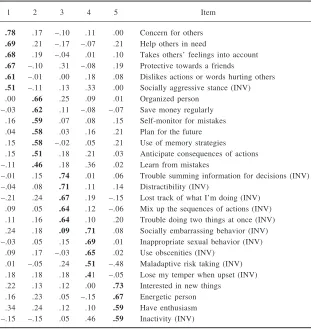
Corrected item-total correlations revealed 3 items with correlations below .2, which were dropped from the analyses. Exploratory factor analysis was done on the remaining items using principal components analysis with varimax rotation. The number of factors to be extracted was determined by interpret-ability and parallel analysis. Parallel analysis indicated a 5-factor structure, which also yielded logically interpretable factors (Zwick & Velicer, 1986). The five factors had 9, 7, 13, 5, and 4 items, respectively. Eigenvalues for these 5 factors were 4.0, 4.0, 4.0, 3.2, and 2.1, which accounted for 9.8%, 9.7%, 9.6%, 7.7%, and 5.1% of the variance, respectively. Collectively these 5 components accounted for 42.0% of the total variance. To refine and shorten the scales, up to 6 items with the highest loadings were chosen from each factor. This yielded 5 factors with a total of 27 items (6, 5, 6, 6, and 4 items per factor), which were again subjected to principal components analysis. Eigenvalues for these 5 factors were 3.1, 2.8, 2.8, 2.5, and 2.2, accounting for 11.5%, 10.4%, 10.2%, 9.4%, and 8.2% of the variance, respectively. Collectively these 5 components accounted for 49.7% of the total variance. Highest item loadings for each item was identical in both factor analyses (41 item and 27 item versions).
These factors were named Empathy (EM), Strategic Planning (SP), Or-ganization (ORG), Impulse Control (IC), and Motivational Drive (MD) (Table 1). Ratings from items were summed to create additive scales. Values for negatively valenced items inverted so that scores on all scales and the total score represent better executive functioning. Cronbach’s alpha was accept-able for the subscales: .76, .70, .75, .69, and .70, respectively, and .82 for the total score. Total scores for the EFI were normally .distributed (Kolmogorov-Smirnov Z = .88, p = .42).
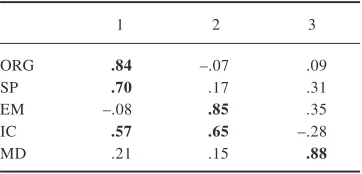
Eigenvalues for these 5 factors were 1.6, 1.2, and 1.1, which accounted for 31.6%, 23.8%, and 21.8% of the variance, and collectively accounted for 77.2% of the total variance (Table 2).
Demographics Influences
[image:8.456.73.386.61.390.2]Linear regression was performed to determine the contributions of demo-graphic variables to EEI total scores, which was significant, F(3,187) = 10.6, p < .001 (Table 3). The model accounted for 14.8% of the variance (Adjusted
Table 1. Factor analysis of the Executive Function Index (N = 188)
1 2 3 4 5 Item
.78 .17 –.10 .11 .00 Concern for others .69 .21 –.17 –.07 .21 Help others in need
.68 .19 –.04 .01 .10 Takes others’ feelings into account .67 –.10 .31 –.08 .19 Protective towards a friends
.61 –.01 .00 .18 .08 Dislikes actions or words hurting others .51 –.11 .13 .33 .00 Socially aggressive stance (INV) .00 .66 .25 .09 .01 Organized person
–.03 .62 .11 –.08 –.07 Save money regularly .16 .59 .07 .08 .15 Self-monitor for mistakes .04 .58 .03 .16 .21 Plan for the future .15 .58 –.02 .05 .21 Use of memory strategies .15 .51 .18 .21 .03 Anticipate consequences of actions –.11 .46 .18 .36 .02 Learn from mistakes
–.01 .15 .74 .01 .06 Trouble summing information for decisions (INV) –.04 .08 .71 .11 .14 Distractibility (INV)
–.21 .24 .67 .19 –.15 Lost track of what I’m doing (INV) .09 .05 .64 .12 –.06 Mix up the sequences of actions (INV) .11 .16.6....64 .10 .20 Trouble doing two things at once (INV) .24 .18 .09 .71 .08 Socially embarrassing behavior (INV) –.03 .05 .15 .69 .01 Inappropriate sexual behavior (INV)
.09 .17 –.03 .65 .02 Use obscenities (INV) .01 –.05 .24 .51 –.48 Maladaptive risk taking (INV) .18 .18 .18 .41 –.05 Lose my temper when upset (INV) .22 .13 .12 .00 .73 Interested in new things
.16 .23 .05 –.15 .67 Energetic person .34 .24 .12 .10 .59 Have enthusiasm –.15 –.15 .05 .46 .59 Inactivity (INV)
R2=.0134). Females scored higher than males, and scores increased with age
and educational level. Analyses of variance of subscales showed sex differ-ences to be significant for IC and EM scales, with medium effect sizes as indicated by Cohen’s d (Table 4).
Validity
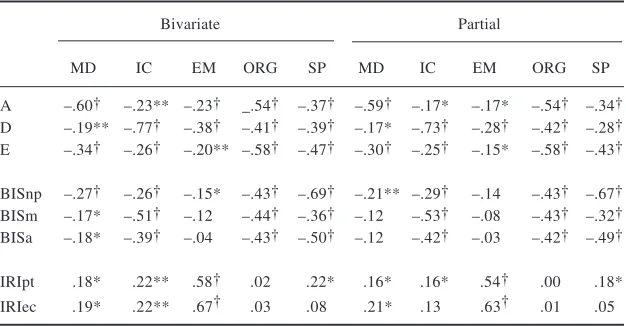
[image:9.456.137.318.73.160.2]Pearson correlations coefficients were obtained between scales of the EFI, FrSBe, BIS, and IRI (Table 5). Inverse correlations occurred between scales of the all scales of the EFI with the all scales of the FrSBe. Inverse correla-tions also occurred between the all BIS scales and MD, IC, ORG, and SP, whereas only BISnp correlated with EM. Both IRI scales correlated posi-tively with MD, IC, and EM, whereas only IRIpt correlated posiposi-tively with SP. Partial correlations were performed to control for the influences of age,
Table 2. Second order factor analysis of the Executive Function Index subscales (N = 188)
1 2 3
ORG .84 –.07 .09
SP .70 .17 .31
EM –.08 .85 .35
IC .57 .65 –.28
MD .21 .15 .88
Values for inverted items (INV) were inverted prior to the factor analysis. Abbreviations: EM = empathy, SP = strategic planning, ORG = organization, IC = impulse control, and MD = motivational drive.
Table 3. Linear regression of demographic variables predicting total scores of the Executive Function Index
B SE Beta Partial Part
Age .28 .08 .24** .25 .24
Sex –3.99 l.67 –.16* –.17 –.16
Education 1.54 .41 .26** .27 .26
[image:9.456.100.353.476.538.2]Table 4. Descriptive statistics for EFI scores
Overall Males Females
M SD M SD M SD p d
MD 14.6 3.0 14.8 2.6 14.5 3.2 .499
IC 16.4 4.0 15.4 3.7 17.2 4.0 .002 0.5
EM 22.8 4.1 21.5 4.1 23.8 3.7 .000 0.6
ORG 18.3 3.7 18.2 3.5 18.4 3.9 .777
SP 23.7 4.4 23.4 4.5 23.9 .4.3 .442
Abbreviations: EM = empathy, SP = strategic planning, ORG = organization, IC = impulse control, and MD = motivational drive.
Table 5. Correlations between subscales of the Executive Function Index subscales (EFI)
Bivariate Partial
MD IC EM ORG SP MD IC EM ORG SP
A –.60† –.23** –.23† _.54† –.37† –.59† –.17* –.17* –.54† –.34† D –.19** –.77† –.38† –.41† –.39† –.17* –.73† –.28† –.42† –.28† E –.34† –.26† –.20** –.58† –.47† –.30† –.25† –.15* –.58† –.43†
BISnp –.27† –.26† –.15* –.43† –.69† –.21** –.29† –.14 –.43† –.67† BISm –.17* –.51† –.12 –.44† –.36† –.12 –.53† –.08 –.43† –.32† BISa –.18* –.39† –.04 –.43† –.50† –.12 –.42† –.03 –.42† –.49†
IRIpt .18* .22** .58† .02 .22* .16* .16* .54† .00 .18*
IRIec .19* .22** .67† .03 .08 .21* .13 .63† .01 .05
[image:10.456.72.385.306.469.2]sex, and education. Small reductions in the magnitude occurred in the corre-lation coefficients, while the overall pattern of recorre-lationships remained and was significant for the majority of correlations.
DISCUSSION
The EFI was created as a brief, self-rated measure of executive functioning in normal individuals. The items were derived from reviews of clinical and experimental studies of executive functions in order to reflect the activity of prefrontal-subcortical systems. This instrument has the advantage of having been developed in a community sample, demonstrating the viability of such an instrument in normal individuals whereas many in the past had been created for clinical purposes. Factor analysis showed that the items organized into 5factors whose content relates to recognized domains of executive func-tioning. The relationship of the content of these scales to prefrontal system function is evident in clinical and neuroimaging studies.
Items of the EM scale reflect a concern for the well-being of others, prosocial behaviors, and a cooperative attitude. Functional neuroimaging studies have shown activation in superior frontal and orbitofrontal cortex during empathy judgments (Farrow et al., 2001; Decety & Caminade, 2003). Activa-tion in the prefrontal-subcortical circuits (orbitofrontal and anterior cingulate cortex, nucleus accumbens, and caudate nucleus) was demonstrated in sub-jects engaging in social cooperation during the Prisoner’s Dilemma Game (Rilling et al., 2002). Both neuroimaging and lesion studies suggest a role for orbitofrontal and medial prefrontal cortex in theory of mind ability, or the ability to take another’s point of view (Goel et al., 1995; Stone et al., 1998). Accordingly, individuals with prefrontal insults exhibit reduced empathy (Eslinger, 1998).
Fincham and colleagues (2002) using the analogous Tower of Hanoi plan-ning task. Individuals with prefrontal and striatal injury show deficits in di-verse tasks of planning (Colvin et al., 2001; Mendez et al., 1989).
ORG items address the ability to carry organized goal-directed behavior through functions like multitasking, sequencing, and holding information in mind in order to make decisions. Dorsolateral prefrontal circuits mediate working memory, a function necessary to handle multiple demands simulta-neously (Courtney et al., 1998). Individuals with lesions of dorsolateral, fron-topolar, and left anterior cingulate show deficits in multitasking (Burgess et al., 2000). Prefrontal systems are also active during use of mnemonic strategies (Speer et al., 2003). Items of the IC scale address self-inhibition, risk taking, and social conduct. Individuals with orbitofrontal injuries show deficiencies in these areas (Malloy et al., 1993). Performance on the Iowa Gambling Task, a measure of risk taking and decision making, causes activation of orbitofrontal and other prefrontal structures (e.g., Bolla et al., 2003). MD items address behavioral drive, activity level, and interest in novelty. Individuals with medial prefrontal circuit dysfunction show apathy, reduced drive, and abulia (Teckin & Cummings, 2003; Sarazin et al., 2003; Matsumoto & Tanaka, 2004).
In addition to items factoring logically according to abilities mediated by prefrontal systems, a second-order, 3-factor model of these subscales showed that ORG and SP form one factor, EM and IC form a second, and MD forms a third. These fit what would be anticipated from Cummings (1993) identifi-cation of dorsolateral, orbitofrontal, and medial prefrontal circuits, respec-tively. The factor organization of the scales parallels the functional organiza-tion of prefrontal circuits.
Regression analysis showed that the EFI total score increases with age and education, and that females score higher than males. This pattern of demographic influences matches those of some other executive measures, such as the FrSBe and Wisconsin Card Sorting Test (Grace & Malloy, 2001; Heaton et al., 1993; Boone et al., 1993). Age-related differences in executive function have been documented and corroborated by neuroimaging studies of prefrontal system activity (Luna et al., 2001). This has particularly been evi-denced in response inhibition tasks (Tannin et al., 2002; Booth et al., 2003; Rubiya et al., 2000). There are several possible neurobiological underpin-nings for this maturation, including increases in frontal myelination, which can persist into the fifth decade of life (Sowell et al., 2003; Bartzokis et al., 2001).
inhibition (Klinteberg et al., 1987), a finding that is not limited to humans (Jentsch & Taylor, 2003). Females, on average, also tend to exhibit higher degrees of empathy (Mehrabian & Epstein, 1972). One possible underpin-ning for these differences is greater volume of orbitofrontal cortex in females compared to males (Gur et al., 2002). Also of interest in this study was the lack of sex differences in dorsolateral prefrontal cortex. The pattern of results reported here fits these neuroanatomical findings: no sex differences in dor-solateral-associated function (SP and ORG), and lower scores in males on orbitofrontal-associated function (IC and EM).
Executive function correlated positively with educational level. Aspects of education have also been associated with executive functions. In children, impulsivity is consistently associated with lower grades and achievement scores, even when IQ is partialled out (Meade, 1981; Miyakawa, 2001). Grades in an undergraduate college course were also found to be inversely related to impulsivity (measured by the Barratt Impulsiveness Scale), independent of age, sex, or years of school completed (Spinella & Miley, 2003). Orbitofrontal-sensitive measures (go/no-go, delayed alternation, and smell identification) were also related to years of educational attainment, independent of age or sex (Spinella & Miley, 2005a). Overall college GPA was inversely related to FrSBe E scores, even after controlling for hours worked and studying per week (Spinella & Miley, 2005b). Hours studying per week relate inversely to the FrSBe A scale, even after controlling for hours worked per week.
all subjective data, corroborating evidence from other objective sources is desirable. Scores on SREF measures could he influenced by temporary con-ditions or by individual biases. Epistemologically, one is limited to conclude that the patterns of responses observed are consistentwith prefrontal system function.
However, insofar as SREF measures do correlate with objective mea-sures of brain structure and function, they are useful research instruments. This is especially the case because they can be quick and efficient means to gather data in large samples, affording statistical power and control of covariates. Results from SREF research can be used to corroborate and also to elaborate upon findings from more objective measures like functional neuroimaging. Given the low cost of administering SREF measures, they can also be used to test new hypotheses regarding executive function, which could then be fol-lowed by objective methods.
REFERENCES
Amieva, H., Phillips, L., & Della Sala, S. (2003). Behavioral dysexecutive symptoms in normal aging. Brain and Cognition, 53(2), 129–132.
Bartzokis, G., Beckson, M., Lu, P. H., Nuechterlein, K. H., Edwards, N., & Mintz, J. (2001). Age-related changes in frontal and temporal lobe volumes in men: A magnetic resonance imaging study. Archives of General Psychiatry, 58(5),461–465. Beauchamp, M. H., Dagher, A., Aston, J. A., & Doyon, J. (2003). Dynamic
func-tional changes associated with cognitive skill learning of an adapted version of the Tower of London task. Neuroimage, 20(3),1649–1460.
Bogod, N. M., Mateer, C. A., & Macdonald, S. W. S. (2003). Self-awareness after traumatic brain injury: A comparison of measures and their relationship to ex-ecutive functions. Journal of the International Neuropsychological Society, 9(3), 450–458.
Bolla, K. I., Eldreth, D. A., London, E. D., Kiehl, K. A., Mouratidis, M., et al. (2003). Orbitofrontal cortex dysfunction in abstinent cocaine abusers performing a deci-sion-making task. Neuroimage, 19(3),1085–1094.
Boone, K. B., Ghaffarian, S., & Lesser, I. M. (1993). Wisconsin Card Sorting Test performance in healthy, older adults: Relationship to age, sex, education, and IQ. Journal of Clinical Psychology, 49, 54–60.
Booth, J. R., Burman, D. D., Meyer, J. R., Lei, Z., & Trommer, B. L. (2003). Neural development of selective attention and response inhibition. Neuroimage, 20(2), 737–751.
Burgess, P. W., Veitch, E., de Lacy Costello, A., & Shallice, T. (2000). The cognitive and neuroanatomical correlates of multitasking. Neuropsychologia, 38(6),848–863. Cahn-Weiner, D. A., Grace, J., & Ott, B. R. (2002). Cognitive and behavioral fea-tures discriminate between Alzheimer’s and Parkinson’s disease. Neuropsychia-try, Neuropsychology, & Behavioral Neurology, 15(2), 79–87.
Carrillo-de-la-Pena, M. T., Otero, J. M., & Romero, E. (1993). Comparison among various methods of assessment of impulsiveness. Perceptual & Motor Skills, 77(2), 567–575.
Chiaravalloti, N. D., & DeLuca, J. (2003). Assessing the behavioral consequences of multiple sclerosis: An application of the Frontal Systems Behavior Scale (FrSBe). Cognitive & Behavioral Neurology, 16, 54–67.
Chow, T. W. (2000). Personality in frontal lobe disorders. Current Psychiatry Re-ports, 2(5), 446–451.
Colvin, M. K., Dunbar, K., & Grafman, J. (2001). The effects of frontal lobe lesions on goal achievement in the water jug task. Journal of Cognitive Neuroscience, 13(8), 1129–1147.
Courtney, S. M., Petit, L., Haxby, J. V., & Ungerleider, L. G. (1998). The role of prefrontal cortex in working memory: Examining the contents of consciousness. Philosophical Transactions of the Royal Society of London B Biological Sci-ences, 353(1377), 1819–1828.
Cummings, J. L. (1993). Frontal-subcortical circuits and human behavior. Archives of Neurology, 50(8), 873–880.
Cummings, J. L., Mega, M., Gray, K., Rosenberg-Thompson, S., Carusi, D. A., & Gornbein, J. (1994). The Neuropsychiatric Inventory: Comprehensive assessment of psychopathology in dementia. Neurology, 44(12), 2308–2314.
Curwen, T. (2003). The importance of offense characteristics, victimization history, hostility, and social desirability in assessing empathy of male adolescent sex offenders. Sex Abuse,15(4),347–364.
Davis, M. H. (1980). A multidimensional approach to individual differences in empa-thy. Catalog of Selected Documents in Psychology, 10(MS. 2124), 85–100. Decety, J., & Chaminade, T. (2003). Neural correlates of feeling sympathy.
Neuro-psychologia, 41, 127–138.
Dougherty, D. M., Bjork, J. M., Huckabee, H. C., Moeller, F. G., & Swann, A. C. (1999). Laboratory measures of aggression and impulsivity in women with bor-derline personality disorder. Psychiatry Research, 85(3),315–326.
Eslinger, P. J. (1998). Neurological and neuropsychological bases of empathy. Euro-pean Neurology, 39, 193–199.
Farrow, T. F., Zheng, Y., Wilkinson, I. D., Spence, S. A., Deakin, J. F., et al. (2001). Investigating the functional anatomy of empathy and forgiveness. Neuroreport, 12, 2433–2438.
Fincham, J. M., Carter, C. S., van Veen, V., Stenger, V. A., & Anderson, J. R. (2002). Neural mechanisms of planning: A computational analysis using event-related fMRI. Proceedings of the National Academy of Science USA,99(5),3346–3351. Fuster, J. M. (2000). Executive frontal functions. Experimental Brain Research,133(1),
66–70.
Goel, V., Grafman, J., Sadato, N., & Hallett, M. (1995). Modeling other minds. Neuroreport, 6, 1741–1746.
Govern, J. M., & Marsch, L. A. (2001). Development and validation of the situ-ational self-awareness scale. Consciousness and Cognition, 10(3), 366–378. Grace, J., & Malloy, P. F. (2001). Frontal Systems Behavior Scale. Lutz, FL:
Psy-chological Assessment Resources, Inc.
Grace, J., Stout, J. C., & Malloy, P. F. (1999). Assessing frontal behavior syndromes with the Frontal Lobe Personality Scale. Assessment, 6, 269–284.
Gur, R. C., Gunning-Dixon, F., Bilker, W. B., & Gur, R. E. (2000). Sex differences in temporo-limbic and frontal brain volumes of healthy adults. Cerebral Cortex, 12(9), 998–1003.
Heaton R. K., Chelune G. J., Talley, J. L., Kay, G. G., & Curtiss, G. (1993). Wiscon-sin Card Sorting Test Manual Revised and Expanded. Odessa, FL: Psychologi-cal Assessment Resources, Inc.
Hoptman, M. J., Volavka, J., Johnson, G., Weiss, E., Bilder, R. M., & Lim, K. O. (2002). Frontal white matter microstructure, aggression, and impulsivity in men with schizophrenia: A preliminary study. Biological Psychiatry, 52(1),9–14. Horn, N. R., Dolan, M., Elliott, R., Deakin, J. F., & Woodruff, P. W. (2003).
Re-sponse inhibition and impulsivity: An IMRJ study. Neuropsychologia, 41, 1959– 1966.
Jentsch, J. D., & Taylor, J. R. (2003). Sex-related differences in spatial divided atten-tion and motor impulsivity in rats. Behavioral Neuroscience, 117(1),76–83. Johnson, S. C., Baxter, L. C., Wilder, L. S., Pipe, J. G., Heiserman, J. E., & Prigatano,
G. P. (2002). Neural correlates of self-reflection. Brain, 125(Pt 8), 1808–1814. Kelley, W. M., Macrae, C.N., Wyland, C. L., Caglar, S., Inati, S., & Heatherton, T. F. (2002). Finding the self? An event-related fMRI study. Journal of Cognitive Neuroscience, 14(5), 785–794.
Kertesz, A., Davidson, W., & Fox, H. (1997). Frontal Behavior Inventory: Diagnos-tic criteria for frontal lobe dementia. The Canadian Journal of Neurological Sciences, 24(1),29–36.
Kircher, T. T., Brammer, M., Bullmore, E., Simmons, A., Bartels, M., et al. (2002). The neural correlates of intentional and incidental self processing. Neuropsychologia, 40(6),683–392.
Klinteberg, B. A., Levander, S. E., & Schalling, D. (1987). Cognitive sex differ-ences: Speed and problem-solving strategies on computerized neuropsychologi-cal tasks. Perceptual & Motor Skills, 65(3),683–697.
Maturation of widely distributed brain function subserves cognitive development. Neuroimage, 13(5), 786–793.
Lyke, J., & Spinella, M. (2004). Associations among aspects of impulsivity and eat-ing factors in a non-clinical sample. International Journal of Eating Disorders, 36, 229–233.
Malloy, P. F., Bihrle, A., Duffy, J., & Cimino, C. (1993). The orbitomedial frontal syndrome. Archives of Clinical Neuropsychology, 8(3), 185–201.
Martzke, J. S., Swan, C. S., & Varney, N. R. (1991). Posttraumatic anosmia and orbital frontal damage: Neuropsychological and neuropsychiatric correlates. Neuropsychology, 5(3),213–225.
Matsumoto, K., & Tanaka K. (2004). The role of the medial prefrontal cortex in achieving goals. Current Opinions in Neurobiology, 14(2),178–185.
McKinlay, W. W., & Brooks, D. N. (1984). Methodological problems in assessing psychosocial recovery following severe head injury. Journal of Clinical Neurop-sychology, 6(1), 87–99.
Meade, E. R. (1981). Impulse control and cognitive functioning in lower- and middle-SES children: A developmental study. Merrill-Palmer Quarterly, 27(3), 271– 285.
Mehrabian, A., & Epstein, N. (1972). A measure of emotional empathy. Journal of Personality, 40, 525–543.
Mendez, M. F., Adams, N. L., & Lewandowski, K. S. (1989). Neurobehavioral changes associated with caudate lesions. Neurology, 39(3),349–354.
Miller, E. K., & Cohen, J. D. (2001). An integrative theory of prefrontal cortex func-tion. Annual Review of Neuroscience, 24, 167–202.
Miyakawa, J. (2001). Performance on the Matching Familiar Figures Test, classroom behaviors, and school achievements of elementary school children in Japan. Japanese Journal of Psychology, 72(5),435–442.
Murphy, K. R., & Adler, L. A. (2004). Assessing attention-deficit/hyperactivity dis-order in adults:Focus on rating scales. Journal of Clinical Psychiatry, 65(Suppl 3), 12–17.
Newman, S. D., Carpenter, P. A., Varma, S., & Just, M. A. (2003). Frontal and pa-rietal participation in problem solving in the Tower of London: fMRI and com-putational modeling of planning and high-level perception. Neuropsychologia, 41(12),1668–1682.
Oswald, P. A. (2003). Does the interpersonal Reactivity Index Perspective-taking scale predict who will volunteer time to counsel adults entering college? Perceptual and Motor Skills, 97(3 Pt 2), 1184–1186.
Patton, J. H., Stanford, M. S., & Barratt, E. S. (1995). Factor structure of the Barratt impulsiveness scale. Journal of Clinical Psychology, 51(6),768–774.
Paulsen, J. S., Ready, R. E., & Stout, J. C. (2000). Neurobehaviors and psychotic symptoms in Alzheimer’s disease. Journal of the International Neuropsychological Society, 6(7), 815–820.
Perez-Albeniz, A., & de Paul, J. (2003). Dispositional empathy in high- and low-risk parents for child physical abuse. Child Abuse and Neglect, 27(7), 769–780. Port, A., Willmott, C., & Charlton, J. (2002). Self-awareness following traumatic brain
injury and implications for rehabilitation. Brain Injury, 16(4), 277–289. Rilling, J., Gutman, D., Zeh, T., Pagnoni, G., Berns, G., et al. (2002). A neural basis
for social cooperation. Neuron, 35, 395–405.
Roche, N. L., Fleming, J. M., & Shum, D. H. (2002). Self-awareness of prospective memory failure in adults with traumatic brain injury. Brain Injury, 16(11),931– 945.
Rubia, K., Overmeyer, S., Taylor, E., Brammer, M., Williams, S. C., et al. (2000). Functional frontalisation with age: Mapping neurodevelopmental trajectories with fMRI. Neuroscience & Biobehavioral Reviews, 24(1),13–19.
Sarazin, M., Michon, A., Pilion, B., Samson, Y., Canuto, A., Gold, G., et al. (2003). Metabolic correlates of behavioral and affective disturbances in frontal lobe pa-thologies. Journal of Neurology, 250(7), 827–833.
Sowell, E. R., Peterson, B. S., Thompson, P. M., Welcome, S. E., Henkenius, A. L. et al. (2003). Mapping cortical change across the human life span. Nature Neu-roscience, 6(3),309–315.
Speer, N. K., Jacoby, L. L., & Braver, T. S. (2003). Strategy-dependent changes in memory: Effects on behavior and brain activity. Cognitive, Affective & Behav-ioral Neuroscience, 3(3), 155–167.
Spinella, M. (2004). Neurobehavioral correlates of impulsivity. International Journal of Neuroscience, 114(1),95–104.
Spinella M. (2003). Relationship between drug use and prefrontal-associated traits. Addiction Biology, 8(1),67–74.
Spinella, M., & Lyke, J. (2004). Executive personality traits and eating behavior. International Journal of Neuroscience, 114(1),95–104.
Spinella, M., & Miley, W. M. (2003). Impulsivity and educational achievement in college students. College Student Journal, 37(4), 545–549.
Spinella, M., & Miley, W. M. (2005a). Orbitofrontal function and educational attain-ment. College Student Journal, in press.
Spinella, M., & Miley, W. M. (2005b). The role of prefrontal systems in college-level academic achievement, in review.
Starkstein, S. E., Mayberg, H. S., Preziosi, T. J., Andrezejewski, P., Leiguarda, R., & Robinson, R. G. (1992). Reliability, validity, and clinical correlates of apathy in Parkinson’s disease. Journal of Neuropsychiatry & Clinical Neurosciences, 4(2), 134–139.
Stuss, D. T., & Levine B. (2002). Adult clinical neuropsychology: Lessons from studies of the frontal lobes. Annual Review of Psychology, 53, 401–133.
Swann, A. C., Anderson, S. C., Dougherty, D. M., & Moeller, F. G. (2001). Mea-surement of inter-episode impulsivity in bipolar disorder. Psychiatry Research, 101(2), 195–197.
Tamm, L., Menon, V., & Reiss, A. L. (2002). Maturation of brain function associ-ated with response inhibition. Journal of the American Academy of Child and Adolescent Psychiatry, 41(10), 1231–1238.
Tekin, S., & Cummings, J. L. (2002). Frontal-subcortical neuronal circuits and clini-cal neuropsychiatry: An update. Journal of Psychosomatic Research, 53(2),647– 654.
van den Heuvel, O. A., Groenewegen, H. J., Barkhof, F., Lazeron, R. H., van Dyck, R., & Veltman, D. J. (2003). Frontostriatal system in planning complexity: A parametric functional magnetic resonance version of Tower of London task. Neuroimage, 18(2), 367–374.
Varney, N. R., & Bushnell, D. L. (1998). NeuroSPECT findings in patients with posttraumatic anosmia: A quantitative analysis. Journal of Head Trauma Reha-bilitation, 13(3),63–72.
Velligan, D. I., Ritch, J. L., & Sui, D. (2002). Frontal systems behavior scale in schizophrenia: Relationships with psychiatric symptomatology, cognition and adaptive function. Psychiatry Research, 113(3),227–236.
Wilson, B. A., Alderman, N., Burgess, P. W., Emslie, H., & Evans, J. J. (1996). Behavioral assessment of the dysexecutive syndrome. Burt St Edmunds, UK: Thames Valley Test Company.
Zilberman, M. L., Tavares, H., & El-Guebaly, N. (2003). Relationship between crav-ing and personality in treatment-seekcrav-ing women with substance-related disor-ders. BMC Psychiatry, 3(1),1.