Copyright © 2011-15. Vandana Publications. All Rights Reserved.
Volume-5, Issue-1, February-2015
International Journal of Engineering and Management Research
Page Number: 17-30
Foreign Direct Investment (FDI)
Dr. Taruna Tomar
I.
FDI CONCEPT
International Monetary Fund (IMF) and Organization for Economic Cooperation and Development (OECD) define FDI as a category of cross border investment made by a resident in one economy (the direct investor) with the objective of establishing a lasting interest in an enterprise (the direct investment enterprise) that is resident in an economy other than that of the direct investor.
FDI is defined under Dictionary of Economics as
―Investment in a foreign country through the acquisition
of a local company or the establishment thereof an
operation on a new site.‖ It refers to capital inflow from abroad. It is a form of long term international capital movement, made for the purpose of productive activity and accompanied by the intention of managerial control or participation in the management of foreign firm.
FDI is also described as “investment into the business of a country by a company in another country”. Mostly the investment is into production by either buying a company in the target country or by expanding operations of an existing business in that country”. Such investments can take place for many reasons, including to take advantage of cheaper wages, special investment privileges (e.g. tax exemptions) offered by the country.
II.
THE PURPOSE FOR WHICH THE
COUNTRIES SEEK FDI
Domestic capital is inadequate for the purpose of economic growth.
Foreign capital is usually essential, at least as a temporary measure, during the period when the capital market is in the process of development.
Foreign capital usually brings it with other scarce productive factors like technical knowhow, business expertise and knowledge.
III.
FOREIGN DIRECT
INVESTMENT IN INDIA
Foreign investment was introduced in 1991 under by then finance minister Mr. from a baseline of less than $1 billion in 1990[1], a 2012
Copyright © 2011-15. Vandana Publications. All Rights Reserved.
IV. TYPES OF FDI
Greenfield Investment
Greenfield Investment is a form of foreign direct investment where a parent company starts a new venture in a foreign country by constructing new operational facilities from the ground up. In addition to building new facilities, most parent companies also create new long-term jobs in the foreign country by hiring new employees.
Developing countries often offer prospective companies tax-breaks, subsidies and other types of incentives to set up green field investments. Governments often see that losing corporate tax revenue is a small price to pay if jobs are created and knowledge and technology is gained to boost the country’s human capita.
V.
FEATURES OF GREENFIELD
INVESTMENT[2]
Direct investment in new facilities/ expansion of existing facilities
Objective to create new production capacity and jobs, transfer technology and know-how and form linkages to the global marketplace
Leads to crowding out of local industry due to production of goods more cheaply (due to advanced technology and efficient processes) and uses up resources (labor, intermediate goods, etc)
Profits from production do not feed back into the local economy but to the multinational's home economy
VI.
BROWNFIELD INVESTMENT[3]
When a company or government entity purchases or leases existing production facilities to launch a new production activity it is called Brownfield Investment. This is one strategy used in foreign-direct investment.
Mergers & Acquisitions
• Primary type of FDI involving transfer of existing assets from local Company to foreign Company
• Assets and operation of firms from different countries are combined to establish a new legal entity (Cross-border merger)
• Control of assets and operations is transferred to foreign company by its local affiliate company (Cross-border acquisition)
• No long term benefits to the local economy, unlike Greenfield investment, as mostly the owners of the local firm are paid in stock from the acquiring firm
Vertical Foreign Direct Investment
Vertical Foreign Direct Investment takes place when a multinational corporation owns some shares of a foreign enterprise, which supplies input for it or uses the output produced by the MNC.
Backward vertical: Industry abroad provides inputs for a firm's domestic production processes
Forward vertical: Industry abroad sells the outputs of a firm's domestic production processes
Horizontal foreign direct investments[5]
Investment in the same industry abroad as a firm operates in at home.
Copyright © 2011-15. Vandana Publications. All Rights Reserved.
VII.
FDI – ADVANTAGES VS DISADVANTAGES
FDI –Advantages
1. Inflow of equipment & technology 2. Competitive advantage & innovation 3. Financial resources for expansion 4. Employment generation
5. Contribution to exports growth
6. Access to global marketplace for domestic players 7. Access to low cost resources for investor
8. Access to new market/distribution channel for products.
9. Improved consumer welfare through reduced costs, wider choice and improved quality
FDI –Disadvantages • Crowding of local industry
• Loss of control
• Repatriation of profits/dividends by investor
• Conflicts of codes/laws
• Possible exploitation of resources material/ wages
• Effect on local culture/sentiments socio cultural effect
• Effect on natural environment
IX.
FDI PROCEDURE IN INDIA
A foreign company planning to set up business operations in India may:
• Incorporate a company under the Companies Act, 1956, as a Joint Venture or a Wholly Owned Subsidiary.
• Set up a Liaison Office / Representative Office or a Project Office or a Branch Office of the foreign company which can undertake activities permitted under the Foreign
Exchange Management (Establishment in India of Branch Office or Other Place of Business) Regulations, 2000.
Foreign Direct Investment (FDI) is permitted as under the following forms of investments:
• Through financial collaborations
• Through joint ventures and technical collaborations
• Through capital markets via Euro issues
• Through private placements or preferential allotments
AnIndian company may receive Foreign Direct Investment under the two routes as given under: i. Automatic Route
Copyright © 2011-15. Vandana Publications. All Rights Reserved.
ii. Government Route
FDI in activities not covered under the automatic route requires prior approval of the Government which are considered by the Foreign Investment Promotion Board (FIPB), Department of Economic Affairs, Ministry of Finance.
The Indian company having received FDI either under the Automatic route or the Government route is required to comply with provisions of the FDI policy including reporting the FDI to the Reserve Bank.
The instruments for receiving Foreign Direct Investment in an Indian company
Foreign investment is reckoned as FDI only if the investment is made in equity shares, fully and mandatorily convertible preference shares and fully and mandatorily convertible debentures with the pricing being decided upfront as a figure or based on the formula that is decided upfront. Partly paid equity shares and warrants issued by an Indian company in accordance with the provision of the Companies Act, 2013 and the SEBI guidelines, as applicable, shall be treated as eligible FDI instruments w.e.f. July 8, 2014 subject to compliance with FDI scheme. The pricing and receipt of balance consideration shall be as stipulated in terms of
Any foreign investment into an instrument issued by an Indian company which:
• gives an option to the investor to convert or not to convert it into equity or
• does not involve upfront pricing of the instrument as a date would be reckoned as External Commercial Borrowing (ECB) and would have to comply with the ECB guidelines.
The FDI policy provides that the price/ conversion formula of convertible capital instruments should be determined upfront at the time of issue of the instruments. The price at the time of conversion should not in any case be lower than the fair value worked out, at the time of issuance of such instruments, in accordance with the extant FEMA regulations [valuation as per any internationally accepted pricing methodology on arm’s length basis for the unlisted companies and valuation in terms of SEBI (ICDR) Regulations, for the listed companies] without any assured return.
Foreign Investment through GDRs is treated as Foreign Direct Investment
• Indian companies are allowed to raise equity capital in the international market through the issue of Global Depository Receipt (GDRs)
• GDRs are designated in dollars and are not subject to any ceilings on investment
• Applicant company seeking approval should have consistent track record for good performance (financial or otherwise) for a minimum period of 3 years (this condition is relaxed for infrastructure projects such as power generation, telecommunication, petroleum exploration and refining, ports, airports and roads)
• GDR proceeds can be used for financing capital goods imports, capital expenditure including domestic purchase/installation of plant, equipment and building and investment in software development, prepayment or scheduled repayment of earlier external borrowings, and equity investment in JV/WOSs
The procedure to be followed after investment is made under the Automatic Route or with Government approval On receipt of share application money:
Within 30 days of receipt of share application money/amount of consideration from the non-resident investor, the Indian company is required to report to the Foreign Exchange Department, Regional Office concerned of the Reserve Bank of India, under whose jurisdiction its Registered Office is located, the Advance Reporting Form, containing the following details :
• Name and address of the foreign investor/s;
• Date of receipt of funds and the Rupee equivalent;
• Name and address of the authorised dealer through whom the funds have been received;
• Details of the Government approval, if any; and
• KYC report on the non-resident investor from the overseas bank remitting the amount of consideration.
The Indian company has to ensure that the shares are issued within 180 days from the date of inward remittance which otherwise would result in the contravention / violation of the FEMA regulations.
Upon issue of shares to non-resident investors:
Copyright © 2011-15. Vandana Publications. All Rights Reserved.
X.
CURRENT INDIAN FDI LIMITS
Sector FDI Cap/Equity Entry
Route
A. Agriculture
1. Floriculture, Horticulture, Development of Seeds, Animal Husbandry, Pisciculture, Aquaculture, Cultivation of vegetables & mushrooms and services related to agro and allied sectors.
100%
Automatic
2. Tea sector, including plantation 100% FIPB
(FDI is not allowed in any other agricultural sector /activity)
B. Industry
1. Mining covering exploration and mining of diamonds & precious stones; gold, silver and minerals.
100%
Automatic
2. Coal and lignite mining for captive consumption by power projects,
and iron & steel, cement production. 100% Automatic
3. Mining and mineral separation of titanium bearing minerals 100% FIPB
C. Manufacturing
1. Alcohol- Distillation & Brewing 100% Automatic
2. Coffee & Rubber processing & Warehousing. 100% Automatic
3. Defence production 26% FIPB
4. Hazardous chemicals and isocyanates 100% Automatic
5. Industrial explosives -Manufacture 100% Automatic
6. Drugs and Pharmaceuticals 100% Automatic
7. Power including generation (except Atomic energy); transmission,
distribution and power trading. 100% Automatic
(FDI is not permitted for generation, transmission & distribution of electricity produced in atomic power plant/atomic energy since private investment in this activity is prohibited and reserved for public sector.)
D. Services
1. Civilaviation (Greenfield projects and Existing projects)
100% Automatic
2. Asset Reconstruction companies 49% FIPB
3. Banking (private) sector 74% (FDI+FII).
FII not to exceed 49% Automatic 4. NBFCs : underwriting, portfolio management services, investment
advisory services, financial consultancy, stock broking, asset
management, venture capital, custodian, factoring, leasing and finance,
housing finance, forex broking, etc. 100% Automatic
5. Broadcasting a. FM Radio
Copyright © 2011-15. Vandana Publications. All Rights Reserved.
b. Cable network; c. Direct to home; d. Hardware facilities such as up-linking, HUB.
e. Up-linking a news and current affairs TV Channel
49% (FDI+FII)
100%
6. Commodity Exchanges 49% (FDI+FII) (FDI
26 % FII 23%) FIPB
7. Insurance 26% Automatic
8. Petroleum and natural gas : a. Refining 49% (PSUs). 100% (Pvt. Companies) FIPB (for PSUs). Automatic (Pvt.) 9. Print Media
a. Publishing of newspaper and periodicals dealing with news and current affairs
b. Publishing of scientific magazines / speciality journals/periodicals
26% 100% FIPB FIPB 10. Telecommunications
a. Basic and cellular, unified access services, national / international long-distance, V-SAT, public mobile radio trunked services (PMRTS), global mobile personal communication services (GMPCS) and others.
74% (including FDI, FII, NRI, FCCBs, ADRs/GDRs,
convertible preference shares, etc.
Automatic up to 49% and FIPB beyond 49%.
XI.
SECTORS WHERE FDI IS BANNED
1. Retail Trading (except single brand product retailing); Atomic Energy;
2. Lottery Business including Government / private lottery, online lotteries etc; 3. Gambling and Betting including casinos etc.;
4. Business of chit fund; 5. Nidhi Company;
6. Trading in Transferable Development Rights (TDRs); 7. Activities/sector not opened to private sector investment;
8. Agriculture (excluding Floriculture, Horticulture, Development of seeds, Animal Husbandry, Piscicultureand cultivation of vegetables, mushrooms etc. under controlled conditions and services related to agro and allied sectors) and Plantations (Other than Tea Plantations);
9. Real estate business, or construction of farm houses; Manufacturing of Cigars, cheroots, cigarillos and cigarettes, of tobacco or of tobacco or of tobacco substitutes
XII.
FDI TREND IN INDIA
Foreign investments provide a great stimulus for growth to the Indian economy. The continuous inflow of foreign direct investments (FDI), which is now allowed across several industries, manifests the faith that foreign investors have in the country's economy. FDI inflows to
India increased 17 per cent in 2013 to reach US$ 28 billion, as per a United Nations report.
Copyright © 2011-15. Vandana Publications. All Rights Reserved.
sectors such as defence, PSU oil refineries, telecom, power exchanges and stock exchanges, among others. The same year, established global players such as Tesco, Singapore Airlines and Etihad lined up to invest in India as the government opened more sectors to overseas investment.
Market size
India received cumulative FDI inflows (including equity inflows, re-invested earnings and other capital) of
US$ 338,522 million during the period April 2000-July 2014, according to data published by Department of Industrial Policy and Promotion (DIPP), Government of India.
Total FDI equity inflows in India (including amount remitted through RBI's-NRI Schemes) during April 2000-July 2014 stood at US$ 228,317 million.
Copyright © 2011-15. Vandana Publications. All Rights Reserved.
Copyright © 2011-15. Vandana Publications. All Rights Reserved.
XIII. INVESTMENTS
Norway's Telenor Group plans to invest an additional Rs 780 crore (US$ 129.79 million) to increase its ownership in Indian subsidiary Uninor to 100 per cent; Telenor currently owns a 74 per cent stake in Uninor. "Continuing its long-term commitment to India, Telenor Group has filed to take complete ownership of its Indian business unit. An application has been filed with the Foreign Investment Promotion Board (FIPB) of the Government of India, seeking approval for an additional investment of Rs 780 crore (US$ 129.79 million) to raise ownership in Uninor to 100 per cent," as per a company statement.
Chinese telecom equipment maker ZTE Corporation plans to establish a Global Network Operating Centre (GNOC) in India. The centre will seek to manage the networks of multiple telecom carriers in Asia and Africa. "ZTE is in discussions with several telecom operators in Indonesia, Malaysia and Nigeria to manage their networks from a future GNOC in India for both fixed line as well as wireless networks," said MrXuHuijun, Senior Vice-President - Wireless Business, ZTE Corporation.
Japan's Suzuki Motor Corporation (SMC), the parent company of Maruti Suzuki, will spend Rs 18,500
crore (US$ 3.07 billion) to establish a new factory in Gujarat. SMC plans to establish a 100 per cent subsidiary, Suzuki Motor Gujarat (SMG), to manufacture cars on a strictly no-loss, no-profit basis for Maruti Suzuki.
Copyright © 2011-15. Vandana Publications. All Rights Reserved.
distribution firm Mahindra Insurance Brokers and Shriram CCL.
XIV. GOVERNMENT INITIATIVES
The Reserve Bank of India (RBI) has allowed overseas investors, including foreign portfolio investors (FPIs) and non-resident Indians (NRIs), to invest up to 26 per cent in insurance and related activities via the automatic route. "Effective from February 4, 2014, foreign investment by way of FDI, investment by foreign institutional investors (FIIs)/FPIs and NRIs up to 26 per cent under automatic route shall be permitted in insurance sector," as per the RBI.
The RBI has allowed a number of foreign investors to invest, on repatriation basis, in non-convertible/ redeemable preference shares or debentures
which are issued by Indian companies and are listed on established stock exchanges in the country. The investment will be within the overall limit of US$ 51 billion allocated for corporate debt. Long-term investors who are registered with Securities and Exchange Board of India (SEBI) will also be deemed as eligible investors.
In an effort to bring in more investments into debt and equity markets, the RBI has established a framework for investments which allowsFPIs to take part in open offers, buyback of securities and disinvestment of shares by the Central or State governments. Under a new scheme named 'Foreign Portfolio Investment', the RBI said portfolio investors, which includes FIIs and qualified foreign investors (QFIs) registered as per SEBI guidelines, will be called registered foreign portfolio investors (RFPIs).
XV.
ROAD AHEAD
Foreign investment inflows are anticipated to more than double and breach the US$ 60 billion mark in FY 15 as foreign investors show more confidence in India's new government, as per an industry study. "Riding on huge expectations from the incoming Modi government, global investors are gung ho on the Indian economy which is expected to witness over 100 per cent increase in foreign investment inflows - both FDI and FIIs - to above US$ 60 billion in the current financial year, as against US$ 29 billion during 2013-14," as per the study.
The country will require around US $1 trillion in the 12th Five-Year Plan (2012-17), to fund infrastructure growth covering sectors such as highways, ports and airways. This necessitates substantial support in terms of FDI. In 2013, FDI was witnessed in sectors such as automobiles, chemicals, computer software and hardware, construction development, pharmaceuticals, power, services, and telecommunications. France, Germany, Japan, Mauritius, the Netherlands, Singapore, the UK, and UAE invested in India during that year.
XVI. GLOBAL TRENDS IN FDI
INFLOWS
During the period subsequent to dotcom burst, there has been an unprecedented rise in the cross-border
Copyright © 2011-15. Vandana Publications. All Rights Reserved.
decline in M&A activities occurred as the turmoil in stock markets obscured the price signals upon which M&As rely. There was a decline in the number of green field investment cases as well, particularly those related to business and financial services.
From an institutional perspective, FDI by private equity funds declined as their fund raising dropped on the back of investors’ risk aversion and the collapse of the leveraged buyout market in tune with the deterioration in credit market conditions. On the other hand, FDI from sovereign wealth funds (SWFs) rose by 15 per cent in 2009. This was apparently due to the revised investment strategy of SWFs - who have been moving away from banking and financial sector towards primary and manufacturing sector, which are less vulnerable to financial market developments as well as focusing more on Asia.
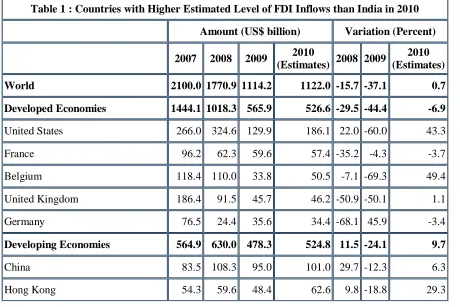
As the world economic recovery continued to be uncertain and fragile, global FDI flows remained stagnant at US $ 1.1 trillion in 2010. According to UNCTAD’s Global Investment Trends Monitor (released on January 17, 2011), although global FDI flows at aggregate level remained stagnant, they showed an uneven pattern across regions – while it contracted further in advanced economies by about 7 per cent, FDI flows recovered by almost 10 per cent in case of developing economies as a
group driven by strong rebound in FDI flows in many countries of Latin America and Asia. Rebound in FDI flows to developing countries has been on the back of improved corporate profitability and some improvement in M&A activities with improved valuations of assets in the stock markets and increased financial capability of potential buyers.
Improved macroeconomic conditions, particularly in the emerging economies, which boosted corporate profits coupled with better stock market valuations and rising business confidence augured well for global FDI prospects. According to UNCTAD, these favourable developments may help translate MNC’s record level of cash holdings (estimated to be in the range of US$ 4-5 trillion among developed countries’ firms alone) into new investments during 2011. The share of developing countries, which now constitutes over 50 per cent in total FDI inflows, may increase further on the back of strong growth prospects. However, currency volatility, sovereign debt problems and potential protectionist policies may pose some risks to this positive outlook. Nonetheless, according to the Institute of International Finance (January 2011), net FDI flows to EMEs was projected to increase by over 11 per cent in 2011. FDI flows into select countries are given i
Table 1 : Countries with Higher Estimated Level of FDI Inflows than India in 2010
Amount (US$ billion) Variation (Percent)
2007 2008 2009 2010
(Estimates) 2008 2009
2010 (Estimates)
World 2100.0 1770.9 1114.2 1122.0 -15.7 -37.1 0.7
Developed Economies 1444.1 1018.3 565.9 526.6 -29.5 -44.4 -6.9
United States 266.0 324.6 129.9 186.1 22.0 -60.0 43.3
France 96.2 62.3 59.6 57.4 -35.2 -4.3 -3.7
Belgium 118.4 110.0 33.8 50.5 -7.1 -69.3 49.4
United Kingdom 186.4 91.5 45.7 46.2 -50.9 -50.1 1.1
Germany 76.5 24.4 35.6 34.4 -68.1 45.9 -3.4
Developing Economies 564.9 630.0 478.3 524.8 11.5 -24.1 9.7
China 83.5 108.3 95.0 101.0 29.7 -12.3 6.3
Copyright © 2011-15. Vandana Publications. All Rights Reserved.
Russian Federation 55.1 75.5 38.7 39.7 37.0 -48.7 2.6
Singapore 35.8 10.9 16.8 37.4 -69.6 54.1 122.6
Saudi Arabia 22.8 38.2 35.5 - 67.5 -7.1 -
Brazil 34.6 45.1 25.9 30.2 30.3 -42.6 16.6
India 25.0 40.4 34.6 23.7 61.6 -14.4 -31.5
Source: World Investment Report, 2010 and Global Investment Trends Monitor, UNCTAD.
XVII. CONCLUSION
As evidenced by analysis and data the concept and material significance of FDI has evolved from the shadows of shallow understanding to a proud show of force. The government while serious in its efforts to induce growth in the economy and country started with foreign investment in a haphazard manner. While it is accepted that the government was under compulsion to liberalize cautiously, the understanding of foreign investment was lacking. A sectorial analysis reveals that while FDI shows a gradual increase and has become a staple for success for India.
The decisions governing FDI have been spread over many areas and agencies that have to be streamlined or an overarching regulatory body and practical policy has to be developed. Thus the impact of the reforms in India on the policy environment for Foreign Direct Investment presents a mixed picture. The industrial reforms have gone far, though they need to be supplemented by more infrastructure reforms, which are a critical missing link. While many policy barriers have been removed on FDI in India, results have at times been disappointing due to administrative barriers at the state level as well as lack of coordination between the central and state governments. There need to be greater coordination between the center and states to ensure that the substantial foreign interest in investing in India gets translated into actual investment flows to the state.
REFERENCES
[1] http://en.wikipedia.org/wiki/Foreign_direct_investment#cite_ note-edges-18 [2] http://www.slideshare.net/snehalsoni/fdi-presentation [3] http://ecurrentaffairs.in/blog/special-article-on-greenfield-investment-vs-brownfield-investment/ [4] http://www.indianmba.com/Occasional_Papers/OP203/op203. html[5]
http://www.ibef.org/economy/foreign-direct-investment.aspx
[6] http://www.allbankingsolutions.com/Banking-Tutor/FDI-in-India.htm [7] http://dipp.nic.in/English/Publications/FDI_Statistics/2014/in dia_FDI_January2014.pdf [8] http://www.mondaq.com/india/x/256108/international+trade+ investment/Liberalization+Of+Foreign+Direct+Investment+L imits+In+12+Sectors
[9] http://www.ukessays.com/essays/economics/the-concept-of-foreign-direct-investment-in-india-economics-essay.php [10] http://www.slideshare.net/snehalsoni/fdi-presentation [11] http://www.rbi.org.in/ [12] http://www.dipp.gov.in/English/Policies/FDI_Circular_2014. pdf [13] http://www.indianmba.com/Occasional_Papers/OP203/op203. html [14] http://hal.inria.fr/docs/00/84/68/25/PDF/Effects_of_Foreign_ Direct_Investment_FDI_in_the_Indian_Economy.pdf
[15]