Stochastic Variance-Reduced Cubic Regularization Methods
Dongruo Zhou [email protected]
Department of Computer Science University of California, Los Angeles Los Angeles, CA 90095, USA
Pan Xu [email protected]
Department of Computer Science University of California, Los Angeles Los Angeles, CA 90095, USA
Quanquan Gu [email protected]
Department of Computer Science University of California, Los Angeles Los Angeles, CA 90095, USA
Editor:Zhihua Zhang
Abstract
We propose a stochastic variance-reduced cubic regularized Newton method (SVRC) for non-convex optimization. At the core of SVRC is a novel semi-stochastic gradient along with a semi-stochastic Hessian, which are specifically designed for cubic regularization method. For a nonconvex function withncomponent functions, we show that our algorithm is guaranteed to converge to an (,√)-approximate local minimum within Oe(n4/5/3/2)1
second-order oracle calls, which outperforms the state-of-the-art cubic regularization algo-rithms including subsampled cubic regularization. To further reduce the sample complexity of Hessian matrix computation in cubic regularization based methods, we also propose a sample efficient stochastic variance-reduced cubic regularization (Lite-SVRC) algorithm for finding the local minimum more efficiently. Lite-SVRC converges to an (,√)-approximate local minimum within Oe(n+n2/3/3/2) Hessian sample complexity, which is faster than
all existing cubic regularization based methods. Numerical experiments with different non-convex optimization problems conducted on real datasets validate our theoretical results for both SVRC and Lite-SVRC.
Keywords: Cubic Regularization, Nonconvex Optimization, Variance Reduction, Hessian Sample Complexity, Local Minimum
1. Introduction
We study the following unconstrained finite-sum nonconvex optimization problem:
min
x∈Rd
F(x) := 1 n
n
X
i=1
fi(x), (1)
1. HereOehides poly-logarithmic factors.
c
where each fi : Rd → R is a general nonconvex function. Such nonconvex optimization
problems are ubiquitous in machine learning, including training deep neural network (LeCun et al., 2015), robust linear regression (Yu and Yao, 2017) and nonconvex regularized logistic regression (Reddi et al., 2016b). In principle, finding the global minimum of (1) is generally a NP-hard problem (Hillar and Lim, 2013) due to the lack of convexity.
Instead of finding the global minimum, various algorithms have been developed in the lit-erature (Nesterov and Polyak, 2006; Cartis et al., 2011a; Carmon and Duchi, 2016; Agarwal et al., 2017; Xu et al., 2018b; Allen-Zhu and Li, 2018) to find an approximate local minimum of (1). In particular, a point xis said to be an (g, H)-approximate local minimum ofF if
k∇F(x)k2 ≤g, λmin(∇2F(x))≥ −H, (2)
whereg, H >0 are predefined precision parameters. It has been shown that such
approx-imate local minima can be as good as global minima in some problems. For instance, Ge et al. (2016) proved that any local minimum is actually a global minimum in matrix comple-tion problems. Therefore, to develop an algorithm to find an approximate local minimum is of great interest both in theory and practice.
A very important and popular method to find the approximate local minimum is cubic-regularized (CR) Newton method, which was originally introduced by Nesterov and Polyak (2006). Generally speaking, in thek-th iteration, CR solves a sub-problem which minimizes a cubic-regularized second-order Taylor expansion at current iterate xk. The update rule
can be written as follows:
hk= argmin h∈Rd
h∇F(xk),hi+
1 2h∇
2F(x
k)h,hi+
M 6 khk
3
2, (3)
xk+1 =xk+hk, (4)
whereM >0 is a penalty parameter used in CR. Nesterov and Polyak (2006) proved that to find an (,√)-approximate local minimum of a nonconvex function F, CR requires at most O(−3/2) iterations. However, a major drawback for CR is that it needs to sample n individual gradients ∇fi(xk) and Hessian matrices ∇2fi(xk) in (3) at each iteration,
which leads to a totalO(n−3/2) Hessian sample complexity, i.e., number of queries to the stochastic Hessian ∇2f
i(x) for some i and x. Such computational cost will be extremely
expensive whenn is large as in many large scale machine learning problems.
To overcome the computational burden of CR based methods, some recent studies have proposed to use sub-sampled Hessian instead of the full Hessian (Kohler and Lucchi, 2017; Xu et al., 2017a) to reduce the Hessian complexity. In detail, Kohler and Lucchi (2017) proposed a sub-sampled cubic-regularized Newton method (SCR), which uses a subsampled Hessian instead of full Hessian to reduce the per iteration sample complexity of Hessian evaluations. Xu et al. (2017a) proposed a refined convergence analysis of SCR, as well as a subsampled Trust Region algorithm (Conn et al., 2000). Nevertheless, SCR bears a much slower convergence rate than the original CR method, and the total Hessian sample complexity for SCR to achieve an (,√)-approximate local minimum is O(e −5/2). This suggests that the computational cost of SCR could be even worse than CR when.n−1.
2016; Reddi et al., 2016a) into the cubic-regularized Newton method. The key component in our algorithm is a novel semi-stochastic gradient, together with a semi-stochastic Hes-sian, that are specifically designed for cubic regularization. Furthermore, we prove that, forL2-Hessian Lipschitz functions, to attain an (,
√
L2)-approximate local minimum, our proposed algorithm requiresO(n+n4/5/3/2) Second-order Oracle (SO) calls andO(1/3/2) Cubic Subproblem Oracle (CSO) calls. Here an SO oracle represents an evaluation of triple (fi(x),∇fi(x),∇2fi(x)), and a CSO oracle denotes an evaluation of the exact solution (or
inexact solution) of the cubic subproblem (3). Compared with the original cubic regu-larization algorithm (Nesterov and Polyak, 2006), which requires O(n/3/2) SO calls and O(1/3/2) CSO calls, our proposed SVRC algorithm reduces the SO calls by a factor of Ω(n1/5).
The second-order oracle complexity is dominated by the maximum number of queries to one of the elements in the triplet (fi(x),∇fi(x),∇2fi(x)), and therefore is not always
desirable in reflecting the computational complexity of multifarious applications. Therefore, we need to focus more on the Hessian sample complexity of cubic regularization methods for relatively high dimensional problems. Based on the SVRC algorithm, in order to further reduce the Hessian sample complexity, we also develop a sample efficient stochastic variance-reduced cubic-regularized Newton method called Lite-SVRC, which significantly reduces the sample complexity of Hessian matrix evaluations in stochastic CR methods. Under mild conditions, we prove that Lite-SVRC achieves a lower Hessian sample complexity than existing cubic regularization based methods. We prove that Lite-SVRC converges to an (,√)-approximate local minimum of a nonconvex function within O(ne +n2/3−3/2) Hessian sample complexity.
We summarize the major contributions of this paper as follows:
• We present a novel cubic regularization method (SVRC) with improved oracle com-plexity. To the best of our knowledge, this is the first algorithm that outperforms cubic regularization without any loss in convergence rate. In sharp contrast, existing subsampled cubic regularization methods (Kohler and Lucchi, 2017; Xu et al., 2017a) suffer from worse convergence rates than cubic regularization.
• We also extend SVRC to the case with inexact solution to the cubic regularization subproblem. Similar to previous work (Cartis et al., 2011a; Xu et al., 2017a), we layout a set of sufficient conditions, under which the output of the inexact algorithm is still guaranteed to have the same convergence rate and oracle complexity as the exact algorithm. This further sheds light on the practical implementation of our algorithm.
• As far as we know, our work is the first to rigorously demonstrate the advantage of variance reduction for second-order optimization algorithms. Although there exist a few studies (Lucchi et al., 2015; Moritz et al., 2016; Rodomanov and Kropotov, 2016) using variance reduction to accelerate Newton method, none of them can deliver faster rates of convergence than standard Newton method.
• We conduct extensive numerical experiments with different types of nonconvex opti-mization problems on various real datasets to validate our theoretical results for both SVRC and Lite-SVRC.
When the short version of this paper was submitted to ICML, there was a concurrent work by Wang et al. (2018a), which applies the idea of stochastic variance reduction to cubic regularization as well. Their algorithms have a worse Hessian sample complexity than Lite-SVRC. Since the short version of this paper was published in ICML, there have been two followup works by Wang et al. (2018b) and Zhang et al. (2018), which both proposed similar algorithms to our Lite-SVRC algorithm, and achieved the same Hessian sample complexity. However, Wang et al. (2018b) and Zhang et al. (2018)’s results rely on the adaptive choice of batch size for stochastic Hessian. Furthermore, Zhang et al. (2018)’s result relies on a stronger notion of Hessian Lipschitz condition. We will discuss the key difference between our Lite-SVRC algorithm and the algorithms in Wang et al. (2018a,b); Zhang et al. (2018) in detail in Section 7.
Notation: We usea(x) =O(b(x)) ifa(x)≤Cb(x), where C is a constant independent of any parameters in our algorithm. We use O(e ·) to hide polynomial logarithm terms. We usekvk2 to denote the 2-norm of vectorv∈Rd. For symmetric matrix H∈
Rd×d, we use
kHk2 and kHkSr to denote the spectral norm and Schatten r- norm ofH. We denote the
smallest eigenvalue of Hto beλmin(H).
2. Related Work
Cubic Regularization and Trust-region Newton MethodTraditional Newton method in convex setting has been widely studied in past decades (Bennett, 1916; Bertsekas, 1999). The most related work to ours is the nonconvex cubic regularized Newton method, which was originally proposed in Nesterov and Polyak (2006). Cartis et al. (2011a) presented an adaptive framework of cubic regularization, which uses an adaptive estimation of the local Lipschitz constant and approximate solution to the cubic subproblem. To connect cubic regularization with traditional trust region method (Conn et al., 2000; Cartis et al., 2009, 2012, 2013), Blanchet et al. (2016); Curtis et al. (2017); Mart´ınez and Raydan (2017) showed that the trust-region Newton method can achieve the same iteration complexity as the cubic regularization method. To overcome the computational burden of gradient and Hessian matrix evaluations, Kohler and Lucchi (2017); Xu et al. (2017a,b) proposed to use subsampled gradient and Hessian in cubic regularization. On the other hand, in order to solve the cubic subproblem (3) more efficiently, Carmon and Duchi (2016) proposed to use gradient descent, while Agarwal et al. (2017) proposed a sophisticated algorithm based on approximate matrix inverse and approximate PCA. Tripuraneni et al. (2018) proposed a refined stochastic cubic regularization algorithm based on above subproblem solver. How-ever, none of the aforementioned variants of cubic regularization outperforms the original cubic regularization method in terms of oracle complexity.
showed that by calculating the negative curvature using Hessian information or Hessian vector product, one can find approximate local minima faster than first-order methods. Xu et al. (2018b); Allen-Zhu and Li (2018); Jin et al. (2018) further proved that gradient methods with additive noise are also able to find approximate local minima faster than the first-order methods. Yu et al. (2017) proposed the GOSE algorithm to save negative curva-ture computation and Yu et al. (2018) improved the gradient complexity by exploring the third-order smoothness of objective functions. Raginsky et al. (2017); Zhang et al. (2017); Xu et al. (2018a) proved that a family of algorithms based on discretizations of Langevin dynamics can find a neighborhood of the global minimum of nonconvex objective functions.
Variance ReductionVariance-reduced techniques play an important role in our proposed algorithm, which have been extensively studied for large-scale finite-sum optimization prob-lems. Variance reduction was first proposed in convex finite-sum optimization (Roux et al., 2012; Johnson and Zhang, 2013; Xiao and Zhang, 2014; Defazio et al., 2014), which uses semi-stochastic gradient to reduce the variance of the stochastic gradient and improves the gradient complexity of both stochastic gradient descent (SGD) and gradient descent (GD). Representative algorithms include Stochastic Average Gradient (SAG) (Roux et al., 2012), Stochastic Variance Reduced Gradient (SVRG) (Johnson and Zhang, 2013) and SAGA (Defazio et al., 2014), to mention a few. Garber and Hazan (2015); Shalev-Shwartz (2016) studied non-convex finite-sum problems where each individual function may be non-convex, but their sum is still convex. Reddi et al. (2016a) and Allen-Zhu and Hazan (2016) ex-tended SVRG to the general non-convex finite-sum optimization, and proved that SVRG is able to converge to a first-order stationary point with the same convergence rate as gra-dient descent, yet with an Ω(n1/3) improvement in gradient complexity. Recently Zhou et al. (2018b) and Fang et al. (2018) further improved the gradient complexity of SVRG type of algorithms to converge to a first-order stationary point in nonconvex optimization to an optimal rate. However, to the best of our knowledge, it is still an open problem whether variance reduction can improve the oracle complexity of second-order optimization algorithms.
The remainder of this paper is organized as follows: we present the stochastic variance-reduced cubic regularization (SVRC) algorithm in Section 3. We present our theoretical analysis of the proposed SVRC algorithm in Section 4 and discuss on SVRC with inexact cubic subproblem oracles in Section 5. In Section 6, we propose a modified algorithm, Lite-SVRC, to further reduce Hessian sample complexity and present its theoretical analysis in Section 7. We conduct thorough numerical experiments on different nonconvex optimization problems and on different real world datasets to validate our theory in Section 8. We conclude our work in Section 9.
3. Stochastic Variance-Reduced Cubic Regularization
In this section, we present a novel algorithm, which utilizes stochastic variance reduction techniques to improve cubic regularization method.
Algorithm 1 Stochastic Variance Reduction Cubic Regularization (SVRC)
1: Input: batch size parameters bg, bh, cubic penalty parameters {Ms,t}, epoch number
S, epoch length T and starting pointx0.
2: Initializationxb 1 =x
0
3: fors= 1, . . . , S do
4: xs0 =bx
s
5: gs=∇F(xb
s) = 1
n
Pn
i=1∇fi(xb
s),Hs= 1
n
Pn
i=1∇2fi(xb
s)
6: for t= 0, . . . , T −1do
7: Sample index setIg, Ih,|Ig|=bg,|Ih|=bh;
8: vts= b1
g
P
it∈Ig
∇fit(x
s
t)− ∇fit(bx
s)
+gs− 1
bg
P
it∈Ig∇
2f
it(bx
s)−Hs
(xst−xbs)
9: Us
t = b1h
P
jt∈Ih
∇2f
jt(x
s
t)− ∇2fjt(xb
s) +Hs
10: hst = argminhvst,hi+ 12hUsth,hi+Ms,t
6 khk 3 2,
11: xst+1 =xst+hst
12: end for
13: xbs+1 =xsT
14: end for
15: Output: xout =xst, wheres, tare uniformly random chosen froms∈[S] andt∈[T].
Nevertheless, the stochastic gradient and Hessian matrix have large variances, which un-dermine the convergence performance. Inspired by SVRG (Johnson and Zhang, 2013), we propose to use a semi-stochastic version of gradient and Hessian matrix, which can control the variances automatically. Specifically, our algorithm has two loops. At the beginning of the s-th iteration of the outer loop, we denote bx
s = xs
0. We first calculate the full gradientgs =∇F(bx
s) and Hessian matrixHs=∇2F( b
xs), which are stored for further ref-erences in the inner loop. At thet-th iteration of the inner loop, we calculate the following semi-stochastic gradient and Hessian matrix:
vst = 1 bg
X
it∈Ig
∇fit(x
s
t)− ∇fit(xb
s)
+gs− 1
bg
X
it∈Ig
∇2fit(xb
s)−Hs
(xst −bxs , (5)
Ust = 1 bh
X
jt∈Ih
∇2fjt(x
s
t)− ∇2fjt(bx
s)
+Hs, (6)
whereIg andIh are batch index sets, and the batch sizesbg =|Ig|, bh =|Ih|will be decided
later. In each inner iteration, we solve the following cubic regularization subproblem:
hst = argminmst(h),
mst(h) =hvts,hi+1 2hU
s
th,hi+
Ms,t
6 khk 3
2, (7)
where{Ms,t} are cubic regularization parameters, which may depend onsand t. Then we
perform the update xst+1 =xst +hst in the t-th iteration of the inner loop. The proposed algorithm is displayed in Algorithm 1.
is that our gradient and Hessian estimators consist of mini-batches of stochastic gradient and Hessian. The second one is that we use second-order information when we construct the gradient estimator vst, while classical SVRG only uses first-order information to build it. Intuitively speaking, both features are used to make a more accurate estimation of the true gradient and Hessian with affordable oracle calls. Note that similar approximations of the gradient and Hessian matrix have been staged in recent work by Gower et al. (2018) and Wai et al. (2017), where they used this new kind of estimator for traditional SVRG in the convex setting, which radically differs from our setting.
4. Theoretical Analysis of SVRC
In this section, we prove the convergence rate of SVRC (Algorithm 1) to an (,√ )-approximate local minimum. We first lay out the following Hessian Lipschitz assumption, which is necessary for our analysis and is widely used in the literature (Nesterov and Polyak, 2006; Xu et al., 2016; Kohler and Lucchi, 2017).
Assumption 1 (Hessian Lipschitz) There exists a constant L2 > 0, such that for all
x,y and i∈[n]
∇2fi(x)− ∇2fi(y)
2 ≤L2kx−yk2.
The Hessian Lipschitz assumption plays a central role in controlling the changing speed of second order information. In fact, this is the only assumption we need to prove our theoretical results for SVRC. We then define the following optimal function gap between initial pointx0 and the global minimum ofF.
Definition 2 (Optimal Gap) For function F(·) and the initial point x0, let∆F be
∆F = inf{∆∈R:F(x0)−F∗≤∆},
where F∗ = infx∈RdF(x).
W.L.O.G., we assume ∆F <+∞ throughout this paper. Before we present nonasymptotic
convergence results of Algorithm 1, we define the following useful notation
µ(x) = max
k∇F(x)k32/2,−λ
3
min ∇2F(x)
L32/2
. (8)
A similar definition also appears in Nesterov and Polyak (2006) with a slightly different form, which is used to describe how much a point is similar to a true local minimum. In particular, according to the definition in (8), µ(x)≤3/2 holds if and only if
k∇F(x)k2≤, λmin ∇2F(x)
>−pL2. (9)
Definition 3 (Second-order Oracle) Given an index iand a point x, one second-order oracle (SO) call returns such a triple:
[fi(x),∇fi(x),∇2fi(x)]. (10)
Definition 4 (Cubic Subproblem Oracle) Given a vector g∈Rd, a Hessian matrixH
and a positive constantθ, one Cubic Subproblem Oracle (CSO) call returns hsol, where hsol
can be solved exactly as follows
hsol = argmin h∈Rd
hg,hi+1
2hh,Hhi+ θ 6khk
3 2.
Remark 5 The second-order oracle is a special form of Information Oracle firstly intro-duced by Nemirovsky and Yudin (1983), which returns gradient, Hessian and all high order
derivatives of the objective function F(x). Here, our second-order oracle will only returns
first and second order information at some point of single objective fi instead of F. We
argue that it is a reasonable adaption because in this paper we focus on finite-sum objective
function. The Cubic Subproblem Oracle will return an exact or inexact solution of (7),
which plays an important role in both theory and practice.
Now we are ready to give a general convergence result of Algorithm 1:
Theorem 6 Under Assumption 1, suppose that the cubic regularization parameter Ms,t of
Algorithm 1 satisfies that Ms,t =CML2, where L2 is the Hessian Lipschitz parameter and
CM ≥100is a constant. The batch sizes bg and bh satisfy that
bg ≥5T4, bh ≥100T2logd, (11)
where T ≥2 is the length of the inner loop of Algorithm 1 and d is the dimension of the
problem. Then the output of Algorithm 1 satisfies
E[µ(xout)]≤
240CM2 L12/2∆F
ST . (12)
Remark 7 According to (8), to ensure that xout is an (,
√
L2)-approximate local
mini-mum, we can set the right hand side of (12) to be less than3/2. This immediately implies
that the total iteration complexity of Algorithm 1 is ST =O(∆FL21/2−3/2), which matches
the iteration complexity of cubic regularization (Nesterov and Polyak, 2006).
Remark 8 Note that there is a logd term in the expression of the parameter, and it is
only related to Hessian batch size bh. The logd term comes from matrix concentration
inequalities, which is believed to be unavoidable (Tropp et al., 2015). In other words, the
batch size of Hessian matrix bh has an inevitable relation to dimension d, unlike the batch
size of gradientbg.
Corollary 9 Under Assumption 1, let the cubic regularization parameter Ms,t = M =
CML2, whereCM ≥100is a constant. Let the epoch lengthT =n1/5, batch sizesbg = 5n4/5,
bh = 100n2/5logd, and the number of epochsS = max{1,240CM2 L
1/2
2 ∆Fn−1/5−3/2}. Then
Algorithm 1 will find an (,√L2)-approximate local minimumxout within
O
n+∆F
√
L2n4/5
3/2
SO calls (13)
and
O
∆F
√
L2
3/2
CSO calls. (14)
Remark 10 Corollary 9 states that we can reduce the SO calls by setting the batch sizebg, bh
related to n. In contrast, in order to achieve an (,√L2) local minimum, original cubic
regularization method in Nesterov and Polyak (2006) needs O(n/3/2) second-order oracle
calls, which is by a factor of n1/5 worse than ours. And subsampled cubic regularization
(Kohler and Lucchi, 2017; Xu et al., 2017b) requires O(n/e 3/2+ 1/5/2) SO calls, which is
also worse than our algorithm.
In Table 1, we summarize the comparison of our SVRC algorithm with the most related algorithms in terms of SO and CSO oracle complexities. It can be seen from Table 1 that our algorithm (SVRC) achieves the lowest (SO and CSO) oracle complexity compared with the original cubic regularization method (Nesterov and Polyak, 2006) which employs full gradient and Hessian evaluations and the subsampled cubic method (Kohler and Lucchi, 2017; Xu et al., 2017b). In particular, our algorithm reduces the SO oracle complexity of cubic regularization by a factor ofn1/5for finding an (,√L2)-approximate local minimum.
Algorithm SO calls CSO calls Gradient Lipschitz Hessian Lipschitz
CR O n
3/2
O 1
3/2
no yes
SCR Oe
n 3/2 +
1
5/2
2 O 1
3/2
yes yes
SVRC
e O
n+n34//25
O
1
3/2
no yes (Algorithm 1)
Table 1: Comparisons between different methods to find (,√L2)-local minimum on the second-order oracle (SO) complexity and the cubic sub-problem oracle (CSO) com-plexity. The compared methods include (1) CR: Cubic regularization (Nesterov and Polyak, 2006) and (2) SCR: Subsampled cubic regularization (Kohler and Lucchi, 2017; Xu et al., 2017b).
5. SVRC with Inexact Oracles
In practice, the exact solution to the cubic subproblem (7) cannot be obtained. Instead, one can only get an approximate solution by some inexact solver. Thus we replace the CSO oracle in (4) with the following inexact CSO oracle
e
hsol≈argmin
h∈Rd
hg,hi+1
2hh,Hhi+ θ 6khk
3 2.
To analyze the performance of SVRC with inexact cubic subproblem solver, we relax the exact solver hst in Line 10 of Algorithm 1 with
e
hst ≈argminmst(h). (15)
The ultimate goal of this section is to prove that the theoretical results of SVRC still hold with inexact subproblem solvers. To this end, we present the following sufficient condition, under which inexact solution can ensure the same oracle complexity as the exact solution:
Condition 11 (Inexact Condition) For each s, t and a given δ > 0, ehst satisfies δ
-inexact condition if hest satisfies
mst(hest)≤ − Ms,t
12 keh
s tk32+δ,
k∇mst(hest)k2 ≤M 1/3
s,t δ2/3,
khestk2− khstk2 ≤M
−1/3
s,t δ1/3.
Remark 12 Similar inexact conditions have been studied in the literature of cubic regular-ization. For instance, Nesterov and Polyak (2006) presented a practical way to solve the cubic subproblem without termination condition. Cartis et al. (2011a); Kohler and Lucchi (2017) presented termination criteria for approximate solution to cubic subproblem, which is slightly different from Condition 11.
Now we present the convergence result of SVRC with inexact CSO oracles:
Theorem 13 Suppose that for eachs, t,hest is an inexact solver of cubic subproblemmst(h),
which satisfies Condition 11. Under the same conditions of Theorem 6, the output of Algo-rithm 1 satisfies
E[µ(xout)]≤
240CM2 L12/2∆F
ST + 480C 2
ML
1/2
2 δ. (16)
Remark 14 By the definition of µ(x), in order to attain an (,√L2)-approximate local
minimum, we require E[µ(xout)]≤3/2 and thus 480CM2 L
1/2
2 δ < 3/2, which implies that δ
in Condition 11 should satisfy δ <(480CM2 L21/2)−13/2. Thus the total iteration complexity
of Algorithm 1 with inexact oracle is still O(∆FL12/2−3/2).
Corollary 15 Suppose that for eachs, t,hest is an inexact solver of cubic subproblemmst(h),
which satisfies Condition 11 with δ = (960CM2 )−1L2−1/23/2. Under Assumption 1, let the
cubic regularization parameter Ms,t=M =CML2, where CM ≥100is a constant. Let the
epoch length T = n1/5, batch sizes bg = 5n4/5 and bh = 100n2/5logd, and the number of
epochs S = max{1,480CM2 L12/2∆Fn−1/5−3/2}. Then Algorithm 1 will find an (,
√
L2) -approximate local minimum within
O
n+∆F
√
L2n4/5
3/2
SO calls (17)
and
O
∆F
√
L2
3/2
CSO calls. (18)
Remark 16 It is worth noting that even with the inexact CSO oracle satisfying Condition 11, the SO and CSO complexities of SVRC remain the same as that of SVRC with exact CSO oracle. Furthermore, this result always holds with any inexact cubic sub-problem solver.
6. Lite-SVRC for Efficient Hessian Sample Complexity
As we discussed in the introduction section, when the problem dimension d is relatively high, we may want to focus more on the Hessian sample complexity of cubic regularization methods than the second-order oracle complexity. In this section, we present a new algo-rithm Lite-SVRC based on SVRC, which trades the second-order oracle complexity for a more affordable Hessian sample complexity. As is displayed in Algorithm 2, our Lite-SVRC algorithm has similar structure as Algorithm 1 withS epochs andT iterations within each epoch. At thet-th iteration of thes-th epoch, we also use a semi-stochastic gradientve
s
t and
Hessian Ust to replace the full gradient and full Hessian in CR subproblem (3) as follows
e
vst = 1 Bg;s,t
X
it∈Ig
∇fit(x
s
t)− ∇fit(xb
s)
+gs, (19)
Ust = 1 Bh
X
jt∈Ih
∇2fjt(x
s
t)− ∇2fjt(bx
s)
+Hs, (20)
where bxs is the reference point at whichgs and Hs are computed,Ig and Ih are sampling
index sets (with replacement),Bg;s,t andBh are sizes of Ig andIh.
Compared with SVRC (Algorithm 1), Lite-SVRC uses a lite version of semi-stochastic gradientve
s
t. Note that the additional Hessian information in the semi-stochastic gradient in
(5) actually increases the Hessian sample complexity. Therefore, with the goal of reducing the Hessian sample complexity, the standard semi-stochastic gradient (Johnson and Zhang, 2013; Xiao and Zhang, 2014) is used in this section. Note that similar semi-stochastic gradient and Hessian have been proposed in Johnson and Zhang (2013); Xiao and Zhang (2014) and Gower et al. (2018); Wai et al. (2017); Zhou et al. (2018a); Wang et al. (2018a,b); Zhang et al. (2018) respectively. In Algorithm 2, we choose fixed batch size of stochastic Hessian asBh =|Ih|. However, the batch size of stochastic gradient is chosen adaptively at
each iteration:
Bg;s,t=Dg/kxst−xb
sk2
whereDg is a constant only depending onnand d.
Algorithm 2 Sample efficient stochastic variance-reduced cubic regularization method (Lite-SVRC)
1: Input: batch size parameters Dg, Bh, cubic penalty parameter{Ms,t}, epoch number
S, epoch length T and starting pointx0.
2: Initializationxb1 =x0
3: fors= 1, . . . , S do
4: xs0 =bx
s
5: gs=∇F(xbs) = 1nPn
i=1∇fi(xb
s),Hs=∇2F( b
xs) = n1Pn
i=1∇2fi(bx
s)
6: hs0= argminh∈Rdms0(h) =hgs,hi+12hHsh,hi+M6s,0khk32
7: xs1 =xs0+hs0
8: for t= 1, . . . , T −1do
9: Bg;s,t=Dg/kxst−xb
sk2 2, t >0
10: Sample index setIg, Ih ⊆[n],|Ig|=Bg;s,t,|Ih|=Bh
11: evts= B1
g;s,t
P
it∈Ig∇fit(x
s
t)− ∇fit(bx
s) +gs
12: Ust = B1
h
P
jt∈Ih∇
2f
jt(x
s
t)− ∇2fjt(xb
s) +Hs
13: hst = argminh∈Rdmst(h) =hvest,hi+12hUsth,hi+M6s,tkhk32
14: xst+1 =xst+hst
15: end for
16: xbs+1 =xsT
17: end for
18: Output: xout =xst, wheres, tare uniformly random chosen froms∈[S] andt∈[T].
In addition, the major difference between our algorithm and the SVRC algorithms pro-posed in Wang et al. (2018a); Zhang et al. (2018); Wang et al. (2018b) is that our algorithm uses a constant Hessian minibatch size instead of an adaptive one in each iteration, and thus the parameter tuning of our algorithm is much easier. In sharp contrast, the minibatch sizes of the stochastic Hessian in the algorithm proposed by Wang et al. (2018a); Zhang et al. (2018); Wang et al. (2018b) are dependent on both accuracy parameter and the current update hs
t, which make the update an implicit one and it is hard to tune such
hyperparameters in practice.
7. Theoretical Analysis of Lite-SVRC
In this section, we present our theoretical results on the Hessian sample complexity of Lite-SVRC (Algorithm 2). Different from the analysis of Lite-SVRC in Section 4 which only requires the Hessian Lipschitz condition (Assumption 1), we will need additionally the following smoothness assumption for the analysis of Lite-SVRC:
Assumption 17 (Gradient Lipschitz) There exists a constant L1>0, such that for all x,y and i∈ {1, ..., n}
Assumptions 1 and 17 are mild and widely used in the line of research for finding approximate global minima (Carmon and Duchi, 2016; Carmon et al., 2018; Agarwal et al., 2017; Wang et al., 2018a; Yu et al., 2018).
Recall the definition in (8), we need to upper bound µ(xout) in order to find the ap-proximate local minimum. The following theorem spells out the upper bound of µ(xout).
Theorem 18 Under Assumptions 1 and 17, suppose that n > 10, Ms,t = CML2, Dg ≥
C1L21/L22·n4/3/CM and Bh >144(C1Ch)2/3n2/3/CM2 , where Ch = 1200(logd) and CM, C1
are absolute constants. Then the output xout of Algorithm 2 satisfies
E[µ(xout)]≤
216CM2 L12/2∆F
ST . (22)
Remark 19 Theorem 18 suggests that with a fixed number of inner loopsT, if we run
Algo-rithm 2 for sufficiently largeS epochs, then we have a point sequencexi whereE[µ(xi)]→0.
That being said, xi will converge to a local minimum, which is consistent with the
conver-gence analysis in existing related work (Nesterov and Polyak, 2006; Kohler and Lucchi, 2017; Wang et al., 2018a).
Now we provide a specific choice of parameters used in Theorem 18 to derive the total Hessian sample complexity of Algorithm 2.
Corollary 20 Under the same assumptions as in Theorem 18, let batch size parameters
satisfyDg = 4L21/L22·n4/3 andBh= logd·(Ch·n)2/3. Set the inner loop parameterT =n1/3
and cubic regularization parameterMs,t=CML2, whereCM is an absolute constant. Set the
epoch number S=O(max{L12/2∆F/(3/2n1/3),1}). Then the output xout from Algorithm 2
is an (,√L2)-approximate local minimum after
e O
n+∆F
√
L2 3/2 ·n
2/3
stochastic Hessian evaluations. (23)
Moreover, the total number of CSO calls of Algorithm 2 is
O
∆F
√
L2 3/2
.
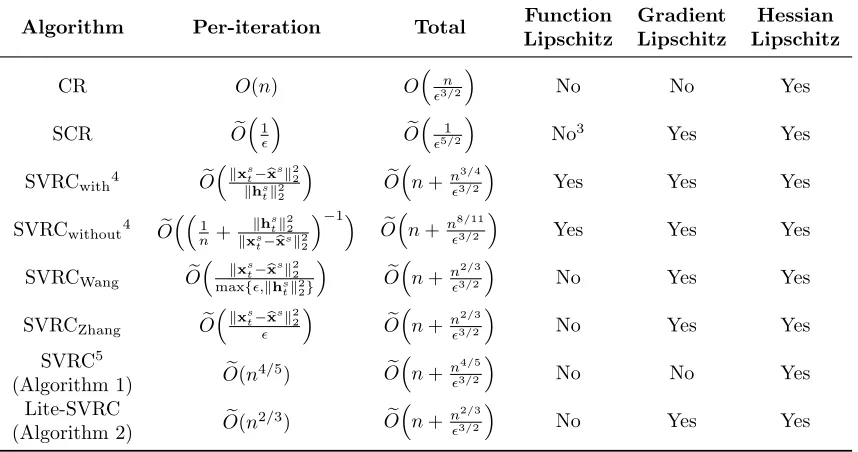
Remark 21 Note that the CSO oracle complexity of Lite-SVRC is the same as SVRC. In what follows, we present a comprehensive comparison on Hessian sample complexity between our Lite-SVRC and other related algorithms in Table 2. The algorithm proposed in Wang et al. (2018a) has two versions: sample with replacement and sample without replacement. For the completeness, we present both versions in Wang et al. (2018a). From Table 2 we can
see that Lite-SVRC strictly outperforms CR by a factor of n1/3 and outperforms SVRC by
a factor of n2/15 in terms of Hessian sample complexity. Lite-SVRC also outperforms SCR
when = O(n−2/3), which suggests that the variance reduction scheme makes Lite-SVRC
perform better in the high accuracy regime. More importantly, our proposed Lite-SVRC does
the algorithm proposed in Wang et al. (2018a). In terms of Hessian sample complexity, our
algorithm directly improves that of Wang et al. (2018a) by a factor of n2/33. The Hessian
sample complexity of Lite-SVRC is the same as that of the algorithms recently proposed in Wang et al. (2018b) and Zhang et al. (2018). Nevertheless, Lite-SVRC uses a constant Hessian sample batch size in contrast to the adaptive batch size as used in Wang et al. (2018b); Zhang et al. (2018), which makes the use of Lite-SVRC algorithm much simpler and more practical.
Algorithm Per-iteration Total Function Gradient Hessian Lipschitz Lipschitz Lipschitz
CR O(n) O n
3/2
No No Yes
SCR Oe
1
e O 1
5/2
No3 Yes Yes
SVRCwith4 Oe kxs
t−bx
sk2 2 khs
tk22
e
On+n33//24
Yes Yes Yes
SVRCwithout4 Oe
1
n+
khs tk22 kxs
t−bx
sk2 2
−1 e
On+n83//112
Yes Yes Yes
SVRCWang Oe kxs
t−bx
sk2 2 max{,khs
tk22}
e
On+n32//23
No Yes Yes
SVRCZhang Oe
kxs t−bx
sk2 2
e
On+n32//23
No Yes Yes
SVRC5
e
O(n4/5) Oe
n+n34//25
No No Yes
(Algorithm 1) Lite-SVRC
e O(n2/3)
e
On+n32//23
No Yes Yes
(Algorithm 2)
Table 2: Comparisons of per-iteration and total sample complexities of Hessian evaluations for different algorithms: CR (Nesterov and Polyak, 2006), SCR (Kohler and Luc-chi, 2017; Xu et al., 2017a), SVRCwith (Wang et al., 2018a), SVRCwithout (Wang et al., 2018a), SVRCWang (Wang et al., 2018b), SVRCZhang (Zhang et al., 2018), SVRC (Algorithm 1) and Lite-SVRC (Algorithm 2). Similar to Table 1, the CSO oracle complexities of all the methods being compared are the same, i.e. O(1/3/2). Therefore, we omit it for simplicity.
Recall the inexact cubic subproblem solver defined in Section 5. The same inexact CSO oracles can also be used in Algorithm 2. In what follows, we present the convergence result of Lite-SVRC with inexact CSO oracles.
3. Although the refined SCR in Xu et al. (2017b) does not need function Lipschitz, the original SCR in Kohler and Lucchi (2017) needs it.
4. In Wang et al. (2018a), both algorithms need to calculate λmin(∇2F(xst)) at each iteration to decide
whether the algorithm should continue, which adds additional O(n) Hessian sample complexity. We
choose not to include this into the results in the table.
Theorem 22 Suppose that for each s, t, ehst is an inexact solver of cubic subproblem mst(h)
satisfying Condition 11. Then under the same conditions of Theorem 18, the output of Algorithm 2 satisfies
E[µ(xout)]≤
216C2
ML
1/2 2 ∆F
ST + 432C 2
ML
1/2
2 δ. (24)
In addition, Algorithm 2 with inexact oracle can also reduce the Hessian sample com-plexity, which is summarized in the following corollary.
Corollary 23 Suppose that for eachs, t,hest is an inexact solver of cubic subproblem mst(h)
satisfying Condition 11 with δ = (864CM2 L21/2)−13/2. Then with the same choice of
pa-rameters in Corollary 20, Algorithm 2 will find an (,√L2)-approximate local minimum
within
e O
n+∆F
√
L2 3/2 ·n
2/3
stochastic Hessian evaluations,
and
O
∆F
√
L2 3/2
CSO calls.
8. Experiments
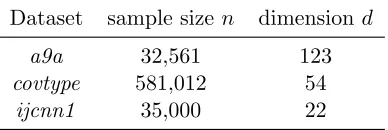
In this section, we conduct experiments on real world datasets to support our theoretical analysis of the proposed SVRC and Lite-SVRC algorithms. We investigate two nonconvex problems on three different datasets,a9a,ijcnn1 andcovtype, which are all common datasets used in machine learning and the sizes are summarized in Table 3.
8.1. Baseline Algorithms
Dataset sample size n dimension d
a9a 32,561 123
covtype 581,012 54
ijcnn1 35,000 22
Table 3: Datasets used in experiments. To validate the superior performance of
the proposed SVRC (Algorithm 1) in terms of second-order oracles, we com-pare it with the following baseline algo-rithms: (1) trust-region Newton meth-ods (TR) (Conn et al., 2000); (2) Adap-tive Cubic regularization (Cartis et al., 2011a,b); (3) Subsampled Cubic regular-ization (Kohler and Lucchi, 2017); (4) Gradient Cubic regularization (Carmon and Duchi, 2016) and (5) Stochastic
et al. (2018a), but the one based on sampling without replacement performs better in both theory and experiments. We therefore only compare with this one. Note that the SVRC algorithms in Wang et al. (2018b); Zhang et al. (2018) are essentially the same as our Lite-SVRC algorithm, except in the choice of batch size for stochastic Hessian. Thus we do not compare our Lite-SVRC with these algorithms (Wang et al., 2018b; Zhang et al., 2018).
8.2. Implementation Details
For Subsampled Cubic and SVRC-without, the sample size Bk is dependent on khkk2 (Kohler and Lucchi, 2017) and Bh is dependent on khstk2 (Wang et al., 2018a), which make these two algorithms implicit algorithms. To address this issue, we follow the sug-gestion in Kohler and Lucchi (2017); Wang et al. (2018a) and use khk−1k2 and khst−1k2 instead ofkhkk2 andkhstk2. Furthermore, we choose the penalty parameterMs,tfor SVRC,
SVRC-without and Lite-SVRC as constants which are suggested by the original papers of these algorithms. Finally, to solve the CR sub-problem in each iteration, we choose to solve the sub-problem approximately in the Krylov subspace spanned by Hessian related vectors, as used by Kohler and Lucchi (2017).
8.3. Nonconvex Optimization Problems
In this subsection, we formulate the nonconvex optimization problems that will be studied in our experiments. In particular, we choose two nonconvex regression problem as our objectives with the following nonconvex regularizer
g(λ, γ,x) =λ·
d
X
i=1
(γxi)2
1 + (γxi)2
, (25)
where λ, γ are the control parameters andxi is the i-th coordinate of x. λ and γ are set
differently for each dataset. This regularizer has been widely used in nonconvex regression problem, which can be regarded as a special example of robust nonlinear regression (Reddi et al., 2016b; Kohler and Lucchi, 2017; Wang et al., 2018a).
8.3.1. Logistic Regression with Nonconvex Regularizer
The first problem is a binary logistic regression problem with a nonconvex regularizer g (Reddi et al., 2016b). Given training data xi ∈ Rd and label yi ∈ {0,1}, 1 ≤ i≤ n, our
goal is to solve the following optimization problem:
min
s∈Rd
1 n
n
X
i=1
yi·logφ(s>xi) + (1−yi)·log[1−φ(s>xi)]
+g(λ, γ,s), (26)
whereφ(x) = 1/(1 + exp(−x)) is the sigmoid function and g is defined in (25).
8.3.2. Nonlinear Least Square with Nonconvex Regularizer
Given training dataxi∈Rdandyi ∈ {0,1}, 1≤i≤n, our goal is to minimize the following
problem
min
s∈Rd
1 n
n
X
i=1
yi−φ(s>xi)2+g(λ, γ,s). (27)
Here φ(x) = 1/(1 + exp(−x)) is again the sigmoid function andg is defined in (25).
8.4. Experimental Results for SVRC
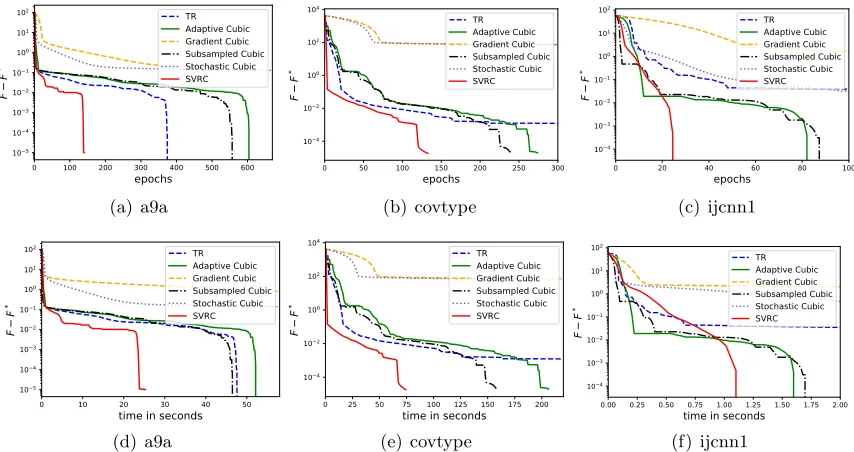
In this subsection, we present the experimental results for SVRC compared with baseline algorithms (1)-(5) listed in Section 8.1. Here, we fix λ= 10 and γ = 1 of the nonconvex regularizergin (25) for both the logistic regression and the nonlinear least square problems.
Calculation for SO calls: ForSubsampled Cubic, each loop takes (Bg+Bh) SO calls,
whereBg and Bh are the subsampling sizes of gradient and Hessian. ForStochastic Cubic,
each loop costs (ng+nh) SO calls, wherengandnhdenote the subsampling sizes of gradient
and Hessian-vector operator. Gradient Cubic, Adaptive Cubic and TR cost n SO calls in each loop. We define the amount of epochs to be the amount of SO calls divided byn.
Parameters: For each algorithm and each dataset, we choose different bg, bh, T for
the best performance. Meanwhile, we choose the cubic regularization parameter as Ms,t=
α/(1 +β)(s+t/T),α,β >0 for each iteration. Whenβ= 0, it has been proved to enjoy good convergence performance. This choice of parameter is similar to the choice of penalty pa-rameter inSubsampled CubicandAdaptive Cubic, which sometimes makes some algorithms behave better in our experiments.
Subproblem Solver: With regard to the cubic subproblem solver for solving (7), we choose the Lanczos-type method used in Cartis et al. (2011a), which finds the global minimizerhst of mst(h) in a Krylov subspaceKl= span{vts,Ustvts,(Ust)2vts, . . . ,(Ust)l−1vts}, whereldis the dimension ofKland can be selected manually or adaptively (Cartis et al., 2011a; Kohler and Lucchi, 2017). The computational complexity of Lanczos-type method consists of two parts according to Carmon and Duchi (2018). First, (l−1) matrix-vector products are performed to calculate the basis of Kl, whose computational complexity is O(d2l). Second, the minimizer ofms
t(h) is computed in subspace Kl, whose computational
complexity isO(llogl). Thus, the total computational complexity of Lanczos-type method isO(d2l).
At each iteration, SVRC needs to compute the semi-stochastic gradientvst and Hessian
Ust, which costs O(dbg+d2bh) computational complexity for both nonconvex regularized
logistic regression and nonlinear least square problems, wherebg and bh are the mini-batch
sizes of stochastic gradient and Hessian respectively. Putting these pieces together, the per-iteration complexity of SVRC isO(dbg+d2bh+d2l), and the total computational complexity
of SVRC is O(ST(dbg+d2bh+d3)), where S is the number of epochs and T is the length
of epoch.
For the binary logistic regression problem in (26), the parameters of Ms,t = α/(1 +
β)(s+t/T), α, β > 0 are set as follows: α = 0.05, β = 0 for a9a and ijcnn1 datasets and α = 5e3, β = 0.15 for covtype. The experimental results are shown in Figure 1. For the non-linear least squares problem in (27), we set α = 0.05,1e8,0.003 and β = 0,1,0.5 for
2. From both Figures 1 and 2, we can see that SVRC outperforms all the other baseline algorithms on all the datasets. The only exception happens in the non-linear least square problem on the covtype dataset, where our algorithm behaves a little worse than Adaptive Cubic at the high accuracy regime in terms of epoch counts. However, under this setting, our algorithm still outperforms the other baselines in terms of the CPU time.
0 100 200 300 400 500 600 epochs
105
104
103
102
101
100
101
102
F
F
*
TR Adaptive Cubic Gradient Cubic Subsampled Cubic Stochastic Cubic SVRC
(a) a9a
0 50 100 150 200 250 300 epochs
104 102 100 102 104
F
F
*
TR Adaptive Cubic Gradient Cubic Subsampled Cubic Stochastic Cubic SVRC
(b) covtype
0 20 40 60 80 100 epochs
104 103 102 101 100 101 102
F
F
*
TR Adaptive Cubic Gradient Cubic Subsampled Cubic Stochastic Cubic SVRC
(c) ijcnn1
0 10 20 30 40 50 time in seconds 105
104
103
102
101
100
101
102
F
F
*
TR Adaptive Cubic Gradient Cubic Subsampled Cubic Stochastic Cubic SVRC
(d) a9a
0 25 50 75 100 125 150 175 200 time in seconds 104
102
100
102
104
F
F
*
TR Adaptive Cubic Gradient Cubic Subsampled Cubic Stochastic Cubic SVRC
(e) covtype
0.00 0.25 0.50 0.75 1.00 1.25 1.50 1.75 2.00 time in seconds
104 103 102 101 100 101 102
F
F
*
TR Adaptive Cubic Gradient Cubic Subsampled Cubic Stochastic Cubic SVRC
(f) ijcnn1
Figure 1: Logarithmic function value gap for nonconvex regularized logistic regression on different datasets. (a), (b) and (c) present the oracle complexity comparison; (d), (e) and (f) present the runtime comparison.
8.5. Experimental Results for Lite-SVRC
In this subsection, we present the experimental results for Lite-SVRC compared with all the baselines listed in Section 8.1. For Lite-SVRC, we use the same cubic subproblem solver used for SVRC in the previous subsection.
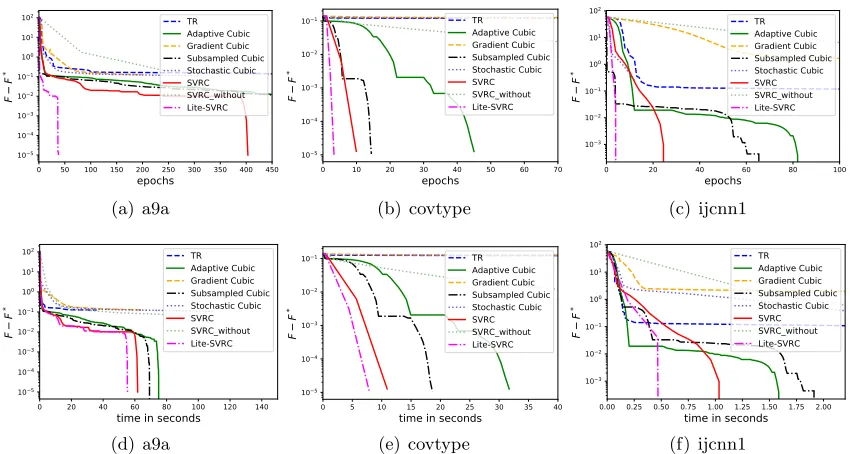
In the binary logistic regression problem in (26), for the nonconvex regularizergin (25), we set λ= 10−3 for all three datasets, and set γ = 10,50,100 for a9a,ijcnn1 and covtype
0 10 20 30 40 50 60 70 80 epochs 105 104 103 102 101 100 F F * TR Adaptive Cubic Gradient Cubic Subsampled Cubic Stochastic Cubic SVRC (a) a9a
0 10 20 30 40 50 epochs 105 104 103 102 101 F F * TR Adaptive Cubic Gradient Cubic Subsampled Cubic Stochastic Cubic SVRC (b) covtype
0 5 10 15 20 25 30 epochs 105 104 103 102 101 F F * TR Adaptive Cubic Gradient Cubic Subsampled Cubic Stochastic Cubic SVRC (c) ijcnn1
0 1 2 3 4 5 6 7 time in seconds
105 104 103 102 101 100 F F * TR Adaptive Cubic Gradient Cubic Subsampled Cubic Stochastic Cubic SVRC (d) a9a
0 5 10 15 20 25 30 35 40 time in seconds
105 104 103 102 101 F F * TR Adaptive Cubic Gradient Cubic Subsampled Cubic Stochastic Cubic SVRC (e) covtype
0.00 0.05 0.10 0.15 0.20 0.25 0.30
time in seconds
105 104 103 102 101 F F * TR Adaptive Cubic Gradient Cubic Subsampled Cubic Stochastic Cubic SVRC (f) ijcnn1
Figure 2: Logarithmic function value gap for nonlinear least square on different datasets. (a), (b) and (c) present the oracle complexity comparison; (d), (e) and (f) present the runtime comparison.
0 50 100 150 200 250 300 350 400 450 epochs 105 104 103 102 101 100 101 102 F F * TR Adaptive Cubic Gradient Cubic Subsampled Cubic Stochastic Cubic SVRC SVRC_without Lite-SVRC (a) a9a
0 10 20 30 40 50 60 70 epochs 105 104 103 102 101 F F * TR Adaptive Cubic Gradient Cubic Subsampled Cubic Stochastic Cubic SVRC SVRC_without Lite-SVRC (b) covtype
0 20 40 60 80 100 epochs 103 102 101 100 101 102 F F * TR Adaptive Cubic Gradient Cubic Subsampled Cubic Stochastic Cubic SVRC SVRC_without Lite-SVRC (c) ijcnn1
0 20 40 60 80 100 120 140 time in seconds
105 104 103 102 101 100 101 102 F F * TR Adaptive Cubic Gradient Cubic Subsampled Cubic Stochastic Cubic SVRC SVRC_without Lite-SVRC (d) a9a
0 5 10 15 20 25 30 35 40 time in seconds
105 104 103 102 101 F F * TR Adaptive Cubic Gradient Cubic Subsampled Cubic Stochastic Cubic SVRC SVRC_without Lite-SVRC (e) covtype
0.00 0.25 0.50 0.75 1.00 1.25 1.50 1.75 2.00 time in seconds 103 102 101 100 101 102 F F * TR Adaptive Cubic Gradient Cubic Subsampled Cubic Stochastic Cubic SVRC SVRC_without Lite-SVRC (f) ijcnn1
0 2 4 6 8 10 epochs
105 104 103 102 101 100
F
F
*
TR Adaptive Cubic Gradient Cubic Subsampled Cubic Stochastic Cubic SVRC SVRC_without Lite-SVRC
(a) a9a
0 10 20 30 40 50 epochs
105 104 103 102
F
F
*
TR Adaptive Cubic Gradient Cubic Subsampled Cubic Stochastic Cubic SVRC SVRC_without Lite-SVRC
(b) covtype
0 20 40 60 80 100 120 140 epochs
105 104 103 102 101 100
F
F
*
TR Adaptive Cubic Gradient Cubic Subsampled Cubic Stochastic Cubic SVRC SVRC_without Lite-SVRC
(c) ijcnn1
0 1 2 3 4 5
time in seconds 105
104
103
102
101
100
F
F
*
TR Adaptive Cubic Gradient Cubic Subsampled Cubic Stochastic Cubic SVRC SVRC_without Lite-SVRC
(d) a9a
0 5 10 15 20 25 30 time in seconds
105 104 103 102
F
F
*
TR Adaptive Cubic Gradient Cubic Subsampled Cubic Stochastic Cubic SVRC SVRC_without Lite-SVRC
(e) covtype
0 2 4 6 8 10
time in seconds 105
104 103 102 101 100
F
F
*
TR Adaptive Cubic Gradient Cubic Subsampled Cubic Stochastic Cubic SVRC SVRC_without Lite-SVRC
(f) ijcnn1
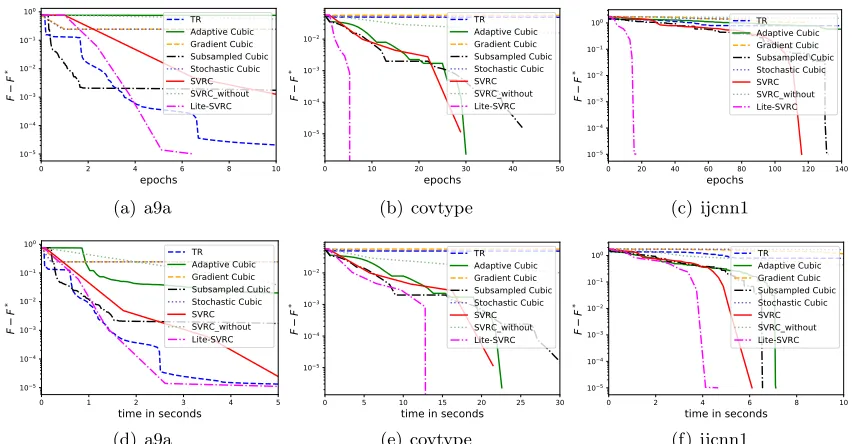
Figure 4: Function value gap of different algorithms for nonlinear least square problems on different datasets. (a)-(c) are plotted w.r.t. Hessian sample complexity. (d)-(e) are plotted w.r.t. CPU runtime.
than other methods, because as we pointed out in the introduction, it needs to compute the minimum eigenvalue of the Hessian in each iteration, which actually makes the Hessian sample complexity even worse than Subsampled Cubic, let alone the runtime complexity.
For the least square problem in (27), the parametersλandγin the nonconvex regularizer for different datasets are set as follows: λ= 5×10⁻³ for all three datasets, andγ = 10,20,50
fora9a,ijcnn1 andcovtype datasets respectively. The experimental results are summarized
in Figure 4, where the first row shows the plots of function value gap v.s. Hessian sample complexity and the second row presents the plots of function value gap v.s. CPU runtime (in seconds). It can be seen that Lite-SVRC again achieves the best performance among all the algorithms regarding to both sample complexity of Hessian and runtime when the required precision is high, which supports our theoretical analysis.
9. Conclusions
Acknowledgement
We would like to thank the anonymous reviewers for their helpful comments. This research was sponsored in part by the National Science Foundation IIS-1904183 and IIS-1906169. The views and conclusions contained in this paper are those of the authors and should not be interpreted as representing any funding agencies.
Appendix A. Proof of Main Theoretical Results for SVRC
In this section, we present the proofs of our main theoretical results for SVRC. Let us first recall the notations used in Algorithm 1. vst and Ust are the semi-stochastic gradient and Hessian defined in (5) and (6) respectively. xst’s are the iterates and bxs’s are the reference points used in Algorithm 1. bg and bh are the batch sizes of semi-stochastic gradient and
Hessian. S and T are the number of epochs and epoch length of Algorithm 1. We set Ms,t :=M =CML2 as suggested by Theorems 6 and 13, where CM >0 is a constant. hst
is the exact minimizer ofmst(h), wheremts(h) is defined in (7). ehst is the inexact minimizer defined in (15).
In order to prove Theorems 6 and 13, we lay down the following useful technical lemmas. The first lemma is standard in the analysis cubic regularization methods.
Lemma 24 Suppose F is L2-Hessian Lipschitz for some constant L2 > 0. For the
semi-stochastic gradient and Hessian defined in (5)and (6), we have the following results:
vst +Usthst +M 2 kh
s
tk2hst = 0, (28)
Ust +M 2 kh
s
tk2I0, (29)
hvst,hsti+1 2hU
s
thst,hsti+
M 6 kh
s tk32≤ −
M 12kh
s
tk32. (30)
The next two important lemmas control the variances ofvts andUst.
Lemma 25 For the semi-stochastic gradient vst defined in (5), we have
Eitk∇F(x
s
t)−vtsk
3/2
2 ≤
L32/2 b3g/4
kxst−xbsk32,
where Eit is the expectation over all it∈Ig.
Lemma 26 Let Ust be the semi-stochastic Hessian defined in (6). If the batch size satisfy
bh ≥400 logd, then we have
Ejt
∇2F(xst)−Ust 3
2≤1200L 3 2
logd
bh
3/2
kxst −bxsk32,
Lemma 27 For the semi-stochastic gradient and Hessian defined in (5) and (6) and h ∈
Rd, we have
h∇F(xst)−vst,hi ≤ M
27khk 3 2+
2k∇F(xst)−vtsk32/2
M1/2 ,
∇2F(xst)−Ust
h,h
≤ 2M
27 khk 3 2+
27 M2
∇2F(xst)−Ust 3 2.
Lemma 28 Let h ∈ Rd and C
M ≥ 100. For the semi-stochastic gradient and Hessian
defined in (5)and (6), we have
µ(xst+h)≤9CM3/2 h
M3/2khk32+k∇F(xst)−vstk23/2+M−3/2∇2F(xst)−Ust 3 2 +k∇mst(h)k32/2+M3/2khk2− khstk2
3i .
Lemma 29 Leth∈Rd andC≥3/2, For the semi-stochastic gradient and Hessian defined
in (5) and (6), we have
kxst+h−xbsk32≤2C2khk32+ (1 + 3/C)kxst−bxsk32. (31)
Lemma 30 We define constant series ct for 0 ≤ t ≤ T as follows: cT = 0 and ct =
ct+1(1 + 3/T) +M(500T3)−1 for 0≤t≤T −1. Then we have for any 1≤t≤T,
M/24−2ctT2 ≥0. (32)
A.1. Proof of Theorem 6
Proof [Proof of Theorem 6] We first upper bound F(xst+1) as follows F(xst+1)≤F(xst) +h∇F(xst),hsti+1
2
∇2F(xst)hst,hst+L2 6 kh
s tk32 =F(xst) +hvts,hsti+1
2hU
s
thst,hsti+
M 6 kh
s
tk32+h∇F(xts)−vst,hsti
+1 2
∇2F(xst)−Usthst,hst−M −L2
6 kh
s tk32
≤F(xst)−M
12kh
s tk32+
M 27kh
s tk32+
2k∇F(xst)−vstk32/2
M1/2
+1 2
2M
27 kh
s tk32+
27 M2
∇2F(xst)−Ust 3 2
−M−L2
6 kh
s tk32
≤F(xst)−M
12kh
s tk32+
2
M1/2k∇F(x
s
t)−vstk
3/2 2 +
27 M2
∇2F(xst)−Ust 3
2, (33) where the first inequality follows from Lemma 40 and the second inequality holds due to Lemmas 24 and 27. We define
Rst =EF(xts) +ctkxst−xb
sk3 2
wherect is defined in Lemma 30. Then by Lemma 29, for T ≥3/2 we have
ct+1kxst+1−xb
sk3
2 =ct+1khst+xst−xb
sk3
2 ≤2ct+1T2khstk23+ct+1(1 + 3/T)kxst−bx
sk3 2. (35) Applying Lemma 28 withh=hst, we have
240CM2 L12/2−1µ(xst+1)≤ M
24kh
s tk32+
k∇F(xst)−vstk32/2
24M1/2 +
∇2F(xst)−Ust 3 2 24M2 +k∇m
s t(hst)k
3/2 2 24M1/2 +
M 24
khstk2− khstk2 3
= M 24kh
s tk32+
k∇F(xst)−vstk32/2
24M1/2 +
∇2F(xst)−Ust 3 2
24M2 , (36) where the equality is due to Lemma 24. Adding (33) with (35) and (36) and taking total expectation, we have
Rst+1+ 240CM2 L12/2−1
E[µ(xst+1)] =E
h
F(xst+1) +ct+1kxst+1−bx
sk3
2+ 240CM2 L
1/2 2
−1
µ(xst+1)i
≤E
F(xst) +ct+1(1 + 3/T)kxst−xb
sk3
2− khstk32 M/24−2ct+1T2
+E
h
3M−1/2k∇F(xts)−vstk23/2+ 28M−2∇2F(xst)−Ust 3 2 i
≤EF(xst) +ct+1(1 + 3/T)kxst−xb
sk3 2
+E
h
3M−1/2k∇F(xts)−vstk32/2
+ 28M−2∇2F(xst)−Ust 3 2 i
, (37)
where the third inequality holds due to Lemma 30. To further bound (37), we have
3
M1/2Ek∇F(x
s
t)−vtsk
3/2
2 ≤
3L32/2 M1/2b3/4
g
Ekxst−bx
sk3 2 ≤
M 1000T3Ekx
s t −bx
sk3
2, (38) where the first inequality holds due to Lemma 25, the second inequality holds due toM ≥
100L2 and bg ≥5T4 from the condition of Theorem 6. We also have
28 M2E
∇2F(xst)−Ust 3 2≤
28×15000L32 M2(b
h/logd)3/2
Ekxst−bx
sk3 2 ≤
M 1000T3Ekx
s t −xb
sk3
2, (39) where the first inequality holds due to Lemma 26, where we have bh ≥ 100T2logd ≥
400 logd, and the second inequality holds due toM ≥100L2 and bh≥100T2logdfrom the
assumption of Theorem 6. Thus, submitting (38) and (39) into (37), we have
Rst+1+ 240CM2 L12/2−1E[µ(xst+1)]≤E
F(xst) +kxst−xbsk32
ct+1(1 + 3/T) + M 500T3
=EF(xst) +ctkxst−bx
sk3 2
where the first equality holds due to the definition of ct in Lemma 30. Telescoping (40)
from t= 0 to T −1, we have
Rs0−RTs ≥
T
X
t=1
240CM2 L12/2−1E[µ(xst)].
By the definition of cT in Lemma 30, we have cT = 0, then RsT = EF(xsT) +cTkxsT −
b
xsk3 2
= EF(xb
s+1); meanwhile by the definition of xs
0, we have xs0 = xb
s. Thus we have
Rs
0 =E
F(xs
0) +c0kxs0−bx
sk3 2
=EF(bx
s), which implies
EF(xb
s)− EF(xb
s+1) =Rs
0−RsT ≥ 240CM2 L
1/2 2
−1
T
X
t=1
E[µ(xst)]. (41)
Finally, telescoping (41) froms= 1 to S yields
∆F ≥ S
X
s=1
EF(bx
s)− EF(bx
s+1)≥ 240C2
ML
1/2 2
−1
S
X
s=1
T
X
t=1
E[µ(xst)].
By the definition about choice of xout, we complete the proof.
A.2. Proof of Corollary 9
Proof We can verify that the parameter setting in Corollary 9 satisfies the requirement of Theorem 6. Thus, submitting the choice of parameters into Theorem 6, the output of Algorithm 1xout satisfies that
E[µ(xout)]≤ 240C
2
ML
1/2 2 ∆F
ST ≤
3/2, (42)
which indeed implies that xout is an (,
√
L2)-approximate local minimum. Next we cal-culate how many SO calls and CSO calls are needed. Algorithm 1 needs to calcal-culate full gradient gs and full Hessian Hs at the beginning of each epoch, with n SO calls. In each
epoch, Algorithm 1 needs to calculate vts and Ust with bg +bh SO calls at each iteration.
Thus, the total amount of SO calls is
Sn+ (ST)(bg+bh)≤n+C1∆FL12/2n4/5−3/2+C1∆FL12/2−3/2(5n4/5+ 1000n2/5logd)
=Oe
n+∆F
√
L2n4/5 3/2
,
where C1 = 240CM2 . For the CSO calls, Algorithm 1 needs to solve cubic subproblem at each single iteration. Thus, the total amount of CSO calls is
ST ≤C1∆FL12/2
−3/2=O
∆F
√
L2 3/2
A.3. Proof of Theorem 13
Proof [Proof of Theorem 13] Similar to (33) in the proof of Theorem 6, we have
F(xst+1)≤F(xts) +∇F(xst),hest
+ 1 2
∇2F(xst)hest,hest
+L2 6
ehst
3 2 =F(xst) +vst,hest
+1
2
Usthest,ehst
+M 6
ehst
3 2+
∇F(xst)−vst,ehst
+1 2
(∇2F(xst)−Uts)hest,ehst
−M−L2
6 ehst
3 2
≤F(xst)−M
12 ehst
3 2+δ+
M 27 ehst
3 2+
2k∇F(xst)−vstk32/2
M1/2
+1 2 2M 27 ehst
3 2+ 27 M2
∇2F(xst)−Ust 3 2
−M−L2
6 ehst
3 2
≤F(xst)−M
12 ehst
3 2+
2
M1/2k∇F(x
s
t)−vstk
3/2 2 +
27 M2
∇2F(xst)−Ust 3 2+δ,
(43)
where the second inequality holds because hest is an inexact solver satisfying Condition 11. By Lemma 29 withh=hest, we have
ct+1kxst+1−bx
sk3 2=ct+1
xst−bxs+hest 3
2≤2ct+1T 2
ehst 3
2+ct+1(1 + 3/T)kx
s t −bx
sk3 2.
(44)
By Lemma 28, we also have
240CM2 L12/2−1µ(xst+1) = 240CM2 L12/2−1
µ xst +hest
≤ M
24 ehst
3 2+
k∇F(xst)−vstk32/2
24M1/2 +
∇2F(xst)−Ust 3 2 24M2 +
∇mst hest
3/2 2 24M1/2 +
M ehst
2− kh
s tk2
3 24 ,
(45)
Since ehst is an inexact solver satisfying Condition 11, we have
∇mst hest
3/2 2 24M1/2 +
M ehst
2− kh
s tk2
3 24 ≤ δ 24 + δ
24 < δ. (46)
Submitting (46) into (45), we have
240CM2 L12/2−1µ(xst+1)≤ M
24 ehst
3 2+
k∇F(xst)−vstk32/2
24M1/2 +
∇2F(xst)−Ust 3 2
24M2 +δ. (47) Then adding (43), (44) and (47) up, we have
Rst+1+ 240CM2 L21/2−1E[µ(xst+1)] =E
h
F(xst+1) +ct+1kxst+1−xb
sk3
2+ 240CM2 L
1/2 2
−1
≤EhF(xst) +ct+1(1 + 3/T)kxst−bx
sk3 2−
ehst
3
2 M/24−2ct+1T 2i +E
3
M1/2k∇F(x
s
t)−vstk
3/2 2 +
28 M2
∇2F(xst)−Ust 3 2 + 2δ ≤E
F(xst) +ct+1(1 + 3/T)kxst−bx
sk3 2
+E
3
M1/2k∇F(x
s
t)−vstk
3/2 2 +
28 M2
∇2F(xst)−Ust 3 2
+ 2δ. (48)
Since the parameter setting is the same as Theorem 6, by (38) and (39), we have
3
M1/2Ek∇F(x
s
t)−vstk
3/2 2 ≤
M 1000T3Ekx
s t−xb
sk3
2, (49)
28 M2E
∇2F(xst)−Ust 3 2≤
M 1000T3Ekx
s t−xb
sk3
2. (50)
Submitting (49) and (50) into (48) yields
Rts+1+ 240CM2 L12/2−1E[µ(xst+1)]≤E
F(xst) +kxst−bxsk32
ct+1(1 + 3/T) +
M 500T3
+ 2δ
=EF(xst) +ctkxst−xb
sk3 2
+ 2δ
=Rst+ 2δ, (51)
where the first equality holds due to the definition of ct in Lemma 30. Telescoping (40)
from t= 0 to T −1, we have
Rs0−RsT ≥
T
X
t=1
240CM2 L12/2−1E[µ(xst)]−2δ
.
By the definition of cT in Lemma 30, we have cT = 0, then RsT = E
F(xsT) +cTkxsT −
b
xsk3 2
= E[F(bx
s+1)]; meanwhile by the definition of xs
0, we have xs0 = bx
s. Thus we have
R0s=EF(x0s) +c0kxs0−bx
sk3 2
=E[F(xb
s)], which further implies
E[F(xb
s)]− E[F(xb
s+1)] =Rs
0−RsT ≥ T
X
t=1
240CM2 L12/2−1E[µ(xst)]−2δ
. (52)
Finally, telescoping (52) froms= 1 to S, we obtain
∆F ≥ S
X
s=1
E[F(bx
s)]− E[F(xb
s+1)]≥
S X s=1 T X t=1 h
240CM2 L12/2−1
E[µ(xst)]−2δ
i .
A.4. Proof of Corollary 15
Proof [Proof of Corollary 15] Under the parameter choice in Corollary 15, it holds that
E[µ(xout)]≤
240CM2 L12/2∆F
ST + 480C 2
ML
1/2 2 δ≤
3/2/2 +3/2/2 =3/2. (53) Thus, xout is an (,
√
L2)-approximate local minimum. By the proof of Corollary 9, the total amount of SO calls is
Sn+ (ST)(bg+bh)≤n+C1∆FL12/2n
4/5−3/2+C
1∆FL12/2
−3/2(5n4/5+ 1000n2/5logd) =Oe
n+∆F
√
L2n4/5 3/2
,
where C1 = 480CM2 . For the CSO calls, Algorithm 1 needs to solve cubic subproblem at
each single iteration. Thus, the total amount of CSO calls is
ST ≤C1∆FL12/2
−3/2=O
∆F
√
L2 3/2
.
Appendix B. Proof of Technical Lemmas in Appendix A
In this section, we prove the technical lemmas used in Appendix A.
B.1. Proof of Lemma 24
The result of Lemma 24 is typical in the literature of cubic regularization (Nesterov and Polyak, 2006; Cartis et al., 2011a,b), but no exactly the same result has been shown in any formal way. Thus we present the proof here for self-containedness.
Proof [Proof of Lemma 24] For simplicity, we let g =vts,H=Uts, θ=Mt and hopt =hst.
Then we need to prove
g+Hhopt+ θ
2khoptk2hopt=0, (54)
H+ θ
2khoptk2I0, (55)
hg,hopti+ 1
2hHhopt,hopti+ θ 6khoptk
3 2≤ −
θ
12khoptk 3
2. (56)
Letλ=θkhoptk2/2. Note thathopt = argminm(h), then the necessary condition∇m(hopt) =
0 and ∇2m(hopt)0 can be written as
∇m(hopt) =g+Hhopt+λhopt=0, (57)
w>∇2m(hopt)w=w>
H+λI+λ
hopt
khoptk2
hopt
khoptk2 >