RESEARCH REPOSITORY
This is the author’s final version of the work, as accepted for publication following peer review but without the publisher’s layout or pagination.
The definitive version is available at:
https://doi.org/10.1016/j.hydromet.2017.10.011
Ang, K.L., Li, D. and Nikoloski, A.N. (2017) The effectiveness of ion exchange
resins in separating uranium and thorium from rare earth elements in acidic
aqueous sulfate media. Part 1. Anionic and cationic resins.
Hydrometallurgy, 174. pp. 147-155.
http://researchrepository.murdoch.edu.au/id/eprint/38825/
Copyright: © 2017 Elsevier B.V.
The effectiveness of ion exchange resins in separating uranium and thorium from rare earth elements in acidic aqueous sulfate media. Part 1. Anionic and cationic resins
Kwang Loon Ang, Dan Li, Aleksandar N. Nikoloski
PII: S0304-386X(17)30483-8
DOI: doi:10.1016/j.hydromet.2017.10.011
Reference: HYDROM 4670
To appear in: Hydrometallurgy
Received date: 9 June 2017
Revised date: 23 September 2017 Accepted date: 4 October 2017
Please cite this article as: Kwang Loon Ang, Dan Li, Aleksandar N. Nikoloski , The effectiveness of ion exchange resins in separating uranium and thorium from rare earth elements in acidic aqueous sulfate media. Part 1. Anionic and cationic resins. The address for the corresponding author was captured as affiliation for all authors. Please check if appropriate. Hydrom(2017), doi:10.1016/j.hydromet.2017.10.011
ACCEPTED MANUSCRIPT
The effectiveness of ion exchange resins in separating uranium
and thorium from rare earth elements in acidic aqueous sulfate
media. Part 1. Anionic and cationic resins
Kwang Loon Ang, Dan Li and Aleksandar N. Nikoloski*
Chemical and Metallurgical Engineering and Chemistry,
School of Engineering and Information Technology, Murdoch University, Australia
*
Corresponding author. Telephone: +61 8 9360 2835; Fax: +61 8 9360 6343. E-mail address: [email protected] (A. N. Nikoloski).
ACCEPTED MANUSCRIPT
AbstractConventional ion exchange resins with different functional groups were evaluated for their potential application in separating uranium U(VI) and thorium Th(IV) from rare earth elements RE(III). The resins studied comprised strong- and weak-base anion exchange resins, and strong- and weak-acid cation exchange resins. The selectivity of these resins to adsorb U(VI) and Th(IV) in the presence of selected RE(III) was examined in sulfuric acid media of varying concentrations. It was evident that the adsorption performance of the resins was acid concentration-dependent. Most candidate resins had potentially feasible selective adsorption at or below 0.1 mol/L H2SO4 (pH ≥ 0.7). Within the group of anion exchange resins, both the
strong- and weak-base resins exhibited a similar selectivity with U(VI) adsorbed in preference to RE(III). The difference between them was their adsorption of Th(IV). The weak-base resin with primary amine functional group demonstrated superior separation of Th(IV) from RE(III). For this resin, 78% of U(VI) and 68% of Th(IV) were adsorbed while RE(III) co-adsorption was less than 5% at 0.0005 mol/L H2SO4 (pH 3). In the case of the
strong-acid cation exchange resins, Th(IV) and RE(III) were adsorbed in preference to U(VI),
i.e., RE(III) > Th(IV) >> U(VI). The weak-acid cation exchange resins, on the other hand, displayed limited adsorption of all elements.
Keywords:
ACCEPTED MANUSCRIPT
1. IntroductionThe separation of uranium and thorium from rare earths is one of the most important tasks in the hydrometallurgical production of these elements. This is because U(VI) and Th(IV) invariably coexist with the two most abundant rare earth minerals, i.e. monazite and bastnaesite. The method of removing U(VI) and Th(IV) in conventional hydrometallurgical processing of rare earths has problems pertaining to the disposal of solid and/or liquid waste, in addition to substantial loss of rare earths to waste (Gui, et al., 2014; Zhu, et al., 2015). For that reason, in the past decade there has been a resurgence of investigations into U(VI) and Th(IV) separation involving the use of different methods (Cheng, et al., 2011; Deng, et al., 2013; Fan, et al., 2011; Gao, et al., 2012; Nasab, et al., 2011; Song, et al., 2009; Zhang, et al., 2012; Zhong & Wu, 2012; Zuo, et al., 2008).
A literature review into the separation of U(VI) and Th(IV) from rare earths shows that extensive work has been conducted to separate U(VI) and Th(IV) using liquid or solvent extractants. This is considered a convenient and efficient method to purify the rare earths because of its simplicity and ease of operation (He, et al., 2013). However, one of its drawbacks is the need to dispose of organic waste generated in the recovery process (Gui, et al., 2014). In contrast, ion exchange (IX) is known to produce less liquid waste, whether aqueous or organic in nature, and hence there are fewer waste disposal issues. IX also does not have issues of phase separation, third phase formation, or solvent loss, and is particularly advantageous for adsorption of metals present in low concentrations, e.g., from bastnaesite ores with a low content of U(VI) and Th(IV). These merits of IX therefore justify research into the technology to further develop its potential for separation of U(VI) and Th(IV) from rare earths.
The objective of this study was to evaluate the adsorption affinity of various IX resins with different physicochemical properties for U(VI) and Th(IV) in sulfuric acid media containing selected light, medium, and heavy RE(III), i.e., lanthanum (III), cerium (III), gadolinium (III) and ytterbium (III). Comparative adsorption data for the resins were presented to demonstrate the ones that are most selective towards U(VI) and Th(IV) over RE(III). Rather than focusing on a single element system, the impact that the presence of RE(III) have on the adsorption ability of the resins to selectively adsorb U(VI) and Th(IV) was investigated. The scope of this investigation was limited to readily available commercial IX resins rather than chemically modified IX resins that might not be economically viable. The candidate resins comprised anion and cation exchange resins, and chelating resins including two solvent-impregnated resins containing extractants commonly used in SX processes for rare earths separation, namely, di-(2-ethylhexyl) phosphoric acid (D2EHPA) and organophosphinic acid.
ACCEPTED MANUSCRIPT
2006). This paper presents, for the first time, the application of a weak-base anion exchange resin with primary amine functional group to the separation of U(VI) and Th(IV) from RE(III). The results from this paper will also be compared with the IX performance of chelating resins reported elsewhere (Ang, et al., 2017b).
2. Experimental materials and methods
2.1.Candidate resins
The ion exchange resins used in this study were selected from commercially-available resins supplied by resin manufacturing companies. Their physicochemical properties, as reported in their product data sheets, are tabulated in Table 1.
Table 1. Physicochemical properties of candidate resins
Resin ID Functional group Structure Total capacity
min. eq/L
AnIXR 1 Primary amine Macroporous 2.2
AnIXR 2 92%-tertiary, 8%-quaternary amine Macroporous 1.6
AnIXR 3 80%-tertiary, 20%-quaternary amine Macroporous 1.6
AnIXR 4 Quaternary amine, type I Gel 1.4
AnIXR 5 Quaternary amine, type I Gel 1.6
AnIXR 6 Quaternary amine, type I Macroporous 1.15
AnIXR 7 Quaternary amine, type II Gel 1.2
AnIXR 8 Quaternary amine, type II Macroporous 1.1
AnIXR 9 Quaternary amine, type II Macroporous 1.0
CatIXR 1 Sulfonic Gel 2.0
CatIXR 2 Sulfonic Macroporous 1.8
CatIXR 3 Carboxylic Porous 4.5
CatIXR 4 Carboxylic Macroporous 4.3
ACCEPTED MANUSCRIPT
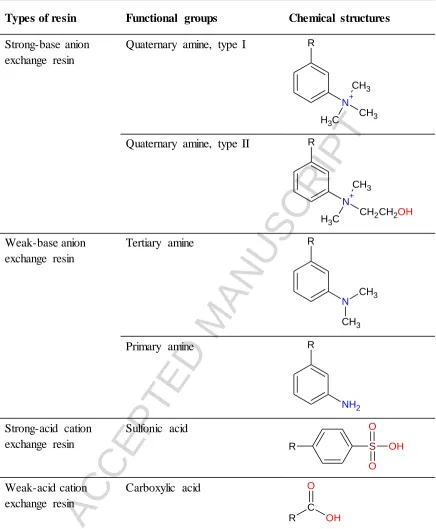
Table 2. Schematics of functional groups of various ion exchange resinsTypes of resin Functional groups Chemical structures
Strong-base anion exchange resin
Quaternary amine, type I R
N+
C H3
CH3
CH3
Quaternary amine, type II R
N+
C H3
CH3
CH2CH2OH
Weak-base anion exchange resin
Tertiary amine R
N
CH3 CH3
Primary amine R
NH2
Strong-acid cation exchange resin
Sulfonic acid
S O O OH R Weak-acid cation exchange resin
Carboxylic acid
C
O
OH
R
ACCEPTED MANUSCRIPT
2.2.Synthetic solutions
Concentrated stock solution was prepared by dissolving appropriate amounts of Th(SO4)2·8H2O, UO2SO4·3H2O, La2(SO4)3, Ce2(SO4)3, Gd2(SO4)3 and Yb2(SO4)3·8H2O in
distilled water. The synthetic solution was prepared fresh from the stock solution before each test with a concentration of 2 mmol/L for each metal ion. Th(SO4)2·8H2O (99.9%) and
UO2SO4·3H2O (99.9%) were procured from International Bio-Analytical Industries, Inc.
(Florida, USA). La2(SO4)3 (99.99%), Ce2(SO4)3 (99.99%), Gd2(SO4)3 (99.99%) and
Yb2(SO4)3·8H2O (99.9%) were obtained locally from Sigma-Aldrich. All other chemicals
used were of analytical grade.
2.3.Adsorption procedure
The adsorption experiments were carried out in a batch setup to examine the adsorption of U(VI), Th(IV) and RE(III) in H2SO4 media by different ion exchange resins. The following
steps were repeated for each candidate resin.
To investigate the effect of acidity, 100 mL of synthetic solution with varying concentrations of H2SO4 (0.0005–2.0 mol/L) was added to a conical flask containing 1 g resin (dry,
free-rolling). The mixture was equilibrated in a Thermoline Scientific BT-350R refrigerated shaking water bath machine at constant temperature of 20°C for 24 hours. The solution was sampled 2 hours after the start of equilibration, and a second sample was extracted at the end of the 24-hour test. The concentrations of metal ions in the sample were determined by inductively coupled plasma mass spectrometry (ICP-MS iCAP Qc, Thermo Fisher Scientific, Germany).
The adsorption percentage of each metal ion was calculated according to Equation 1:
% Adsorption =𝐶0− 𝐶
𝐶0 × 100 (1)
where C0 and C are the initial and equilibrium concentrations, respectively, of metal ion in
aqueous solution (mg/L).
The distribution coefficient Kdfor each metal ion was calculated according to Equation 2:
𝐾d=𝐶0− 𝐶
𝐶 ∙
𝑉
𝑚 (2)
ACCEPTED MANUSCRIPT
3. Results and discussion3.1.Anion exchange resins
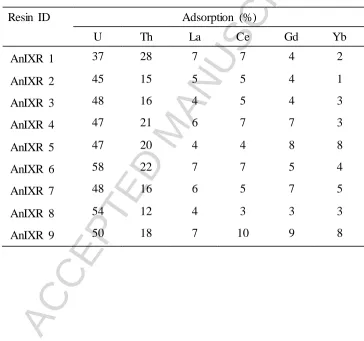
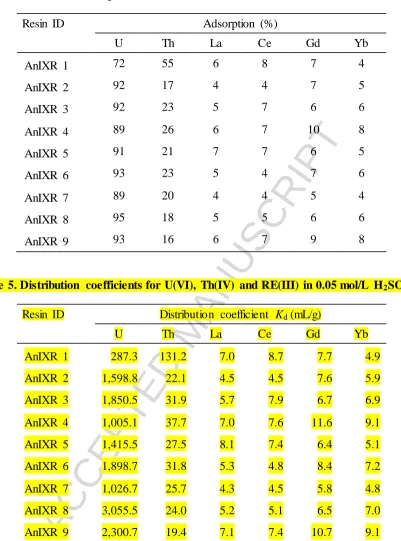
Nine anion exchange resins were tested for their adsorption affinity for U(VI) and Th(IV) in acidic sulfate solution containing RE(III). The primary amine functionalised AnIXR 1 is a weak-base anion exchange resin. AnIXR 2 and AnIXR 3, containing a mixture of tertiary and quaternary amino groups, are classified as intermediate-base anion exchange resins. The remaining resins with quaternary ammonium functionality are strong-base anion exchange resins. Their adsorption of U(VI), Th(IV) and RE(III) after contact times of 2 hours and 24 hours are tabulated in Table 3 and Table 4 respectively. The distribution coefficient Kd values
of each resin for U(VI), Th(IV) and RE(III) are tabulated in Table 5.
Table 3. 2-hour IX adsorption of U(VI), Th(IV) and RE(III) in 0.05 mol/L H2SO4
Resin ID Adsorption (%)
U Th La Ce Gd Yb
AnIXR 1 37 28 7 7 4 2
AnIXR 2 45 15 5 5 4 1
AnIXR 3 48 16 4 5 4 3
AnIXR 4 47 21 6 7 7 3
AnIXR 5 47 20 4 4 8 8
AnIXR 6 58 22 7 7 5 4
AnIXR 7 48 16 6 5 7 5
AnIXR 8 54 12 4 3 3 3
ACCEPTED MANUSCRIPT
Table 4. 24-hour IX adsorption of U(VI), Th(IV) and RE(III) in 0.05 mol/L H2SO4
Resin ID Adsorption (%)
U Th La Ce Gd Yb
AnIXR 1 72 55 6 8 7 4
AnIXR 2 92 17 4 4 7 5
AnIXR 3 92 23 5 7 6 6
AnIXR 4 89 26 6 7 10 8
AnIXR 5 91 21 7 7 6 5
AnIXR 6 93 23 5 4 7 6
AnIXR 7 89 20 4 4 5 4
AnIXR 8 95 18 5 5 6 6
AnIXR 9 93 16 6 7 9 8
Table 5. Distribution coefficients for U(VI), Th(IV) and RE(III) in 0.05 mol/L H2SO4
Resin ID Distribution coefficient Kd (mL/g)
U Th La Ce Gd Yb
AnIXR 1 287.3 131.2 7.0 8.7 7.7 4.9
AnIXR 2 1,598.8 22.1 4.5 4.5 7.6 5.9
AnIXR 3 1,850.5 31.9 5.7 7.9 6.7 6.9
AnIXR 4 1,005.1 37.7 7.0 7.6 11.6 9.1
AnIXR 5 1,415.5 27.5 8.1 7.4 6.4 5.1
AnIXR 6 1,898.7 31.8 5.3 4.8 8.4 7.2
AnIXR 7 1,026.7 25.7 4.3 4.5 5.8 4.8
AnIXR 8 3,055.5 24.0 5.2 5.1 6.5 7.0
AnIXR 9 2,300.7 19.4 7.1 7.4 10.7 9.1
ACCEPTED MANUSCRIPT
not found., it is concluded that anion exchange resins show high to moderate adsorption affinity for U(VI), moderate to low for Th(IV), and negligible for RE(III) in acidic sulfate media.
The results in Table 3 and Table 4 also highlight a marked difference in the adsorption performance of the weak-base anion exchange resin AnIXR 1 and the rest of the anion exchange resins. Table 4 shows that AnIXR 1 has the highest adsorption percentage of Th(IV) among the anion exchange resins, more than twice the amount adsorbed by any of the other resins. However, the adsorption of U(VI) by AnIXR 1 was less than 90%, whereas it was approximately 90% or more for all the other anion exchange resins. This suggests that weak-base anion exchange resin has higher affinity for Th(IV) and lower affinity for U(VI) than intermediate- and strong-base anion exchange resins. This is likewise seen in
Figure 1 to Figure 9 for adsorption at different acidities.
It is also significant to point out that the strong-base anion exchange resins from different manufacturers are made with certain different physicochemical properties. The results, however, did not show any significant variation between strong-base anion exchange resins with different physicochemical properties, but all strong-base anion exchange resins exhibited similar adsorption patterns. Rather, significant variation was observed between anion exchange resins with different functional groups, i.e., between weak-base anion exchange resin that contains primary amine functional group and strong-base anion exchange resins resin that contains quaternary amine functional group or alike. This highlights another important finding that the key underlying factor behind the adsorption performance of the resins is the functional groups.
There do not appear to be any report in the literature comparing the adsorption of U(VI) and Th(IV) by weak- and strong-base anion exchange resins in H2SO4 media except for a study
ACCEPTED MANUSCRIPT
Amberlite CG-4B has a higher adsorption affinity for Th(IV) than the strong-base anion exchange resin AG1X-8, which is consistent to what was reported in this present study. In the case of U(VI), the weak-base anion exchange resin showed higher adsorption affinity than the strong-base anion exchange resin, which is contrary to what was reported in this present study. The difference is likely because Kuroda, et al. (1972) was reporting the individual IX adsorption of U(VI) and Th(IV), whereas this present study involved the simultaneous IX adsorption of both elements. Since U(VI) and Th(IV) were simultaneously adsorbed by the weak-base anion exchange resin AnIXR 1, there could have been some sort of competing effect from the anionic Th(IV) sulfato complexes adsorbed on the resin, which in turn results in the lower adsorption of U(VI) by the resin.
ACCEPTED MANUSCRIPT
Figure 1. Adsorption of selected metal ions as a logarithmic function of [H+] in sulfuric acid media for AnIXR 1 resin containing primary amine group. [UO22+] = [Th4+] = [La3+] = [Ce3+] =
[Gd3+] = [Yb3+] = 2 mmol/L. □ U; ◯ Th; △ La; ▽ Ce;
◁
Gd;▷
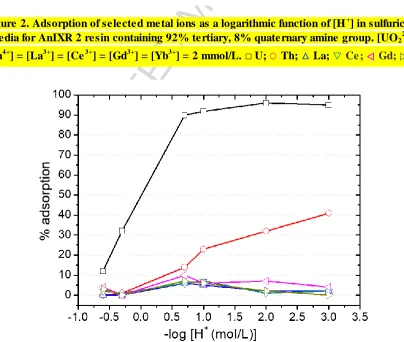
Yb.Figure 2. Adsorption of selected metal ions as a logarithmic function of [H+] in sulfuric acid media for AnIXR 2 resin containing 92% tertiary, 8% quaternary amine group. [UO22+] =
ACCEPTED MANUSCRIPT
Figure 3. Adsorption of selected metal ions as a logarithmic function of [H+] in sulfuric acid media for AnIXR 3 resin containing 80% tertiary, 20% quaternary amine group. [UO22+] =
[Th4+] = [La3+] = [Ce3+] = [Gd3+] = [Yb3+] = 2 mmol/L. □ U; ◯ Th; △ La; ▽ Ce;
◁
Gd;▷
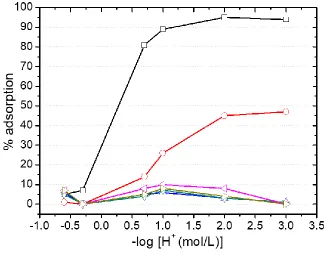
Yb.Figure 4. Adsorption of selected metal ions as a logarithmic function of [H+] in sulfuric acid media for AnIXR 4 resin containing type I quaternary amine group. [UO22+] = [Th4+] = [La3+] =
ACCEPTED MANUSCRIPT
Figure 5. Adsorption of selected metal ions as a logarithmic function of [H+] in sulfuric acid media for AnIXR 5 resin containing type I quaternary amine group. [UO22+] = [Th4+] = [La3+] =
[Ce3+] = [Gd3+] = [Yb3+] = 2 mmol/L. □ U; ◯ Th; △ La; ▽ Ce;
◁
Gd;▷
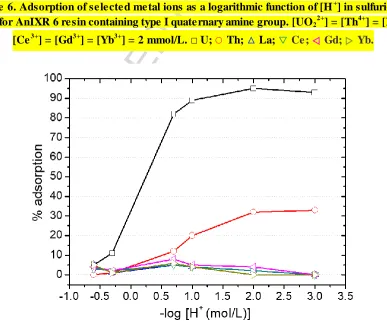
Yb.Figure 6. Adsorption of selected metal ions as a logarithmic function of [H+] in sulfuric acid media for AnIXR 6 resin containing type I quaternary amine group. [UO22+] = [Th4+] = [La3+] =
ACCEPTED MANUSCRIPT
Figure 7. Adsorption of selected metal ions as a logarithmic function of [H+] in sulfuric acid media for AnIXR 7 resin containing type II quaternary amine group. [UO22+] = [Th4+] = [La3+] =
[Ce3+] = [Gd3+] = [Yb3+] = 2 mmol/L. □ U; ◯ Th; △ La; ▽ Ce;
◁
Gd;▷
Yb.Figure 8. Adsorption of selected metal ions as a logarithmic function of [H+] in sulfuric acid media for AnIXR 8 resin containing type II quaternary amine group. [UO22+] = [Th4+] = [La3+] =
ACCEPTED MANUSCRIPT
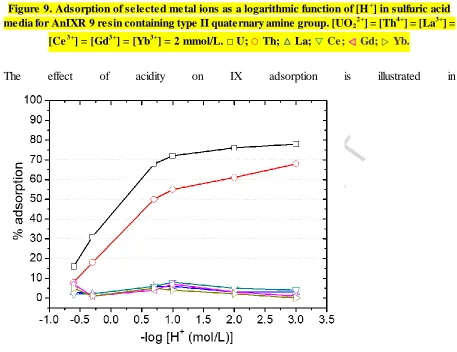
Figure 9. Adsorption of selected metal ions as a logarithmic function of [H+] in sulfuric acid media for AnIXR 9 resin containing type II quaternary amine group. [UO22+] = [Th4+] = [La3+] =
[Ce3+] = [Gd3+] = [Yb3+] = 2 mmol/L. □ U; ◯ Th; △ La; ▽ Ce;
◁
Gd;▷
Yb.The effect of acidity on IX adsorption is illustrated in
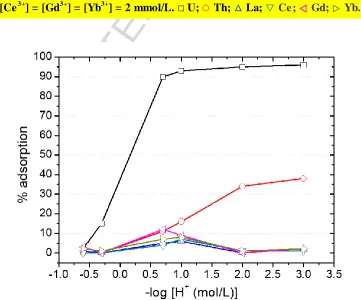
Figure 1 to Figure 9. It is obvious that the adsorption of U(VI) and Th(IV) is dependent on acid concentration, particularly that of U(VI). The resins show similar acid concentration-dependent behaviour, having a sharp increase in the adsorption percentage of U(VI) as H2SO4
concentration decreases from 2 mol/L to 0.1 mol/L. This indicates that anion exchange resins effectively adsorb U(VI) at 0.1 mol/L H2SO4 and below (or pH ≥ 0.7). Apart from the
hydrogen ions, the fact that U(VI) adsorption is strongly suppressed by increasing H2SO4
concentration is due to the formation of bisulfate ions rather than sulfate ions in H2SO4
solution (Jamrack, 1963; Preuss & Kunin, 1958; Zagorodnyaya, et al., 2013; Zagorodnyaya, et al., 2015). The 2-step reaction below shows how H2SO4 undergoes stepwise dissociation to
form bisulfate and sulfate ions.
First step: H2SO4 (aq) → H+ (aq) + HSO4- (aq) (2)
Second step: HSO4- (aq) ⇌ H+ (aq) + SO42- (aq) (3)
The dissociation constants for the first and second steps are 1.0×10³ and 1.2×10⁻², respectively (Spencer, et al., 2010). In other words, more bisulfate ions are present in H2SO4
ACCEPTED MANUSCRIPT
concentration, which in turn increases U(VI) adsorption. This is also most likely the explanation behind the increasing Th(IV) adsorption with decreasing acidity.
Another observation of the results is that Th(IV) is consistently adsorbed to a much lesser extent than U(VI) on anion exchange resins in H2SO4 solutions, even at very low acidity.
Other published works have also come to this conclusion (Bunney, et al., 1959; Kraus & Nelson, 1958; Kuroda, et al., 1972; Strelow & Bothma, 1967). This suggests that the tested anion exchange resins, apart from the weak-base anion exchange resin AnIXR 1, may be more suitable for the separation of U(VI) from RE(III), than Th(IV) from RE(III), in H2SO4
media. The difference between the adsorption of U(VI) and Th(IV) by anion exchange resins is explained in the latter section of this paper along with the results obtained for the cation exchange resins. However, it may be of practical interest to report that intermediate- and strong-base anion exchange resins could separate U(VI) from Th(IV), with the best separation obtained at 0.1 mol/L H2SO4 in the current study.
None of the anion exchange resins exhibit any significant adsorption affinity for RE(III) at any acid concentration. The results demonstrate that the adsorption affinity for RE(III) remains low regardless of the acidity. This lack of adsorption of RE(III) on anion exchange resins from pure aqueous H2SO4 solutions has been reported in many other studies (Banks, et
al., 1958; Hughes & Carswell, 1970; Jangida, et al., 1965; Korkisch, 1989; Kuroda, et al., 1972; Nagle & Murthy, 1959; Strelow & Bothma, 1967). Kołodyńska and Hubicki (2012) explained this by noting that RE(III) show little tendency to form anionic complexes with simple inorganic ligands, e.g., sulfate ions. RE(III) are therefore weakly adsorbed onto anion exchange resins in a pure aqueous H2SO4 system.
There is therefore a potential application of anion exchange resin in the separation of U(VI) and Th(IV) from RE(III) in H2SO4 media. The weak-base anion exchange resin with a
primary amine functional group was the best performing resin among the anion exchange resins. In the current experiment, feasible separation of U(VI) and Th(IV) from RE(III) was attained at 0.1 mol/L H2SO4 and below, with the best separation at 0.0005 mol/L H2SO4 (pH
3). The separation factors for Th(IV)–RE(III) and U(VI)–RE(III) cannot be measured due to the very low RE(III) adsorption by AnIXR 1. The intermediate- and strong-base anion exchange resins, on the other hand, are only suitable for the separation of U(VI) from RE(III), but not Th(IV) from RE(III), in H2SO4 media.
3.2.Cation exchange resins
Four cation exchange resins were tested for their adsorption affinity for U(VI) and Th(IV) in acidic sulfate solution containing RE(III). The sulfonic acid functionalised CatIXR 1 and CatIXR 2 are strong-acid cation exchange resins, while the carboxylic acid functionalised CatIXR 3 and CatIXR 4 are weak-acid cation exchange resins. Their adsorption of U(VI), Th(IV) and RE(III) at contact times of 2 hours and 24 hours are tabulated in Table 6 and Table 7 respectively. The distribution coefficient Kd values of each resin for U(VI), Th(IV)
and RE(III) are tabulated in Table 8.
ACCEPTED MANUSCRIPT
Resin ID Adsorption (%)
U Th La Ce Gd Yb
CatIXR 1 30 43 49 49 48 47
CatIXR 2 28 37 45 46 46 44
CatIXR 3 7 5 8 8 8 4
CatIXR 4 4 4 5 5 4 3
Table 7. 24-hour IX adsorption of U(VI), Th(IV) and RE(III) in 0.05 mol/L H2SO4
Resin ID Adsorption (%)
U Th La Ce Gd Yb
CatIXR 1 25 80 96 95 95 94
CatIXR 2 27 80 94 93 91 89
CatIXR 3 4 4 4 4 4 4
ACCEPTED MANUSCRIPT
Table 8. Distribution coefficients for U(VI), Th(IV) and RE(III) in 0.05 mol/L H2SO4
Resin ID Distribution coefficient Kd (mL/g)
U Th La Ce Gd Yb
CatIXR 1 34.1 473.5 6,435.5 4,008.3 4,122.5 2,455.6
CatIXR 2 38.3 484.5 2,547.8 2,148.5 1,348.4 1,062.3
CatIXR 3 4.7 4.4 4.1 4.3 4.5 4.1
CatIXR 4 6.8 3.0 3.3 2.5 5.9 2.0
3.2.1.Cation exchange resins with sulfonic acid functionality
The strong-acid cation exchange resins in Table 6 show appreciable adsorption of U(VI), Th(IV) and RE(III) after 2 hours of contact in the acidic sulfate solution. Among the elements adsorbed, RE(III) had the highest adsorption percentage, followed by Th(IV) and U(VI). After a contact time of 24 hours, the adsorption percentages of Th(IV) and RE(III) both doubled compared to after 2 hours, whereas, for U(VI), the percentage adsorbed stayed nearly the same as after 2 hours of contact. Based on the Kd values in Table 8, it is concluded that
strong-acid cation exchange resins show high adsorption affinity for RE(III), moderate for Th(IV), and low for U(VI) in acidic sulfate media.
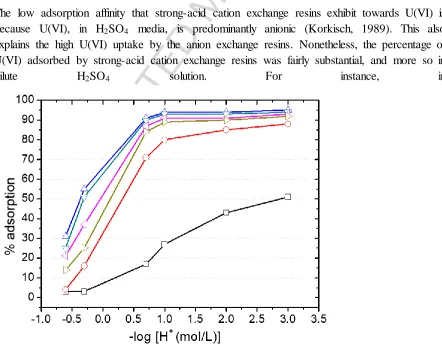
The low adsorption affinity that strong-acid cation exchange resins exhibit towards U(VI) is because U(VI), in H2SO4 media, is predominantly anionic (Korkisch, 1989). This also
explains the high U(VI) uptake by the anion exchange resins. Nonetheless, the percentage of U(VI) adsorbed by strong-acid cation exchange resins was fairly substantial, and more so in
ACCEPTED MANUSCRIPT
Figure 11, the percent U(VI) adsorbed was as much as 51% at 0.0005 mol/L H2SO4. Korkisch
(1989) attributed this to the increasing formation of U(VI) cationic species as H2SO4
concentration decreases. This most likely also explains the unexpected behaviour of anion exchange resins whereby the adsorption percentage of U(VI) showed a marginal decrease from 0.005 mol/L to 0.0005 mol/L H2SO4 (see Figure 2 to Figure 9). As for the ionic state of
Th(IV) in H2SO4 media, the results from both anion and cation exchange resins show that it
tends to be the opposite of that of U(VI), but similar to that of RE(III).
The observation that RE(III) is adsorbed in preference to Th(IV) on strong-acid cation exchange resins in H2SO4 solution is consistent with what was previously reported (Chang, et
al., 1974; Marhol, 1982; Nietzel, et al., 1958; Strelow, 1961; Strelow, et al., 1965), but no explanation has been provided as to why the resin exhibited this selectivity. Strong-acid cation exchange resins show higher affinity for metal cations of higher charge (Hubicki & Kołodyńska, 2012). This is because their adsorption affinity is determined mainly by the valence of the metal cation (Page, et al., 2017). Unlike the weak-base anion exchange resins, strong-acid cation exchange resins have no complexing ability (Zagorodni, 2007). It is thus suggested that sulfate complexation of Th(IV) ions may have affected their adsorption affinity for strong-acid cation exchange resins (Borai & Mady, 2002; Page, et al., 2017). This is likely because Th(IV) ions, due to sulfate complexation, can exist as ThSO42+ ions in a
H2SO4 system (Kim & Osseo-Asare, 2012). Since ThSO42+ ions are of lower charge than
RE(III) ions, the resin would exhibit higher affinity for RE(III) than Th(IV).
In the case of metal cations with the same charge, the affinity of the strong-acid cation exchange resins is towards the cation with the greater ionic radii (Hubicki & Kołodyńska, 2012). This is because larger cations have lower hydration energy as a result of their lower charge density. The more strongly hydrated cations will have a greater tendency to migrate to where there is more water, i.e., out of the resin and into the surrounding solution, as opposed to weakly hydrated cations (Walton, 2011). This explains the selectivity trend observed for the different RE(III), since their ionic radii decrease across the lanthanide series. If U(VI) was present as UO22+ ions, the resin would prefer the larger ThSO42+ ions than the smaller UO22+
ACCEPTED MANUSCRIPT
Figure 10. Adsorption of selected metal ions as a logarithmic function of [H+] in sulfuric acid media for CatIXR 1 resin containing sulfonic acid group. [UO22+] = [Th4+] = [La3+] = [Ce3+] =
ACCEPTED MANUSCRIPT
Figure 11. Adsorption of selected metal ions as a logarithmic function of [H+] in sulfuric acid media for CatIXR 2 resin containing sulfonic acid group. [UO22+] = [Th4+] = [La3+] = [Ce3+] =
[Gd3+] = [Yb3+] = 2 mmol/L. □ U; ◯ Th; △ La; ▽ Ce;
◁
Gd;▷
Yb.Based on these results, strong-acid cation exchange resins are not suitable for separating U(VI) and Th(IV) from RE(III) in H2SO4 solution. Nevertheless, there seems to be a potential
use of the resin in separating U(VI) from Th(IV) and RE(III) at 0.1 mol/L H2SO4 andbelow.
The separation process in the current experiment was most efficient when the acid concentration was between 0.05 mol/L and 0.1 mol/L H2SO4 (or 1 > pH > 0.7).
3.2.2.Cation exchange resins with carboxylic acid functionality
The weak-acid cation exchange resins in Table 6 show no appreciable adsorption of U(VI), Th(IV) or RE(III) after 2 hours of contact in the acidic sulfate solution. After a contact time of 24 hours, there is still no appreciable adsorption of U(VI), Th(IV) or RE(III). Based on the
Kd values in Table 8, it is concluded that weak-acid cation exchange resins do not adsorb
U(VI), Th(IV) and RE(III) in acidic sulfate media.
ACCEPTED MANUSCRIPT
2006; Zaganiaris, 2011), as a result of which the non-ionized resins would lose their ability to readily adsorb U(VI), Th(IV) and RE(III).
However, Figure 12 and Figure 13 show that the resins exhibited appreciable adsorption of U(VI), Th(IV) and RE(III) at 0.005 mol/L H2SO4 and below. CatIXR 4, for instance, showed
an adsorption of 51% U(VI) and 79% Th(IV) at 0.0005 mol/L H2SO4. This is explained by
the fact that the carboxyl functional groups can form chelating complexes with metal cations in addition to the ability for simple ion exchange interactions (Choppin, 1980; Pesavento, et al., 1994; Pesavento, et al., 2003; Zaganiaris, 2016; Zagorodni, 2007). Since complexation with metal cations is possible, the protons from the functional groups can be displaced by certain metal cations to form complexes at pH values more or less acidic (Zaganiaris, 2016). It is therefore deduced that U(VI), Th(IV) and RE(III) were adsorbed by the weak-acid cation exchange resins through the displacing of protons from the carboxyl groups followed by the formation of complexes with the functional groups.
Figure 12. Adsorption of selected metal ions as a logarithmic function of [H+] in sulfuric acid media for CatIXR 3 resin containing carboxylic acid group. [UO22+] = [Th4+] = [La3+] = [Ce3+] =
ACCEPTED MANUSCRIPT
Figure 13. Adsorption of selected metal ions as a logarithmic function of [H+] in sulfuric acid media for CatIXR 4 resin containing carboxylic acid group. [UO22+] = [Th4+] = [La3+] = [Ce3+] =
[Gd3+] = [Yb3+] = 2 mmol/L. □ U; ◯ Th; △ La; ▽ Ce;
◁
Gd;▷
Yb.Figure 12 shows that the adsorption of U(VI) and Th(IV) by CatIXR 3 peaked at 0.005 mol/L H2SO4 while its adsorption of RE(III) continued to increase with decreasing acidity. In the
case of CatIXR 4, there was no adsorption of RE(III) while its adsorption of U(VI) and Th(IV) continued to increase with decreasing acidity. The discrepancy between these two resins with the same functionality is due to their different physical structures, i.e., CatIXR 3 has a porous structure, while CatIXR 4 has a macroporous structure. A porous resin has a smaller pore size than a macroporous resin which would impede the diffusion of larger cations into the resin. This explains why the adsorption percentages of the larger cations U(VI) and Th(IV) by CatIXR 3 were capped at 33% and 25% respectively, while the adsorption of the smaller cation RE(III) continued to increase. With less competition from U(VI) and Th(IV), the resin then became selective for RE(III).
On the other hand, a typical macroporous weak-acid cation exchange resin that allows free diffusion of cations of all sizes would exhibit the following order of selectivity: Th(IV) > U(VI) > RE(III). This is demonstrated by CatIXR 4 in Figure 13 which shows high adsorption affinity for Th(IV), moderate for U(VI), but negligible for RE(III) at 0.005 mol/L H2SO4 and below. The adsorption of each individual RE(III) across the range of acidities
tested was less than 5%. CatIXR 4 is therefore a potentially suitable resin for the separation of U(VI) and Th(IV) from RE(III) at 0.005 mol/L H2SO4 and below (pH ≥ 2). The separation
ACCEPTED MANUSCRIPT
4. ConclusionsConventional ion exchange resins with different physicochemical properties were evaluated for their ability to separate U(VI) and Th(IV) from RE(III) in sulfuric acid media. The resins are grouped into two broad categories according to their functional groups, namely, (i) strong- and weak-base anion exchange resins, and (ii) strong- and weak-acid cation exchange resins. Their adsorption of U(VI), Th(IV) in the presence of selected elements of RE(III) at different acidities was investigated. It was evident from the results that the adsorption performance of the resins was acid concentration-dependent. Most candidate resins showed potentially feasible selective adsorption at or below 0.1 mol/L H2SO4 (pH ≥ 0.7).
Specifically, the strong-base anion exchange resins did not effectively separate Th(IV) from RE(III) but were found to be effective in separating U(VI) from RE(III), and potentially also U(VI) from Th(IV). Approximately 90% of U(VI) was adsorbed at 0.1 mol/L H2SO4 with the
adsorption of Th(IV) and RE(III) being less than 30%. The AnIXR 1 weak-base anion exchange resin with primary amine functional group showed similar selectivity for U(VI) over RE(III), but was able to also effectively separate Th(IV) from RE(III). At 0.0005 mol/L H2SO4 (pH 3), the adsorptions of U(VI) and Th(IV) were 78% and 68% respectively, while
the adsorption of RE(III) was less than 5%.
On the other hand, both the strong- and the weak-acid cation exchange resins were ineffective in separating U(VI) and Th(IV) from RE(III). In the case of the strong-acid cation exchange resins, Th(IV) and RE(III) were adsorbed in preference to U(VI), i.e., RE(III) > Th(IV) >> U(VI). The weak-acid cation exchange resins displayed limited adsorption capacity in an acidic solution. The best performing cation exchange resin was CatIXR 4. At 0.0005 mol/L H2SO4 (pH = 3), its adsorptions of U(VI) and Th(IV) were 51% and 79% respectively while
the adsorption of RE(III) was no more than 5%.
In summary, among these conventional ion exchange resins, the weak-base anion exchange resin with primary amine functional group showed the best potential for effective application in separating U(VI) and Th(IV) from RE(III) in acidic sulfate media. This highlights the opportunity for the application of conventional ion exchange resins in the hydrometallurgical processing of RE(III) to remove U(VI) and Th(IV) impurities from the rare earths liquors.
Acknowledgements
ACCEPTED MANUSCRIPT
ReferencesAng, K. L., Nikoloski, A. N. & Li, D., 2017b. Comparative study of the application of ion exchange resins for separation of U(VI) and Th(IV) from RE(III) in H2SO4 media. Part
2. Chelating resins. Manuscript submitted for publication.
Banks, C. V., Thompson, J. A. & O’Laughlin, J. W., 1958. Separation and determination of small amounts of rare earths in uranium. Anal. Chem., 30(11), pp. 1792-1795.
Borai, E. & Mady, A., 2002. Separation and quantification of 238U, 232Th and rare earths in monazite samples by ion chromatography coupled with on-line flow scintillation detector. Appl. Radiat. Isot., 57(4), pp. 463-469.
Bunney, L., Ballou, N., Pascual, J. & Foti, S., 1959. Quantitative radiochemical analysis by ion exchange. Anion exchange behavior of several metal ions in hydrochloric, nitric and sulfuric acid solutions. Anal. Chem., 31(3), pp. 324-326.
Chang, C., Shih, J. & Chang, C., 1974. Spectrographic determination of trace rare earth elements in high purity thorium. Fresenius J. Anal. Chem., 270(3), pp. 187-190.
Cheng, Z. et al., 2011. Synthesis and characterization of an ion-imprinted polymer for
selective solid phase extraction of thorium(IV). Microchim. Acta, 173(3), pp. 423-431.
Choppin, G. R., 1980. Binding of lanthanides and actinides by polyelectrolytes. In: G. J. McCarthy, J. J. Rhyne & H. B. Silber, eds. The rare earths in modern science and technology. New York: Plenum Press, pp. 69-76.
Deng, Q. et al., 2013. New cyclen derivative ligand for thorium(IV) separation by solvent extraction. J. Radioanal. Nucl. Chem., 295(1), pp. 125-133.
Durham, D. G., 2006. Isolation by ion-exchange methods. In: S. D. Sarker, Z. Latif & A. I. Gray, eds. Natural products isolation. 2nd ed. New Jersey: Humana Press, pp. 159-183.
Fan, S. et al., 2011. Synergistic extraction and separation study of rare earth elements from nitrate medium by mixtures of sec-nonylphenoxy acetic acid and 2,2′-bipyridyl. J. Chem. Technol. Biotechnol., 86(5), pp. 719-723.
Gao, S., Shen, X., Chen, Q. & Gao, H., 2012. Solvent extraction of thorium(IV) using W/O microemulsion. Sci. China Chem., 55(9), pp. 1712-1718.
Gui, W. et al., 2014. Recovery of Th(IV) from acid leaching solutions of bastnaesite at low concentrations. Hydrometallurgy, Volume 147-148, pp. 157-163.
ACCEPTED MANUSCRIPT
Hubicki, Z. & Kołodyńska, D., 2012. Selective removal of heavy metal ions from waters and waste waters using ion exchange methods. In: A. Kilislioglu, ed. Ion exchange
technologies. s.l.:InTech, pp. 193-240.
Hubicki, Z. & Wójcik, G., 2006. Studies of the selective removal of micro-quantities of platinum(IV) ions from macro-quantities of model solutions of aluminium, copper, iron, nickel and zinc chloride on anion-exchangers of various types. Adsorpt. Sci. Technol., 24(7), pp. 559-569.
Hughes, K. & Carswell, D., 1970. Separation of the principal components in monazite. Analyst, 95(1128), pp. 302-303.
Jamrack, W., 1963. Rare metal extraction by chemical engineering techniques: international series of monographs on chemical engineering. Great Britain: Pergamon Press.
Jangida, B., Krishnamachari, N., Varde, M. & Venkatasubramania, V., 1965. An anion-exchange method for the determination of rare earths, thorium and uranium in monazite. Anal. Chim. Acta, 32(C), pp. 91-94.
Kim, E. & Osseo-Asare, K., 2012. Aqueous stability of thorium and rare earth metals in monazite hydrometallurgy: Eh-pH diagrams for the systems Th-, Ce-, La-, Nd- (PO4)–
(SO4)–H2O at 25°C. Hydrometallurgy, Volume 113-114, pp. 67-78.
Kołodyńska, D. & Hubicki, Z., 2012. Investigation of sorption and separation of lanthanides on the ion exchangers of various types. In: A. Kilislioglu, ed. Ion exchange
technologies. s.l.:InTech, pp. 101-154.
Korkisch, J., 1989a. Handbook of ion exchange resins: their application to inorganic analytical chemistry. Florida: CRC Press, Inc..
Korkisch, J., 1989b. Handbook of ion exchange resins: their application to inorganic analytical chemistry. Florida: CRC Press, Inc..
Kraus, K. A. & Nelson, F., 1958. Metal separations by anion exchange. Philadelphia, American Society for Testing Materials, pp. 27-57.
Kuroda, R., Oguma, K., Kono, N. & Takahashi, Y., 1972. Adsorption behavior of various metals on a weakly basic anion-exchange resin in sulfuric acid media. Anal. Chim. Acta, 62(2), pp. 343-349.
Marhol, M., 1982. Ion exchangers in analytical chemistry. Their properties and use in inorganic chemistry. Prague: Academia.
ACCEPTED MANUSCRIPT
Nasab, M. E., Sam, A. & Milani, S., 2011. Determination of optimum process conditions for the separation of thorium and rare earth elements by solvent extraction.
Hydrometallurgy, 106(3-4), pp. 141-147.
Nietzel, O. A., Wessling, B. W. & DeSesa, M. A., 1958. Ion exchange - spectrophotometric determination of thorium. Anal. Chem., 30(7), pp. 1182-1185.
Page, M. J., Soldenhoff, K. & Ogden, M. D., 2017. Comparative study of the application of chelating resins for rare earth recovery. Hydrometallurgy, Volume 169, pp. 275-281.
Pesavento, M., Biesuz, R., Alberti, G. & Sturini, M., 2003. Characterization of the sorption of uranium(VI) on different complexing resins. Anal. Bioanal. Chem., 376(7), pp. 1023-1029.
Pesavento, M., Biesuz, R. & Cortina, J. L., 1994. Sorption of metal ions on a weak acid cation-exchange resin containing carboxylic groups. Anal. Chim. Acta, 298(2), pp. 225-232.
Preuss, A. F. & Kunin, R., 1958. Uranium recovery by ion exchange. In: J. W. Clegg & D. D. Foley, eds. Uranium ore processing. Massachusetts: Addison-Wesley Publishing
Company, Inc., pp. 191-236.
Song, N. et al., 2009. Extraction and separation of rare earths from chloride medium with mixtures of 2-ethylhexylphosphonic acid mono-(2-ethylhexyl) ester and sec-nonylphenoxy acetic acid. J. Chem. Technol. Biotechnol., 84(12), pp. 1798-1802.
Spencer, J. N., Bodner, G. M. & Rickard, L. H., 2010. Chemistry: structure and dynamics. 5th ed. USA: John Wiley & Sons.
Strelow, F., 1961. Some equilibrium distribution coefficient values for cations in nitric, sulpuric and hydrochloric acids using AG sulphonated polystyrene resins. S. Afr. J. Chem., 14(2), pp. 51-57.
Strelow, F., Rethemeyer, R. & Bothma, C., 1965. Ion exchange selectivity scales for cations in nitric acid and sulfuric acid media with a sulfonated polystyrene resin. Anal. Chem., 37(1), pp. 106-111.
Strelow, F. W. E. & Bothma, C. J. C., 1967. Anion exchange and a selectivity scale for elements in sulfuric acid media with a strongly basic resin. Anal. Chem., 39(6), pp. 595-599.
Walton, H. F., 2011. Ion-exchange reaction. [Online]
Available at: https://www.britannica.com/science/ion-exchange-reaction/In- industry-and-medicine
[Accessed 12 March 2017].
ACCEPTED MANUSCRIPT
Zaganiaris, E. J., 2016. Ion exchange resins and adsorbents in chemical processing. 2nd ed. Paris: Books on Demand GmbH.
Zagorodni, A. A., 2007. Ion exchange materials: properties and applications. Amsterdam, The Netherlands: Elsevier BV.
Zagorodnyaya, A. et al., 2013. Sorption of rhenium and uranium by strong base anion exchange resin from solutions with different anion compositions. Hydrometallurgy, Volume 131-132, pp. 127-132.
Zagorodnyaya, A. et al., 2015. Regularities of rhenium and uranium sorption from mixed solutions with weakly basic anion exchange resin. Miner. Process. Extr. Metall. Rev., 36(6), pp. 391-398.
Zhang, Y. et al., 2012. Study on thorium recovery from bastnaesite treatment process. J. Rare Earths, 30(4), pp. 374-377.
Zhong, X. & Wu, Y., 2012. Recovery of uranium and thorium from zirconium oxychloride by solvent extraction. J. Radioanal. Nucl. Chem., 292(1), pp. 355-360.
Zhu, Z., Pranolo, Y. & Cheng, C. Y., 2015. Separation of uranium and thorium from rare earths for rare earth production - a review. Miner. Eng., Volume 77, pp. 185-196.
ACCEPTED MANUSCRIPT
Highlights IX resins evaluated for separating U(VI) & Th(IV) from rare earth elements in sulfate media
Studied were strong- and weak-base anion & strong- and weak-acid cation exchange resins
The adsorption performance was acid concentration-dependent
Most resins potentially feasible for selective adsorption at pH ≥ 0.7