ISSN: 2374-2208(Print), 2374-2194(Online) Copyright © The Author(s). 2014. All Rights Reserved. Published by American Research Institute for Policy Development DOI: 10.15640/jibe.v2n4a6 URL: http://dx.doi.org/10.15640/jibe.v2n4a6
Using ANOVA to Examine the Relationship between Safety & Security and Human Development
Mouhamadou Thile Sow1
Abstract
Using one-way analysis of variance (ANOVA), this study aimed to examine the relationship between safety and security index and human development. The sample consisted of 53 African countries. A one-way ANOVA was conducted to try to answer the research question (RQ): Does a statistical significant relationship exist between safety and security index and human development. The results indicated that there is a statistically significant relationship with strong effect size between safety and security index and human development. In order for African countries to experience steady economic growth and sustainable human development, security and safety issues must first be addressed.
Keywords: Employee Turnover,ANOVA, Human Development, Safety, Security, Descriptive Statistics, Hypothesis Testing
Introduction
Measuring human development and factors related to this concept has been in the center of interest for both scholars and practitioners (Pideda, 2012). Enyekit, Ubulom, and Onuekwa (2011) opined that national development is impossible if human development is stagnated. According to Nelson and Quick (2012), safety, security, and human development are important drivers of employee motivation, which is a driver of turnover intention. Understanding factors that influence turnover intention could prevent employee turnover and the cost related to it. The purpose of this study was to contribute to the debate of employee turnover and human development by examining the relationship between safety and security index and human development.
Research question and Hypotheses
The goal of this study was be to examine the relationship between safety and secure index and human development. The independent variable was the safety and security index (S&S) and the dependent variable was the human development (HD) Using these variables, I sought to answer the following research question.
RQ: Does a statistical significant relationship exist between safety and security index and human development?
H0: There is no statistically significant relationship between safety and security index
and human development index.
H1: There is a statistically significant relationship between safety and security index
and human development index.
Source of Data
The Index of African Governance was the data used in this study. The Index of African Governance was a project of Harvard University's Kennedy School of Government's Program on Intrastate Conflict and Conflict Resolution and of the World Peace Foundation. This data set includes data variables on rule of law; sustainable economic opportunity; human development; participation and resource human; and safety and security of every Africa country. For the purpose of this study, we used data on safety and security index and the human development only. The study sample consisted of 53 African countries. The raw data for this study is available on National Bureau of Economic Research website.
Data Collection
Every research has assumption. The underlining assumption of this study is that data used for the study represent the true safety and security index as well as the true human development scores of the participant.
Data Analysis
According to Venkatesh, Brown, & Bala (2013) researchers can examine relationships between two variables by comparing the mean of the dependent variable between two or more groups within the independent variable. Using the suggestion of Venkatesh et al., I divided the participants into two groups based on their scores on the independent variable. I then compared the means of the two groups on the dependent variable.
The data analysis process of this study included two stages. The first stages included a descriptive analysis to describe the distribution of the data. The second stage included hypothesis testing with ANOVA.
Choice of ANOVA
In the process of examining the relationship between variables, researchers can use t-test or ANOVA to compare the means of two groups on the dependent variable (Green & Salkind, 2012). The main difference between test and ANOVA is that t-test can only be used to compare two groups while ANOVA can be used to compare two or more groups. In the process of selecting the data analysis technique for this study, I considered both ANOVA and t-test. The advantage ANOVA has over t-test is that the post-hoc tests of ANOVA allow to better controlling type 1 error (Hopkins, 2000). Therefore, in order to control type 1 error, I chose ANOVA as data analysis technique for this study.
Descriptive Statistics
Table 1: Descriptive Statistics
N Minimum Maximum Mean Std. Deviation
Safety & Security 53 33.26 99.99 82.447 16.848
Human Development 53 31.52 89 55.268 15.491
Valid N (listwise) 53
The study sample consisted of 53 participants. The independent variable, safety & security scores ranged from 33.26 to 99.99 with a mean of 82.477 and a standard deviation of 16.848. The dependent variable, human development scores ranged from 31.52 to 89 with a mean of 55.268 and a standard deviation of 15.491.
Hypothesis Testing: ANOVA
To prepare for the ANOVA test, participants were divided into two groups based on their scores on the independent variable, the safety and security index. The mean (82.447) of the safety and security was used as reference to divide the participants. Participants with safety and security score less or equal to the mean were put in the Low SS group and the rest of the participants were put in theHigh SS group (SS=Safety and Security).
After dividing participants into two groups, I conducted one-way ANOVA to examine the difference between the mean of human development among Low SS and High SS countries. Table 2 displays the summary for the ANOVA.
Table 2: Summary of ANOVA
Note: Effect size η2= .28, df=51
A p value of less than .05 was required for significance. The ANOVA was significant F(1, 51)= 5.36, p= 0.25. This result allowed to rejecting the null hypothesis H0. The effect size was strong (η
2
= .28), with safety and security factor accounting for 28% of variance of human development.
N Mean
Low SS High SS Low SS High SS Mean Difference (High-Low) F P
Because the overall test was significant, a post-hoc test using Dunnett’s C test was conducted to compare the mean of the two groups. The results indicated that countries with high safety and security score had significantly higher human development score than countries with low safety and security score. Table 2 shows the mean of the two groups.
Interpretation of the Results
A one-way ANOVA was conducted to evaluate the relationship between safety and security index and human development. The independent variable, safety and security index included two levels: Low SS and High SS. The dependent variable was the human development score. The ANOVA was significant F(1, 51)= 5.36, p= 0.25. The strength of the relationship between safety and security index and human
development as assess by η2= .28 was strong with safety and security factor accounting for 28% of variance of human development. The results of the ANOVA allowed to rejecting the null hypothesis H0 and supporting the conclusion that there is
a statistically significant and strong relationship between safety and security score and human development.
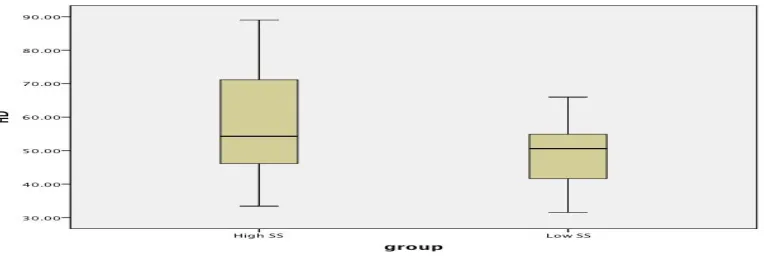
Because the overall test was significant, a post-hoc test using Dunnett’s C test was conducted to compare the mean of the two groups. The results indicated that countries with high safety and security index had significantly higher human development scores than countries with low safety and security index. Figure 1 shows the distribution of the human development scores across the two levels of safety and security.
Conclusion
The purpose of this study was to examine the relationship between safety and security index and human development. Descriptive statistics allowed to determining the mean of the independent variable safety and security index, and the dependent variable, human development. Using the mean of the independent variable as reference, I divided the participants into two groups including Low SS and High SS. Thereafter, I computed a one-way ANOVA to analyze the data. The ANOVA was significant, the effect size was strong, allowing to rejecting the null hypothesis, and indicating that there is a statistically significant relationship with strong effect size between safety and security index and human development. Furthermore, a post-hoc test indicated that High SS countries had significantly higher human development than Low SS countries, indicating that human development improves with an increase of safety and security. These results support the conclusion that there is a statistically significant and strong relationship between safety and security index and human development.
References
Enyekit, E. O., Ubulom, W. J., & Onuekwa, F. A. (2011). Achieving human capital development in Nigeria through vocational education for nation building. Academic Research International, 1, 355-360. Retrieved from
http://www.journals.savap.org.pk/
Green, S. B., & Salkind, N. J. (2010). Using SPSS for Windows and Macintosh: Analyzing and Understanding Data (5th ed.). Upper Saddle River, NJ: Pearson Education, Inc. Nelson, D. L., & Quick. J. C. (2012). ORGB (3rd ed.). Mason, OH: Cengage
Pineda, J. (2012). Sustainability and human development: A proposal for a sustainability adjusted human development index. Theoretical & Practical Research in Economic Fields, 3(2), 73-100. Retrieved from http://econpapers.repec.org/article/srstpref1/ Venkatesh, V., Brown, S., & Bala, H. (2013). Bridging the qualitative-quantitative divide: