The Thirty-Third AAAI Conference on Artificial Intelligence (AAAI-19)
Motion Guided Spatial Attention for Video Captioning
Shaoxiang Chen, Yu-Gang Jiang
*Shanghai Key Lab of Intelligent Information Processing, School of Computer Science, Fudan University Shanghai Institute of Intelligent Electronics & Systems
{sxchen13, ygj}@fudan.edu.cn
Abstract
Sequence-to-sequence models incorporated with attention mechanism have shown promising improvements on video captioning. While there is rich information both inside and between frames, spatial attention is rarely explored and mo-tion informamo-tion is usually handled by 3D-CNNs as just an-other modality for fusion. On the an-other hand, researches about human perception suggest that apparent motion can attract attention. Motivated by this, we aim to learn spatial atten-tion on video frames under the guidance of moatten-tion informa-tion for capinforma-tion generainforma-tion. We present a novel video capinforma-tion- caption-ing framework by utilizcaption-ing Motion Guided Spatial Attention (MGSA). The proposed MGSA exploits the motion between video frames by learning spatial attention from stacked op-tical flow images with a custom CNN. To further relate the spatial attention maps of video frames, we designed a Gated Attention Recurrent Unit (GARU) to adaptively incorporate previous attention maps. The whole framework can be trained in an end-to-end manner. We evaluate our approach on two benchmark datasets, MSVD and MSR-VTT. The experiments show that our designed model can generate better video rep-resentation and state of the art results are obtained under pop-ular evaluation metrics such as BLEU@4, CIDEr, and ME-TEOR.
1
Introduction
Automatically describing the content of a video using nat-ural language, i.e., video captioning, is a challenging task in computer vision. Lots of practical applications such as auxiliary aid for visually impaired people, human computer interaction, and video retrieval can benefit from video cap-tioning, thus it has drawn great research attention. In gen-eral, video captioning systems can be roughly divided into two components: video representation and sentence gener-ation. Traditional approaches (Krishnamoorthy et al. 2013; Thomason et al. 2014; Guadarrama et al. 2013) used var-ious visual classifiers/trackers to detect visual concepts and then generate sentences with predefined language templates. For video representation, these approaches rely on hand-crafted features which do not generalize well and can not be trained in an end-to-end manner. With the rapid devel-opment of deep learning, two major changes have been
*Corresponding author.
Copyright © 2019, Association for the Advancement of Artificial Intelligence (www.aaai.org). All rights reserved.
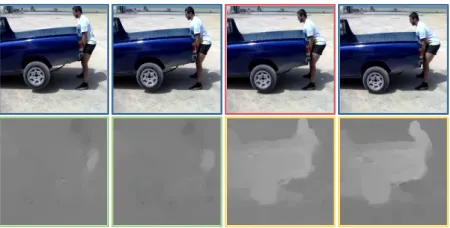
Figure 1: Best viewed in color. Example video frames shown with optical flow in the bottom row. The frame in red box is the sampled key frame. The flow images in green and yel-low boxes are the horizontal and vertical component of the optical flow computed around the key frame, respectively.
made to video captioning systems: convolutional neural net-works (CNNs) for video representation and recurrent neu-ral networks (RNNs) for sequence modeling. Earlier re-searchers (Venugopalan et al. 2015a; 2015b; Donahue et al. 2015) directly extracted global feature (i.e., a single vector to represent one frame) of video frames from a pre-trained CNN and fed to RNNs (LSTM (Hochreiter and Schmidhu-ber 1997), GRU (Chung et al. 2014), etc.) for sentence gen-eration. While these plain sequence-to-sequence approaches can achieve significant improvements over traditional meth-ods, they still suffer from loss of both spatial and tempo-ral information in videos. Later works (Yao et al. 2015; Baraldi, Grana, and Cucchiara 2017; Pan et al. 2016) tried to exploit the temporal structure of videos by adaptively as-signing weights to video frames at every word generation step, which is known as temporal attention. But in these works, video frames are still represented by global feature vectors extracted from CNNs. Thus, the rich visual contents in video frames are not fully exploited. Spatial attention is widely adopted in image captioning. (Xu et al. 2015) pro-posed to learn a set of attention weights for image regions1
to represent their relevance to the generated words, so that the regional features can be better combined. Motivated by
1
the success of spatial attention in image captioning, recent works (Yang, Han, and Wang 2017; Li, Zhao, and Lu 2017) in video captioning have also adopted spatial attention, in which the attention weights are learned from scratch.
Videos by nature have clear indication of where the ac-tions/events are happening, that is the motion between video frames. Prior researches of human perception (Itti and Baldi 2005; Howard and Holcombe 2010) have shown that hu-man attentions are also more likely to be drawn to the ap-parently changing regions of a video. Motivated by this, we propose to guide the spatial attention by optical flow, which can capture the pattern of apparent motion between consecu-tive video frames. An example is shown in Figure 1: the mo-tion captured by optical flow in both horizontal and vertical direction is a strong indication of the action and the related objects in the video. Besides, the actions in videos is related across time. So we also consider the temporal relation be-tween attention maps, and propose a GRU-like Gated Atten-tion Recurrent Unit (GARU) to model this relaAtten-tionship.
Our contributions of this work are as follows: (1) We present a novel video captioning framework named Motion Guided Spatial Attention (MGSA), which utilizes optical flow to guide spatial attention. To the best of our knowl-edge, this is the first work that incorporates optical flow for attention guidance in video captioning. (2) We show that in-troducing recurrent relations between consecutive spatial at-tention maps can give a boost to captioning performance and designed a recurrent unit called Gated Attention Recurrent Unit (GARU) for this purpose. (3) We achieve the current state of the art results on two large-scale datasets: MSVD and MSR-VTT. We also investigate spatial attention maps learned by our MGSA model and show that it can better lo-cate regions of interest.
2
Related Works
Temporal Attention. One of the first works that have adopted CNN and RNN for video captioning is (Venu-gopalan et al. 2015b), in which video representation is ob-tained by mean-pooling CNN features extracted from a se-quence of sampled video frames and then fed it to LSTM for caption generation. This approach actually treated video as an image and ignored the temporal structure of videos. Thus, following works tries to encode the videos while exploiting their structures. S2VT (Venugopalan et al. 2015a) first en-codes the video feature sequence with two layers of LSTM and then the language generation (decoding) is conditioned on the final encoding state. The LSTMs in these two stages share the same parameters. This kind of encoding-decoding approach have been successfully applied to neural machine translation (Sutskever, Vinyals, and Le 2014). In (Yao et al. 2015), the authors exploit the temporal structure of a video by introducing soft-attention mechanism in the decod-ing stage, which assigns weights to video frames calculated from the decoder state and video features. (Baraldi, Grana, and Cucchiara 2017) further propose to model the hierar-chical structure of videos by detecting the shot boundaries while generating captions. (Zhu, Xu, and Yang 2017) also propose Multirate Gated Recurrent Unit to encode frames of
a video clip with different intervals, so that the model can be capable of dealing with motion speed variance.
Spatial Attention.Our focus in this paper is to exploit the spatial information of video frames. Due to the large amount of video data, spatial information has been overlooked in video captioning due to the high computational cost. But in image captioning, spatial information is widely utilized through attention. In (Xu et al. 2015), two forms of atten-tion mechanism are proposed for image capatten-tioning. One is stochastic hard attention, which selects a single image region according to a multinoulli distribution and requires Monte Carlo sampling to train. The other is a differentiable approx-imation of the former, which computes weights for all the image regions and then a weighted sum over all the regional features. Although the hard attention was shown to give bet-ter performance, labet-ter researchers have preferred the soft ap-proximation for its ease of training. (Liu et al. 2017) show that if supervision for attention is available during training image captioning models, the trained models can better lo-cate regions that are relevant to the generated captions. How-ever, due to the vast amount of video data, there are no such fine-grained spatial annotation in existing video cap-tioning datasets. Recently, there are works that try to incor-porate spatial attention in video captioning. (Li, Zhao, and Lu 2017) apply region-level (spatial) soft attention to ev-ery video frame and then frame-level (temporal) attention to all the frames to obtain a multi-level attention model for video captioning. (Yang, Han, and Wang 2017) propose to generate spatial attention under the guidance of global fea-ture, which is the mean-pooled regional features. They also designed a Dual Memory Recurrent Model (DMRM) to in-corporate the information of previously encoded global and regional features. The MAM-RNN (Li, Zhao, and Lu 2017) applies spatial attention in the encoding stage followed by temporal attention in the decoding stage. The spatial at-tention maps are directly propagated during encoding. (Li, Zhao, and Lu 2017) and (Yang, Han, and Wang 2017) are most related to our work, however, their spatial attentions are generated from the regional features and recurrent states of the RNNs, without direct guidance.
GARU GARU GARU CNN
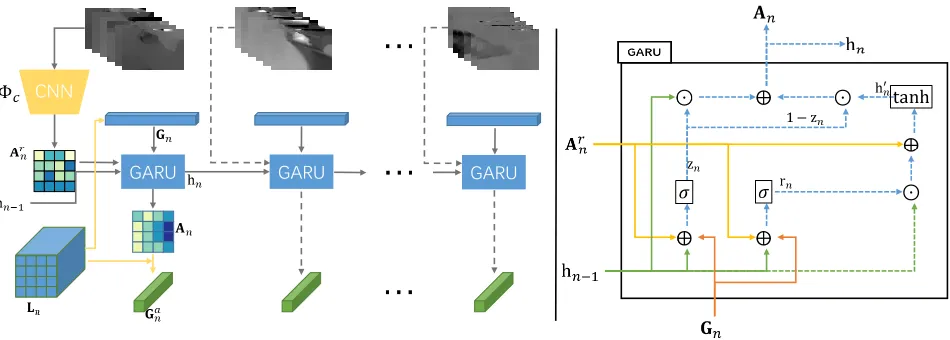
Figure 2: The architecture of our proposed MGSA for video feature encoding. Left: Overview of MGSA. Dashed connections have some components omitted for clarity.Ar
nis the rough attention map produced by the CNN that operates on stacked optical flow images.Gnis obtained by spatially mean-poolingLn.Ganis the weighted sum ofLnwithAnas the weights. Right: The details of GARU. Solid lines stands for weighted connections, i.e., the inputs are multiplied by a weight matrix, and dashed lines stands for direct connections.,⊕andσstands for element-wise multiplication, addition and sigmoid function, respectively.
3
Approach
Different from many existing works, which focus on fully exploiting the multimodal information in videos, we aim at designing a video captioning model that effectively attends to spatial regions-of-interest under the guidance of motion information in videos. We use dense optical flow to explic-itly capture the motion between consecutive frames. First, stacked dense optical flow extracted around sampled key frame is fed to a CNN to compute a rough spatial atten-tion map. To utilize the relaatten-tion between attenatten-tion maps, we then designed a gated attention recurrent unit (GARU) to in-corporate attention information from previous frames. The GARU outputs refined attention map, and the regional fea-tures are aggregated into a discriminative global representa-tion with the help of the attenrepresenta-tion map.
Our approach is also in a sequence-to-sequence manner, and can be divided into encoding and decoding stages. We first give an overview of our approach in Section 3.1. We then introduce the encoding stage, including our proposed MGSA and GARU in Section 3.2. Finally we describe the decoding stage in Section 3.3.
3.1
Overview
Given a video, we uniformly sample N frames as the key frames. We compute horizontal and vertical components of optical flow forMframes centered at each key frame to cap-ture the short-term motion information. These optical flows are stacked as a tensor2 F with shape (N, HI, WI,2M), whereHI andWI are the height and width of the frames,
2
Following the programming convention in Tensorflow, we use tensor to denote multidimensional arrays in this paper. A tensor Twith shape(N0, N1, ..., ND−1)is an array of rankD, and its
axisihas lengthNi. We use subscript to index sub-tensors, e.g., Tistands forT’si-th sub-tensor in the first axis, which has shape (N1, ..., ND−1).
respectively. The video frames are fed to a pre-trained CNN to extract regional features. We generally take the activa-tions of the last convolutional layer of the CNN. The re-sulting feature is also a tensorLwith shape(N, H, W, D), whereDis the number of output channels of the pre-trained CNN, and H and W are the spatial dimensions. As fig-ure 2 shows, the stacked flows are fed to a custom CNN denoted byΦcand the output will be a tensorArwith shape (N, H, W,1), or(N, H, W)if we squeeze the last dimen-sion. Each sub-tensor ofAr, which is denoted asArn and has shape of(H, W), is the rough spatial attention map of each corresponding frame. The rough attention map itself can also be used to aggregate the regional features. But we wish to refined it by considering the interrelationship of the attention maps across time. Thus the rough attention maps are then sequentially processed by our designed Gated At-tention Recurrent Unit (GARU) to incorporate previous at-tention maps. We also feed global feature vectorGn, which is the spatially mean-pooledLnwith lengthDto the GARU to provide high-level information of the key frame. The re-fined attention mapsAis applied to weighL, obtaining the attended global representation of the corresponding frames, denoted asGa. The above encoding stage can be formalized as below:
Ar= Φc(F), (1)
hn,An= GARU(hn−1,Arn,Gn), (2)
Gan=fatt(Ln,An), (3) where n = 1,2, ..., N and fatt is the attention operation along the spatial dimensions ofLn withAn, the attention map refined by GARU as the weights.hnis the hidden state of GARU.Gais the concatenation ofGa
vectors (x1, x2, ..., xT), where T is the length of the sen-tence. We then embed the one-hot vectors toW-dimensional vectors, and the embedding is trained jointly with the model. At each time stept, the decoder is trained to predict thet -th word conditioned on -the previoust−1words andGa. The output of the decoder is thus a conditional probability distribution:
p(xt|x1, x2, ..., xt−1,Ga;θ), (4)
whereθstands for all the trainable model parameters. We define the objective function as negative log-likelihood:
Loss=− T
X
t=1
logp(xt|x1, x2, ..., xt−1,Ga;θ). (5)
The model learns to minimize the negative log-likelihood by stochastic gradient descent during training.
3.2
Motion-Guided Spatial Attention
In video action recognition (Simonyan and Zisserman 2014; Wang et al. 2016), the CNNs that take optical flow as in-put are designed to have similar or identical architecture as the CNNs that process RGB frames, which are usually deep. Unlike recognizing actions and events, learning spatial at-tention map from optical flow images is an easier task. Since optical flow already explicitly captures the motion, which is a good hint for where the model show attend to. Thus for this task, we designed a 5-layer CNN, i.e., theΦcin Eq. (1). We interleave max-pooling with convolution to reduce the spatial resolution and increase receptive field.
We have also experimented with deeper CNN architec-tures and found that the increase of performance is not sig-nificant. Thus we chose a lightweight CNN for better train-ing efficiency.
The rough spatial attention mapAr produced by Φ c is solely generated from short-term motion information around a key frame. While this attention map is already applicable, we wish to take one step further. Since an action in video is continuous in time, the attention maps of nearby key frames should also be related. Based on this observation, we design a GRU-like gated recurrent unit named GARU to incorpo-rate previous spatial attention map when generating the cur-rent one.
As shown in Figure 2, the proposed GARU take the rough attention map generated by the flow CNN,Arnand the global feature of the key frame,Gn. At each time step, GARU pro-duces the refined attention mapAn, and propagates the state
hnto the next time step. The detailed computation of GARU is as follows:
rn=σ W(r)Arn+U
(r)
hn−1+V(r)Gn
, zn=σ W(z)Arn+U
(z)h
n−1+V(z)Gn
, h'n= tanh W(h)Arn+rnU(h)hn−1,
hn=hn−1zn+h'n(1−zn),
(6)
whereσstands for the sigmoid function and stands for element-wise multiplication.U,V andW with different su-perscripts are all trainable parameters. Note that hn−1 is
LSTM_1
LSTM_2 LSTM_1
LSTM_2
LSTM_1
LSTM_2
FC FC FC
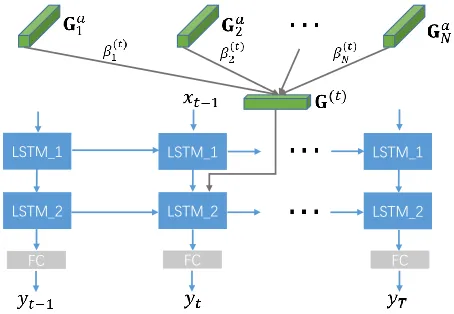
Figure 3: The decoder structure used in our approach.
equivalent to An−1.rn is the reset gate that controls how much information from previous hidden state we should keep.zn is the element-wise update gate that directly con-trols how much of the previous attention map should be kept. The initial state of GARU is simply set to zero.
The attention weights of every region is obtained by ap-plying softmax function toAnalong the spatial dimensions:
αnhw=
exp(Anhw)
PH
h=1
PW
w=1exp(Anhw)
. (7)
Then the attended global feature by a weighted sum over the regional features:
Gan= H
X
h=1
W
X
w=1
αnhwLnhw. (8)
Eq. 7 and Eq. 8 also complement the details of the fatt operation in Eq. 3. The generated global feature sequence
(Ga
1,Ga2, ...,GaN)is the encoded feature representation for each frame and is fed to the decoder for sentence generation.
3.3
The Decoding Stage
In previous methods (Pan et al. 2016; Yang, Han, and Wang 2017), temporal attention in decoding stage is shown to im-prove the captioning performance. As shown in Figure 3, we further apply temporal attention to the spatially-attended feature sequence(Ga
1,Ga2, ...,GaN)at each word generation step to further obtain a temporally attended feature:
G(t)= N
X
n=1
βn(t)Gan, (9)
whereβ(1t), β2(t), ..., β(Nt)are the attention weights dynami-cally decided att-th time step. The computation ofβ(nt) re-lies on the recurrent states of decoder LSTMs, which stores the information of previously seen words and features, and is computed as
h(1)t , c(1)t = LSTM 1 xt−1,(h (1)
t−1, c (1)
t−1)
,
h(2)t , c(2)t = LSTM 2 [h(1)t ,G(t)],(h(2)t−1, c(2)t−1)
,
whereh(tl),c(tl)are the hidden and cell state of thel-th LSTM at time stept, and[·]stands for tensor concatenation.β(nt)is then computed as
e(nt)=WATtanh(W[h(1)t , h
(2)
t ] +UGan+b),
β(nt)= exp(e
(t)
n )
PN
n=1exp(e (t)
n )
, (11)
whereWA, W,U andb are trainable parameters that are shared across all time steps. We use a single output layer that maps the output of LSTM 2 into a distribution over the vocabulary:
yt=sof tmax(W(o)h
(2)
t ) =p(xt|x1, x2, ..., xt−1,Ga;θ).
(12)
During testing time, the ground truth sentence
(x1, x2, ..., xT)is not given. Thus the input to the LSTM 1 is the previous word prediction of the model:
xt= arg max
w∈Vp(w|x1, x2, ..., xt−1,G
a;θ), (13)
where V is the vocabulary. The whole framework can be trained in an end-to-end manner.
4
Experiments
4.1
Datasets
MSVD. The MSVD dataset (Chen and Dolan 2011) is a widely used benchmark dataset for video captioning meth-ods. It contains 1,970 videos clips collected from YouTube with an average duration of 9.6 seconds. Each video has around 40 human annotated sentences. In our experiments, we follow the split settings in prior works (Xu et al. 2017; Yao et al. 2015): 1,200 videos for training, 100 videos for validation and 670 videos for testing. The resulting training set has a vocabulary size of 9,657.
MSR-VTT. The MSR-VTT dataset (Xu et al. 2016) is a large scale open-domain video captioning dataset. It con-tains 10,000 video clips with an average duration of 14.9 seconds and 20 human annotated captions per clip. Besides, each clip has an expert-defined category label. We follow the standard dataset split in the dataset paper: 6,513 video for training, 497 videos for validation and 2,990 videos for testing. The resulting training set has a vocabulary size of 23,393.
4.2
Implementation Details
Feature Extraction. For every video, we uniformly sam-ple 20 key frames. Optical flows in both horizontal and vertical directions are computed for 6 consecutive frames centered at each key frame. The flow magnitude is clipped to[−20,20]and then normalized to[0,255]. The flow im-ages are then cropped and resized so that the CNN out-puts match the spatial size of image features. We extract static image features from models pre-trained on the Im-ageNet: GoogleNet (Szegedy et al. 2015) and Inception-ResV2 (Szegedy et al. 2017). Futures from the C3D net-work are also included to model the short-term motion in-formation. Note that C3D learns motion information from
RGB images, while could be a complement to our model. For the MSR-VTT dataset, we also include audio feature (BoAW (Pancoast and Akbacak 2014)) and the coarse cat-egory information.
Training Settings. The LSTMs used in our model all have 1024 hidden units and the word embedding size is set to 512. The optical flow images are normalized so that their pixel values are in the range[−1,1]before being fed to CNN. We apply dropout with rate of 0.5 to all the ver-tical connections of LSTMs and L2 regularization with a
factor of 5×10⁻⁵ to all the trainable parameters to miti-gate overfitting. We apply ADAM optimizer with a learning rate of10−4and batch size of 32 to minimize the negative log-likelihood loss. All the components of our model and training are implemented in Tensorflow3. On a commodity
GTX 1080 Ti GPU, the times needed to extract frame fea-tures and optical flows for a typical 10-second video clip are 400ms and 800ms, respectively. After feature extraction, our model can generate caption for a video in 45ms.
Evaluation Settings. During evaluation/testing, we use beam search with size 5 for sentence generation. We employ three common metrics in video captioning task: BLEU@4, CIDEr, and METEOR. All the metrics are computed by the codes from the Microsoft COCO Evaluation Server4.
4.3
Compared Methods
We choose to compare our proposed approach with the fol-lowing state of the art methods. Their major approaches can be grouped tothree categories: Temporal attention (1,2,3), spatial attention (4,5,6) and multi-modal fusion (7,8,9,10).
1. HRNE with Attention (Pan et al. 2016). HRNE considers the hierarchical structure of the video when encoding, and decodes the sentence with temporal attention. 2. Soft Attention (SA) (Yao et al. 2015). As introduced in
Section 2.
3. hLSTMat (Song et al. 2017). In decoding stage, hLST-Mat adaptively selects how much of the temporally at-tended features should be used for generating a specific word.
4. DMRM (Yang, Han, and Wang 2017). As introduced in Section 2.
5. MAM-RNN (Li, Zhao, and Lu 2017). As introduced in Section 2.
6. Dense Caption (Shen et al. 2017). This approach aims to select multiple spatial region sequences via a mapping between frame regions and lexical labels for dense video captioning.
7. MA-LSTM (Xu et al. 2017). MA-LSTM is conceptually similar to Attention Fusion, except that modality-wise fusion is done by the proposed Child-Sum fusion unit. 8. Attention Fusion (Hori et al. 2017). In decoding stage,
temporal attentions are computed for multiple modalities and then fused by a modality-wise attention.
9. M&M-TGM (Chen et al. 2017). M&M-TGM uses a multi-modal multi-task training scheme which learns to jointly predict the captions and topic of the videos.
3
https://github.com/tensorflow/tensorflow
4
Dataset MSVD MSR-VTT
Model Features B@4 C M Features B@4 C M
HRNE w/ Attention (Pan et al. 2016) G 43.8 - 33.1 - - -
-SA (Yao et al. 2015) G 41.9 51.7 29.6 V+C 36.6 - 25.9
hLSTMat (Song et al. 2017) G 48.5 - 31.9 R-152 38.3 - 26.3 DMRM w/o SS (Yang, Han, and Wang 2017) G 50.0 73.2 33.2 - - -
-MAM-RNN (Li, Zhao, and Lu 2017) G 41.3 53.9 32.2 - - -
-Dense Caption (Shen et al. 2017) - - - - R-50+C+A 41.4 48.9 28.3 MA-LSTM (Xu et al. 2017) G+C 52.3 70.4 33.6 G+C+A 36.5 41.0 26.5 Attention Fusion (Hori et al. 2017) V+C 52.4 68.8 32.0 V+C+A 39.7 40.0 25.5 M&M-TGM (Chen et al. 2017) I+C 48.76 80.45 34.36 I+C+A 44.33 49.26 29.37
v2t navigator (Jin et al. 2016) - - - - C+A 40.8 44.8 28.2
Aalto (Shetty and Laaksonen 2016) - - - - G+C 39.8 45.7 26.9 VideoLab (Ramanishka et al. 2016) - - - - R+C+A 39.1 44.1 27.7
MGSA(G) G 49.5 74.2 32.2 G 39.9 45.0 26.3
MGSA(I) I 53.0 86.4 34.7 I 41.7 48.1 27.5
MGSA(I+C) I+C 53.4 86.7 35.0 I+C 42.4 47.5 27.6
MGSA(I+A+C) - - - - I+A+C 45.4 50.1 28.6
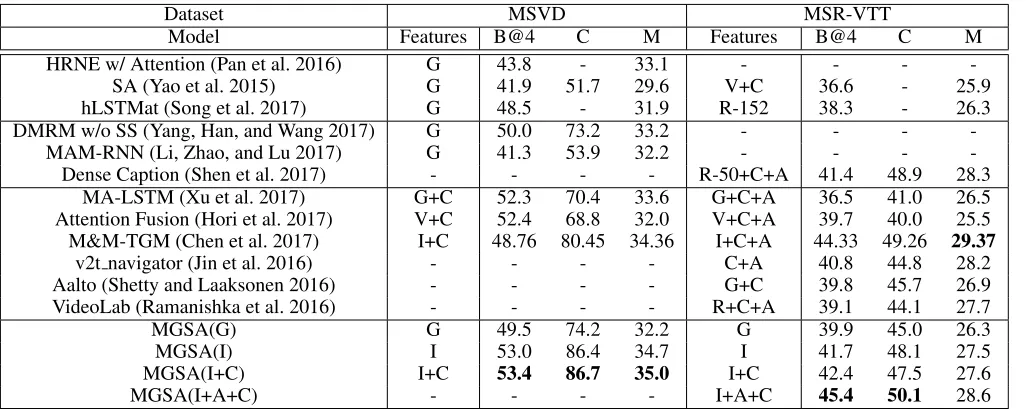
Table 1: Captioning performance comparison on MSVD and MSR-VTT. We note the features used for fare comparison, where G, V, C, R-N, I and A denote GoogleNet, VGGNet, C3D, N-layer ResNet, Inception-ResNet-V2, and audio features, respec-tively. Note that audio is not available on MSVD. “-” means that the authors did not report the corresponding results.
10. MM2016 VTT Challenge winners (Jin et al. 2016; Ramanishka et al. 2016; Shetty and Laaksonen 2016). These approaches mainly use multimodal fusion en-coders to fully exploit the visual, motion and audio in-formation in videos.
4.4
Experimental Results of Model Variants
Model B@4 C M
Spatial Attention 49.8 72.2 32.9 Spatial Attention w/ GARU 51.0 81.8 34.0 MGSA w/o GARU 51.0 83.3 33.1 MGSA w/ GARU 53.0 86.4 34.7
Table 2: Comparison of model variants on MSVD.
First, we perform experiments on the MSVD dataset to test the effectiveness of individual components of our model. As shown in Table 2, the Spatial Attention is a simplified model of (Li, Zhao, and Lu 2017) with the propagation of spatial attention map removed. We make this modification in order to show the effectiveness of our proposed GARU, which also has the ability of relating attention maps. It can be observed that for both Spatial Attention and MGSA, adding GARU to incorporate the relations of attention maps across time can significantly improve the performance re-garding the CIDEr measure: the relative improvement for Spatial Attention and MGSA is 13.3% and 5.6%, respec-tively. By comparing MGSA to Spatial Attention, we show that even without considering the interrelationship of spatial attention maps, motion-guided attention outperforms spa-tial attention computed from regional features. Regarding the CIDEr measure, the relative improvement of our MGSA over Spatial Attention is 15.4%. Overall, these comparisons
of model variants prove both of our proposed MGSA and GARU to be effective.
4.5
Experimental Results on MSVD
We compare our complete model, i.e., the MGSA w/ GARU in Table 2 to the state of the art models on MSVD. The results are summarized in Table 1. Our approach outper-forms approaches which only exploit the temporal structure of videos (HRNE, hLSTMat and SA). This apparently shows that exploiting spatial information in video frames can boost video captioning performance. For models based on spatial attention, MAM-RNN is the most related approach to ours. When both using GoogleNet features, ours significantly out-performs MAM-RNN. This can be attributed to the usage of motion-guided attention and GARU. As for another related approach that utilize spatial attention, DMRM, our approach achieves on-par performance with it. For the multi-modal fusion methods, ours can already outperform them even without fusing multiple features (MGSA(I)). Our full model (MGSA(I+C)) significantly outperforms the best competitor M&M TGM with relative improvements of 9.5%, 7.8% and 1.9% for BLEU@4, CIDEr and METEOR, respectively.
4.6
Experimental Results on MSR-VTT
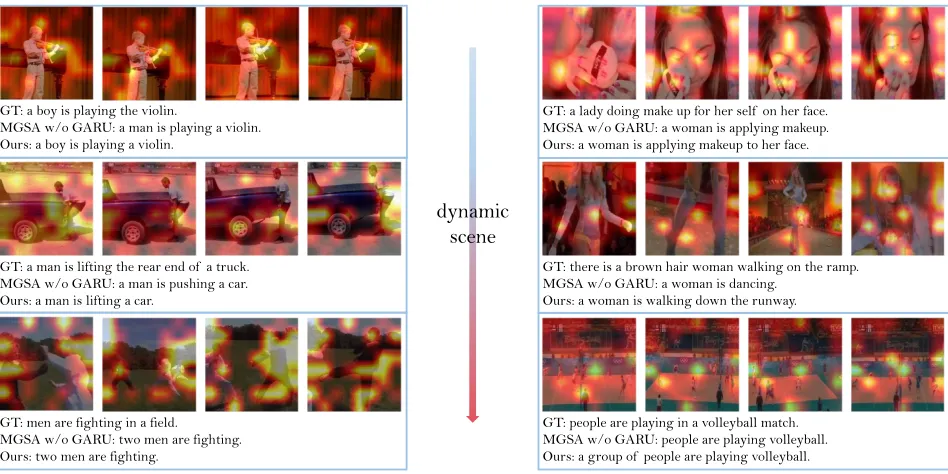
GT: a boy is playing the violin.
MGSA w/o GARU: a man is playing a violin. Ours: a boy is playing a violin.
GT: a man is lifting the rear end of a truck. MGSA w/o GARU: a man is pushing a car. Ours: a man is lifting a car.
GT: men are fighting in a field. MGSA w/o GARU: two men are fighting. Ours: two men are fighting.
GT: a lady doing make up for her self on her face. MGSA w/o GARU: a woman is applying makeup. Ours: a woman is applying makeup to her face.
GT: there is a brown hair woman walking on the ramp. MGSA w/o GARU: a woman is dancing.
Ours: a woman is walking down the runway.
GT: people are playing in a volleyball match. MGSA w/o GARU: people are playing volleyball. Ours: a group of people are playing volleyball.
dynamic scene
Figure 4: Sample captions generated by our model with and without GARU. The corresponding attention maps are generated by our model with GARU and visualized as heatmaps. The three rows to the left and right are from the MSVD and MSR-VTT, respectively. From top to bottom, the scenes are more and more dynamic.
G(t)in the decoding stage. When multi-modal features
in-cluding audio (A) and short-term motion (C) are incorpo-rated, the full model, MGSA(I+A+C) outperforms all other methods. To summarize, the results achieved by our methods are the current state of the art on both datasets.
4.7
Qualitative Analysis
To gain an intuition of the spatial attention learned by our model, we present some example sentences generated by different models along with the attention maps generated by our model (MGSA w/ GARU). In order to demonstrate the effectiveness of motion-guided attention, we select scenes with different degrees of dynamics. In Figure 4, we can see that our model can generate relevant sentences while attend-ing to the important regions of the frames. For example, in the “man lifting car” video, the important region is the man and the car. They can both be captured by optical flow, and our model can then generate accurate attention maps. It is also shown that without GARU, the model can make mis-takes in distinguishing the actions such as “pushing/lifting” and “walking/dancing”. This indicates that considering the interrelationship between attention maps is essential. For relatively static scenes like in the “playing violin” video, our model can capture the slight action of the person and attend to the important regions. For more dynamic scenes, such as the ones in the third row, there will be dramatic changes caused by camera motion. Our model can still robustly cap-ture the correct attention region. The reason behind this could be that inputing stacked optical flow from multiple frames can mitigate the affection of sudden changes. In the “men fighting” video, our MGSA consistently focus on the
fighting men, the changing background does not disturb the attention. Interestingly, in the “volleyball match” video the camera focus rapidly switches between two sides and our MGSA always attends to the focus of the match: it tracks the volleyball.
5
Conclusions
We propose a novel video captioning framework by learn-ing spatial attention under the guidance of motion informa-tion. The proposed MGSA utilize motion information be-tween consecutive frames by applying CNN to stacked op-tical flows. In addition, a gated recurrent unit named GARU is designed to adaptively relate spatial attention maps across time. With all the designs, we achieve the current state of the art results on both MSVD and MSR-VTT. Our future work will consider incorporating semantic information for spatial attention, which may complement the motion-guided atten-tion in recognizing visual concepts.
Acknowledgements. This work was supported in part by two projects from NSF China (61622204, 61572134) and one project from STCSM, China (16QA1400500).
References
Baraldi, L.; Grana, C.; and Cucchiara, R. 2017. Hierarchi-cal boundary-aware neural encoder for video captioning. In
CVPR, 3185–3194.
Chen, S.; Chen, J.; Jin, Q.; and Hauptmann, A. G. 2017. Video captioning with guidance of multimodal latent topics. InACM MM, 1838–1846.
Chung, J.; Gulcehre, C.; Cho, K.; and Bengio, Y. 2014. Em-pirical evaluation of gated recurrent neural networks on se-quence modeling. arXiv preprint arXiv:1412.3555.
Donahue, J.; Hendricks, L. A.; Guadarrama, S.; Rohrbach, M.; Venugopalan, S.; Darrell, T.; and Saenko, K. 2015. Long-term recurrent convolutional networks for visual recognition and description. InCVPR, 2625–2634.
Guadarrama, S.; Krishnamoorthy, N.; Malkarnenkar, G.; Venugopalan, S.; Mooney, R. J.; Darrell, T.; and Saenko, K. 2013. Youtube2text: Recognizing and describing arbitrary activities using semantic hierarchies and zero-shot recogni-tion. InICCV, 2712–2719.
Hochreiter, S., and Schmidhuber, J. 1997. Long short-term memory.Neural computation9(8):1735–1780.
Hori, C.; Hori, T.; Lee, T.; Zhang, Z.; Harsham, B.; Hershey, J. R.; Marks, T. K.; and Sumi, K. 2017. Attention-based multimodal fusion for video description. InICCV, 4203– 4212.
Howard, C. J., and Holcombe, A. O. 2010. Unexpected changes in direction of motion attract attention. Attention, Perception, & Psychophysics72(8):2087–2095.
Itti, L., and Baldi, P. 2005. Bayesian surprise attracts human attention. InNIPS, 547–554.
Jin, Q.; Chen, J.; Chen, S.; Xiong, Y.; and Hauptmann, A. 2016. Describing videos using multi-modal fusion. InACM MM, 1087–1091. ACM.
Krishnamoorthy, N.; Malkarnenkar, G.; Mooney, R. J.; Saenko, K.; and Guadarrama, S. 2013. Generating natural-language video descriptions using text-mined knowledge. In
AAAI.
Li, X.; Zhao, B.; and Lu, X. 2017. MAM-RNN: multi-level attention model based RNN for video captioning. InIJCAI, 2208–2214.
Liu, C.; Mao, J.; Sha, F.; and Yuille, A. L. 2017. Atten-tion correctness in neural image capAtten-tioning. InAAAI, 4176– 4182.
Pan, P.; Xu, Z.; Yang, Y.; Wu, F.; and Zhuang, Y. 2016. Hi-erarchical recurrent neural encoder for video representation with application to captioning. InCVPR, 1029–1038.
Pancoast, S., and Akbacak, M. 2014. Softening quantization in bag-of-audio-words. InICASSP, 1370–1374.
Ramanishka, V.; Das, A.; Park, D. H.; Venugopalan, S.; Hen-dricks, L. A.; Rohrbach, M.; and Saenko, K. 2016. Multi-modal video description. InACM MM, 1092–1096. ACM. Shen, Z.; Li, J.; Su, Z.; Li, M.; Chen, Y.; Jiang, Y.; and Xue, X. 2017. Weakly supervised dense video captioning. In
CVPR, 5159–5167.
Shetty, R., and Laaksonen, J. 2016. Frame-and segment-level features and candidate pool evaluation for video cap-tion generacap-tion. InACM MM, 1073–1076. ACM.
Simonyan, K., and Zisserman, A. 2014. Two-stream
convo-lutional networks for action recognition in videos. InNIPS, 568–576.
Song, J.; Gao, L.; Guo, Z.; Liu, W.; Zhang, D.; and Shen, H. T. 2017. Hierarchical LSTM with adjusted temporal attention for video captioning. InIJCAI, 2737–2743. Sutskever, I.; Vinyals, O.; and Le, Q. V. 2014. Sequence to sequence learning with neural networks. InNIPS, 3104– 3112.
Szegedy, C.; Liu, W.; Jia, Y.; Sermanet, P.; Reed, S. E.; Anguelov, D.; Erhan, D.; Vanhoucke, V.; and Rabinovich, A. 2015. Going deeper with convolutions. InCVPR, 1–9. Szegedy, C.; Ioffe, S.; Vanhoucke, V.; and Alemi, A. A. 2017. Inception-v4, inception-resnet and the impact of resid-ual connections on learning. InAAAI, 4278–4284.
Thomason, J.; Venugopalan, S.; Guadarrama, S.; Saenko, K.; and Mooney, R. J. 2014. Integrating language and vi-sion to generate natural language descriptions of videos in the wild. InCOLING, 1218–1227.
Tran, D.; Bourdev, L. D.; Fergus, R.; Torresani, L.; and Paluri, M. 2015. Learning spatiotemporal features with 3d convolutional networks. InICCV, 4489–4497.
Venugopalan, S.; Rohrbach, M.; Donahue, J.; Mooney, R. J.; Darrell, T.; and Saenko, K. 2015a. Sequence to sequence -video to text. InICCV, 4534–4542.
Venugopalan, S.; Xu, H.; Donahue, J.; Rohrbach, M.; Mooney, R. J.; and Saenko, K. 2015b. Translating videos to natural language using deep recurrent neural networks. In
NAACL, 1494–1504.
Wang, L.; Xiong, Y.; Wang, Z.; Qiao, Y.; Lin, D.; Tang, X.; and Gool, L. V. 2016. Temporal segment networks: Towards good practices for deep action recognition. InECCV, 20–36. Xu, K.; Ba, J.; Kiros, R.; Cho, K.; Courville, A. C.; Salakhutdinov, R.; Zemel, R. S.; and Bengio, Y. 2015. Show, attend and tell: Neural image caption generation with visual attention. InICML, 2048–2057.
Xu, J.; Mei, T.; Yao, T.; and Rui, Y. 2016. MSR-VTT: A large video description dataset for bridging video and lan-guage. InCVPR, 5288–5296.
Xu, J.; Yao, T.; Zhang, Y.; and Mei, T. 2017. Learning multimodal attention LSTM networks for video captioning. InACM MM, 537–545.
Yang, Z.; Han, Y.; and Wang, Z. 2017. Catching the tem-poral regions-of-interest for video captioning. InACM MM, 146–153.
Yao, L.; Torabi, A.; Cho, K.; Ballas, N.; Pal, C. J.; Larochelle, H.; and Courville, A. C. 2015. Describing videos by exploiting temporal structure. In ICCV, 4507– 4515.