The Thirty-Third AAAI Conference on Artificial Intelligence (AAAI-19)
On the Persistence of Clustering
Solutions and True Number of Clusters in a Dataset
Amber Srivastava,
1Mayank Baranwal,
2Srinivasa Salapaka
1 1University of Illinois at Urbana-Champaign,2University of Michigan, Ann Arbor[email protected], [email protected], [email protected]
Abstract
Typically clustering algorithms provide clustering solutions with prespecified number of clusters. The lack of a priori knowledge on the true number of underlying clusters in the dataset makes it important to have a metric to compare the clustering solutions with different number of clusters. This article quantifies a notion ofpersistenceof clustering solu-tions that enables comparing solusolu-tions with different num-ber of clusters. The persistence relates to the range of data-resolution scales over which a clustering solution persists; it is quantified in terms of the maximum over two-norms of all the associated cluster-covariance matrices. Thus we associate a persistence value for each element in a set of clustering so-lutions with different number of clusters. We show that the datasets wherenaturalclusters are a priori known, the cluster-ing solutions that identify the natural clusters are most persis-tent - in this way, this notion can be used to identify solutions withtruenumber of clusters. Detailed experiments on a va-riety of standard and synthetic datasets demonstrate that the proposed persistence-based indicator outperforms the exist-ing approaches, such as, gap-statistic method,X-means,G -means,P G-means, dip-means algorithms and information-theoretic method, in accurately identifying the clustering so-lutions with true number of clusters. Interestingly, our method can be explained in terms of the phase-transition phenomenon in the deterministic annealing algorithm, where the number of distinct cluster centers changes (bifurcates) with respect to an annealing parameter.
Introduction and Related Work
Many high-impact application areas such as bio-informatics (Andreopoulos et al. 2009), (Di Nuovo and Catania 2008), exploratory data mining (Larose and Larose 2014), combi-natorial drug discovery (Sharma, Salapaka, and Beck 2008), data and network aggregation (Yuan, Zhan, and Wang 2014), medical imaging (Huang et al. 2015) and many other in-formation processing fields have fueled significant work on clustering algorithms. Most of these algorithms such as k -means (Hartigan and Wong 1979),k-medoids (Park and Jun 2009), and expectation-maximization (Dempster, Laird, and Rubin 1977) require the number of clusters to be prespeci-fied. Despite substantial work on clustering algorithms, there is relatively scant literature on determining the true number
Copyright c2019, Association for the Advancement of Artificial Intelligence (www.aaai.org). All rights reserved.
of clusters in a dataset. In this context, it should be noted that there is no single agreed-upon notion ofnatural clus-ters ortruenumber of clusters; typically existing algorithms make assumptions on the datasets (e.g. generated from a mixture of Gaussian distributions) and validate their results on datasets that satisfy the assumptions.
There are various measures developed to characterize the clustering solutions resulting from a clustering algorithm with different number (k) of clusters. One of the popular methods for determining the number of clusters is based on computinggap statistic(Tibshirani, Walther, and Hastie 2001). It compares the total intracluster variation for differ-ent values ofk(number of clusters) with their expected val-ues under null reference distribution of the data. The num-ber of clusters k is ascribed to the case where the gap is largest. However, as remarked in (Feng and Hamerly 2007), this method works well for finding a small number of clus-ters, but has difficulty as the truekincreases.
Some of the recent methods that determine the number of clusters under some assumptions on datasets include
-X-means algorithm (Pelleg, Moore, and others 2000), where clustering usingk-means is performed for a range of num-berkof clusters, and the valuekt :=kthat yields the best
Bayesian Information Criterion (BIC) (Kass and Wasserman 1995) score is chosen as an estimate for the true number of clusters. Other related algorithms use criteria such as Akaike information criteria (Akaike 2011) or minimum description length (Rissanen 1978) instead of BIC. TheX-means algo-rithm works well for well-separated spherical clusters but tends to overfit in the case of non-spherical clusters (Feng and Hamerly 2007).
The information-theoretic approach (Sugar and James 2003) where it estimates the number of true clusters kt
by detecting a significant jump in the modified distortion
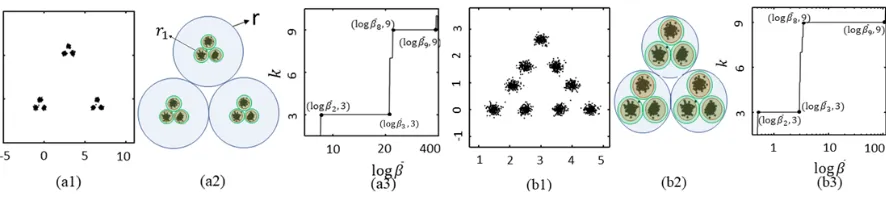
Figure 1: Illustration of a mixture of nine Gaussian distributions arranged in groups of three superclusters. In (a1) the three superclusters are well separated from each other while in (b1) they are closer to each other. Observe that in (a2) for a large range in resolution scales (radiir) within the blue annulus, each supercluster appears as a single cluster, and only for a small range of resolution scale depicted by green annulus, each Gaussian distribution is identifiable separately. In other words for a large range of resolution the only the three superclusters are distinguishable from one another while for a smaller range of resolution each Gaussian distribution is identified separately. In (b1) since the three superclusters are closer to each other, the range of resolution scales within the blue annulus gets reduced, thereby indicating existence of three natural clusters in (a1) and nine natural clusters in (b1).
validated; typically done using the Anderson-Darling statis-tic test (Stephens 1974) on each cluster after projecting it onto a one-dimensional space.P G-means algorithm (Feng and Hamerly 2007) is an improvement on theG-means al-gorithm, where the number of clusters in a Gaussian mixture model is obtained by applying the Kolmogorov-Smirnov (KS) test to the one-dimensional projection of the entire
dataset;P G-means also works well when the true clusters are overlapping with each other.
Dip-means (Kalogeratos and Likas 2012) is another method that assumes the dataset is generated from a mixture of unimodal distributions. Here, Hartigan’s dip statistic test (Hartigan and Hartigan 1985) is used to verify the unimodal nature of the admissible cluster. The authors also extend the dip-means algorithm to shape clustering problems by using kernelk-means (Dhillon, Guan, and Kulis 2004) for cluster-ing. Other alternative approaches in the literature to estimate the true number of clusters are Bayesiank-means (Kurihara and Welling 2009) that uses Maximization-Expectation to learn a mixture model, a method based on repairing faults in Gaussian mixture models (Sand and Moore 2001) and various stability-based model validation methods (Lange et al. 2003), (Tibshirani and Walther 2005), (Levine and Do-many 2001). The main drawbacks in most of the above ex-isting methods stem from the underlying restrictive assump-tions on the datasets; accordingly, the algorithms do not per-form well when datasets do not meet the assumptions, which is often the case when considering standard non-synthetic datasets. These methods fail to accurately estimate the true number of clusters in most of the standard datasets as illus-trated in the experiment section in this paper.
In this article we develop a notion ofpersistenceof clus-tering solutions that enables comparing solutions, which re-sult from a clustering algorithm, with different number of clusters. Here we do not make any assumptions on the under-lying data distribution. Since a clustering solution requires grouping a set of points in such a way that points in the same cluster are more similar to each other than to those in other clusters. We characterize persistenceof a
cluster-ing solution as therangeof resolution scales for which (a) points within each cluster seem indistinguishable, and (b) points in different clusters are distinguishable. For instance, Figure 1(a1) illustrates a dataset containing nine Gaussian clusters which are arranged in groups of three superclusters. If we choose the resolution scale of radiusr, as shown in Figure 1(a2), then the points within each super-cluster is in-distinguishable. Therefore, one will conclude that at this res-olution level the dataset consists of only three clusters. Also note that in Figure 1(a1), the three suclusters are per-sistent for a large range of resolution scales as indicated by the thickness of the blue annulus around each of them. On the other hand, the green annulus around each of the nine Gaussian clusters, is relatively thinner indicating that a clus-tering solution that identifies all the nine Gaussian clusters is relatively less persistent.
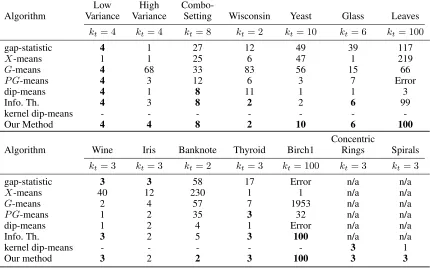
In a later section we quantify this notion of persistence of a clustering solution with k distinct clusters. In partic-ular, the persistence is characterized in terms of the max-imum over two-norms of all the cluster covariance matri-ces at two sucmatri-cessive values ofk. We also show analytically how for a clustering solution that identifies natural clusters, this measure correctly estimates the true number of clusters through a simple illustrative example consisting of spherical clusters with uniform distributions. We also provide exten-sive experimental results on a variety of standard and syn-thetic datasets in a later section. The results demonstrate that our method outperforms over the existing algorithms described above. In particular, our method correctly esti-mates the true number of clusters on 13 of the 14 benchmark datasets tested, whereas the next best method could estimate the true number of clusters only on 7 benchmark instances.
Persistence of a Clustering Solution and its
Quantification
consid-ered as a single cluster, while on the other hand each data point can also be considered as a cluster by itself. Thus in Figure 1(a1), at low resolution scale (characterized here by a radius greater than the diameter of the entire dataset) no two points of the dataset are distinguishable from each other and the entire dataset is deemed a single cluster. Now con-sider a clustering solution at a higher resolution scale (for instance resolution characterized by the radiusr in Figure 1(a2)), the datapoints from the three superclusters become distinct from one another and we are able to identify these as three distinct clusters in the dataset. Upon further increasing the resolution scale (for instance resolution characterized by the radiusr1) in Figure 1(a2), the datapoints sampled from each of the nine Gaussian distributions become distinct from one another and we are able to identify the nine clusters in the dataset. On further increasing the resolution scale, each point by itself will be regarded as a cluster.
We use resolution to capture the notion of persistence of clustering solution. We propose that the clustering solution that persists for large range of resolution is a good indica-tor of natural clusters and corresponding number estimates true number of clusters. In fact, after quantifying persistence later in this section, we show that for both the datasets in Figure 1(a1) and 1(b1), the persistence is larger for cluster-ing solutions with three and nine clusters, while they are rel-atively small for clustering solutions with other number of clusters. Moreover, we observe that the three super-clusters are more persistent than the nine clusters for the dataset in Figure 1(a1), while nine clusters are more persistent than the three super-clusters in Figure 1(b1); this is also intuitive from the relative thickness of the blue and green annuli in Figures 1(a2) and 1(b2). Therefore, this suggests that the three super-clusters aremorenatural in Figure 1(a1) while the nine clusters aremorenatural in Figure 1(b1). These in-ferences agree with our intuition from visual inspection of these datasets and are also corroborated by the measure pro-posed later in this section.
Letβkdenote the lowest resolution scale at whichk+ 1
clusters are identifiable in a dataset. We define the persis-tence of a clustering solution withk clusters as[logβk −
logβk−1]. Thetrue numberof clusters can be estimated in terms of persistence of clustering solution. Accordingly, if the clustering into k groups is persistent for a long range of resolution scales, withoutk+ 1clusters becoming evi-dent in the dataset, then k is a good estimate for the true number of clusters. In other words, for a clustering solu-tion with true numberktof natural clusters it takes a large
change in the resolution scale for the data points, originally belonging to the same cluster, to become distinguishable enough so as to belong to different clusters. Our hypothe-sis is that for a clustering solution withktnatural clusters
logβkt−logβkt−1>logβk−logβk−1for allk6=kt.
Quantification of persistence of a clustering solution and resolution scales:This quantification is substantially motivated by our reinterpretation of the deterministic an-nealing (DA) algorithm (Rose 1998). The DA algorithm mimics the annealing procedure studied in statistical physics literature and gives high quality clustering solutions on lin-early separable data. We do not describe the DA algorithm
in detail here albeit re-interpret the auxiliary cost function (referred to asfree-energyin (Rose 1998)) in DA to discern a possible use of its annealing parameter as a measure of resolution.
The DA algorithm views the problem of clustering a dataset X = {xi : xi ∈ Rd,1 ≤ i ≤ N} consist-ing of N data points intok groups of nearly similar enti-ties as an equivalent facility location problem (FLP), where the goal is to allocate a set of facilities Y = {yj : yj ∈
Rd,1 ≤ j ≤ k} to data points {xi} such that the cu-mulative distance between data points and their nearest fa-cilities is minimum. Note that the facility locations are in-deed the centroids of individual clusters (for linearly sepa-rable data and with squared Euclidean metric) and the FLP viewpoint is critical to many commonly used clustering al-gorithms, such as k-means . Thus, a solution to FLP re-sults in clustering of the underlying dataset where the cor-responding clusters{πj}are defined byvoronoi partitions πj = {xi ∈ X : yj = argmin{yl}d(xi,yl)}. More
pre-cisely, we consider the following optimization problem for FLP
D= min
Y N
X
i=1
pi
X
{yj}
min
1≤j≤kd(xi,yj), (1)
where pi denotes a known relative weight of vector xi
(e.g. pi = N1), and d(xi,yj) is a measure of distance
between xi andyj which is usually considered to be the
squared Euclidean distance. In data compression litera-ture D is usually referred to as the distortion function (Gersho and Gray 2012). DA considers the log-sum-exp approximation where it approximates min
1≤j≤kd(xi,yj) by
−1 βlog
Pk
j=1e
−βd(xi,yj), which results in the following
smooth optimization problem that approximates (1)
F= min
Y −
1
β N
X
i=1
pilog
X
{yj}
e−βd(xi,yj), (2)
which is parameterized byβ ∈ R. The parameterβ deter-mines the extent of approximation ofDbyF. At larger val-ues ofβ → ∞the approximation functionF tends to con-verge at the distortionD. On the other hand, at low values of
β (≈0)approximationF is considerably distinct from the distortionD. HereF is referred to as thefree-energy func-tion andβ as an annealing parameter in the DA algorithm. We obtain the minimum (local) ofFat a givenβ, by setting the partial derivative∂∂Fy
jto zero, which results in the
follow-ing centroid-like condition for squared Euclidean distances:
yj=
N
X
i=1
pip(j|i)xi
.
N
X
i=1
pip(j|i)
,where (3)
p(j|i) = e−βd(xi,yj)
. X
yj∈Y
e−βd(xi,yj). (4)
e−βd(x2,yj) when β is small (β ≈ 0), i.e. points x
1
and x2 are indistinguishable. More precisely, for every
> 0, there exists β > 0 small enough such that
e−βd(x1,yj)−e−βd(x2,yj)
< . Note that from (3), at small values ofβ (≈0)all the facilities{yj}are coincident. We can deduce from here that at lowβvalues, no two data points are distinguishable (within), that is, the optimization prob-lem (2) cannot differentiate between them, and therefore en-tire dataset will be deemed as a single cluster. In fact, the DA algorithm associates only one resourcey1 at the
cen-troid of the entire dataset. Now asβ increases, two distinct points that originally belonged to the same cluster πj,
be-come distinguishable for large enoughβ, i.e.e−βd(x1,yj)no
longer approximatese−βd(x2,yj); thus the problem (2) can
differentiate between these data points, and they need not necessarily belong to the same cluster. In the limitβ→ ∞, all the data points are entirely distinct from each other and the optimal solution to (2) is to assign a distinct facility to each point since no two data points are similar enough to be put in the same cluster. Thus β quantifies our intuitive notion of resolution. Equivalently,logβ quantifies the reso-lution scale.
To quantifypersistenceof a clustering solution in the FLP setup, we need to determine the range of resolution scales logβ over which a clustering solution persists. Note that a clustering solution{πj} to the FLP persists till the set of
cluster centersY ={yj}cease to be a minima ofF as the annealing parameterβ (resolution) is increased. Therefore in context of the relaxed problem (2), we need to computeY
such that it minimizesFand find the range of values oflogβ
for which it remains a minimum, i.e. at every resolution level in this range the optimal centersYmust satisfy
d
dF(Y+Ψ)
=0= 0, and (5)
H(Y,Ψ, β) := d 2
d2F(Y+Ψ)
=0>0, (6)
for all finite perturbationsΨ. The cluster centersY ceases to be a minimum ofF for a value ofβ when the Hessian (6) is no longer positive definite, that is when there exists a perturbationΨsuch thatH(Y,Ψ, β)is no longer positive definite. Now it can be shown that ford(xi, yj)as squared
Euclidean distance the Hessian is
H(Y,Ψ, β) =X
yj
pip(j|i)ψjT h
I−2β CX |k y j i ψj + N X i=1 pi h X yj
p(j|i)(xi−yj)Tψj i2
, (7)
whereCX |k y j,
N
X
i=1
p(i|j)(xi−yj)(xi−yj)T (8)
is thecluster covariance matrixof the posterior distribution
p(i|j)andIis the identity matrix of appropriate dimensions. From (7), it is not difficult to show that H(Y,Ψ, β)loses
its positivity only when dethI−2β Ck X |y0
i
= 0 at some
y0∈ Y (please refer to supplementary material for proof)1;
therefore the critical value ofβbeyond which the clustering centerY ={yj∈Rd: 1≤j≤k}is no longer a minimum is given by
βk = 1
.
2λmax(CX |k y 0)
, (9)
whereλmax(CX |k y0)is the largest eigenvalue ofCX |k y0. In fact y0 is the centroid of that cluster which has the
maxi-mum variance, i.e.y0= arg max{yj}λmax(C k
X |yj).
There-fore beyond the critical valueβk in (9) the number of
iden-tifiable cluster increases by one so as to identify a new min-imum ofF (Rose 1998). This makes intuitive sense, since we would expect the clusters with biggest variance to split before the others. The spread directions are indicated by the associated eigenvectors of the covariance matrix, with the largest spread along the eigenvector corresponding to the largest eigenvalue. Therefore using this analysis we can quantify persistence of a clustering solution withkclusters byv(k) := logβk−logβk−1, whereβk, is the resolution at
which the number of distinct clusters increases fromk−1 to k. Thetrue numberkt of clusters can be estimated by
argmaxkv(k).
Making the persistence independent of the DA algo-rithm:Note that, though our quantification of persistence of a clustering solution is motivated from the DA algorithm, we can easily make it algorithm independent by replacing soft associations in (8) with hard associations; thus we re-define the cluster covariance matrix (8) for clustering solution with
kclusters as
¯
CX |k yj=
N
X
i=1
νij(xi−yj)(xi−yj)T (10)
where the posterior distribution term p(i|j) ∈ [0,1]is re-placed byνij ∈ {0,1}that represents hard-associations
be-tween the vectorxiand cluster centroidyjsuch thatνij = 1
if vectorxibelongs to the clusterπjand zero otherwise. We
formally define the true number of clustersktin a dataset as
kt:= arg max k
h
v(k) := log ¯βk−log ¯βk−1 i
, (11)
whereβ¯k:=
h max 1≤j≤k
2λmax C¯X |k yj
i−1
(12)
is the minimum resolution level at whichk+ 1distinct clus-ters centroids should be allocated to the dataset.
Remark on Scalability and use of log in v(k): Note that our proposed method is scalable with respect to size (N) of the dataset as it requires computation of the largest eigenvalue of ad×dcovariance matrixC¯X |k y
jwhich can be
computed inO(d2), wheredis the dimension of the feature-space. Our notion of persistence captures, by what factor one should scale resolution to obtain more clusters. This factor is simply expressed as a difference using log for better vi-sualization. Also the range of resolutions is typically very
1
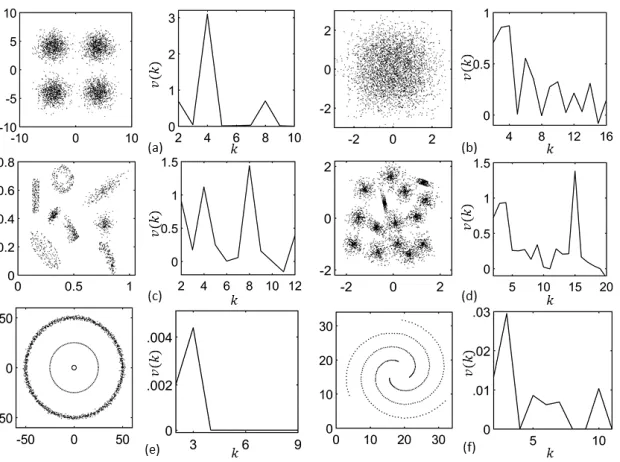
Figure 2: Evaluation of our method on a variety of synthetic datasets - (a) Low variance Gaussian,kt= 4, (b) High variance
Gaussian,kt = 4, (c) ComboSetting,kt = 8, (d) Synthetic-15 (S15),kt = 15, (e) Concentric rings,kt= 3, and (f) Spirals, kt= 3. Our method predicts the correct number of clusters in each of these scenarios.
large (each data point is a highest resolution cluster to the entire dataset being the lowest resolution cluster); therefore log function discriminates this range better.
Algorithm 1main(X,kmax)
1. Initializek= 1.
2. Run a clustering algorithm onX withkclusters and com-puteβ¯kusing (12).
3. k←−k+ 1. Go to step 2. Stop ifk=kmax+ 1.
4. Choosektusing (11).
Figures 1(a3) and 1(b3) illustrates our method for de-termining number of true clusters on two datasets consid-ered in Figures 1(a1) and 1(b1) respectively. Observe that the quantities log ¯β3 −log ¯β2 log ¯βk −log ¯βk−1 and log ¯β9−log ¯β8log ¯βk−log ¯βk−1for allk6= 3andk6= 9 in both the figures. Further, we observe in the Figure 1(a3) thatlog ¯β3−log ¯β2>log ¯β9−log ¯β8which indicateskt= 3
(using (10)) for the dataset in Figure 1(a1). Similarly we ob-serve in Figure 1(b3) thatlog ¯β9−log ¯β8>log ¯β3−log ¯β2 which indicates kt = 9 for the dataset in Figure 1(b1).
Again, these inferences agree with our intuition from visual inspection of these datasets. Extending to nonlinearly sep-arable data:The method proposed above works well for linearly separable data. However, many problems such as shape clustering or clustering with pairwise distances often consist of data points that are not separable linearly. We use kernel trick (Dhillon, Guan, and Kulis 2004) to overcome this issue. Accordingly, we map data points xi to an
ab-stract higher-dimensional space (where data-points are
lin-Figure 3: Illustrates two circular clusters of radius Rwith uniformly distributed data-points.
early separable) through a suitably chosen kernel function
φ(·). While an explicit representation of kernel functionφ(·) is unknown, the inner-productsφ(xi)Tφ(xj)are known as
elements of a kernel matrix K (Dhillon, Guan, and Kulis 2004). Thus, in order to identify the clustering solution with the correct number of clusters in a nonlinearly separable dataset, one must evaluate the largest eigenvalue of the ker-nel data covariance matrixC¯φk(X)|y
jdefined as:
¯
Cφk(X)|y j=
X
xi∈πj
(φ(xi)−yj) (φ(xi)−yj)
T
, (13)
whereπjdenotes thej-th cluster. Computation of
eigenval-ues ofC¯k
φ(X)|yjis not straightforward (sinceφis unknown),
however, we make use of the following lemma in order to obtain the spectral values ofC¯k
φ(X)|yj.
Lemma 1 Let C¯φk(X)|y
j be the cluster covariance
ma-trix as defined in (13). Then C¯φk(X)|y
j and A = [Akl]
share the same non-zero eigenvalues, where Akl =
(φ(xk)−yj)
T
(φ(xl)−yj).
Table 1: Comparing algorithms on a variety of standard and synthetic datasets
Algorithm
Low High
Combo-Variance Variance Setting Wisconsin Yeast Glass Leaves
kt= 4 kt= 4 kt= 8 kt= 2 kt= 10 kt= 6 kt= 100
gap-statistic 4 1 27 12 49 39 117
X-means 1 1 25 6 47 1 219
G-means 4 68 33 83 56 15 66
P G-means 4 3 12 6 3 7 Error
dip-means 4 1 8 11 1 1 3
Info. Th. 4 3 8 2 2 6 99
kernel dip-means - - -
-Our Method 4 4 8 2 10 6 100
Algorithm
Concentric
Wine Iris Banknote Thyroid Birch1 Rings Spirals
kt= 3 kt= 3 kt= 2 kt= 3 kt= 100 kt= 3 kt= 3
gap-statistic 3 3 58 17 Error n/a n/a
X-means 40 12 230 1 1 n/a n/a
G-means 2 4 57 7 1953 n/a n/a
P G-means 1 2 35 3 32 n/a n/a
dip-means 1 2 4 1 Error n/a n/a
Info. Th. 3 2 5 3 100 n/a n/a
kernel dip-means - - - 3 1
Our method 3 2 2 3 100 3 3
Note that from (3), the cluster center yj =
1
|πj|
P
xi∈πjφ(xi). Thus elements of A are known in
terms of the elements of kernel matrix, and hence the spectral values ofC¯k
φ(X)|yjcan be easily obtained.
We demonstrate the efficacy of our proposed metric using simulations on synthetic and standard datasets in the exper-iments section. Additionally, we analytically solve for the persistence of clustering solutions for an example problem as shown in Figure 3. The Figure illustrates two equally sized circular clusters (kt = 2) with uniform distribution.
One can easily compute the cluster covariance matrices for clustering solutions (as given by k-means) at variousk’s and show thatv(2)> η∀η∈ {v(3), v(4), v(5), v(6)}; thereby implying that for the dataset in Figure 3,k= 2is amore nat-ural choice of the number of clusters thank= 3,4,5and6. Please refer to the supplementary material1for the proof.
Experiments
In this section we employ the notion of persistence in estimating the true number of clusters in synthetic as well as standard datasets from the literature (Dheeru and Karra Taniskidou 2017), (Fr¨anti and Sieranoja 2018) and provide comparisons with the gap-statistic method (Tibshi-rani, Walther, and Hastie 2001), dip-means (Kalogeratos and Likas 2012), X-means (Pelleg, Moore, and others 2000),
G-means (Hamerly and Elkan 2004),P G-means (Feng and Hamerly 2007) algorithms and the information theoretic ap-proach (Sugar and James 2003). We observe that our pro-posed method outperforms the existing methods on various
standard datasets as well as on synthetic datasets with acute overlap between two clusters.
As the method proposed in this paper evaluates a cluster-ing solution for its persistence, any suitable clustercluster-ing algo-rithm can be employed to obtain these clustering solutions. Note that irrespective of the criteria or metric used, a stable and good clustering solution at eachk is a prerequisite to correctly estimating the true number of clusters in a dataset. Since thek-means algorithm is ubiquitous in the data sci-ence literature, in all our simulations on linearly separable datasets we usek-means algorithm with multiple runs to de-termine the clustering solution at each value of k. For the purpose of estimating the true number of shape clusters we use the spectral clustering algorithm (Ng, Jordan, and Weiss 2002) to obtain the clustering solutions at variousk’s. Also note that for all the simulations demonstrated in this section we normalize every dataset to mean zero and standard devi-ation one.
Figure 2 demonstrates multiple instances of synthetic datasets, and the corresponding plots ofv(k)versusk, where
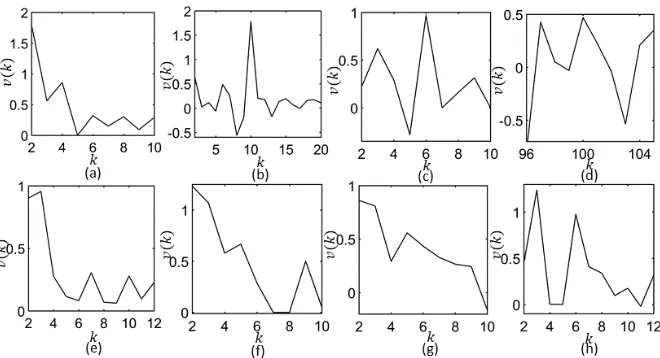
algo-Figure 4: Illustration of performance of our method on high-dimensional datasets - (a) Wisconsin (d= 9,N = 681,kt= 2),
(b) Yeast (d= 8,N = 1484,kt= 10), (c) Glass (d= 9,N = 214,kt= 6) (d) Leaves (d= 64,N = 1600,kt = 100) (e)
Wine (d= 13,N = 178,kt= 3) (f) Iris (d= 4,N = 150,kt= 3) (g) Banknote Authentication (d= 4,N = 1372,kt= 2)
(h) Thyroid (d= 5,N= 215,kt= 3) . Note that, except for the Iris dataset,v(kt)is maximum in all the plots.
rithms such asG-means,P G-means and dip-means fail to estimate the true number of clusters in this case (as shown in Table 1), even though this dataset satisfies the assumptions required by these algorithms. In Figure 2c, the dataset is a mixture of well separated eight non-uniform clusters. The corresponding plot ofv(k)versuskdetermines two distin-guishable peaks atk = 4andk = 8, although the peak is larger atk = 8and denotes the true number of clusters in this dataset.
Similar conclusions are observed for the linearly sepa-rable S15 dataset (a mixture of 15 Gaussian distribution (Fr¨anti and Virmajoki 2006)) in Figure 2(d), and other stan-dard high-dimensional datasets - Wisconsin (d = 9,N = 681,kt = 2), Yeast (d = 8,N = 1484,kt = 10), Glass
(d = 9,N = 214,kt = 6), Leaves (d = 64,N = 1600, kt= 100), Wine (d= 13,N = 178,kt = 3), Iris (d= 4, N = 150, kt = 3), Banknote Authentication (d = 4, N = 1372,kt = 2), Thyroid (d = 5,N = 215,kt = 3),
shown in Figure 4, where our proposed method estimates the true number of clusters appropriately. In particular, note that our proposed metric estimates the true number of clusters for a very high-dimensional leaves (d= 64,kt = 100) dataset
and a large Birch1 (N = 100,000,kt = 100) dataset. All
the other methods, except Information Theoretic approach on Birch1 dataset, fail to determine the true number of clus-ters in these two datasets. Table 1 compares our method to the gap-statistic, X-means, G-means, P G-means, dip-means, kernel dip-means algorithms and information theo-retic approach of determining the true number of clusters in the dataset. We observe that our method estimates the correct value ofkteven for the high-variance Gaussian distribution
Figure 2(b), yeast dataset, banknote authentication dataset and a high-dimensional Leaves dataset (d = 64) where all the other methods fail to correctly estimate the true num-ber of clusters. As previously noted, the proposed metric is scalable with respect to the size of the datasets and involves
eigenvalue computation of a d×dcluster covariance ma-trix, wheredis the dimension of datapoints in the dataset. For the Iris dataset most of the methods, including ours, es-timate the true number of clusters to be2. This is because the two of three clusters in the Iris dataset have significant overlap with each other. However, the gap-statistic method outperforms all the others and estimates correctly the true number of clusters in the Iris dataset.
As described earlier, our technique extends to non-linearly separable data too. Figure 2e and 2f illustrate two non-linearly separable datasets. We use the spectral cluster-ing algorithm (Ng, Jordan, and Weiss 2002) and determine the similarity graph using the Gaussian similarity function,
s(xi, xj) = exp(−kxi−xjk2/(2σ2)), where theσ
param-eter is set to be0.01and0.08for (e) concentric rings, and (f) spirals, respectively. Table 1 shows comparison with the kernel dip-means (Kalogeratos and Likas 2012) algorithm on these two non-linearly separable datasets. Note that the latter fails to correctly estimate the true number for clusters on the spiral dataset.
Conclusion
References
Akaike, H. 2011. Akaike’s information criterion. In Interna-tional encyclopedia of statistical science. Springer. 25–25. Andreopoulos, B.; An, A.; Wang, X.; and Schroeder, M. 2009. A roadmap of clustering algorithms: finding a match for a biomedical application. Briefings in Bioinformatics
10(3):297–314.
Dempster, A. P.; Laird, N. M.; and Rubin, D. B. 1977. Max-imum likelihood from incomplete data via the em algorithm.
Journal of the royal statistical society. Series B (method-ological)1–38.
Dheeru, D., and Karra Taniskidou, E. 2017. UCI machine learning repository.
Dhillon, I. S.; Guan, Y.; and Kulis, B. 2004. Kernel k-means: spectral clustering and normalized cuts. InProceedings of the tenth ACM SIGKDD international conference on Knowl-edge discovery and data mining, 551–556. ACM.
Di Nuovo, A. G., and Catania, V. 2008. An evolutionary fuzzy c-means approach for clustering of bio-informatics databases. InFuzzy Systems, 2008. FUZZ-IEEE 2008.(IEEE World Congress on Computational Intelligence). IEEE In-ternational Conference on, 2077–2082. IEEE.
Feng, Y., and Hamerly, G. 2007. Pg-means: learning the number of clusters in data. InAdvances in neural informa-tion processing systems, 393–400.
Fr¨anti, P., and Sieranoja, S. 2018. K-means properties on six clustering benchmark datasets.
Fr¨anti, P., and Virmajoki, O. 2006. Iterative shrink-ing method for clustershrink-ing problems. Pattern Recognition
39(5):761–765.
Gersho, A., and Gray, R. M. 2012. Vector quantization and signal compression, volume 159. Springer Science & Busi-ness Media.
Hamerly, G., and Elkan, C. 2004. Learning the k in k-means. InAdvances in neural information processing systems, 281– 288.
Hartigan, J. A., and Hartigan, P. M. 1985. The dip test of unimodality.The Annals of Statistics70–84.
Hartigan, J. A., and Wong, M. A. 1979. Algorithm as 136: A k-means clustering algorithm. Journal of the Royal Sta-tistical Society. Series C (Applied Statistics)28(1):100–108. Huang, C.-W.; Lin, K.-P.; Wu, M.-C.; Hung, K.-C.; Liu, G.-S.; and Jen, C.-H. 2015. Intuitionistic fuzzyc-means clus-tering algorithm with neighborhood attraction in segmenting medical image. Soft Computing19(2):459–470.
Kalogeratos, A., and Likas, A. 2012. Dip-means: an incre-mental clustering method for estimating the number of clus-ters. InAdvances in neural information processing systems, 2393–2401.
Kass, R. E., and Wasserman, L. 1995. A reference bayesian test for nested hypotheses and its relationship to the schwarz criterion. Journal of the american statistical association
90(431):928–934.
Kurihara, K., and Welling, M. 2009. Bayesian k-means as a “maximization-expectation” algorithm.Neural computation
21(4):1145–1172.
Lange, T.; Braun, M. L.; Roth, V.; and Buhmann, J. M. 2003. Stability-based model selection. InAdvances in neural in-formation processing systems, 633–642.
Larose, D. T., and Larose, C. D. 2014. Discovering knowl-edge in data: an introduction to data mining. John Wiley & Sons.
Levine, E., and Domany, E. 2001. Resampling method for unsupervised estimation of cluster validity. Neural compu-tation13(11):2573–2593.
Ng, A. Y.; Jordan, M. I.; and Weiss, Y. 2002. On spectral clustering: Analysis and an algorithm. InAdvances in neural information processing systems, 849–856.
Park, H.-S., and Jun, C.-H. 2009. A simple and fast algo-rithm for k-medoids clustering. Expert systems with appli-cations36(2):3336–3341.
Pelleg, D.; Moore, A. W.; et al. 2000. X-means: Extending k-means with efficient estimation of the number of clusters. InIcml, volume 1, 727–734.
Rissanen, J. 1978. Modeling by shortest data description.
Automatica14(5):465–471.
Rose, K. 1998. Deterministic annealing for clustering, com-pression, classification, regression, and related optimization problems. Proceedings of the IEEE86(11):2210–2239. Sand, P., and Moore, A. W. 2001. Repairing faulty mix-ture models using density estimation. InICML, 457–464. Citeseer.
Sharma, P.; Salapaka, S.; and Beck, C. 2008. A scalable approach to combinatorial library design for drug discovery.
Journal of chemical information and modeling48(1):27–41. Stephens, M. A. 1974. Edf statistics for goodness of fit and some comparisons. Journal of the American statistical Association69(347):730–737.
Sugar, C. A., and James, G. M. 2003. Finding the num-ber of clusters in a dataset: An information-theoretic ap-proach. Journal of the American Statistical Association
98(463):750–763.
Tibshirani, R., and Walther, G. 2005. Cluster validation by prediction strength. Journal of Computational and Graphi-cal Statistics14(3):511–528.
Tibshirani, R.; Walther, G.; and Hastie, T. 2001. Estimat-ing the number of clusters in a data set via the gap statistic.
Journal of the Royal Statistical Society: Series B (Statistical Methodology)63(2):411–423.
Yuan, F.; Zhan, Y.; and Wang, Y. 2014. Data density corre-lation degree clustering method for data aggregation in wsn.