ENCOURAGING STUDENT ENGAGEMENT
WITH COLLABORATIVE SERIOUS GAMES:
THE COCO FRAMEWORK
Prins Butt, Southampton Solent University
Gary Wills, University of Southampton
United Kingdom
Abstract
Collaborative serious games may offer new methods for encouraging student engagement but are currently underexplored in the literature. Their
construction remains difficult partly due to a lack of conceptualisation. In this paper, we present COCO—a conceptual framework for collaborative serious games. We explore the validity of its components using t-tests to analyse the data from surveying and interviewing 10 experts and surveying 23 students. We find the results validate the framework and conclude that our framework provides an appropriate theoretical foundation for further research and can aid understanding and communication about collaborative serious games.
Introduction
Student engagement is a topic of interest to educators as correlations between student engagement and learning continue to be observed (Halm 2015). There is an abundance of research to indicate that engagement has an impact on learning. That is, students that fail to engage and fail to achieve academic success can become demotivated, abandon their study and be deterred from future educational opportunities (Kirby & Sharpe, 2001). Poor student engagement has consequences for academic institutions as it results in poor retention rates, which can have a negative impact on finances, accreditation and reputation (Baruah, 2011). Academic institutions are therefore
continually identifying and pursuing reforms that seek to improve student engagement and retention (Anderman, 1997). Educators, for their part, have been trying to address student engagement for some time and with varying degrees of success. Two approaches that have been explored in the literature in this regard are collaborative learning and serious games. The benefits of collaborative learning are widely documented and accepted and its
In this paper we present a conceptual framework for collaborative serious games, which can be used to inform studies and methods that lead to their construction. We draw on knowledge and understanding from a number of disciplinary fields including learning theory, pedagogy and game design and identify five core dimensions that form the basis of the framework. The remainder of this paper provides a review of related work, the proposed framework and a discussion of the methodology and results of validating the framework. The paper concludes with a summary of the main contribution of this research and recommendations for future work.
Literature Review
Student engagement is a “broad construct” (Coates 2007, p. 122) and a variety of definitions and uses for this term exist in the literature (Appleton,
Christenson, & Furlong, 2008). Despite considerable focus there is a lack of constancy in the application of any one definition. Some researchers have focused on behavioural components (Squires, Huitt, & Segars, 1981) such as attendance or the time spent on a task. Others have identified emotional (Skinner & Belmont 1993) and cognitive (Fredricks, Blumenfeld, & Paris, 2004) components indicating the importance of students engaging with their hearts and minds. For the purpose of this study, student engagement is understood as the energy exerted by students in educationally meaningful tasks and includes behavioural, emotional and cognitive components as well as a social dimension.
Collaborative Learning
Collaborative learning supports a social learning paradigm (Vygotsky, 1978) and describes situations “in which two or more people interact with each other and, in some circumstances, some types of interaction occur that have a positive effect” (Dillenbourg, Baker, Blaye, & O’Malley, 1996) on learning. It can be encouraged with group goals and individual accountability (Slavin 1988) and affected by group composition, group size and individual
differences (Dillenbourg et al., 1996). It relies on social skills and positive interdependence (Laal, 2012), which can present challenges, but where meaningful collaboration takes place, can result in higher-order thinking (Ma, 2009) and significant contribution to student engagement and achievement.
Computer Supported Collaborative Learning
Computers offer new opportunities for communication and collaboration, and their role in computer supported collaborative learning continues to be
explored. Research in this field has evolved with the technology from facilitating organisation and communication to providing intelligent tutoring systems and integrated collaborative working environments. More recently, the use of computer games has also received growing focus in this field.
Serious Games
market (NewZoo, 2014). Their popularity has attracted much academic interest leading to the field of serious games. These use instructional and game elements for non-entertainment purposes (Charsky, 2010) and are explored in academia as a means of motivating and engaging students. A number of frameworks for serious games already exist including the input-process-outcome model (Garris, Ahlers, & Driskell, 2002) and the four-dimensional framework (de Freitas & Oliver 2006). However, these are limited to single players and give little consideration to the social dimension of student engagement. More recent studies (Wendel, Gutjahr, Göbel, & Steinmetz, 2012; Vahdat, George, & Serna,. 2013) have investigated the idea of collaborative serious games but this area remains underexplored.
The COCO Framework
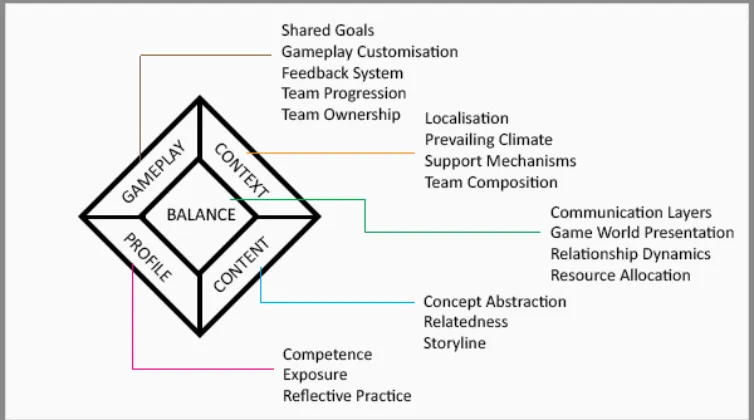
The proposed conceptual framework is shown in Figure 1 and consists of five dimensions and nineteen components.
Gameplay
The Gameplay dimension includes the features of the game that control how the game is played. This dimension consists of Shared Goals, Gameplay Customisation, Feedback System, Team Progression and Team Ownership. Shared Goals are specific, measurable, attainable, relevant and time-bound results that the group aim to achieve in the game. Gameplay Customisation is the functionality that is made available by the game that allows the players to directly modify the gameplay in accordance with their preferences. Feedback System is the functionality that is responsible for the type and the timeliness of feedback generated by the game and presented to the player before, during and after the gameplay. Team Progression is the functionality for managing progress made by the group towards achieving the shared goals. Team Ownership is the functionality for managing the degree of control and autonomy the players can exercise in tandem particularly in relation to the shared resources.
Context
The Context dimension relates to the entities and mechanisms that are external to the game and impact the game. This dimension consists of Localisation, Prevailing Climate, Support Mechanisms and Team Composition.
Localisation is the degree to which the game is adapted for different locales including linguistic, cultural and legal and identity differences. Prevailing Climate is the emotional atmosphere in which the game is being played. Support Mechanisms are the type and extent of support available external to the game. Team Composition is the number of individuals that make up the team and their relative attributes, characteristics and traits.
Profile
The Profile dimension relates to a learner’s prior learning and expectations. This dimension consists of Competence, Exposure and Reflective Practice. Competence is an individual player’s state or quality of being adequately or well qualified to perform a task within a specific range of skill, knowledge or ability. Exposure is the breadth and depth of skills, knowledge and experience of a player. Reflective Practice is the degree of conscious analysis of practice and its significance exhibited outside of the gameplay.
Content
The Content dimension is the actual learning content provided in the game and consists of Concept Abstraction, Relatedness and Storyline. Concept
Abstraction is the need and degree to which a concept or idea is abstracted in relation to its real-world concrete equivalent. Relatedness is the degree of affinity and connection between the learner and the subject matter. Storyline is the need and extent to which the storyline is interwoven into gameplay and has a purpose, is meaningful and supports progression.
Balance
The Balance dimension represents the components of the game that affect or are affected by the components in each of the other dimensions and controls the overall presentation of the game as well as the relationships in the game. This dimension consists of Communication Layers, Game-World
Presentation, Relationship Dynamics and Resource Allocation.
Communication Layers are the different means of exchanging information during gameplay and their relative information density. Game-World
Presentation is the degree of realism, interaction and immersion offered by the gameplay. Relationship Dynamics is the balance between the relationships of all the players during gameplay. Resource Allocation is the distribution of available resources between the players.
Validation of the COCO Framework
Methodology
To validate our framework we used a mixed methods approach as this allows more insight to be gained than either a qualitative or quantitative method on its own (Stecklar, McLeroy, Goodman, Bird, & Mc-Cormick, 1992).
Qualitative data was collected using individual interviews whilst quantitative data was collected using surveying.
Procedure
Two surveys were conducted. The first involving 10 experts, and the second involving 23 students. The 10 experts were selected for sampling based on the relevance and currency of their experience. Each expert completed a survey in which they indicated the level of importance of each component in our framework for a collaborative serious game using a Likert five-point scale ranging from 5 = extremely important to 1 = not at all important. The results of the survey were then interpreted using a one-sample t-test with the
following hypothesis:
H0: µ ≥ 3.5 Component is important for a collaborative serious game HA: µ < 3.5 Component is not important for a collaborative serious game Test Criteria: if p value ≤ 0.05 then reject null hypothesis H0 in favour of alternative hypothesis HA.
The same hypothesis was then tested in the second survey with each of the 23 students selected based on three criterion: the student is enrolled and actively studying a games development course, the student has completed a year of study at FHEA level 4, and the student has experience of group work.
A two-sample t-test was then performed on the two sample groups using the following hypothesis:
H0: µexperts = µstudents Means of the two groups are the equal HA: µexperts ≠ µstudents Means of the two groups are not equal
Test Criteria: if p-value ≤ 0.05 then reject null hypothesis H0 in favour of the alternative hypothesis HA else accept null hypothesis H0.
The surveys were followed by individual interviews with experts during which they discussed their responses. The interviews were transcribed and verified before being analysed for further insights.
Results and Interpretation
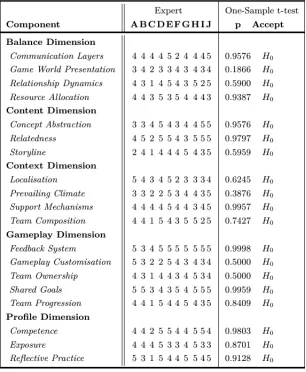
Table 1
Responses of Experts and One-Sample t-Test
They indicate that the null hypothesis is accepted for each component in our framework indicating that each is important for a collaborative serious game. The p-values for the Game-World Presentation and Prevailing Climate
components are < 0.5. Therefore we can infer that whilst not enough to reject the null hypothesis, these components exhibit statistically weak levels of importance to collaborative serious games. Conversely, with p-values greater than 0.99, the Support Mechanisms, Feedback System and Shared Goals components exhibit statistically strong levels of importance to collaborative serious games.
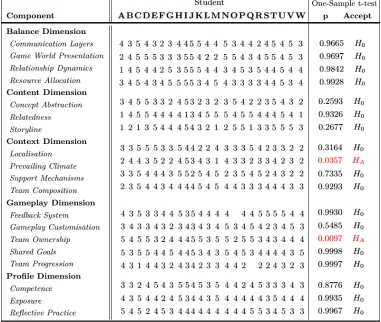
Table 2
Responses of Students and One-Sample t-Test
A two-sample t-test shows no statistically significant difference at the 5% significance level between the two groups for all but the Game-World Presentation (p=0.0463) and Feedback System (p=0.0354) components. Whilst both groups consider both of these components important, students consider the Game-World Presentation to be more important than is deemed by the experts. Similarly, the experts consider the Feedback System to be more important than is deemed by the students. During interviews, six experts expressed the view that realism in the Game-World Presentation could be compromised, which may explain the difference in view between experts and students. For example, one expert stated, “It’s nice to have a degree of
realism,” but elaborated, “It can be a significant factor but not necessarily a deciding factor with regards to immersion. There are games that can be less realistic but offer deeper levels of immersion.” Three experts cited cost as a factor with one expert stating, “I think it could be [realistic] but the cost is so high. It is not necessary.” With regards to the Feedback System, all ten
student engagement, which may explain why the experts rated the Feedback System so highly. In relation to the Prevailing Climate, two experts stated that it was not important, whilst a further three felt it was dependent on the players. For example, one expert expressed, “I think that this one depends on people. Personally I think I am good at ignoring the noise,” whilst another offered, “It would have some effect on you so you would have to make sure the game is playing in the right climate. So it is important but I don’t think it’s necessarily essential.” One expert felt that “distractions” in the prevailing climate could “stop the students from paying attention to the game or from benefitting from the game’s objectives” and suggested, “We should have a controlled
environment.” One expert in relation to Game Customisation also expressed this idea of a controlled environment:
At the end of day you want to achieve the learning objectives of a particular unit using games. I don’t think students should be given the opportunity to customise the game. The game should be designed by the tutor or lecturer and the students should just play it.
The other experts felt that being able to customise the game could be useful and expressed accessibility as a recurring view. The experts provided similar insights regarding the remaining components with the results broadly
validating the COCO framework.
Conclusion
We have explored the synergy between collaborative learning and serious games in the form of collaborative serious games. We have developed a conceptual framework to explain the core components of collaborative serious games and their relationships. We have evaluated our framework by analysing the results of student surveys and expert surveys and interviews and found that the results support our framework. We expect that our framework can aid understanding and communication related to collaborative serious games and can contribute to studies and methods that lead to their construction. As future work we plan to further validate our framework and use the framework to inform the design and development of a collaborative serious game.
Acknowledgements
This research is used for writing up a PhD thesis at the University of
Southampton. I would like to thank Gary Wills for his PhD supervision and my colleagues Jomo Batola and Neville Palmer for their feedback during the drafting of this paper.
References
Anderman, E. M. (1997). Motivation and school reform. Advances in Motivation and Achievement, 10, 303-337
Appleton, J. J., Christenson, S. L., & Furlong, M. J. (2008). Student
Bandura, A. (1977). Social learning theory. Upper Saddle River, NJ: Prentice-Hall.
Baruah, T. D. (2011). Improving student retention through technology in India. The Asian Society of Open and Distance Education, 9(2), 15-25. Charsky, D. (2010). From edutainment to serious games: A change in the use
of game characteristics. Games and Culture, 5(2), 177-198.
Coates, H. (2007). A model of online and general campus-based student engagement. Assessment and Evaluation in Higher Education, 32(2), 121-141
Crawford, C. (2003). Chris Crawford on game design. San Francisco, CA: New Riders.
de Freitas, S., & Oliver, M. (2006). How can exploratory learning with games and simulations within the curriculum be most effectively evaluated? Computers & Education, 46, 249-264.
Dillenbourg, P., Baker, M., Blaye, A. , & O’Malley, C. (1996). The evolution of research on collaborative learning. In E. Spada & P. Reiman (Eds.), Learning in humans and machine: Towards an interdisciplinary learning science (pp. 189-211). Oxford: Elsevier.
Fredricks, J. A., Blumenfeld, P. C., & Paris, A. H. (2004). School
engagement: Potential of the concept, state of the evidence. Review of Educational Research,4(1), 59-109.
Garris, R., Ahlers, R., & Driskell, J. E. (2002). Games, motivation, and learning: A research and practice model. Simulation and Gaming, 33(4), 441-467.
Halm, D. S. (2015). The impact of engagement on student learning. International Journal of Education and Social Science, 2(2), 22-33. Juul, J. (2003). The game, the player, the world: Looking for a heart of
gameness. Proceedings of Level Up: Digital Games Research Conference (pp. 30-45).
Kirby, D., & Sharpe, D. (2001). Student attrition from Newfoundland and Labrador’s Public College. Alberta Journal of Educational Research, XLVII(4), 353-368.
Laal, M. (2013). Positive interdependence in collaborative learning. Procedia - Social and Behavioral Sciences, 93, 1433-1437.
Ma, A.W.W. (2009). Computer supported collaborative learning and higher order thinking skills: A case study of textile studies. Interdisciplinary Journal of E-Learning and Learning Objects, 5, 145-167.
NewZoo.(2014). Towards the global games market in 2017. A broad look at market growth by screen & region. Retrieved from
http://www.newzoo.com/insights/free-casual-games-sector-report-towards-global-games-market-2017/
Skinner, E., & Belmont, M. (1993) Motivation in the classroom: Reciprocal effects of teacher behavior and student engagement across the school year. Research and Technology in Education, 85(4), 571-581.
Slavin, R. E. (1988). Cooperative learning and student achievement. Educational Leadership, 45(2), 31-33.
SpilGames. (2013). State of online gaming report.Retrieved from http://www.spilgames.com/state-online-gaming-2013-2/
Stecklar, A., McLeroy, K. R., Goodman, R. M., Bird, S. T., & Mc-Cormick, L. (1992). Toward integrating qualitative and quantitative methods: An Introduction. Health Education Quarterly, 19(1), 1-8.
Vahdat, M., George, S., & Serna, A. (2013). Wizard of Oz in designing a collaborative learning serious game on table tops. International Journal of Information and Education Technology, 3(3), 325-329.
Vygotsky, L. S. (1978). Mind in society: Development of higher psychological processes. Cambridge, MA: Harvard University Press.
Wendel, V., Gutjahr, M., Göbel, S., & Steinmetz, R. (2012). Designing collaborative multiplayer serious games for collaborative learning. Proceedings of the CSEDU, 2, 199-210.
Author Details Prins Butt
[email protected] Gary Wills