ISSN: 2231-5373 http://www.ijmttjournal.org Page 380
Propagation of P and SV Waves through
Loosely Bonded Solid/Solid Interface
Vinod Kaliraman
Department of Mathematics, Chaudhary Devi Lal University, Sirsa, India-125055
Abstract
In the present investigation, the solution of the governing equations of micropolar elastic solid and fluid saturated incompressible porous solid is employed to study the reflection and transmission phenomenon at a loosely bonded interface between micropolar elastic solid half space and fluid saturated porous half space. P-wave or SV-wave is considered to be incident on the plane interface through fluid saturated porous solid half space. The amplitude ratios of various reflected and transmitted waves are derived and computed numerically for the model under consideration for different values of bonding parameter. The results thus obtained are depicted graphically with angle of incidence of incident wave. It is found that these amplitude ratios depend on angle of incidence of the incident wave and material properties of the medium. Effect of bonding parameter, fluid filled in the pores of fluid saturated porous medium on the amplitude ratios is shown.
Keywords: Porous solid, micropolar elastic solid, reflection, transmission, longitudinal wave, transverse wave, amplitude ratios, empty porous solid, loosely bonded interface
.
1. Introduction
Most of natural and man-made materials, including engineering, geological and biological media, possess a microstructure. In case of bodies with definite internal structure, for example, sand, fissured rocks, cemented sandstone, limestone in others sediments permitted by groundwater or oil, the existing theories related to elasticity needs to be upgraded. These materials often present on and below the surface of Earth. All these material along with certain others, for example, ceramics, bread, lungs kidneys, aquifers from which ground water is pumped, reservoirs which yield oil and gas have some characteristics in common that permit them to be named as porous materials. A porous material is regarded as a material whose solid portion is continuously connected throughout the whole volume to form a solid Matrix with voids through which the liquid or gas may flow.
The ordinary classical theory of elasticity fails to describe the microstructure of the material. To tackle this problem, Suhubi and Eringen (1964), Eringen and Suhubi (1964) developed a theory in which they considered the microstructure of the material and they showed that the motion in a granular structure material is characterized not by a displacement vector but also by a rotation vector. Gautheir (1982) found aluminum-epoxy composite to be a micropolar material. Many problems of waves and vibrations have been discussed in micropolar elastic solid by several researchers. Some of them are Parfitt and Eringen (1969), Tomar and Gogna (1992), Tomar and Kumar (1995), Singh and Kumar (2007), Kumar and Barak (2007) etc.
In the problems of wave propagation at the interface between two elastic half spaces, the contact between them is normally assumed to be welded. However, in certain situations, there are reasons for expecting that bonding is not complete. Murty (1976) discussed a theoretical model for reflection, transmission, and attenuation of elastic waves through a loosely bonded interface between two elastic solid half spaces by assuming that the interface behaves like a dislocation which preserves the continuity of stresses allowing a finite amount of slip. A similar situation occurs at the two different poroelastic solids, as the liquid present in the porous skeleton may cause the two media to be loosely bonded. Vashisth and Gogna (1993), Kumar and Singh (1997) etc. discussed the problems of reflection and transmission at the loosely bonded interface between two half spaces.
ISSN: 2231-5373 http://www.ijmttjournal.org Page 381
1990b) developed an interesting theory for porous medium having all constituents to be incompressible. There are sufficient reasons for considering the fluid saturated porous constituents as incompressible. Therefore, the assumption of incompressible constituents meet the properties appearing the in many branches of engineering and avoids the introduction of many complicated material parameters as considered in the Biot theory because Biot’s theory was based on the assumption of compressible constituents.
Based on the theory given by de Boer and Ehlers (1990a, 1990b), many researchers like de Boer and Didwania (2004), de Boer and Liu(1994,1995), Kumar and Hundal (2003), Tajuddin and Hussaini (2006), Kumar et.al.(2011), Kumari (2014), Abo-Dahab (2015), Marin (2016), Reda et.al. (2016), Sheikholeslami (2017) etc. studied some problems of wave propagation in fluid saturated porous media. Using the theory of de Boer and Ehlers (1990) for fluid saturated porous medium and Eringen (1968) theory for micropolar elastic solid, the reflection and transmission of longitudinal wave (P-wave) or transverse wave (SV-wave) at a loosely bonded interface between micropolar elastic solid half space and fluid saturated porous solid half space is discussed. Amplitudes ratios for various reflected and transmitted waves are computed for a particular model and depicted graphically and discussed accordingly. The model considered is assumed to exist in the oceanic crust part of the earth and the propagation of wave through such a model will be of great use in the fields related to earth sciences.
2. Formulation of the problem
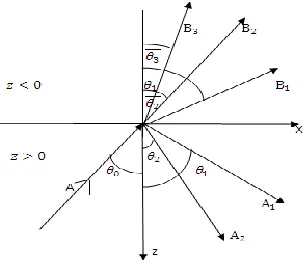
Consider a two dimensional problem by taking the z-axis pointing into the lower half-space and the plane interface z=0 separating the fluid saturated porous half space M1 [z > 0] and micropolar elastic solid half spaceM2 [z<0]. A
longitudinal wave or transverse wave propagates through the medium M1 and incident at the plane z=0 and making
an angle θ0 with normal to the surface. Corresponding to incident longitudinal or transverse wave, we get two
reflected waves in the medium M1 and three transmitted waves in medium M2. See figure 1.
Figure 1. Geometry of the problem.
3. Basic equations and constitutive relations 3.1.For medium 𝐌𝟐 (Micropolar elastic solid half space)
The equation of motion in micropolar elastic medium are given by Eringen (1968) as
c12+ c32 ∇2ϕ =
∂2ϕ
∂t2 (1)
c22+ c32 ∇2U + c32∇ ×Φ =
∂2U
∂t2 (2)
c42∇2− 2ω02 Φ +ω02∇ × U =
∂2Φ
∂t2 (3)
ISSN: 2231-5373 http://www.ijmttjournal.org Page 382
C12=
λ + 2μ
ρ ; c22=
μ
ρ ; c32=
κ
ρ ; c42=
γ
ρj ; ω02=
κ
ρj (4)
Parfitt and Eringen (1969) have shown that equation (1) corresponds to longitudinal wave propagating with velocity v1, given by v12= c12+ c32 and equations (2)-(3) are coupled equations in vector potentials U and Φ and these
correspond to coupled transverse and micro-rotation waves. If ω2
ω02> 2, there exist two sets of coupled-wave
propagating with velocities 1/λ2 and 1/λ3; where
λ22=
1
2 B − B2− 4C ,
λ32 =
1
2 B + B2− 4C , (5)
where
B =q p − 2
ω2 +
1
c22+ c32 +
1 c42 ;
C = 1
c42−
2q
ω2
1 c22+ c32 ;
p = κ
μ + κ ; q =
κ
γ (6)
Considering a two dimensional problem by taking the following components of displacement and micro rotation as
u = u, 0, w , Φ = 0,Φ2, 0 (7)
where
u =∂ϕ
∂x−
∂ψ
∂z w = ∂ϕ
∂z+
∂ψ
∂x (8)
and components of stresses are as under
tzz = λ + 2μ + κ
∂2ϕ
∂z2+ λ
∂2ϕ
∂x2 + 2μ + κ
∂2ψ
∂x ∂z (9)
tzx = 2μ + κ
∂2ϕ
∂x ∂z− μ + κ
∂2ψ
∂z2+ μ
∂2ψ
∂x2 − κΦ2 (10)
mzy = γ∂∂zΦ2 (11)
3.2.For medium 𝐌𝟏 (Fluid saturated incompressible porous solid)
Following de Boer and Ehlers (1990b), the governing equations in a fluid-saturated incompressible porous medium are
div ηS𝐱
S+ηF𝐱 F = 0. (12)
div𝐓𝐄𝐒−ηS grad p +ρS 𝐛 − 𝐱 s − 𝐏𝐄𝐅= 0, (13)
div𝐓𝐄𝐅−ηF grad p +ρF 𝐛 − 𝐱 F + 𝐏𝐄𝐅= 0, (14)
where 𝐱 i and 𝐱 i i = S, F denote the velocities and accelerations, respectively of solid (S) and fluid (F) phases of
ISSN: 2231-5373 http://www.ijmttjournal.org Page 383
stress in the solid and fluid phases respectively, 𝐏𝐄𝐅is the effective quantity of momentum supply and ηS and ηF
are the volume fractions satisfying
ηS+ηF= 1. (15)
If 𝐮S and 𝐮F are the displacement vectors for solid and fluid phases, then
x S = 𝐮 S ; 𝐱 s = 𝐮 s ; 𝐱 F= 𝐮 F; 𝐱 F= 𝐮 F (16)
The constitutive equations for linear isotropic, elastic incompressible porous medium are given by de Boer, Ehlers and Liu (1993) as
𝐓𝐄𝐒= 2μS𝐄S+λS ES. 𝐈 𝐈, (17)
𝐓𝐄𝐅= 0, (18)
𝐏𝐄𝐅= −𝐒v 𝐮 F− 𝐮 S , (19)
where λS and μS are the macroscopic Lame’s parameters of the porous solid and 𝐄S is the linearized Langrangian
strain tensor defined as
𝐄S =
1
2 grad 𝐮S+ gradT𝐮S , (20)
In the case of isotropic permeability, the tensor 𝐒v describing the coupled interaction between the solid and fluid is
given by de Boer and Ehlers (1990b) as
𝐒v =
ηF 2γFR
KF 𝐈, (21)
where γFR is the specific weight of the fluid and KF is the Darcy’s permeability coefficient of the porous medium.
Making the use of (16) in equations (12)-(1 4), and with the help of (17)-(20), we obtain
div ηS𝐮
S+ηF𝐮 F = 0, (22)
λS+μS grad div 𝐮
S+μSdiv grad 𝐮S−ηSgrad p +ρS(𝐛 − 𝐮 s) + Sv 𝐮 F− 𝐮 S = 0, (23)
− ηFgrad p +ρF 𝐛 − 𝐮
F − Sv 𝐮 F− 𝐮 S = 0. (24)
For the two dimensional problem, we assume the displacement vector 𝐮i i = F, S as
𝐮i= ui, 0, wi where i = F, S. (25)
Equations (22) - (24) with the help of eq. (25) in absence of body forces take the form
ηS ∂2uS
∂x ∂t+
∂2wS
∂z ∂t + ηF
∂2uF
∂x ∂t+
∂2wF
∂z ∂t = 0, (26)
ηF∂p
∂x+ ρF
∂2uF
∂t2 + Sv
∂uF
∂t −
∂uS
∂t = 0, (27)
ηF∂p
∂z+ ρF
∂2wF
∂t2 + Sv
∂wF
∂t −
∂wS
ISSN: 2231-5373 http://www.ijmttjournal.org Page 384 λS+ μS ∂θS
∂x + μS∇2uS− ηS
∂p
∂x− ρS
∂2uS
∂t2 + Sv
∂uF
∂t −
∂uS
∂t = 0, (29)
λS+ μS ∂θS
∂z + μS∇2wS− ηS
∂p
∂z− ρS
∂2wS
∂t2 + Sv
∂wF
∂t −
∂wS
∂t = 0, 30
where
θS =∂ uS
∂x +
∂ wS
∂z (31)
and
∇2= ∂2
∂x2+
∂2
∂z2 (32)
Also, tzzS and tzxS the normal and tangential stresses in the solid phase are as under
tzzS = λS
∂uS
∂x +
∂wS
∂z + 2μS
∂wS
∂z (33)
tzxS= μS
∂uS
∂z +
∂wS
∂x (34)
The displacement components ujand wj are related to the dimensional potential ϕj and ψj as
uj=∂ϕj
∂x + ∂ψj
∂z ; w
j=∂ϕj ∂z −
∂ψj
∂x ; j = S, F. 35
Using equation (35) in equations (26)-(30), we obtain the following equations determining ϕS, ϕF, ψS , ψF and p as:
∇2ϕS− 1
C12
∂2ϕS
∂t2 −
Sv
λS + 2μS ηF 2
∂ϕS
∂t = 0, (36)
ϕF= −ηS
ηFϕS 37
μS∇2ψS− ρS∂2ψS
∂t2 + Sv
∂ψF
∂t −
∂ψS
∂t = 0 (38)
ρF∂2ψF
∂t2 + Sv
∂ψF
∂t −
∂ψS
∂t = 0 (39)
ηF 2p − ηSρF∂2ϕS
∂t2 − Sv
∂ϕS
∂t = 0 (40)
where
C1 =
ηF 2 λS+ 2μS
ηF 2ρS+ ηS 2ρF (41)
ISSN: 2231-5373 http://www.ijmttjournal.org Page 385 ϕS, ϕF,ψS,ψF, p = ϕ
1S, ϕ1F,ψ1S,ψ1F, p1 exp iωt (42)
where ω is the complex circular frequency.
Making the use of (42) in equations (36)-(40), we obtain
∇2+ω2
C12
− iωSv
λS+ 2μS ηF 2 ϕ1S = 0 (43)
μS∇2+ ρSω2− iωS
v ψ1S= −iωSvψ1F (44)
−ω2ρF+ iωS
v ψ1F− iωSvψ1S = 0 (45)
ηF 2p
1+ ηSρFω2ϕ1S− iωSvϕ1S= 0 (46)
ϕ1F= −
ηS
ηFϕ1S (47)
Equation (43) corresponds to longitudinal wave propagating with velocity v1, given by
v12=
1
G1 (48)
where
G1=
1
C12−
iSv
ω λS+ 2μS ηF 2 (49)
From equation (44) and (45), we obtain
∇2+ω2
v22 ψ1
S = 0 (50)
Equation (50) corresponds to transverse wave propagating with velocity v2, given by v22= 1/G2
Where G2= ρS μS−
iSv μSω−
Sv2
μS −ρSω2+iωSv (51)
In medium 𝐌𝟐
ϕ = B1 exp iδ1 x sinθ1 − z cosθ1 + iω1 t , (52)
ψ = B2 exp iδ2 x sinθ2 − z cosθ2 + iω2 t
+ B3 exp iδ3 x sinθ3 − z cosθ3 + iω3 t , (53)
Φ2= EB2 exp iδ2 x sinθ2 − z cosθ2 + iω2 t
+ FB3 exp iδ3 x sinθ3 − z cosθ3 + iω3 t , (54)
where E =
δ22 δ22− ω 2 c 22+c32 +pq
deno . (55)
F =
δ32 δ32− c 22+c32 ω 2 +pq
deno . (56)
ISSN: 2231-5373 http://www.ijmttjournal.org Page 386
deno. = p 2q −ω
2
c42 ; δ2 2= λ
22ω2 ; δ32= λ32ω2 (57)
In medium 𝐌𝟏
ϕS, ϕF, p = 1, m
1, m2 A01 exp ik1 x sinθ0– z cosθ0 + iω1t +A1 exp ik1 x sinθ1+ z cosθ1
+ iω1t , (58)
ψS ,ψF = 1, m
3 B01 exp ik2 x sinθ0– z cosθ0 + iω2t + A2 exp ik2 x sinθ2+ z cosθ2
+ iω2t , (59)
where
m1= −
ηS
ηF ; m2= −
ηSω
12ρF− iω1Sv
ηF 2 ;
m3=
iω2Sv
iω2Sv− ω22ρF
(60)
and B1 , B2 , B3 are amplitudes of transmitted P-wave, transmitted coupled transverse and micro-rotation waves
respectively. Also A01or B01 , A1 and A2 are amplitudes of incident P-wave or SV-wave, reflected P-wave and
reflected SV-wave respectively and to be determined from boundary conditions.
4. Boundary conditions
The appropriate boundary conditions are the continuity of displacement, micro rotation and stresses at the interface separating media M1 and M2. Mathematically, these boundary conditions at z=0 can be expressed as:
tzz = tzzS− p ; tzx = tzxS ; mzy = 0 ;
tzx = kt uS− u ; w = wS (61)
where kt= ik0μτ and τ = γ/ 1 − γ sinθ0
where γ is bonding constant 0 ≤ γ ≤ 1,γ = 0 corresponds to smooth surface and γ = 1 corresponds to welded interface.
In order to satisfy the boundary conditions, the extension of the Snell’s law will be
sinθ0
v0 =
sinθ1
v1 =
sinθ2
v2 =
sinθ1
v 1 =
sinθ2
v 2 =
sinθ3
v 3 , (62)
where v 2=λ1
2 ; v 3= 1 λ3
For longitudinal wave,
v0= v1 ; θ0= θ1 (63)
For transverse wave,
v0= v2 ; θ0= θ2 (63A)
Also
ISSN: 2231-5373 http://www.ijmttjournal.org Page 387
Making the use of potentials given by equations (52)-(54) and (58)-(59) in the boundary conditions given by (61) and using (62)-(64), we get a system of five non homogeneous equations which can be written as
aij 5
j=1
Zj= Yi, i = 1,2,3,4,5 (65)
where
Z1=
B1
B0 ; Z2=
B2
B0 ; Z3=
B3
B0 ; Z4=
A1
B0 ; Z5=
A2
B0 (66)
where B0= A01 or B01 is amplitude of incident P-wave or SV-wave respectively.
Also Z1 to Z5 are the amplitude ratios of transmitted longitudinal wave, transmitted coupled transverse wave at an
angle θ2, transmitted coupled microrotational wave at an angle θ3, reflected P wave and reflected SV wave,
respectively. Also aij and Yi are as
a11= −λδ12− 2μ + κ δ12cos2θ1 ,
a12= 2μ + κ δ22sinθ2cosθ2,
a13= 2μ + κ δ32sinθ3cosθ3,
a14= k12 λS+ 2μScos2θ1 + m2,
a15= −2μSk22sinθ2cosθ2,
a21= 2μ + κ δ12sinθ1cosθ1,
a22= μδ22cos 2 θ2+ κδ22cos2θ2− κE,
a23= μδ32cos 2 θ3+ κδ32cos2θ3− κF,
a24= μSk12sin2θ1, a25= μSk22 cos2θ2, a31= 0, a32= δ2E cosθ2, a33= δ3F cosθ3,
a34= 0, a35= 0,
a41= 2μ + κ δ12sinθ1cosθ1+ kti δ1sinθ1,
a42= μδ22cos 2 θ2+ κδ22cos2θ2− κE + kti δ2cosθ2,
a43= μδ32cos 2 θ3+ κδ32cos2θ3− κF + kti δ3cosθ3,
a44= −kti k1sinθ1, a45= −kti k2cosθ2,
a51= −i δ1cosθ1, a52= i δ2sinθ2,
a53= i δ3sinθ3, a54= −i k1cosθ1,
a55= i k2sinθ2= 0,
For incident P wave
ISSN: 2231-5373 http://www.ijmttjournal.org Page 388
For incident SV wave
Y1= a15 ; Y2= −a25 ; Y3= a35 ; Y4= a45 ; Y5= −a55 (67)
5. Numerical results and discussion
In order to study in more detail the behaviour of various amplitude ratios, we have computed them numerically for a particular model for which the values of relevant elastic parameters are as follow
In medium M2, the physical constants for micropolar elastic solid are taken from Gauthier (1982) as
λ = 7.59 × 10¹⁰ N
m2, μ = 1.89 × 10¹⁰
N m2,
κ = 1.49 × 10⁸ N
m2, ρ = 2.19 ×
103kg
m3 ,
γ = 2.68 × 10⁴ N, j = 1.96 × 10⁻⁶m2, ω2
ω02= 200. (68)
In medium M1, the physical constants for fluid saturated incompressible porous medium are taken from de Boer,
Ehlers and Liu (1993)as
ηS= 0.67, ηF= 0.33, ρS= 1.34Mg
m3,
ρF= 0.33 Mg/m3, λS = 5.5833MN
m2, KF=
0.01m
s ,
γFR =10.00KN
m3 , μS=
8.3750 N
m2 , (69)
A computer programme in MATLAB has been developed to calculate the modulus of amplitude ratios of various reflected and transmitted waves for the particular model and to depict graphically. In figures (2) - (21) solid lines show the variations of amplitude ratios Zi for welded interface i.e. γ = 1, dashed lines for bonding parameter
γ = 0.5 and dashed dotted line for smooth interface i.e. γ = 0. In Figures (2)-(11), there is P wave incident
whereas in figures (12)-(21), SV wave is incident. In the figures (2)-(6) and (12)-(16), medium –I is porous solid whereas in figures (7)-(11) and (17)-(21), the medium-I is empty porous solid (EPS), but medium-II is same in all figures i.e. micropolar elastic solid.
In figures (2)-(11), the values of Zi , (i = 1,2,3) or modulus of amplitudes ratios corresponding to transmitted
waves are greater for bonding parameter γ = 1 i.e. for welded interface whereas the values of Zi , (i = 4,5) are
small for modulus of amplitudes ratios corresponding to reflected waves for bonding parameter γ = 1 . Effect of fluid filled in pores of porous solid is significant as it is clear after comparison of figures (2)-(6) and figures (7)-(11). Effect of incident wave is also significant as it is clear by comparing the figures (2)-(6) to corresponding figures (12)-(16). The values of Zi , (i = 1,2,3,4,5) are greater for bonding parameter γ = 1 i.e. for welded interface in
ISSN: 2231-5373 http://www.ijmttjournal.org Page 389
Figures 2-6. Variation of the amplitude ratios with angle of incidence of incident longitudinal wave
ISSN: 2231-5373 http://www.ijmttjournal.org Page 390
ISSN: 2231-5373 http://www.ijmttjournal.org Page 391
Figures 17-21. Variation of the amplitude ratios with angle of incidence of incident transverse wave showing porous effect
6. Conclusion
In conclusion, a mathematical study of reflection and transmission coefficients at loosely bonded interface separating micropolar elastic solid half space and fluid saturated incompressible porous half space is made when longitudinal wave or transverse wave is incident. It is observed that
1. The amplitudes ratios of various reflected and transmitted waves are found to be complex valued.
2. The modulus of amplitudes ratios of various reflected and transmitted waves depend on the angle of incidence of the incident wave and material properties of half spaces.
3. The effect of fluid filled in the pores of incompressible fluid saturated porous medium is significant on the amplitudes ratios.
4. The effect of incident wave is significant on amplitude ratios. All the amplitudes ratios are found to depend on incident waves.
5. The effect of bonding parameter for loosely bonded interface is significant either longitudinal wave is incident or transverse wave is incident.
6. The impact of saturation of fluid in a poroelastic material is quantitative on amplitude ratios. 7. The change in material property of a medium in the model reflects on the amplitude ratios.
The model discussed in this paper is one of the more realistic forms of the earth models. The present theoretical results may provide useful information for experimental scientists, seismologists and researchers working in the area of wave.
7. References
[1] Abo-Dahab, S.M., Abd-Alla, A.M. and Kilicman, A., Propagation of P- and T-waves in solid-liquid of thermoelastic media subjected to initial stress and magnetic field in context of CT-theory, Journal of mechanical science and technology, 29(2), 579-591, 2015.
[2] Bowen, R.M., Incompressible porous media models by use of the theory of mixtures, J. Int. J. Engg. Sci. 18, 1129-1148, 1980. [3] de Boer, and Didwania, A. K., Two phase flow and capillarity phenomenon in porous solid- A Continuum Thermomechanical Approach,
Transport in Porous Media (TIPM), 56, 137-170, 2004.
[4] de Boer, R. and Ehlers, W., The development of the concept of effective stress, Acta Mechanica A 83, 77-92,1990.
[5] de Boer, R. and. Ehlers, W ,Uplift, friction and capillarity-three fundamental effects for liquid- saturated porous solids, Int. J, Solid Structures B, 26,43-57,1990.
[6] de Boer, R., Ehlers, W. and Liu, Z., One dimensional transient wave propagation in fluid saturated incompressible porous media, Arch. App. Mech. 63, 59-72, 1993.
[7] de Boer, R. and Liu, Z., Plane waves in a semi-infinite fluid saturated porous medium, Transport in Porous Media, 16 (2), 147-173, 1994.
[8] Eringen, A.C. and Suhubi, E.S., Nonlinear theory of simple micro-elastic solids I, International Journal of Engineering Science,2,189-203,1964.
[9] Eringen, A.C., Linear theory of micropolar viscoelasticity, International Journal of Engineering Science, 5,191-204, 1968.
[10] Gautheir, R.D., Experimental investigations on micropolar media, Mechanics of micropolar media (eds) O Brulin, R K T Hsieh (W orld Scientific, Singapore), p.395, 1982.
[11] Kumar, R., Barak, M., Wave propagation in liquid-saturated porous solid with micropolar elastic skelton at boundary surface, Applied Mathematics and Mechanics, 28(3), 337-349, 2007.
[12] Kumar, R. and Hundal, B.S., Wave propagation in a fluid saturated incompressible porous medium, Indian J. Pure and Applied Math.4, 51-65, 2003.
[13] Kumar, R., Miglani, A. and Kumar, S., Reflection and Transmission of plane waves between two different fluid saturated porous half spaces, Bull. Pol. Ac., Tech., 227-234, 59(2), 2011.
[14] Kumar,R. and Singh,B., Reflection and transmission of elastic waves at a loosely bonded interface between an elastic and micro polar elastic solid, Indian Journal of Pure and Applied Mathematics,28,1133-1153,1997.
[15] Kumari, N., Reflection and transmission of longitudinal wave at micropolar viscoelastic solid/fluid saturated incompressible porous solid interface, Journal of Solid Mechanics, 6(3), 240-254, 2014.
[16] Kumari, N., Reflection and transmission phenomenon at an imperfect boundary of viscoelastic solid and fluid saturated incompressible porous solid, Bulletin of Mathematics and Statistics Research, 2(3), 306-319, 2014.
[17] Murty, G.S., Reflection, transmission and attenuation of elastic waves at a loosely bonded interface of two half spaces, Geop hys. J.R. Astrom. Soc., 44, 389-404, 1976.
[18] Marin, M. and Baleanu, D., On vibration in thermoelasticity without energy dissipation for micropolar bodies, Boundary value problem, vol. 2016, art. No. 111, 1-19, 2016.
[19] Parfitt, V.R, and Eringen, A.C., Reflection of plane waves from the flat boundary of a micropolar elastic half space, J. Acoust. Soc. Am., 45, 1258-1272, 1969.
ISSN: 2231-5373 http://www.ijmttjournal.org Page 392
[21] Sheikholeslami, Mohsen, Numerical simulation of magnetic nanofluid natural convection in porous media, Physics Letters A, http://dx.doi.org/10.1016/j.physleta.2016.11.042, 2017.
[22] Singh, B. and Kumar, R. Wave reflection at viscoelastic-micropolar elastic interface, Applied Mathematics and Computation ,185,421-431,2007.
[23] Tomar S. K, and Gogna, M. L., Reflection and refraction of longitudinal microrotational wave at an interface between two different micropolar elastic solids in welded contact, Int. J. Eng. Sci. 30:1637-1646, 1992.
[24] Tomar, S. K. and Kumar, R., Reflection and refraction of longitudinal displacement wave at a liquid micropolar solid interface, Int. J. Eng. Sci. 33:1507-1515, 1995.
[25] Tajuddin, M. and Hussaini, S.J., Reflection of plane waves at boundaries of a liquid filled poroelastic half-space, J. Applied Geophysics 58, 59-86, 2006.