MF Integrator: A Module for Converting METAFONT into Outline Font
Ammar Ul Hassan
1, Jaeyoung Choi
1,*, Geunho Jeong
21
School of Computer Science and Engineering, Soongsil University, Korea.
2
Gensol Soft, 99 Jangseungbaegi-Ro, Dongjak-Gu, Seoul 06936, Korea.
Received 12 March 2018; received in revised form 17 May 2018; accepted 25 May 2018
Abstract
METAFONT is a description language that generates TeX-oriented bitmap fonts which are not popular outside
the TeX world. The number of fonts prepared with METAFONT are very small compared with outline fonts. Font
libraries like FreeType, which are used to render fonts in outline and some bitmap formats doesn’t provide any
support for METAFONT. A research, MFCONFIG module added an indirect support of METAFONT inside
FreeType rasterizer but it has problems of performance and dependency. In this paper, we have proposed a module
named MF Integrator for FreeType rasterizer. The proposed module overcome the problems of performance and
dependency of MFCONFIG module. Authors tested proposed module with a client application which is used to
display styled text on screen. Users can now take the benefits of METAFONT by using our proposed MF Integrator
module.
Keywords: metafont, freetype, fontconfig, font processing
1.
Introduction
Fonts are the graphical representation of text in a specific style and size. These fonts are mainly categorized in two types;
outline fonts and bitmap fonts. For creating a new font style for outline font, font designers have to design a new file every time.
METAFONT is a programming language introduced by D. E. Knuth [1], which allows users to generate different font styles
easily. METAFONT files are different from outline font files. METAFONT file consists of functions for drawing characters
and has parameters for different font styles. By changing the parameter values, various font styles can easily be generated.
However, users are unable to use METAFONT on their PCs because the current font system doesn’t provide any direct
use of METAFONT and TeX bitmap fonts such as GF and PK fonts [2]. As it was developed in 1980’s, the PC was not fast
enough to provide a real-time conversion of METAFONT fonts into its corresponding outline fonts. To use METAFONT in
font engines like FreeType [3], users need to convert METAFONT into its corresponding outline font.
MFCONFIG [4] is a plug-in module of FONTCONFIG [5] which provides users a way of using METAFONT inside
current font system. This plugin-in module of FONTCONFIG provides font information to FreeType engine. It allows users to
render METAFONT styled characters on screen. Users can easily change parameter values and display various styled text
using MFCONFIG module. Even though by using MFCONFIG module variety of font styles can be generated from
METAFONT, it has its own problems. The main problems of MFCONFIG module include performance and dependability. As
it is plugged into the high-level of font system and not directly plugged in FreeType engine, it makes its performance poor. It is
also dependent on FONTCONFIG library, therefore if there is no FONTCONFIG in font environment this module cannot
work .
In this paper, MF Integrator module is proposed which directly converts METAFONT into its corresponding outline font
FreeType engine. This module is implemented directly inside FreeType so it has no dependency on other high-level font
libraries like FONTCONFIG and Xft [7]. This module has overcome the problems of MFCONFIG module. By using MF
Integrator module, the conversion of METAFONT into its corresponding outline font is unnecessary. The MF Integrator
module has a better performance and no dependability issues as compared with MFCONFIG module.
2.
MFCONFIG Module and Issues
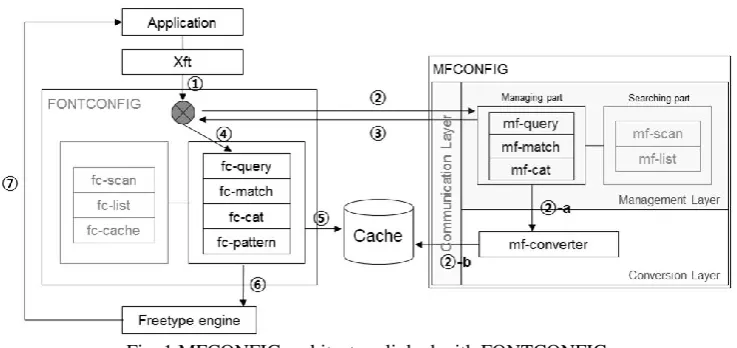
MFCONFIG is a plug-in module for FONTCONFIG. It enables the use of METAFONT format on Linux font system. It
mainly consists of three sub-layers; Communication layer, Management layer, and Conversion layer. Communication layer is
the starting point of MFCONFIG. It provides a medium for interaction between MFCONFIG and FONTCONFIG.
Management layer is responsible for tasks like searching and other operations. And Conversation layer is responsible for
converting METAFONT file into its corresponding outline font file. Fig. 1 shows the architecture of MFCONFIG module
linked with FONTCONFIG.
Fig. 1 MFCONFIG architecture linked with FONTCONFIG
Although MFCONFIG supports METAFONT in Linux font system, it still has its own problems. These problems are
mainly related to performance and dependability. As MFCONFIG is plugged in the high-level of font system i.e.
FONTCONFIG and not directly plugged inside FreeType, it makes its performance very slow compared to the font-specific
driver modules supported by FreeType. Whenever a client application inputs a METAFONT file for rendering styled text,
FONTCONFIG communicates with MFCONFIG, performs operations, and then sends input to FreeType for rendering text.
This whole process becomes slow because of the high-level operations before FreeType receives its input.
Other than the performance problem, MFCONFIG also has a dependability problem. As it is dependent on
FONTCONFIG library, this means that if there is a font environment where there is no FONTCONFIG, then this module
cannot be used. FONTCONFIG is mainly used in Linux font system for locating fonts and no other operating systems so,
MFCONFIG cannot be supported in them.
The proposed MF Integrator module has tried to resolve these two problems of MFCONFIG. It can be used for processing
METAFONT files directly inside FreeType as like any other driver modules like TrueType driver module, Type1 driver
module etc.
3.
MF Integrator Module
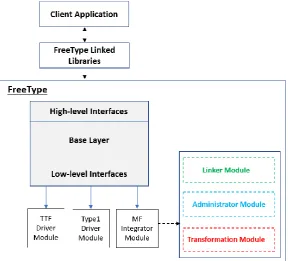
MF Integrator module mainly consists of 3 sub-modules; Linker module, Administrator module, and Transformation
FreeType library is dealt by this module. Linker module is mainly liable for linking METAFONT request to MF Integrator
module. The module provides a two-way linking, i.e. it links the METAFONT file request to MF Integrator module and returns
its respective outline font file. Administrator module handles all the administrative related tasks like searching if the requested
METAFONT is installed or not. Storing the newly created outline font information in a list. This list indicates whether a font
file is already prepared or not. Managing tasks like verifying the list if the outline font file for the requested METAFONT file
exists, sending METAFONT file to Transformation module for converting it into outline font file, returning the newly prepared
outline font file from Transformation module to Linker module.
Fig. 2 MF Integrator Module Architecture
The work of MF Integrator module is perfectly compatible with any FreeType version. This module can work as driver
module for managing METAFONT font which is not supported in FreeType by default. Whenever a different METAFONT
style is input, MF Integrator module can easily display the resulting fonts on screen. As it is directly implemented inside
FreeType engine, it has a better performance and no dependability compared with MFCONFIG module
4.
Testing MF Integrator Module
FreeType library supports many font formats like Truetype, Type1, etc. These format specific font modules are called
driver modules. Based on the input, FreeType decides which driver module to call for further operations. For example, if the
input file is Type1 format then FreeType calls Type1 driver module for processing it. FreeType doesn’t support a driver
module for processing METAFONT files.
For checking the working of this new MF Integrator module, a client application is used which is responsible for printing
the styled font text on the screen. This client application takes a font file and text to be printed on the screen as input and passes
this input to FreeType for processing. After processing by FreeType this application prints styled text on the screen.
For testing that FreeType now directly supports METAFONT file input using MF Integrator module, a METAFONT
called Computer Modern is input to the client application. This font file is passed to MF Integrator module using the Linker
module. Linker module then examines the request and passes this METAFONT file to Administrator module. Administrator
module takes this request, performs management related tasks, and passes the input file to Transformation module.
is stored in the list for future reusability. This outline font file is then passed to FreeType core processing layer for further
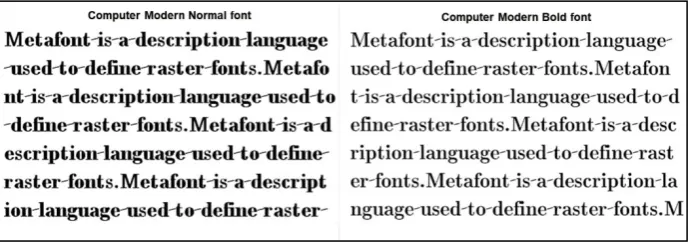
operations. After default operations by FreeType, it is returned to client application which displays the corresponding styled text on screen. Fig. 3 shows the results of the printing of METAFONT “Computer Modern normal font” and “Computer Modern bold font”.
Fig. 3 Normal and bold styled METAFONT using MF Integrator Module
The MF Integrator module is developed to overcome the problems of MFCONFIG module. It provides users to display
various METAFONT styled fonts on screens just like any other fonts like TrueType etc. By just changing the parameters of
METAFONT source file users can display different styled fonts on screen.
As this module is implemented directly inside FreeType engine, its performance is very fast compared to the MFCONFIG
module. FreeType receives a METAFONT request from client application and process it directly just like any other default
Driver modules. MF Integrator module is only dependent on FreeType engine unlike MFCONFIG module which was
dependent on FONTCONFIG. This module provides reusability and portability features and can be used in any operating
system which supports FreeType engine.
5.
Conclusion
In this paper, we proposed a module for FreeType engine named MF Integrator module. This module overcomes the
problems like performance and dependability of MFCONFIG module. MF Integrator module provides a direct usage of
METAFONT format as it is implemented directly inside FreeType.
The research MFCONFIG module provided a way to use METAFONT format in current font system. But this module has
its own problems; it is plugged in FONTCONFIG and not directly in FreeType, therefore if there is no FONTCONFIG library
in the operating system, this module cannot be used. MFCONFIG module performance is also slow because it is implemented
in the high-level of font system.
We tested proposed module with a client application which is used to display styled text on screen. Users can now take the
benefits of METAFONT by using our proposed MF Integrator module. Future work will consider about proposed module
optimization and direct usage of bitmap fonts which is not supported by FreeType.
Acknowledgment
This work was supported by Institute for Information & communications Technology Promotion (IITP) grant funded by
the Korean government(MSIT) (No. R0117-17-0001, Technology Development Project for Information, Communication, and
Broadcast).
References
[3] D. Turner, R. Wilhelm, and W. Lemberg, “Freetype”, www.freetype.org, 2000.
[4] J. Y. Choi, S. M. Kim, H. J. Lee, and G. H. Jung, “MFCONFIG: a METAFONT plug-in module for FreeType rasterizer,” TUGBoat, vol. 37, no. 2, pp. 163-170, 2016.
[5] Keith Packard, “Font configuration and customization for ppen source systems”, https://keithp.com/keithp/talks/guadec2002/fontconfig.pdf