41 | http://mojes.um.edu.my/ EISSN: 2289-3024
MALAYSIAN ONLINE JOURNAL OF EDUCATIONAL SCIENCES JULY 2019, 7 (3)
INTRODUCTION
Reflection and reflective practices have been known to be indispensable characteristics that one should possess in order to be called a competent professional(Argyris & Schon, 1974; Boud, Keogh, & Walker, 1985; Moon, 1999; Schön, 1984, 1987; Mann, Gordon, & MacLeod, 2009). This is because reflective practices provide opportunities incorporate theory into practice to foster professional action and thoughts (Mann et al., 2009). Thereby, reflective practices are being integrated into all educational levels as a part of students’ learning process throughout their studies. It is believed that through reflection, learners take active responsibility for their own learning (Moon, 1999; Mezirow, 2000; Chirema, 2007). In this regard, Allan and Driscoll (2014) argue that by integrating reflection and reflective practices into existing coursework, learners can improve their learning through connecting and analyzing an event, experience, or thought; creating a bridge between their thoughts and actions. They reiterate that reflection is a powerful ability that allows learners to make connections to prior, present and future learning situations. Similarly, Mahlanze and Sibiya (2017) revealed that student nurses supported the use of reflective practices in the process of professional development and clinical learning. Participants in the study confirm that these reflective activities improved their ability in making proactive decisions, taking educative actions as well as being actively involved in their own learning.
DETERMINING DIMENSIONS OF PERCEPTION ON REFLECTIVE JOURNAL WRITING: PRACTICAL APPLICATION OF IMPORTANCE-PERFORMANCE ANALYSIS
*Fatemeh Haji Seyed Abolghasem Juliana Othman
Shanina Sharatol Ahmad Shah Faculty of Education, University of Malaya
ABSTRACT
Although reflective journal writing (RJW) has become a popular way to evaluate learning, little is known about participants’ perceptions upon this educational activity. The purpose of this research paper was to utilize Importance-Performance Analysis (IPA) to determine the dimension of pre-registered student nurses’ perception on reflective journal writing. A total of thirty conveniently selected participants contributed to the study. Data was collected based on an adapted survey questionnaire. Data was analyzed through SPSS (V. 24) as well as importance-performance matrix. By using IPA matrix, participants rated the importance attribute in the “ideal” reflective journal writing and how satisfied they were with their performance in the actual setting. With a two-dimensional grid of importance and performance, the location of these attributes would determine what the participants’ ideas were regarding RJW and how the educators would take necessary action accordingly. For the most parts, the results indicated that participants were satisfied with the academic practice. IPA proved to be a useful evaluation tool enabling curriculum and syllabus designers to identify the strength and weaknesses of RJW as perceived by participants.
42 | http://mojes.um.edu.my/ EISSN: 2289-3024
MALAYSIAN ONLINE JOURNAL OF EDUCATIONAL SCIENCES JULY 2019, 7 (3)
Reflection is believed to be the point of departure for levels of reflectivity that is more than just thoughtful practice or contemplative thinking. It relates to a thought process that establishes a baseline of understanding of different concepts, values, and beliefs initiated inter-personally or intra-personally that play significant role in the process of learning (Boud et al., 1985; Mezirow, 2000; Schön, 1987). The term reflective practitioners were first introduced by Schön (1984) that are in demand in the constantly changing world today. According to him, the reflective practitioner can reflect upon old experience to develop new knowledge and bring this tacit knowledge to the surface in order to acquire deep and lifelong learning.
RJW in Nursing Education
Reflective journal writing (RJW) has earned a reputation of being an educational tool (Mann et al., 2009; Milinkovic & Field, 2005; Plack & Greenberg, 2005). This acknowledgement has emerged due to the nature of reflective journal writing that enhances the students’ self-learning through deep and critical thinking in workplace arena and making meaning from the experience (Mezirow, 1998; Joseph, McClure, & Joseph, 1999; Moon, 1999). Since nurses are required to accomplish a significant amount of formal education, they must be proficiently knowledgeable about the new healthcare systems created by scientific and technological advances. Moreover, due to the nature of their profession, nurses should be equipped with the ability of applying academic knowledge into practice, making sound clinical judgment, effective decisions, and have a critical mind. These abilities in the literature are known as the ability to reflect (Schön, 1984).According to Braine (2009), nurses aspire to be reflective practitioners, so, they engage in reflective practices to reach the level of competency which is considered to have many attributes of reflective practices such as problem-solving skills and critical thinking. In the current Nursing Programme for Pre-Registered Student Nurse (PRSN), reflective practice is an explicit component of the nursing curriculum in the context of this study.
Nursing programs are designed to prepare nurses to become knowledgeable registered nurses in future who are clinically competent as well as professionally developed to meet the challenges and expectations in nursing. Hence, reflective journal writing has been considered a strategy to deal with these challenges facing nursing profession. Similarly, nurse educators encourage student nurses to reflect, that is to think about past experiences, present situations, and expected consequences of their practice. This, according to Thorpe (2004), can help student nurses to explain what they are doing and why. In other words, nurse educators promote professional nursing practice that is more reflective rather than merely routine (Thorpe, 2004). Schön (1987) introduces the significant impact of critical reflection in the development of professional and clinical knowledge. The ability to employ critical-thinking skills enhances student nurses to be more creative and resourceful which can assist them to achieve lifelong learning.
The role of reflective writing is considered fundamental in promoting meaningful learning and effective reflection. Mezirow (1997) suggested several ways to stimulate transformational learning, including journal writing, group projects, role play, case studies and many more. He believes these could stimulate critical consciousness and critical reflection that are integral parts of transformative process. What was strongly emphasized by Mezirow was that transformational learning could be realized when the experiences were discussed and explored. Furthermore, Mezirow (1981), states that reflective writing can facilitate the autonomy in learners when they take the responsibility for their own learning and gradually are capable of achieving lifelong learning. Thus, a liberated learner is a self-directed learner that has engaged in critical reflection.
Perception on RJW
43 | http://mojes.um.edu.my/ EISSN: 2289-3024
MALAYSIAN ONLINE JOURNAL OF EDUCATIONAL SCIENCES JULY 2019, 7 (3)
and staff nurses. Abednia, Hovassapian, Teimornejhad and Ghanbari (2013) explored in-service teachers’ perception regarding the challenges of reflective journal writing. They concluded that reflective journal writing serves as a dialogue between tutors and students, and they need to show enthusiasm toward students’ journals and be thoughtful to their comment on these journals since it influences the effectiveness and meaningfulness of the reflective journals. A study on investigating Malaysian students’ perception of critical thinking was conducted by Shazaitul and Maisarah in 2015. They concluded that students need to be well prepared to work with other people in a real work place. With the emphasis on understanding the subject matter in class, the students could advance in thinking process; especially in dealing with unpredictability of time constraint. Similarly, Braine (2009) pointed out that learners articulate their perceptions of a lack of self-efficacy in teachers to facilitate reflection and recommend strategies to teach reflection. She advocated that student nurses need carefully planned strategies to develop the skill of reflection. If the ability to practice reflectivity is perceived important in the process of professionalism, then the nurse educators must address the issues of how to teach and how students develop this skill (Braine, 2009). As reflection is a personal and individual mental activity, this study was conducted to explore the perceptions of PRSN on reflective journaling. As prior studies primarily focused on one predetermined aspect of the experience, this study attempts to provide a broader view of the entire participants’ perception on reflective journal writing.
METHODOLOGY
As the aim of this study indicates, a quantitative descriptive method was used to explore the dimension of perception on reflective journal writing (RJW) among the pre-registered student nurses.
Instrumentation
A structured questionnaire was adapted and modified to elicit pre-registered student nurses’ perceptions regarding reflective journaling. The questionnaire consisted of 47 items in five different sections aiming to reveal the participants’ perception and their personal thoughts and opinion on the role of reflective journaling in their personal and professional development as well as their clinical learning. The questionnaire was divided into five sections namely: a) usefulness of RJW; b) undesirable effects of RJW; c) barriers to good reflection; d) the role of mentors in RJW; and e) RJW as a tool to assess learning outcome. In this survey questionnaire, the participants’ perceptions were measured across Likert Scales using five points of Strongly Disagree to Strongly Agree. Although there is no theoretical reason to rule out different lengths of response scale, Creswell (2012) maintains that five rating scales illustrate “a scale with theoretically equal intervals among responses” (p. 167).
Importance-Performance Analysis
44 | http://mojes.um.edu.my/ EISSN: 2289-3024
MALAYSIAN ONLINE JOURNAL OF EDUCATIONAL SCIENCES JULY 2019, 7 (3)
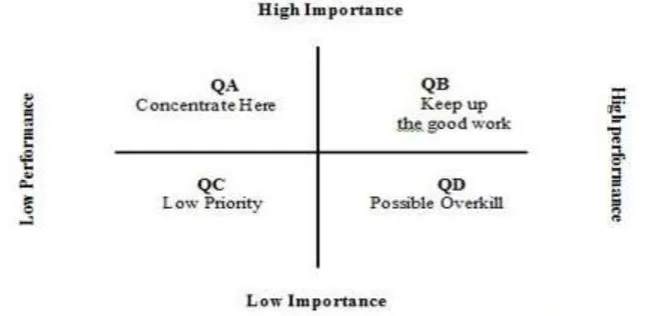
QA. First quadrant: Concentrate here, where high importance and low performance meet each other. This quadrant is the most critical classification because underperformance requires immediate attention and represents major weaknesses and threats to performing competitively. The factors must be identified to take action toward possible change in policy, and strategies.
QB. Second quadrant: Keep up with the good work, where high importance and high performance meet. The attributes within this quadrant are indicative of standard performance where major strengths should be maintained. It also indicates that the resources and efforts are being effectively allocated and used where they are needed. Thus, current approaches and strategies should be continued and enhanced.
QC. Third quadrant: Low priority, where low importance and low performance attributes meet. Attributes in this quadrant do not require immediate action as it denotes no threat and represents minor weaknesses. Azzopardi and Nash (2013) stated that these attributes attract low priority and decision-makers can ascertain the losing out completely on resources and effort. That is, if no importance placed on that attribute, extra effort to improve performance is unnecessary.
QD. Fourth quadrant: Possible overkill, where low importance and high performance attributes meet. The attributes in this quadrant are suggestive of over-performance. That signifies inefficient use of resources due to low priority for improvement. In this case, strategies to release resources and efforts seem appropriate and should be diverted in other required areas.
Figure 1. Importance-Performance Matrixes (Source: Martilla and James, 1977)
45 | http://mojes.um.edu.my/ EISSN: 2289-3024
MALAYSIAN ONLINE JOURNAL OF EDUCATIONAL SCIENCES JULY 2019, 7 (3)
Respondents
A convenience sampling was done with 30 pre-registered student nurses who had been introduced to reflective journal writing in the first year of their study. Almost all the participants revealed similar characteristics of gender, age, and educational background. Polit and Beck (2012) indicate that if the group is homogeneous, confounding variables are controlled and internal validity is maintained. This group of PRSN was selected because they were familiar with reflective practice and had had their examinations on this subject a month prior to data collection.
Data Analysis
The questionnaire was analysed using SPSS to present the Mean and Standard Deviation which are represented in graphs and tables. Moreover, in order to have more scientific results from the Mean (M), Important-Performance Analysis Method (IPA) were used. The graphic representation of IPA allows one to see where the participants’ perception could be allocated in terms of importance and performance criteria. Descriptive statistics was utilized to describe trends in the data and to show the general tendencies by calculating the Mean and Standard Deviations (SD). Then, the researcher summarized the overall tendency of the data, variability of the scores and to see where one score stands in comparison with others (Creswell, 2012). However, to have more reliable results for participants’ perception, the researcher utilized an exploratory research technique called Importance-Performance Analysis Method or (IPA Matrix). The utility of the IPA lays in its ability to bring together, both the participants’ (importance) and their (performance) perspectives.
Two lines are created horizontally and vertically across the matrix from the mid-point of X and Y axis. The mean score of both importance and performance dimensions make the points in the IPA matrix. Accordingly, the results of mean were utilized and placed in the four quadrants. With this, the results were more reliable as they demonstrate the actual place of the mean score and the interpretation that follows the discussion. Accordingly, the attributes were classified or compared to the relative importance- performance rating.
Precision of Study
46 | http://mojes.um.edu.my/ EISSN: 2289-3024
MALAYSIAN ONLINE JOURNAL OF EDUCATIONAL SCIENCES JULY 2019, 7 (3)
RESULTS AND DISCUSSION
The main purpose of the study was to determine the dimensions of perception on RJW and how PRSN ranked the importance of RJW and how they rated their performance based on actual experience of this activity. The purpose should help to accumulate information with regard to:
General perceptions (importance) of PRSN who take part in RJW after their clinical posting.
Actual experience (performance) of PRSN in relation with their perception of RJW
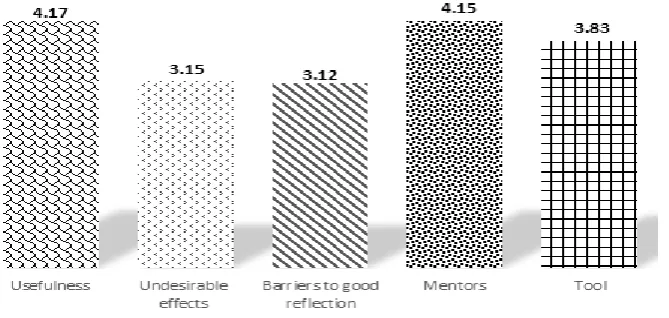
As the questionnaire consisted of five sections, each table and corresponding IPA action grid refers to a particular section with different numbers of items and related results of mean and the quantifier of attributes. The participants shared their feedback and provided their responses based on their knowledge and understanding of reflective journal writing to each section. Findings confirmed that the greatest total gap was between section one on the usefulness of RJW (T=4.17<5) and section three on barriers to good reflection (T=3.12<5). However, the least total gap belonged to participants’ perceptions on usefulness of RJW (T=4.17<5) and the role of mentors in RJW (T=4.15<5). It can be concluded that the PRSN perceive RJW to be very useful in their educational process. Their ideas about undesirability of RJW could not be a barrier in their learning. Furthermore, among five quality dimensions, the highest reliability of .87 was related to section one on the usefulness of RJW, whereas the least reliability (.69) belonged to section five on using RJW as a tool for assessment purposes. Figure 2 depicts the summary of means of the PRSN’s perceptions on RJW related to five sections of the questionnaire.
Figure 2. Summary of perception on the Reflective Journal Writing (RJW)
The Usefulness of RJW
47 | http://mojes.um.edu.my/ EISSN: 2289-3024
MALAYSIAN ONLINE JOURNAL OF EDUCATIONAL SCIENCES JULY 2019, 7 (3)
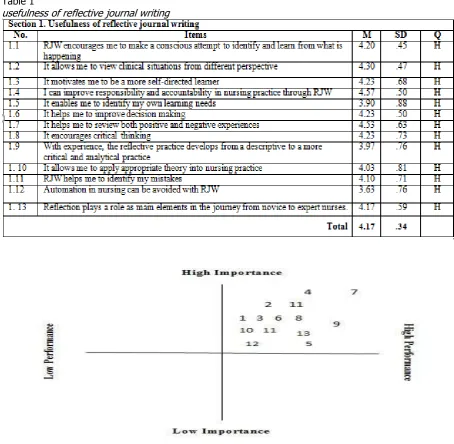
Table 1
usefulness of reflective journal writing
Figure 3. Action Grid demonstrating Importance and Performance data for usefulness of reflective journal writing
Interpretation of IPA Results
48 | http://mojes.um.edu.my/ EISSN: 2289-3024
MALAYSIAN ONLINE JOURNAL OF EDUCATIONAL SCIENCES JULY 2019, 7 (3)
Undesirable Effects of RJW
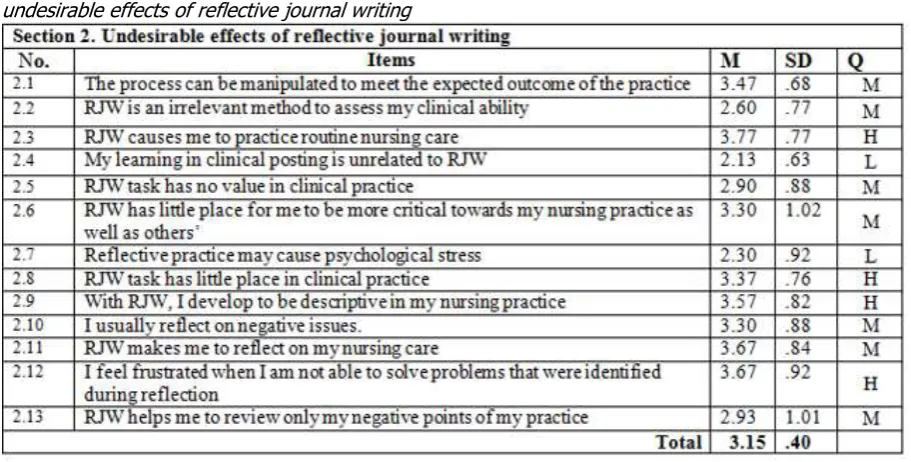
This section constituted 13 items discussing the adverse impacts of reflective journal writing among the participants. According to Table 2, item number 2.3 demonstrates the highest mean of M = 3.77<5 and SD =.77. On the other hand, the lowest mean appeared for item number four with the result of M = 2.13<5 and SD = .63. However, the significance of this result for item number three is very surprising and could be considered an unexpected one, or serendipity. While some studies claimed that reflective journaling prevents student nurses from routine work is a positive effect of reflective writing (e.g. Chirema, 2007; Jasper, 1999; Mezirow, 2000), the participants for this study perceive reflective journaling as a cause that makes them practice routine nursing care. It can be implied that they look at reflective practice as a means for doing what is “right” in nursing care.
Moreover, the lowest score of this category was for item 2.4 with the result of (M = 2.13<5, SD = .63). These results indicate that participants perceive reflective journaling to be much related to their clinical learning. These results are in line with the findings of other studies namely, Milinkovic and Field (2005) and Chirema (2007). This result also coincides with a study conducted in SEGI University in 2014 in Malaysia on learning style. In this study, female pre-clinical medical students, showed to be in favour of more reading and writing as their dominant learning style rather than kinesthetic which was more common among male students. We can claim that the participants in this study also fall in group of writing as a preferred model of learning style. As Table 2 indicates, the participants’ perception about undesirable effects of RJW has a result of low mean (M=3.15<5). That is, although sections 1 and 2 have a similar number of items, there were significant differences in results.
Table 2
undesirable effects of reflective journal writing
49 | http://mojes.um.edu.my/ EISSN: 2289-3024
MALAYSIAN ONLINE JOURNAL OF EDUCATIONAL SCIENCES JULY 2019, 7 (3)
Figure 4. Action Grid demonstrating Importance and Performance data for undesirable effects of reflective journal writing
Interpretation of IPA Results
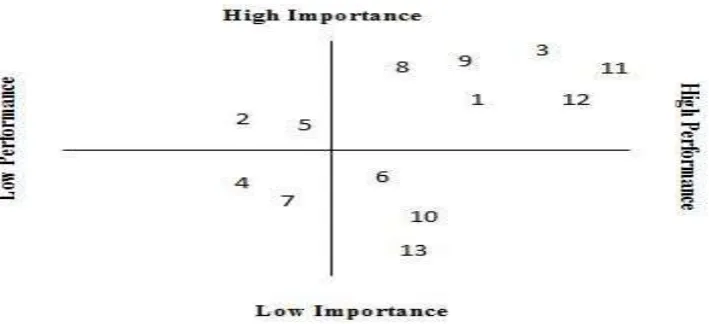
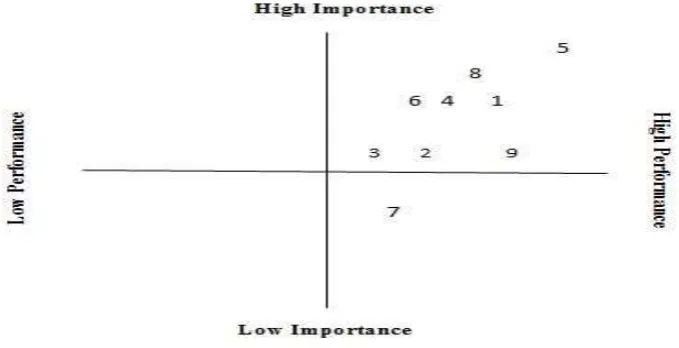
As in Figure 4, the action grid of IPA matrix for Table 2 indicates that the attributes are items scattered in all four quadrants. This means that the dimension of the participants’ perceptions of RJW is wider and locates the attributes of undesirable effects of RJW in all quadrants. For instance, the attributes (2 and 5) were located in the first quadrant (QA) where high importance and low performance meet. As the relevancy and value of RJW in clinical practice have negatively perceived, the indication was that immediate attention must be given to escalate the performance of RJW among participants. In this regard, factors must be identified to take action towards possible change in policy, and strategies. Moreover, a number of six attributes (1, 3, 8, 9, 11, and 12) were placed in the second quadrant (QB) where the high importance and high performance are meeting in one quarter. That is, the feedback on perception indicated that PRSN have used their major strengths effectively and this standard performance should be maintained. For instance, Chirema (2007) stated that participants manipulate their writing to what was expected from them to write in their journal because they want to maintain their status with their tutors. In this case, the participants paid attention to their high performance and showed their awareness on the priority and importance of RJW in their syllabus. The participants declared “RJW has little place in their nursing practice”; that is, they wrote descriptively in their RJ which made them realize the problem but not being able to solve it. They placed high importance and high performance in their RJW even though they had faced difficulties. These attributes were somehow overlapping with items in other section to maintain correct reply from the participants.
Similarly, two attributes (4 and 7) were located in the third quadrant (QC) where the low importance and low performance attributes meet. This quadrant represents low priority and requires no immediate action. Due to limited number of attributes, it can be assumed that decision-makers place no importance on these attributes. On the other hand, the results showed that three attributes (6, 10, and 13) were placed on the fourth quadrant (QD) where low importance and high performance attributes meet each other. That is, although PRSN did their reflective journals regularly, they had negative ideas about this practice and found RJW useless in the process of learning. In this case, the resources were inefficiently used and it would be better to be diverted in other required areas.
Barriers to Good Reflection
50 | http://mojes.um.edu.my/ EISSN: 2289-3024
MALAYSIAN ONLINE JOURNAL OF EDUCATIONAL SCIENCES JULY 2019, 7 (3)
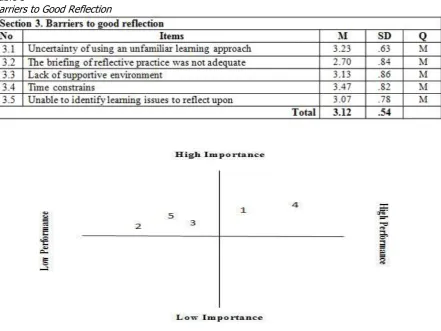
designed to capture any possible inhibition for PRSN to project effective reflection that is the precursor of real reflective journaling. Comparable to other studies, the item with highest mean is “Time constrains” was considered the highest barrier to produce a good reflective journal with a result of (M = 3.47, SD=.82). The factor of “time constrain” or “lack of time” or “have not enough time” appeared in almost every study on reflective writing. For instance, Chirema (2007) has concluded that some respondents did not believe it was necessary to write journal as it is very time consuming.
Furthermore, participants were uncertain or agreed and no one showed strong disagreement upon the issue of inadequacy of briefing for reflective practice; so, the lowest mean was for “inadequate briefing” with M = 2.70 and SD = .84. In general, barriers to good reflection among PRSN is moderate (M = 3.12, SD = .54). Thus, it can be implied that with appropriate amount of briefing from their mentors, still the time factor is the major barrier to good reflection. Additionally, the statistics of analysis indicates that the lowest mean refers to barrier to good reflection among other components of reflective journaling M=3.12 out of 5.
Table 3
Barriers to Good Reflection
Figure 5. Action Grid demonstrating Importance and Performance data for Barriers to Good Reflection
Interpret the Results of IPA
51 | http://mojes.um.edu.my/ EISSN: 2289-3024
MALAYSIAN ONLINE JOURNAL OF EDUCATIONAL SCIENCES JULY 2019, 7 (3)
On the other hand, two attributes (1 and 4) were located on the second quadrant (QB) of high importance and performance.As the barrier for the RJW concerned,participants’ perceptions on these attributes indicated that being uncertain and being concern about time constrains were two important factors influencing their performance. Thus, truly these two attributes had impact on their quality of writing.
Mentors in Reflective Practice
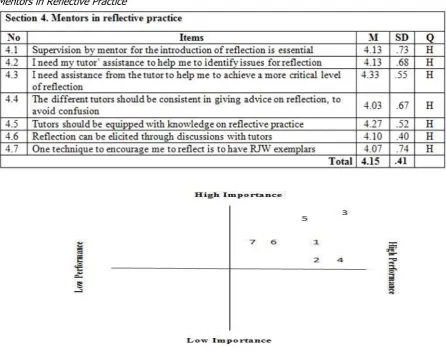
In this section, “mentors” referred to the Nurse Tutors (NT) who teach and train Student Nurses and shape their academic life. As far as reflection concerns, these mentors play different rules of preceptors, supervisors, facilitators, and advisors for reflection activities. According to the result demonstrated in the table 4, item number three, “need assistance”, projected with the highest mean of M = 4.33 and SD =.55. Whereas, the lowest mean is for the item number four, “sufficient briefing”, with M = 4.03 and SD = .67. This result is supported by the study conducted among Malaysian undergraduates. Accordingly, Malaysian educationalists found that Malaysian students are not independent enough (Farida, 1995 as cited in Maesin et al., 2009), that is they expected to be “spoon-fed” with information.
Table 4
Mentors in Reflective Practice
Figure 6. Action Grid demonstrating importance and performance data for mentors’ roles in reflective practice
52 | http://mojes.um.edu.my/ EISSN: 2289-3024
MALAYSIAN ONLINE JOURNAL OF EDUCATIONAL SCIENCES JULY 2019, 7 (3)
Interpret the Results of IPA
The action grid of IPA matrix (figure 6) for this section demonstrates that all the attributes were placed in the second quadrant (QB). That is, the dimension of the PRSN’s perception on the role of mentors in RJW was considered as high importance and high performance. This quadrant denotes keep up with the good work that indicates mentors’ efforts toward RJW practice was positively allocated and used where they are needed. Participants had confidently emphasised on their tutors’ briefing, assistance, and having discussion and giving exemplar were their major strengths in the process of producing RJW for the sake of their learning. Moon (1999) emphasised that valued personal experience can play a role in learners’ development and emancipation. Mentors’ valued experience was considered important and necessary for PRSN to produce RJW competitively.
Reflective Practice as a Tool to Assess Learning
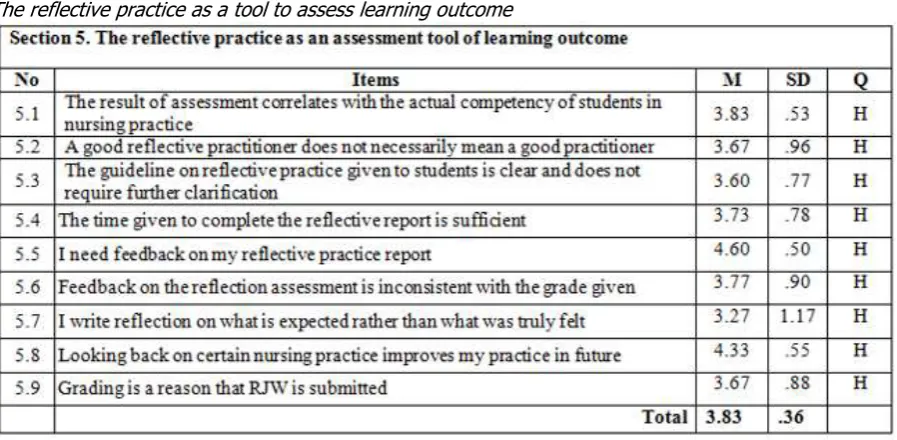
This section consisted of nine items designed to statistically describe the PRSN’s perceptions of appropriateness of the use of RJW for assessment purposes. As for descriptive analysis, the item with highest mean belonged to the item number five,” I need feedback on my reflective practice report”, with M = 4.60 and SD =.50. This item received agreements that showed there is a high consistency among the majority of participants on the notion of feedback from their mentors on their RJW. However, the lowest mean referred to item number seven, “I write reflection on what is expected rather than what was truly felt”, with M = 3.27 and SD = 1.17. It can be implied that the participants write about the real-life event as it was expected to be seen or perceived by their mentors. This result was aligned with findings in other studies (e.g. Chirema, 2007).
Table 5
53 | http://mojes.um.edu.my/ EISSN: 2289-3024
MALAYSIAN ONLINE JOURNAL OF EDUCATIONAL SCIENCES JULY 2019, 7 (3)
Figure 7. Action Grid demonstrating importance and performance data for the reflective practice as an assessment tool of learning outcome
Interpret the Results of IPA
As the result of table 5 displayed in the action grid of IPA matrix (figure 7), it can be concluded that participants’ perceptions on using RJW for assessment purposes placed majority of attributes on the second quadrant (QB) and only one fell on the fourth quadrant (QD). This means that the participants’ perceptions had carried high importance and high performance for this section. The fourth quadrant signifies keep up with the good work that indicates participants had been positive to use their RJW as an assessment tool to evaluate their learning of clinical posting. This finding demonstrated that participants provided quality dimensions of their perceptions to maintain the use of RJW for assessment purposes confidently.
The fourth quadrant (QD) is also known as possible overkill that is an over-performance had taken place. This means the dimension of participants’ perceptions was low importance with high performance. That is, PRSN participated actively in RJW; however, the writings projected little truth. Hence, mentors, tutors, and other policy makers must inspect what had caused this condition and divert their effort to more appropriate areas.
CONCLUSION AND RECOMMENDATIONS
54 | http://mojes.um.edu.my/ EISSN: 2289-3024
MALAYSIAN ONLINE JOURNAL OF EDUCATIONAL SCIENCES JULY 2019, 7 (3)
Figure 8. Summary of total attributes in each quadrant
According to Figure 8, it can be concluded that from the total overview of the results, majority of attributes pertaining to RJW practice had been located in the second quadrant (QB) which indicates keep up with the good work. However, other attributes, although there show minor differences, they require attention. Hence, the dimensions in importance-performance matrix can guide educators to identify the most appropriate strategic options to enhance effectiveness of RJW practices among PRSN. Moreover, to researcher’s knowledge, no evidence of IPA has been found in evaluating RJW; so, these findings can be a platform for future studies on RJW in the domain of IPA. Azzopardi and Nash (2013) recommended that further study would be needed to develop a refined IPA framework aimed at enhancing the reliability and validity of IPA in the research. Lai and Hitchcock (2015) specified that “although there are certain weaknesses, ‘data-centered quadrants approach’ is the most common direct measurement in IPA matrix. The simplicity and effectiveness enhance the method’s suitability for junior researchers with limited experience of performing complex statistical analyses.” (p. 253). If novice researchers who may have a limited knowledge of the various statistical approaches and are interested in conducting IPA, then this study has met it objectives to introduce guidelines for them.
ACKNOWLEDGMENTS
The author appreciates University Malaya College of Allied Health, Department of Diploma of Nursing which facilitated the process of data collection.
REFERENCES
Abalo, J., Varela, J., & Manzano, V. (2007). Importance values for importance- performance analysis: A formula for spreading out values derived from performance rankings. Journal of Business Research, 60(2), 115-121.
Abednia, A., Hovassapian, A., Teimornejhad, S., & Ghanbari, N. (2013). Reflective journal writing: Exploring in-service EFL teachers’ perceptions. System, 41, 503-514.
Alberty, S., & Mihalik, B. J. (1989). The use of importance-performance analysis as an evaluative technique in adult education. Evaluation Review, 13(1), 33-44.
Allan, E. G., & Driscoll, D. L. (2014). The three-fold benefit of reflective writing: Improving program assessment, student learning, and faculty professional development. Assessing Writing, 21, 37– 55.
Argyris, C., & Schon, D. (1974). Theory in practice: Increasing professional effectiveness. San Francisco: Jossey-Bass.
Azer, S. A. (2008). Use of portfolios by medical students: Significance of critical thinking. The Kaohsiung Journal of Medical Sciences, 24(7), 361-366.
Azzopardi, E., & Nash, R. (2013). A critical evaluation of importance-performance analysis. Tourism Management, 35, 222-233.
55 | http://mojes.um.edu.my/ EISSN: 2289-3024
MALAYSIAN ONLINE JOURNAL OF EDUCATIONAL SCIENCES JULY 2019, 7 (3)
Boud, D., & Walker, D. (1998). Promoting reflection in professional courses: The challenge of context. Studies in Higher Education, 23(2), 191-206.
Braine, M. E. (2009). Exploring new nurse teachers’ perception and understanding of reflection: An exploratory study. Nurse Education in Practice, 9(4), 262-270.
Chapman, R. G. (1993). Brand performance comparatives. Journal of Products &Brand Management, l2(1), 42-50.
Chirema, K. D. (2007). The use of reflective journals in the promotion of reflection and learning in post-registration nursing students. Nurse Education Today, 27(3),192-202.
Chong, M. C. (2009). Is reflective practice a useful task for student nurses? Asian Nursing Research, 3(3), 111-120.
Creswell, J. W. (2012). Educational research, planning, conducting and evaluating qualitative and
quantitative research. (4th Ed). Boston: Pearson.
Jasper, M. A. (1999). Nurses' perceptions of the value of written reflection. Nurse Education Today, 19(6), 452.
Joseph, M., McClure, C., & Joseph, C. (1999). Service quality in the banking sector: The impact of technology on service delivery. International Journal of Bank Marketing, 4, 182-193
Lai, K. W., & Hitchcock, M. (2015). Importance-performance analysis in tourism: A framework for researchers. Tourism Management, 48, 242-267
Lestander, O., Lehto, N., & Engstrom, A. (2016). Nursing students' perceptions of learning after high fidelity simulation: Effects of a three-step post-simulation reflection model. Nurse Education Today, 40, 219–224
Mackintosh, C. (1998). Reflection: a flawed strategy for the nursing profession. Nurse Education Today, 18(7), 553-557.
Maesin, A., Mansor, M., Shafie, L. A., & Nayan, S. (2009). A study of collaborative learning among Malaysian undergraduates. Asian Social Science, 5(7), 70-76.
Mahlanze, H. T., & Sibiya, M. N. (2017). Perceptions of student nurses on the writing of reflective journals as a means for personal, professional and clinical learning development. Health SA Gesondheid, 22, 79-86.
Mann, K., Gordon, J., & MacLeod, A. (2009). Reflection and reflective practice in health professions education: a systematic review. Advances in Health Sciences Education, 14(4), 595-621
Mezirow, J. (1981). A critical theory of adult learning and education. Adult Education Quarterly, 32(1), 3-24.
Mezirow, J. (1997). Transformative learning: Theory to practice. New Directions for Adult and Continuing Education, 74, 5-12.
Mezirow, J. (1998). How critical reflection. Adult Education Quarterly, 48(3), 185-198
Mezirow, J. (2000). Learning as transformation: Critical perspectives on a theory in progress. San Francisco, CA: Jossey-Bass.
Martilla, J., & James, J. (1977). Importance-performance analysis. Journal of Marketing, 41(1), 77-79 Milinkovic, D., & Field, N. (2005). Demystifying the reflective clinical journal. Radiography, 11(3),
175-183.
Moon, J. A. (1999). Reflection in learning and professional development theory and practice. London, UK: Kogan Page.
Nitse, P. S., & Bush, R. P. (1994). An examination of retail dental practices versus private dental practices using an importance-performance analysis. Health Marketing Quarterly, 11(1-2), 207-222
Plack, M. M., & Greenberg, L. (2005). The reflective practitioner: Reaching for excellence in practice. Pediatrics, 116(6), 1546-1552.
Polit, D. F., & Beck, C.T. (2012). Essentials of nursing research: Appraising evidence for nursing practice. (8th ed.) Philadelphia, PA: Lippincott Williams & Wilkins.
Pan, F. C. (2015). Practical application of importance-performance analysis in determining critical job satisfaction factors of a tourist hotel. Tourism Management, 46, 84-91
Schön, D. A. (1987). Educating the reflective practitioner. San Francisco, CA: Jossey-Bass.
56 | http://mojes.um.edu.my/ EISSN: 2289-3024
MALAYSIAN ONLINE JOURNAL OF EDUCATIONAL SCIENCES JULY 2019, 7 (3)
Shazaitul, A. R., & Maisarah, M. S. (2015). The perception of critical thinking and problem-solving skill among Malaysian undergraduate students. Social and Behavioral Sciences, 172, 725 – 732 Thorpe, K. (2004). Reflective learning journals: From concept to practice. Reflective Practice, 5(3),
327-343.