Tribology in Industry
www.tribology.rsOptimization of the vibration isolation performance
of an impact-testing machine using multi-walled
carbon nanotubes reinforced elastomeric machine
mounts
K. Tsongas
a, G. Mansour
aaLaboratory for Machine Tools and Manufacturing Engineering, Department of Mechanical Engineering, Aristotle University of Thessaloniki, University Campus, 54124, Thessaloniki, Greece.
Keywords:
Nano composites Vibration isolation Genetic algorithm Non-destructive testing NBR
Carbon nanotubes Impact testing machine
A B S T R A C T
The objective of this paper is to investigate the vibration isolation performance of an impact testing machine mounted on elastomeric nanocomposite mounts. An effective analytical-experimental test method was implemented in this paper to characterize the vibration isolation performance of acrylonitrile-butadiene rubber (NBR) mounts reinforced with multi-walled carbon nanotubes (MWCNTs). This method utilizes modal tests in order to measure experimental transfer functions (TFs) of a impact testing machine as a correlation parameter to analytical-experimental determined TFs. The optimization procedure is carried out using a genetic algorithm (GA) by minimizing the difference between the experimental data from modal tests and the calculated response. A series of NBR mounts were manufactured with different concentrations of MWCNTs. The vibration isolation capacity of the machine mounts was determined through the transmissibility of a suitably designed test system. Elastomers’ vibration isolation performance was ameliorated with the inclusion of MWCNTs, signifying that the enhancement of the elastomers with MWCNTs was rather effective. It is also shown that the stiffness of an elastomer and its damping capacity can be tuned by adjusting the proportion of MWCNTs. The vibration level of the impact-testing machine was decreased to 91% by incorporating the optimal concentration of MWCNTs in NBR mounts.
© 2019 Published by Faculty of Engineering
Corresponding author:
K. Tsongas
Laboratory for Machine Tools and Manufacturing Engineering, Department of Mechanical
Engineering, Aristotle University of Thessaloniki, University Campus, 54124, Thessaloniki, Greece. E-mail: [email protected]
1. INTRODUCTION
Transient or dynamic loads can cause high vibration levels to a machinery, which are directly related to its performance. This is either
by virtue of causing temporary malfunction during excessive motion or by creating disturbance or discomfort, such as objectionable noise levels, operator discomfort, unsafe operating condition, stress fatigue failure,
R
ES
EA
R
premature wear. For all these potential complications, it is essential that the vibrations encountered in service or operation to be predicted and brought under acceptable levels [1]. Therefore, vibration isolation aims towards the protection of a machinery from severe external shocks and vibrations, as well as from irregular disturbances caused by the machine itself, along with the decrease of noise and vibration levels in a workshop area.
Passive vibration isolation utilizing resilient mounts has been widely used in vibration and noise control to hinder the spread of vibrations from a source to a receiving structure or a structural component with a significant radiating area. In order to design an operative isolator or to predict the level of isolation, a precise measurement of the dynamic behavior, i.e. dynamic complex stiffness and damping, is required. The concept of complex stiffness with viscous and hysteresis damping has been exquisitely explained for a single degree of freedom (SDOF) system [2]. Several test methods have been developed in order to characterize the complex modulus parameters of elastomeric machine mounts [3-6]. In the past, the damping capacity of conventional engineering materials has not generally provided sufficient energy dissipation to limit resonant amplitudes of vibration [7]. The damping capacity is an important element for vibration isolation; therefore, it is necessary to develop structural components with high values of damping factors. Therefore, it would be of great importance to examine new machine mounts that simultaneously exhibit high damping - high stiffness, with low density, which include elastomeric matrix nanocomposites.
Considering their intriguing physical properties and unique structure, carbon nanotubes (CNTs) attract increasing attention since their discovery [8–10]. With their exceptional mechanical and physical behavior and application prospects in engineering materials, CNTs have been considered as good fillers for modifications in polymeric materials [11, 12]. The influence of single-walled carbon nanotubes (SWNTs) on the mechanical and physical behavior reinforcing natural rubber (NR) has been investigated [13] with dynamic mechanical analysis (DMA), differential scanning calorimetry, and Raman spectroscopy to acquire the possible interactions
between both phases, as well as the dispersion of the SWNTs in the elastomeric matrix. Another study [14] has performed tensile tests on cured SBR specimens reinforced with various concentrations of MWCNTs. According to this paper, elongation at break remained at the level of control SBR samples (~460 %) for concentrations up to 7.5wt% MWCNTs and then marginally reduced while the stress at break increased by 210 % up to 7.5wt% MWCNTs, demonstrating the strengthening impact of MWCNTs and their interfacial bonds with SBR.
However, comparing with the great number of papers on applications of CNTs in polymers and elastomers [12-14], there were rather fewer reports dealing with the vibration isolation performance of CNTs in elastomer. The vibration isolation properties of NBR mounts modified with different concentrations of MWCNTs have been investigated by Tsongas et al. [15] with static and cyclic compression, along with an analytical-experimental modal testing method. The addition of MWCNTs significantly improved the vibration isolation performance of the rubber-based composites. The dynamic stiffness, the damping and the capacity to isolate vibrations can be adjusted by modifying the content of MWCNTs in NBR mounts. The higher percentage reduction of the vibration level of the specimens occurred for the 20wt% MWCNTs/NBR with an improvement of 69 %.
of the modal parameters. The vibration isolation performance of the isolators was characterized by analyzing the resonant frequencies, the damping and the transmissibility of the nano-modified elastomeric isolators. This was a repetitive procedure for the different nanofiller concentrations in the elastomeric matrix. The optimal nanocomposite elastomers were applied to a vertical impact test machine and the vibration levels were measured through the analysis of the transmissibility.
2. EXPERIMENTAL DETAILS
2.1Manufacturing of NBR/MWCNTs nanocomposite machine mounts
The acrylonitrile-butadiene rubber used was supplied by Nitriflex (Brazil). It was mixed with a commercial masterbatch (Graphistrength C E2-40) which is based on acrylonitrile rubber resin that contains perfectly dispersed MWCNTs at a concentration of 40wt%. Graphistrength C E2-40 is appropriate for the manufacturing of conductive or antistatic materials based on carboxylated, hydrogenaded plastisized or nonplastisized elastomers. The manufacturing procedure is illustrated in Fig. 1.
Fig. 1. Manufacturing process steps of the vibration isolation nanocomposite NBR/MWCNTs mounts.
The mixing was carried out using a two-roll mill (open mill) at temperature 70 oC and 40 rev min−1
(RPM) roller’s speed for 25 min. The NBR was sufficiently masticated and thus became softer at a reduced viscosity. The appropriate amounts of
the masterbatch pellets were then added thereby maintaining a desired MWCNTs weight ratio. The vulcanization additives consisted of crosslinker sulfur (3.2 %), activators stearic acid, SA, (1 %) and zinc oxide, ZnO, (6 %), accelerants dibenzothiazole disulfide, DM, (1.5 %) and tetramethylthiuram disulphide, TMTD, (0.5 %) and plasticizer dioctylphthalate, DOP, (12.5 %). When the mixture started to look homogeneous, the final part of the rubber was introduced and the nanocomposite rubber was ready for molding. This last step was important for efficient vulcanization of the rubber. Then the nanocomposite rubbers were fabricated using a hot press at 150 oC for 10 min and the specimens
were cut into shapes. NBR nanocomposites with various MWCNTs loadings were produced. At least five nanocomposite specimens were prepared with MWCNTs of 0 to 20wt%. Subsequently, MWCNTs/rubber elements were bonded between a steel pedestal and steel cap. The final dimensions of the NBR/MWCNTs isolation mounts were 60mm diameter and 27 mm height.
2.2Transmissibility of machine mounts, modal tests and signal processing
A machine mount with a pre-load mass can be characterized as a single degree of freedom (SDOF) system consisted of a mass, a spring and a dashpot. The transfer function of a system 𝐺𝑖𝑗
describes the relation between input excitation at point 𝑖 and output response at point 𝑗. In order to introduce an analytical mode representation, a genetic algorithm (GA) optimization method has been utilized to fit experimental transfer function curves with a set of superimposed, single-mode vibratory response functions [15-23]. The vibration isolation performance of the mounts is evaluated with the transmissibility analysis of the mass-mount system, which represents the ratio of the energy coming out of the system to the energy going into the system. Transmissibility represents the non-dimensional ratio of the response amplitude (output) of a system in steady-state forced vibration to the excitation amplitude (input) [24]. The ratio may be one of forces, displacements, velocities, or accelerations.
𝐹𝑇(𝑡) = 𝑘𝑥 + 𝑐𝑥̇ (1)
The magnitude of this force can be written as a function of frequency as:
𝐹̃𝑇(𝜔) = √[𝑘𝑥̃(𝜔)]2+ [𝜔𝑐𝑥̃(𝜔)]2
= 𝑥̃(𝜔)√𝑘2+ (𝜔𝑐)2 (2)
So the transmissibility can be expressed by the following relation:
𝑇(𝜔) =𝐹̃𝑇(𝜔) 𝐹̃1(𝜔)
(3)
where 𝐹̃1(𝜔) is the magnitude of the excitation force function of the modal hammer and 𝐹̃𝑇(𝜔) is the magnitude of the transmitted force through the machine mount to the supporting structure or base.
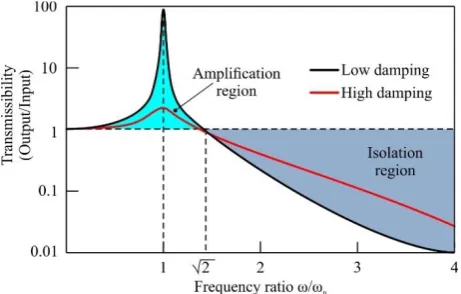
Fig. 2. Typical transmissibility curves comparing the damping of vibration isolators.
The transmissibility curve in Fig. 2 shows the efficiency of the mount to decrease the levels of vibration. It also demonstrates a number of significant concepts. Firstly, the mounts should be selected to avoid exciting the natural frequencies of the machine. Secondly, damping is important in the range of resonance whether the dynamic system is operating near resonance or must pass through resonance during start-up. Lastly, in the isolation region, the larger the ratio 𝜔/𝜔𝑛, i.e. the smaller the value of the natural frequency 𝜔𝑛, the smaller the transmissibility value will be.
The typical experimental setup for the evaluation of the vibration isolation properties of the nanocomposite machine mounts is illustrated in Fig. 3, where each NBR/MWCNTs isolator was fixed on a dynamometer, with a steel mass (10 kg) used as a static pre-load. A modal hammer with a piezoelectric force transducer (2302-10 Model, Endevco) was used to apply an impact force along the center of the mass. The transmitted force was acquired with a three component piezoelectric
dynamometer (Kistler 9257A), connected accordingly with the suitable charge amplifiers. The dynamometer was mounted on a granite block by screws to resemble clamped boundary conditions. The response was recorded through acceleration sensors with a sensitivity of 100 mV/g (Brüel & Kjaer 4507B), mounted at the top of the steel preload-mass. The analog signals of the dynamometer, the modal hammer and the accelerometers were amplified and then acquired by an analog-to-digital (A/D) converter connected to a computer employing MATLAB software for immediate signal processing [16]. The frequency span of acceleration signals was up to 1600 Hz, the sampling time was 1 s and the sampling frequency was 4096 samples per second (Hz). All the machine mounts were tested 10 times and linear averaging was implemented to avoid the effect of random noise.
3. APPLICATION OF THE PROPOSED
NANOCOMPOSITE ELASTOMERS
MOUNTED TO AN IMPACT TEST MACHINE
3.1Determination of the vibration isolation properties of the NBR/MWCNTs machine mounts proposed for vibration isolation
The transfer functions (𝐺11, 𝐺21) of the mass-isolator test system were calculated in magnitude, real and imaginary part. These functions were used to determine the loss factor (𝑛) and the transmissibility (𝛵) functions of each test system. The modal test parameters were obtained by curve fitting the real and imaginary components of the experimental transfer functions through the GA optimization method. The objective function in the flowchart of the identification process illustrated in Fig. 3 can be described by:
𝑂𝑏𝑗𝑒𝑐𝑡𝑖𝑣𝑒 𝑓𝑢𝑛𝑐𝑡𝑖𝑜𝑛 𝑓
= ∑ (1 −𝐺𝑖𝑗 𝐺(𝑗𝜔)𝑒𝑥𝑝𝑒𝑟𝑖𝑚𝑒𝑛𝑡𝑎𝑙
𝑖𝑗 (𝑗𝜔)𝑎𝑛𝑎𝑙𝑦𝑡𝑖𝑐𝑎𝑙 ) 2 𝑛
𝑘=1
(4)
values corresponding to the minimum fitness function value (ε) are selected as the optimum variables values of the GA. The usage of random numbers in GAs to produce the individuals of each generation gives the ability to explore the whole space of solutions [16].
These analytical transfer functions identified the resonance of the fundamental longitudinal mode for each of the MWCNT/NBR mounts [15]. The transmissibility analysis was used to evaluate the effectiveness of the NBR/MWCNTs vibration isolation mounts. The transmissibility curves were calculated to study the performance characteristics of the various MWCNTs/NBR isolation mounts. Considering Eq.3 the force transmissibility of each mount is computed as
function of frequency. Changing the concentration of MWCNTs in the NBR, it shifts the transmissibility curve and also changes its shape, along the frequency axis. These results have shown that the addition of MWCNTs can reduce the whole transmissibility level of the NBR system and greatly suppress vibration in the resonance region. This can be mainly attributed to the higher loss factor of the NBR/MWCNTs compared to the 0wt% MWCNTs/NBR. The higher percentage reduction of the resonant transmissibility values of the specimens occurs for the 20wt% MWCNTs/NBR with an improvement of 69%. Therefore, the most effective isolation mount was achieved with the concentration of 20wt% MWCNTs in the NBR base system.
3.2Assessment of the vibration isolation performance of the impact test machine using Finite Element Analysis (FEA)
An impact test machine was used to apply the optimal under study nanocomposite mounts. The impact tester was initially mounted on four regular isolators made out of natural rubber (NR). Firstly, a theoretical model of the machine-isolator system was introduced in order to access the modal parameters and the vibration isolation performance of the existing mounts and the proposed nanocomposite ones. The computational model that was employed in order to evaluate the dynamic response of the impact tester was achieved with the use of the finite element software code ANSYS APDL. Meshing was done using hexahedral elements and tetrahedral elements for more complex geometries. Based on the convergence results, 115046 nodes and 63568 elements with an average element size of 0.575mm, were considered to be adequate to obtain acceptable accuracy in the calculated responses. This was also verified with the good agreement of the FEM results with the experimental work.
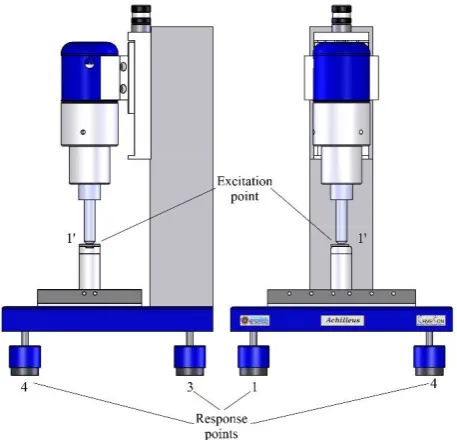
Fig. 4. Characteristic measurement points for the dynamic analysis of the impact test machine.
At first a modal analysis was introduced and afterwards a harmonic mode superposition analysis was performed. The total mass of the impact testing machine was calculated 58 kg, which was used as gravitational static load. For the determination of the resonant frequencies
and participation factors, the modal analysis was carried out using the block Lanczos method. The modal superposition method enables the expression of the response of a multi-degree-of-freedom system as a linear combination of its corresponding modal responses. It uses free vibrations mode shapes to uncouple equations of motion. For the harmonic analysis, the impact load was applied at excitation point 1', while the response was acquired under the mounts at points 1, 2, 3 and 4, as shown in Fig. 4.
Fig. 5. Evaluation of the transmissibility curve of the NR, NBR and the nanocomposite mounts 20wt% MWCNTs/NBR using FEA.
The results of the transmissibility curves as estimated by the FEM are shown in Fig. 5. The vibration isolation behavior of NR and NBR mounts is relatively similar to the resonant frequency and the transmissibility value at resonance. Furthermore, the nanocomposite 20wt% MWCNTs/NBR mount presents slightly different resonant frequency, since MWCNTs increase the stiffness of the elastomer. More importantly, the transmissibility value at resonance is significantly decreased to almost 100 %. Thus, the 20wt% MWCNTs/NBR mounts are considered as the optimal solution to reduce the vibration level of this impact testing machine.
3.3Comparison of the vibration isolation performance between the NR mounts of the impact tester and the nanocomposite NBR/MWCNTs mounts
algorithm was implemented in order to determine the characteristic modal parameters of the transfer function of the system. The transmissibility curve was calculated with the use of two accelerometers, one mounted near the excitation point 1' and the other mounted at points 1, 2, 3 and 4 respectively. The signals of the impact force and the two acceleration responses were acquired by the A/D converter, connected to a computer employing MATLAB software for immediate signal processing and calculation of the transfer functions and the transmissibility. The function of the transmissibility curve was then calculated by the following relation:
𝑇(𝜔) = 𝛸̃𝑖(𝜔)
𝛸̃1′(𝜔) (5)
where 𝛸̃𝑖(𝜔) is the magnitude of the
displacement transferred through mount 𝑖 to the ground and 𝛸̃1′(𝜔) is the magnitude of the displacement at the excitation point.
Fig. 6. Impact test machine arrangement mounted on 20wt% MWCNTs/NBR.
Figure 7 demonstrates the comparison between the transmissibility curves of the regular NR mounts and nanocomposite 20wt% MWCNTs/NBR, which were considered
optimal. The fundamental natural frequency of the machine-mount system was calculated at 29Hz. Initially, the first natural frequency of the impact-testing/NR system is slightly shifted from 29 Hz to 33 Hz. This phenomenon can be attributed to the increase of stiffness of the NBR/MWCNTs mounts. The addition of MWCNTs in the elastomeric matrix decreased the vibration level of the impact testing machine by changing the structural damping of the system, while the first natural frequency remained almost the same. For further change of the natural frequency of the system, in order to avoid coinciding with excitation frequencies, this could be accomplished by adding stiffeners, which raise the natural frequency or by adding mass, which lowers the natural frequency.
Table 1. Comparison of the transmissibility values at resonance as calculated with the analytical-experimental method for the original NR and proposed 20wt% MWCNTs/NBR mounts.
Excitation at 1' - Response
at 𝑖
Original NR mounts
Proposed 20wt%
MWCNTs/NBR Change
Τ(𝜔 = 29𝐻𝑧) Τ(𝜔 = 33𝐻𝑧)
1' - 1 58 5 91 %
1' - 2 28 6.5 77 %
1' - 3 61 8 87 %
1' - 4 19 6 68 %
Fig. 7. Comparison of the transmissibility curve between the NR and the 20wt% MWCNTs/NBR mounts.
4. CONCLUSION
The overall objective of this paper is the optimization of the vibration isolation performance of an impact-testing machine mounted on NBR isolators reinforced with MWCNTs. The vibration isolation properties of the impact testing machine mounted on MWCNTs/NBR isolators were assessed by the transmissibility curves. The characterization of the vibration isolation procedure in this study was mainly consisted of three steps. The first step was the measurement of an appropriate set of experimental transfer functions of the impact testing machine-mounts system through modal tests. The next step was to identify these experimental data using appropriate curve-fitting procedures of an optimization genetic algorithm. The last step had to do with the association of these results of the analytical- experimental curve fits to construct the required mathematical model of the impact testing machine. This last step enables the reduction of a vast number of actual
measurements to a small and efficient set of data. This reduction procedure provides also the advantage of removing irregular values, which unavoidably occur in experimental data.
It is of great importance that this procedure enables the generation of a model for predicting the effects of modifications to the original impact testing machine. This was achieved by modelling the individual nanocomposite mounts and then analytically connecting them together to form the original system, the model of the complete structure can be developed.
resonance reached a decrease of 91 %. Therefore, the 20wt% MWCNTs/NBR mounts are considered as the most effective vibration isolators for this impact testing machine.
REFERENCES
[1] D.J. Ewins, Modal testing: Theory and practice, Research Studies Press, John Wiley and Sons, Lechtworth, New York, 1984.
[2] S. Neumark, Concept of complex stiffness applied to problems of oscillations with viscous and hysteresis damping, Aeronautical Research Council reports and memoranda no. 3269, 1962. [3] S.O. Oyadiji, G.R. Tomlinson, Characterization of the Dynamic Properties of Viscoelastic Elements by the Direct Stiffness and Master Curve Methodologies, Part 1: Design of Load Frame and Fixtures, Journal of Sound and Vibration, vol. 186, iss. 4, pp. 623-647, 1995, doi: 10.1006/jsvi.1995.0474
[4] S.O. Oyadiji, G.R. Tomlinson, Determination of the Complex Moduli of Viscoelastic Structural Elements by Resonance and Non-resonance Methods, Journal of Sound and Vibration, vol. 101, iss. 3, pp. 277-298, 1985, doi: 10.1016/S0022-460X(85)80129-2 [5] U.J. Kurze, Laboratory Measurements of
Vibro-acoustical Properties of Resilient Elements, Part I: Theoretical Basis, Acta Acustica, vol. 2, pp. 483-490, 1994.
[6] BS ISO 10846 1-5, Acoustic and vibration – laboratory measurement of vibro-acoustic transfer properties of resilient elements, 2009. [7] R. Adams, Mechanisms of damping in composite
materials, Journal de Physique Colloques, vol. 44, no. C9, pp. C9-29-C9-37, 1983, doi:
10.1051/jphyscol:1983903
[8] S. Iijima, T. Ichihashi, Single-shell carbon nanotubes of 1-nm diameter, Nature, vol. 363, pp. 603–605, 1993.
[9] T.W. Odom, J.L. Huang, P. Kim, C.M. Lieber, Atomic structure and electronic properties of single-walled carbon nanotubes, Nature, vol. 391, pp. 62–64,1998.
[10] J.W.G. Wildoer, L.C. Venema, A.G. Rinzler, R.E. Smalley, C. Dekker, Electronic structure of atomically resolved carbon nanotubes, Nature, vol. 391, pp. 59–62, 1998.
[11] E.T. Thostenson, Z. Ren, T.W. Chou, Advances in the science and technology of carbon nanotubes and their composites: A review, Compos Sci Tech vol. 61, iss. 13, pp. 1899-1912, 2001, doi:
10.1016/S0266-3538(01)00094-X
[12] R. Andrews, M.C. Weisenberger, Carbon nanotube polymer composites, Current Opinion in Solid State and Materials Science, vol. 8, iss. 1, pp. 31-37, 2004, doi: 10.1016/j.cossms.2003.10.006
[13] M.A. Lopez-Manchado, J. Biagiotti, L. Valentini, J.M. Kenny, Dynamic mechanical and Raman spectroscopy studies on interaction between single-walled carbon nanotubes and natural rubber, Journal of Applied Polymer Science, vol. 92, iss. 5, pp. 3394-3400, 2004, doi: 10.1002/app.20358 [14] S.K. Peddini, C.P. Bosnyak, N.M. Henderson, C.J.
Ellison, D.R. Paul, Nanocomposites from styrene-butadiene rubber (SBR) and multiwall carbon nanotubes (MWCNT) part 1: Morphology and rheology, Polymer, vol. 55, iss. 1, pp. 258-270, 2014, doi: 10.1016/j.polymer.2013.11.003 [15] K. Tsongas, D. Tzetzis, G. Mansour, Mechanical
and vibration isolation behaviour of acrylonitrile-butadiene rubber/multi-walled carbon nanotube composite machine mounts, Plastics, Rubber and Composites, vol. 46, iss. 10, pp. 458-468, 2017,
doi: 10.1080/14658011.2017.1391975
[16] G. Mansour, K. Tsongas, D. Tzetzis, Modal testing of nanocomposite materials through an optimization algorithm, Measurement, vol. 91, pp. 31-38, 2016,
doi: 10.1016/j.measurement.2016.05.032
[17] G. Mansour, K. Tsongas, D. Tzetzis, Investigation of the dynamic mechanical properties of epoxy resins modified with elastomers, Composites Part B: Engineering, vol. 94, pp. 152-159, 2016, doi:
10.1016/j.compositesb.2016.03.024
[18] G. Mansour, K. Tsongas, D. Tzetzis, Modal testing of epoxy carbon–aramid fiber hybrid composites reinforced with silica nanoparticles, Journal of Reinforced Plastics and Composites, vol. 35, iss. 19, pp. 1401–1410, 2016, doi:
10.1177/0731684416652488
[19] G. Mansour, K. Tsongas, D. Tzetzis, K. Tzikas, Dynamic mechanical characterization of polyurethane/multi-walled carbon nanotube composite thermoplastic elastomers, Polymer-Plastics Technology and Engineering, vol. 56, iss. 14, pp. 1505-1515, 2017, doi:
10.1080/03602559.2016.1277243
[20] M. Mansour, K. Tsongas, D. Tzetzis. Measurement of the mechanical and dynamic properties of 3D printed polylactic acid reinforced with graphene, Polymer-Plastics Technology and Engineering, vol. 58, iss. 11, pp. 1234–1244, 2019, doi:
10.1080/03602559.2018.1542730
Engineering, vol. 57, iss. 16, pp. 1715–1725, 2018, doi: 10.1080/03602559.2017.1419490 [22] G. Mansour, K. Tsongas, D. Tzetzis, Internal
Friction of Epoxy Resin Composites Reinforced with Carboxyl-Terminated Butadiene-Acrylonitrile (CTBN) Rubber, Balkan Tribological Association, vol. 21, no. 3, pp. 575-584, 2015. [23] G. Mansour, K. Tsongas, D. Tzetzis, Investigation
of the Dynamic Behaviour of Epoxy Reinforced
Nanosilica and Microparticulate Rubber Composites through Analytical-Experimental Transfer Functions, in ICCM20, 20th International Conference on Composite Materials, 19-24 July 2015, Copenhagen, Denmark.