Copyright © 2018 by Academic Publishing House Researcher s.r.o.
Published in Slovak Republic
European Journal of Economic Studies
Has been issued since 2012.E-ISSN: 2305-6282
2018, 7(2): 98-108
DOI: 10.13187/es.2018.7.98
www.ejournal2.com
The Sustainable Food Self-Sufficiency Achievement Strategy in East Java Province, Indonesia
Nasikh a , *
a Unversitas Negeri Malang, Indonesia
Abstract
This study aims at identifying the characteristic of the local resources regarding to the sustainable food self-sufficiency in East Java as well as arranging policy strategy of regional government of East Java to achieve the sustainable food self-sufficiency. The study is carried out in Madiun and Nganjuk regencies in East Java. The two regencies are chosen as they are the food buffering area for other regencies in East Java. The study is conducted in eight months, from March to October 2015. The research finding shows that the regional characteristic in the local resources-based sustainable food self-sufficiency in East Java has been surplus in terms of rice which is 4.403.553 tons; corn which is 6.095.325 tons; meat which is 146.448 tons; and egg which is 29.147 tons. The availability of energy total consumed by East Java citizens in 2014 is 3.589 kcal/cap/day or 149.54 % out of the Recommended Dietary Allowance which is 2.400 kcal/cap/day. The availability of energy in 2014 is dominated by vegetable (96.91 %) and animals (3.09 %). If compared to the Recommended Dietary Allowance in 2012, the decrease is 967 kcal/cap/day or 21.22 %. The strategy of the regional government to maintain the local food security to be the imported-rice free is encouraging the food reserve development, enhancing the food distribution system, fostering the consumption diversification, monitoring fresh food, conducting citizen empowerment action program to solve the food security issue, and synchronizing the action program funding among the state budget, regional government budget, and citizen fund in East Java.
Keywords: the sustainable food self-sufficiency, food distribution system, local resources, the regional characteristic, strategy of the regional.
1. Introduction
Food is a basic need of human beings whose fulfillment is the part of basic human right for every Indonesian citizen. Its fulfillment is to meet the basic need of human being which is fairly, equally, and sustainably according to the principle of food sovereignty, self-sufficiency, and security. It means that in order to meet the food need of the citizen to the individual level, the country has a freedom to determine their food policy independently without any pressure from any parties. Food business actors are free to determine and run their business according to the resources they have. Hence, the development of food security is also the national priority in the Rencana Pembangunan Jangka Menengah Nasional (RPJMN) or National Mid-Term Development Planning in 2010 to 2014 focusing to increase the food availability, food distribution stabilization, food diversification acceleration, and fresh food security monitoring based on the
* Corresponding author
regional characteristic. The food security development is carried out through various attempts in order to improve the economic growth and decrease the poverty level as a form of social, cultural, and economic development which is the part of the overall development.
The food consumption fulfillment has to prioritize the local production by utilizing the local resources and wisdom optimally (Nasikh, et al. 2015). To achieve it, there are three fundamental things to be paid attention to: (1) the food availability is based on the utilization of local resources optimally, (2) the food is affordable and easy to access by all citizen in terms of the physical and economic aspects, and (3) the food and nutrient are meant to consumed for healthy, active, and productive life. The local resources-based food can be available optimally through food diversification and local food production priority. The affordability in terms of the physical and economic aspects is undertaken by stabilizing the staple food’s s price, managing the staple food reserve, and distributing the staple food well (Nasikh, et al., 2015; Das, et al., 2012; García et al., 2014).
Therefore, the implementation of the food security development program is done by referring to the food security sub-system: (a) in terms of food availability, the program is conducted by increasing production, fostering the availability, and handling the food insecurity issue, (b) in terms of food distribution, it is undertaken by stabilizing the food distribution and reserve, and (c) in terms of food consumption, it is done by improving the quality of food consumption and security. Consequently, the agricultural development program and the food security are directed to encourage the conducive social, cultural, and economic condition which leads to the stable and sustainable food security.
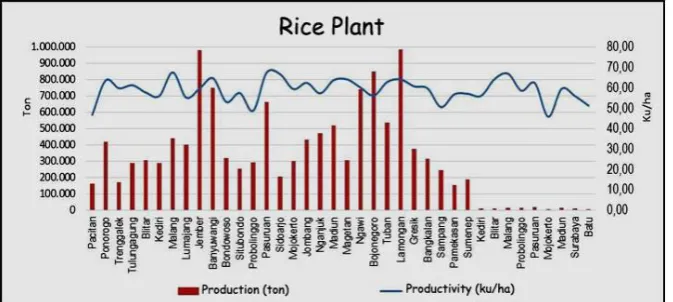
In terms of the national rice production contribution, East Java is in the second place after West Java. There are two regencies which become the rice producers in East Java and they are the research setting of this study: Madiun and Nganjuk regencies (according to Figure 1 below). Thus, those two regencies become the location of this study. Despite the fact that they are not the biggest rice producers, they can support the rice production of other regencies in East Java as displayed in
Figure 1 below.
Fig. 1. Production and Productivity of Rice Plants of East Java Source: Agricultural Bureau of East Java 2015
Local Resources-Based Product Technology Innovation to Achieve the Sustainable Food Self-Sufficiency
The Indonesian’s local food potential is very high. However, its contribution to support the food security is still low. This is caused by the lack of local food’s technology innovation so that the Indonesian consumers are not interested in buying the food product. Thus, the local food’s technology innovation has to be absolutely invented. Welli (2007), in his research, has given an illustration of how to create innovation in the local food product. He mentions creating added value to the local food product so that it has higher value or at least equal to the rice or wheat-based food product which dominate the menu of Indonesian citizens. The creation of the local food product has to be able to meet the demand of the developing globalization era. It is not only the taste aspect of the food product, but the consumer also wish to have healthy and safe food.
The innovation should not only concern the nutrient, quality, and food safety aspects, but it also needs to consider the consumer’s preference. Thus, the local food industry with high ethnicity and special characteristic will always ensure their food safety. As the local food product has the specific characteristic, they need to be handled properly. The appropriate knowledge of food technology is also required. Other than innovation, the other important factor is the role of the regional government to support and develop the local food product (Degye et al., 2013; Francis et al., 2015; Nasikh, 2016).
The number of Indonesian local food products is very abundant. It is usually closely related to the local culture. Hence, the product is often named after the place where it is from, such as dodol garut, jenang kudus, gudek jogja, and etcetera. The various local food products are very potential to achieve the national food self-sufficiency. Its achievement will accelerate the national food security (Onakuse, 205; Sheryl, 2015; Anastasia, Alex, 2015; Yangui et al., 2014).
However, up to now, the local food product has not been able to replace rice and flour which dominate the food in Indonesia. One of the reasons is because of the low technology innovation in the local food product. Some creations of local food product are cassava vruitpao (bakpao made of cassava), steak kampong Mucuna Crispy (steak made of kara benguk), rasi (rice made of cassava), and brownies made of cassava. Yet, these products are still less popular than rice and flour.
On the other hand, in this globalization era, the consumer’s demand towards food is growing up. In other words, the consumer’s taste is very important for the food producers. The researcher suggests that the technology innovation in the local food product must be invented as soon as possible. The technology innovation not only concern the quality, nutrient, and food safety aspects which are popularized by many people, but it also consider the consumer’s preference. Particularly in terms of food diversification, the food technology is expected to be able to play its role to increase the added value of the local food product. Consequently, the consumer is interested in buying the local food product (Vishwambhar, 2015; Ekin, et al., 2015). Innovation is not the only factor; the role of the regional government to support and develop the local food product is also highly required.
Farmer’s Empowerment to Improve the Sustainable Food Self-Sufficiency
In the context of human’s life, food resources are definitely required. However, in the present days, the issue of food insecurity often happens in some parts of the country. Therefore, the regional government as mandated in the decentralization has to be able to establish farmer’s empowerment program to achieve the food security. The study by Sean et al. (2012) used the qualitative research method and descriptive approach done by observation, interview, and documentation. The data analysis was conducted by the model adopted from Miles and Huberman (1984). The finding of his study shows that the farmer’s empowerment program is considered good to achieve the food security as the product is better and improved. This better and improved product is due to the improved knowledge and skill of the farmer in agriculture. The main supporting factor in the successful food security is the support from the regional government as well as the support in the form of subsidy and seeds. While the obstacle is the low human resources quality as well as the limited farming equipment. The synergy among farmers, society, and government is required to support the farmer’s empowerment program to improve the food security (Nasikh, 2014).
and skill. Seeing this phenomenon, as mandated in the regional autonomy, the regional government of Nganjuk regency has its authority to develop its agriculture by empowering their farmers. One of the areas in Nganjuk regency with the farmer’s empowerment program is Betet village, Ngronggot district. The empowerment is done by counselling. The counselling aims at delivering information about the new technology and the way of better farming to the farmer group or Gabungan Kelompok Tani (Gapoktan) or Farmers Group Association done by Penyuluh Pertanian Lapangan (PPL) or Field Agricultural Counsellor. The counselling is conducted to improve the farmer’s capability and skill in utilizing their agricultural work to obtain better and more varied results. The better result will lead to the food security achievement. The conclusion that is drawn is as follows. First, the internal obstacle factor is the low quality of human resources and lack of agricultural machinery. Second, the external obstacle factor is the unstable weather and the limited capacity of agricultural resources. Next, the internal supporting factor is the farmer’s empowerment program and the support from the regional government of Nganjuk regency. And last but not least, the external supporting factor is the subsidy to lower the farmer’s burden.
The Food Reserve in East Java Province
In order to fulfil the food need for all Indonesian citizens, the existence of food is very beneficial. Its availability comes from three resources, which are (1) production; (2) food intake; and (2) food reserve. The food reserve is one of the significant components in the food availability whose function is to balance the gap between the food production and need. It can also be used to anticipate the temporary shortage of food due to the disturbance of staple food stock, for instance because of the transportation facilities issue in the natural disaster.
There are some reasons underlying the importance of the food reserve development. First, there are still 11.37 % poor families in Indonesia (BPS March 2013) and 19.46 % of food insecurity (in 2012). Second, the effect of climate anomaly is very unpredictable which leads to the uncertainty of product (crop failure, flood, long drought) and natural disaster. Next, the harvesting period is uneven in each the period and area. Another reason is there are a lot of regionals which belong to the food insecurity category. Last but not least, there are a lot of urgent situations which require food reserve to resolve the post-disaster, food insecurity, and regional food assistance issues. The paragraph 2 of Food Law number 18 in 2012 mandates that the Central and Regional Governments have to facilitate the food reserve development based on the local wisdom.
The food reserve development is carried out in order to empower and prevent the society from the food insecurity. It is done by facilitating the physical development of barns, filling in the food reserve, and strengthening the group institution. By having the empowerment activity, it is expected that the society able to manage their food reserve within their group and improve their role in running the economic function so that they are able to maintain and develop their own food reserve. The food reserve development has been carried out since 2009 through the food reserve development activity which consists of three stages, namely growing stage, developing stage, and self-sufficiency stage (Nasikh et al., 2015; Rosmery et al., 2016; García et al., 2012).
The growing stage involves the location identification and physical development of barns funded by the Dana Alokasi Khusus (DAK) or the Specific Allocation Fund in the agricultural field. While the development stage is a step to identify the Food Barn Group and fill in the food reserve funded by the Social Assistance Fund. The last stage, the self-sufficiency stage is the time to strengthen the group institution through the allocation of Social Assistance Fund so that they are able to develop their business for the sustainability of the food barn institution.
2. Methods
which is relevant to handle the issue of food security in the research setting. The sample is taken purposively from each relevant department, thus, the result can represent this study.
The data collection method which is employed in this study is divided into two, namely (1) Primary Data; it is an activity done to obtain authentic or direct data. The technique used is as follows; (a) Observation. The observation technique that is conducted by the researcher is direct observation in the research location in order to cross-check the data that he obtains from the other data collection technique. This observation is done in the implementation of the sustainable food self-sufficiency; (b) Questionnaire. The data collection by filling in questionnaire is done by the citizen in the planning area. In this study, the questionnaire is spread to several SKPDs which become the sample representing all research data; (c) Interview. In this study, the researcher employs a led interview pattern, in which the interviewer brings a set of complete and detailed questions which is meant in the structural interview. The interviewee is the regional government staff in the research location who recognize the development of food security in the research setting as well as related institutions. (2) Secondary Data; it is an activity done to obtain authentic or direct data from Laws, Government Regulation, Governor Regulation, as well as reports made by the regional government or food security agency, and data from certain websites or the Internet. After that, the obtained data are proceeded through data grouping, classification of problem rank, and classification of internal and external factors. The analysis model of quantitative data used in this research is relevant with the interactive model which involves the reduction, data display, and verification processes.
The research finding is analyzed quantitatively and qualitatively. Thus, the data are needed to be tested their validity. Validity is the degree of preciseness in the research object compared to the obtained data. While reliability is related to the degree of consistency and the data stability. In the view of quantitative research, data are considered reliable if there are two or more researchers produce similar data in the same object, or the same researcher produce similar data in different period. The objectivity is related to the interpersonal agreement among a lot of people towards one set of data. In the standard qualitative research, it is called data validity. The validity of the data in this study is tested through the implementation of criteria proposed by Lincoln (1990). They proposed four criteria to test the data validity, namely credibility, transferability, dependability, and conformability.
3. Results and Discussion
In order to accelerate the food consumption diversification, an action was required to excel the food consumption diversification in each related agricultural institution under the coordination of Food Security Board. It was to encourage the availability of various staple food and improve the local resource-based food consumption. Therefore, a Governor Regulation was required to be established as a reference which triggered the local resources-based food consumption diversification. It involved the synergic coordination between the stakeholders in the central and regional levels.
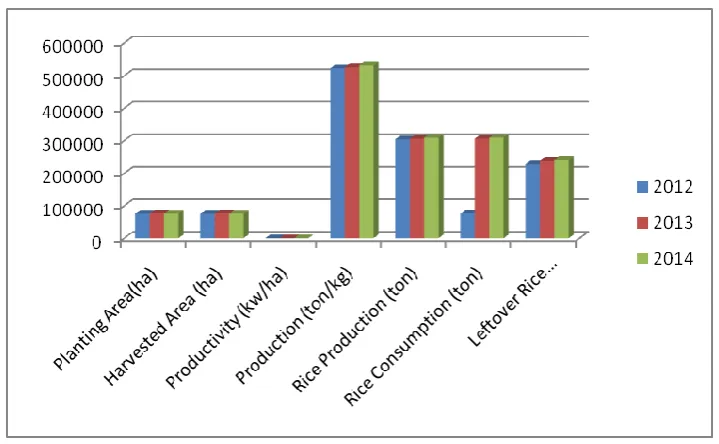
In 2014, the East Java governor and regents as well as mayors in all around East Java committed to accelerate the self-sufficiency of five types of strategic food, namely rice, corn, soybean, sugar, and meat. Related to this achievement target, the regional government of East Java would focus more on the productivity and plant index. The rice production’s target in East Java is displayed in Figure 2 below.
Fig. 2. Rice Production Target of East Java Province Source: Agricultural Bureau of East Java 2015
Regional Characteristic in the Local Resources-Based Sustainable Food Self-Sufficiency
Food self-sufficiency was an important and strategic factor, regarding to the fact that food was the basic need of human being. The right of food was the significant part of the basic human right. Figure 3 below was the condition of Rice Production and Contribution Target of Madiun regency which was explained according the result in the field.
Fig. 3. Rice Production Targets and Contributions Rice Of Madiun Regency Source: Food Security Agency Madiun 2015
Figu. 4. Food Needs Consumption of Madiun Population Source: Food Security Agency of Madiun 2015
According in figure 4. during 2010 to 2014 the amount of rice was enough to fulfil the need of rice of Madiun regency citizen. In 2014, the rice availability level was 429,90 kg/cap/year and the consumption level was 95,7 kg/cap/year. It became the highest achievement in the food fulfillment. It meant that the availability of rice was four times higher than the consumption level. This number was so satisfying that the Madiun regency became the Food Barn of East Java and they obtained achievement of Adikarya Pangan Nasional in 2012.
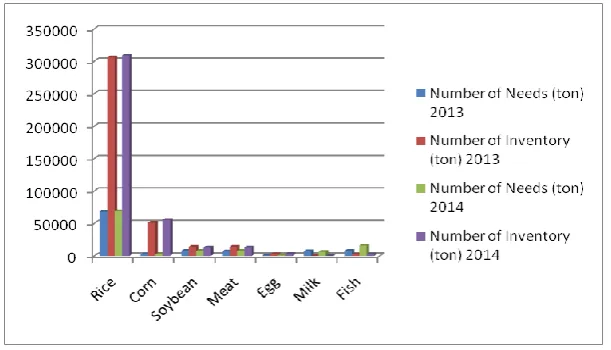
The need and availability of staple food of Nganjuk regency was displayed in Figure 5 below.
Fig. 5. Food Needs Consumption of Nganjuk Population Source: Food Security Agency of Nganjuk 2015
Based on the Figure 5, it was shown that from seven types of staple food in Nganjuk regency, only one kind of food whose availability was lower than the need of the citizen. It was fish. While the availability of other six staple food was exceed the need of the Nganjuk regency citizen.
one of the references to plan the policy related to the food and nutrient availability to achieve the food stabilization and self-sufficiency.
The Appropriate Strategic Policy Model to Achieve the Local Resources-Based Sustainable Food Self-Sufficiency
The direction of food and agricultural policy of East Java in 2005 to 20125 was to develop the agribusiness-based modern economy. It encouraged the shift of agribusiness from the comparative advantage to the competitive advantage through the capital development and advanced technology improvement in its sub-system and the quality of human resources improvement. While the direction of food and agricultural policy of East Java in 2009 to 2014 was to revitalize the agriculture and develop the agribusiness and agroindustry to improve the farmer’s empowerment and its supporting institutions, enhance the productivity, competitiveness, and added value of the agricultural product, foster the agroindustry and agribusiness development to empower the economy, as well as improve the food security protection.
There were three strategic policy models implemented by the regional government of East Java to maintain the food security. First, they implemented the synergic coordination among the regency/city governments to arrange the policy related to availability, distribution, consumption, and safety of fresh food. Second, they developed food reserve, distribution system, and consumption diversification. Last but not least was they monitored the fresh food safety. The role of private party, citizens, and other citizen institutions had to be enhanced to monitor the availability, distribution, consumption, and fresh food safety. Their role could be implemented in the empowerment action program to resolve the issue of food security in East Java.
The strategic target of the regional government in maintaining the local food security was as follows (1) the formulation of the sectorial policy and price which supported the improvement of Nilai Tukar Petani (NTP) or farmer exchange value so that it could be the incentive for the business actors in the agricultural field, (2) the policy to limit the import partially or wholly should be balanced by the attempt to improve the local commodity productivity, (3) the distribution monitoring to reduce the illegal export as well as the implementation of regulation for the foreign food company to sell their product partially or wholly in the domestic market, (4) the enhancement of the warehouse utilization to reduce the price fluctuation inter season, (5) the improvement of regional government’s role in authorizing food commodity stock and its role in arranging food stock data and information accurately, (6) acceleration of infrastructure development, including the irrigation facilities, road, market, and harbor to encourage the goods distribution as well as the incentive to increase the products, (7) the limitation of the productive land conversion and slower the population growth level, and (8) the citizen’s expectation management, particularly those which were related to the administration price to isolate or limit its effect to the rising price of goods and service (Nasikh, et al., 2015; Sans and López 2015).
The Citizen Food Barn Development was carried out in three years within three stages, namely growing stage, developing stage, and self-sufficiency stage. With the process, it was expected that the citizen able to manage and develop the food reserve stock volume to meet the need of all citizen when they were challenged by the food shortage or food insecurity. In the growing stage, identification of groups and location, determination of target group, and utilization of DAK to build the food barn, and the physical building of the barn were facilitated by the DAK in the agricultural field. While in the developing stage, the activity was about supplying the food for the barn and developing the group capacity. Last but not least, in the self-sufficiency stage, the activity included the attempt to strengthen the institution and stabilize the food reserve and the citizen food reserve institution.
4. Conclusion
regional government to maintain the local food security to achieve the imported rice-free is to encourage the food reserve development, enhance the food distribution system, improve the consumption diversification, monitor the fresh food security, implement the citizen empowerment action program to resolve the issue of food security, as well as support the funding synchronization among the state budget, regional government budget, and citizen fund in East Java.
To strengthen the food reserve of the regional government of East Java, the manifestation of the iron stock concept or the endless reserve is supposed to be implemented. It is especially to face the urgent situation. Thus, it is suggested that rice monitoring and controlling are strict so that no stock of rice is rid out of the province. If they find any violations, the penalty is applied.
To guarantee the management of staple food distribution, the central and regional governments have to attempt to keep the stabilization of staple food price by improving the trading policy management in the country and outside the country. In challenging the urgent situation, the government is expected to mobilize the government and citizen’s food reserve as well as involve the national food industry.
5. Acknowledgements
This paper was supported by the DRPM Ministry of Research, Technology and Higher Education Indonesia; LP2M, Faculty of Economics, Universitas Negeri Malang (UM) and Research and Development Agency of East Java, Indonesia.
References
Carolyn, dan Stephanie, 2014 – Carolyn, Dimitri, dan Stephanie, Rogus (2014). Food Choices, Food Security, and Food Policy. Journal of International Affairs, 67 (2), pp. 19–31.
Das et al., 2012 – Das M., Ganguly A., Haldar, P. (2012). Annual biomass production of two acridids (Orthoptera: Acrididae) as alternative food for poultry. Spanish Journal of Agricultural Research, 10 (3), pp: 671-680. Instituto Nacional de Investigación y Tecnología Agraria y Alimentaria (INIA). Available online at www.inia.es/sjar. DOI: http://dx.doi.org/10.5424/sjar/ 2012103-222-11.
Degye et al., 2013 – Degye, Goshu, Belay, Kassa, dan Mengistu, Ketema (2013). Measuring diet quantity and quality dimensions of food security in rural Ethiopia. African Journal of Agriculture and Food Security, 1 (4), pp. 082–092.
Duncan et al., 2014 – Duncan, Boughton, Glenn, Denning, Khin, Mar, Dan Cho, Larry, C.Y. Wong. (2014). Agricultural Policy, Agricultural Transformation, Agriculture, Food Security, Rural, Smallholder. Journal of International Affairs, 67 (2), hal. 55–71.
Ekin et al., 2015 – Ekin, Birol., J. V. Meenakshi, Adewale, Oparinde., Salomon, Perez. dan Keith, Tomlins (2015). Developing country consumers’ acceptance of biofortified foods: a synthesis. Food Security, 7 (3), hal. 555–568.
Fitria et al., 2012 – Fitria Sean, Ribawanto Heru, Nurani Farida (2012). The Farmer’s Empowerment to Improve the Food Security (Study at Betet village, Ngronggot district, Nganjuk regency). Unpublished. The Faculty of Administration Science, Brawijaya University, Malang.
Food Law Number – Food Law Number 18 in 2012 about food.
Francis et al., 2015 – Francis, Lwanga, Rhoda K. Wanyenze, Joseph KB Matovu, Christopher Garimoi Orach (2015). Food Security and Nutritional Status of Children Residing in Sugarcane Growing Communities of East-Central Uganda: A Cross-sectional Study. Journal of Food Security, 3 (2), hal 34-39. Available online at http://pubs.sciepub.com/jfs/3/2/1 © Science and Education Publishing. DOI: 10.12691/jfs-3-2-1
García-Galán et al., 2012 – García-Galán M.M., Del Moral-Agúndez A., Galera-Casquet C., (2012). Assessing the introduction and development of a designation of origin from the firm's perspective: The case of the Ribera del Guadiana wine PDO. Span J Agric Res., 10 (4): 890-900. DOI: http://dx.doi.org/10.5424/sjar/2012104-2873
García-Galán et al., 2014 – García-Galán M.M., Del Moral-Agúndez A, Galera-Casquet C. (2014). Valuation and importance of the extrinsic attributes of the product from the firms' perspective in a Spanish wine protected designation of origin. Span J Agric Res 12 (3): 568-579. DOI: http://dx.doi.org/10.5424/sjar/2014123-6036
Law Number 18… – Law Number 18 in 2012 substituting the Food Law Number 7 in 1996.
Law Number 41… – Law Number 41 in 2009 about the Agricultural Land Conservation and
Law Number 26 in 2008 about RTRWN.
Lincoln, 1990 – Lincoln, Y.S. (1990). The making of a constructivist. Newbury Park, CA: Sage.
Makri, Koutsouris, 2015 – Makri A., Koutsouris A. (2015). Innovation networking within Producer Groups (PGs): The case of two PGs in Ierapetra, Crete. Journal of Agricultural Economics Review. Volume 16. Number 1 pp. 88–97.
Miles, Huberman, 1984 – Miles, M.B., Huberman, A.M. (1984). Qualitative data analysis: A sourcebook of new methods. Beverly Hills, CA: Sage.
Mosleh et al., 2016 – Mosleh Mostafa K., Hassan Quazi K, Chowdhury Ehsan H. (2016). Development of a remote sensing-based rice yield forecasting model. Spanish Journal of Agricultural Research, 14(3), e0907, 11 p. Instituto Nacional de Investigación y Tecnología Agraria y Alimentaria (INIA). DOI: http://dx.doi.org/10.5424/sjar/2016143-8347
Nasikh et al., 2015 – Nasikh, Hakim, L., Moeheriono (2015). The Regional Government Policy to Maintain the East Java Food Security to Achieve the Imported Rice-Free. Joint research of Balitbang of East Java Province and the State University of Malang. Research Finding Report. Unpublished.
Nasikh, 2013 – Nasikh (2013). A Model of Collaborative Forest Resources Management Between the Local Government and Pesanggem Farmers To Improve the Prosperity of Poor Family Farmers in East Java. Indonesian Journal of Geography. 45 (1), pp. 80-89. URL: http://jurnal.ugm.ac.id/ijg/article/view/2408/2164
Nasikh, 2014 – Nasikh (2014). Horizontal Management of Forest Resources to Enhance the Partnership and Account Ability in Pasuruan, East Java, Indonesia. Asian Journal of Humanities and Social Studies. 2 (5), pp. 685–688.
Nasikh, 2016 – Nasikh (2016). Institutional Model and Activities of Destitute Society Around Forest as an Attempt to Develop the Sustainable and Equitable Forest in East Java, Indonesia. Periodica Polytechnica Social and Management Sciences OnlineFirst, paper 8536 DOI: 10.3311/PPso.8536 Creative Commons.
Onakuse, 2015 – Onakuse, S. (2015). Changing food security: The challenges of climate change in Ukpeko, Etsako East, Edo State Nigeria. African Journal of Agriculture and Food Security, 3 (1), pp. 113–117.
Ramos-Sandoval et al., 2016 – Ramos-Sandoval Rosmery, García-Álvarez-Coque José M., Mas-Verdú Francisco (2016). Innovation behaviour and the use of research and extension services in small-scale agricultural holdings. Spanish Journal of Agricultural Research 14(4), e0106, 14 pages. Instituto Nacional de Investigación y Tecnología Agraria y Alimentaria (INIA). DOI: http://dx.doi.org/10.5424/sjar/2016144-8548
Sanjuán, López, 2015 – Sanjuán Sans P, López A.I. (2015). Beef animal welfare, attitudes and willingness to pay: A regional comparison across the Pyrenees. Span J Agric Res., 13(3): e0105. DOI: http://dx.doi.org/10.5424/sjar/2015133-7273
The Agricultural Agency… – The Agricultural Agency of East Java 2015. Unpublished.
The Agricultural Minister Regulation…, a – The Agricultural Minister Regulation Number 43/Permentan/OT.140/10/2009 about the Acceleration of the Local Resources-Based Food Consumption Diversification.
The Agricultural Minister Regulation…, b – The Agricultural Minister Regulation Number 61/Permentan/OT.140/10/2010 about the Organization of Agricultural Ministry.
The Agricultural Minister… – The Agricultural Minister Regulation Number
08/Permentan/OT.140/1/2014 about the Guideline of Citizen Food Barn Development.
The Constitution… – The Constitution of Republic of Indonesia in 1945.
The Food Security… – The Food Security Agency of East Java. 2014. Unpublished.
The Governor Regulation of East… – The Governor Regulation of East Java Number 71 in 2009, about the Guideline to Implement the Acceleration of the Local Resources-Based Food Consumption Diversification in East Java.
The President Decree… – The President Decree Number 22 in 2009 about the Local Resources-Based Food Consumption Diversification Policy, followed up by the Agricultural Minister Regulation Number 43/Permentan/OT.140/10/2009 about the Local Resources-Based Food Consumption Diversification Acceleration.
The Statistical Agency, 2013 – The Statistical Agency. The data of Poverty Level and Food Security, 2013.
Vishwambhar, 2015 – Vishwambhar, Prasad. S. (2015). Issues and Options of Food Security and Poverty: An Empirical Study of Mizoram, the Eastern Extension of the Himalaya. Journal of Food Security, 3 (4), pp. 107-114. Available online at http://pubs.sciepub.com/jfs/3/4/3. DOI: 10.12691/jfs-3-4-3
Welli, Yuliatmoko, 2007 – Welli, Yuliatmoko (2007). The Local Food Product Technology Innovation to Accelerate the Food Security, Mimeo, the Open University, Pondok Cabe, South Tangerang.