307
Module Development Teaching Guidelines In
Basic School Homeschooling
Rosda Fajri Kafarisa
Abstract: This research originated from the results of a preliminary study that did not yet provide written homeschooling guidelines / instructions that could help give tutors an initial picture during the learning process. This study aims to develop valid, practical and effective modules for primary school homeschooling teaching guides. The development model used in this study is the Dick and Carey model, with the stages used namely analyzing, designing, developing, implementing and evaluating. The research subjects were package A homeschooling tutors consisting of 5 tutors from Homeschooling Khoiru Ummah and 10 Primagama Homeschooling tutors, a total of 15 package A homeschooling tutors. The results of the assessment conducted by expert lecturers, the developed modules were declared to be valid evenly. the average score of module material validation is 4.67, the average score given for the assessment of module form is 4.61, the average score given for module motivation assessment is 4.76, the average score given for assessment the language and module readability is 4.42 with all classifications very good. The results of data analysis from the learner respondent questionnaire were 4.49 and the results of the questionnaire responses from the instructor instructors were 4.56 and entry was classified as very good, the module was declared practical. The results of the learning outcomes test conducted at the end of the study with the completeness of learning outcomes on average 14 participants (90.48%) respondents stated complete (graduated) and only 1 participant (9.52%) respondents who have not completed (not graduated), module developed was categorized as effective. The conclusion is that this module was successfully developed and can be declared valid, practical and effective.
Keywords: Modules, Teaching, Homeschooling, Elementary Schools
————————————————————
PRELIMINARY
The existence of homeschooling which is now developing is actually producing outstanding students. As reported in Libutan 6 news on July 10, 2007, one of his students was Bilal who was able to compete with students in formal schools. Bilal's story to SCTV, Bilal when fourth grade elementary school decided to leave formal school to homeschool the reason so he could learn while getting to know the surrounding environment. Thanks to the support of Yayah Komariah as Bilal's mother, Bilal was able to achieve the top ten elementary school Mathematics Olympiad. Jamaludin, (2015) in his research concluded that homeschooling has been offered a flexible learning for children who might face difficulties in traditional schooling. Issues such as racism, special needs in learning, and incentive for traditional learning were able to resolved through homeschool implementation.Reporting from Tribunjogja.com on March 31, 2018, the Head of the Yogyakarta City Education Office, Edy Heri Suasana explained that since 2010 it had placed the position of non-formal education on a par with formal form of equality. We have facilitated non-formal education with the National Learning Activity Center (SKB) and also a Community Learning Activity Center (PKBM) which serves Package A, Package B, Package C. In Palembang in particular, the name of homeschool learning has been heard which is one of PKBM learning A, B and C included in non-formal education. From the explanation above, the researchers collected preliminary data on non-formal education in South Sumatra Province and there were as many as 634 non-formal education consisting of Courses, PKBM and SKB spread in various districts / cities in South Sumatra. In the city of Palembang there are 24 PKBM registered in Dapodik PAUD-Dikmas Palembang city.
Table 1.1. List of PKBM in Palembang City NO INSTITUTION NAME NO INSTITUTION NAME
1 PKBM CAHAYA 13 AL-IZZIYAH
2 GRIYA ASRI 14 ADWIYAH
3 ANGGREK 15 PKBM RAHMA SARI
4 HOMESCHOOLING
KHOIRU UMMAH 16 PKBM AMALIA
5 AL-MARFU’AH 17 HOMESCHOOLING
PRIMAGAMA 6 MELATI MUJAHIDIN 18 PKMB AL AKBAR
7 PKBM ANANDA 19 PKBM PELITA
8 MAWAR 20 SEKOLAH CATUR
9 KI BANTEN 21 PKBM TUT WURI
HANDAYANI
10 NUR BINA UTAMA 22 PKBM REMILING JAYA 11 PKBM MUTIARA 23 PKBM SRIWIJAYA
12 KARYA SAKTI 24 RSI
(Source: Ministry of Education and Culture reference data) Of the 24 PKBM names in Palembang, there are four PKBMs called Homecshooling institutions where homeschooling is better known as informal education but homeschooling institutions have become non-formal education channels where each student can take an exam that the government has recognized. In non-formal homeschooling the government does not instruct by making regulations on standards of content and processes, but providing standards of assessment and diplomas for homeschooling graduates to be able to continue their education to a higher level. Based on the results of interviews conducted by researchers to one of the homeschool tutors in August 2018, Arum Ningsih revealed that as a tutor he experienced some confusion when confronted directly with students. This confusion is caused by a lack of explanatory guidance in teaching. When the signature of the tutor contract is only asked about ability and given general explanation about students and schools. In addition, the confusion of tutors on curriculum issues and learning device plans will be used during learning. When schools expect conducive learning and can facilitate students in their development, schools must also be able to facilitate tutors in learning.
________________________________
Rosda Fajri Kafarisa; Students of Education Management Masters Program University of PGRI Palembang E-mail:
308
TEACHING MODULE
Understanding the module according to Kunandar (2009) is a learning tool developed from each competency and subject matter to be delivered, and contains material, worksheets, activity sheets and also answer sheets for learners. Nasution (2010) continued, stating the module was formulated as a complete unit that stood alone and consisted of a series of learning activities arranged to help achieve a number of objectives specifically and clearly formulated. Mudlofir (2011) suggests that the module is a teaching material that is arranged systematically, interestingly includes teaching material, methods and evaluations that can be used independently. In line with what dikemukakaan by Sukirman (2012) the module is a part of planned unity of learning that has been designed to be able to help students individually in achieving their learning goals. Where students who have high speed in learning will master the material faster. Meanwhile, students who have low speed in learning can learn again by repeating parts that have not been understood until they understand using modules. From the module understanding according to some experts above, it can be concluded that the module is a learning media in the form of printed teaching materials that are arranged to be studied independently in accordance with the instructions, where the module has a fairly strong information power. Modules can also be used as a handle and means in an effective, flexible, interesting and detailed learning process that is easily understood in order to provide assistance or guidance in mastering their learning goals. Another opinion also expressed by Suhardan (2006) that teaching is basically an academic activity in the form of communication interactions between instructors and students. According to Gagne in Sanjaya (2007), states the instruction is a set of events that effect learners in learning that is facilitated, that teaching or teaching is part of learning (instruction), where the role of the teacher is more emphasized on how to design or arrange various resources and facilities available for use or use by students in learning a lesson. Danim (2008) states that teaching can be defined as a process of organizing or arranging a number of potential sources properly and correctly so that a child's learning process occurs. From the opinions of the experts above, teaching is an effort to integrate the environment in its relationship with students, teaching materials and instructors that lead to the learning process. Teaching a complex activity carried out by the teacher (tutor) in conveying knowledge to students so that the learning process takes place using the environment both in the classroom and outside the classroom so as to provide encouragement to students. From the opinions on the modules and teaching described above, it can be said that modules can be used as print teaching materials that can be studied independently anywhere and anytime. Modules can be in the form of learning material that is summarized in such a way as to meet the needs of the learning process. module teaching is teaching that is partially or completely based on the module. Where teaching modules can provide opportunities for learners to learn at their own pace, because learners use different techniques to solve certain problems based on the background of their respective knowledge and habits. From there, researchers create a teaching guide module to help educators (tutors) before going directly into the field and doing the learning process. Guidelines here are prepared to provide guidance or guidance to tutors in conducting the learning process so as to achieve learning
objectives. So, the teaching guide module is a printed teaching material that can provide guidance to educators (tutors) in transferring knowledge so that students can participate in shaping their own knowledge and with this teaching guide module educators (tutors) can make this module a reference in teaching activities independent.
HOMESCHOOLING LEARNING
309 competition among learners causes students to feel stressed
so that the child is learning as a liability burden and not as a requirement. So that the emergence of homeschooling as alternative education, where the intelligence of children will be fully developed by giving flexibility for students to enjoy the learning process. The purpose of homeschool learning is to hone students' skills more intensively, especially for students who still feel less than optimal when studying at school and feel much more effective when studying at home. Even though it has advantages compared to the formal education system, homeschooling also has negative and positive impacts for students. In accordance with the main goals of homeschooling that seek to carry out education in order to optimize child development naturally, the use of homeschool learning methods emphasizes contextual approaches and active learning. In homeschool learning, it must be noted that the design of the material to be presented must be in accordance with the curriculum in public schools.
PRIMARY SCHOOL
Primary school education is the basis for the formation of the main children's education. Where the main purpose of the school for the future is to conduct a character education movement. Lewis and Ponzio (2016) in his research stated that the common denominator and key to character education for the future is community, the concept of community relations and three themes for providing better implementation of character education and also careful consideration is given to the interaction and contributions of the school and society in terms of promoting and developing character education. Where school is not only a place to study and seek knowledge but schools can bring children to feel comfortable, happy and like learning. Equity education is included in the non-formal education unit of the center for community learning activities (PKBM). Based on the applicable law, equality education programs can be incorporated into their functions as substitutes for formal education. The equality education program in non-formal education is the Package A program equivalent to SD, Package B is equivalent to SMP, Package C is equivalent to high school. The package A program is specifically aimed at an illiteracy eradication program that is equivalent to elementary school formal education, and also as a fulfillment of the need to complete the 9-year basic education compulsory education program (package A and package B) and provide access to higher education, namely C. package
DEVELOPMENT METHOD
The type of research used is R & D (Research and Development) or what is often called "development". What is meant by development research is a series of processes or steps in order to develop a new product or improve existing products so that they can be accounted for (Tegeh et al, 2014). The development steps in this study use the Dick and Carey models (Tegeh et al., 2014). There are ten stages of the process carried out from the beginning of development to the product as a result of development.
1. Identify Instructional Goals (Identifying Learning Objectives)
2. Conduct Instructional Analysis (Performing Learning Analysis)
3. Analyze Learners and Contexts (Analyzing the Learner and its Context)
4. Write Performance Objectives
5. Develop assessment instruments (Developing Instruments)
6. Develop Instructional Strategy (Developing Learning Strategies)
7. Develop And Select Instructional Materials (Developing and Selecting Learning Materials)
8. Design and Conduct Formative Evaluation (Designing and Implementing Formative Evaluation)
9. Revise instructional (Revise Learning)
10. Design and Conduct Sumative Evaluation (Designing and Implementing Summative Evaluations).
RESEARCH LOCATIONS AND SUBJECTS
The location of the research is the place where the research was conducted. In accordance with the problems raised in this study, the location of the research used as a source of data is Primitive Homeschooling Primagama Homeschooling in Palembang. According to Arikunto (2016) the research subject is the giver of the limitation in the form of objects, things or people where the data for the research variable is attached, and which is disputed. Moleong (2014) describes the research subject as an informant, which means that people in the research setting are used to provide information about the situation and background conditions of the study. In a study, the research subject had a very strategic role because in the research subject, it was data about the research variables observe. The research subjects were package A homeschool tutors consisting of 5 tutors from Homeschooling Khoiru Ummah and 10 Primagama Homeschooling tutors, a total of 15 package A homeschooling tutors.
RESEARCH DESIGN
The development model used is the Dick and Carey model. This Dick and Carey model has a distinctive characteristic of the R & D method in general, which has systematic research stages / designs. The stages used are analyzing, designing, developing, implementing and evaluating (Dick, Carey, and Carey: 2001).
Analyze
In this stage researchers conduct literature studies and interviews in homeschooling to be able to identify and analyze problems and needs.
Design
This stage determines the preparation of the initial module in the form of a conceptual framework and
components contained in the module in
310
DEVELOPMENT RESULTS AND DISCUSSION
1. Analysis Phase
At the analysis stage, the author conducted a needs analysis. Needs analysis was carried out through interviews in August 2018 to 5 tutors from Homeschooling Khoiru Ummah and 10 tutors from Primagama Homeschooling, so that a total of 15 homescholing A package tutors were obtained. Based on the needs analysis data obtained through interviews with 15 tutors teaching in homeschooling, it can be concluded that respondents generally feel awkward and not maximal in doing teaching in homeschooling, due to the lack of understanding and knowledge of tutors about homeschool learning since the first time they jumped immediately became a tutor at homeschooling.
2. Planning Phase
The design stage is carried out during October to November 2018. At this stage the researcher prepares what elements are needed in the module such as the preparation of maps and the framework of the module requirements, references used in developing the material contained in the module, and various instruments that used to assess the module being developed. The framework / design of this module are as follows: a) Introduction that explains the background of writing modules, competency targets, learning objectives, and how to use the module; b) Learning activity 1 about Homeschooling Education Institutions; c) Learning activities 2 about Children with Special Needs; d) Learning activity 3 about Language Learning; e) Learning activity 4 about Learning; f) Learning activity 5 about Natural Science Learning; g) Learning activity 6 about Social
Sciences Learning; and h) Learning activities 7 about Citizenship Education Learning, where each learning activity includes Learning Objectives, Achievement Indicators, Material Descriptions, Summary, Practice Questions, Feedback, and Answer Keys.
3. Development Phase
At this stage, researchers develop modules based on the designs that have been prepared. The module is then given to the validator for validation and limited testing in focus group discussions.
a. Module Development
Module development is done by compiling the contents of the module which consists of several activities that must be completed by the participants of the learning, including analysis activities, reflective thinking, guidance, brainstorming, discussion, group discussions, practices and presentations. This module is developed according to the drafting principles. Modules developed with competencies 1) Can get to know homeschool education institutions further; 2) Able to understand each character of students so that it makes it easier for tutors to interact with students; 3) Able to create conducive conditions that can help develop students optimally; 4) Can be used as a guide in carrying out the teaching and learning process; 5) Able to understand each subject matter giving to students so as to facilitate the transfer of knowledge; and 6) Able to integrate the environment and subject matter in relation to students.
b. Preparation of answer keys
The module for the learning instructor's handbook is also equipped with an answer key. The answer key is at the end of the module after the learning activity.
c. Module Validation
At this stage, the researcher then conducts module validation through experts, namely Dr. Arwan, M.Pd., Dr. Happy Fitria, M.Pd., and Dewi Rosanti, M.Sc as expert lecturers. To obtain the validity data of the module developed, a module assessment sheet is used. The module is consulted with the supervisor and revised, then the module is validated by an expert lecturer in their field. The results of the validation are then analyzed by calculating the average score of the results of the module assessment sheet and converting the average score into qualitative values according to the assessment aspects. The module is said to be valid if it meets the minimum module rating classification either. The following describes the results of the validator's assessment of the module.
Table 4.2. Results of Module Material Validation No. Respondents Average Classification
1 4,55
4, 67 Sangat Baik
2 4,64
3 4,82
Based on the data in Table 4.2, it is known that the score for the module material validation is 4.67 and is classified as very good. So, it can be concluded that the material in the module is declared valid.
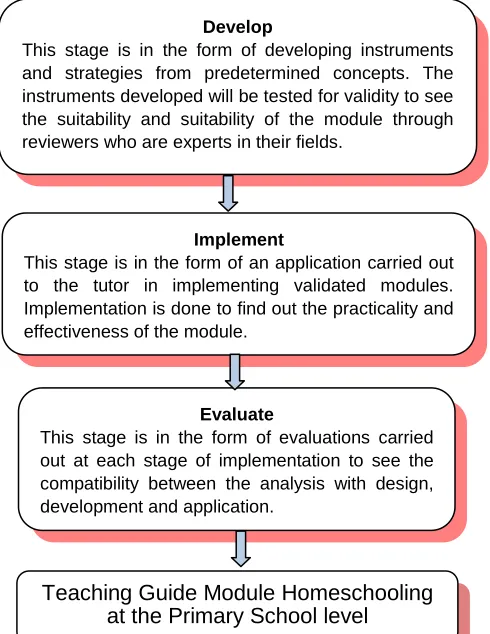
Develop
This stage is in the form of developing instruments and strategies from predetermined concepts. The instruments developed will be tested for validity to see the suitability and suitability of the module through reviewers who are experts in their fields.
Implement
This stage is in the form of an application carried out to the tutor in implementing validated modules. Implementation is done to find out the practicality and effectiveness of the module.
Evaluate
This stage is in the form of evaluations carried out at each stage of implementation to see the compatibility between the analysis with design, development and application.
311 d. Module Revision
Module revisions are based on suggestions and input from the validator at Module validation. There are some suggestions given for improvements to the initial product before it is revised. First, according to Dr. Arwan, M.Pd. Improve writing procedures. Secondly, according to Dr. Happy Fitria, M.Pd. repair writing, especially foreign terms, italicized and letter consistency observed. Third, according to Dewi Rosanti, M.Sc. so that the basics of the literature are added to the basis for the preparation of the module. The results of the validation were then tested in small groups and large groups and were refined at the focus group discussion held in December 2018 until January 2019. Based on the results of the FGD this module was declared very good and feasible to use.
4. Implementation Phase
At this stage, researchers together with homeschool education institutions (research subjects) prepare paratutors (learning participants), and organize the study room. Next the researchers tested the practicality and effectiveness of the module. The modules that have been validated by experts will be tested in small groups in the FGD then implemented experimentally on 15 respondents in learning the use of homeschooling teaching guide modules at elementary school level consisting of 5 tutors from Homeschooling Khoiru Ummah and 10 Primagama Homeschooling tutors, resulting in a total of 15 respondents package homeschooling tutor A. At the implementation stage, researchers conduct testing the practicality and effectiveness of the guide module teaching at homeschooling at the elementary school level to the subject of the study. Based on the results of the implementation, the following findings were obtained.
a. Module Practicality Testing
In this study, the response questionnaire was used to obtain data on the practicality of using the module. Data was obtained from questionnaire responses for participants and learning instructors. The results of data analysis from participant response questionnaires obtained a score of 4.49 and included in the classification very well, while the response questionnaire from learning instructors obtained a score of 4.56 and entered very good classification. This shows that the developed module was declared practical because the average score of 4.49 and 4.56 and included in the classification of assessment was very good so that it was suitable to be used in learning to use teaching modules at the elementary school level.
b. Module Effectiveness Testing
To get the value of module effectiveness, learning test results were used before and after learning. Learning outcomes test data obtained by documenting the test results of learning conducted by learning participants (tutors) with minimum completeness criteria (KKM) is 75. The results of the pretest 15 learners from Khoiru Homeschooling, Primagama Homeschooling and Homeschooling, obtained an average result of 69.52% of the learning participants not yet completed (not graduating) and only 30.48% of participants completed. Thus it can be concluded that before learning, the average respondent did not pass. Posttest results of 15 learners from Homeschooling Khoiru Primagama Homeschooling and Homeschooling with an average yield of 13.57 14 learners or
90.48% of respondents completed (graduated) and only 1.43 1 participant or 9.52% of respondents who have not completed (not pass). Based on the results of the analysis of the learning outcomes test, the compiled modules are declared effective so that they are suitable for use in learning the use of teaching modules at the elementary school level.
5. Evaluation Phase
The evaluation phase is done by analyzing the suitability between needs analysis with module design, module design with development, and development with implementation. Improvement of the module at the evaluation stage is based on tutors' suggestions and comments as participants and from the learning instructor both written in the response questionnaire and delivered at the end of the learning process. In addition, the module repairs are also based on the results of observations and evaluations after the learning is done through the initial test (pretest) and the final test (posttest) using the teaching module at the primary school level homeschooling. Evaluation of the learning process was carried out by researchers to see the suitability of the implementation of the module with the design made. The results of the evaluation were carried out by the researcher using posttest to see the level of achievement of the respondents from the pretest and after being given learning using this module. Based on the results of the evaluation on the results of tests given before and after learning, it can be concluded overall that this module has an effect, because there is an increase in the value of respondents from before and after module learning. The following is a table of evaluation of learning outcomes.
Table 4.13. Evaluation of Learning Test Results
Completeness
Pretest Posttest
Criteria
f % f %
Complete learner
participants 5 30,48 14 90,48 Effec- tive Learners who have
not finished 1
0 69,52 1 9,52
The results of the evaluation in the process, the researchers conducted with Primagama Homeschooling Principal Rosmaini, S.Pd. Based on the results of the process evaluation from the training it can be concluded that all observed aspects "exist" and on average "very good".
CONCLUSION
1. The results of the assessment carried out by the lecturers of experts, the module developed was declared valid with the average score of the material validation of the module is 4.67 with very good classification. The average score given for the assessment of module form is 4.61 with very good classification. The average score given for module motivation assessment is 4.76 with very good classification. The average score given for language assessment and module readability is 4.42 with very good classification.
312 responses from the learning instructors is 4.56 and entry is
classified as very good so that it is suitable for use in the learning module usage guide teaching at homeschooling at the elementary school level.
3. The results of the learning outcomes tests conducted at the end of the study, the modules developed were categorized as effective. This is indicated by the percentage of learning completeness of the learners who are in a very good classification with an average result of 14 participants (90.48%) respondents stated complete (graduated) and only 1 participant (9.52%) respondents who have not completed (not graduated) )
BIBLIOGRAPHY
[1]. Arikunto, S. (2016). Prosedur Penelitian Suatu Pendekatan Praktik. Jakarta: Rineka Cipta.
[2]. Danim, S. (2008). Media Komunikasi Pendidikan: Pelayanan Profesional Pembelajaran dan Mutu Hasil Belajar (Proses Belajar Mengajar di Perguruan Tinggi). Jakarta: Bumi Aksara.
[3]. Dick, W., Carey, L., & Carey, J. O. (2001). The Systematic Design of Instruction. United States: Addison-Wesley Educational Publisher Inc.
[4]. Jamaludin, K. A., Alias, N., & Dewitt, D. Research and Trends in the Studies of Homeschooling Practices: A Review on SelectedJournals.The Turkish Online Journal of Educational Technology Vol. 14, Issue 3 Tahun 2015.
[5]. Kunandar. (2009). Penelitian Tindakan Kelas. Jakarta: RajaGrafindo Persada.
[6]. Liputan6news. 10 Juli 2007. Siswa Homeschooling mampu Berprestasi. Oleh Zwasty Andria dan Bondhan Wicaksono.
[7]. Moleong, L. J. (2014). Metodologi Penelitian Kualitatif. Bandung: Remaja Rosdakarya.
[8]. Mudlofir, A. (2011). Aplikasi Pengembangan Kurikulum Tingkat Satuan Pendidikan dan Bahan Ajar Dalam Pendidikan Agama Islam. Jakarta: PT Raja Grafindo Persada.
[9]. Nasution, S. (2010). Berbagai Pendekatan Dalam Proses Belajar & Mengajar. Jakarta: Bumi Aksara.
[10]. Razi, A. Homeschooling: an Alternative Education in Indonesia.International Journal of Nusantara Islam Vol.4, No.2 Tahun 2016.
[11]. Sanjaya, W. (2007). Strategi Pembelajaran Berorientasi Standar Proses Pendidikan. Jakarta: Kencana Prenada Media Group.
[12]. Sheng, X. (2014). Learning with Mothers. A Study of Homeschooling in China. Taipei: Sense Publishers.
[13]. Sugiarti, D. Y. Mengenal Homescholling Sebagai Lembaga Pendidikan Alternatif. Jurnal EdukasiVol.1
No.2 Tahun 2009.
[14]. Suhardan. (2006). Supervisi Bantuan Profesional. Bandung: CV. Alfabeta.
[15]. Sukirman, (2012).Pengembangan Media Pembelajaran. Yogyakarta: Pedagodia.
[16]. Sumardiono. (2014). Apa Itu Homeschooling?. JaKarta: Panda Median.
[17]. Tegeh, M., Jampel, I. N., & Pudjawan, K. (2014). Model Penelitian Pengembangan. Yogyakarta: Graha Ilmu.