http://www.sciencepublishinggroup.com/j/ijefm doi: 10.11648/j.ijefm.20180605.12
ISSN: 2326-9553 (Print); ISSN: 2326-9561 (Online)
A Systems Balance Approach Against Systematic Risks of
China
Zou Lixing
1, 2, 31
China Association for Social and Economic System Analysis Research, Beijing, China 2
Research Institute, China Development Bank, Beijing, China 3
China Center for Modernization Institute of Chinese Academy of Science, Beijing, China
Email address:
To cite this article:
Zou Lixing. A Systems Balance Approach Against Systematic Risks of China. International Journal of Economics, Finance and Management Sciences. Vol. 6, No. 5, 2018, pp. 208-215. doi: 10.11648/j.ijefm.20180605.12
Received: July 3, 2018; Accepted: September 10, 2018; Published: November 6, 2018
Abstract:
The current international and domestic situation is very complicated. Particularly modernization of China is an extremely complex systems project. Contradictions of imbalance in the systems must be solved by means of systems balance. Below we will take a look into the patterns of balance for systems movement, and the operation mode of the system balance approach against systematic risks of China. The change of systems (things) is always in a repeating process from imbalance to balance and re-balance. In this repeating process, there is a balance force that drives the contradictory movement of things and their change to correlate and interact with one another. A proper degree of system balance is a sign of wisdom to weigh pros and cons based on the interconnections of things. A state-level laboratory dedicated to social and economic systems’ integrated balance should be in place to meet the requirements for balanced market development. From the system balance perspective, risks and returns always exist together in the financial system. The key is to transfer risks that you are least sure of, reduce risks that cannot be transferred or are too expensive to transfer, and augment those that you can profit from, with minimum costs and maximum profits. The assets and debts in the financial system always follow the principle of equilibrium. To properly understand and handle the relations between assets and debts, equities and securities, we need to shift more attention from the scale to the quality of financial development, extend traditional financial functions of “deposit, trade facilitation and resource allocation” to new functions such as “corporate governance, signaling, and risk management”. We need to examine the RMB-USD relations in the context of the international community with a shared future. The internationalization of renminbi is not to challenge the leading role of the US dollar as an international currency, but to offer a necessary supplement and make constructive efforts for the balanced development of the international currency system.Keywords: Systems Balance Approach,
Systematic Risks, Metasynthetic Engineering1. Systems Balance Principle
The first, the discussion will focus on the general systems balance principle and characteristics, the process in systems balance thinking from characterization to quantification back again to characterization, and the "degree" of systems balance.
1.1. Purpose of Systems Balance Research
A system is an organism with certain functions which is formed by a group of related components. The balance of a system, which is an important way of its existence, is a comprehensive phenomenon where contradictions therein
It is intended to explore laws of systems movement inclined to balance in extremely complex changes and, based on thorough analysis on the systems structure, environment and functions, look further into superficial and essential characteristics of systems balance and the interacting process and features of its internal, underlying and external forces, and find out the nature and patterns of the change in or the movement of systems balance. The basic idea is that balance thinking and the Hall for Workshop of Metasynthetic Engineering (balance lab) are employed to characterize and build models for unbalanced and uncertain phenomena (fuzzy phenomena) that abound in the real world with the intention of dealing with them properly. Some expositions and outlines created on systems balance thinking ought to be an important part of the "science of science and technology systems [2], and the "science of wisdom in cyberspace [3]”. Strengthening systems balance research may reveal trends and characteristics of modern science and technology, reflect the requirements and direction of complex social and economic changes, and help people to attempt new explorations, acquire new knowledge, discover new laws while understanding the world, as well as to employ the new laws and new knowledge thus obtained to solve contradictions of unbalanced, insufficient and uncoordinated social and economic development.
1.2. Systems Balance Principle and Characteristics
The systems balance principle unveils how the interacting parts of the systems as a whole are inclined to balance while they adapt to environmental changes. According to preliminary findings of systems balance research, "the change of systems (things) is always in a repeating process from imbalance to balance and re-balance. In this repeating process, there is a balance force that drives the contradictory movement of things and their change to correlate and interact with one another. This balance force is self-generating, self-balancing, spontaneous, autonomous and natural, and it is the absolute, permanent, and dynamically stable force that spurs the movement of things. Things under the balance force create systems balance movement, which is the foundation of the universe, the guarantee of life, the cause of being, the basis of connection, the condition of activity, the origin of things, and the base of development [4]”.
Systems balance movement has seven main characteristics. The first is about foundation, without which no system can exist. In a hierarchical chain of related systems, for instance, there objectively exists a deepest-seated primitive body which plays the fundamental role in the balanced development of things. The second is about structure, because of which systems exist. Under the balance force, the bodies of things tend to adapt and self-organize themselves in response to environmental changes. When a system is disturbed by internal and external environmental factors, it may, through its self-organizing function, coordinate activity within to stay relatively stable. For example, the universe has a self-structure of intrinsic forces: the earth has a structure formed through its gravity, and the earth's gravity and the sun's gravity interact with one another to make the earth part of the solar system.
The third is about wholeness, because of which systems exist. "The spatial and temporal world which man has explored from the littoscopic, microscopic, macroscopic, cosmoscopic and bulgoscopic perspectives is a whole in which things correlate and interact with one another." For example, a biological system is a closely-knitted whole in which the change of a particular element causes chain reactions and systematic changes. The fourth is about correspondence. Things exist corresponding to one another. Under the balance power, things are both antithetical and united, both common and special, always with two corresponding and mutually balancing properties. One example is complexity versus simplicity, where a complex world is certain to have a simple kernel corresponding to it. The fifth is about symmetry. Systems exist in symmetry. Symmetry here refers not to simple physical symmetry, but to symmetry in nature of systems themselves. Examples include positive and negative charges in physics, positive and reverse reactions in chemistry, prosperity and decline in economics, and positive and negative feedback in the financial market. The sixth is about reflectivity. Systems reflect and influence one another. For example, people influence, and are influenced by, the environment; people's attitudes influence the development of things, which in return influences people's attitudes. The seventh is about rhythm. Systems exist in rhythmic motion. For example, human life is physiologically, behaviorally and mentally rhythmic; human society is economically, politically and culturally rhythmic. Through elements of internal and external connection, structure and feedback, the balance law passes the balance force to systems and hence encourages their change and development.
Under the law of systems balance, human social systems have followed a "unitary to plural to integrated" trajectory: the "primitive globalization" of ancient human civilization was globalization where man interacted with nature and unitary human society became plural; the "modern globalization" of industrial civilization is globalization where individuals interact with one another and plural human society becomes integrated; and the "future globalization" of green civilization will be globalization where civilization and globalization interact with one another and there is a plurality of centers.
Under the law of systems balance, the change of economic and social systems and that of the natural environment is certain to reach a dynamic balance, and the force of man and that of nature is bound to be in a state of balance. Man is great, but if in production and life man has no regard for laws of nature and doesn't follow the balance law nor voluntarily comply with the trend of balance nor actively adopt balance thinking and behavioral measures, human economic and social development will inevitably be punished by the invisible natural force of balance that exists objectively.
consciousness of modernization; in the 21st century, China is certain to develop a reasonably full consciousness of modernization and, while learning from tradition and history, create a sound theoretical system necessary to guide the country in building a highly modernized country.
Under the law of systems balance, in developing the socialist economy with Chinese characteristics, there always is a force that is inclined to correct another force and thus drives the economy to adjust, dynamically balance, and spiral ahead. The first 30 years following the founding of new China saw a "Great Leap Forward" dominated by a planned economy; in more than 30 years of reform and opening-up, such a "Great Leap Forward" has been dominated by a market economy; and 30 years to come, there will for certain be healthy development of a mixed economy.
Under the law of systems balance, there have to be a hybrid way of thinking between materialism and idealism, a mixed economy between the publicly-owned economy and the privately-owned economy, an interacting mechanism linking up the government and the market. In other words, between any two extremities there must exist an intermediate space.
1.3. The Degree of System Balance
Compared with other laws, the law of system balance has another hallmark: the degree. The degree of system balance is not for measurement in the general sense, but for revealing the sections and turning points of a process, so as to provide scientific evidence for voluntary intervention. A proper degree of system balance is a sign of wisdom to weigh pros and cons based on the interconnections of things. The keyword is “proper”; it is not compromise for compromise’s sake or the middle course. Without a proper degree of system balance, substantial development would not be possible. It is a quantified measurement to translate the development process into test figures or sections. It combines qualitative with quantitative analysis, social sciences with natural sciences, and macro with micro elements. It applies to everything in the world for it is with the measurement of degree that the natural order takes shape. One more step, you might miss truth and enter into fallacy; one step less, what you do might be futile. The “degree” thus plays an irreplaceable role. The number-quadrant system is common in ancient Chinese literature, such as The Book of Changes, which differentiates between big and small, whole and parts, and shows ancient Chinese’ dialectical thinking and decision-making based on it. Yet it is far from enough to meet the modern society’s theoretical and technical demand for system balance measurement. Constraints are an important part of modern economies. The more mature the market, the more it needs clearly-defined conditions and constraints.
A proper degree of market development is the prerequisite for the market’s sound and sustainable development and
shows that the market elements are well matched in terms of quantity and quality. For instance, the balance degree of government debts and foreign debts is generally measured via global comparison or internationally recognized standards. The European Union sets the guideline that the government debts should not exceed 60% of the GDP and issues a warning of danger when the figure exceeds 90% [6].
To impose proper market constraints, we need to grasp the right trend of development and meet certain requirements for precision which is often verified through modeling. For example, in the case of social and economic systems, system modeling can give us an approximate description and analysis of the real system and thus inspire proper constraints. The description precision is good as long as it meets research needs. The description of social and economic systems, with the precision error kept within 5%, can be trusted and applied. Fuzziness with certain accuracy is more valuable than total accuracy, just as painting is truer than photography. Therefore, the degree measurement of system balance will help us not only better understand the law of system balance, but also actively explore the way to better measure it.
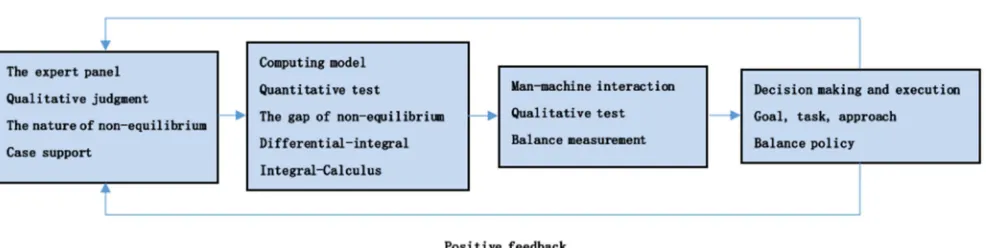
1.4. From Qualitative to Quantitative and Then Back to Qualitative Analysis of System Balance
Figure 1. The Process from Qualitative to Quantitative and then to Qualitative Analysis of Balance.
The system balance approach is an innovation based on the meta-synthesis approach. Compared with the latter, first, it pursues balanced development and makes it clear that every means must serve this goal; secondly, it adopts more advanced technologies and incorporates big data-based public opinion into meta-synthesis; thirdly, it considers system balance not just a goal, but also a means, and needs to rule out extreme understanding and behavior in the process of input and judgment, which is even more important in the analysis of social and economic systems. The system balance approach is ultimately based on the balance mentality and the combination of micro and macro analysis, and of logical thinking and thinking in images.
2. The System Balance Principle Is an
Important Weapon Against Systematic
Financial Risks
According to the law of system balance, the system balance principle can be applied to address systematic risks. But how? We need an effective operational mode.
2.1. Apply the System Balance Approach to the Financial System
The financial system is composed of multiple institutions and individuals, part of the even more complicated social system. Spatially speaking, it often has a layered structure. For instance, in many countries, the financial system is composed of the central bank, policy banks, commercial banks, specialized banks, and non-banking financial institutions. Temporally speaking, it must maintain certain liquidity in a certain time span. For example, the US financial system handles at least 250 million check transactions and 150 million e-transactions per day on average. Functionally speaking, its functions, such as payment, trade, storage, bookkeeping, and investment, are often correlated with each other and must follow established, strict procedures. Like a living body, the financial system exists in two environments. One is the internal environment: it is relatively stable, with inner functions and potential forces to balance and keep sub-systems within it operating in a coordinated, orderly manner, leading to the healthy status of trading behavior and
credit flow in economic life. The other is the ever-changing external environment, or external man-made and natural forces. External factors such as geopolitics, military conflicts, emergencies and technological revolutions will affect the stability of the financial system. As the financial system is linked increasingly closely with social development, the financial system and the society are in the symbiotic relationship. From micro to macro levels, the financial system is a unified, complicated grid system, and its priority task is to strike a balance between credit and risks.
2.2. The Credit Balance Issue in the Financial System
Credit is the most fundamental, important factor in the complex financial system and environment. It shows the central role of social system integration; it connects the financial system spatially, temporally and functionally; it exists in every corner of the financial environment. Credit concerns the personal interests of individuals and every aspect of social life. It is shown in the credit exchange behavior engaged by ordinary people and in the proportion to balance. The credit spirit represents a positive value and outlook of the mankind and targets at the central issue of all transactions. As an old Chinese saying goes, “The world is hustling and bustling for nothing but interests.” A person without credit won’t gain foothold anywhere; a business without credit won’t be able to last. All the transactions we make in modern society are based on credit. Credit balance is the central issue of the financial system.
surely come to diminish and overcome the damages and disruptions of anti-credit behavior, explore more and more roads for normal operation, and eventually establish the dominant position in the market economy. It will because the law of value, the supply-demand law, the competition law and the balance law will work together to form an objective check-and-balance mechanism and stimulate the survival of the fittest as the market economy develops; because credit activities, with their public and moral appeal, will generate a force driving balanced social progress and credit development. Of course, it won’t be enough to rely completely on “the invisible hand” of the market; the superstructure needs to act and establish effective mechanisms to speed up the process. Credit activities can be developed just like productivity, and their development can be sped up by combining external factors (such as the government’s advantages in organization and coordination) and the market’s fundamental roles.
For example, China Development Bank (CDB) has always been pushing ahead the formation of the “credit development
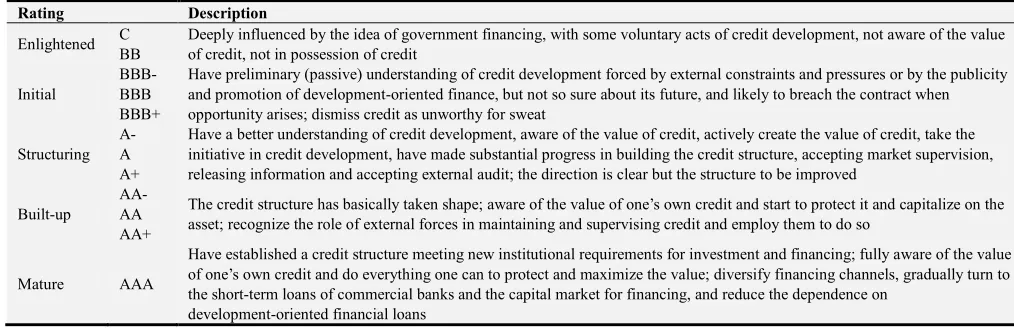
degree” (or “credit degree” for short) system and has introduced a set of indicators to evaluate it. The so-called credit degree is the degree of market credit development in a certain place. CDB combines qualitative and quantitative analysis, evaluates the client’s credit development status in five aspects: the credit and legal awareness, the legal-person governance structure, the quality of the credit structure, the credit development prospects, and diverse financing, and then rates the credit development degree. In practice, credit development has several ratings, each in the linear functional relationship with capital investment efficiency. According to the market credit development status, CDB employs the meta-synthesis approach to roughly classify the ratings into five categories: Enlightened, Initial, Structuring, Built-up, and Mature, which are further divided into 12 gradations: ratings C and BB for Enlightened, BBB-, BBB, and BBB+ for Initial, A-, A, and A+ for Structuring, AA-, AA, and AA+ for Built-up, and AAA for Mature. Table 1 lists the general characteristics of each of them.
Table 1. Description of Credit Development Gradation Ratings.
Rating Description
Enlightened C Deeply influenced by the idea of government financing, with some voluntary acts of credit development, not aware of the value of credit, not in possession of credit
BB
Initial
BBB- Have preliminary (passive) understanding of credit development forced by external constraints and pressures or by the publicity and promotion of development-oriented finance, but not so sure about its future, and likely to breach the contract when opportunity arises; dismiss credit as unworthy for sweat
BBB BBB+
Structuring
A- Have a better understanding of credit development, aware of the value of credit, actively create the value of credit, take the initiative in credit development, have made substantial progress in building the credit structure, accepting market supervision, releasing information and accepting external audit; the direction is clear but the structure to be improved
A A+
Built-up
AA-
The credit structure has basically taken shape; aware of the value of one’s own credit and start to protect it and capitalize on the asset; recognize the role of external forces in maintaining and supervising credit and employ them to do so
AA AA+
Mature AAA
Have established a credit structure meeting new institutional requirements for investment and financing; fully aware of the value of one’s own credit and do everything one can to protect and maximize the value; diversify financing channels, gradually turn to the short-term loans of commercial banks and the capital market for financing, and reduce the dependence on
development-oriented financial loans
From the above preliminary classification of market credit ratings by CDB, we can see that: market credit development is stage-specific, dynamic and open to leaps and bounds; the degree of market credit development is closely related to the level of economic development; the higher the credit rating, the more advanced the market economy; sound credit development will stimulate the stably rapid growth of the market economy; and the degree of market credit development is reflected throughout the whole process of economic operation. So far, China is in lack of necessary financing support for coordinated economic and social development. In particular, credit financing is insufficient for the development of agriculture, rural areas and farmers’ livelihood, small- and medium-sized enterprises (SMEs), the development of West China, the rejuvenation of old industrial bases in Northeast China, and the development of county economies. The root cause is linked to the degree of market credit development and the credit balance issue. Therefore, it is imperative to strengthen the development of the market credit system, realize credit-debt balance (the development and utilization of credit) for market players, and balance credit and risks, so as to more effectively allocate production factors and promote
balanced economic development.
In the credit-based financial market system, there exist different financial markets at various levels as well as all sorts
of financial instruments, which might breed
market environment is changing faster with growing and increasingly complicated credit conflicts, more hazards to P2P schemes, growing irregularities and uncertainties in the market, growing market risks, and more prominent conflicts caused by the uneven, un-coordinated and insufficient social and economic development. To address these conflicts and issues, we may resort to the system balance approach.
2.3. The Operation Mode of the System Balance Approach
The system balance approach is a balance-centered system analysis method.
2.3.1. Basic Idea
To follow the law of balance and apply the balance mentality and principle to study issues by trying to strike a balance between parts and the whole, and between different levels, and explore ways to address system imbalance.
2.3.2. Basic Principle
To break down the system properly for analysis, then synthesize the analysis results of parts, and eventually study and address the issue as a whole to realize overall balance of the system in question. In reality, the common practice is to establish a highly intelligent man-machine or man-network mechanism, with man playing the leading role, employ expert analysis, psychological profiling, model-based analysis, data mining, textual mining and web mining, integrate the thoughts, experience, knowledge and wisdom of all personnel involved and all sorts of intelligence, information and data, especially big data about the public opinion, elevate qualitative understanding from multiple angles to quantitative understanding, rule out extreme perceptions and behaviors in the course of qualitative and quantitative analysis, design and adopt proper policy measures, adjust the association between parts, levels and system environments, and coordinate the whole with its parts and environments, so as to achieve the
optimum functions we are looking for and realize sustainable and sound development of the system as a whole.
2.3.3. Operational Mode
A state-level laboratory dedicated to social and economic systems’ integrated balance (Hall for Workshop of Meta-synthetic Engineering, HWME) should be in place to meet the requirements for balanced market development. The lab is an application of the “meta-synthesis from qualitative to quantitative analysis. [7]” It synthesizes the analysis by experts from various fields on development issues concerning the actual economic system, operational mechanism and administrative system. On top of that, it establishes a man-machine, man-network intelligent model for macro social and economic analysis, employs a sea of statistical data and cutting-edge algorithms, probes into the causes for social and economic imbalance, reveals certain inner quantitative associations in social and economic systems, and analyzes the results of “the multi-stage game of observable behaviors with imperfect information [8]”, to support macroeconomic decision making, help policy makers grasp the development status, predict the development trend, monitor operational indicators, and plan economic development, and provide them with quantitative references. Meanwhile, it can also perform modeling and meta-synthesis for the analysis of certain financial issues such as liquidity, retirement insurance and investment overheating, and produce quantitative references for policy making accordingly.
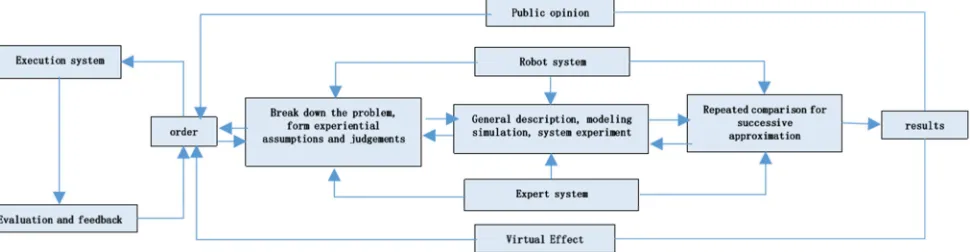
The above lab will, through the man-machine, man-network combination while with man playing the lead role, acquire extensive information, insightful knowledge and visionary wisdom, and serve as a key intelligent means in the new era to effectively prevent systematic financial risks. Figure 2 shows the working mode under which the system balance approach is applied to support policy making.
Figure 2. The Working Mode under Which the System Balance Approach Is Applied to Support Policy Making.
2.4. Financial Relations Revealed by the System Balance Approach
Here we try to build an operational model of applying the system balance approach to prevent systematic financial risks. So far, the model only exists as a vision, without specific cases and data to back it up, or description of the inevitable, definite quantitative relations between all kinds of phenomena, but
some important internal relations have revealed themselves.
2.4.1. The Risk-Return Relations
sound financial order to achieve it. Risks are prevalent in market activities. “The higher the risk, the bigger the return” – this is the golden rule of investment. There is no return that doesn’t come with some risk. Risks and returns not just go hand in hand, but also are positively correlated in quantity. Given the unique conditions and short history of Chinese financial industry, its clients, business insiders and even regulators are indifferent to risks, lack risk awareness and countermeasures against risks, and fail to spot the characteristics of risky activities or the existence of “grey rhinos”. Meanwhile when talking about risks, they unconsciously dismiss all risks as nothing but a disaster and would do everything to avoid them. What they want is risk-free investment. Neither of the above attitudes toward risks is advisable. The sensible way is to treat risks with reason and keep them under proper control. The key is to transfer risks that you are least sure of, reduce risks that cannot be transferred or are too expensive to transfer, and augment those that you can profit from, with minimum costs and maximum profits. This is risk management.
To maximize profits from risk management, we must properly handle the relations between financial innovation and financial regulation. Financial innovation meets the needs for economic development. Without innovation, we won’t be able to meet the diverse needs for social financing or realize inclusive finance. But financial innovation must be subject to financial regulation. While encouraging innovation and lowering the threshold for market entry, we must specify the purpose, the execution body and the means of regulation to effectively ensure sound development of financial innovation. Regulation is to serve innovation and innovation should precede regulation. The effect of regulation is measured by whether it can create a boom of innovation. It requires superb skills from the regulators to keep rein over and protect innovation at the same time, to protect and leverage the mutual reinforcement of innovation and regulation.
To maximize profits from risk management, we must also properly handle the relations between the real economy and the virtual economy. They are two sides of a coin. On one hand, the real economy is the most important, the basis for the virtual economy, a benchmark to test the development status of the virtual economy, and is what the virtual economy is based on and for. On the other, the virtual economy is comparatively independent, follows its own development pattern and exerts effects on the real economy. “Historically speaking, the development degree of the virtual economy, including the capitalization of idle money, socialization of interest-hike capital, marketization of negotiable securities, the internationalization of financial markets and the integration of international financial markets, reflects that of the real economy” [9]. To properly handle their relations, we need to attach equal importance to both economies, coordinate their even, synchronized development, actively contribute to the Global Financial Innovation Network and the Global Regulatory Sandbox, and improve domestic capacity building for financial regulation while working with other countries to better the global coordination mechanism for financial
regulation.
2.4.2. The RMB-USD Relations
We need to examine the RMB-USD relations in the context of the international community with a shared future. The current world is marked with the prominent conflict between economic integration and political pluralism, which is a natural result of international competition. No matter what competition we are engaged in, we human beings are bound together by the common future. From the perspective of globalization, economic globalization requires global governance systems and mechanisms and global currencies. The closer we move toward globalization, the more we need unified standards, norms and currencies; ultimately one international currency will suffice for the entire world. But in reality, we live in a society of conflicts and changes, the international political scene will be dominated by pluralism for quite a period to come. In other words, in the future, the United States might co-exist as the only super power with several regional powers. In that case, there will be several currencies in use in the world, given the state sovereignty, economic sovereignty, and in particular historical reasons and the varying degree of development in different countries. By then, the US dollar might play the dominant role while supplemented by other currencies, or the US dollar will act as the international currency while other currencies as the national and regional currencies, the so-called dual-track currency system. Such a system is the outcome of the real world and exists for a reason and for necessity. Its existence is justified and should be respected and preserved by countries and regions around the world. China, of course, respects and contributes to the current system. The internationalization of renminbi is not to challenge the leading role of the US dollar as an international currency, but to offer a necessary supplement and make constructive efforts for the balanced development of the international currency system. Of course, we hail the US dollar as an international currency not like sheep, but for a constructive purpose: we hope that the US government would truly shoulder the responsibilities of the US dollar as an international currency, instead of seeking only for its own interests. On top of that, it will be meaningful for the world to discuss the possibility of building a new international currency system reflecting the current economic status.
2.4.3. The Asset-Debt Relations
Table 2. The Initial Balance Sheet.
Assets Liabilities
+1 +1
Nowadays, debts are piling up for households, enterprises, countries and even the international society. Debt-fueled household consumption has become a trend: in 2017, the leverage ratio of Chinese residents reached 55.1%. Investment loan has become a business strategy for enterprises: in 2017, the liability ratio of industrial enterprises above the designated size in China hit 55.5%, and the figure for state-owned enterprises was 65%. Borrowing to reach higher has become a development mode for the government: in 2017, the debt ratio (outstanding debt/GDP) of the Chinese government was 36.2%. In the balance sheet, liabilities must be matched with the corresponding amount of assets in order to maintain asset-debt equilibrium. The debt-to-asset swap must take place via financial channels. The conversion of debts into assets will surely involve a lot of financial operations, leading to the following three phenomena. First, the cycle of debt inflation, financial inflation and asset inflation is formed. As debts swell, financial inflation and asset inflation are inevitable. Obviously, such assets are based on debts, thus vulnerable to risks and dangerous. Secondly, Internet-based transactions, as a new form of financial channel, tend to exacerbate financial inflation and asset inflation, which is easily translated into the increase in numbers, not the improvement of quality in the balance sheet, or even leads to false equilibrium. Thirdly, creditors’ rights and equity are asymmetric. As Mr. Chen Yuan once pointed out at the Guanghua Forum of Peking University, “debts take up the most part of an economy while capital and equity the least,” and “such extreme asymmetry is a problem not just of China, but of the entire world. It is just more highlighted in emerging economies such as China [11]”. To ultimately address this issue, we need to strictly abide by the law of balance, and apply the system balance approach to consider and address problems encountered. To properly understand and handle the relations between assets and debts, equities and securities, we need systematic design of profits and losses, integrated schemes for equities and securities, issue more shares and swap debts when necessary, and promote the mutual match and conversion of shares and debts. We need to shift more attention from the scale to the quality of financial development, extend traditional financial functions of “deposit, trade facilitation and resource allocation” to new functions such as “corporate governance, signaling, and risk management”, and strive to maintain basic equilibrium
between revenue growth, expenditure growth and debt growth in economic and financial activities.
3. Conclusion
To sum up, system balance is the direction to which all the conflicts and changes are heading. The undertaking to develop socialism with Chinese characteristics is a great systematic project. The system balance approach is a major weapon against systematic risks and against all problems triggered by imbalance and incoordination in the course of development.
References
[1] Yu Jingyuan. "Development and Application of Systems Science and Engineering [J]". Scientific Decision Making, December 2017, p1-17.
[2] Lu Mingsen and Bao Shixing (2014). Qian Xuesen on Wisdom in Cyberspace. Tsinghua University Press, p162.
[3] Lu Mingsen and Bao Shixing (2014). Qian Xuesen on Wisdom in Cyberspace. Tsinghua University Press, p308.
[4] Zou Lixing. China’s Logic: the Balance Development, World Scientific. May 2018. pp, 2-4.
[5] Department of Graduate Administration, China Aerospace Academy of Systems Science and Engineering. Lectures on Systems Engineering: A Graduate Course of the China Aerospace Academy of Systems Science and Engineering. China Astronautic Publishing House, 2013, p96.
[6] GyÖrgy Matolcsy. Economic Balance and Growth: Consolidation and Stabilization in Hungary 2010-2014. The Magyar Nemzeti Bank, 2015, pp. 625-627.
[7] Yu Jingyuan. "Development and Application of Systems Science and Engineering [J]". Scientific Decision Making, December 2017, p8.
[8] Drew Fudenberg, Jean Tirole. Games Theory. China Renmin University Press. 2010. 10th edition. pp. 275.
[9] Zou Lixing. Development-oriented Finance and Sustainable development in China. Hunan University Press. June 2013. Pp253-254.
[10] Stephen G. Cecchetti. Money, Banking, and Financial Markets. Peking University Press. 2006. P409.