The Effect of Reliability Index Values on Resulting
Reliability-Based Topology Optimization
Configurations: Numerical Validation by Shape
Optimization
G. Kharmanda
1, I. R. Antypas
2*, A. G. Dyachenko
2 1National Institute of Applied Sciences of Rouen
(Saint- Étienne-du-Rouvray, France)
2
Don State Technical University (Rostov-on-Don, Russia)
*[email protected]Introduction. The classical topology optimization leads to structural type and general lay-out prediction and gives a rough description of the shape of both the external and internal structure boundaries. However, Reliability-Based Topology Optimization (RBTO) model produces multiple reliability-based topologies with high levels of performance. The aim of this work is to study the effect of reliability changes on the obtained topologies.
Materials and Methods. The developed Gradient-Based Method (GBM) has been used
efficiently as a general method for several applications (statics and dynamics). When con -sidering several reliability levels, several topologies can be obtained. In order to compare the resulting topologies, a shape optimization is considered as a detailed design aspect.
Results. Numerical applications are carried out on an MBB (Messerschmitt-Bölkow-Blohm) beam subjected to a distributed load. The DTO model is carried out without con-sideration of reliability concept. However, for the RBTO model, an interval of reliability is considered that produces several topologies. Here, the randomness is applied on geometry and material parameters. The application of the shape optimization algorithm leads to reduced structural volumes when increasing the reliability levels.
Discussion and Conclusion. In addition to its simplified implementation, the developed
GBM strategy can be considered as a generative tool to provide the designer with several solutions. The shape optimization is considered as a numerical validation of the impor-tance of the different resulting RBTO layouts.
Keywords: deterministic topology optimization, reliability-based topology optimization, Gradient-Based Method
For citation: Kharmanda G., Antypas I.R., Dyachenko A.G. The Effect of Reli-ability Index Values on Resulting ReliReli-ability-Based Topology Optimization Con-figurations: Numerical Validation by Shape Optimization.Inzhenerernyye tekhnolo-gii i sistemy =Engineering Technologies and Systems. 2019; 29(3):332-344. DOI: https://doi.org/10.15507/2658-4123.029.201903.332-344
УДК 620.1.515.1:004.052 DOI: 10.15507/2658-4123.029.201903.332-344 http://vestnik.mrsu.ru ISSN Print 2658-4123 ISSN Online 2658-6525
ИНФОРМАТИКА, ВЫЧИСЛИТЕЛЬНАЯ
ТЕХНИКА И УПРАВЛЕНИЕ /
СOMPUTER SCIENCE, COMPUTER
ENGINEERING AND MANAGEMENT
© Kharmanda G., Antypas I. R., Dyachenko A. G., 2019
ENGINEERING TECHNOLOGIES AND SYSTEMS
Влияние значений индекса надежности
на результирующие конфигурации оптимизации
топологии на основе надежности: численная
проверка с помощью оптимизации формы
Г. Харманда
1, И. Р. Антибас
2*, А. Г. Дьяченко
2 1Национальный институт прикладных наук Руана
(г. Сент-Этьен-дю-Рувре, Франция)
2
ФГБОУ ВО «Донской государственный технический
университет» (г. Ростов-на-Дону, Россия)
Введение. Классическая оптимизация топологии приводит к прогнозированию структурного типа и общей компоновки и дает приблизительное описание формы внешних, а также внутренних границ структуры. Однако модель оптимизации топо
-логии на основе надежности (RBTO) создает несколько топологий с высоким уров
-нем производительности. Целью данной работы является изучение влияния измене
-ний надежности на полученные топологии.
Материалы и методы. Разработанный градиентный метод (GBM) эффективно ис
-пользуется в качестве общего метода для нескольких приложений (статики и ди
-намики). При рассмотрении нескольких уровней надежности можно получить несколько топологий. Для их сравнения оптимизация формы рассматривается как аспект детального проектирования.
Результатыисследования. Расчеты балки, подверженной распределенной нагруз
-ке, выполнялись с помощью вычислительного приложения на MBB (Messerschmitt-Bölkow-Blohm). DTO-модель внесена без рассмотрения принципиальной схемы надежности. Однако для RBTO-модели учитывался интервал надежности, который произвел несколько топологий. Здесь случайность применяется к геометрии и пара
-метрам материала. Применение алгоритма оптимизации формы приводит к умень
-шению структурных объемов при повышении уровня надежности.
Обсуждение и заключение. Помимо упрощенной реализации, разработанная страте
-гия GBM может рассматриваться как генеративный инструмент для предоставления проектировщику нескольких решений. Оптимизация формы рассматривается как численная проверка важности различных результирующих макетов RBTO.
Ключевые слова: детерминированная оптимизация топологии, оптимизация топо
-логии на основе надежности, градиентный метод
Для цитирования: Харманда Г., Антибас И. Р., Дьяченко А. Г. Влияние значе
-ний индекса надежности на результирующие конфигурации оптимизации то
-пологии на основе надежности: численная проверка с помощью оптимизации формы // Инженерные технологии и системы. 2019. Т. 29, № 3. С. 332‒344. DOI: https://doi.org/10.15507/2658-4123.029.201903.332-344
Introduction
Optimizing the topology seeks to an-swer one of the first questions regarding the nature of the structure in order to meet the required specifications. So the prob-lem of topology is to determine the gener-al characteristics of the studied structure, and the purpose of topology optimiza-tion is to make this initial choice as
au-tomatic as possible [1]. In addition, both macroscopic structures and microscopic materials can be found using topology optimization concepts. In other words, it is not only the optimal spatial distribution of the material on the macroscopic struc-tural scale, but also the optimal local use of the cellular material on the microscopic scale1.
1 Xia L. Multiscale Structural Topology Optimization. ISTE–Elsevier; 2016. Available at: https://
334
Two basic topology optimization mod-els can be classified in the literature: de-terministic and reliability-based models. In Deterministic Topology Optimization (DTO), one can search for a single solu-tion for a given domain2. But the Reliabil-ity-Based Topology Optimization (RBTO) model studied in this article, can lead to several solutions with different advantag-es, allowing us to choose the best topology to meet the technical specifications. The structural weight of the solutions obtained using this model is reduced in comparison with the DTO model. In addition, when us-ing the RBTO model, the obtained layout is more reliable in comparison with the deterministic topology at the same weight values3. To develop this model, two points of view are presented: topology optimiza-tion and reliability analysis. A literature review is presented in the next section to show the various advantages of the RBTO model. As result, several reliability-based topologies are obtained when considering several reliability levels. To compare the resulting topologies, a shape optimization is considered and shows that for the same boundary conditions, the RBTO configu-rations reduce the structural weight when increasing the reliability index values.
Literature Review
The main difference between DTO and RBTO is to consider the uncertainty on the parameters having important roles for optimal topology. The main idea of reliability-based topology optimization is based on the reliability-based design opti-mization. When considering the reliabili-ty-based design optimization problem, the
uncertainties regarding variable sizes are taken into account to ensure greater reli-ability of the proposed solution. However, the reliability-based topology optimiza-tion aims to provide designers with several solutions that have several levels of reli-ability. Here the designer can choose the best solution. In the RBTO model, several methods have been developed. The diffe- rent works can be divided into two points of view.
From point of view “topology opti-mization”, the reliability-based topology optimization model was developed in the article of G. Kharmanda and N. Olhoff4 to provide the designer with multiple re-liability-based structures, but in the clas-sical topology optimization, the designer produces only one deterministic topo- logy. It is shown that the importance of the reliability-based topology optimization model leads to structures that are more ro-bust than those obtained by deterministic topology optimization for the same weight [2–4]. In addition, probabilistic neural networks in the case of highly nonlinear or disjoint problems of the failure region are used in some studies [5]. This strategy has been successfully applied on various trusses. Recently, a method of optimiza-tion of the topology of detailed design of solid structures based on probabilistic reli-ability has been developed5.
From a point of view “reliability analysis”, deterministic topology optimi-zation is formulated as finding the most rigid structural arrangement with volume restriction. To maintain rigidity stability in topological design, optimization prob-2 Kharmanda G., El-Hami A. Biomechanics: Optimization, Uncertainties and Reliability. ISTE–Wi
-ley; 2017. Available at: http://ebook-dl.com/book/8163 (accessed 01.05.2019). (In Eng.)
3 Kharmanda G., Olhoff N. Reliability-Based Topology Optimization: Report. Aalborg: Aalborg
Uni-versitetsforlag; 2001. Available at: http://www.forskningsdatabasen.dk/en/catalog/2389380317 (accessed 01.05.2019). (In Eng.)
4 Kharmanda G., Olhoff N. Reliability-Based Topology Optimization as a New Strategy to Generate
Dif-ferent Topologies. In: 15th Nordic Seminar in Computational Mechanics. Aalborg: Aalborg University; 2002. Pp. 11-14. Available at: https://www.researchgate.net/publication/237295035_Reliability-Based_Topology_ Optimization_as_a_New_Strategy_to_Generate_Different_Structural_Topologies (accessed 01.05.2019). (In Eng.)
5 Bae K., Wang S. Reliability-Based Topology Optimization. In: 9th AIAA/ISSMO Sympo
ENGINEERING TECHNOLOGIES AND SYSTEMS
lem is formulated as a volume minimiza-tion problem with displacement restricminimiza-tion and RBDO technique is applied6. Here, the objective is to minimize the structural volume under the condition of the linear limit state function. Further, in article of H. Agarwal7 a hybrid cellular automaton (HCA) was developed for the structural synthesis of a continuum material, where the state of each cell is determined by both density and strain energy. The paper [6] uses an unrelated RBDO approach in which topology optimization is separated from reliability analysis. The use of RBTO taking into account the gradient free hy-brid cellular automata (HCA) method was performed8. Here, the formulation also in-cludes uncertainty about material proper-ties. The RBTO model using bidirectional evolutionary structural optimization and the standard response surface method was performed [7]. A computational method for reliability-based topology optimization for continuous domain under uncertainty of material properties has been developed [8].
Comparing both different points of view, the computing time of the reliability-based topology optimization methods in terms of “reliability analysis” is very high since a large number of design variables are associated with optimization problems of the continuum topology9.
Thus, the point of view “topology op-timization” seems to be very interesting to topology developers because it leads to several reliability-based structures with respect to changes in the reliability index. It produces different structures while when
considering the point of view “reliability analysis”, we get the same structure with different densities that makes no sense for the next detailed design stages.
To perform RBTO tasks, some RBDO methods can be used since we deal with a different definition or philosophy. Se- veral RBDO methods have been devel-oped with respect to their use10 [9]. The gradient-based method seems very easy to use, especially when considering static cases [2; 3]. In this work, a gradient-based method is used to create several reliability-based topologies. The resulting models are considered as the input configuration of the shape optimization algorithm in order to show their different advantages.
Materials and Methods
Deterministic Topology Optimization The problem of topology optimiza-tion is related to the minimizaoptimiza-tion of strain energy under the condition of limiting the structural volume [10]. All load para- meters and material properties are treated as deterministic values. The topology opti-mization problem consists of minimizing the compliance with a target percentage of the structural volume. This problem can be mathematically expressed [11]:
min :
. .: ,
Comp s t V
V ft 0
£ (1)
where Comp is the compliance consider-ing the material densities in each element as optimization variables that belong to the interval [0, 1]. V0 and V are the initial-and 6 Patel N.M., Agarwal H., Tovar A., Renaud J. Reliability Based Topology Optimization Using the
Hy-brid Cellular Automaton Method. In: 46th AIAA/ASME/ASCE/AHS/ASC Structures, Structural Dynamics
and Materials Conference; 2005. AIAA: 2005-2134. (In Eng.) DOI: https://doi.org/10.2514/6.2005-2134
7 Agarwal. H. Reliability Based Design Optimization: Formulations and Methodologies: PhD.
Thesis. Notre Dame: University of Notre Dame; 2004. Available at: http://adsabs.harvard.edu/ abs/2004PhDT...148A (accessed 01.05.2019). (In Eng.)
8 Ibid.
9 Kharmanda G., Olhoff N. Reliability-Based Topology Optimization as a New Strategy...
10 Yaich A., Kharmanda G., El Hami A., Walha L., et al.Reliability Based Design Optimization under
Fatigue Damage Constraints of Structures Subject to Random Vibrations. In: ECSO 2017: European Confer-ence on Stochastic Optimization; 2017. Pp. 20-22. (In Eng.) DOI: https://doi.org/10.1017/jmech.2017.44;
336
current structural volume values. Formu-lation (1) is a basic form and can be used with several topology optimization meth-ods such as SIMP (Solid Isotropic Micro-structure with Penalty), homogenization approach [11; 12]. In this work, SIMP method is considered. Equation (1) can be expressed by:
min : ( )
: ( ) : ( ) C x V V f T e p e N e T e
x q Kq q k q x Kq F = = = = =
∑
1 0 0 s.t.:0 x< min≤ ≤x 1,
(2)
where q and F are the global displacement and force vectors, respectively. K is the global stiffness matrix. qe and k0 are the element displacement vector and stiffness matrix, respectively. X is the vector of de-sign variables; xmin is a vector of minimum relative densities (non-zero to avoid sin-gularity). N is the number of elements to discretize the design domain. p is the pe-nalization power. V(x) and V0 are the ma-terial volume and design domain volume, respectively and f is the prescribed volume fraction.
Reliability-Based Topology Optimi-zation
In deterministic structural optimiza-tion, the designer seeks to reduce construc-tion costs without taking into account the effects of material uncertainty, geometry, and load. In this case, the resulting optimal configurations can represent a lower level of reliability and then result in a higher failure rate. The balance between mini-mizing costs and maximini-mizing reliability is a big challenge for the designer. The im-portance of reliability criteria in determin-istic design optimization is to increase the
level of design reliability without signifi-cantly increasing its weight. Thus, when the concept of reliability is integrated into the optimization of size and/or shape [13; 14], the model is called Reliability-Based Design Optimization (RBDO)11, which allows to design structures that meet the requirements of economy and security. However, when introducing reliability analysis to topology optimization, the non-quantitative nature is taken into account. This model is called Reliability-Based To-pology Optimization (RBTO). The goal of the RBTO model is to address some of the uncertainties in geometry or design load by introducing reliability criteria into the optimization procedure. This integration takes into account the randomness of the applied loads and the description of the geometry. The RBTO task can be written as [11]: min : . .: : , Comp s t and V V f t t
β β≥
≤ 0
(3)
where β and βtare the structural reliability index and the target reliability index, spectively (for more information about re-liability methods, see12 [15]). Considering that SIMP method is implemented, Equa-tion (3) can be written as:
min : ( )
( ) : ( , , )
( )
C T x
e p e N e T e t
x q Kq q k q u
K x y u
= =
≥
=
∑
1 0
s.t.:β β
⋅⋅ =
=
< ≤ ≤
q x y u F y u x y u y u
0 x x 1.
( , , ) ( , )
: ( ) ( , )
: min
V , ,
V0 f
(4)
11 Kharmanda G., El-Hami A. Reliability in Biomechanics. ISTE–Wiley; 2016. Available at: https://
www.wiley.com/en-tm/Reliability+in+Biomechanics-p-9781786300249 (accessed 01.05.2019). (In Eng.); Kharmanda G., Antypas I. Integration of Reliability and Optimization Concepts into Composite Yarns. In:
10th International Scientific-Practical Conference of Current Status and Prospects of Agricultural Engi -neering, “INTERAGROMASH-2017”. Rostov-on-Don: DSTU Publ. Centre; 2017. p. 174-176. (In Eng.)
ENGINEERING TECHNOLOGIES AND SYSTEMS
The integration of reliability analysis into the topology optimization has been carried out by performing gradient-based method for static studies [3].
Reliability index effect on resulting reliability-based topologies
When considering deterministic to-pology optimization, we can modify the nature of the structure more profoundly. This way the geometry of the part is en-visaged without any prior requirement as to the domains and/or the connections of the structural elements present in the solu-tion. The topology optimization involves, in one way or another, the determination of the shape or transverse dimensions of the structure, so certain some authors also call it generalized shape optimization [16–19]. Reliability-Based Topology Optimization has the objective to introduce reliability analysis into topology optimization in or-der to generate several topologies relative to the values of the reliability index. In our study13, the relationship between the objec-tive function (compliance) and the reliabil-ity index for the four studied structures14. As results, the complexity of the geometry and the multiple loading of the structures play a very important role relative to the reliability index variability, which enables the designer to choose the best solution out of the different topologies obtained by Reliability-Based Topology Optimization. However, there is no validation
concern-ing the importance of this changes. There-fore, we seek in this works to use the shape optimization to test several layouts.
Results
TOPOLOGY OPTIMIZATION RE-SULTS
We consider an MBB (Messerschmitt-Bölkow-Blohm) [20; 21] beam subject to a distributed load as an example for this nu-merical demonstration (Fig. 1). Figure 1a shows a full design domain of the studied beam with all boundary conditions while Figure 1b illustrates the equivalent sym-metry boundary conditions of a half beam. The random input parameters are: the number of elements of meshing model, in directions x and y (nelx = 40 and nely = 40), the volume fraction (volfrac = 0,5) and the distributed load (P = –1).
In order to demonstrate the effect of re-liability index, we generate several topolo-gies considering different reliability levels. The code is developed using MATLAB and based on the previous codes developed by the first author [5–7]. The objective is to perform topology optimization to obtain the best distribution of the materials. The topology optimization problem is then to minimize the compliance of the structure, subject to the volume fraction (50 %). The behavior of the used material is linear-elastic-isotropic. Table 1 shows the differ-ent resulting topologies for DTO layout and RBTO configurations for β ∈ −
[ ]
1 6 .13 Kharmanda G., El-Hami A. Reliability-Based Topology Optimization Model. In: Biome-chanics: Optimization, Uncertainties and Reliability. ISTE–Wiley; 2017. 5:121-152. (In Eng.) DOI:
https://doi.org/10.1002/9781119379126.ch4
14 Bae K., Wang S. Reliability-Based Topology Optimization.
a b
F i g. 1. Initial configuration and boundary conditions: a) full design domain; b) half of the design domain
with symmetry boundary conditions
338
Shape optimization results
In order to demonstrate the importance of the integration of reliability constraints into the deterministic topology optimiza-tion, we apply a shape optimization algo-rithm to the different resulting topologies. The integration of the reliability-based method leads to different topologies rela-tive to the positions of the elements mak-ing up the structure.
The shape optimization problem is to minimize the structural volume subject to mechanical stress using ANSYS Software. An MBB beam is loaded by a vertical pressure P = 20 N/mm2. It is fixed at its
up-T a b l e 1
Т а б л и ц а 1
Deterministic Topology Optimization (DTO) and Reliability-Based Topology Optimization (RBTO) layouts
Детерминированная оптимизация топологии (DTO) и схемы оптимизации топологии на основе надежности (RBTO)
Model Half design domain Full design domain
DTO
RBTO
β = 1
RBTO
β = 2
RBTO
β = 3
RBTO
β = 4
RBTO
β = 5
RBTO
β = 6
per extremities. The material in this beam is steel, which has a Young's modulus: E = 200 GPa and a Poisson’s ratio: v = 0.3. The allowable stress is σw = 970 Mpa. The beam length and height are: L = 200 mm and H = 100 mm, respectively and the thickness is considered to be: 20 mm.
ENGINEERING TECHNOLOGIES AND SYSTEMS
the von-Mises stress distribution at the op-timal configuration for the DTO layout and RBTO configurations when considering re-liability indices: β ϵ [1‒3].
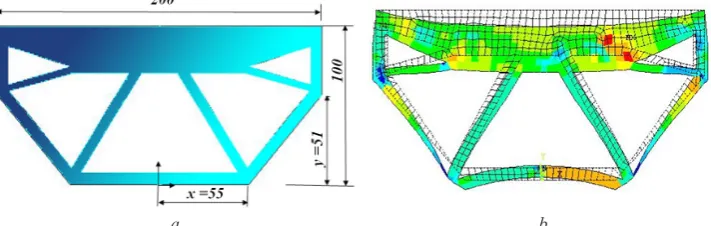
The second configuration corresponds to the RBTO result for β = 4. In figure 3a, the optimization variables are x, x1 and y. For the resulting topology, the structural volume of the optimal configuration, illus-trated in figure 3b, is 134100 mm3. Figu- re 3b shows the von-Mises stress distribu-tion at the optimal configuradistribu-tion for the
a b
F i g. 2. Deterministic Topology Optimization (DTO) layout and Reliability-Based Topology
Optimization (RBTO) configuration when considering β = [1‒3]: a) geometrical model;
b) von-Mises stress distribution
Р и с. 2. Детерминированная топология оптимизации (DTO): расположение и основанная на надежности топология оптимизация (RBTO) конфигурация при рассмотрении β = [1‒3]:
а) геометрическая модель; б) распределение напряжений по Мизесу
RBTO configuration when considering reliability indices β = 4.
The third configuration corresponds to the RBTO results for β ϵ [5‒6]. In figure 4a the optimization variable is x. For the resulting topology, the structural volume of the optimal configuration, illus-trated in figure 4b, is 132130 mm3. figu- re 4b shows the von-Mises stress distribu-tion at the optimal configuradistribu-tion for the RBTO configuration when considering reliability indices β ϵ [5‒6].
a b
F i g. 3. Reliability-Based Topology Optimization (RBTO) configuration when considering β = 4: a) geometrical model; b) von-Mises stress distribution
Р и с. 3. Конфигурацияоптимизациитопологиинаосновенадежности (RBTO) прирассмотрении
340
Discussion and Conclusion
The DTO algorithm leads to a single topology considering a given initial design space while the RBTO algorithm leads to several topologies relative to the reliability index values. Here, the reliability introduc-tion on the topology optimizaintroduc-tion process leads to a significant change of layouts when the reliability index becomes more than 3.
To evaluate this effect, a shape opti-mization procedure is required. When the structural geometry evolves during the shape optimization process, the problem becomes more complex because the design variables are represented by coordinates of certain points in the geometry. The shape optimization loop contains three steps: 1) description of the geometry; 2) mesh and FEM evaluation of the model; 3) calcula-tion of the gradients to minimize the
ob-jective function. As result, we note that for the same boundary conditions, the RBTO second configuration reduces the structural weight by 10 %. The RBTO third configura-tion reduces the structural weight by 11 % for the same conditions.
Thus, reliability-based topology op-timization is able to generate multiple topologies, giving the designer a range of solutions by adding certain reliability constraints. The proposed RBTO model aims to consider randomness (variability) of the most important quantities of a struc-ture such as the geometry and the applied loads. This model can provide designers with several topologies. Another advantage is the reduction of weight of structures for the same conditions. This weight reduction will manifest itself in deterministic design optimization as well as in reliability-based design optimization.
a b
F i g. 4. Reliability-Based Topology Optimization (RBTO) configuration when considering β = [5‒6]:
a) geometrical model; b) von-Mises stress distribution
Р и с. 4. Конфигурация оптимизации топологии на основе надежности (RBTO)
при рассмотренииβ = [5‒6]: а) геометрическая модель; б) распределение напряжений по Мизесу
REFERENCES
1. Bendsoe M.P., Kikuchi N. Generating Optimal Topologies in Optimal Design Using a Homogeni-zation Method. Computer Methods in Applied Mechanics and Engineering. 1988; 71(2):197-224. (In Eng.) DOI: https://doi.org/10.1016/0045-7825(88)90086-2
2. Kharmanda G., Olhoff N., Mohamed A., Lemaire M. Reliability-Based Topology Opti -mization. Structural and Multidisciplinary Optimization. 2004; 26(5):295-307. (In Eng.) DOI: https://doi.org/10.1007/s00158-003-0322-7
ENGINEERING TECHNOLOGIES AND SYSTEMS
4. Patel J., Choi S.K. Classification Approach for Reliability-Based Topology Optimization Using Prob -abilistic Neural Networks. Journal of Structural and Multidisciplinary Optimization. 2012; 45(4):529-543. (In Eng.) DOI: https://doi.org/10.1007/s00158-011-0711-2
5. Wang L., Liu D., Yang Y., et al. A Novel Method of Non-Probabilistic Reliability-Based Topol -ogy Optimization Corresponding to Continuum Structures with Unknown but Bounded Uncertain-ties. Computer Methods in Applied Mechanics and Engineering. 2017; 326:573-595. (In Eng.) DOI: https://doi.org/10.1016/j.cma.2017.08.023
6. Eom Y.-S., Yoo K.-S., Park J.-Y., Han S.-Y. Reliability-Based Topology Optimization Using a Stan-dard Response Surface Method for Three-Dimensional Structures. Journal of Structural and Multidis-ciplinary Optimization. 2011; 43(2):287-295. (In Eng.) DOI: https://doi.org/10.1007/s00158-010-0569-8
7. Jalalpour M., Tootkaboni M. An Efficient Approach to Reliability-Based Topology Optimization
for Continua under Material Uncertainty. Journal of Structural and Multidisciplinary Optimization. 2016; 53(4):759-772. (In Eng.) DOI: https://doi.org/10.1007/s00158-015-1360-7
8. Kharmanda G. The Safest Point Method as an Efficient Tool for Reliability-Based Design Op -timization Applied to Free Vibrated Composite Structures. Vestnik Donskogo gosudarstvennogo tekh-nicheskogo universiteta = Vestnik of Don State Technical University. 2017; 17(2):46-55. (In Russ.) DOI: https://doi.org/10.23947/1992-5980-2017-17-2-46-55
9. Yaich A., Kharmanda G., El Hami A., Walh L., et al. Reliability-Based Design Optimization
for Multiaxial Fatigue Damage Analysis Using Robust Hybrid Method. Journal of Mechanics. 2017; 34(5):551-566. (In Eng.) DOI: https://doi.org/10.1017/jmech.2017.44
10. Kharmanda G., Antypas I.R., Dyachenko A.G. Inverse Optimum Safety Factor Method for Reliability-Based Topology Optimization Applied to Free Vibrated Structures. Inzhenernyye tekhnologii i sistemy = Engineering Technologies and Systems. 2019; 29(1):8-19. (In Eng.) DOI: https://doi.org/10.15507/2658-4123.029.201901.008-019
11. Bendsoe M.P. Optimal Shape Design as a Material Distribution Problem. Structural Optimization. 1989; 1(4):193-202. (In Eng.) DOI: https://doi.org/10.1007/BF01650949
12. Bendsoe M.P., Sigmund O. Material Interpolations in Topology Optimization. Archive of Applied Mechanics. 1999; 69(9-10):635-654. (In Eng.) DOI: https://doi.org/10.1007/s004190050248
13. Kharmanda G., Antypas I. Integration of Reliability Concept into Soil Tillage Machine Design. Vestnik Donskogo gosudarstvennogo tekhnicheskogo universiteta = Vestnik of Don State Technical University. 2015; (2):22-31. Available at: https://cyberleninka.ru/article/v/integration-of-reliability-concept-into-soil-tillage-ma-chine-design (accessed 01.05.2019). (In Russ.)
14. Kharmanda G., Antypas I. Reliability-Based Design Optimization Strategy for Soil Tillage
Equipment Considering Soil Parameter Uncertainty. Vestnik Donskogo gosudarstvennogo tekhnichesk-ogo universiteta = Vestnik of Don State Technical University. 2016; 16(2):136-147. (In Russ.) DOI: https://doi.org/10.12737/19690
15. Ibrahim M.-H., Kharmanda G., Charki A. Reliability-Based Design Optimization for Fatigue Dam-age Analysis. The International Journal of Advanced Manufacturing Technology. 2015; 76(5-8):1021-1030. (In Eng.) DOI: https://doi.org/10.1007/s00170-014-6325-2
16. Rozvany G.I.N., Zhou M., Birker T. Generalized Shape Optimization without Homogeniza-tion. Structural Optimization. 1992; 4(3-4):250-252. Available at: https://link.springer.com/content/ pdf/10.1007%2FBF01742754.pdf (accessed 01.05.2019). (In Eng.)
17. Zhou M., Rozvany G.I.N. The COC Algorithm, Part II: Topological, Geometrical and Generalized Shape Optimization. Computer Methods in Applied Mechanics and Engineering. 1991; 89(1-3):309-336. (In Eng.) DOI: https://doi.org/10.1016/0045-7825(91)90046-9
18. Rozvany G.I.N., Bendsee M.P., Kirsch U. Addendum “Layout Optimization of Structures”. Ap-plied Mechanics Reviews. 1995; 48(2):41-119. (In Eng.) DOI: https://doi.org/10.1115/1.3101884
342
20. Madsen S., Lange N.P., Giuliani L., et al. Topology Optimization for Simplified Structural Fire Safety. Engineering Structures. 2016; 124:333-343. (In Eng.) DOI: https://doi.org/10.1016/j.engstruct.2016.06.018
21. Rostami S.A.L., Ghoddosian A. Topology Optimization under Uncertainty by Using the New
Collocation Method. Periodica Polytechnica Civil Engineering. 2019; 63(1):278-287. (In Eng.) DOI: https://doi.org/10.3311/PPci.13068
Received 18.01.2019; revised 14.02.2019; published online 30.09.2019
About authors:
Ghias Kharmanda, Researcher of Mechanics Laboratory of Normandy, National Institute of Applied
Sciences of Rouen (685 University Avenue, Saint-Étienne-du-Rouvray 76801, France), D.Sc. (Engineering), ResearcherID: O-6690-2018, ORCID: https://orcid.org/0000-0002-8344-9270, [email protected]
Imad R. Antypas, Associate Professor of Chair of Design Principles of Machines, Don State Technical
University (1 Gagarin Square, Rostov-on-Don 344000, Russia), Ph.D. (Engineering), ResearcherID:
O-4789-2018, ORCID: https://orcid.org/0000-0002-8141-9529, [email protected]
Alexey G. Dyachenko, Associate Professor of Chair of Design Principles of Machines, Don State
Technical University (1 Gagarin Square, Rostov-on-Don 344000, Russia), Ph.D. (Engineering), Re -searcherID: O-4796-2018, ORCID: https://orcid.org/0000-0001-9934-4193, [email protected]
Contribution of the authors:
G. Kharmanda – scientific guidance, statement of the problem, definition of research methodology,
collection and analysis of analytical and practical materials on the research topic, critical analysis and
finalization of the solution, computer realization of the solution of the problem; I. R. Antypas – statement of the problem, definition of research methodology, collection and analysis of analytical and practical materials on the research topic; A. G. Dyachenko – analysis of scientific sources on the topic of research,
critical analysis and revision of the text.
Acknowledgements: The research is done within the frame of the independent R&D. The authors would like to thank Engs. I. Al-Khatib and A. Abadi from University of Aleppo, for their valuable
contri-bution in RBTO code which is elaborated by the first author.
All authors have read and approved the final manuscript.
СПИСОК ИСПОЛЬЗОВАННЫХ ИСТОЧНИКОВ
1. Bendsoe M. P., Kikuchi N. Generating Optimal Topologies in Optimal Design Using a Homog-enization Method // Computer Methods in Applied Mechanics and Engineering. 1988. Vol. 71, Issue 2. Pp. 197–224. DOI: https://doi.org/10.1016/0045-7825(88)90086-2
2. Reliability-Based Topology Optimization / G. Kharmanda [et al.] // Structural and Multidisciplinary Optimization. 2004. Vol. 26, Issue 5. Pp. 295–307. DOI: https://doi.org/10.1007/s00158-003-0322-7
3. Reliability-Based Topology Optimization for Different Engineering Applications / G.
Khar-manda [et al.] // International Journal of CAD/CAM. 2007. Vol. 7, no. 1. Pp. 61–69. URL: http://
www.koreascience.or.kr/article/ArticleFullRecord.jsp?cn=E1CDBZ_2007_v7n1_61 (дата обращения: 01.05.2019).
4. Patel J., Choi S. K. Classification Approach for Reliability-Based Topology Optimization Using
Probabilistic Neural Networks // Journal of Structural and Multidisciplinary Optimization. 2012. Vol. 45,
Issue 4. Pp. 529–543. DOI: https://doi.org/10.1007/s00158-011-0711-2
5. A Novel Method of Non-Probabilistic Reliability-Based Topology Optimization Corresponding to
Con-tinuum Structures with Unknown but Bounded Uncertainties / L. Wang [et al.] // Computer Methods in Applied
ENGINEERING TECHNOLOGIES AND SYSTEMS 6. Reliability-Based Topology Optimization Using a Standard Response Surface Method for Three-Dimensional Structures / Y.-S. Eom [et al.] // Journal of Structural and Multidisciplinary Optimization. 2011. Vol. 43, Issue 2. Pp. 287–295. DOI: https://doi.org/10.1007/s00158-010-0569-8
7. Jalalpour M., Tootkaboni M. An Efficient Approach to Reliability-Based Topology Optimization
for Continua under Material Uncertainty // Journal of Structural and Multidisciplinary Optimization. 2016. Vol. 53, Issue 4. Pp. 759–772. DOI: https://doi.org/10.1007/s00158-015-1360-7
8. Харманда Г. Точечный метод как самый безопасный и эффективный инструмент для опти
-мизации на основе надежности // Вестник Донского государственного университета. 2017. Т. 17,
№ 2. С. 46–55. DOI: https://doi.org/10.23947/1992-5980-2017-17-2-46-55
9. Reliability-Based Design Optimization for Multiaxial Fatigue Damage Analysis Using Robust
Hybrid Method / A. Yaich [et al.] // Journal of Mechanics. 2017. Vol. 34, Issue 5. Pp. 551–566. DOI:
https://doi.org/10.1017/jmech.2017.44
10. Kharmanda G., Antypas I. R., Dyachenko A. G. Inverse Optimum Safety Factor Method for Reliability-Based Topology Optimization Applied to Free Vibrated Structures // Engineering Technologies
and Systems. 2019. Vol. 29, no. 1. Pp. 8–19. DOI: https://doi.org/10.15507/2658-4123.029.201901.008-019
11. Bendsoe M. P. Optimal Shape Design as a Material Distribution Problem // Structural
Optimiza-tion. 1989. Vol. 1, Issue 4. Pp. 193–202. DOI: https://doi.org/10.1007/BF01650949
12. Bendsoe M. P., Sigmund O. Material Interpolations in Topology Optimization // Archive of
Ap-plied Mechanics. 1999. Vol. 69, Issue 9–10. Pp. 635–654. DOI: https://doi.org/10.1007/s004190050248
13. Харманда Г., Антибас И. Интеграция концепции надежности в проектирование почвообраба
-тывающих машин // Вестник Донского государственного технического университета. 2015. № 2 (81). С. 22–31. URL: https://cyberleninka.ru/article/v/integration-of-reliability-concept-into-soil-tillage-machine-design (дата обращения: 01.05.2019).
14. Харманда М. Г., Антибас И. Р. Стратегия оптимизации проектирования надежности почвообрабатывающей техники с учетом параметрической неопределенности почвы // Вест
-ник Донского государственного технического университета. 2016. Т. 16, № 2. С. 136–147. DOI:
https://doi.org/10.12737/19690
15. Ibrahim M.-H., Kharmanda G., Charki A. Reliability-Based Design Optimization for Fatigue Damage Analysis // The International Journal of Advanced Manufacturing Technology. 2015. Vol. 76,
Is-sue 5–8. Pp. 1021–1030. DOI: https://doi.org/10.1007/s00170-014-6325-2
16. Rozvany G. I. N., Zhou M., Birker T. Generalized Shape Optimization without
Homogeniza-tion // Structural OptimizaHomogeniza-tion. 1992. Vol. 4, Issue 3–4. Pp. 250–252. URL: https://link.springer.com/ content/pdf/10.1007%2FBF01742754.pdf (дата обращения: 01.05.2019).
17. Zhou M., Rozvany G. I. N. The COC Algorithm, Part II: Topological, Geometrical and Gener-alized Shape Optimization // Computer Methods in Applied Mechanics and Engineering. 1991. Vol. 89,
Issue 1–3. Pp. 309–336. DOI: https://doi.org/10.1016/0045-7825(91)90046-9
18. Rozvany G. I. N., Bendsee M. P., Kirsch U. Addendum “Layout Optimization of Structures” // Applied Mechanics Reviews. 1995. Vol. 48, Issue 2. Pp. 41–119. DOI: https://doi.org/10.1115/1.3101884
19. Duysinx P., Van Miegroet L., Jacobs T., Fleury C. Generalized Shape Optimization Using
X-FEM and Level Set Methods // Solid Mechanics and its Applications. 2006. Vol. 137, Pp. 23–32. DOI:
https://doi.org/10.1007/1-4020-4752-5_3
20. Madsen S., Lange N. P., Giuliani L., et al. Topology Optimization for Simplified Structural Fire Safe
-ty // Engineering Structures. 2016. Vol. 124. Pp. 333–343. DOI: https://doi.org/10.1016/j.engstruct.2016.06.018
21. Rostami S. A. L., Ghoddosian A. Topology Optimization under Uncertainty by Using the New Collocation Method // Periodica Polytechnica Civil Engineering. 2019. Vol. 63, Issue 1. Pp. 278–287.
DOI: https://doi.org/10.3311/PPci.13068
344
Об авторах:
Харманда Гиас, исследователь лаборатории механики Нормандии, Национальный институт прикладных наук Руана (76801, Франция, г. Сент-Этьен-дю-Рувре, Авеню-дель-Университе, д. 685), доктор технических наук, ResearcherID: O-6690-2018, ORCID: https://orcid.org/0000-0002-8344-9270,
Антибас Имад Ризакалла, доцент кафедры основ конструирования машин, ФГБОУ ВО «Донской государственный технический университет» (344000, Россия, г. Ростов-на-Дону, пл. Гагарина, д. 1), кандидат технических наук, ResearcherID: O-4789-2018, ORCID: https://orcid.org/0000-0002-8141-9529,
Дьяченко Алексей Геннадьевич, доцент кафедры основ конструирования машин, ФГБОУ ВО «Донской государственный технический университет» (344000, Россия, г. Ростов-на-Дону, пл. Гагарина, д. 1), кандидат технических наук, ResearcherID: O-4796-2018, ORCID:
https://orcid.org/0000-0001-9934-4193, [email protected]
Заявленный вклад соавторов:
Г. Харманда – научное руководство, постановка задачи, определение методологии иссле
-дования, критический анализ и доработка решения, компьютерная реализация решения за
-дачи; И. Р. Антибас – анализ теоретических и практических материалов по теме исследования; А. Г. Дьяченко – анализ научных источников по теме исследования, критический анализ и дора
-ботка текста.
Благодарности: Работа выполненa в рамках инициативной НИР. Авторы выражают призна
-тельность И. Аль-Хатибу и А. Абади, представителям Университета Алеппо, за их ценный вклад в изучение RBTO.