INTRODUCTION
There is a potential risk of contamination with pathogen bacteria during the food processing, packaging, storage, and transportation but it is possible to minimize the contamination if sanitary measures, hygiene practices, proper cooling, careful handling and proper storage of the products is enforced. However, there are still cases of outbreaks
UDC: 579.64:637.5(497.7)
Original Scienti
fi
c Article
ABSTRACT
Available online at www.macvetrev.mk
EVALUATION OF THE HYGIENE STATUS IN SEVERAL MEAT AND
DAIRY PROCESSING ESTABLISHMENTS IN R.MACEDONIA
Ratkova Marija, Prodanov Mirko, Angelovski Ljupco, Jankuloski Dean,
Sekulovski Pavle
,
Mojsova Sandra
Food institute, Faculty of Veterinary Medicine, University “Ss. Cyril and Methodius”, Skopje, Macedonia
Received 14 June 2013; Received in revised form 18 July 2013; Accepted 26 August 2013
The hygiene practice is one of the most important aspects in the production of safe food. The effectiveness of the cleaning and disinfection programs can be evaluated by continuous examination of the microbiological counts of the surfaces and hands of the workers by taking swabs.
In a period of 6 months, 717 swabs were examined, 600 of them from working surfaces, and 117 from employees hands, by using the standard swabbing technique. From the meat production premises 453 swabs were sampled from surfaces and 94 swab samples from workers hands. At the dairy establishments, 147 swabs were taken from the surfaces and 23 swabs from employees hands. The samples were tested for total bacteria viable count according to ISO 4833:2003 and the enumeration of Enterobacteriaceae according to ISO 21528-2:2004, and after that the results were evaluated in accordance with Directive 471/2001/EEC. Obtained results from the meat processing plants were the following: 15.6% were unacceptable for total viable count (TVC) and 7.5% were unacceptable for enumeration of Enterobacteriaceae from the swabs taken from surfaces, and 10.6% and 2.1% respectively from the swabs taken from their workers. The results in the milk processing premises were: 9.5% unacceptable for TVC and 2% unacceptable for enumeration of Enterobacteriaceae from the swabs from their surfaces, and 17.4% and 8.7% respectively from the swabs taken from their workers.
The results are indicating that although there is a high level of appropriate hygiene practice in all of the food production premises, there is still a percent of unacceptable results, which suggests a lack of hygiene and can emphasis the need for further improvement of the cleaning and disinfecting techniques especially for the surfaces in the meat processing premises and an improvement in the personal hygiene in the dairy industry.
Keywords : hygiene practice, swabs, TVC, Enterobacteriaceae
Corresponding author: Ratkova Marija , MSc
E-mail address: [email protected]
Present address: Food institute, Faculty of Veterinary Medicine-Skopje, “Ss. Cyril and Methodius” University,
Lazar Pop- Trajkov 5-7, 1000 Skopje, R. Macedonia tel: +389 2 3240 736; fax: +389 2 3114 619
Copyright: © 2013 Ratkova M. This is an open-access article published under the terms of the Creative Commons Attribution License which permits unrestricted use, distribution, and reproduction in any medium, provided the original author and source are credited.
Competing Interests: The authors have declared that no competing
from food-borne bacteria all over the world, which proves that there is still a lack of hygiene and subsequently contamination in the whole food chain (1).
In the food processing establishments, there are many conditions that would provide a good environment for the attachment of bacteria and possible biofi lm formation. This encompasses the
fl owing water, surfaces at which raw food is handled and to which bacteria readily attaches, ample nutrients, raw materials, or an environment which is bringing the bacteria in the plant and supports their growth (2, 3).
biocide sensitivity (4, 5, 6). It is important to keep the pathogens out of the processing plant, eliminating them through proper GHP (Good Hygiene Practice), preventing post-processing contamination and utilizing proper sanitation. Increased attention is focused on maintaining proper hygiene of the equipment and working surfaces in order to prevent the cross-contamination. The hygiene habits and discipline of the workers also play a signifi cant role in improving hygiene during processing.
The cleaning phase is thought to be the most important stage for minimizing microbial colonization and removing of the attached microorganisms to working surfaces (3). Surfaces which came in direct contact with the products are usually cleaned several times per day, while environmental surfaces such as walls may be cleaned once per week.
Environmental surfaces such as fl oors and walls, if contaminated with microorganisms, may be indirect sources of microbial contamination. They could be a serious source of spreading of the microorganisms, which can be transferred to the products by vectors such as air, personnel and cleaning systems (3, 4, 5). Therefore the hygiene of the surfaces in the production plant directly affects the quality and safety of the food products. And if there are no proper cleaning procedures of the working surfaces and environmental surfaces, an increased rate of biofi lm formation is possible (3).
The main goal of this study was to determine and evaluate the hygiene parameters from the working surfaces and hands of the workers from several dairy and meat processing premises in Republic of Macedonia.
MATERIALS AND METHODS
During a period of 6 months (from July to December 2012), 717 swabs were collected and examined, 600 of them from working surfaces, and 117 from employees hands. They were taken from 5 dairy and 5 meat premises by using the standard swabbing technique. From the dairy production plant147 swabs were taken from working surfaces, and also 23 swabs from employees. From the meat processing premises 453 working surfaces swabs
were tested, and 94 swabs from the hands of the workers. They were examined for total viable count and enumeration of Enterobacteria ceaea according to the documents ISO 4833:2003 (9) and ISO 21528-2:2004 (10). The results were evaluated in accordance with Directive 471/2001/EEC (11).
The surfaces were swabbed (5x5cm2) with two cotton-tipped sterile swabs (FL medical, Torrglia, Italy), one of them pre-moistened with diluent (Maximum recovery diluent (Fluka, Missouri, USA) with sodium thiosulfate (Sigma, Missouri, USA) and placed in a 10 ml diluents (Maximum recovery diluents 9 ml. and sodium thiosulfateas inactivator 1ml.). The tubes were vortexed for 30 s. The suspension of the swabs was serially, decimally diluted in diluent and duplicate 1 ml aliquots were placed in sterile Petri dishes for pour-plating method using Plate count Agar (Oxoid, Hampshire, UK) for TVC and VRBG agar (Oxoid,Hampshire, UK) for the count of Enterobacteriaceae. Plates were than incubated 72 h at 30 °C for total viable count and 24 h at 37 °C for Enterobacteriaceae.
RESULTS
The results of the swab samples were evaluated in accordance with Directive 471/2001/EEC (11).
After the analysis of the swabs, the percent of unacceptable results for each dairy premise for the period of the testing are given in Table 1. It is evident that the total count of Enterobacteriaceae in dairy premise 5 was >1 cfu/cm2, while TVC was
in a good range in four of the dairy plants, except in dairy premise 5, especially for the counts from the swabs taken from workers hands (Table 1).
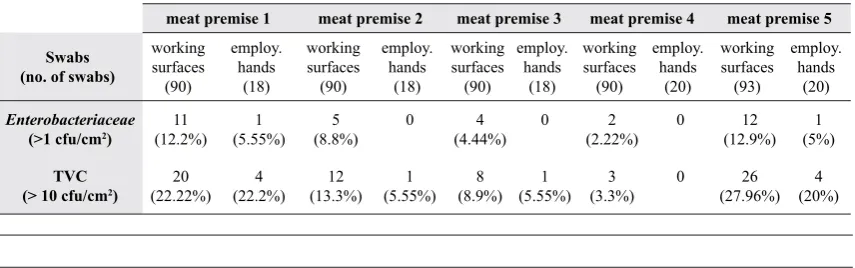
The percent of unacceptable results from the swabs taken in meat processing plants are presented in Table 3. Total count of Enterobacteriaceae found on worker hands comply with the Directive 471/2001/EEC, while working surfaces were contaminated in all 5 meat premises. The results of TVC for employee hands were satisfactory in all 5 meat premises, but working surfaces in meat
Table 1. Swabs from employees and working surfaces from each of the examined fi ve dairy premises that do not comply with the legislative
dairy premise 1 dairy premise 2 dairy premise 3 dairy premise 4 dairy premise 5
Swabs (no. of swabs)
working surfaces (29) employ. hands (4) working surfaces (29) employ. hands (4) working surfaces (29) employ. hands (5) working surfaces (30) employ. hands (5) working surfaces (30) employ. hands (5) Enterobacteriaceae
(>1 cfu/cm2)
1
(3.45%) 0 0 0 0 0 0 0
2 (6.67%)
2 (40%) TVC
(> 10 cfu/cm2) 3 (10.34%) 0 2 (6.89%) 1 (25%) 1 (3.45%) 0 2 (6.67%) 0 6 (20%) 3 (80%)
Table 2. Swabs from employees and working surfaces from all fi ve dairy premises that do not comply with the legislative
Sample type Enterobacteriacae
(>1 cfu/cm2)
Total viable count (> 10 cfu/cm2)
Employee hand swab 2 (8.7%) 4 (17.4%)
Working surface swab 3 (2%) 14 (9.5%)
plants 1, 2 and 5 did not comply with the Directive 471/2001/EEC. The results for all of the meat premises taken in total in the meat processing establishments were: 15.6% unacceptable for total viable count and 7.5% unacceptable for enumeration of Enterobacteriaceae, and 10.6% and 2.1% respectively unacceptable from the swabs taken from the workers (Table 4).
Table 3. Swabs from employees and working surfaces from each of the examined fi ve meat premises that do not comply with the legislative
meat premise 1 meat premise 2 meat premise 3 meat premise 4 meat premise 5
Swabs (no. of swabs)
working surfaces (90) employ. hands (18) working surfaces (90) employ. hands (18) working surfaces (90) employ. hands (18) working surfaces (90) employ. hands (20) working surfaces (93) employ. hands (20) Enterobacteriaceae (>1 cfu/cm2)
11 (12.2%) 1 (5.55%) 5 (8.8%) 0 4 (4.44%) 0 2 (2.22%) 0 12 (12.9%) 1 (5%) TVC (> 10 cfu/cm2)
20 (22.22%) 4 (22.2%) 12 (13.3%) 1 (5.55%) 8 (8.9%) 1 (5.55%) 3 (3.3%) 0 26 (27.96%) 4 (20%)
Table 4. Swabs from employees and working surfaces from all fi ve meat premises that do not comply with the legislative
Sample type Enterobacteriacae
(>1 cfu/cm2)
Total viable count (> 10 cfu/cm2)
Employee hand swab 2 (2.1%) 10 (10.6%)
DISCUSSION
The goal of the food safety system using the GHP is to assure safe and reliable products which will lead to consumer safety and greater public health. Therefore, one of the aims is to have control and appropriate management of the hygiene in the food industry premises as a part of the food safety chain.
The food processing premises, equipment and environmental surfaces are usually hygienically designed, and during the processing it is essential to have effective and controlled cleaning and sanitation programme. This is the major step which provides the determination and the control of the routes of contamination of the food working surfaces. If the sanitation programme is not effective enough, microorganisms could be present and remain at concentrations that could contaminate the food and may affect the quality and safety of the food products (3-5).
Working surfaces of the food premises and the workers hygiene could present an obstacle in the food safety system, if there are inadequate sanitary measures taken. The problems with the mishandling of the sanitation and even a formation of biofi lms on the surfaces can easily be detected by swab sampling and testing.
From the results of this study, it can be seen that the working surfaces from the dairy processing premises are better sanitized than those in the meat processing plants, but the situation regarding the hygiene of the workers is opposite.
During the period of six months, the food industry premises involved in the study were using different detergents and cleaning techniques, and consequently the sanitizing process in the premises was one of the main issues. They were asked to switch the used detergent every 2 months. The case in the premises involved in our study was the following: both meat and dairy premises with numbers 2, 3 and 4 were using alkaline products for 4 months, and after that they have changed the detergent (2-neutral and 3,4 - acidic). The meat and dairy premises numbered as 1 were using acidic detergents for two months and then they have changed them for alkaline products for the next four months. In premises number 5 acidic products were used for sanitation and they were switched with neutral ones for the last two months in the study.
When we compare results from swab technique after acidic, alkaline and neutral products were used in processing premises it was evident that, the premises using the alkaline product for cleaning had evidently better reduction of the Enterobacteriaceae then others. This is in agreement with other studies (3,8).
A lack of hygiene in the examined meat and milk processing premises was identifi ed, but also there was a problem in the hygiene of the workers which is a threat for contamination of the products. In that manner, it is advisable to do same improvements and changes in their GHP and improve the hygiene habits of the workers in order to have better sanitation practices and safer food products.
REFERENCES
1. Angelovski Lj., Jankuloski, D., Ratkova, M., Prodanov, M., Mojsova, S., Sekulovski, P. (2012). Assesment of the microbial parametars along the production phase at a dairy plant. Mac Vet Rev, 35 (1): 13-21.
2. Jayarao, B. M., Henning, D. R. (2001). Prevalence of Foodborne Pathogens in Bulk Tank Milk. Journal Dairy Sci, 84, 2157–2162.
3. Gibson, H., Taylor, J.H., Hall, K.E., Holah, J.T. (1999). Effectiveness of cleaning techniques used in the food industry in terms of the removal of bacterial biofi lms. Journal of Applied Microbiology, 87(1): 41-48.
4. Nathanon, T. (2004). Biofi lm removal technique using sands as a research tool for accessing microbial attachment on surface. Songklanakarin J. Sci. Technol., 26(1): 109-115.
5. Frank, J. Revis, F., Chmielewski, A. N. (1997). Effectiveness of Sanitation with Quaternary Ammonium Compound or Chlorine on Stainless Steel and Other Domestic Food-Preparation Surfaces. International Association of Milk, Food and Environmental Sanitarians, Journal of Food Protection, 60, 1.
7. Zottola, E. A. (1994). Scientific status summary: Microbial attachment and biofilm formation: a new problem for the food industry? Food Technology, 48, 107–114.
8. Krysinski, E. P., Brown, L. J., Marchisello, T. J. (1992). Effect of cleaners and sanitizers on
Listeria monocytogenes attached to product contact surfaces. J. Food Prot., 55, 246–251.
9. EN/ISO 4833:2003 Microbiology of food and animal feeding stuffs -- Horizontal method for the enumeration of microorganisms -- Colony-count technique at 30 degrees C.
Please cite this article as: Ratkova Marija, Prodanov Mirko, Angelovski Ljupco, Jankuloski Dean, Sekulovski Pavle, Mojsova Sandra. Evaluation of the hygiene status in several meat and dairy processing establishments in R.Macedonia. Mac Vet Rev 2013; 36 (2): 101-105.
10. EN/ISO 21528-2:2004 Microbiology of food and animal feeding stuffs -- Horizontal methods for the detection and enumeration of
Enterobacteriaceae -- Part 2: Colony-count method.