Please cite this article as: A. M. Fathollahi-Fard, M. Hajiaghaei-Keshteli, R. Tavakkoli-Moghaddam, A Lagrangian relaxation-based algorithm to solve a home health care routing, International Journal of Engineering (IJE), IJE TRANSACTIONS A: Basics Vol. 31, No. 10, (October 2018) 1734-1740
International Journal of Engineering
J o u r n a l H o m e p a g e : w w w . i j e . i rA Lagrangian Relaxation-based Algorithm to Solve a Home Health Care Routing
Problem
A. M. Fathollahi-Farda, M. Hajiaghaei-Keshteli*a, R. Tavakkoli-Moghaddamb,c
a Department of Industrial Engineering, University of Science and Technology of Mazandaran, Behshahr, Iran b School of Industrial Engineering, College of Engineering, University of Tehran, Tehran, Iran
c Arts et Métiers Paris Tech, LCFC, Metz, France
P A P E R I N F O
Paper history: Received 05 March 2018
Received in revised form 29 April 2018 Accepted 17 Aguest 2018
Keywords:
Home Health Care Vehicle Routing Problem
Lagrangian Relaxation-based Algorithm
A B S T R A C T
Nowadays, a rapid growth in the rate of life expectancy can be seen especially in the developed countries. Accordingly, the population of elderlies has been increased. By another point of view, the number of hospitals, retirement homes along with medical staffs has not been grown with a same rate. Hence, Home Health Care (HHC) operations including a set of nurses and patients have been developed recently by both academia and health practitioners to consider elderlies’ preferences willing to receive their cares at their homes instead of hospitals or retirement homes. To alleviate the drawbacks of pervious works and make HHC more practical, this paper introduces not only a new mathematical formulation considering new suppositions in this research area but also a solution approach based on Lagrangian relaxation theory has been employed for the first time. The main strategy of used algorithm aims to fill the gap between the lower bound and upper bound of problem and finds a solution which has both optimality and feasibility properties. By generating a number of numerical examples, results show the performance of the proposed algorithm analyzed by different criteria as well as the efficiency of developed formulation through a set of sensitivity analyses.
doi: 10.5829/ije.2018.31.10a.16
1. INTRODUCTION1
In these days, an increase in the life expectancy for developed countries as well as a decrease in the preference of old people for the informal care are likely to lead an increase for the demand of Home Health Care (HHC)’s services especially in the last decade [1]. As pointed out by European Commission [2], the population of 60 years-old and over has been grown from 17 percent in 1980 to 22 percent in 2004. Furthermore, this factor approximately may be increased to 32 percent in 2030. Additionally, the life expectancy for both men and women show a great growth in the last decade. It is also estimated that this factor for men increases from 68 to 76 and also for women shows a bigger growth from 76 to 84 in European countries [3]. On the other hand, the number
*Corresponding Author Email: [email protected] (M.
Hajiaghaei-Keshteli)
of hospitals and retirement homes has not been increased in a same rate for the population of older than 60-year old. These reports and reasons indicate the importance of HHC services for the current population of these countries [3]. In addition, more than two-thirds (69.1 percent) of home health care recipients are over age 65. In the United States, Medicare is the largest single payer of home care services [4]. For instance, Medicare spending was approximately 41 percent of the total home health care and hospice expenditure in 2009 [5]. Besides, approximately $72.2 billion was projected to be spent on home health care in this year. Accordingly, the number of persons employed in U.S. HHC is surprisingly increased during this century. Figure 1 shows a statistical graph related to this issue2.
As can be seen, there were approximately 1,495,000 persons employed in HHC of U.S.
2
Figure 1. Number of persons employed in HHC services in the U.S. from 2000 to 2016
Clearly, this issue reveals the importance of economic driver of HHC services [6].
The Home Health Care Routing Problem (HHCRP) is a preliminary of Vehicle Routing Problem (VRP) [4, 5]. It has been known as a NP-hard problem. Accordingly, exact algorithms are often not able to find optimal solution for this problem in a reasonable time [7].
In 2012, Rasmussen et al. [8] suggested a home care crew-scheduling problem as a type of VRP with Time Window (VRPTW). Besides, Nickel et al. [9] firstly added Master Schedule Problem (MSP) and Operational Planning Problem (OPP) into HHCRP. In another recent study, Liu et al. [10] considered different heuristics based on Genetic Algorithm (GA) and Tabu Search (TS) to address the HHCRP. In another similar work, Liu et al. [5] developed a hybrid TS based on local searches to explore the feasible and infeasible solutions. Mankowska et al. [11] added the interdependencies of services for HHCRP. They also proposed an MILP model and to solve the model, the exact method by using GAMS software was utilized. In 2015, Hiermann et al. [12] offered a multi-modal HHCRP by considering a case study in Austria. The main contribution was to propose a number of metaheuristics: VNS, Memetic Algorithm (MA), Scatter Search (SS) and a simulated annealing hyper-heuristic. In addition, Fikar and Hirsch [13] added some new assumptions such as the possibility of walking to patients and interdependencies of services. Braekers et al. [3] was among the first studies to develop a bi-objective HHCRP. Their goal was to find a trade-off between the total cost and patient inconvenience. In 2017, Shi et al. [6] introduced VRPTW based on fuzzy numbers. They applied a hybrid GA to solve the benchmarked instances of VRPTW. In 2018, Cappanera et al. [14] developed a robust optimization model for HHCRP under demand uncertainty in a multiple-day horizon time. Recently, Lin et al. [4] developed an integrated model to consider both nurse scheduling and VRPTW in HHCRP by applying a hybrid Harmony Search Algorithm (HSA) and GA.
This section follows four sections. Section 2 describes the used mathematical model. Section 3 considers our Lagrangian relaxation-based algorithm with its steps. Section 4 performs the experimental computation through a set of numerical instances. Finally, the last section proposes the conclusion and future works.
2. RROBLEM MODELLING
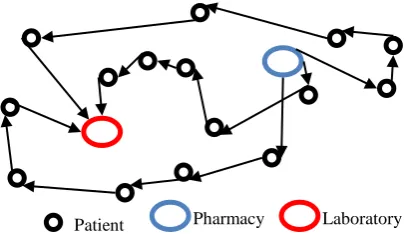
In this section, a new MILP formulation is proposed. The main activities of a HHC company reveal that the drugs or medical instruments from a pharmacy to the patients should be delivered. Then, after visiting all patients, the biological samples are collected to transform from patients’ home to the laboratory. To graph the proposed HHCRP, Figure 2 depicts an assumed instance with 15 patients and 3 nurses. The developed HHCRP considers the following assumptions:
The developed model is a type of single objective optimization MILP model.
The HHCRP involves numerous patients with a set of nurses and only one pharmacy and one laboratory. The demand (required drug) of each patient must be
met.
There are different types of transportation systems including different cars, public trains, etc., in which they are considered in the model by assigning different types of capacities and transportation costs of the vehicle type k for each unit of travelled distance from patient i to patient j.
Each nurse starts from the pharmacy and goes to the laboratory after visiting his/her assigned patients. The working time and required drugs for each
patient should be estimated before the visit.
The location of the pharmacy and laboratory are predefined.
The time window is considered for the HHC services.
Figure 2. Graphical illustration of proposed HHCRP [6]
0 500000 1000000 1500000 2000000
2
0
0
0
2
0
0
1
2
0
0
2
2
0
0
3
2
0
0
4
2
0
0
5
2
0
0
6
2
0
0
7
2
0
0
8
2
0
0
9
2
0
1
0
2
0
1
1
2
0
1
2
2
0
1
3
2
0
1
4
2
0
1
5
2
0
1
6
N
u
m
b
er
o
f
p
er
so
n
s
Pharmacy
To control the transportation cost more efficiently, a penalty value is considered for the overall distance travelled by the nurses.
The notations of developed HHCRP including indices, parameters and decision variables are stated as follows: Indices:
,
i j Indices of patients, i j, {1, 2,...,M}
n Index of nurses, n{1, 2,..., }N
k Index of transport systems, k{1, 2,..., }K
Parameters:
ij
D Distance between patients i and j
k
TC Transportation cost per unit of distance for transport
system k
k
CAP The capacity of transport system k
i
W The working time for the nurse to service the patient
i
i
E The earliest service time for the patient i
i
L The latest service time for the patient i
ij
T The traveling time from patients i to j
PEN Amount of penalty for nurses for over distance traveling between patients (1
5 PEN
)
BIG A positive large number, this parameter is generated to construct the time window constraints
nk
MDIS Maximum desired traveled distance for the nurse n
by using transportation system k
i
A Demand of patient i (amount of drugs required for
patient i)
i
B Biological samples collected from patient i to
transform the laboratory Decision variables:
k ijn
X
It gets 1 if the nurse n by using transport system k visits the patient i before patient j; otherwise it gets 0.
in
S Denotes the time at which nurse n begins to service
the patient i.
nk
O Overall distance traveled by nurse n using transport
system k.
Regarding the above notations, it should be mentioned that k
ojn
X is the symbol of starting from pharmacy, while
0
k i n
X is the symbol of ending at laboratory for the routes of nurses. In the following, the MILP formulation of introduced HHCRP is presented and illustrated.
1 1 1 1 1 1
( )
K N M M N K
k
ij k ijn nk k
k n i j n k
Z Min D TC X O TC PEN
(1). .
s t
1 1 1 1,
N K M k ijn n k j
X i M
(2)1
1, , ,
K k ijn k
X i j M n N
(3) 1 1 , , M M ki ijn k
i j
A X CAP k K n N
(4)1 1
, ,
M M
k
i ijn k
i j
B X CAP k K n N
(5)1 1 1, K M k ojn k j
X n N
(6)1 1
0, , ,
M M
k k
ihn hjn
i j
X X h M k K n N
(7)0 1 1, , M k i n i
X k K n N
(8)1
(1 ) , , , ,
K k
in ij i ijn jn
k
S T W BIG X S i j M k K n N
(9)
, ,
i in i
E S L i M nN (10)
1 1
( )
M M k
nk ij ijn nk
i j
O D X MDIS
(11), 0
in nk
S O (12)
{0,1} k ijn
X (13)
Equation (1) shows the objective function in two terms. The first and second terms are considered the routing and scheduling of nurses to visit the patients. In the first one, due to travelled distance for the nurses by transportation system type k, the transportation cost is considered to be minimized. As per the second term, the overall travelled distance for nurses regarding to the maximum desired travelled distance by considering the type of transportation system is computed by adding a penalty value to calculate the extra transportation costs. There are also a number of constraints in the proposed model. Equation (2) indicates each patient is visited only once. Equation (3) shows that each nurse is assigned to only one vehicle. Equations (4) and (5) ensures that the used transport system should have enough capacity to transform the patient’s drugs as well as the biological samples. Equation (6) represents that each nurse starts from its pharmacy. Equation (7) shows that the nurse visits the patient and then leaves the patient. This constraint reduces the extra number of unfeasible sub-tours for the model. Equation (8) also guarantees that each nurse should go back to the laboratory after visiting the patients. Equation (9) is designed to ensure that each nurse n cannot arrive at patient j before,
in ij i
employed transport system. Finally, Equations (12) and (13) enforce the non-negativity restrictions and binary variables of the developed HHCP, respectively.
3. SOLUTION APPROACH
This paper employs a Lagrangian relaxation-based algorithm as a type of sub-gradient algorithm to solve the combinatorial optimization problems [15]. The proposed methodology involves two main components i.e. lower and upper bounds. First of all, the proposed formulation should be relaxed by eliminating a set of constraints from the model and adding them into the objective function [16]. Then, these constraints are multiplied by Lagrange multipliers. In regards to the present relaxed problem, solving it in the case of minimization, provides a lower bound for the original formulation [17]. Then, this solution should be utilized in the original model by generating a feasibility procedure. This feasible solution forms the upper bound of the original formulation. By employing these lower and upper bounds, the algorithm aims to fill the gap between them and finds a solution which has both optimality and feasibility properties [18].
3. 1. Relaxed Problem To achieve the relaxed problem, a number of hard constraints should be relaxed from the original formulation. Since the constraint in Equation (9) is a big-M type constraint, it makes the model more difficult. Setting the path of nurses by considering the availability times of patients reduces the space of feasible solutions. This constraint is also a version of Miller-Tucker-Zemlin subtour of elimination constraint [19]. So, the relaxed formulation of the problem with Lagrange multiplier
ijnis as follows:"
1 1 1
1 (
( (1 )))
M M N ijn i j n
K k
in jn ij i ijn
k
Z Min
S S T W BIG X
(14)s.t.
k ijn
X ) are employed by the original
formulation to find the lower bound of model. Note that although this solution may be not feasible, it will be an optimal solution for the original problem [16].
Additionally, an upper bound to start the main loop of methodology is also needed to be explored. A simple approach to get the upper bound is to change the obtained solution from the relaxed model (lower bound) to make it feasible for the original problem [15]. In this case, the number of assigned nurses and patients should
be reduced ( k ijn
X ) to make it feasible. According to the matrix space of decision variable, a set of arrays equaled to 1 are randomly changed to zero. This reduction will be continued to make feasible matrix of k
ijn
X . By solving the restricted decision variable in the original formulation, the initial upper bound is generated. Note that although this solution may not be optimal, it will be a feasible solution for the original problem [20].
3. 2. Updating the Lower Bound and the Upper Bound Regarding the adopted Lower Bound (LB) and Upper Bound (UB) for the proposed problem, the main loop of proposed Lagrangian relaxation-based algorithm is structured as follows:
Step 0: Initialize the Lagrange multiplier 0
ijn
and set t=0;
Step 1: Let t
ijn ijn
and solve the relaxed problem (Z").
Then, consider the obtained decision variable with the optimal solution of
( t) ijn
Z to update the LB as follows:
1
( )
max( , t )
ijn
t t
LB LB Z (15)
Step 2: According to the optimal solution of
( t) ijn
Z , if this solution yield an unfeasible solution, the number of assigned patients to the nurses will be decreased until the restricted problem provides a feasible solution. Consequently, the UB will be updated as follows:
1
( )
min( , k )
ijn
t t t
X
UB UB Z (16)
Step 3: The Lagrange multiplier should be updated as follows:
1
1 max(
( (1 )), 0)
t t t
ijn ijn
K k
in jn ij i ijn
k
S S T W BIG X
(17)where 1
1 1 2
( )
t t
t t
t t
UB UB
f
UB LB
and being f a number
distributed by U(0, 2) in the first iteration and it is decreased during the number of iterations by
1
t t
f f without any improvement. Note that
isreduction rate taken between 0.5 and 1; Step 4: t=t+1;
Step 5: If a feasible LB reaches or t satisfies the maximum number of iteration (Maxit) then, stop and display LB. Otherwise, go to Step 1;
Generally speaking, the proposed methodology has three input parameters including 0
ijn
, f0and . These
parameters should be tuned before running the algorithm to enhance its performance. Among them, the most important parameter of the algorithm is an initial Lagrange multiplier 0
ijn . Equations (2)-(8) and (10)-(13)
4.COMPUTATIONAL EXPERMENTS
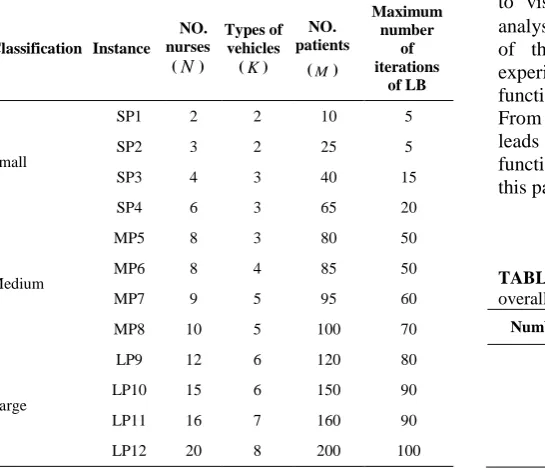
4. 1. Relaxed Problem Here, twelve test problems with three classifications i.e. small: SP1 to SP4, medium: MP5 to MP8 and large sizes: LP9 to LP12 are presented. These test problems have been nechmarked from Fathollahi-Fard et al. [21]. Table 1 shows the sizes of problem instances. The maximum number of iterations for Lagrangian relaxation based algorithm (LB) is set by increasing the size of problem [15].
4. 2. Tuning Here, Taguchi method offered by Taguchi [22] is utilized to achieve a well selected of algorithm’s parameters. This method was first considered to decrease the number of experiments in quality engineering topics [21, 23]. Generally, two well-known methods i.e. Signal-to-Noise (S/N) and Relative Percentage Deviation (RPD) are used in this methodology to set a proper number of parameters [24-26]. The higher value of S/N brings a better quality [27]. The lower value of RPD brings the better quality.This study considers maximum four levels for the factors of LB. The complementary information about the factors is given in Table 2.
TABLE 1. The instances for test problem
Classification Instance NO. nurses (N)
Types of vehicles
(K)
NO. patients
(M)
Maximum number
of iterations
of LB
Small
SP1 2 2 10 5
SP2 3 2 25 5
SP3 4 3 40 15
SP4 6 3 65 20
Medium
MP5 8 3 80 50
MP6 8 4 85 50
MP7 9 5 95 60
MP8 10 5 100 70
Large
LP9 12 6 120 80
LP10 15 6 150 90
LP11 16 7 160 90
LP12 20 8 200 100
TABLE 2. The algorithm’s factors and their levels
Algorithm Factor Levels 1 2 3 4
LB
A: Lagrangian multiplier
() 0.01 0.1 0.5 0.8
B: Updater of Lagrangian
multiplier (f ) 1 1.5 1.8 1.95
C: Rate of reduction () 0.85 0.9 0.95 0.99
To decrease the number of trials for the implemented algorithm, Taguchi method suggests a set of orthogonal array [28, 29]. According to the factors and their levels, Taguchi method offers L16 for LB method.
4. 3. Evaluation of Developed Algorithm
Inspecting the results in Table 3, the proposed Lagrangian relaxation-based algorithm finds a feasible LB in half of the test problems (SP1 to MP6). In the rest of the test problems,a feasible LB has not reached until the end of iterations. The main disadvantage of method is referred to computational time which increases by the sizes of problem, exponentially. Generally speaking, the time computational of algorithm is clearly lower than an exact algorithm.
4. 4. Sensitivity Analysis The penalty value for overall traveled distance of the length of tour of nurses to visit their patients (
PEN
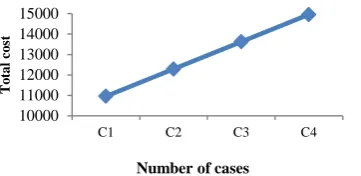
) by some sensitivity analyses have been performed by increasing the amount of this parameter. Table 4 gives the details of experiments. To identify the behavior of objective function, the given values are depicted in Figure 3. From the results, generally, an increase in this parameter leads to an increase in the behavior of objective function. As a result, it seems that the higher value of this parameter can reduce the total cost more efficiently.TABLE 4. Sensitivity analyses on the penalty value for
overall traveled distance of the tour of nurses
Number of cases PEN Z
C1 1.5 10959
C2 2.5 12292.33
C3 3.5 13625.67
C4 4.5 14959
TABLE 3. The results of problem (OUT=the average of solutions; CPU=the computational time based second)
Algorithm SP1 SP2 SP3 SP4 MP5 MP6 MP7 MP8 LP9 LP10 LP11 LP12
LB
OUT 3255 5033 5433 7264 7751 7988 8952 9548 9986 10609 10954 12382
Feasibility - - - -
Figure 3. Behavior of objective function for the sensitivity analyses on the overall traveled distance
5.DISCUSSION AND CONCLUSION
This study proposed a new formulation in the area of home health care considering a policy for overall distance by different type of vehicles. Another main innovation of this study was tooffer a lower bound for the problem by a Lagrangian relaxation-based algorithm updating both lower bound and upper bound to achieve a solution, which has both optimality and feasibility. The algorithm was tuned by Taguchi experiments to set a proper value for parameters. Finally, the results discussions along with the sensitivity analyses on the key parameters of model were performed, satisfactorily. For future studies, the proposed mathematical formulation may be expanded by some other new suppositions in this research area. For example, the patients’ inconvenience may be suggested to add into the formulation. Considering the cross-docking operations into the constraint is recommended as well.
6. REFERENCES
1. Fikar, C. and Hirsch, P., "Home health care routing and
scheduling: A review", Computers & Operations Research, Vol. 77, (2017), 86-95.
2. Employment, E.C.D.-G.f. and E., E.O.U., "Europe's
demographic future: Facts and figures on challenges and opportunities, Office for official publications of the European communities, (2007).
3. Braekers, K., Hartl, R.F., Parragh, S.N. and Tricoire, F., "A bi-objective home care scheduling problem: Analyzing the
trade-off between costs and client inconvenience", European Journal
of Operational Research, Vol. 248, No. 2, (2016), 428-443.
4. Lin, C.-C., Hung, L.-P., Liu, W.-Y. and Tsai, M.-C., "Jointly rostering, routing, and rerostering for home health care services: A harmony search approach with genetic, saturation, inheritance, and immigrant schemes", Computers & Industrial Engineering, Vol. 115, (2018), 151-166.
5. Liu, R., Xie, X. and Garaix, T., "Hybridization of tabu search with feasible and infeasible local searches for periodic home health care logistics", Omega, Vol. 47, (2014), 17-32.
6. Shi, Y., Boudouh, T. and Grunder, O., "A hybrid genetic
algorithm for a home health care routing problem with time
window and fuzzy demand", Expert Systems with Applications,
Vol. 72, (2017), 160-176.
7. Sahebjamnia, N., Fard, A.M.F. and Hajiaghaei-Keshteli, M.,
"Sustainable tire closed-loop supply chain network design: Hybrid metaheuristic algorithms for large-scale networks", Journal of Cleaner Production, Vol. 196, (2018), 273-296. 8. Rasmussen, M.S., Justesen, T., Dohn, A. and Larsen, J., "The
home care crew scheduling problem: Preference-based visit
clustering and temporal dependencies", European Journal of
Operational Research, Vol. 219, No. 3, (2012), 598-610.
9. Nickel, S., Schröder, M. and Steeg, J., "Mid-term and short-term
planning support for home health care services", European
Journal of Operational Research, Vol. 219, No. 3, (2012), 574-587.
10. Liu, R., Xie, X., Augusto, V. and Rodriguez, C., "Heuristic algorithms for a vehicle routing problem with simultaneous delivery and pickup and time windows in home health care", European Journal of Operational Research, Vol. 230, No. 3, (2013), 475-486.
11. Mankowska, D.S., Meisel, F. and Bierwirth, C., "The home health care routing and scheduling problem with interdependent services", Health Care Management Science, Vol. 17, No. 1, (2014), 15-30.
12. Hiermann, G., Prandtstetter, M., Rendl, A., Puchinger, J. and Raidl, G.R., "Metaheuristics for solving a multimodal
home-healthcare scheduling problem", Central European Journal of
Operations Research, Vol. 23, No. 1, (2015), 89-113. 13. Fikar, C. and Hirsch, P., "A matheuristic for routing real-world
home service transport systems facilitating walking", Journal of
Cleaner Production, Vol. 105, (2015), 300-310.
14. Cappanera, P., Scutellà, M.G., Nervi, F. and Galli, L., "Demand
uncertainty in robust home care optimization", Omega, Vol. 80,
(2018), 95-110.
15. Dukkanci, O. and Kara, B.Y., "Routing and scheduling decisions in the hierarchical hub location problem", Computers & Operations Research, Vol. 85, (2017), 45-57.
16. Mestria, M., "New hybrid heuristic algorithm for the clustered
traveling salesman problem", Computers & Industrial
Engineering, Vol. 116, (2018), 1-12.
17. Golshahi-Roudbaneh, A., Hajiaghaei-Keshteli, M. and Paydar, M.M., "Developing a lower bound and strong heuristics for a truck scheduling problem in a cross-docking center", Knowledge-Based Systems, Vol. 129, (2017), 17-38.
18. Astorino, A., Gaudioso, M. and Miglionico, G., "Lagrangian relaxation for the directional sensor coverage problem with continuous orientation", Omega, Vol. 75, (2018), 77-86. 19. Miller, C.E., Tucker, A.W. and Zemlin, R.A., "Integer
programming formulation of traveling salesman problems", Journal of the ACM (JACM), Vol. 7, No. 4, (1960), 326-329. 20. Fard, A.M.F., Gholian-Jouybari, F., Paydar, M.M. and
Hajiaghaei-Keshteli, M., "A bi-objective stochastic closed-loop supply chain network design problem considering downside risk", Industrial Engineering & Management Systems, Vol. 16, No. 3, (2017), 342-362.
21. Fathollahi-Fard, A.M., Hajiaghaei-Keshteli, M. and Tavakkoli-Moghaddam, R., "A bi-objective green home health care routing problem", Journal of Cleaner Production, Vol. 200, (2018), 423-443.
22. Taguchi, G., Introduction to quality engineering: Designing
quality into products and processes. 1986.
23. Fard, A.M.F. and Hajiaghaei-Keshteli, M., "A bi-objective partial interdiction problem considering different defensive systems with capacity expansion of facilities under imminent attacks", Applied Soft Computing, Vol. 68, (2018), 343-359. 10000
11000 12000 13000 14000 15000
C1 C2 C3 C4
T
o
tal
co
st
24. Fathollahi-Fard, A.M., Hajiaghaei-Keshteli, M. and Tavakkoli-Moghaddam, R., "The social engineering optimizer (SEO)", Engineering Applications of Artificial Intelligence, Vol. 72, (2018), 267-293.
25. Fathollahi-Fard, A.M. and Hajiaghaei-Keshteli, M., "A stochastic multi-objective model for a closed-loop supply chain with environmental considerations", Applied Soft Computing, Vol. 69, (2018), 232-249.
26. Hajiaghaei-Keshteli, M. and Fard, A.M.F., "Sustainable closed-loop supply chain network design with discount supposition", Neural Computing and Applications, (2018), 1-35.
27. Nasiri, E., Afshari, A.J. and Hajiaghaei-Keshteli, M., "Addressing the freight consolidation and containerization
problem by recent and hybridized meta-heuristic algorithms", International Journal of Engineering-Transactions C: Aspects, Vol. 30, No. 3, (2017), 403-410.
28. Sadeghi-Moghaddam, S., Hajiaghaei-Keshteli, M. and
Mahmoodjanloo, M., "New approaches in metaheuristics to solve the fixed charge transportation problem in a fuzzy
environment", Neural Computing and Applications, (2017),
1-21.
29. Samadi, A., N., M., Fathollahi Fard, A.M. and Hajiaghaei-Keshteli, M., "Heuristic approaches to solve the sustainable
closed-loop supply chain", Journal of Industrial and
Production Engineering, Vol. 35, No. 2, (2018), 102-117.
A Lagrangian Relaxation-based Algorithm to Solve a Home Health Care Routing
Problem
A. M. Fathollahi-Farda, M. Hajiaghaei-Keshtelia, R. Tavakkoli-Moghaddamb,c
a Department of Industrial Engineering, University of Science and Technology of Mazandaran, Behshahr, Iran b School of Industrial Engineering, College of Engineering, University of Tehran, Tehran, Iran
c Arts et Métiers Paris Tech, LCFC, Metz, France
P A P E R I N F O
Paper history: Received 05 March 2018
Received in revised form 29 April 2018 Accepted 17 Aguest 2018
Keywords:
Home Health Care Vehicle Routing Problem
Lagrangian Relaxation-based Algorithm
هدیکچ
دارفا تیعجم عوضوم نیا هب هجوت اب .دش یم هدید هتفای هعسوت یاهروشک رد یگدنز هب دیما خرن رد یعیرس دشر کی ،هزورما خرن کی رد یکشزپ یاه کمک هارهم هب نادنلماس یاه هناخ ،اه ناتسرامیب دادعت ،رگید یهاگن زا .تسا هتفای شیازفا لاسنهک ،ور نیا زا .تسا هتفاین شیازفا هباشم رد هک دوش یم نارامیب و راتسرپ یدادعت لماش یگناخ تبقارم تملاس هب طوبرم تایلمع
یتبقارم تامدخ تفایرد یارب نسم دارفا تلایاتم تنفرگ رظن رد یارب تملاس ناکراشم و یهاگشناد زکارم طسوت یرخا یاه لاس تسا هتفای شترسگ نادنلماس یاه هناخ ای ناتسرامیب یاج هب دوخ ی هناخ رد هدش مانجا یلبق یاهراک یاه یتساک شهاک یارب .
شور کی هکلب دنکیم یفرعم هزوح نیا رد دیدج تایضرف اب ار دیدج لدم کی اهنت هن هلاقم نیا ،هلاسم نیا ندرک یدربراک و تسا متیروگلا یلصا راتخاس .تسا هدش هتفرگ راک هب راب ینلوا یارب نیژنارگلا یزاس دازآ متیروگلا رب ینتبم لح رپ یارب هدش هداف
هتشاد ار یگنیبه و ندوب یندش یاه هصخشم هک باوج کی ندرک ادیپ روظنم هب هلاسم یلااب دح و ینیاپ دح ینب هلصاف ندرک رارق لیلتح دروم فلتمخ یاه رایعم اب هک یداهنشیپ متیروگلا ییاراک زا ناشن جیاتن ،یددع یاه لاثم زا یا هعوممج دیلوت اب .دشاب مه و هتفرگ .دهد یم ناشن ار نوگانوگ یاه تیساسح لیلتح اب هدش هتفای هعسوت لدم یشبخ رثا ،یننچ doi: 10.5829/ije.2018.31.10a.16