AUT J. Elec. Eng., 50(2) (2018) 109-120 DOI: 10.22060/eej.2018.14303.5217
Model Predictive Control of Distributed Energy Resources with Predictive Set-Points
for Grid-Connected Operation
A. Saleh*, A. Deihimi
Electrical Engineering Department, Bu-Ali Sina University, Hamedan, Iran
ABSTRACT: This paper proposes an MPC - based (model predictive control) scheme to control active and reactive powers of DERs (distributed energy resources) in a grid - connected mode (either through a bus with its associated loads as a PCC (point of common coupling) or an MG (micro - grid)). DER may be a DG (distributed generation) or an ESS (energy storage system). In the proposed scheme, the set - points provided to MPC are forecast for future instances by a linear extrapolation to gain smooth active and reactive power exchange under various loading conditions (e.g. balanced / imbalanced, nonlinear and dynamic loading) and voltage imbalance imposed by the upstream grid. In this scheme active and reactive power control change to current control and the references of the currents are forecast. The stability of the proposed control scheme is analyzed and discussed. The effectiveness of the proposed scheme is demonstrated by extensive time - domain simulations using PSCAD / EMTDC for various conditions (various loads, voltage imbalance, parallel operation with other DGs, parameter uncertainties and measurement noises) in several case studies. Comparing the obtained results with those of the two other schemes (PI - based and convectional MPC) shows the superiority of the proposed scheme.
Review History:
Received: 9 April 2018 Revised: 10 June 2018 Accepted: 4 September 2018 Available Online: 1 October 2018
Keywords:
Distributed Energy Resource Micro-Grid
Grid-Connected Operation Model Predictive Control Predictive Set-Points
1- Introduction
MGs (micro-grids) which consist of DERs (distributed
energy resources) (DGs (distributed generations) and ESSs
(energy storage systems)) and loads, which are electrically
connected to each other, are conceived as a small grid [1], [2]. As DGs, WT (wind turbine) and PV (photovoltaic array) are
suitable to apply in MGs,because of their geographical small
size and more scalable than conventional power plants. Also, conventional generators (diesel and gas fueled generators) are used into MGs [3]. When WT and PV are used as the major DGs in the MGs, since energy sources of them have intermittent and stochastic nature, energy storages, as ESSs, play an important role in the MGs to support renewable power penetrations [4]. MG can operate grid-connected or islanded. In grid-connected operation, MG is connected to the main grid at the PCC (point of common coupling) and voltage and frequency are dictated by the main grid. In this operation mode DERs must properly exchange active and reactive powers that are deduced by operation management [5] in the various conditions e.g. imbalanced/nonlinear load
and imposed voltage imbalance. In reference [6], a
current-controlled real-/reactive-power controller is developed where conventional PI-based is used as the main controller. This control scheme is designed for inverter-based renewable sources which are connected to a balanced grid and has no proper performance under unmoral conditions. References
[7] and [8] proposed direct power control strategies based
on sliding mode control method under voltage unbalancing of main grid, but imbalanced/nonlinear load conditions are
not demonstrated. Two control schemes based on adaptive
Lyapunov function and sliding mode method in [9] are used to compensate the negative-sequence current components
caused by unbalanced loads in some part of the MG and directly regulate the positive-sequence active and reactive
power injected by DGs to the MG, respectively. Reference [10]
proposed direct Lyapunov control method to control DGs in
a grid connected MG with nonlinear loads. The used method in [11] is developed to improve grid-connected operation of inverter-based renewable resources under grid-impedance uncertainties. The proposed control scheme in [12] utilizes PI current controller for a WT to control delivered power to distributed grid under existence nonlinear loads.
In recent years, MPC (model predictive control) has found many applications in power electronics and other industrial
fields [13-23]. MPC is greatly suitable for the control of
power converters due to its fast dynamic response, easy inclusion of nonlinearities and flexibility to include system requirements in controller design [19]. One of the solutions to control the grid-connected electronically-interfaced DGs was proposed in [13] where a direct power control scheme based on MPC was designed and examined for normal conditions,
e.g. balanced load and grid voltage and imbalanced/nonlinear
load and voltage imbalance conditions were not considered.
Model predictive scheme was proposed in [14] to control active and reactive powers for a single WT connected to the main grid through an LC filter. This reference considered neither imbalanced/nonlinear load nor voltage imbalance conditions.
In view of the aforementioned previous works, the main controller of inverter-based DERs should be preferably designed insensitive to loading dynamics to give a robust transient and steady-state performance at various loading and bus voltage conditions under grid-connected operation. Moreover, the fast dynamic response of MPC along with its optimal dedicated design based on system requirements can be used to achieve better regulation of power exchange of
a DER with on-grid system. Hence, a control scheme based on MPC is proposed in this paper for the main controller of inverter-based DERs where set-points of the inverter currents are forecast for future times (against conventional method in design of MPC) to give a desired performance regardless of loading variations or bus voltage imbalance. The effectiveness of the proposed control scheme is demonstrated by time-domain simulation conducted in PSCAD/EMTDC.
This paper is organized as follows. In section 2, the considered multi-bus MG is described. Structure of used DERs in the MG and their main proposed controllers are developed in sections 3 and 4. Simulation results are discussed in section 5, and conclusion is given in section 6.
2- Multi-bus MG description
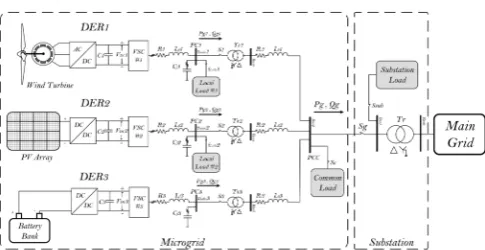
Fig.1 shows the single-line diagram of the considered multi-bus MG.
The MG consists of three inverter-based DER units which two of them are DGs and the other is ESS. DER1 is a WT, and DER2 is a PV array. WT and PV are main producers. The DER3 is a BT (battery bank) for storing extra energy produced by DGs or receiving from main grid in off-peak durations. The stored energy is used when DGs cannot provide power demand. Voltage of DER converter dc-link is regulated by its respective AC/DC or DC/DC converter at a desired voltage
(VDC) as seen in Fig. 1, and the DER will deliver the necessary
power in such a way that maintains the power balance in the dc-link [22]. Thus the energy source/storage of each DER is replaced by an ideal DC voltage source [24]. Each DER is connected to its PC (point of connection) bus through an LC filter. Power exchange of each DER is occurred through a
step-up Y/Δ transformer. Transformers are paralleled to each
other at PCC (point of common coupling) through
interlink-lines modeled by series RL branches. PCC is connected to
20 KV main grid via a step-up Δ/Y transformer (as main
transformer) installed in substation. Three groups of loads are assumed that includes local load, common load and substation load. Local loads are connected to PC buses of DGs. This group (Fig.2) consists of balanced/imbalanced, nonlinear and dynamic motor loads. Common load which is a balanced load is connected to PCC. Substation load is connected to the low voltage side of the main transformer that can be balanced/ imbalanced load. Parameters of the DERs, MG, substation and main grid are given in Table 1.
Fig. 1. Single-line diagram of the considered multi-bus MG.
Table 1. DERs, MG, Substation and Main Grid parameters
Parameter Remark
DERs
Power
rating 10 Inverter
Lf 100
filter
Cf 500
R 1.5
VDC 4 DC-link
fs 6480 Switching frequency
Ts [µs] 10 Sampling time
Tr 0.612/4 (Y/Δ) Leakage reactance X=10%
Local Loads
R1 83
RL Local Load
L1 137
R2 50
RLC Local Load
L2 68
C2 13.55
R3 17 Imbalanced Local Load (phase a to ground- Tr: 0.612/0.184 (Δ /Y), X=10%)
L3 21.8
R4 700 Nonlinear Local Load (Tr: 0.612/0.612 (Δ /Y), X=10%)
L4 20
Power
rating 0.8
Induction Machine Local Load
Vm 0.868
ω 377
Rr [pu] 0.0132 Rs [pu] 0.0184 Lm [pu] 3.8 Llr [pu] 0.0223 Lls [pu] 0.0223
MG
Zl1 50+j37.70
Inter-link lines Impedance Zl2 60+j45.24
Zl3 55+j41.47
Rc 8300
RL Common Load
Lc 13700
Substation
Tr 4/20 (Δ /Y) Leakage reactance X=10%
Rsub 7 Imbalanced Substation Load (phase a to ground- Tr: 4/0.612 (Δ /Y), X=10%)
Lsub 20
Main Grid
V 20
3- DER and its main controller
A typical inverter-based DER along with its main controller is
shown in Fig. 3. The synchronous dq reference frame is used
for the control system while the PLL (phase locked loop) [25]
produces ρ as the angle between the rotating d-axis and the
stationary α-axis as well as ω as the angular frequency of PC
voltage. PC voltage voabc and ω are imposed by the upstream
grid.
The main controller regulates exchanged active and
reactive powers to their set-points (Pg*, Q
g*). For DGs, Pg*
is determined by the MPPT (maximum power point tracker) algorithm [26-29], and for ESS, is deduced based on power balance as follow [5]:
(1)
WT PV BT loss load demand
P
+
P
+
P
=
P
+
P
+
P
PWT, PPV and PBT are WT, PV and BT powers. Ploss, Pload and
Pdemand are total loss of the MG network, total load in MG and demanded power by main grid.
Qg* is provided by the MG operator that can be zero, negative
or positive values [14]. The instantaneous active and reactive
powers Pg and Qg are exchanged between DER and upstream
grid, calculated from output voltages and currents as bellow (2)
3
( ) ( ( ) ( ) ( ) ( ))
2
g od gd oq gq
P t = v t i t v t i t+
(3)
3
( ) ( ( ) ( ) ( ) ( ))
2
g od gq oq gd
Q t = −v t i t v t i t+
vod and voq are dq components of the PC voltage.igd , and igq
are dq components of the interlink-line currents. With respect
to (2) and (3), one can deduce that [6]
(4)
* * *
2 2 2 2
( ) ( )
2 2
( ) ( ) ( )
3 ( ) ( ) 3 ( ) ( )
oq od
gd g g
od oq od oq
V t V t
i t P t Q t
V t V t V t V t
= +
+ +
(5)
* * *
2 2 2 2
( ) ( )
2 2
( ) ( ) ( )
3 ( ) ( ) 3 ( ) ( )
oq od
gq g g
od oq od oq
V t V t
i t P t Q t
V t V t V t V t
= −
+ +
where Vod and Voq are signals obtained from filtering vod
and voq respectively. igd* , and i
gq* are set-points of igd and igq
respectively.vod and voq are filtered in such a way that only
high frequency disturbances caused by inverter switching
can be removed. Thus, tracking the Pg* and Q
g* are changed
to tracking the igd* and i
gq*. In the next section the proposed
control scheme is described. 4- The proposed control scheme
4- 1- Controller construction
In this section, MPC [30] is used for the main controller
of an inverter-based DER to regulate igdand igqof the DER
connected to an on-grid system (Fig.3). Assume that a DER
is individually connected to a balanced main grid (vod = dc
constant and voq = 0) and has no local load (iLabc= 0). With
respect to Fig.3 [6]
(6) ( )
d gd i (t) i t=
(7)
( )
q gq f o
i (t) i t C v
=
+
ω
Therefore, in order to control igd(t) and igq(t), id(t) and iq(t)
must be controlled. id(t) and iq(t) are dq components of the
inverter currents. Thus state-space equations of the model can
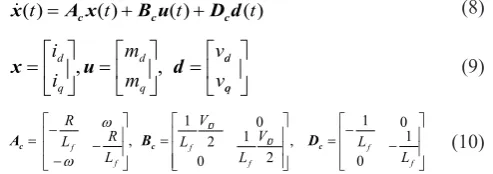
be expressed as given in (8)-(10).
(8) ) ( ) ( ) ( )
(t A xt B ut Dd t
x = c + c + c
(9) = = = oq od q d q d v v m m i i d u
x , ,
(10) − − = = − − − = f f DC f D C f f f L L V L V L L R L R 1 0 0 1 , 2 10 02 1
, c c
c B D
A ω
ω
x, u and d are vectors of states, inputs and disturbances,
respectively. md and mq are dq components of modulating
signals. Filter inductance and capacitance are denoted by
Lfand Cf, respectively. R models the ohmic loss of the filter
inductor and includes the effects of on-state resistance of switches. The states of the model are also assumed as the
Fig. 2. The collection of different load types connected to the PC of the DGs.
outputs of the model as given in (11) and (12) in order to limit the excursions of output currents of the inverter in design of MPC.
(11) )
( )
(t C x t
y = c
(12) = 1 0 0 1 c C
Then, the discrete-time state-space equations are derived as
given in (13)-(15) using Ts as the sampling time.
(13) ) ( ) ( ) ( ) 1
(k m m k m k m k
m A x B u D d
x + = + +
(14) )
( )
(k Cmxm k
y =
(15)
1 1
, ( ) , ( ) ,
c s c s c s
A T A T A T
m m c c m c c m c
A =e B =A e− −I B D =A e− −I D C =C
Differences of the state-space equations in (13) are:
(16)
( 1) ( 1) ( ) ( ) ( ) ( )
m m m m m m m
x k x k x k A x k B u k D d k
∆ + = + − = ∆ + ∆ + ∆
∆xm, ∆u and ∆d are differences of the states, inputs and
disturbances, respectively. If the sampling time is sufficiently
small, it can be assumed that the imposed voltages by the on-grid system have no large excursions during each time step and Δd(k)≈ 0 for ki ≤ k ≤ ki+Nc-1. Thus, the augmented state-space model is expressed as below:
(17)
( 1) ( ) ( )
X k+ =AX k + ∆B u k
(18)
( ) ( )
y k =CX k
(19)
[
]
( )
( ) m( ) , m , m ,
m m m m
A 0 B
x k
X k =∆y k A=C A I B=C B C= 0 I
The objective function that is optimized for MPC is: (20)
( ) (T ) T
s s
J = R Y Q R Y− − + ∆U R U∆
where
(21) 2
1 2
[ ( 1| ) ( | )] ( )
, ( ) ( ) , ( ), ( ) ( ) ( 1) p T
i i i p i i B
B
Np Np Np Nc
N
i dref i
s i i
qref i
i c
Y y k k y k N k FX k U
CA CB 0 0
CAB CB 0
CA F
CA B CA B CA B
CA
I
u k I i k
U R r k r k i k
u k N I
− − −
= + + = + Φ ∆
= Φ =
∆ ∆ = = = ∆ + −
∆U is differences of the control variables. ki is the instant at
which the control signals are produced for the future. Np and
Nc are prediction and control horizons, respectively. They
are specified in the design process. Q and R are weighting
diagonal matrices are so selected that the controller exhibits satisfactory performance. idref(ki) and iqref(ki) are calculated as below:
(22)
* ( )
dref i gd i i (k ) i k=
(23)
*
( )
( )
qref i gq i f o i
i (k ) i k
=
+
C v k
ω
where igd*(k
i) and igq*(ki) are obtained from (4) and (5) at
instant ki, respectively.
If a local load exists at PC of DER, with selecting set-points of
id and iq according to equations (22) and (23), local loads will
draw their currents from the on-grid system. This matter will be an important problem when the local load is imbalanced or nonlinear which respectively leads to imbalance and distortion at the bus voltages as well as the PC voltages of DER. This bus voltage imbalance and distortion leads to ripple and distortion at exchanged power profiles. To provide local load by DER completely and to remove aforementioned undesired events, values of iLd(k) and iLq(k) must be added to idref(k)
and iqref(k) for ki ≤ k ≤ ki+Np as the set-points, respectively.
If iLd(ki) and iLq(ki) as the references of the local load currents
are added to ki ≤ k ≤ ki+Np (as conventional method in design
of MPC), they lead to undesired performance for imbalanced, nonlinear and dynamic loads. To improve the performance of the MPC, and since iLd(k) and iLq(k) are unknown for ki ≤ k ≤
ki+Np, these values are forecast for prediction horizon based
on iLd(k) and iLq(k) in 0≤ k ≤ ki.
Moreover, if main grid voltage be imbalanced by each
reason, vod and voq will oscillate with 2ω-rad/sec sinusoidal
ripple and according to (4)-(5) lead to oscillatory igd*and igq*.
Thus choice of Rs according to (21) and allocating igd*(ki),
igq*(k
i) and vo(ki)= vod2(ki)+voq2(ki) to all of their set-points in the future instances cause undesired performance for the controller, and the powers are exchanged with oscillatory profiles and not smoothly. Thus, these values must be forecast for the better performance of the MPC with upstream grid
voltage imbalance. As aforementioned, according to (17),
if the sampling time Ts, be sufficiently small, this voltage
imbalance does not affect the performance of the MPC and the forecasting igd*(ki), igq*(ki) and vo(ki) are not required.
With respect to the above arguments
(24) * * * * * ( ) ( ) ( ) ( ) ( ) ( ) ( )
( 1) ( 1) ( 1)
( 1) ( 1) ( 1) ( 1)
( ) (
( )
s
dref i gd i Ld i
qref i gq i f o i Lq i
p p
dref i gd i Ld i
p p p
qref i gq i f o i Lq i
p
dref i p gd i
qref i p R
i k i k i k
i k i k C v k i k
i k i k i k
i k i k C v k i k
i k N i k
i k N
ω ω = + + + + + + + + = + + + + + + + + *( ) )( ( ) )( ) p
p Ld i p
p p p
gq i p f o i p Lq i p
N i k N
i k N C v k Nω i k N
+ + + + + + +
where igd*p(k
i), igq*p(ki), iLdp(ki) and iLqp(ki) are predicted values
of igd*(k
i), igq*(ki), iLd(ki) and iLq(ki), respectively. These values
are obtained by linear extrapolation technique.
∆U is obtained as below by minimizing the objective function
in (20):
(25) 1
( T ) T ( ( ))
B B B s i
U Q R − Q R FX k
∆ = Φ Φ + Φ −
Based on receding horizon principle
(26)
( )
( ) 0 0 ( ) ( ) ( ( ) ( )) ( )
Nc
i y i mpc i y i i x m i
u k I U K r k K X k K r k y k K x k
∆ = ∆ = − = − − ∆
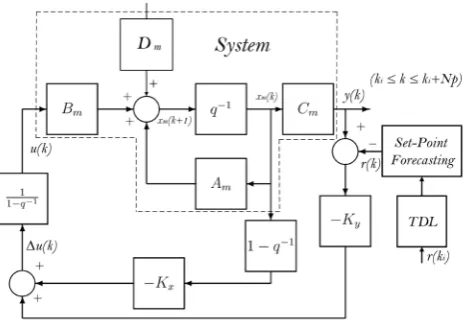
Ky, Kx and Kmpc = [KxKy] are coefficient matrices. The discrete-time MPC block diagram with set-point forecasting path is shown in Fig. 4.
4- 2- Stability analysis
MPC has been widely applied as an effective control strategy for many industrial applications, and its stability has also
been under study [32]. There are some studied cases in the
with sufficiently large prediction horizon (or infinite horizon) and stability of MPC with terminal-state penalty in the cost function [30], [33] and [34]. In this paper, the finite receding horizon MPC (often called classic MPC [35]) with a cost function given in (20) where does not have terminal-state constraints and terminal-state penalty is used to achieve desirable performance of the DG main controller. An approach based on the Lyapunov function was given in [35] to establish the stability of the classic MPC where the model of the controlled system is perfect. The perfect model as defined in [35] is the system model without disturbances. The key point is to find a Lyapunov function for the MPC. To analyze stability of the proposed controller, a similar approach as given in [35] is used. Thus, (26) is rewritten as below:
( )
mpc( )
u k
K X k
∆
= −
(27)where
The closed-loop state-space equations of system are given in (28).
( 1)
( )
( ) (
mpc) ( )
X k
+ =
AX k
+ ∆
B u k
=
A BK
−
X k
(28) The cost function given in (20) can be rewritten as (29) for the system that will be similar to the cost function of a discrete-time linear quadratic regulator (DLQR).1
1 ( | ) ( | ) 0 ( | ) ( | )
Np Nc
T T
m m
J X k m k QX k m k − u k m k R u k m k
= =
=
∑
+ + +∑
∆ + ∆ + (29)where
= Q
Q~ 00 0 .
2 2×
Q and R2×2 are coefficient submatrices that are located on
the main diagonals of Q and R, respectively. The Lyapunov
function V(X~ (k),k)is chosen as below:
1
* * * *
min
1 0
( ( ), ) Np T( | ) ( | ) Nc T( | ) ( | )
m m
V X k k J X k m k QX k m k − u k m k R u k m k
= =
= =∑ + + +∑∆ + ∆ +
(30)
Superscript * denotes the optimal values. The stability of the classic MPC is established when the Lyapunov function decreases along the state trajectory:
( ( 1), 1) ( ( ), ) 0
V X k + k+ −V X k k < (31)
Using the proved theorem given in [35], the closed-loop system of the classic MPC is stable and (31) is met when
there exists any Δu*(k) such that:
*T( 1| ) *( 1| ) T( | ) ( | ) *T( | ) *( | ) 0
X k + k QX k + k −X k k QX k k + ∆u k k R u k k∆ < (32)
Using (28) and (32), the following condition can be obtained:
1
2 2 2 2 2 2
( ) ( ) 0
0 0 ( )
T T
mpc mpc mpc mpc
T T
mpc B B B
Nc
A BK Q A BK K RK Q
K I Q R − QF
× × ×
− − + − <
= Φ Φ + Φ
(33)
Therefore, if Q and Rare selected appropriately such that
(33) is met, the stability of the proposed controller will be guaranteed. For instance, the stability is guaranteed for chosen Q=I2×2 andR=I2×2 where Np=Nc=20.
5- Time-domain simulation results
In this section, the proposed control scheme is applied to
a grid-connected DER with a capacity of 10 MVA and its
performance is investigated under various case studies. The detailed switched model of the system is simulated using PSCAD/EMTDC [31]. A collection of different local load types is considered to be connected to the PC through individual circuit breakers as shown in Fig. 2. The local loads include: (a) two three-phase balanced loads, (b) an induction motor, (c) an imbalanced load and (d) a nonlinear load. In
figures and tables, voltages are expressed in kV, currents in
kA, active (reactive) power in MW (MVAr), load torque in
per-unit (p.u.). For the local load collection, four case studies
are examined where the open/close state of breakers and set-points of active and reactive powers are given in tables in specified time intervals. Also the performance of the proposed control scheme under unbalance voltages of main grid is demonstrated in a case study. In these case studies obtained results are compared with those of PI-based scheme proposed in [6] and CMPC (conventional MPC) scheme. In case study 1 to 7, one DG is considered that is connected to the main grid. The last case study is related to connection and parallel operation of three DERs in a grid-connected multi-bus MG shown in Fig. 1. In all case studies the renewable energy resources are replaced with DC voltage sources, thus the dynamics of them are not considered.
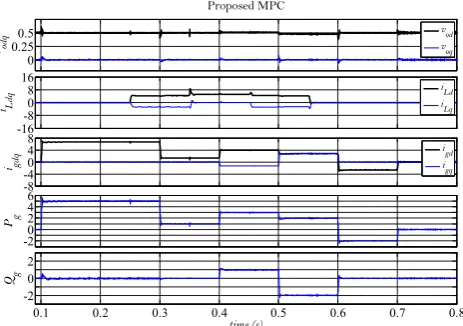
5- 1- Case study 1: Three-phase balanced local load
Two three-phase balanced loads are connected to and disconnected from the PC in a sequence given in Table 2. Simulation results are illustrated in Fig. 5 for the proposed control scheme. As can be observed, active and reactive powers are exchanged very fast and accurately even after each switching instant. Waveforms for two other schemes (PI and CMPC) are the same as those have been shown in Fig. 5 and the schemes have no superiority to each other.
Table 2. Case study 1
time [s] 0-0.1 0.1-0.25 0.25-0.35 0.35-0.45 0.45-0.55 0.55-0.8
B1_1 O O C C C O
B1_2 O O O C O O
time [s] 0-0.1 0.1-0.3 0.3-0.4 0.4-0. 5 0.5-0.6 0.6-0.7 0.7-0.8
Pg 0 5 1 3 2 -2 0
Qg 0 0 0 1 -2 0 0
O = open, C = close, P [MW], Q [MVAr]
5- 2- Case study 2: Three-phase imbalanced local load
The three-phase imbalanced load is connected (B3 is closed)
to the PC from t= 0.2 s and is followed by several changes
in set-points of active and reactive powers as given in Table
1. This load (R3=1 [mΩ] and L3=3 [µH]) is selected greater
(about 7 times) than that presented in Table 1. Fig. 6 to 8 illustrate the results of three control schemes. A comparison of the results is illustrated in Fig. 9. In Fig.9 (a) to (c) waveforms of the injected currents to the upstream grid are shown. As
can be seen, injected currents when proposed scheme is used are pure sinusoidal balanced currents. The better steady-state performance of the proposed scheme is clearly observed.
When the imbalanced load is connected to the PC at t=0.2
s, Pg and Qg are distorted by 2ω rad/sec ripple components
for the PI-based control scheme and CMPC due to portion
of imbalanced local load currents iLabc drawn from main grid.
Such ripples are very little in Pg and Qg for the proposed
control scheme, and exchanged powers are very smooth (see Fig. 9(d) and (e)). As Fig. 6 to 8 shown, the performance of the PI-based is better than CMPC, but the proposed control scheme demonstrates much desired performance in comparison with two other schemes.
5- 3- Case study 3: Nonlinear and imbalanced local load
The same sequence of events as the case study 2 is considered
for this study where addition to B3, B4 is also closed at t=0.2
s. In this case study, R4=300 [mΩ] and L4=10 [µH] are greater
than those in Table 1. Fig. 10, 11 and 12 illustrate the obtained results of three control schemes. Although the three schemes can successfully regulate the powers to their set-points, the steady state performance of the proposed scheme is much better as can be observed in Fig. 13.
5- 4- Case study 4: Induction motor starting
The effectiveness of the proposed scheme is studied for starting an induction motor. The sequence of events is given in 0
0.250.5
vod
q
Proposed MPC
vod voq
-16-8 0 8 16
iLdq
iLd iLq
-8 -40 4 8
igdq
igd igq
-20 2 4 6
Pg
0.1 0.2 0.3 0.4 0.5 0.6 0.7 0.8
-20 2
Qg
time (s)
Fig. 5. The results of the proposed control scheme in case study 1.
0 0.250.5
vod
q
Proposed MPC
vod voq
-16-8 0 8 16
iLdq
i
Ld
i
Lq
-8 -40 4 8
igdq
igd igq
-20 2 4 6
Pg
0.1 0.2 0.3 0.4 0.5 0.6 0.7 0.8
-2 0 2
Qg
time (s)
Fig. 6. The results of the proposed control scheme in case study 2.
0 2 4 6
Pg
CMPC PI Proposed MPC
0.25 0.3 0.35 0.4 0.45 0
2
Qg
time (s)
CMPC PI Proposed MPC
-50 5
igab
c
-50 5
igab
c
-50 5
igab
c
(a)
(b)
(e) (d) (c)
Proposed MPC PI CMPC
Fig. 9. Comparison of the results: (a)-(c): injected currents to upstream grid, (d) and (e): exchanged active and reactive powers when CMPC, PI-based controller and proposed MPC
are used in case study 2.
0 0.250.5
vod
q
CMPC
vod voq
-16-8 0 8 16
iLdq
iLd iLq
-8 -40 4 8
igdq
igd igq
-20 2 4 6
Pg
0.1 0.2 0.3 0.4 0.5 0.6 0.7 0.8
-20 2
Qg
time (s)
Fig. 8. The results of the CMPC in case study 2.
0 0.250.5
vodq
PI Controller
vod voq
-16-8 0 8 16
iLdq
iLd iLq
-8 -40 4 8
igdq
igd igq
-20 2 4 6
Pg
0.1 0.2 0.3 0.4 0.5 0.6 0.7 0.8
-20 2
Qg
time (s)
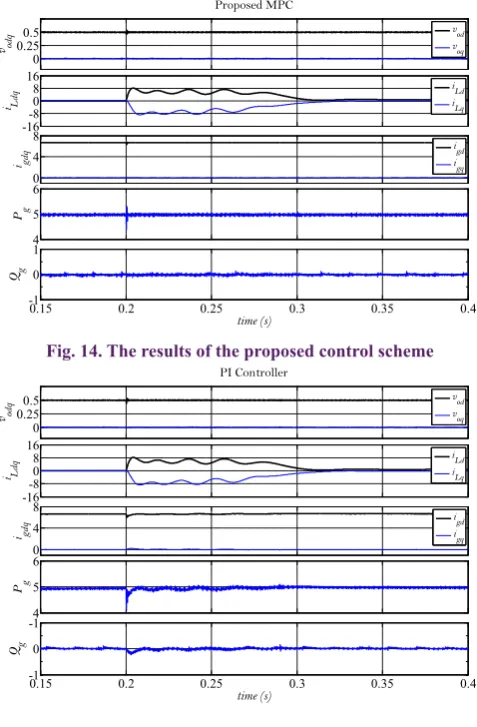
Table 3. Fig. 14, 15 and 16 illustrate the results of three control schemes. As can be seen, the proposed control scheme regulates active and reactive powers accurately. However, the PI-based scheme and CMPC have similar performance for this load condition and cannot properly regulate active and reactive powers. In Fig. 17 the exchanged power for PI-based and the proposed schemes are compared and the superiority of the proposed scheme is evident.
0 0.250.5
vod
q
Proposed MPC
vod voq
-16-8 0 8 16
iLdq
iLd iLq
-8 -40 4 8
igdq
igd igq
-20 2 4 6
Pg
0.1 0.2 0.3 0.4 0.5 0.6 0.7 0.8
-20 2
Qg
time (s)
Fig. 10. The results of the proposed control scheme in case study 3.
0 2 4 6
Pg
CMPC PI Proposed MPC
0.25 0.3 0.35 0.4 0.45
0 2
Qg
time (s)
CMPC PI Proposed MPC -50
5
igab
c
-50 5
igab
c
-50 5
igab
c
(a)
(b)
(e) (d) (c)
Proposed MPC PI CMPC
Fig. 13. Comparison of the results: (a)-(c): injected currents to upstream grid, (d) and (e): exchanged active and reactive powers when CMPC, PI-based controller and proposed MPC
are used in case study 3.
0 0.250.5
vod
q
Proposed MPC
vod voq
-16-8 0 8 16
iLdq
iLd iLq
0 4 8
igdq
igd igq
4 5 6
Pg
0.15 0.2 0.25 0.3 0.35 0.4
-1 0 1
Qg
time (s)
Fig. 14. The results of the proposed control scheme
0 0.250.5
vod
q
CMPC
vod voq
-16-8 0 8 16
iLdq
iLd iLq
-8 -40 4 8
igdq
igd igq
-20 2 4 6
Pg
0.1 0.2 0.3 0.4 0.5 0.6 0.7 0.8
-20 2
Qg
time (s)
Fig. 12. The results of the CMPC in case study 3.
0 0.250.5
vodq
PI Controller
vod voq
-16-8 0 8 16
iLdq
iLd iLq
-8 -40 4 8
igdq
igd igq
-20 2 4 6
Pg
0.1 0.2 0.3 0.4 0.5 0.6 0.7 0.8
-2 0 2
Qg
time (s)
Fig. 11. The results of the PI-based control scheme in case study 3.
in case study 4.
0 0.250.5
vodq
PI Controller
vod voq
-16-8 0 8 16
iLdq
iLd iLq
0 4 8
igdq
igd igq
4 5 6
Pg
0.15 0.2 0.25 0.3 0.35 0.4
-1 0 -1
Qg
time (s)
Fig. 15. The results of the PI-based control scheme in case study 4.
Table 3. Case study 4
time [s] 0-0.2 0.2-0.4
B2 O C
TL 0 0.7
Pg 5 5
5- 5- Case study 5:Main grid voltage imbalance
The same sequence of power set-points as the case study 2 is considered for the case study 5. The imbalanced local
load is connected to the PC at t=0.5 s. Main grid voltages are
imbalanced. Therefore vod and voq will oscillate with 2ω-rad/
sec sinusoidal ripple and lead to oscillatory igd*and igq*. Fig. 18,
19 and 20 illustrate the obtained results of the three control schemes. Although the schemes can successfully regulate powers to their set-points, the steady state performance of the proposed scheme is much better, as can be observed in
Fig. 21. As mentioned in section 4, when local load is not
connected yet (up to t=0.5 s), since the sampling time in the
simulation is selected sufficiently small, the profiles of the exchanged active (reactive) power when the proposed control
scheme and CMPC are utilized is similar to each other and are smoother than those of PI-based scheme, but when the
local load is connected (after t=0.5 s), CMPC has no desired
performance in comparison with the proposed and PI-based control schemes(see Fig. 21).
5- 6- Case study 6: Robustness Assessment
In practical applications, system parameters like R, Lf and Cf
are subjected to some uncertainties. To assess the robustness
of the proposed control scheme, -50% mismatch in Lf and Cf
and +100% mismatch in R are supposed and the case study
2 is repeated. As depicted in Fig. 22, the results show stable 0
0.250.5
vodq
CMPC
vod voq
-16-8 0 8 16
iLdq
iLd iLq
0 4 8
igdq
igd igq
4 6
Pg
0.15 0.2 0.25 0.3 0.35 0.4
0
Qg
time (s)
Fig. 16. The results of the CMPC in case study 4.
4.5 5.0 5.5
Pg
Proposed MPC PI
0.15 0.2 0.25 0.3 0.35 0.4
-0.5 0 0.5
Qg
time (s)
Proposed MPC PI
Fig. 17. Comparison of the results of the proposed and PI-based schemes in case study 4.
0 0.250.5
vod
q
Proposed MPC
vod voq
-16-8 0 8 16
iLdq
iLd iLq
-8 -40 4 8
igdq
igd igq
-20 2 4 6
Pg
0.1 0.2 0.3 0.4 0.5 0.6 0.7 0.8
-20 2
Qg
time (s)
Fig. 18. The results of the proposed control scheme in case study 5.
-2 0 2 4
Pg
CMPC PI Proposed MPC
0.45 0.5 0.55 0.6 0.65
-2 0
Qg
time (s)
CMPC PI Proposed MPC
Fig. 21. Comparison of the results of three schemes in case study 5
0 0.250.5
vod
q
CMPC
vod voq
-16-8 0 8 16
iLdq
iLd iLq
-8 -40 4 8
igdq
igd igq
-20 2 4 6
Pg
0.1 0.2 0.3 0.4 0.5 0.6 0.7 0.8
-2 0 2
Qg
time (s)
Fig. 20. The results of the CMPC in case study 5.
0 0.250.5
vodq
PI Controller
vod voq
-16-8 0 8 16
iLdq
iLd iLq
-8 -40 4 8
igdq
igd igq
-20 2 4 6
Pg
0.1 0.2 0.3 0.4 0.5 0.6 0.7 0.8
-20 2
Qg
time (s)
performance of the proposed scheme and accurate regulation of exchanged active (reactive) power under the assumed uncertainties.
5- 7- Case study 7: Measurement noises
In this case study, case study 2 is repeated by considering measurement noises. Measurement noises with 20 percent value [36] are supposed for currents in measurement process. Fig. 23 shows the performance of the proposed controller and compares the power profiles with those of case study 2, where no measurement noises exist.
5- 8- Case study 8: Grid-connected operation of a multi-bus MG
In this case study MG described in section 2 is studied. The considered scenario and sequence of events are given in
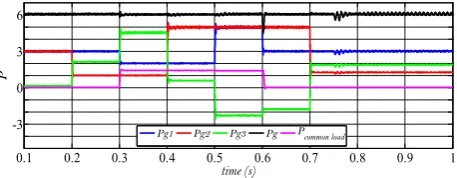
Table 4. MG must provide 6 MW for the main grid during the
scenario. DGs in addition to powers that deliver to the MG, must provide their local load. Therefore, as aforementioned, active power set-points of DGs which are positive or zero values are dependent on the obtained data from MPPT mechanism (total producible power) and are required active power of their local loads. Those for BT are determined by power balance equation (1) which can be positive or negative or zero. Reactive power set-points are determined based on MG internal consumption and grid operator command. Fig. 24 to Fig. 26 show simulation results for DERs in the MG under given scenario. As can be seen, powers are
exchanged very smoothly under various events. At t=0.75 s,
Table 4. Case study 8
time [s] 0.1-0.2 0.2-0.3 0.3-0.4 0.4-0.5 0.5-0.6 0.6-0.7 0.750.7- 0.75-1
B3DERs
(local
load) C C C C C O C C
Sc
(common
load) O O C C C O O O
Ssub
(substation
load) O O O O O O O C
PDER1 3 3 2 2 5 3 3 3
PDER2 3 1 1 5 5 5 1.25 1.25
PDER3 0.13 2.13 4.55 0.57 -2.33 -1.81 1.88 1.88
Pdemand 6 6 6 6 6 6 6 6
Pcommon load 0 0 1.4 1.4 1.4 0 0 0
Ploss 0.13 0.13 0.15 0.17 0.27 0.2 0.13 0.13 QDERs 0.5 0.5 0.8 0.8 0.8 0.5 0.5 0.5 O = open, C = close, P [MW], Q [MVAr]
0.5 1 1.5
Pg
0.3 0.31 0.32 0.33 0.34 0.35 0.36 0.37 0.38 0.39 0.4
-0.5 0 0.5
Qg
time (s)
-2.5 0 2.5
igabc
with noise without noise
with noise without noise
Fig. 23. Zoomed view of the proposed control scheme results in case study 7.
the substation imbalanced load is connected, and due to imbalanced currents which draws from main transformer voltage at low voltage side, is imbalanced. This unbalancing
is propagated to PC voltages of DERs (vodq oscillate from
t=0.75 s). Delivered powers by DERs under this event are
approximately maintained smooth, but aggregated power injected to the main grid through the main transformer has small amplitude sinusoidal ripple (see Fig. 27). If PI-based control scheme or CMPC is used, aggregated powers delivered will have severe ripples under the given scenario.
6- Conclusions
A control scheme based on MPC is proposed for the main controller of inverter-based DERs to regulate active and reactive powers exchanged between DERs and on-grid system. Active and reactive power control change to current control and the set-points are forecast to improve DER
0 0.250.5
vodq
MPC Controller
vod voq
-16-8 0 8 16
iLdq
iLd iLq
-8 -40 4 8
igdq
igd igq
-20 2 4 6
Pg
0.1 0.2 0.3 0.4 0.5 0.6 0.7 0.8
-20 2
Qg
time (s)
Fig. 22. The results of the proposed control scheme in case study 6.
0 0.250.5
vodq
DER1
vod voq
-2 0 2
iLdq
iLd iLq
-8 -40 4 8
igdq
igd igq
-20 2 4 6
Pg
0.10 0.2 0.3 0.4 0.5 0.6 0.7 0.8 0.9 1
1 2
Qg
time (s)
performance under various types of local loads and voltage imbalance of the main grid. While imbalanced/nonlinear and induction motor loads as local loads are switching or bus voltages are imbalanced, the regulation is performed properly and smoothly. The control scheme enables an accurate active/
reactive power regulation in connecting the DER to a
multi-bus grid-connected MG in parallel operation with other
DERs. The proposed control scheme presents much better performance in comparison with the PI-based control scheme and CMPC.
References
[1] G. Pepermans, J. Driesen, D. Haeseldonckx, R. Belmans,
W. Dhaeseleer, Distributed generation: Definition, benefits and issues, Energy Policy, 33(6): (2005) 787–98.
[2] T. C. Green, M. Prodanovic, Control of inverter-based
micro-grids, Electr. Power Syst. Res. Distrib. Generation, 77(9) (2007) 1204–13.
[3] J. Rocabert, A. Luna, F. Blaabjerg, P. Rodriguez, Control
of Power Converters in AC Microgrids, IEEE Trans. on Power Electronics, 27(11) (2012) 4734-4749.
[4] F.A. Bhuiyan, A. Yazdani, Energy Storage Technologies
for Grid-Connected and Off-Grid Power System Applications, IEEE Electrical Power and Energy Conference, 2012.
[5] A. Deihimi, B. Keshavarz Zahed, R. Iravani, An
interactive operation management of a micro-grid with multiple distributed generations using multi-objective uniform water cycle algorithm, Energy, 106 (2016) 482-509.
[6] A. Yazdani, R. Iravani, Voltage-Sourced Converters
in Power Systems: modeling, control and applications, IEEE Wiley Press, 2010.
[7] L. Shang, J. Hu, Sliding-mode-based direct power
control of grid-connected wind-turbine-driven doubly fed induction generators under unbalanced grid voltage conditions, IEEE Trans. Energy Conversion, 27(2) (2012) 362–373.
[8] L. Shang, D. Sun, J. Hu, Sliding-mode-based direct
power control of grid-connected voltage-sourced inverters under unbalanced network conditions, IET Power Electron, 4(5) (2011) 570–579.
[9] M.M, Rezaei, J. Soltani, A robust control strategy for
a grid-connected multi-bus microgrid under unbalanced load conditions, Electrical Power and Energy Systems, 71 (2015) 68-76.
[10] M. Mehrasa, E. Pouresmaeil, B. N. Jørgensen, J. P.S. Catalão, A control plan for the stable operation of microgrids during grid-connected and islanded modes, Electric Power Systems Research, 129 (2015) 10-22.
[11] A. H. Syed, M.A. Abido, New enhanced performance robust control design schemefor grid-connected VSI, Control Engineering Practice, 53 (2016) 92-108.
[12] E. Pouresmaeil, O. Gomis-Bellmunt, D. Montesinos-Miracle, J. Bergas-Jané, Multilevel converters control for renewable energy integration to the power grid, Energy, 36 (2011) 950-363.
[13] J. Hu, J. Zhu, D. G. Dorrell, Model predictive control of inverters for both islanded and grid-connected operations in renewable power generations, IET Renewable Power Generation, 8(3) (2013) 240-248.
[14] V. Yaramasu, B. Wu, Model predictive decoupled active and reactive power control for high-power grid-connected four-level diode-clamped inverters, IEEE Trans. Power Electron, 61(7) (2014) 3407–3417.
[15] R. Halvgaard, L. Vandenberghe, N.K. Poulsen, H. Madsen, J.B. Jørgensen, Distributed model predictive control for smart energy systems, IEEE Trans. Smart Grid, 7(3) (2016) 1675-1682.
[16] A.S. Ashtari, A. Khaki Sedigh, Adaptive Simplified Model Predictive Control with Tuning Considerations, Amirkabir International Journal of Science& Research, 46(2) (2014).
0 0.250.5
vod
q
DER2
vod voq
0
iLdq
i
Ld
i
Lq
-8 -40 4 8
igdq
igd igq
-20 2 4 6
Pg
0.1 0.2 0.3 0.4 0.5 0.6 0.7 0.8 0.9 1
0 1 2
Qg
time (s)
Fig. 25. The results of DER2 for the proposed control scheme in case study 8.
0 0.250.5
vodq
DER3
vod voq
-8 -40 4 8
igdq
igd igq
-20 2 4 6
Pg
0.1 0.2 0.3 0.4 0.5 0.6 0.7 0.8 0.9 1
0 1 2
Qg
time (s)
Fig. 26. The results of DER3 for the proposed control scheme in case study 8.
0.1 0.2 0.3 0.4 0.5 0.6 0.7 0.8 0.9 1 -3
0 3 6
P
time (s)
Pg1 Pg2 Pg3 Pg Pcommon load
[17] P. Kou, D. Liang, L. Gao, F. Gao, Stochastic coordination of plug-In electric vehicles and wind turbines in microgrid: a model predictive control approach, IEEE Trans. Smart Grid, 7(3) (2016) 1537-1551.
[18] J. Rodriguez, P. Cortes, Predictive Control of Power Converters and Electrical Drives, IEEE Wiley Press, 2012.
[19] L. Tarisciotti, P. Zanchetta, A. Watson, S. Bifaretti, J. C. Clare, Modulated model predictive control for a 7- level cascaded H-bridge back-to-back converter, IEEE Trans. Ind. Electron, 61(2) (2014) 5375-5383.
[20] K. M. Abo-Al-Ez, A. Elaiw, X. Xia, A dual-loop model predictive voltage control/sliding-mode current control for voltage source inverter operation in smart microgrids, Electric Power Components and Systems, 42(3) (2014) 348-360.
[21] P. Cortés, G. Ortiz, J. I. Yuz, J. Rodriguez, S. Vazquez, L. G. Franquelo, Model predictive control of an inverter with output LC filter for UPS applications, IEEE Trans. Ind. Electron, 56(6) (2009) 1875-1883.
[22] K. T. Tan, X. Y. Peng, P. L. So, Y. C. Chu, M. Z. Q. Chen, Centralized Control for Parallel Operation of Distributed Generation Inverters in Microgrids, IEEE Trans. On Smart Grid, 3(4) (2012) 1977-1987.
[23] D. Song, J. Yang, M. Dong, Y. H. Joo, Model predictive control with finite control set for variable-speed wind turbines, Energy, Accepted Manuscript (2017).
[24] M. Hamzeh, H. Karimi, H. Mokhtari, Harmonic and Negative-Sequence Current Control in an Islanded Multi-Bus MV Microgrid, IEEE Trans. On Smart Grid, (2013).
[25] S. K. Chung, A phase tracking system for three phase utility interface inverters, IEEE Transactions on Power
Electronics, 5(3) (2000) 431-438.
[26] A. Medjber, A. Guessoum, H. Belmili, A. Mellit, New neural network and fuzzy logic controllers to monitor maximum power for wind energy conversion system, Energy, 106 (2016) 137-146.
[27] S. Ganjefar, A. Mohammadi, Variable speed wind turbines with maximum power extraction using singular perturbation theory, Energy, 106 (2016) 510-519.
[28] M. E. Basoglu, B. Çakir, A novel voltage-current characteristic based global maximum power point tracking algorithm in photovoltaic systems, Energy, 112 (2016) 153-163.
[29] S. S. Mohammed, D. Devaraj, T.P. I. Ahamed, A novel hybrid Maximum Power Point Tracking Technique using Perturb & Observe algorithm and Learning Automata for solar PV system, Energy, 112 (2016) 1096-1106.
[30] L. Wang, Model Predictive Control System Design and Implementation Using MATLAB, London, 2009.
[31] PSCAD/EMTDC v. 4.5.0.0, Manitoba HVDC Research Centre, Winnipeg, MB, Canada, 2012.
[32] J. Lofberg, Linear Model Predictive Control Stability and Robustness, Sweden, 2001.
[33] L. Grune, J. Pannek, Nonlinear Model Predictive Control: Theory and Algorithems, Springer Press 2017.
[34] J. M. Maciejowski, Predictive Control with Constraints, London, 2000.
[35] W. H. Chen, Stability Analysis of Classic Finite Horizon Model Predictive Control, International Journal of Control, Automation and Systems, 8(2) (2010) 187-197.
[36] N. Suyaroj, N. Watson, Transients State Estimation with Measurement Noise, IEEE Conference, 2015.
Pleasecitethisarticleusing:
A. Saleh, A. Dehimi, Model Predictive Control of Distributed Energy Resources with Predictive Set-Points for Grid-Connected Operation, AUT J. Elec. Eng., 50(2) (2018) 109-120.