Queensland building work enforcement
guidelines
Achieving compliance of building work with the
provisions of the Building Act 1975 and the
Integrated Planning Act 1997
Contents
1. Introduction 4
2. Types of offences 5
2.1 General 5
2.2 Issuing more than one notice 5
3. Duty to enforce 10
3.1 Introduction 10
3.2 Pyrenees case 10
4. Enforcement options 10
4.1 Letters of demand 10
4.2 Show cause notices 10
4.3 Show cause and procedural fairness 11
4.4 Revocation notices 12
4.5 Enforcement notices 13
4.6 Complaint and summons 19
4.7 Declarations 19
4.8 Enforcement orders 20
5. Investigation of offences 20
5.1 Identification of a matter requiring investigation 20
5.2 Jurisdiction 20
5.3 Entering land to investigate an offence 21 5.4 Investigations following lawful entry 21
5.5 Investigations generally 24
6. Evidence for court proceedings 24
6.1 Burden of proof 24
6.2 Standard of proof 25
7. Penalties 26 7.1 Fines to be paid to local government 26
8. Administrative matters 26
8.1 Delegation of authority from the chief executive officer 26
8.2 Service of documents 26
9. Precedents 28
9.1 General 28
9.2 Show cause notice (antecedent to issue of a section 16(4) of the BA revocation notice for
outdoor swimming pool fence)—local government 29 9.3 Show cause notice (antecedent to issue of a
section 22(1) of the BA enforcement notice)
—local government 31
9.4 Show cause notice (antecedent to issue of a section 22(2) of the BA enforcement notice)
—local government 33
9.5 Show cause notice (antecedent to issue of a section 22(2) of the BA enforcement notice)
—private certifier 35
9.6 Show cause notice (antecedent to issue of a section 4.3.11 of IPA enforcement notice)
—local government or private certifier 37 9.7 Revocation notice for outdoor swimming pool
fence (Section 16(4) of the BA)—local government 39 9.8 Enforcement notice (section 22(1) of the BA)
—local government 41
9.9 Enforcement notice (section 22(2) of the BA
–local government 44
9.10 Enforcement notice (section 22(2) of the BA)
—private certifier 47
9.11 Enforcement notice (section 4.3.11 of IPA)
1 Introduction
The purpose of these guidelines is to provide guidance to local governments and private certifiers with respect to achieving compliance of building work with the provisions of the
Building Act 1975 (BA) and the Integrated Planning Act 1997 (IPA). The guideline does this by providing advice on the respective responsibilities of private certifiers and local
governments in resolving offences related to building work, and their powers and duties in the investigation and enforcement of offences.
Local governments are responsible for the good rule and government of their area. This includes ensuring the interests of their community are safeguarded. On the other hand, private certifiers are required to always act in the public interest. Both therefore share
responsibility for the correct administration and enforcement of building work provisions under their overlapping jurisdictions.
Private certifiers and local governments must ensure building work for which they are engaged, complies with all requirements within their area of jurisdiction. To fulfil their obligations, private certifiers and local governments must investigate whether the building work complies with the BA. If they become aware of the occurrence of a development offence, the private certifier or local government must take appropriate action to have the matter remedied.
This may entail negotiating with the applicant or owner to remedy a development offence. Alternatively, it may be necessary to issue show cause and enforcement notices, and institute prosecution proceedings in respect of works for which the private certifier or local government were engaged.
If a person fails to comply with a notice served by a private certifier, the private certifier is required to refer the matter to the local government. However, it is not acceptable for a private certifier to just inform the local government and expect them to take further legal action. A private certifier has an obligation to resolve the problem. A private certifier’s failure to act may constitute professional misconduct. The local government will decide what further action it may take in the matter. To ensure the public interest is protected, local governments are empowered to enforce the provisions of the BA or IPA where a private certifier has failed to act.
In considering whether to issue a notice, private certifiers should take into account, the extent of their responsibility and jurisdiction in relation to the issue involved.
Private certifiers are not engaged to perform building certifying functions on self-assessable development. Therefore, only councils may issue enforcement notices to require an owner to make self-assessable development comply with applicable codes. Similarly, it is not within the jurisdiction of a private certifier to take enforcement action concerning compliance with a planning scheme.
If a private certifier has knowledge of a situation likely to cause damage or injury but does not have statutory powers which enable it to fix the situation, it should bring the situation to the attention of the owner and the local government.
It is envisaged that these guidelines will be used as a practical manual to help ensure that action is undertaken in the appropriate manner at the appropriate time.
The procedures discussed in these guidelines are designed to help ensure that the investigation of offences, the gathering of evidence, and the issuing of relevant notices proceeds according to law.
•
formal enforcement action will be unnecessary in many instances, as the issues will be resolved by consultation, a ‘Letter of demand’, or as the result of a ‘Show cause notice’•
the investigation of offences will become more efficient by minimising doubts as to appropriate procedures to be adopted•
steps in the investigation will only have to be taken once•
in the event it becomes necessary to commence proceedings, the evidence required for a successful prosecution will have been gathered during the investigation in a lawful manner and in an admissible form.Local government officers and private certifiers responsible for the investigation of alleged offences under the BA and IPA should ensure that they are familiar with the procedures discussed in these guidelines prior to embarking upon an investigation.
These guidelines should not be treated as a substitute for:
• having an understanding of the operation of the legislation
• the need to take legal advice as appropriate.
It is highly desirable that the user understands and has experience with the legislation and brings to every investigation a working knowledge of the meaning and purpose of the relevant provisions.
2 Types of offences
2.1 General
The following legislation creates offences in relation to building matters:
•
the IPA•
the BA•
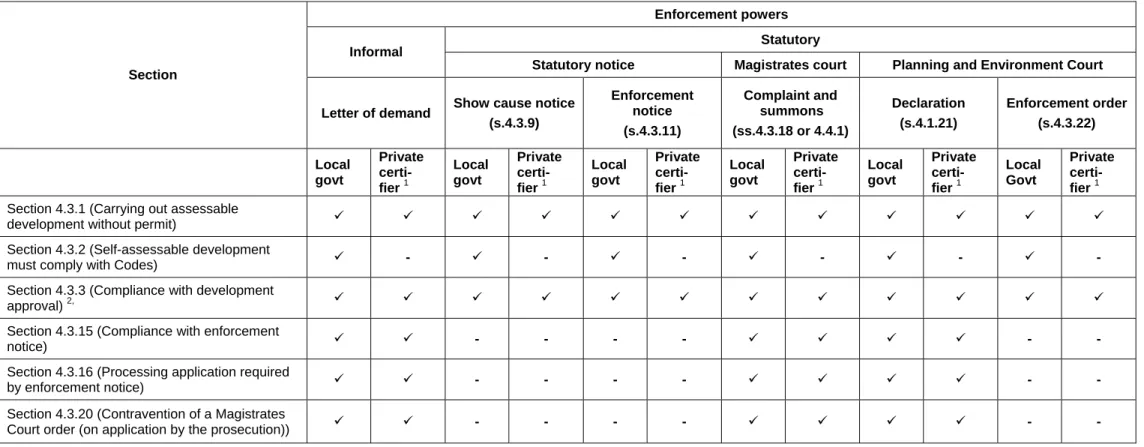
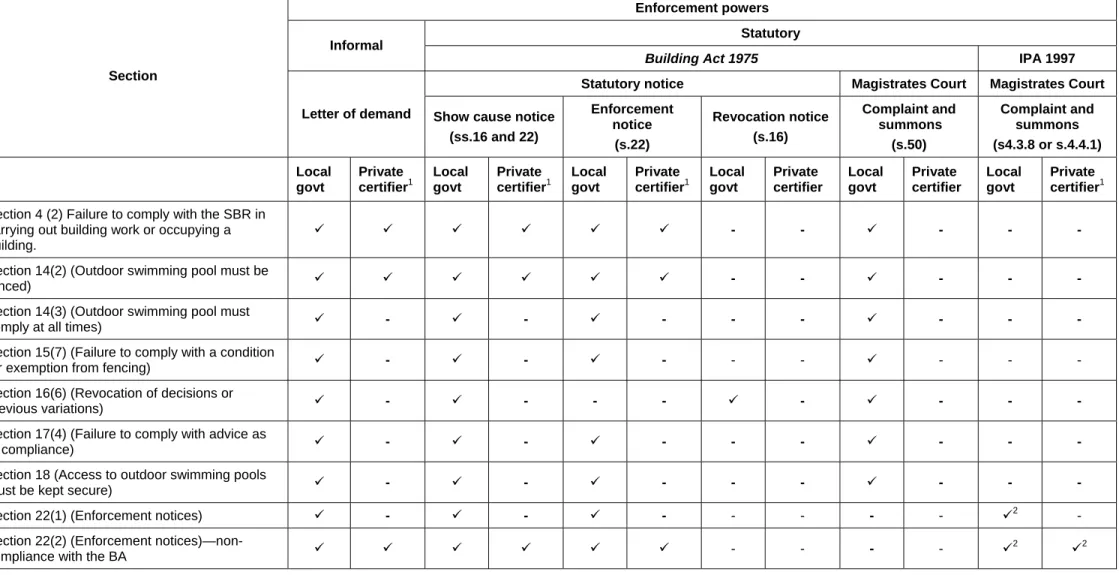
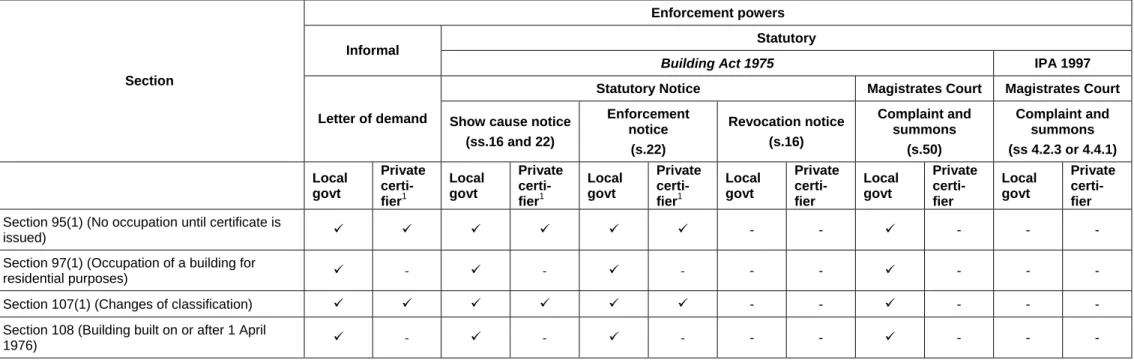
the Standard Building Regulation 1993 (SBR).The following tables specify the various enforcement options available to local governments and private certifiers for offences created by the above legislation:
•
Table 1.1 (Offences under the Integrated Planning Act 1997)•
Table 1.2 (Offences under the Building Act 1975)•
Table 1.3 (Offences under the Standard Building Regulation 1993).2.2 Issuing more than one notice
Enforcement notices may in certain circumstances be able to be issued under more than one piece of legislation.
For example, if a building is being constructed other than in accordance with a development permit and as a result the work is dangerous an enforcement notice may be given under:
• section 4.3.3 (Compliance with development approval) of IPA, for failing to carry out works in compliance with a development permit
• section 22(1)(b) (Enforcement notices) of the BA on the basis that the building, structure or building work is dangerous.
It might also be the case that some part of the Building Code of Australia (BCA) has not been complied with. The BCA is deemed by section 8 (BCA forms part of regulation) of the SBR to be part of the SBR. Pursuant to section 49 (Owner liable for offences under the Standard Building Regulation) of the BA an owner of a building or structure is deemed to be guilty of an offence if they fail to comply with the SBR. An enforcement notice may therefore also be given to the owner of a building or structure under section 22(2) (enforcement notices) of the BA for not complying with a particular matter in the BA on the basis that there has been non compliance with the BCA.
The important thing to note is that one offence may allow more than one notice to be issued. Therefore before preparing an enforcement notice, private certifiers and local government officers should give consideration to what provisions of the BA, IPA, the SBR or the BCA have not been complied with. They should then consider whether an enforcement notice should be given under the IPA rather than or in addition to the BA.
Where enforcement notices are to be issued under both the IPA and the BA, two separate enforcement notices must be given as the requirements for enforcement notices under each Act are different.
Table 1.1—Offences under the Integrated Planning Act 1997
1. A private certifier may only take action in relation to non-compliance where the private certifier is engaged to perform the functions of a private certifier.
2. Section 4.3.3 includes failure to comply with a condition of approval. This would include for example, failure to comply with a condition to give a required notice of inspection under sections 69(4), 86(6) and 88(2) of the SBR.
Enforcement powers Statutory Informal
Statutory notice Magistrates court Planning and Environment Court Section
Letter of demand Show cause notice (s.4.3.9) Enforcement notice (s.4.3.11) Complaint and summons (ss.4.3.18 or 4.4.1)
Declaration (s.4.1.21) Enforcement order (s.4.3.22) Local govt Private certi- fier 1
Local govt
Private certi- fier 1
Local govt
Private certi- fier 1
Local govt
Private certi- fier 1
Local govt
Private certi- fier 1
Local Govt
Private certi- fier 1 Section 4.3.1 (Carrying out assessable
development without permit) 9 9 9 9 9 9 9 9 9 9 9 9
Section 4.3.2 (Self-assessable development
must comply with Codes) 9 - 9 - 9 - 9 - 9 - 9 -
Section 4.3.3 (Compliance with development
approval) 2, 9 9 9 9 9 9 9 9 9 9 9 9
Section 4.3.15 (Compliance with enforcement
notice) 9 9 - - - - 9 9 9 9 - -
Section 4.3.16 (Processing application required
by enforcement notice) 9 9 - - - - 9 9 9 9 - -
Section 4.3.20 (Contravention of a Magistrates
Table 1.2—Offences under the Building Act 1975
Enforcement powers Statutory Informal
Building Act 1975 IPA 1997
Statutory notice Magistrates Court Magistrates Court
Section
Letter of demand Show cause notice (ss.16 and 22)
Enforcement notice (s.22) Revocation notice (s.16) Complaint and summons (s.50) Complaint and summons (s4.3.8 or s.4.4.1) Local govt Private certifier1 Local govt Private certifier1 Local govt Private certifier1 Local govt Private certifier Local govt Private certifier Local govt Private certifier1 Section 4 (2) Failure to comply with the SBR in
carrying out building work or occupying a building.
9 9 9 9 9 9 - - 9 - - -
Section 14(2) (Outdoor swimming pool must be
fenced) 9 9 9 9 9 9 - - 9 - - -
Section 14(3) (Outdoor swimming pool must
comply at all times) 9 - 9 - 9 - - - 9 - - -
Section 15(7) (Failure to comply with a condition
for exemption from fencing) 9 - 9 - 9 - - - 9 - - -
Section 16(6) (Revocation of decisions or
previous variations) 9 - 9 - - - 9 - 9 - - -
Section 17(4) (Failure to comply with advice as
to compliance) 9 - 9 - 9 - - - 9 - - -
Section 18 (Access to outdoor swimming pools
must be kept secure) 9 - 9 - 9 - - - 9 - - -
Section 22(1) (Enforcement notices) 9 - 9 - 9 - - - - - 92
- Section 22(2) (Enforcement
notices)—non-compliance with the BA 9 9 9 9 9 9 - - - - 9
2 92
1. A private certifier may only take action in relation to non-compliance where the private certifier is engaged to perform the functions of a private certifier.
Table 1.3 – Offences under the Standard Building Regulation 1993
Enforcement powers Statutory Informal
Building Act 1975 IPA 1997
Statutory Notice Magistrates Court Magistrates Court
Section
Letter of demand Show cause notice (ss.16 and 22)
Enforcement notice (s.22) Revocation notice (s.16) Complaint and summons (s.50) Complaint and summons (ss 4.2.3 or 4.4.1) Local govt Private certi- fier1 Local govt Private certi- fier1 Local govt Private certi- fier1 Local govt Private certi- fier Local govt Private certi- fier Local govt Private certi- fier Section 95(1) (No occupation until certificate is
issued) 9 9 9 9 9 9 - - 9 - - -
Section 97(1) (Occupation of a building for
residential purposes) 9 - 9 - 9 - - - 9 - - -
Section 107(1) (Changes of classification) 9 9 9 9 9 9 - - 9 - - -
Section 108 (Building built on or after 1 April
1976) 9 - 9 - 9 - - - 9 - - -
1. A private certifier may only take action in relation to non-compliance where the private certifier is engaged to perform the functions of a private certifier.
3 Duty to enforce
3.1 Introduction
Local governments and private certifiers have enforcement powers under the IPA and BA. However with power comes responsibility.
The common law through the decisions of the courts has imposed various duties with respect to the exercise of the power to investigate offences and take enforcement action.
3.2 Pyrenees
case
3.2.1 Decision
The High Court, in Pyrenees Shire Council v Day, considered the circumstances in which local governments will be liable in negligence in the exercise of their statutory powers. The findings in this case are likely to apply to private certifiers as they have been given enforcement powers under the IPA and BA.
3.2.2 Duty to enforce
The court found that once a local government has knowledge of a situation which may cause damage or injury and it commences to exercise statutory powers to fix the situation, it will have a duty of care to ensure that its powers are exercised to the fullest extent necessary in order to fix the situation. This duty will be owed to anyone who might foreseeably suffer damage from the situation, whether or not they rely on the local government or private certifier to act or even know of the existence of the statutory power to act.
Local governments and private certifiers cannot avoid liability by not acting at all. Apart from the fact that ‘not acting’ will often be unacceptable for responsible local governments and private certifiers, if a local government or private certifier has knowledge of a situation likely to cause damage or injury and has statutory powers which enable it to fix the situation, it is likely it will have a positive duty to exercise those statutory powers.
The practical questions to be asked by local government officers and private certifiers to determine whether action should be taken are:
Do I know of a situation that requires remedying?
Do I have statutory powers to act in relation to the situation?
If I don’t act is it possible that loss, damage or injury may occur?
If the answers to these questions are ‘yes’, then action should be taken to remedy the situation.
4 Enforcement options
4.1 Letters of demand
It is always possible to forward a ‘Letter of demand’ to an alleged offender requiring:
that an ongoing breach of the BA or IPA be ceased
Sending such a letter is often enough to ensure compliance. However, if the offence is dangerous, an enforcement notice should be given.
In relation to work in progress, it may be appropriate to issue an informal inspection defect notice on site.
4.2 Show cause notices
4.2.1 Purpose of a ‘Show cause notice’
The purpose of a ‘Show cause notice’ is to invite a person to:
• show cause why an ‘Enforcement notice’ or a ‘Revocation notice’ should not be
given to them
• make representations about the issues dealt with in the notice.
4.2.2 When is a ‘Show cause notice’ not required
A ‘Show cause notice’ must be given to a person prior to giving an ‘Enforcement notice’ or ‘Revocation notice’.
However, an ‘Enforcement notice’ or ‘Revocation notice’ can be given under the BA without giving a ‘Show cause notice’ in the following circumstances:
• section 22(5) (Enforcement notices) of the BA—if about a matter of a dangerous
or minor nature
• section 16(3) (Revocation of a decision or previous variations) of the BA—if the work the owner must do to comply with section 14(2) (Outdoor swimming pools must be fenced) of the BA is of a minor nature.
What constitutes a ‘matter of a dangerous or minor nature’ is not defined, nor has it been tested in the court. However, it is reasonable to assume dangerous is intended to refer to some circumstance where a building or structure is structurally unsound and could collapse, or presents another immediate hazard.
A building or structure that was lawfully constructed, and remains structurally sound or intact, cannot be considered dangerous because it does not meet current safety standards.
It is reasonable to assume minor is intended to refer to a matter that is readily rectified without cost that would prove excessive to the owners.
An ‘Enforcement notice’ can be given under IPA without giving a ‘Show cause notice’ pursuant to section 4.3.8 (Application of div 2) of IPA—if it is about:
(a) work the assessing authority reasonably believes is a danger to persons or a risk to public health or
(b) work the assessing authority reasonably believes is of a minor nature or (c) carrying out development that is the demolition of a work or
4.2.3 Requirements of a ‘Show cause notice’
Section 21 (Show cause notices) of the BA and section 4.3.10(1) (General requirements of Show cause notice) of IPA specify a number of requirements in relation to the giving of a Show cause notice.
These provisions require a ‘Show cause notice’ inviting a person to show cause why an
enforcement or ‘Revocation notice’ should not be given to the person must: (a) be in writing
(b) outline the facts and circumstances forming the basis for the belief that an enforcement or ‘Revocation notice’ should be given to the person
(c) state that representations may be made about the ‘Show cause notice’ (d) state how the representations may be made
(e) state where the representations may be made or sent (f) state:
(i) a day and time for making the representations
(ii) a period within which the representations must be made.
Section 21(2) of the BA and section 4.3.10(2) of the IPA require that the day or period stated in the notice must be, or must end, at least 20 business days after the notice is given.
‘Business days’ does not include weekends or public holidays.
4.3 Show cause and procedural fairness
The BA and IPA allow persons in certain circumstances to ‘show cause’ why an enforcement or ‘Revocation notice’ should not be given to them.
The ‘rules of natural justice’ (also known as ‘procedural fairness’) should be applied to a show cause proceeding. What the rules require is flexible, depending upon the circumstances of the particular case. In most cases, the rules require:
•
That the person be given sufficient time within which to show cause. In most cases a period of at least 20 business days notice should be sufficient. However thecircumstances may require that a person be given more time. In such a case, any request to delay the show cause should be seriously considered.
•
That the person be given all documents and information that set out the nature of the complaint made against them. For example, it may be appropriate to give a report about the complaint to the person so they know the case made against them at the show cause. Details about the informant/complainant are irrelevant for the purposes of determining the nature of the complaint made and may be withheld.•
That the person be given an opportunity to be heard. It may not always be appropriate to require the person to show cause in writing. The precedent documents included in these guidelines encourage representations to be made in writing. However, if an oral hearing is requested it should be permitted.•
That the person be allowed to be represented by a lawyer or agent at the meeting.•
That the person considering the show cause be unbiased. Even a reasonableapprehension of bias is enough to taint a decision. Justice must not only be done, but be seen to be done. It is recommended that (if possible) the person who hears or assesses the representations in the show cause should be a person other than the person who issued the ‘Show cause notice’. This brings a ‘fresh’ mind to the process. However,
private certifiers proposing to deal with a show cause must ensure that they are the private certifier who was engaged to perform the functions of a private certifier.
•
That the decision to proceed further with the service of an enforcement notice be based upon ‘logically probative evidence’—not mere speculation or suspicion.The above rules must be observed. If the rules are not observed, the receiver of the notice may be able to apply to the Planning and Environment Court for a declaration, amongst other things, that a decision made consequent upon the show cause was void. The court might order that the show cause be heard again.
Local government officers proposing to deal with a show cause must ensure that they are appropriately authorised.
4.4 Revocation
notices
The power to give a ‘Revocation notice’ concerning swimming pool fencing is limited to a local government and is found in section 16 (Revocation of decisions or previous variations) of the BA.
A local government may only issue a ‘Revocation notice’ where the requirements of section 16(1) of the BA are satisfied. These requirements will be satisfied if, in relation to fencing around an outdoor swimming pool on residential land, the local government has previously made a decision or given a variation and the local government is satisfied one or more of the following has happened:
•
the decision or variation was based on a false or misleading particular given by the owner of the land•
a significant change has happened so that reasonable provision no longer exists for inhibiting access by young children to the pool•
if the decision or variation was subject to conditions—the owner has contravened a condition.Prior to issuing a ‘Revocation notice’ a local government must first give the owner a ‘Show cause notice’ and consider any representations made by the owner.
A ‘Show cause notice’ need not be given if the work the owner must do to comply with section 14(2) (Outdoor swimming pools must be fenced) of the BA is of a minor nature. If a local government decides to issue a ‘Revocation notice’ the notice must specify:
•
what the owner must do to comply with section 14(2) of the BA and•
the day by which the work must be done.Section 20 of the BA provides that a person may appeal a ‘Revocation notice’ to the building and development tribunal.
4.5 Enforcement
notices
In many instances, enforcement notices in respect of a particular matter may be issued under both the IPA and BA.
Enforcement notices issued under the IPA are only applicable where a person has committed or is committing a development offence, such as undertaking building work without first obtaining the required development permit. Therefore, IPA enforcement notices are given for work in progress.
BA enforcement notices are given in respect to the condition or use of buildings or structures or non-compliance with the BA.
4.5.1 IPA enforcement notices
Schedule 10 of the IPA defines an assessing authority for building work, as a private certifier who has been engaged to perform building certifying functions, and a local government. As an assessing authority, both the private certifier and local government, may issue enforcement notices under section 4.3.11(Giving enforcement notice) of the IPA where a person has committed or is committing a development offence. Development offences are listed in sections 4.3.1A to 4.3.7 of the IPA.
The enforcement notice may require the person to refrain from committing the development offence or to remedy the commission of the offence in a way stated in the notice.
4.5.2 Requirements of an IPA enforcement notice
Section 4.3.13(1) (Specific requirements of enforcement notice) of IPA provides that a notice may require a person to do any of the following:
(a) to stop carrying out a development (b) to stop a stated use of premises (c) to demolish or remove a work
(d) to restore, as far as practicable, premises to the condition the premises were in immediately before a development was started
(e) to do, or not to do, another act to ensure a development complies with a development approval or a code
(f) to apply for a development permit
(g) if the assessing authority reasonably believes a work is dangerous:
(i) to repair or rectify the work or
(ii) to secure the work (whether by a system of supports or in another way) or
(iii) to fence off the work to protect persons.
Section 4.3.14 (General requirements of enforcement notices) of IPA contains a number of mandatory requirements in relation to enforcement notices. An enforcement notice must: (h) be in writing
(i) describe the nature of the alleged offence
(j) inform the person to whom the notice is given of the person’s right to appeal against the giving of the notice. Section 4.3.14(2) of IPA requires if an enforcement notice requires a person to do an act involving the carrying out of the work, it must also give details of the work involved.
Section 4.3.14(3) of IPA provides that if an enforcement notice requires a person to refrain from doing an act, it must also state either:
(a) a period for which the requirement applies or (b) that the requirement applies until further notice.
4.5.3 IPA enforcement notice to demolish a building
Section 4.3.13(2) of IPA provides that a person may be required to demolish or remove a work only if the assessing authority reasonably believes it is not possible and practicable to take steps:
(b) if the work is dangerous—to remove the danger.
Under section 4.3.11 (5) of IPA, neither a private certifier nor a local government can delegate its power to give an enforcement notice about the demolition of a building.
4.5.4 Private certifiers and local governments to consult before issuing enforcement notices
Sections 4.3.11(3) and (3A) of IPA require local governments and private certifiers to consult with each other prior to giving an enforcement notice under IPA unless they reasonably believe the work, in relation to which the enforcement notice is to be given, is dangerous. The purpose of consultation is to achieve a coordinated approach. This should result in consistency on the action required, and the time within which compliance is to be achieved. If a private certifier gives an enforcement notice under IPA for a development offence in a local government area it must give a copy of the enforcement notice to the local government. It is expected that as part of the consultation process, if the local government issues a notice, it will give a copy to the private certifier. In both instances, this should be done as soon as practicable.
Under section 4.3.11(2A) of IPA, if a private certifier gives the local government a copy of an enforcement notice that is later withdrawn, the private certifier must give the local government written notice of the withdrawal. It is expected that if the local government withdraws a notice, it will also notify the private certifier in writing.
4.5.5 BA enforcement notices—existing buildings
There are two principal powers for the giving of enforcement notices under the BA. They are:
•
section 22(1) (Enforcement notices)—available to local governments•
section 22(2) (Enforcement notices)—available to local governments and private certifiers in certain circumstances.An enforcement notice given under section 22(1) (Enforcement notices) of the BA is primarily given for an existing building, structure or building work. Pursuant to this section, a local government may give anenforcement notice if, the local government reasonably believes the building, structure or building work:
•
was built before 30 April 1998 without, or not in accordance with, the approval of the local government•
is dangerous•
is in a dilapidated condition•
is unfit for use or occupation•
is filthy, infected with disease or infested with vermin.An enforcement notice under section 22(1) of the BA may only be given:
•
by a local government•
to the owner of a building, structure or building work.A local government must give a ‘Show cause notice’ before giving an ‘Enforcement notice’, unless the matter about which the enforcement notice is proposed to be given is of a dangerous or minor nature.
4.5.6 BA enforcement notices—non-compliance with BA
An enforcement notice given under section 22(2) and (3) of the BA is primarily given for new buildings, structures or building work. This section provides that a local government or private certifier may give an enforcement notice to a person who does not comply with a ‘particular matter’ in the BA. A private certifier may only give an enforcement notice under this section in relation to building work for which the private certifier is engaged to perform the functions of a private certifier.
Because of the effect of the Acts Interpretation Act 1954, the reference to a particular matter in the BA is taken to also be a reference to a particular matter in the SBR. Therefore
‘particular matter’ also includes breaches of the SBR.
A ‘Show cause notice’ must be given before anenforcement notice is given for any of these additional ‘particular matters’ unless the matter is of a dangerous or minor nature.
4.5.7 Requirements of an BA enforcement notice
Section 23(1) (Specific requirements of enforcement notices) of the BA provides that an enforcement notice may require a person to do (amongst other things) any of the following: (a) to apply for a development permit under the Integrated Planning Act 1997
(b) to do, or not to do, another Act to ensure building work complies with the approval of the local government given before the commencement of this section
(c) to repair or rectify the building or structure
(d) to secure the building or structure (whether by a system of supports or in another way) (e) to fence off the building or structure to protect persons
(f) to cleanse, purify and disinfect the building or structure (g) to demolish or remove the building or structure
(h) to comply with this Act for a particular matter.
4.5.8 BA enforcement notice to demolish a building
Section 23(2) of the BA states that a person may be required to demolish or remove a building or structure only if a local government reasonably believes it is not possible and practical to take steps to comply with subsection (1)(c) to (f). In such a case this should be stated in the notice.
Under section 23 (2) of the BA, only a local government can require a person to demolish a building or structure. A private certifier cannot require a person to demolish or remove a building or structure under the BA.
4.5.9 Deeming a BA enforcement notice to be an IPA enforcement notice
An enforcement notice given under section 22 of the BA is taken by section 22(6) to be an enforcement notice given under section 4.3.11 (Giving enforcement notice) of IPA.
This means that if a person does not comply with the enforcement notice, the person will be guilty of an offence under section 4.3.15 (Compliance with enforcement notice) of IPA. This is prosecuted by way of a complaint and summons under section 4.4.1 (Proceedings for
offences) of IPA. The prosecution is not brought under the BA.
Because an enforcement notice under section 22 of the BA is taken to be an enforcement notice under IPA certain consequences follow including:
•
the general requirements of enforcement notices under sections 4.3.11 and 4.3.14 of the IPA applies to BA enforcement notices•
the penalty under IPA for a failure to comply with a BA enforcement notice is higher (1665 penalty units) than the penalties for offences under the BA and the regulations made under it (the maximum penalty being in most cases 165 penalty units, but often less)•
private certifiers in certain circumstances can perform work not done but required to be done by an enforcement notice under section 4.3.17(1) (Assessing authority may take action) of IPA•
the costs of an investigation may be able to be recovered under section 4.4.6 (Recovery of costs of investigations) of IPA if a prosecution for the failure to comply with anenforcement notice is successful.
4.5.10 Power of local governments if enforcement notice not complied with
Where a person contravenes an enforcement notice by not doing something the local government may:
•
prosecute the person for failing to comply with the enforcement notice under section 4.3.18 of IPA•
exercise the limited power to perform work under section 1066 (Performing work for owner or occupier) of the Local Government Act 1993 (LGA).Section 1066 of the LGA relevantly provides that if the owner or occupier of land or a structure fails to perform work required to be performed under a local government Act, the local government may, by its employees or agents, enter the land or structure and perform the work. The IPA is defined in the LGA as a local government Act.
Also, section 26 (Action local government may take ifenforcement notice not complied with) of the BA provides that if an enforcement notice is given under section 22(1)(b) to (e) or (2) to an owner and the owner fails to perform the work required to be performed under the notice, the failure is taken to be a failure mentioned under section 1066 (Performing work for owner or occupier) of the LGA.
However this power may be exercised only if:
(a) both the owner and occupier agree to the entry
(b) the entry is under an order made under section 1063 (Order on occupier who refuses entry) of the LGA
(c) urgent action is necessary for local government purposes, including, for example, the interests of public health or safety (but this does not apply to the entry of a structure, or the part of a structure, used for residential purposes)
(d) reasonable notice has been given to the owner and occupier of the local government’s intention to enter the land or structure and perform the work (but this does not apply to the entry of a structure, or the part of a structure, used for residential purposes).
4.5.11 Power of private certifiers if enforcement notice not complied with
When a private certifier is the assessing authority under section 5.3.6(1) (Private certifier may act as assessing authority in certain circumstances) of IPA and a person contravenes an enforcement notice by not doing something the private certifier may:
•
prosecute the person for failing to comply with the enforcement notice under section 4.3.18 of IPA•
do the thing under section 4.3.17(1) (Assessing authority may take action) of IPA. Private certifiers should ensure that they keep proper records of all show cause and enforcement notices they give under IPA or the BA.Under section 5.3.6.(2) of IPA, if a person fails to comply with an enforcement notice issued by a private certifier, the private certifier must advise the local government in writing of the failure.
The costs of an investigation incurred by a private certifier may be able to be recovered under section 4.4.6 (Recovery of costs of investigations) of IPA if a prosecution for the failure to comply with an enforcement notice is successful.
Also, the reasonable costs or expenses of the private certifier doing the thing may be recovered by the private certifier as a debt from the person to whom the enforcement notice was given.
4.5.12 Appeals to the building and development tribunal
A person who is given an enforcement notice under section 4.3.11 of the IPA that relates to the BA or section 22 of the BA may appeal to the building and development tribunal. Appeals against BA enforcement notices are made to the tribunal as if the appeal were an appeal under IPA. Section 24 (Appeals against enforcement notices) of the BA states that an appeal must be started within:
• if the notice is given in relation to a dangerous building or structure—five business days
• if the notice is given for any other purpose—20 business days after theenforcement notice is given to the person.
Section 4.2.13 (Appeals against enforcement notices) require an appeal against an IPA enforcement notice to be started within 20 business days after the enforcement notice is given to the person.
Under section 4.2.14 (Stay of operation of enforcement notices) of IPA, the lodging of a notice of appeal about an enforcement notice stays the operation of the enforcement notice until:
• the tribunal, on the application of the entity issuing the notice, decides otherwise
• the appeal is withdrawn
• the appeal is dismissed.
However, the lodging of an appeal against the enforcement notice will not stay the operation of an enforcement notice about:
• a work, if the enforcement notice states the entity believes the work is a danger to persons or a risk to public health
• carrying out development that is the demolition of a work.
4.5.13 Register of enforcement notices
Under section 5.7.2(1)(p) (Documents local government must keep available for inspection and purchase) of IPA a local government must keep a register of all show cause and enforcement notices given under IPA or the BA. The notices must be kept available for inspection and purchase.
A local government must also keep the register maintained under section 25 (Register of notices given) of the BA before 30 April 1998 open to inspection by the public. A local
government may remove from the register all entries and details relating to a notice when the requirements of the notice have been complied with.
4.6 Complaint and summons
4.6.1 Prosecution in the Magistrates Court
A complaint and summons is the form used to commence a prosecution in the Magistrates Court under the Justices Act 1886.
In order to prosecute a person for an offence under the BA a private certifier must first issue an enforcement notice as they cannot prosecute persons for offences under the BA. If a person does not comply with the enforcement notice they will be guilty of an offence under section 4.3.15 (Compliance with enforcement notice) of IPA. This is prosecuted by way of a complaint and summons under section 4.4.1 (Proceedings for offences) of IPA. The
prosecution is not brought under the BA.
It is recommended that legal advice be sought before embarking upon a prosecution in the Magistrates Court. The solicitor should be asked to consider the evidence to support the complaint (remembering that a complaint must be proved at the criminal standard which requires proof beyond a reasonable doubt that an offence has been committed—rather than the civil standard which requires proof on the balance of probabilities).
A complaint should only be commenced if there is sufficient evidence.
If a prosecution is successful, the complainant is entitled to seek the payment of the complainant’s legal costs to bring the prosecution. However, if a prosecution is not successful, the defendant is entitled to seek the payment of the defendant’s legal costs to defend the unsuccessful prosecution.
4.6.2 Time to commence proceedings (a) Integrated Planning Act 1997
Under section 4.4.2 (Limitation on time for starting proceedings) of the IPA a proceeding for an offence against IPA must be commenced within one year after the commission of the offence, or within six months after the offence comes to the local government or private certifier’s knowledge.
This provision would apply to the offence of failing to comply with an enforcement notice under section 4.3.15 (Compliance with enforcement notice) of the IPA.
(b) Building Act 1975
Under section 50(1) (Prosecution of offences) a prosecution in respect of an offence against the BA (including any offence that consists of a breach of the SBR as duly modified in relation to any area) shall be by way of summary proceeding (i.e. Complaint and summons) under the
Justices Act 1886 upon complaint laid within 12 months after the commission of the offence or within 6 months after the offence comes to the knowledge of the local government, whichever period is the later to expire.
This provision applies to all offences against the BA (i.e. it does not apply to the offence of failing to comply with an enforcement notice under section 4.3.15 (Compliance with enforcement notice) of the IPA).
4.7 Declarations
Under section 4.1.21 (Court may make declarations) of IPA, the Planning and Environment Court has jurisdiction to make declarations about:
•
the lawfulness of building workIn addition, section 4.1.22 (Court may make orders about declarations) of IPA provides that the Planning and Environment Court may also make an order about a declaration (e.g. an injunction to restrain building work). A breach of such an order is a contempt of Court. A maximum penalty of 3000 penalty units or two years imprisonment may be ordered for a contempt of court.
Declarations and injunctions can be made (at least on an interim basis) by the court in a matter of hours if necessary.
It is recommended that solicitors be engaged to obtain a declaration or injunction order as the law regarding these types of orders is complex.
4.8 Enforcement
orders
Under section 4.3.22 (Proceedings for orders) of IPA, a person may bring proceedings in the Planning and Environment Court for an enforcement order (including an interim enforcement order) to remedy or restrain the commission of an offence in relation to building work. Again, it is recommended that solicitors be engaged to obtain an order as the law regarding these types of orders (which are in the nature of injunctions) is complex.
5 Investigation offences
5.1 Identification of a matter requiring investigation
Ordinarily, investigations occur in response to a specific complaint or pursuant to a general program of inspection and enforcement.
5.2 Jurisdiction
5.2.1 Local government
A local government does not have unlimited power to investigate offences and enforce the law. A local government only has power where it is granted to the local government by the state government under an Act such as the BA or IPA.
The LGA is the Act which establishes most local governments in Queensland. This Act grants a range of powers to local governments and imposes restrictions upon the use of the powers. The more general term ‘local government Act’ is used in the LGA to mean a law under which a local government may exercise the jurisdiction of local government, and includes for example, the LGA, the Integrated Planning Act1997, the Building Act1975 and planning schemes.
5.2.2 Local government authorised persons’ identity card
A local government is required to give every authorised person an identity card with a recent photograph which is to be signed by the officer and is to identify the officer as an authorised person. This identity card is very important.
A local government officer is not entitled to exercise any power in relation to another person unless the officer has produced an identity card or has the identity card displayed before taking any action. If for some reason it is not practicable to produce the identity card before acting, the officer must produce the identity card at the first reasonable opportunity.
Again, failure to follow this procedure makes the investigation unlawful and may lead to the exclusion of evidence.
5.2.3 Private certifiers
Private certifiers only have power to investigate offences and enforce the law in relation to building work for which they have been engaged to perform the functions of a private certifier.
5.3 Entering land to investigate an offence
5.3.1 Local government
Pursuant to section 86 (carrying out of inspections) of the SBR a building certifier may enter premises at all reasonable times during business hours to determine if a particular stage of building work complies with a development approval, the BA or the SBR.
Other than as provided in section 86 of the SBR the only persons who have power to
investigate offences on behalf of a local government are ‘authorised persons’ who have been appointed by the local government for that purpose. Not every officer is appointed for every purpose, as not every officer has the expertise to be appointed for every purpose.
Accordingly, before acting in relation to a matter, every officer should ensure that they are an authorised person with powers granted under section 1084 (Appointment) of the LGA and that the matter is within the scope of their authority.
If a matter is not within the authority of an officer, any investigations by the officer including any entry upon land may be unlawful and any evidence gathered by that officer may be excluded from court in the event of a prosecution (see paragraph 6 Evidence for court proceedings of the guidelines).
An authorised person does not have an unlimited right to enter land to investigate an alleged offence.
In relation to a public place, an authorised person may only enter that place when the place is open to the public.
In relation to private land, rules must be followed. An authorised person may enter private land to ask for the occupier’s agreement to enter the land or a building or structure on the land for the purpose of investigating an alleged offence.
Where an authorised person has entered private land to ask for the occupier’s consent, the fact that the occupier does not object to an investigation does not make the entry lawful. The authorised person must also inform the occupier of the following matters:
•
the purpose of the entry being to investigate an alleged offence•
that things or information obtained by the local government officer may be used in evidence in court•
that the occupier is not required to agree to the entry.If the occupier then refuses to grant consent, the authorised person may not lawfully remain on the land, they must leave the land and they may not lawfully investigate the alleged offence at that time.
In these circumstances, section 1094 (Warrants of entry) of the LGA provides for a procedure whereby an authorised person can make an application to the Magistrates Court to require an owner to permit entry upon the land to investigate the alleged offence.
If the occupier agrees to the entry it is desirable that the occupier sign an acknowledgment form which records the giving of the advice mentioned above and records the occupier’s consent. The occupier should be immediately given a copy of the acknowledgment form for their records. This should be a standard practice.
If the occupier genuinely agrees to entry, but is not willing to sign an acknowledgment of the agreement, the local government officer should still complete an acknowledgment form and make an appropriate notation as to the conversation about the occupier consenting to entry. The acknowledgment procedure is very important because in a prosecution, if a question arises whether an occupier did agree to the entry upon the land and a signed
acknowledgment form is not produced in evidence, the court is entitled to assume that the occupier did not agree unless the contrary is proved.
If the occupier’s consent is not proved to have been given in accordance with these requirements, the entry upon the land will be deemed to be not lawful and any evidence gathered may be excluded by the court.
5.3.2 Private certifiers
Pursuant to section 86 (Carrying out of inspections) of the SBR a private certifier may enter premises at all reasonable times during business hours to determine if a particular stage of building work complies with a development approval, the BA or the SBR.
Other than as provided in section 86 of the SBR, a private certifier does not have a general right to enter land to investigate an alleged offence.
In relation to a public place, a private certifier may only enter that place when the place is open to the public.
The right to enter private land to conduct compliance inspections other than under section 86 (Carrying out of inspections) of the SBR should form part of a private certifier’s terms of engagement.
If a contractual right to enter private land does not exist, rules must be followed. A private certifier may enter private land to ask for the occupier’s agreement to enter the land or a building or structure on the land for the purpose of investigating an alleged offence. This right of entry could be excluded orally or in writing. For example, a sign on the land could advise that entry on the land is prohibited. In these circumstances the private certifier should not enter the land and should seek permission to enter the land through other forms of
communication or seek the involvement of the local government who can obtain a warrant for entry.
Where a private certifier has entered private land to ask for the occupier’s consent, the fact that the occupier does not object to an investigation does not make the entry lawful. The private certifier must also inform the occupier of the following matters:
•
the purpose of the entry being to investigate an alleged offence•
that things or information obtained by the private certifier may be used in evidence in court•
that the occupier is not required to agree to the entry.If the occupier then refuses to grant consent, the private certifier may not lawfully remain on the land, they must leave the land and they may not lawfully investigate the alleged offence at that time.
In these circumstances, the matter should be referred to the local government as they have powers under the LGA to enter land to investigate alleged offences.
If the occupier agrees to the entry it is desirable that the occupier sign an acknowledgment form which records the giving of the advice mentioned above and records the occupier’s consent. The occupier should be immediately given a copy of the acknowledgment form for their records. This should be a standard practice.
If the occupier genuinely agrees to entry, but is not willing to sign an acknowledgment of the agreement, the private certifier should still complete an acknowledgment form and make an appropriate notation as to the conversation about the occupier consenting to entry.
The acknowledgment procedure is very important because in a prosecution, if a question arises whether an occupier did agree to the entry upon the land and a signed
acknowledgment form is not produced in evidence, the court is entitled to assume that the occupier did not agree unless the contrary is proved.
If the occupier’s consent is not proved to have been given in accordance with these requirements, the entry upon the land will be deemed to be not lawful and any evidence gathered may be excluded by the court.
5.4 Investigations following lawful entry
5.4.1 Consent is required to undertake investigations
It is important to note that when a local government officer or private certifier enters a property and is yet to obtain the occupier’s consent to investigate the alleged offence, the person does not have power to undertake any investigations. Where consent is required but not yet obtained, the only right that a local government officer or private certifier has is to enter and seek that consent agreement.
If at any time after obtaining consent an occupier asks the local government officer or private certifier to leave the premises, the most prudent course of action is to treat the request as a revocation of consent, such that the officer of private certifier should leave the premises and cease the inspection.
The evidence gathered prior to the request would still be lawfully gathered. However, if there were further matters which required investigation, a warrant pursuant to section 1094 (Warrants of entry) of the LGA should be sought by the local government.
5.4.2 Local government
Where no consent is required or where consent has been obtained, a local government officer may:
•
search any part of the place•
may inspect, test, photograph or film anything in or on the place•
may copy a document in or on the place may take samples of or from anything in or on the place•
may take into or onto the place any people, equipment and materials reasonably required to investigate the offence•
may require the occupier or any other person on the place to give reasonable help. It is an offence for a person to refuse to give an inspecting local government officer help when requested, unless the person has a reasonable excuse. It would not be an offence to refuse to give information or to refuse to produce documents if doing so would incriminate that person.5.5 Investigations
generally
5.5.1 Collection of information
The following is intended as a guide for undertaking investigations.
An investigation involves the collection and evaluation of information about things or events. The process includes:
•
interviewing persons to obtain information from persons who have personal knowledge of the event or circumstance of the relevant matter or from the person suspected of being responsible for the action•
preparing ‘hard’ evidence e.g. photographs.5.5.2 Interviewing
In carrying out an interview persons should:
•
be tactful•
be a good listener and observer•
maintain an objective viewpoint free from personal prejudices together with a healthy scepticism (i.e. not believe everything he/she has been told)•
be firm but fair•
be patient, remain completely objective and not emotionally involved with the subject matter of the case.Interviewers should ensure interviews are properly conducted in a timely, efficient and organised manner.
5.5.3 Elements of the offence
A court hearing a prosecution will be purely interested in the elements of the alleged offence for the purposes of determining guilt. The Court will ‘break up’ the offence into elements and determine if there is evidence to prove each of those elements. Some elements are factual, others are legal.
6
Evidence for court proceedings
The following highlight the main rules regarding evidence in criminal prosecutions and the consequences of a failed prosecution.
6.1 Burden of proof
The burden to prove all elements of an offence (and to disprove all defences to the offence during the trial) is always on the prosecution in a criminal trial.
6.2 Standard of proof
The law requires that, in criminal proceedings, the complainant prove beyond a reasonable doubt that an offence has been committed. It is not enough to show that a defendant ‘more likely than not’ committed an offence. This is equivalent to the civil standard of evidence which only requires an assessment of the evidence on the ‘balance of probabilities’. This is not to say that actual (or real) evidence of every element of an offence must be
established. Circumstantial evidence (i.e. evidence which is not real evidence but which tends to establish that fact) may be led about an element of the offence and this may be sufficient to avoid any reasonable doubt.
Diligent record keeping practices will ensure that every prosecution is given the greatest chance of success. It is therefore recommended that:
•
statements (i.e. also known as proofs of evidence) be taken at every opportunity. These should be signed, dated and witnessed•
the reverse side of photos should be signed by the person who took them, dated, and contain a description of what the photo is trying to demonstrate.6.2.1 Involuntary confessions
An involuntary confession by a defendant is not admissible as evidence. The two bases on which evidence is involuntary are:
•
oppression—meaning a confession given under duress, intimidation, or sustained or undue insistence or pressure, whether it be physical or psychological•
inducement—meaning a confession given under a promise or threat.Care must be taken to ensure that any confession given is not made under oppressive circumstances or in response to an inducement, for otherwise the confession may be inadmissible.
6.2.2 Voluntary confession
A voluntary confession is usually enough to prove what has been confessed. However even a voluntary admission can be excluded by a court (under its discretion) on any of the following three bases:
•
where the probative value of the evidence is low, but the prejudicial value (to the defendant) is high•
where it would be unfair to the defendant to accept the evidence•
where the evidence was unlawfully or improperly obtained (i.e. failing to give an appropriate warning to a defendant.Every case is assessed on its merits taking into account fairness to the defendant, and public policy considerations.
6.3 Consequences of a failed prosecution
If a prosecution is unsuccessful on the basis the complainant has not proved beyond a reasonable doubt that the offence has been committed, the defendant will be at liberty to seek an order from the Magistrates Court that the defendant’s legal costs be paid by the
The circumstances under which a magistrate might make an order to pay costs are wide and varied and dependant upon the facts and circumstances of the particular case.
For these reasons it is strongly recommended that legal advice be sought before commencing a prosecution.
7 Penalties
7.1 Fines to be paid to local government
Pursuant to section 4.4.4 (When fines payable to local government) of IPA, any fine payable in relation to the offence of failing to comply with an enforcement notice under section 4.3.15 (Compliance with enforcement notice) of the IPA must be paid to the local government.
8 Administrative
matters
8.1 Delegation of authority from the chief executive officer
Local government authorised persons is discussed in section 5.3 of the guidelines.
It is important to remember that local government officers may only act with the authority of the chief executive officer of the local government. That authority may be provided by specific resolution, or by standing delegation to the chief executive officer by full council under section 472 (Delegation by local government) of the LGA.
Local government officers can only act if the chief executive officer has sub-delegated that authority to the local government officer under section 1132 (Delegation by chief executive officer) of the LGA. Local government officers should ensure they have authority from the chief executive officer before they exercise any of the powers conferred on the local government under legislation.
8.2 Accredited private certifiers to undertake building
certifying functions
Where a contract to perform private certification functions is made with a company, any required enforcement action must be taken by an accredited individual who is an officer or employee of the company. If the contract is with a private certifier, that private certifier must take any required enforcement action.
8.3 Service
of
documents
The law imposes requirements for the service of documents. Some requirements are specified in the particular Act—others are not. This paragraph applies where an Act is silent about how to ‘serve’ or ‘give’ a document. Of course a letter (by itself) which is not a formal document is not subject to any formal requirements
Where an Act is silent about service, reference must be made to part 10 of the Acts Interpretation Act 1954 (AIA) which concerns the service of documents.
Section 39 (Service of documents) provides:
(1) If an Act requires or permits a document to be served on a person, the document may be served:
(a) on an individual:
(ii) by leaving it at, or by sending it by post, telex, facsimile or similar facility to, the address of the place of residence or business of the person last known to the person serving the document
(b) body corporate—by leaving it at, or sending it by post, telex, facsimile or similar facility to, the head office, a registered office or a principal office of the body corporate.
(2) Section (1) applies whether the expression ‘deliver’, ‘give’, ‘notify’, ‘send’ or ‘serve’ or another expression is used.
(3) Nothing in subsection (1):
(a) affects the operation of another law that authorises the service of a document otherwise than as provided in the subsection
(b) affects the power of a court or tribunal to authorise service of a document otherwise than as provided in the subsection.
Section 39A (Meaning of services by post etc.) states:
(1) If an Act requires or permits a document to be served by post, service:
(a) may be effected by properly addressing, prepaying and posting the document as a letter
(b) is taken to have been effected at the time at which the letter would be delivered in the ordinary course of post, unless the contrary is proved.
(2) If an Act requires or permits a document to be served by a particular postal method, the requirement or permission is taken to be satisfied if the document is posted by that method or, if that method is not available, by the equivalent, or nearest equivalent, method provided for the time being by Australia Post.
(3) Subsections (1) and (2) apply whether the expression ‘deliver’, ‘give’, ‘notify’, ‘send’ or ‘serve’ or another expression is used.
(4) Without limiting subsection (2), the requirement or permission mentioned in the subsection is taken to be satisfied, and is taken always to have been satisfied, for the service of a document if the document is, or was, posted by certified mail provided by Australia Post.
In summary it is recommended:
•
if giving a notice to an individual—preference should be given to personal service. This avoids any disputes later whether the notice was received or not. If this is not convenient, the notice should be served by registered mail (this being the modern successor to the old certified mail system), preferably with a ‘return receipt’ to be signed by the addressee•
if giving the notice to a corporation—it is recommended that a historical company search be undertaken with the Australian Securities and Investments Commission (ASIC). This will reveal the registered office of the company. Preference should be given to delivering the notice to this address, or if this is not convenient, posting by registered mail to the registered office. Again a ‘return receipt’ should be sought.Because the AIA deems the document to be served in the ordinary course of post, sufficient time must be allowed for the document to be served if the document requires something to be done within a stated time period. We recommend that at least three clear business days be allowed for the service of the document if the document is served by post. This allows sufficient time for the document to be delivered to the receiving post office, and for the addressee to expeditiously collect the document from the post office after being notified of its arrival.
9 Precedents
9.1 General
This part contains the following template documents to be used when enforcing the provisions of the BA:
•
Show cause notice (Antecedent to issue of a section 16(4) of the BA revocation notice for outdoor swimming pool fence)—local government•
Show cause notice (Antecedent to issue of a section 22(1) of the BA enforcement notice)—local government•
Show cause notice (Antecedent to issue of a section 22(2) of the BA enforcement notice) —local government•
Show cause notice (Antecedent to issue of a section 22(2) of the BA enforcement notice)—private certifier•
Show cause notice (Antecedent to issue of a section 4.3.11 of IPA enforcement notice)— local government or private certifier•
Revocation notice for outdoor swimming pool fence (section 16(4) of the BA—local government•
Enforcement notice (Section 22(1) of the BA enforcement notice)—local government•
Enforcement notice(Section 22(2) of the BA enforcement notice)—local government•
Enforcement notice (Section 22(2) of the BA enforcement notice)—private certifier9.2 Show cause notice (antecedent to issue of a section
16(4) of the BA revocation notice for outdoor swimming
pool fence)—local government
9.2.1 Template
Building Act 1975
Section 16(2) (Revocation of decisions or previous variations)
SHOW CAUSE NOTICE
TAKE NOTICE THAT:
You [1]
of [2]
as owner of a [3]
on [4]
situated at [5] (‘residential land’)
are invited to show cause as to why a Revocation Notice should not be issued to you pursuant to section 16(4) (Revocation of decisions or previous variations) of the Building Act 1975.
The Council has made on [6] in relation to [7] and considers a Revocation Notice should be given to you because the Council is satisfied that [8]
You may send written representations about this Show Cause Notice to the Council at the following address:
The Chief Executive Officer
[9]
Your written representations should be marked with the following reference number to assist Council to give prompt consideration of this matter: [10]
If you wish to make oral representations please contact [11] to arrange when the representations will be heard.
Your representations must be received by the Council no later than [12]
In the event that you fail to show cause within this time a Revocation Notice will be issued to you.
[13]
DATED THIS DAY OF
……… Issuing officer